Combining Seemingly Incompatible Corpora
for Implicit Semantic Role Labeling
Parvin Sadat Feizabadi and Sebastian Pad´o
Institut f¨ur Maschinelle Sprachverarbeitung University of Stuttgart, Germany
{parvin.feizabadi,pado}@ims.uni-stuttgart.de
Abstract
Implicit semantic role labeling, the task of retrieving locally unrealized arguments from wider discourse context, is a knowledge-intensive task. At the same time, the annotated corpora that exist are all small and scattered across different annotation frameworks, genres, and classes of predicates. Previous work has treated these corpora as incompatible with one another, and has concentrated on optimizing the exploitation of single corpora. In this paper, we show thatcorpus combinationis effective after all when the differences between corpora are bridged with domain adaptation methods. When we combine the SemEval-2010 Task 10 and Gerber and Chai noun corpora, we obtain substantially improved performance on both corpora, for all roles and parts of speech. We also present new insights into the properties of the implicit semantic role labeling task.
1 Introduction
Semantic role labeling (SRL) is the task of identify-ing semantic arguments of predicates in text. It is an important step in text analysis and has applications in information extraction (Christensen et al., 2010), question answering (Shen and Lapata, 2007; Moreda et al., 2011) and machine translation (Wu and Fung, 2009; Xiong et al., 2012) . A large body of work exists on algorithms for SRL (Gildea and Jurafsky, 2002; Srikumar and Roth, 2011). Their success is closely connected to the availability of two large, hand-constructed semantic role resources, FrameNet (Fillmore et al., 2003) and PropBank (Palmer et al., 2005). They used to concentrate onovertsemantic
roles, that is, semantic roles that are realized within the local syntactic structure of the predicate.
Recent years have seen a broadening of the focus in SRL toimplicit semantic roles, that is all roles that remain locally unrealized but can be retrieved in the (typically prior) context (Ruppenhofer et al., 2010). In the following example annotated with PropBank roles (cf. Section 2), the target predicatecomehas two roles, a locally realized one (A1, the entity in motion), it, and an implicit role mentioned in the previous sentence (A4, the goal):
Well, sir, it’s [A4this lonely, silent house]
and the queer thing in the kitchen . ... I thought [A1it] hadcomeagain.
Implicit SRL is useful to complete predicates’ ar-gument structures for inference (Mirkin et al., 2010) and paraphrasing (Roth and Frank, 2013), or to assess the coherence of discourse (Burchardt et al., 2005). It however requires (even) more training data than traditional SRL. One reason is that potential argu-ments come from the whole text rather than just the sentence. Another one is that most of the power-ful syntactic features that are a staple in traditional SRL are unavailable across sentence boundaries. Un-fortunately, existing corpora for implicit SRL are quite small: The task requires full-text annotation, which is time-consuming and pushes semantic role frameworks to their limits (Palmer and Sporleder, 2010). It is also hard to do consistently, and can only be crowdsourced in limited settings (Feizabadi and Pad´o, 2014). Thus, even though multiple systems for implicit SRL exist (among others, Tonelli and Del-monte (2011), Laparra and Rigau (2012), Silberer
and Frank (2012)), results are still relatively poor. In this paper, we focus on the fact that the cor-pora that exist for implicit SRL differ not only in the semantic role frameworks used (FrameNet vs. PropBank), but also in genre (newswire vs. nov-els), and classes of annotated predicates (verbs vs. nouns). As a result, they are generally regarded as incompatible, and previous work has concentrated on getting most out of individual corpora, or spend-ing annotation effort on focused extensions of these corpora. Instead, we will follow the intuition that the performance of implicit SRL can be improved significantly bycombining corpora, using simple do-main adaptation techniques to bridge the differences between them. We combine the two largest datasets for implicit SRL, the SemEval-2010 Task 10 dataset (Ruppenhofer et al., 2010) and the Gerber and Chai dataset (Gerber and Chai, 2012). This combination achieves improvements across all target and seman-tic roles despite the differences in genre, domain, and parts of speech. Our analyses indicates that the properties of the implicit SRL task – where syntactic features play a relatively minor role compared to se-mantic and discourse features – are responsible for this picture, and mean that models can actually profit from complementarity between combined corpora.
Plan of the paper. Section 2 summarizes the
re-source and model situation in SRL. Section 3 defines a simple system for implicit SRL that uses domain adaptation. Sections 4 and 5 report experiments and provide analysis. Section 6 concludes.
2 Traditional and Implicit SRL
This section first describes existing resources for tra-ditional and implicit SRL (frameworks and corpora). Then it outlines the state of the art in modeling.
2.1 Frameworks for Semantic Roles
Almost all contemporary work on SRL is based on one of two frameworks: FrameNet and PropBank.
FrameNet is a dictionary and corpus annotated
in the Frame Semantics paradigm (Fillmore et al., 2003). In Frame Semantics, the meaning of pred-icates (verbs, nouns, or adjectives) is conveyed by frames, conceptual structures which represent sit-uations and define salient entities. Semantic roles
describe these salient entities and are therefore lo-cated at the level of frames. E.g., the verbapproach is analyzed as an instance of the frame ARRIVING, with the roles THEME, SOURCE, GOAL:
[Theme He] wasapproaching[Source from
behind and slightly to the right of Sharpe].
Frame Semantics also offers an analysis of unre-alized roles, called Null Instantiations, that distin-guishes three classes. Indefinite non-instantiations (INIs) are interpreted generically. Constructional non-instantiations (CNI) include, e.g., passives. Finally, definite non-instantiations (DNIs) have a specific in-terpretation and often refer to expressions in the con-text. DNIs correspond to the pre-theoretic concept of implicit roles. The FrameNet corpus, however, does not annotate the antecedents of DNIs, so it cannot be used directly as training data for implicit SRL.
PropBank The second major framework for
se-mantic role annotation is PropBank (Palmer et al., 2005). It defines a set of general semantic roles named ARG0-ARG5 of which ARG0 and ARG1 are interpreted as proto-agent and proto-patient (Dowty, 1991), respectively. The higher-numbered roles re-ceive more predicate-specific interpretations. These “core” roles are complemented by adjunct roles such
as MNR (manner) or TMP (time). For example,
Jim Unruh ... said [A1he] isapproaching
[A2next year] [MNRwith caution].
PropBank has annotated the WSJ part of the Penn Treebank, i.e., newswire text, exhaustively with se-mantic roles. While it originally concentrated on verbs, the NomBank project (Meyers et al., 2004) extended the annotation scheme to nouns. PropBank does not have a specific taxonomy of null instantia-tions like FrameNet, but it can nevertheless be used equally for implicit role annotation.
2.2 Annotated Corpora for Implicit SRL
FrameNet and PropBank are both very large corpora, covering tens of thousands of instances. Corpora with implicit role annotation are generally much smaller; the main corpora are summarized in Table 1.
Ruppenhofer et al. Arguably the first corpus with
Corpus Scheme POS Genre # predicates # instances # implicit roles Ruppenhofer et al. (2010) FrameNet V, N Novels 801 1575 245
[image:3.612.81.526.53.116.2]Gerber & Chai (2012) PropBank N Newswire 10 1253 1172 Moor et al. (2013) FrameNet V Newswire 5 1992 242 Feizabadi & Pad´o (2014) FrameNet V Novels 10 384 363
Table 1: Size of available English corpora with implicit semantic role annotation
created for SemEval 2010 Task 10 (Ruppenhofer et al., 2010). This dataset covers a number of chapters from Arthur Conan Doyle short stories and provides full-text annotation of both explicit and implicit se-mantic roles. The texts were annotated manually with FrameNet roles. This dataset is a de-facto standard benchmark for implicit SRL.
Gerber and Chai. A study by Gerber and Chai
(2012) investigated implicit arguments of NomBank nominalizations. They extended a part of the Prop-Bank corpus with implicit roles for 10 nominal pred-icates, of which they annotated all instances.
Further Corpora with Implicit Role Annotation.
Moor et al. (2013) created a corpus with all annotated instances for five verbs with the goal of focused im-provement of implicit SRL. Feizabadi & Pad´o (2014) investigated the use of crowdsourcing to create an-notations for implicit roles. Both corpora are more restricted in size and scope than the first two.
2.3 Models for Semantic Role Labeling
Traditional SRL. A broad range of models have
been proposed for “traditional”, i.e., local SRL (Palmer et al., 2010). The task can be seen as a sequence of two classification tasks, predicate dis-ambiguation and role labeling. Earlier models mod-eled them in a pipeline architecture, but recent works demonstrates the benefits of joint inference (Sriku-mar and Roth, 2011; Das et al., 2014). SRL mod-els have drawn on a wide variety of features from two main groups: syntactic features describing the structural relation between predicate and argument candidate, and semantic features describing role and candidate. A general observation is that SRL models are lexically specific to a substantial degree, i.e., do not generalize very well between predicates, so that the availability of annotations remains a bottleneck.
Implicit SRL was formulated by SemEval 2010
Task 10 in two versions. The “full task” includes
identification of all (explicit or implicit) semantic roles of the target predicate. The “null instantiation task” is the subtask of the full task concerned only with the identification and labeling of antecedents for implicit roles. It assumes that predicates and overt roles are already available. We follow the lead of almost all models for implicit SRL on the null instantiation task. Structurally, it can be approached similarly to role identification in traditional SRL.
The first systems on large-coverage implicit SRL adopted traditional SRL modeling techniques (Chen et al., 2010; Tonelli and Delmonte, 2010). but strug-gled with the scarcity of training data for the com-plex task. Work since then has concentrated on tap-ping into novel knowledge and data sources. There are three main directions. The first one is knowl-edge aboutsemantic types. This includes Ruppen-hofer et al. (2011) who extract semantic types for null instantiations from FrameNet and Laparra and Rigau (2012) who learn distributions over seman-tic types for each role from explicit role annotations in FrameNet. Similarly, Roth and Frank (2013) re-trieve overt instances of implicit roles from compara-ble corpora. The second direction isdiscourse level knowledge. Laparra and Rigau (2013) and Gorin-ski et al. (2013) treat implicit SRL as a task similar to anaphor resolution, which motivates the use of several features of discourse such as distance and salience. A third set of studies concentrated on sim-ply obtainingmore annotated instances. Silberer and Frank (2012) use an entity-based coreference resolu-tion model to automatically extended the training set. Moor et al. (2013) and Feizabadi and Pad´o (2014) manually construct focused corpora (cf. Section 2.2). 3 Combining Corpora for Implicit SRL
3.1 Rationale and Challenges
First, the set of constitutents included in the search for each role is very large, potentially including the whole discourse. To address this problem, implicit SRL systems typically concentrate on a window ofn
sentences, typically the sentence with the predicate and its preceding discourse. Second, the powerful class of syntactic features becomes largely unavail-able beyond sentence boundaries.
This situation calls for large, richly annotated cor-pora. Unfortunately, the annotation effort that has been expended on implicit role has been distributed over a number of different corpora, all of which are fairly small (cf. Section 2.2). The question that we are asking in this paper is:Can data from existing cor-pora be combined rather than spending annotation effort on yet another corpus?
We will consider the combination of the standard benchmark, the SemEval 2010 Task 10 dataset (Rup-penhofer et al., 2010) (henceforth SEMEVAL), with the corpus with the largest number of implicit roles, the Gerber and Chai (2012) corpus (henceforth GER-BERCHAI). The main challenge in this endeavour is that these corpora have very different properties (cf. Table 1). Consequently, a number of challenges arise for data combination. Below we discuss them, our expectations, and our strategies to address them.
Challenge: Differences in Role Framework.
SE-MEVALwas annotated with FrameNet roles, while GERBERCHAIwas annotated with PropBank roles. While semi-automatic conversion schemes now exist in both directions, we decided to adopt the Prop-Bank paradigm, working on the basis of the semi-automatically converted SEMEVALannotation pro-vided by the task organizers. The reasons are twofold: (a), we believe that, in parallel to results on traditional SRL, PropBank roles should be generally easier to label than FrameNet roles; (b), this effect should be particularly pronounced when facing sparse data problems, as is the case here.
Challenge: Differences in Parts of Speech.
SE-MEVALcovers both verbal and nominal predicates, while GERBERCHAI contains only nominal predi-cates (cf. Table 1). Given the absence of syntactic features from implicit SRL, we believe that this is not a huge impediment. We will, however, evaluate on a per-POS basis to test this assumption.
Challenge: Differences in Genre/Domain. Also,
SEMEVALis based on novels dealing with everyday affairs, while GERBERCHAI consists of newswire text focusing on finance and politics. It is well known that the performance of NLP models degrades when applied across domains and genres. This holds for traditional SRL (Carreras and M`arquez, 2005) and is likely to extend to the implicit variant. For this reason, we believe that it is crucial to apply domain adaptation methods to ensure that reasonable gener-alizations can be learned. See Section 3.3 for details.
3.2 A Simple Implicit SRL System
We now describe the simple classification-based sys-tem for implicit SRL that we will use in our experi-ments. Like many systems from the literature, it fo-cuses on the “null instantiation” step (cf. Section 2.2) – i.e., we assume that overtly realized roles are already available. The architecture of our system is inspired by the system by Laparra and Rigau (2012) which is among the best-performing systems on SEMEVAL.
Our system decomposes the task into two steps: (1), Determining a set of implicit roles that should be identified in context; (2) Determining the antecedents of these missing roles. For the first step, we extract thepredominant role set(i.e., most frequently real-ized set) for each predicate by searching the predicate in a large corpus, OntoNotes (Hovy et al., 2006). We assume that all instances of the predicate realize these roles and select the subset that is not realized overtly for inclusion in the second step.
We phrase the second step as binary classification. The items to be classified are triples htarget predi-cate, implicit role, candidate realizationi. The set of candidate realizations is defined as all constituents from the target predicate’s sentence and the two prior sentences which do not fill an explicit role for the tar-get. We employ a Naive Bayes classifier that can deal relatively well with sparse data.1 We use 10 features,
shown in Table 1 which attempt to capture relevant syntacto-semantic and the discourse features.
3.3 Domain Adaptation
The standard assumption in machine leaning is that data are independent and identically distributed, that is, drawn from the same underlying population. This
1We also experimented with other classifiers including SVMs,
Name Description
Expected roles Set of roles required by the target predicates (based on PropBank and NomBank). This feature serves as a delexicalized target representation.
Semantic Type Semantic type of the candidate realization’s head word (WordNet supersenses) or, if pronoun, of the next content words in the coreference chain
Word Frequency Lemma frequency of the candidate filler’s head word POS Part of Speech of candidate realization’s head word
Constituent type The constituent type of the candidate filler, e.g. NP, PP, VP, etc.
Distance Distance between candidate realization and target predicate (in sentences)
Salience Whether the candidate realization’s head word is included in a non-singleton coreference chain Previous Role Whether the candidate realization has overtly realized any semantic role in the dataset Same Role Whether the candidate realization has realized the implicit role as an overt role in the dataset Role Percentage The percentage with which the candidate realization has realized the implicit role
Table 2: Feature Set (above: syntacto-semantic features; below: discourse features)
assumption is violated if the test data differs substan-tially from the training data, and consequently the performance of models learned on the training data suffers on the test data. Since this situation arises fre-quently, the field ofdomain adaptationhas developed (Jiang, 2008). In our application, SEMEVAL and GERBERCHAIcan be understood as two domains.
We adopt Daum´e’s (2007) simple but effective fea-ture augmentationmethod which makes use of some training data in both source and target domain. Each feature is stored in three variants: a general version, a source version and a target version. Each of the two domains (source and target) activates two ver-sions, the general one and its specific one, which can also be given a Bayesian interpretation (Finkel and Manning, 2009). In this manner, the model balances global and domain-specific trends against each other. As an example, the “expected roles” feature (cf. Ta-ble 2), which is shaped by subcategorization, is a likely candidate for changess across domains, due to sense shifts. In contrast, we would not expect the part-of-speech features of realization candidates to undergo major changes across domains.
4 Experiment 1
We present three experiments. Experiment 1 extends the SEMEVALtraining data with out-of-domain data from GERBERCHAIand evaluates on SEMEVAL. Ex-periment 2 swaps the setup, extending the GERBER-CHAIdataset with SEMEVALdata and evaluating on GERBERCHAI. Experiment 3 aims at providing a better understanding of these observations.
4.1 Experimental Setup
Design. In this experiment, we evaluate our
ap-proach on the SEMEVALdataset (SEMEVALis the tar-get domain and GERBERCHAIis the source domain). Since there is an established split of SEMEVALinto training and test parts, we simply use the test part for evaluation, and designate the SEMEVALtraining part as well as GERBERCHAIfor training.
We compare four experimental scenarios (cf. Ta-ble 3): (1) The standard “in-domain” setup that only uses SEMEVAL, as assumed by most studies on the dataset. (2) A pure “out-of-domain” setup where we use only GERBERCHAI as training data. Of course, there is reason to believe that this strategy will perform quite poorly. (3) A simple “concatenation” setup where we train on the union of GERBERCHAI and the SEMEVALtraining corpus. (4) The feature augmentation setting where we train on the combined corpus, but apply Daum´e’s (2007) learning method.
Preprocessing. SEMEVALcomes pre-parsed with
the Collins (Collins, 1997) parser. We parsed GER-BERCHAIwith the same parser, ignoring the Penn Treebank gold trees. Since all datasets are manually annotated with semantic roles, no overt SRL is neces-sary. Coreference information, which we require for some features, is available from manual annotation in the SEMEVALtest part, but not for the other datasets. We computed coreference chains with the Stanford CoreNLP tools (Manning et al., 2014).
Evaluation. We evaluate implicit role predictions
Training Set Pr. Rec. F1
(1) SEMEVALtrain (in-domain) 0.10 0.20 0.13 (2) GERBERCHAI
(out-of-domain) 0.12 0.08 0.10 (3) SEMEVALtrain +
GERBER-CHAI, concat. 0.11 0.19 0.14 (4) SEMEVALtrain +
[image:6.612.75.299.53.174.2]GERBER-CHAI, feature augmentation 0.13 0.30 0.18 Laparra and Rigau (2013) 0.12 0.16 0.14
Table 3: Evaluation of implicit SRL (PropBank roles) on the SEMEVALtest set
% of GERBERCHAI Pr. Rec. F1
[image:6.612.95.276.214.311.2]0 0.10 0.20 0.13 5 0.13 0.29 0.17 10 0.14 0.31 0.19 15 0.13 0.31 0.18 20 0.13 0.30 0.18 100 0.13 0.30 0.18
Table 4: Results on SEMEVALtest, training on SEMEVAL train plus varying amounts of data from GERBERCHAI
according to the guidelines, the true positives include all predictions that match the gold span indirectly through a (manually annotated) coreference chain.
Baseline. All previous studies on the SEMEVAL
dataset used the FrameNet annotation, and without access to the actual predictions we cannot directly compare our predictions to theirs. We are grateful to Laparra and Rigau who agreed to share the predic-tions of their 2013 model with us, which is, at the time of writing, the system with the second-best re-ported scores. We converted the predictions into the PropBank format, using the FrameNet-to-PropBank mapping provided by the task organizers.
Upper bound. Implicit SRL systems typically
trade off recall against precision by restricting the search space. Our system uses two heuristics: It restricts search to the current and two preceding sentences and to the predominant role set (cf. Sec-tion 3.2). The upper bound in recall on SEMEVAL test that can still be achieved in this setting is 60.1%.
4.2 Results
Table 3 shows the results of the four experimental conditions defined above and the comparison system,
the converted Laparra and Rigau (2013). Our system, trained in-domain (1), achieves a performance com-parable to Laparra and Rigau, albeit with a different precision-recall trade-off. Not surprisingly, pure out-of-domain training (2) does not perform well either. Simple data concatenation (3) leads to a minimal nu-meric improvement, but indicates that the datasets are indeed rather different.
We see a substantial improvement in performance when feature augmentation (4) is used. There is not only a major improvement in recall (+10 percentage points) but also a smaller improvement in precision (+3 points). We tested the difference to the in-domain model (1) for significance with bootstrap resampling (Efron and Tibshirani, 1993) and found it to be higly significant (p<0.01). In sum, we see an improvement of 5% F-Score, despite the differences between the corpora, when feature augmentation is used. Notably, we achieve a high recall, despite the upper bound imposed by the filtering heuristics.
Unfortunately, it is rather difficult to pinpoint in-dividual instances whose improvements can be inter-preted in a linguistically meaningful way. A compar-ative feature ablation study for models (1) and (4) showed that discourse features such as Previous Role (cf. Table 2) are among the most important features in (4), while they are almost useless in (1). This indi-cates that discourse-level features particularly profit from the inclusion of out-of-domain data.
Analysis by Amount of Out-of-Domain Data.
Verbal predicates Nominal predicates
Training Set Pr. Rec. F1 Pr. Rec. F1
[image:7.612.111.504.56.150.2](1) SEMEVALtrain (“in-domain”) 0.11 0.20 0.14 0.10 0.21 0.14 (2) GERBERCHAItrain (“out-of-domain”) 0.09 0.12 0.10 0.07 0.11 0.09 (3) SEMEVALtrain + GERBERCHAI, concat. 0.11 0.18 0.13 0.11 0.21 0.14 (4) SEMEVALtrain + GERBERCHAI, feature aug. 0.13 0.30 0.18 0.14 0.32 0.20 Laparra and Rigau (2013) 0.15 0.20 0.17 0.09 0.11 0.09
Table 5: Evaluation of implicit SRL (PropBank roles) on the SEMEVALtest set, by target part of speech
A0 A1 A2
Training Set Pr. Rec. F1 Pr. Rec. F1 Pr. Rec. F1
(1) SEMEVALtrain (“in-domain”) 0.19 0.29 0.23 0.09 0.26 0.13 0.06 0.10 0.07 (2) GERBERCHAI(“out-of-domain”) 0.19 0.34 0.24 0.03 0.06 0.03 0.0 0.0 0.0 (3) SEMEVALtrain + GERBERCHAI, concat. 0.23 0.34 0.27 0.08 0.22 0.11 0.0 0.0 0.0 (4) SEMEVALtrain + GERBERCHAI, feature aug. 0.24 0.42 0.31 0.11 0.37 0.17 0.09 0.24 0.13 Laparra and Rigau (2013) 0.21 0.28 0.24 0.10 0.13 0.11 0.13 0.19 0.15
Table 6: Evaluation of implicit SRL (PropBank roles) on the SEMEVALtest set, by role
Analysis by Predicate POS. Since GERBERCHAI
contains only noun targets, we could hypothesize that its inclusion improves results in SEMEVAL specifi-cally for nominal predicates. To test this hypothesis, we evaluated verbal and nominal predicates sepa-rately. The results in Table 5 are actually comparable across parts-of-speech. Even though the benefit is somewhat smaller for verbs, there is still a substan-tial improvement (+4.1% F1for verbs; +5.9% F1 for nouns). In contrast, studies on traditional SRL found only small (albeit consistent) improvements for ex-tending training sets with instances of targets with different parts-of-speech (Li et al., 2009).
We believe that this is the case because implicit SRL, as discussed in Section 2.3, can rely less on syn-tactic features but must make predictions on the basis of semantic and discourse features, which are more comparable across target parts of speech. Consider these two examples – one verbal and one nominal predicate – of implicit A0 roles. Both occur in the same sentences as their predicates, but outside their syntactic domains:
SEMEVAL: The wagonette waspaid off... while [A0we] started walking.
GERBERCHAI: His ... house ... is up for
saleto pay for [A0his] lawyers.
While the role realizations are quite different struc-turally (subject vs. posessive), they are similar on the
semantics and discourse levels: both are pronouns referring to agent-like entities and are realized in the immediately following discourse.
Analysis by Role. Finally, we performed an
evalu-ation by individual semantic roles, shown in Table 6, to assess to what extent differences in role distribu-tion between SEMEVALand GERBERCHAIinfluence the improvements. We concentrate on A0 through A2, since A3 and A4 are so infrequent in SEMEVAL that evaluation results are not reliable.
[image:7.612.66.552.181.278.2]A0 A1
Training Set Pr. Rec. F1 Pr. Rec. F1
[image:8.612.108.509.52.110.2](1) GERBERCHAI(“in-domain”) 0.15 0.10 0.12 0.18 0.23 0.16 (4) SEMEVAL+ GERBERCHAI, feature augmentation 0.19 0.13 0.15 0.26 0.35 0.30
Table 7: Evaluation of implicit SRL (PropBank roles) on the SEMEVALtest set, by role
Training Set Pr. Rec. F1
(1) GERBERCHAI(in-domain) 0.16 0.10 0.12 (2) SEMEVAL(out-of-domain) 0.11 0.06 0.07 (3) SEMEVAL+ GERBERCHAI,
concat. 0.16 0.09 0.11
(4) SEMEVAL+ GERBERCHAI,
feature augmentation 0.24 0.18 0.21 Upper bound: Gerber & Chai
(2012) 0.58 0.44 0.50
Table 8: Evaluation of implicit SRL (PropBank roles) on GERBERCHAI(3-fold CV)
5 Experiment 2
In Experiment 2, we use a combination of GERBER-CHAIand the complete SEMEVALfor training and evaluate on GERBERCHAI. The main question is whether the addition of the (much smaller) SEMEVAL corpus to GERBERCHAIcan improve performance.
We consider the same four conditions as in Exper-iment 1. To obtain reliable results, we split GERBER-CHAIinto three equal-sized parts and report averages over three cross-validation runs where we always use two thirds for training and one third for testing. Eval-uation also is performed as before, with the exception that in the absence of manually annotated coreference chains, we only count direct matches as true positives. The upper bound for recall on this dataset (using the same 3-sentence window and predominant role set) is rather low, at 44%, which reflects the structural ten-dency of nominalizations to realize few roles locally. Unfortunately, we do not have a directly compa-rable competitor, since Laparra and Rigau did not run their system on GERBERCHAIdata. The results obtained by Gerber and Chai (2012) are not directly comparable, since their approach was hand-tailored towards nominal implicit SRL in the newswire do-main. It incorporates a large number of detailed lin-guistic resources (Penn Treebank, Penn Discourse Bank, NomBank, FrameNet) and assumes gold stan-dard information on all levels. We therefore see this
system as an upper bound rather than as a competitor. The results are shown in Table 8. The overall pat-terns are very similar to Experiment 1: out-of-domain training (2) works worse than in-domain training (1), and simple concatenation (3) does not improve over in-domain training. With feature augmentation, however, we see a significant improvement of 9% in precision, recall and F1. The difference is highly significant at p<0.01. This confirms the effectiveness of corpus combination, despite the small size of the added SEMEVALdataset compared to GERBERCHAI. It is also clear, however, that the results are much worse than the upper bound set by Gerber and Chai. Table 7 subdivides the results by semantic roles for (1), as the in-domain baseline, and (4), as the best model. Again, we see improvements for both A0 and A1, both regarding precision and recall. Interestingly, the improvements as well as the performance for A1 exceed those for A0 – a difference to the SEMEVAL results, where we found the best results for A0.
6 Experiment 3
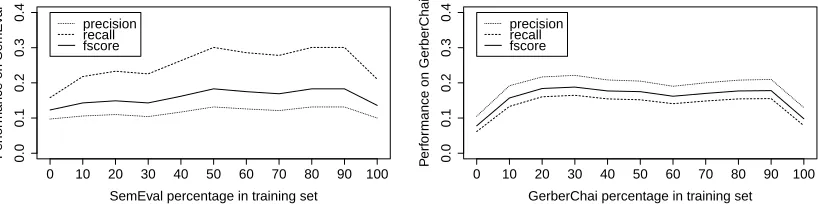
In Experiments 1 and 2, we have found an improve-ment for including out-of-domain data. However, it is unclear so far whether the improvements are sim-ply due to the increased amount of training data, or to the training data becoming morevaried. To distin-guish between these two hypotheses, Experiment 3 keeps the total size of the training set constant and varies the proportions of the two source corpora, S E-MEVALand GERBERCHAI, in 10% increments, from 100% SEMEVALto 100% GERBERCHAI. The size of the training set is limited by the smaller one of the training sets (SEMEVAL, cf. Table 1).
0.0
0.1
0.2
0.3
0.4
SemEval percentage in training set
P
erf
or
mance on SemEv
al
precision recall fscore
0 10 20 30 40 50 60 70 80 90 100
0.0
0.1
0.2
0.3
0.4
GerberChai percentage in training set
P
erf
or
mance on GerberChai
precision recall fscore
[image:9.612.98.507.74.176.2]0 10 20 30 40 50 60 70 80 90 100
Figure 1: Evaluation of models trained on a constant-size training set with changing composition
set, and decreasing performance with more out-of-domain data. If however variety is important, we expect to see a maximum somewhere between the two extremes, at the point where there is enough out-of-domain training data to introduce variety but not enough to overwhelm the in-domain data.
Figure 1 shows the results. On both test sets, we donot see the best result for 100% in-domain data – there is a substantial improvement moving from 100% to 90% in-domain data (from 0.13 to 0.18 F-Score on SEMEVALand from 0.10 to 0.18 on GER-BERCHAI). On the SEMEVALtest set, the result for 90% is the (tied) best result. We see minor variation until roughly the 50-50 split and then a mild degra-dation to the cases where the GERBERCHAItraining data dominates, consistent with Experiment 1. On the GERBERCHAItest set, we see a more symmetri-cal picture, with relatively constant performance for almost all mixtures. We see degradation for the both “pure” (100%) training sets, but still better
perfor-mance for in-domain than for out-of-domain (100% GERBERCHAI: 0.10; 100% SEMEVAL: 0.08).2
Overall, the results are compatible with the second, but not the first hypothesis: the models do seem to profit from the combination of different corpora even when this does not involve larger training sets.
7 Conclusion
This paper has reviewed the state-of-the-art in im-plicit semantic role labeling (SRL) where scarcity of training data is the major bottleneck. We have argued that rather than annotating new datasets, researchers
2Note that these numbers do not match Experiment 2, since
the training set in this experiment is much smaller.
should gauge the potential for combining existing corpora, even if they are very different at first glance.
We have presented experiments on two standard corpora, the SemEval 2010 Task 10 corpus (nov-els) and Gerber and Chai’s nominalization corpus (newswire). They demonstrate that systems trained on either corpus can benefit substantially from combi-nation with the other one. More specifically, we find that (a) domain adaptation techniques are helpful to bridge the differences between corpora; (b) improve-ments from corpus combination apply surprisingly uniformly to different roles and different parts of speech; (c) improvements can be obtained from rela-tively small amounts of “out-of-domain” data.
Further analyses have indicated that it is indeed thecomplementarityof the corpora, rather than the addition of training data, which is responsible for the improvement. This suggests that rather than annotat-ing as many instances as possible, researchers should concentrate on annotating instances that are asvaried as possible, similar to uncertainty sampling in active learning (Lewis and Gale, 1994). In future work, we will experiment with combining more than two corpora to test the scalability of the present approach.
An open question is to what extent the benefits that we see for implicit SRL generalize to other tasks. We believe that two factors combine to give us the present picture: the first one is the set of properties of implicit SRL as a task where semantic and discourse features play important roles. The second one is simply the low baseline performance; overall better models are presumably harder to improve.
Acknowledgments. We would like thank Roman
References
Aljoscha Burchardt, Anette Frank, and Manfred Pinkal. 2005. Building text meaning representations from con-textually related frames – a case study. InProceedings of the International Conference on Computational Se-mantics, pages 66–77, Tilburg, Netherlands.
Xavier Carreras and Llu´ıs M`arquez. 2005. Introduction to the CoNLL-2005 Shared Task: Semantic Role Labeling. InProceedings of the Conference on Computational Natural Language Learning 2005, pages 152–164, Ann Arbor, MI.
Desai Chen, Nathan Schneider, Dipanjan Das, and Noah A. Smith. 2010. SEMAFOR: Frame argument resolution with log-linear models. InProceedings of the Interna-tional Workshop on Semantic Evaluation, pages 264– 267, Uppsala, Sweden.
Janara Christensen, Mausam, Stephen Soderland, and Oren Etzioni. 2010. Semantic role labeling for open information extraction. InProceedings of the NAACL HLT 2010 First International Workshop on Formalisms and Methodology for Learning by Reading, pages 52– 60, Los Angeles, CA.
Michael Collins. 1997. Three generative, lexicalised mod-els for statistical parsing. InProceedings of the 35th Annual Meeting of the Association for Computational Linguistics, pages 16–23, Madrid, Spain.
Dipanjan Das, Desai Chen, Andr´e FT Martins, Nathan Schneider, and Noah A Smith. 2014. Frame-semantic parsing.Computational Linguistics, 40(1):9–56. Hal Daum´e III. 2007. Frustratingly easy domain
adap-tation. InProceedings of the Annual Meeting of the Association for Computational Linguistics, pages 256– 263, Prague, Czech Republic.
David Dowty. 1991. Thematic Proto-Roles and Argument Selection. Language, 67:547–619.
Bradley Efron and Robert J. Tibshirani. 1993. An In-troduction to the Bootstrap. Chapman and Hall, New York.
Parvin Sadat Feizabadi and Sebastian Pad´o. 2014. Crowd-sourcing annotation of non-local semantic roles. In
Proceedings of the Annual Meeting of the European Chapter of the Association for Computational Linguis-tics, pages 226–230, Gothenburg, Sweden.
Charles J. Fillmore, Christopher R. Johnson, and Miriam R.L. Petruck. 2003. Background to FrameNet.
International Journal of Lexicography, 16(3):235–250. Jenny Rose Finkel and Christopher D Manning. 2009. Hierarchical Bayesian Domain Adaptation. In Pro-ceedings of Human Language Technologies: The 2009 Annual Conference of the North American Chapter of the Association for Computational Linguistics, pages 602–610, Boulder, Colorado, USA.
Matthew Gerber and Joyce Y Chai. 2012. Semantic role labeling of implicit arguments for nominal predicates.
Computational Linguistics, 38(4):755–798.
Daniel Gildea and Daniel Jurafsky. 2002. Automatic labeling of semantic roles.Computational Linguistics, 28(3):245–288.
Philip Gorinski, Josef Ruppenhofer, and Caroline Sporleder. 2013. Towards weakly supervised reso-lution of null instantiations. In Proceedings of the International Conference on Computational Semantics, pages 119–130, Potsdam, Germany.
Eduard H Hovy, Mitch Marcus, Martha Palmer, Lance Ramshaw, and Ralph Weischedel. 2006. OntoNotes: The 90% Solution. InProceedings of the Joint Human Language Technology Conference and Annual Meeting of the North American Chapter of the Association for Computational Linguistics, pages 57–60, New York City, NY.
Jing Jiang. 2008. A literature survey on domain adap-tation of statistical classifiers. Technical report, De-partment of Computer Science, University of Illinois at Urbana-Champaign.
Egoitz Laparra and German Rigau. 2012. Exploiting explicit annotations and semantic types for implicit argument resolution. InProceedings of the Interna-tional Conference on Semantic Computing, pages 75– 78, Palermo, Italy.
Egoitz Laparra and German Rigau. 2013. Sources of evidence for implicit argument resolution. In Proceed-ings of the International Conference on Computational Semantics, pages 155–166, Potsdam, Germany. David D. Lewis and William A. Gale. 1994. A sequential
algorithm for training text classifiers. InProceedings of the 17th Annual International ACM SIGIR Conference on Research and Development in Information Retrieval, pages 3–12, Dublin, Ireland.
Junhui Li, Guodong Zhou, Hai Zhao, Qiaoming Zhu, and Peide Qian. 2009. Improving nominal SRL in Chi-nese language with verbal SRL information and au-tomatic predicate recognition. InProceedings of the Conference on Empirical Methods in Natural Language Processing, pages 1280–1288, Singapore.
Christopher D. Manning, Mihai Surdeanu, John Bauer, Jenny Finkel, Steven J. Bethard, and David McClosky. 2014. The Stanford CoreNLP natural language process-ing toolkit. InProceedings of the Annual Meeting of the Association for Computational Linguistics: System Demonstrations, pages 55–60, Baltimore, MD. Adam Meyers, Ruth Reeves, Catherine Macleod, Rachel
Shachar Mirkin, Ido Dagan, and Sebastian Pad´o. 2010. Assessing the Role of Discourse References in Entail-ment Inference. In Proceedings of the 48th Annual Meeting of the Association for Computational Linguis-tics, pages 1209–1219, Uppsala, Sweden.
Tatjana Moor, Michael Roth, and Anette Frank. 2013. Predicate-specific annotations for implicit role binding: Corpus annotation, data analysis and evaluation experi-ments. InProceedings of the International Conference on Computational Semantics, pages 369–375, Potsdam, Germany.
Paloma Moreda, Hector Llorens, Estela Saquete, and Manuel Palomar. 2011. Combining semantic infor-mation in question answering systems. Information Processing & Management, 47(6):870–885.
Alexis Palmer and Caroline Sporleder. 2010. Evaluating FrameNet-style semantic parsing: the role of coverage gaps in FrameNet. InProceedings of the International Conference on Computational Linguistics, pages 928– 936, Beijing, China.
Martha Palmer, Daniel Gildea, and Paul Kingsbury. 2005. The proposition bank: An annotated corpus of semantic roles. Computational Linguistics, 31(1):71–106. Martha Palmer, Dan Gildea, and Nianwen Xue. 2010.
Semantic Role Labeling. Morgan & Claypool. Michael Roth and Anette Frank. 2013. Automatically
identifying implicit arguments to improve argument linking and coherence modeling. In Proceedings of the Joint Conference on Lexical and Computational Semantics, pages 306–316, Atlanta, GA.
Josef Ruppenhofer, Caroline Sporleder, Roser Morante, Collin Baker, and Martha Palmer. 2010. SemEval-2010 Task 10: Linking events and their participants in discourse. InProceedings of the International Work-shop on Semantic Evaluation, pages 45–50, Uppsala, Sweden.
Josef Ruppenhofer, Philip Gorinski, and Caroline Sporleder. 2011. In search of missing arguments: A linguistic approach. InProceedings of the Conference on Recent Advances in Natural Language Processing, pages 331–338, Hissar, Bulgaria.
Dan Shen and Mirella Lapata. 2007. Using semantic roles to improve question answering. InProceedings of the Joint Conference on Empirical Methods in Nat-ural Language Processing and Conference on Com-putational Natural Language Learning, pages 12–21, Prague, Czech Republic.
Carina Silberer and Anette Frank. 2012. Casting implicit role linking as an anaphora resolution task. In Pro-ceedings of the Joint Conference on Lexical and Com-putational Semantics, pages 1–10, Jeju Island, South Korea.
Vivek Srikumar and Dan Roth. 2011. A joint model for extended semantic role labeling. InProceedings of
the Conference on Empirical Methods in Natural Lan-guage Processing, pages 129–139, Edinburgh, United Kingdom.
Sara Tonelli and Rodolfo Delmonte. 2010. VENSES++: Adapting a deep semantic processing system to the identification of null instantiations. InProceedings of the International Workshop on Semantic Evaluation, pages 296–299, Uppsala, Sweden.
Sara Tonelli and Rodolfo Delmonte. 2011. Desperately seeking implicit arguments in text. InProceedings of the ACL 2011 Workshop on Relational Models of Semantics, pages 54–62, Portland, OR, USA.
Dekai Wu and Pascale Fung. 2009. Semantic roles for SMT: A hybrid two-pass model. InProceedings of the Annual Meeting of the North American Chapter of the Association for Computational Linguistics, pages 13–16, Boulder, CO.