Speed-Constrained Tuning for Statistical Machine Translation Using
Bayesian Optimization
Daniel Beck†∗ Adri`a de Gispert‡ Gonzalo Iglesias‡ Aurelien Waite‡ Bill Byrne‡ †Department of Computer Science, University of Sheffield, United Kingdom
[email protected] ‡SDL Research, Cambridge, United Kingdom
{agispert,giglesias,rwaite,bbyrne}@sdl.com
Abstract
We address the problem of automatically finding the parameters of a statistical ma-chine translation system that maximize BLEU scores while ensuring that decoding speed ex-ceeds a minimum value. We propose the use of Bayesian Optimization to efficiently tune the speed-related decoding parameters by eas-ily incorporating speed as a noisy constraint function. The obtained parameter values are guaranteed to satisfy the speed constraint with an associated confidence margin. Across three language pairs and two speed constraint val-ues, we report overall optimization time re-duction compared to grid and random search. We also show that Bayesian Optimization can decouple speed and BLEU measurements, re-sulting in a further reduction of overall op-timization time as speed is measured over a small subset of sentences.
1 Introduction
Research in Statistical Machine Translation (SMT) aims to improve translation quality, typically mea-sured by BLEU scores (Papineni et al., 2001), over a baseline system. Given a task defined by a lan-guage pair and its corpora, the quality of a system is assessed by contrasting choices made in rule/phrase extraction criteria, feature functions, decoding algo-rithms and parameter optimization techniques.
Some of these choices result in systems with sig-nificant differences in performance. For example, in phrase-based translation (PBMT) (Koehn et al.,
∗ This work was done during an internship of the first au-thor at SDL Research, Cambridge.
2003), decoder parameters such as pruning thresh-olds and reordering constraints can have a dramatic impact on both BLEU and decoding speed. How-ever, unlike feature weights, which can be optimized by MERT (Och and Ney, 2004), it is difficult to op-timize decoder parameters either for speed or for BLEU.
We are interested in the problem of automatically finding the decoder parameters and feature weights that yield the best BLEU at a specified minimum de-coding speed. This is potentially very expensive be-cause each change in a decoder parameter requires re-decoding to assess both BLEU and translation speed. This is under-studied in the literature, despite its importance for real-life commercial SMT engines whose speed and latency can be as significant for user satisfaction as overall translation quality.
We propose to use Bayesian Optimiza-tion (Brochu et al., 2010b; Shahriari et al., 2015) for this constrained optimization task. By using prior knowledge of the function to be optimized and by exploring the most uncertain and the most promising regions of the parameter space, Bayesian Optimization (BO) is able to quickly find optimal parameter values. It is particularly well-suited to optimize expensive and non-differentiable functions such as the BLEU score of a decoder on a tuning set. The BO framework can also incorporate noisy constraints, such as decoder speed measurements, yielding parameters that satisfy these constraints with quantifiable confidence values.
For a set of fixed feature weights, we use BO to optimize phrase-based decoder parameters for speed and BLEU. We show across 3 different language
pairs that BO can find fast configurations with high BLEU scores much more efficiently than other tun-ing techniques such as grid or random search. We also show that BLEU and decoding speed can be treated as decoupled measurements by BO. This re-sults in a further reduction of overall optimization time, since speed can be measured over a smaller set of sentences than is needed for BLEU.
Finally, we discuss the effects of feature weights reoptimization after speed tuning, where we show that further improvements in BLEU can be obtained. Although our analysis is done on a phrase-based system with standard decoder parameters (decoding stack size, distortion limit, and maximum number of translations per source phrase), BO could be applied to other decoding paradigms and parameters.
The paper is organized as follows. Section 2 gives a brief overview of Bayesian Optimization and de-scribes how it can be applied to our problem, Section 3 reports our speed-constrained tuning experiments, Section 4 reviews related work, and Section 5 con-cludes.
2 Bayesian Optimization
We are interested in finding a global maximizer of an objective functionf:
θ? = arg max
θ∈Θ f(θ) (1)
where θis a parameter vector from a search space
Θ. It is assumed that f has no simple closed form but can be evaluated at an arbitraryθpoint. In this paper, we takef as the BLEU score produced by an SMT system on a tuning set, andθwill be the PBMT decoder parameters.
Bayesian Optimization is a powerful framework to efficiently address this problem. It works by defining a prior model overf and evaluating it se-quentially. Evaluation points are chosen to maxi-mize the utility of the measurement, as estimated by an acquisition function that trades off exploration of uncertain regions inΘversus exploitation of re-gions that are promising, based on function eval-uations over all x points gathered so far. BO is particularly well-suited whenf is convex, non-differentiable and costly to evaluate (Shahriari et al., 2015).
2.1 Prior Model
The first step in performing BO is to define the prior model over the function of interest. While a num-ber of different approaches exist in the literature, in this work we follow the concepts presented in Snoek et al. (2012) and implemented in the Spearmint1
toolkit, which we detail in this Section.
The prior overf is defined as a Gaussian Process (GP) (Rasmussen and Williams, 2006):
f ∼ GP(m(θ), k(θ, θ0)) (2) where m and k are the mean and kernel (or co-variance) functions. The mean function is fixed to the zero constant function, as usual in GP models. This is not a large restriction because theposterior
overf will have non-zero mean in general. We use the Mat`ern52 kernel, which makes little assumptions about the function smoothness.
The observations, BLEU scores in our work, are assumed to have additive Gaussian noise over f
evaluations. In theory we do not expect variations in BLEU for a fixed set of decoding parameters but in practice assuming some degree of noise helps to make the posterior calculation more stable.
2.2 Adding Constraints
The optimization problem of Equation 1 can be ex-tended to incorporate an added constraint on some measurementc(θ):
θ? = arg max
θ∈Θ f(θ) s.t.c(θ)> t (3)
In our setup,c(θ)is the decoding speed of a con-figurationθ, and t is the minimum speed we wish the decoder to run at. This formulation assumescis deterministic given a set of parametersθ. However, as we show in Section 3.2, speed measurements are inherently noisy, returning different values when us-ing the same decoder parameters.
So, we follow Gelbart et al. (2014) and redefine Equation 3 by assuming a probabilistic modelpover
c(θ):
θ? = arg max
θ∈Θ f(θ) s.t.p(c(θ)> t)≥1−δ (4)
where δ is a user-defined tolerance value. For our problem, the formulation above states that we wish
to optimize the BLEU score for decoders that run at speeds faster thantwith probability1−δ. Likef,c
is also assumed to have a GP prior with zero mean, Mat`ern52 kernel and additive Gaussian noise.
2.3 Acquisition Function
The prior model combined with observations gives rise to a posterior distribution over f. The poste-rior mean gives information about potential optima inΘ, in other words, regions we would like to ex-ploit. The posterior variance encodes the uncertainty in unknown regions ofΘ, i.e., regions we would like toexplore. This exploration/exploitation trade-off is a fundamental aspect not only in BO but many other global optimization methods.
Acquisition functions are heuristics that use in-formation from the posterior to suggest new eval-uation points. They naturally encode the explo-ration/exploitation trade-off by taking into account the full posterior information. A suggestion is ob-tained by maximizing this function, which can be done using standard optimization techniques since they are much cheaper to evaluate compared to the original objective function.
Most acquisition functions used in the literature are based on improving the best evaluation obtained so far. However, it has been shown that this approach has some pathologies in the presence of constrained functions (Gelbart et al., 2014). Here we employ Predictive Entropy Search with Constraints (PESC) (Hern´andez-Lobato et al., 2015), which aims to maximize the information about the global optimum
θ?. This acquisition function has been empirically
shown to obtain better results when dealing with constraints and it can easily take advantage of a sce-nario known as decoupled constraints (Gelbart et al., 2014), where the objective (BLEU) and the con-straint (speed) values can come from different sets of measurements. This is explained in the next Section. Algorithm 1 summarizes the BO procedure under constraints. It starts with a set D0 of data points (selected at random, for instance), where each data point is a (θ, f, c)triple made of parameter values, one function evaluation (BLEU) and one constraint evaluation (decoding speed). Initial posteriors over the objective and the constraint are calculated2. At
2Note that the objective posteriorp(f|D)does not depend
every iteration, the algorithm selects a new evalu-ation point by maximizing the acquisition function
α, measures the objective and constraint values on this point and updates the respective posterior dis-tributions. It repeats this process until it reaches a maximum number of iterations N, and returns the best set of parameters obtained so far that is valid according to the constraint.
Algorithm 1Constrained Bayesian Optimization
Input max. number of iterations N, acquisition function α, initial evaluations D0, min. con-straint valuet, toleranceδ
1: Θ =∅
2: fori= 1,. . . ,N do
3: select newθiby maximizingα:
θi = arg max
θ α(θ, p(f|Di−1), p(c|Di−1))
4: Θ = Θ∪θi
5: query objectivef(θi) 6: query constraintc(θi)
7: augment dataDi =Di∪(θ, f, c)i
8: update objective posteriorp(f|Di) 9: update constraint posteriorp(c|Di) 10: end for
11: returnθ?as per Equation 4
2.4 Decoupling Constraints
Translation speed can be measured on a much smaller tuning set than is required for reliable BLEU scores. In speed-constrained BLEU tuning, we can decouple the constraint by measuring speed on a small set of sentences, while still measuring BLEU on the full tuning set. In this scenario, BO could spend more time querying values for the speed con-straint (as they are cheaper to obtain) and less time querying the BLEU objective.
We use PESC as the acquisition function because it can easily handle decoupled constraints (Gelbart, 2015, Sec. 4.3). Effectively, we modify Algorithm 1 to updateeitherthe objectiveorthe constraint pos-terior at each iteration, according to what is obtained by maximizing PESC at line 3. This kind of decou-pling is not allowed by standard acquisition func-tions used in BO.
The decoupled scenario makes good use of het-erogeneous computing resources. For example, we are interested in measuring decoding speed on a spe-cific machine that will be deployed. But translating the tuning set to measure BLEU can be parallelized over whatever computing is available.
3 Speed Tuning Experiments
We report translation results in three language pairs, chosen for the different challenges they pose for SMT systems: Spanish-to-English, English-to-German and Chinese-to-English. For each language pair, we use generic parallel data extracted from the web. The data sizes are 1.7, 1.1 and 0.3 billion words, respectively.
For Spanish-to-English and English-to-German we use mixed-domain tuning/test sets, which have about 1K sentences each and were created to evenly represent different domains, including world news, health, sport, science and others. For Chinese-to-English we use in-domain sets (2K sentences) cre-ated by randomly extracting unique parallel sen-tences from in-house parallel text collections; this in-domain data leads to higher BLEU scores than in the other tasks, as will be reported later. In all cases we have one reference translation.
We use an in-house implementation of a phrase-based decoder with lexicalized reordering model (Galley and Manning, 2008). The system uses 21 features, whose weights are optimized for BLEU via MERT (Och and Ney, 2004) at very slow decoder parameter settings in order to mini-mize search errors in tuning. The feature weights remain fixed during the speed tuning process.
3.1 Decoder Parameters
We tune three standard decoder parameters θ = (d, s, n)that directly affect the translation speed. We describe them next.
d: distortion limit. The maximum number of source words that may be skipped by the decoder as it generates phrases left-to-right on the target side.
s: stack size. The maximum number of hypotheses allowed to survive histogram pruning in each decoding stack.
n: number of translations. The maximum num-ber of alternative translations per source phrase considered in decoding.
3.2 Measuring Decoding Speed
To get a better understanding of the speed measure-ments we decode the English-German tuning set 100 times with a slow decoder parameter setting, i.e. θ = (5,100,100), and repeat for a fast setting with
θ = (0,1,1). We collect speed measurements in number of translated words per minute (wpm)3.
[image:4.612.319.540.398.514.2]The plots in Figure 1 show histograms contain-ing the measurements obtained for both slow and fast settings. While both fit in a Gaussian distri-bution, the speed ranges approximately from 750 to 950 wpm in the slow setting and from 90K to 120K wpm in the fast setting. This means that speed measurements exhibit heteroscedasticity: they fol-low Gaussian distributions with different variances thatdepend onthe decoder parameter values. This is a problem for our BO setting because the GP we use to model the constraint assumes homoscedastic-ity, or constant noise over the support setΘ.
Figure 1: Histograms of speed measurements. The solid line shows a Gaussian fit with the empirical mean and variance. Note the difference in scale between the two settings, showing the heteroscedasticity.
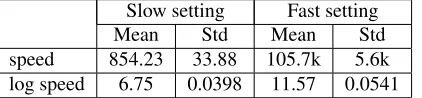
A simple way to reduce the effect of heteroscedas-ticity is to take the logarithm of the speed measure-ments, which is also a standard practice when mod-eling non-negative measures in a GP (Gelbart et al., 2014). Table 1 shows the values for mean and stan-dard deviation before and after the log transforma-tion. Using the logarithm keeps the GP inference
Slow setting Fast setting
Mean Std Mean Std
[image:5.612.82.293.61.110.2]speed 854.23 33.88 105.7k 5.6k log speed 6.75 0.0398 11.57 0.0541
Table 1: Speed means and standard deviations in words per minute before and after the logarithmic transformation.
formulas tractable so we use this solution in our ex-periments.
3.3 BO Details and Baselines
All BO experiments use Spearmint (Snoek et al., 2012) with default values unless explicitly stated otherwise. We set the minimum and maximum val-ues for d, s andn as [0,10], [1,500] and [1,100], respectively. We modeldin linear scale buts and
n in logarithmic scale for both BO and the base-lines. This scaling is based on the intuition that op-timal values forsandnwill be in the lower interval values, which was confirmed in preliminary experi-ments on all three datasets.
We run two sets of experiments, using 2000wpm and 5000wpm as minimum speed constraints. In ad-dition, we use the following BO settings:
Standard (BO-S): in this setting each BO iteration performs a full decoding of the tuning set in order to obtain both the BLEU score and the decoding speed jointly. We useδ= 0.01as the constraint tolerance described in Section 2.2.
Decoupled (BO-D): here we decouple the objec-tive and the constraint as explained in Section 2.4. We still decode the full tuning set to get BLEU scores, but speed measurements are taken from a smaller subset of 50 sentences. Since speed mea-surements are faster in this case, we enforce BO to query for speed more often by modeling the task du-ration as described by Snoek et al. (2012). We use a higher constraint tolerance (δ = 0.05), as we found that BO otherwise focused on the speed constraints at the expense of optimizing BLEU.
We compare these settings against two baselines: grid search and random search (Bergstra and Ben-gio, 2012). Grid search and random search seek pa-rameter values in a similar way: a set of papa-rameter values is provided; the decoder runs over the tun-ing set for all these values; the parameter value that
yields the highest BLEU at a speed above the con-straint is returned. For grid search, parameter val-ues are chosen to cover the allowed value range in even splits given a budget of a permitted maximum number of decodings. For random search, param-eters are chosen from a uniform distribution over the ranges specified above. BO-S, grid search and random search use a maximum budget of 125 de-codings. BO-D is allowed a larger budget of 250 iterations, as the speed measurements can be done quickly. This is not a bias in favour of BO-D, as the overall objective is to find the best, fast decoder in as little CPU time as possible.
3.4 Results
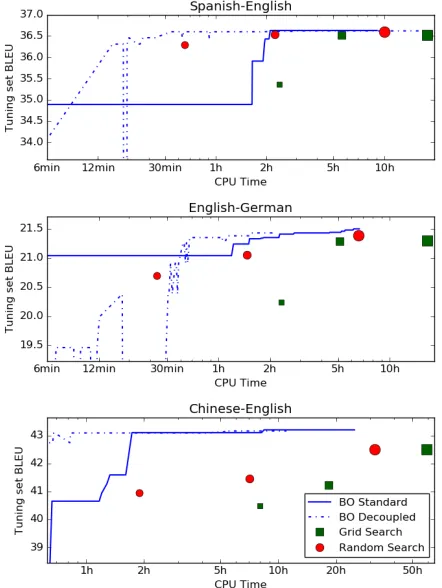
Our results using the 2000wpm speed constraint are shown in Figure 2. The solid lines in the figure show the tuning set BLEU score obtained from the current best parametersθ, as suggested by BO-S, as a func-tion of CPU time (in logarithmic scale). Given that
δ = 0.01, we have a 99% confidence under the GP model that the speed constraint is met.
Figure 2 also shows the best BLEU scores of fast systems found by grid and random search at increasing budgets of 8, 27, and 125 decodings of the tuning set4. These results are represented by
squares/circles of different sizes in the plot: the larger the square/circle, the larger the budget. For grid and random search we report only the single highest BLEU score found amongst the sufficiently fast systems; the CPU times reported are the total time spent decoding the batch. For BO, the CPU times include both decoding time and the time spent evaluating the acquisition function for the next de-coder parameters to evaluate (see Section 3.5).
In terms of CPU time, BO-S finds optimal pa-rameters in less time than either grid search or ran-dom search. For example, in Spanish-to-English, BO-S takes ∼70 min (9 iterations) to achieve 36.6 BLEU score. Comparing to the baselines using a budget of 27 decodings, random search and grid search need∼160 min and∼6 hours, respectively, to achieve 36.5 BLEU. Note that, for a given bud-get, grid search proves always slower than random search because it always considers parameters
val-4For grid search, these correspond to 2, 3 and 5 possible
Figure 2:BLEU scores at 2000wpm. Squares and circles with increasing sizes correspond to searches with increasing evalu-ation budgets (8, 27, 125). For example: in Spanish-English, a random search with a budget of 125 evaluations required 10 CPU hours to run, and the highest BLEU score found among the sufficiently fast (>=2000wpm) systems was 36.2. For BO-D and BO-S, BLEU scores are plotted only if the speed is above 2000wpm and for BO-S only if the full dev set is decoded.
ues at the high end of the ranges (which are the slow-est decoding settings).
In terms of translation quality, we find that BO-S reaches the best BLEU scores across all language pairs, although all approaches eventually achieve similar scores, except in Chinese-to-English where random search is unable to match the BO-S BLEU score even after 125 decodings.
The dotted lines show the results obtained by the decoupled BO-D approach. BO-D does manage to find good BLEU scores, but it proceeds somewhat erratically. As the figure shows, BO-D spends a good deal of time testing systems at parameter val-ues that are too slow. There are also negative excur-sions in the BLEU score, which we observed were due to updates of the posterior constraint model. For
Figure 3:BLEU scores at 5000wpm. Squares and circles with increasing sizes correspond to baselines with increasing evalu-ation budgets (8, 27, 125).
[image:6.612.317.538.66.360.2]pa-rameters that yield significantly better BLEU scores than any of the baselines. It appears that the harsher the speed constraint, the more difficult the optimiza-tion task, and the more chances BO will beat the baselines.
Interestingly, the decoupled BO-D approach is more stable than in the less strict 2000wpm case. Af-ter some initial oscillations in BLEU for English-to-German, BO-D curves climb to optimal parameters in much less CPU time than BO-S. This is clearly seen in Spanish-to-English and Chinese-to-English. We conclude that the harsher the speed constraint, the more benefit in allowing BO to query for speed separately from BLEU.
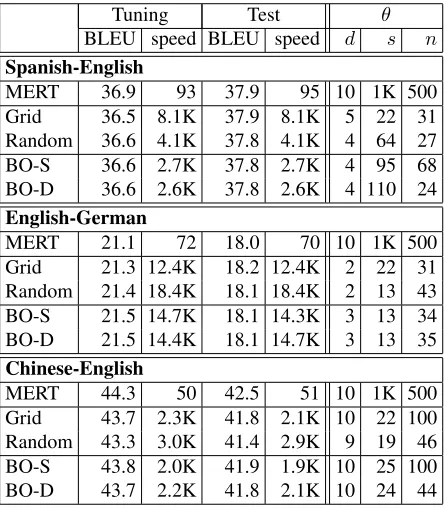
Tables 2 and 3 report the final parametersθfound by each method after spending the maximum al-lowed budget, and the BLEU and speed measured (average of 3 runs) when translating the tuning and test using θ. These show how different each language pair behaves when optimizing for speed and BLEU. For Spanish-to-English and English-to-German it is possible to find fast decoding configu-rations (well above 5K wpm) that nearly match the BLEU score of the slow system used for MERT tuning, i.e. θMERT = (10,1000,500). In
con-trast, significant degradation in BLEU is observed at 5000wpm for Chinese-to-English, a language pair with complicated reordering requirements – notice that all methods consistently keep a very high dis-tortion limit for this language pair. However, both BO-S and BO-D strategies yield better performance on test (at least +0.5BLEU improvement) than the grid and random search baselines.
Only BO is able to find optimal parameters across all tasks faster. The optimum parameters yield simi-lar performance on the tuning and test sets, allowing for the speed variations discussed in Section 3.2. All the optimization procedures guarantee that the con-straint is always satisfied over the tuning set. How-ever, this strict guarantee does not necessarily extend to other data in the same way that there might be variations in BLEU score. This can be seen in the Chinese-English experiments. Future work could focus on improving the generalization of the con-fidence over constraints.
Tuning Test θ
BLEU speed BLEU speed d s n
Spanish-English
MERT 36.9 93 37.9 95 10 1K 500 Grid 36.5 8.1K 37.9 8.1K 5 22 31 Random 36.6 4.1K 37.8 4.1K 4 64 27 BO-S 36.6 2.7K 37.8 2.7K 4 95 68 BO-D 36.6 2.6K 37.8 2.6K 4 110 24
English-German
MERT 21.1 72 18.0 70 10 1K 500 Grid 21.3 12.4K 18.2 12.4K 2 22 31 Random 21.4 18.4K 18.1 18.4K 2 13 43 BO-S 21.5 14.7K 18.1 14.3K 3 13 34 BO-D 21.5 14.4K 18.1 14.7K 3 13 35
Chinese-English
[image:7.612.316.539.59.313.2]MERT 44.3 50 42.5 51 10 1K 500 Grid 43.7 2.3K 41.8 2.1K 10 22 100 Random 43.3 3.0K 41.4 2.9K 9 19 46 BO-S 43.8 2.0K 41.9 1.9K 10 25 100 BO-D 43.7 2.2K 41.8 2.1K 10 24 44
Table 2:Results obtained after reaching the full evaluation bud-get (2000 words/min constraint). Speed is reported in translated words per minute.
Tuning Test θ
BLEU speed BLEU speed d s n
Spanish-English
MERT 36.9 93 37.9 95 10 1K 500 Grid 36.5 8.1K 37.9 8.1K 5 22 31 Random 36.6 8.0K 37.8 7.9K 4 28 43 BO-S 36.6 11.9K 37.8 12.0K 4 19 24 BO-D 36.6 11.0K 37.8 10.9K 4 19 73
English-German
MERT 21.1 72 18.0 70 10 1K 500 Grid 21.3 12.4K 18.2 12.4K 2 22 31 Random 21.4 18.4K 18.1 18.4K 2 13 43 BO-S 21.5 14.7K 18.1 14.3K 3 13 34 BO-D 21.5 14.6K 18.1 14.4K 3 13 33
Chinese-English
[image:7.612.315.538.343.604.2]MERT 44.3 50 42.5 51 10 1K 500 Grid 42.5 10.7K 40.9 10.1K 10 4 100 Random 42.5 10.6K 40.5 10.4K 9 7 14 BO-S 43.2 5.4K 41.4 5.3K 10 13 15 BO-D 43.2 5.8K 41.4 5.7K 10 12 15
Table 3:Results obtained after reaching the full evaluation bud-get (5000 words/min constraint).
3.5 BO Time Analysis
The complexity of GP-based BO isO(n3),nbeing
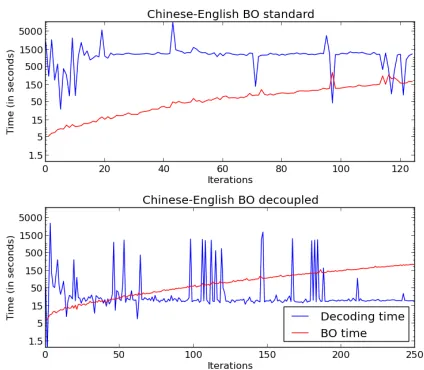
Figure 4: Time spent at each iteration in decoding and in BO (Chinese-to-English, 2000 wpm). BO-S (top), BO-D (bottom)
should not be an issue for low budgets. However, as the number of iterations grows there might reach a point at the time spent on the GP calculations sur-passes the time spent evaluating the function.
This is investigated in Figure 4, where the time spent in decoding versus BO (in logarithmic scale) for Chinese-to-English using the 2K wpm constraint is reported, as a function of the optimization iter-ation. For BO-S (top), decoding time is generally constant but can peak upwards or downwards de-pending on the chosen parameters. For BO-D (bot-tom), most of the decoding runs are faster (when BO is querying for speed), and shoot up significantly only when the full tuning set is decoded (when BO is querying for BLEU). For both cases, BO time increases with the number of iterations, becoming nearly as expensive as decoding when a high maxi-mum budget is considered. As shown in the previous section, this was no problem for our speed-tuning experiments because optimal parameters could be found with few iterations, but more complex settings (for example, with more decoder parameters) might require more iterations to find good solutions. For these cases the time spent in BO could be signifi-cant.
3.6 Reoptimizing Feature Weights
We have used BO to optimize decoder parameters for feature weights that had been tuned for BLEU using MERT. However, there is no reason to believe
Tuning Test θ
BLEU speed BLEU speed d s n
MERT 44.3 – 42.5 51 10 1K 500
[image:8.612.77.289.61.246.2]BO-S 43.8 2.0K 41.9 1.9K 10 25 100 MERT-flat 43.8 2.0K 41.4 1.9K 10 25 100 MERT-opt 44.3 2.0K 42.4 1.9K 10 25 100
Table 4:Chinese-to-English results of re-running MERT using parameters that satisfy the 2K wpm speed constraint.
that the best feature weights for a slow setting are also the best weights at the fast settings we desire.
To assess this we now fix the decoder parame-tersθand re-run MERT on Chinese-to-English with 2000 wpm using the fast settings found by BO-S:
θBO = (10,25,100) in Table 2. We run MERT
starting from flat weights (MERT-flat) and from the optimal weights (MERT-opt), previously tuned for the MERT baseline with θMERT. Table 4 reports
the results.
We find that MERT-opt is able to recover from the BLEU drops observed during speed-constrained tuning and close the gap with the slow baseline (from 41.9 to 42.4 BLEU at 1.8 Kwpm, versus 42.5 for MERT at only 51wpm). Note that this perfor-mance is not achieved using MERT-flat, so rather than tune from flat parameters in a fixed fast setting, we conclude that it is better to: (1) use MERT to find feature weights in slow settings; (2) optimize decoder parameters for speed; (3) run MERT again with the fast decoder parameters from the feature weights found at the slow settings. As noted earlier, this may reduce the impact of search errors encoun-tered in MERT when decoding at fast settings. How-ever, this final application MERT is unconstrained and there is no guarantee that it will yield a decoder configuration that satisfies the constraints. This must be verified through subsequent testing.
4 Related Work
Bayesian Optimization has been previously used for hyperparameter optimization in machine learn-ing systems (Snoek et al., 2012; Bergstra et al., 2011), automatic algorithm configuration (Hutter et al., 2011) and for applications in which system tun-ing involves human feedback (Brochu et al., 2010a). Recently, it has also been used successfully in sev-eral NLP applications. Wang et al. (2015) use BO to tune sentiment analysis and question answering sys-tems. They introduce a multi-stage approach where hyperparameters are optimized using small datasets and then used as starting points for subsequent BO stages using increasing amounts of data. Yogatama et al. (2015) employ BO to optimize text represen-tations in a set of classification tasks. They find that there is no representation that is optimal for all tasks, which further justifies an automatic tuning approach. Wang et al. (2014) use a model based on optimistic optimization to tune parameters of a term extraction system. In SMT, Miao et al. (2014) use BO for fea-ture weight tuning and report better results in some language pairs when compared to traditional tuning algorithms.
Our approach is heavily based on the work of Gelbart et al. (2014) and Hern´andez-Lobato et al. (2015) which uses BO in the presence of unknown constraints. They set speed and memory constraints on neural network trainings and report better results compared to those of naive models which explicitly put high costs on regions that violate constraints. A different approach based on augmented Lagrangians is proposed by Gramacy et al. (2014). The authors apply BO in a water decontamination setting where the goal is to find the optimal pump positioning sub-ject to restrictions on water and contaminant flows. All these previous work in constrained BO use GPs as the prior model.
Optimizing decoding parameters for speed is an understudied problem in the MT literature. Chung and Galley (2012) propose direct search methods to optimize feature weights and decoder parameters jointly but aiming at the traditional goal of maxi-mizing translation quality. To enable search param-eter optimization they enforce a dparam-eterministic time penalty on BLEU scores, which is not ideal due to the stochastic nature of time measurements shown
on Section 3.2 (this issue is also cited by the authors in their manuscript). It would be interesting to incor-porate their approach into BO for optimizing trans-lation quality under speed constraints.
5 Conclusion
We have shown that Bayesian Optimisation per-forms well for translation speed tuning experiments and is particularly suited for low budgets and for tight constraints. There is much room for improve-ment. For better modeling of the speed constraint and possibly better generalization in speed mea-surements across tuning and test sets, one possibil-ity would be to use randomized sets of sentences. Warped GPs (Snelson et al., 2003) could be a more accurate model as they can learn transformations for heteroscedastic data without relying on a fixed trans-formation, as we do with log speed measurements.
Modelling of the objective function could also be improved. In our experiments we used a GP with a Mat`ern52 kernel, but this assumes
f is doubly-differentiable and exhibits Lipschitz-continuity (Brochu et al., 2010b). Since that does not hold for the BLEU score, using al-ternative smoother metrics such as linear cor-pus BLEU (Tromble et al., 2008) or expected BLEU (Rosti et al., 2010) could yield better results. Other recent developments in Bayesian Optimisa-tion could be applied to our settings, like multi-task optimization (Swersky et al., 2013) or freeze-thaw optimization (Swersky et al., 2014).
In our application we treat Bayesian Optimisation as a sequential model. Parallel approaches do exist (Snoek et al., 2012; Gonz´alez et al., 2015), but we find it easy enough to harness parallel computation in decoding tuning sets and by decoupling BLEU measurements from speed measurements. How-ever for more complex optimisation scenarios or for problems that require lengthy searches, paralleliza-tion might be needed to keep the computaparalleliza-tions re-quired for optimisation in line with what is needed to measure translation speed and quality.
References
James Bergstra, R´emi Bardenet, Yoshua Bengio, and Bal´azs K´egl. 2011. Algorithms for Hyper-Parameter Optimization. InProceedings of NIPS.
Eric Brochu, Tyson Brochu, and Nando de Freitas. 2010a. A Bayesian Interactive Optimization Approach to Procedural Animation Design. In Proceedings of ACM SIGGRAPH/Eurographics Symposium on Com-puter Animation.
Eric Brochu, Vlad M. Cora, and Nando de Freitas. 2010b. A Tutorial on Bayesian Optimization of Expensive Cost Functions, with Application to Ac-tive User Modeling and Hierarchical Reinforcement Learning.arXiv:1012.2599v1 [cs.LG].
Tagyoung Chung and Michel Galley. 2012. Direct Error Rate Minimization for Statistical Machine Translation. InProceedings of WMT, pages 468–479.
Michel Galley and Christopher D. Manning. 2008. A Simple and Effective Hierarchical Phrase Reordering Model. InProceedings of EMNLP, pages 847–855. Michael A. Gelbart, Jasper Snoek, and Ryan P. Adams.
2014. Bayesian Optimization with Unknown Con-straints. InProceedings of UAI.
Michael A. Gelbart. 2015. Constrained Bayesian Opti-mization and Applications. Ph.D. thesis, Harvard Uni-versity.
Javier Gonz´alez, Zhenwen Dai, Philipp Hennig, and Neil D. Lawrence. 2015. Batch Bayesian Optimiza-tion via Local PenalizaOptimiza-tion.
Robert B. Gramacy, Genetha A. Gray, Sebastien Le Di-gabel, Herbert K. H. Lee, Pritam Ranjan, Garth Wells, and Stefan M. Wild. 2014. Modeling an Augmented Lagrangian for Blackbox Constrained Optimization.
arXiv preprint arXiv:1403.4890.
Jos´e Miguel Hern´andez-Lobato, Michael A. Gelbart, Matthew W. Hoffman, Ryan P. Adams, and Zoubin Ghahramani. 2015. Predictive Entropy Search for Bayesian Optimization with Unknown Constraints. In
Proceedings of ICML.
Frank Hutter, Holger H. Hoos, and Kevin Leyton-Brown. 2011. Sequential Model-based Optimization for Gen-eral Algorithm Configuration. InProceedings of LION 5.
Philipp Koehn, Franz Josef Och, and Daniel Marcu. 2003. Statistical phrase-based translation. In Proceed-ings of NAACL, pages 48–54.
Yishu Miao, Ziyu Wang, and Phil Blunsom. 2014. Bayesian Optimisation for Machine Translation. In
NIPS Workshop on Bayesian Optimization, pages 1– 5.
Franz Josef Och and Hermann Ney. 2004. The Align-ment Template Approach to Statistical Machine Trans-lation. Computational Linguistics, 30(4):417–449.
Kishore Papineni, Salim Roukos, Todd Ward, and Wei-Jing Zhu. 2001. Bleu: a method for automatic evalu-ation of machine translevalu-ation. InProceedings of ACL, pages 311–318.
Carl Edward Rasmussen and Christopher K. I. Williams. 2006. Gaussian processes for machine learning, vol-ume 1. MIT Press Cambridge.
Antti-Veikko Rosti, Bing Zhang, Spyros Matsoukas, and Richard Schwartz. 2010. Bbn system description for wmt10 system combination task. In Proceedings of WMT and MetricsMATR, pages 321–326.
Bobak Shahriari, Kevin Swersky, Ziyu Wang, Ryan P. Adams, and Nando de Freitas. 2015. Taking the Hu-man Out of the Loop : A Review of Bayesian Opti-mization. Technical Report 1, Universities of Harvard, Oxford, Toronto, and Google DeepMind.
Edward Snelson, Carl Edward Rasmussen, and Zoubin Ghahramani. 2003. Warped Gaussian Processes. In
Proceedings of NIPS, pages 337–344.
Jasper Snoek, Hugo Larochelle, and Ryan P. Adams. 2012. Practical Bayesian optimization of Machine Learning Algorithms. InProceedings of NIPS. Kevin Swersky, Jasper Snoek, and Ryan P. Adams. 2013.
Multi-task Bayesian Optimization. InProceedings of NIPS.
Kevin Swersky, Jasper Snoek, and Ryan P. Adams. 2014. Freeze-Thaw Bayesian Optimization.
arXiv:1406.3896v1 [stat.ML].
Roy Tromble, Shankar Kumar, Franz Och, and Wolfgang Macherey. 2008. Lattice Minimum Bayes-Risk de-coding for statistical machine translation. In Proceed-ings of EMNLP, pages 620–629.
Ziyu Wang, Babak Shakibi, Lin Jin, and Nando de Fre-itas. 2014. Bayesian Multi-Scale Optimistic Opti-mization. InProceedings of AISTATS.
Lidan Wang, Minwei Feng, Bowen Zhou, Bing Xiang, and Sridhar Mahadevan. 2015. Efficient Hyper-parameter Optimization for NLP Applications. In Pro-ceedings of EMNLP, pages 2112–2117.