Proceedings of the Third Workshop on Natural Language Processing and Computational Social Science, pages 94–99 94
Simple dynamic word embeddings for mapping perceptions in the public
sphere
Nabeel Gillani
MIT
Roger Levy
MIT
Abstract
Word embeddings trained on large-scale his-torical corpora can illuminate human biases and stereotypes that perpetuate social inequal-ities. These embeddings are often trained in separate vector space models defined accord-ing to different attributes of interest. In this paper, we develop a single, unified dynamic embedding model that learns attribute-specific word embeddings and apply it to a novel dataset—talk radio shows from around the US—to analyze perceptions about refugees. We validate our model on a benchmark dataset and apply it to two corpora of talk radio shows averaging 117 million words produced over one month across 83 stations and 64 cities. Our findings suggest that dynamic word em-beddings are capable of identifying nuanced differences in public discourse about con-tentious topics, suggesting their usefulness as a tool for better understanding how the pub-lic perceives and engages with different issues across time, geography, and other dimensions.
1 Introduction
Language has long been described as both a cause and reflection of our psycho-social con-texts (Lewis and Lupyan, 2018). Recent work using word embeddings—low-dimensional vec-tor representations of words trained on large datasets to capture key semantic information— has demonstrated that language encodes several gender, racial, and other common contempo-rary biases that correlate with both implicit bi-ases (Caliskan et al., 2017) and macro-scale his-torical trends (Garg et al.,2018).
These studies have validated the use of word embeddings to measure a range of psychologi-cal and social contexts, yet in most cases, they have failed to leverage the full power of avail-able datasets. For example, the historical biases
presented in (Garg et al.,2018) are computed us-ing decade-specific word embeddus-ings produced by training different Word2Vec (Mikolov et al., 2013) models on a large corpus of historical text from that decade. The authors then use a Pro-crustes alignment to project embeddings from dif-ferent models into the same vector space so they can be compared across decades (Hamilton et al., 2016). While this approach is reasonable when there are large-scale datasets available for a given attribute of interest (e.g. decade), it requires an additional optimization step and also disregards valuable training data that could be pooled and leveraged across attribute values to help with both training and regularization. This latter property is particularly appealing—and necessary—in the context of limited data.
In this paper, we use a simple, unified dynamic word embedding model that jointly trains linguis-tic information alongside any categorical variable of interest—e.g. year, geography, income bracket, etc.—that describes the context in which a particu-lar word was used. We apply this model to a novel data corpus—talk radio transcripts from stations located in over 64 US cities—to explore the evo-lution of perceptions about refugees during a one-month period in late 2018. The results from our model suggest the potential to use dynamic word embeddings to obtain a granular, near real-time pulse on how people feel about different issues in the public sphere.
2 Model
2.1 Overview
Our dynamic embedding for wordwis defined as
E(w, A) =γw+ Σa∈Aβwa (1)
off-set forwwith respect to attributeaacross the set of attributesAwe are interested in computing the word embedding with respect to. For example, if we wish to compute the embedding for the word “refugee” as it was used on the 25th day of a par-ticular 30-day corpus of talk radio transcripts, we would setw=ref ugeeandA ={25}. This ap-proach, as formalized in Equation1above, is iden-tical to one introduced by (Bamman et al.,2014), though finer details of our model and training dif-fer slightly, as described below.
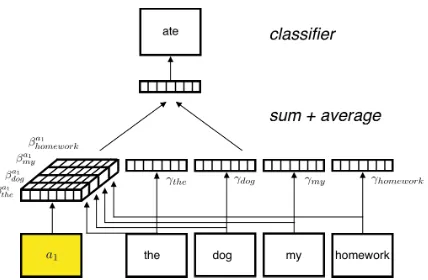
To learnγw andβaw, we train a neural network. Our model is a simple extension to the distributed memory (DM) model for learning paragraph vec-tors originally introduced in (Le and Mikolov, 2014). The DM model uses a continuous bag-of-words architecture to jointly train a paragraph ID with a sequence of words sampled from that para-graph to predict a particular word given the words that surround it. The output of this model includes a semantic vector representation of a) each para-graph, and b) each word in the vocabulary.
Our model extends the DM model by adding an additional dimension to the paragraph vec-tor to learn specific paragraph-by-word—or, in our context,attribute-by-word—embeddings (i.e., βa
w). The penultimate layer (before word predic-tion) is computed as an average of the dynamic embeddings for each context word, i.e., X =
1
NΣNi=1E(wi, S, A), where N is the size of our context window. This average embedding is then multiplied by the output layer parameters and fed through the final layer for word prediction. Figure 1depicts our model architecture.
2.2 Implementation
We build on an existing PyTorch implementation of paragraph vectors1 to implement our model, setting the dimensionality ofγwandβwa to be 100. We use the Adam optimization algorithm with a batch size of 128, word context window size of 8 (sampling four words to the left and right of a target prediction word), learning rate of 0.001, and L2 penalty to regularize all model parameters. We only train embeddings for words that occur at least 10 times in the corpus. For training, we use the negative sampling loss function, described in (Mikolov et al.,2013) to be much more efficient than the hierarchical softmax and yield
competi-1Available at: https://github.com/inejc/
[image:2.595.311.525.59.199.2]paragraph-vectors.
Figure 1: Our dynamic embedding model learns an at-tribute invariant embedding for each training wordw
(i.e.,γw), along with an attribute-specific offset for at-tributeA = {a1} (i.e.,βa1
w). Theγw andβwa1 terms are summed to computeE(w, A)for each context word and averaged across words before classification. Figure inspired by (Le and Mikolov,2014).
tive results2. We train for 1 to 3 epochs and select the model with the lowest loss.
2.3 Validation
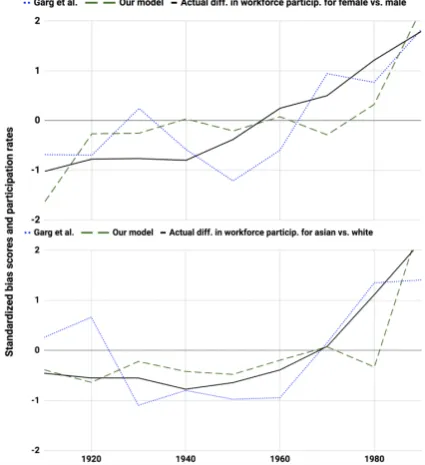
To validate our model, we compare our results to those produced via the decade-by-decade models trained in (Garg et al.,2018) using the Corpus of Historical American English (Davies, 2010). We use the same metric and word lists as the authors to compute bias scores. In particular, we com-pute linguistic bias scores for two analyses pre-sented in (Garg et al., 2018): the extent to which female versus male words are semantically simi-lar to occupation-related words, and the extent to which Asian vs. White last names are semanti-cally similar to the same, from 1910 through 1990. We then compute correlations between changes in these scores and the actual changes in female and Asian workforce participation rates (relative to men and Whites, respectively) over the same time period.
Figure 2depicts these results. The correlation between our scores and changes in workforce par-ticipation rates are similar to the correlation be-tween the scores from (Garg et al.,2018) and the same (r = 0.8, p = 0.01 and r = 0.81, p <
0.01, respectively, for gender occupation bias;r = 0.84, p < 0.01 andr = 0.79, p = 0.01, respec-tively, for Asian/White occupation bias). Qualita-tive inspection of Figure2suggests that our model also produces smoother decade-by-decade scores, suggesting that it not only identifies
Figure 2: Scores produced by (Garg et al.,2018) and our model (blue dotted and green dashed lines, respec-tively) compared to actual workforce participation rates (solid lines) for gender (top) and Asian/White (bottom) linguistic biases. To compare all values on a single y-axis, we standardize both sets of bias scores and work-force participation rates by subtracting the mean and dividing by the standard deviation across decades.
specific fluctuations in word semantics, but also, may provide a more general, regularized model for learning attribute-conditioned word embeddings. Future research should include a comparison of our model’s outputs to the outputs of other dy-namic word embedding models that treat time as a continuously-valued attribute, e.g. (Bamler and Mandt,2017;Rudolph and Blei,2018;Yao et al., 2018).
3 Case study: refugee bias on talk radio
We are interested in applying our dynamic embed-ding model to better-understand talk radio-show biases towards refugees. Talk radio is a significant source of news for a large fraction of Americans: In 2017, over 90% of Americans over the age of 12 listened to some type of broadcast radio during the course of a given week, with news/talk radio serv-ing as one of the most popular types (Pew,2018). With listener call-ins and live dialog, talk ra-dio provides an interesting source of information, commentary, and discussion that distinguishes it from discourse found in both print and social me-dia. Given the proliferation of refugees and
dis-placed peoples in recent years (totalling nearly 66 million individuals in 2016 (UNHCR, 2017))— coupled with the rise of talk radio as a particularly popular media channel for conservative political discourse (Mort, 2012)—analyzing bias towards refugees across talk radio stations may provide a unique window into a large portion of the Ameri-can population’s views on the issue.
3.1 Dataset and analyses
Our data is sourced from talk radio audio data col-lected by the media analytics nonprofit Cortico3. Audio data is ingested from nearly 170 differ-ent radio stations and automatically transcribed to text. The data is further processed to identify dif-ferent speaker turns into “snippets”; infer the gen-der of the speaker; and compute other useful met-rics (more details on the radio data pipeline can be found in (Beeferman and Roy,2018)).
We train our dynamic embedding model on two talk radio datasets sourced from 83 stations lo-cated in 64 cities across the US. Dataset 1 includes 4.4 million snippets comprised of 114 million words produced by 390 shows between September 1 and 30, 2018. Dataset 2 includes over 4.8 mil-lion snippets comprised of 119 milmil-lion total words produced by 433 shows between August 15, and September 15, 20184. These datasets are used for analyses 1 and 2, respectively, described below.
Finally, we define bias towards refugees simi-lar to how the authors of (Garg et al.,2018) define bias against Asians during the 20th century, mea-suring to what extent radio shows associate “out-sider” adjectives like “aggressive”, “frightening”, “illegal”, etc. with refugee and immigrant-related terms in comparison to all other adjectives. To compute refugee bias scores with respect to the attribute set A, we use the relative norm distance metric from (Garg et al.,2018):
biasA= Σr∈R||E(r, A)−all||2−||E(r, A)−out||2
WhereE(r, A)is the dynamic embedding for a given word refugee wordrin the set of all refugee-related words R (e.g. “refugee”, ”immigrant”, ”asylum”, etc);allis the average dynamic embed-ding computed for eachw in the set of all adjec-tives with respect toA;outis analogously defined for outsider adjectives; and|| · ||2is the L2 norm.
3
http://cortico.ai.
4As a rough proxy for removing syndicated content, we
Figure 3: Bias towards refugees as outsiders across talk radio shows from mid-August to mid-September 2018: (a) depicts bias scores computed using a “non-dynamic model”, i.e., training multiple Word2Vec models (one per day of data) and then projecting these models into the same vector space using orthogonal Procrustes alignment, and (b) depicts bias scores computed using our dynamic model. From qualitative inspection, the dynamic model appears to regularize scores across days during which refugee-related news is likely less-salient in public discourse.
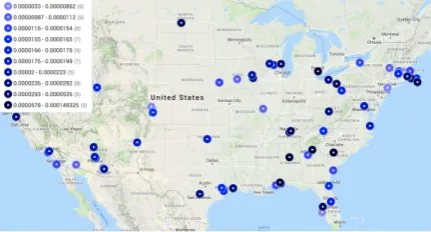
Figure 4: Bias towards refugees as outsiders computed across cities for radio shows aired between September 1 and 30, 2018 (darker means more biased).
3.2 Analysis 1: refugee bias over time
We analyze how refugee biases on talk radio vary by day between August 15 and September 15, 2018. We choose this interval to center on the August 31, 2018 news story regarding the Trump administration’s contentious decision to pull fund-ing from a UN agency that supports Palestinian refugees5. Our attribute of interest is the day in which a particular snippet occurred. Figure 3(b) illustrates the temporal variation in bias scores, highlighting a notable shift towards greater bias
against refugees in response to the news story. In-terestingly, bias towards refugees returns to pre-event levels very quickly after the spike. Comput-ing the correlation between daily bias scores and
5For historical coverage of different
refugee-related news events, please see https: //www.nytimes.com/topic/subject/
refugees-and-displaced-people.
the number of mentions of the keyword “refugee” across stations yieldsr = 0.56, p < 0.001, sug-gesting that additional discourse about refugees tends to be biased against them.
As a comparison, we also compute bias scores by training one Word2Vec model per day and pro-jecting all day-by-day models into the same vec-tor space using orthogonal Procrustes alignment6 similar to (Hamilton et al., 2016). The resulting scores from this non-dynamic model are depicted in3(a). From qualitative inspection, the day-by-day scores produced by the non-dynamic model appear much less smooth, and hence, fail to show the relative shift in discourse that likely occurred in response to a major refugee-related news event. One possible reason for this is that the median number of words for each day in the talk radio corpus is 4 million—over 5x fewer than a me-dian of 22 million words per decade used to train each decade-specific model in (Garg et al.,2018). These results suggest that using our dynamic em-bedding approach is particularly valuable when data is sparse for any given attribute.
3.3 Analysis 2: refugee bias by city
Next, we analyze how bias towards refugees varies by city for talk radio produced between Septem-ber 1 and 30, 2018. We first train our model to learn a city-specific embedding for each word
6We use the Gensim implementations of Word2Vec and
[image:4.595.73.289.328.444.2]and then use these embeddings to compute corre-sponding bias scores, which are depicted in fig-ure4. Qualitatively, cities in the Southeastern US, those closer to the US-Mexico border, and some that have suffered from economic decline in recent years (e.g. Detroit, MI; Youngstown, OH) tend to have talk radio coverage that is more biased to-wards refugees, though the trends are quite var-ied. Interestingly, there is a weak negative, though marginally insignificant, correlation between the level of bias per city and the number of refugees the city admitted in 20177 (r =−0.21, p= 0.1). This relationship persists even after controlling for state fixed effects. A more thorough analysis with additional cities and other city-level covari-ates may reveal meaningful patterns and perhaps even help illuminate which geographies are par-ticularly welcoming towards refugees.
4 Conclusion
In this paper, we present a unified dynamic word embedding model mirroring the earlier work of (Bamman et al.,2014) to learn attribute-specific embeddings. We validated our model by repli-cating gender and ethnic stereotypes produced in (Garg et al., 2018) by training multiple word embedding models and applied it to a novel cor-pus of talk radio data to analyze how perceptions of refugees as “outsiders” vary by geography and over time. Our results illustrate that dynamic word embeddings capture salient shifts in public dis-course around specific topics, suggesting their po-tential usefulness as a tool for obtaining a granu-lar understanding of how the media and members of the public perceive different issues, especially when data is sparse.
Opportunities for future work include a) com-paring the results of our model to other existing dynamic embedding models, particularly when the attribute of interest is temporal in nature, b) ex-ploring embeddings defined with respect to other attributes of interest, perhaps in combination with other contextual embedding models like (Peters et al., 2018), c) exploring alternative definitions of bias towards refugees and other groups, and d) learning a dynamic embedding model for contin-uous attributes in order to limit the need to im-pose (perhaps arbitrary) discretizations. We
be-7We sourced per-city 2017 refugee arrival numbers from
the Refugee Processing Center’s interactive reporting web-page:http://ireports.wrapsnet.org/.
lieve these approaches hold promise in helping us illuminate evolving attitudes and perceptions to-wards different issues and groups across a rapidly expanding digital public sphere.
Acknowledgments
We thank Doug Beeferman, Prashanth Vija-yaraghavan and David McClure for their valuable input on this project. We also thank Nikhil Garg for sharing prior results to help us benchmark our model.
References
R. Bamler and S. Mandt. 2017. Dynamic Word Em-beddings. InProceedings of the International Con-ference on Machine Learning (ICML).
D. Bamman, C. Dyer, and N. A. Smith. 2014. Dis-tributed Representations of Geographically Situated Language. InProceedings of the 52nd Annual Meet-ing of the Association for Computational LMeet-inguistics (Volume 2: Short Papers).
D. Beeferman and B. Roy. 2018. Making radio search-able. https://medium.com/cortico/
making-radio-searchable-f337de9fa325.
Accessed: March 10, 2019.
A. Caliskan, J. J. Bryson, and A. Narayanan. 2017. Semantics derived automatically from lan-guage corpora contain human-like biases. Science, 356(6334):183–186.
M Davies. 2010. The 400 million word corpus of his-torical American English (1810 2009). In Selected Papers from the Sixteenth International Conference on English Historical Linguistics (ICEHL 16).
N. Garg, L. Schiebinger, D. Jurafsky, and J. Zhou. 2018. Word embeddings quantify 100 years of gen-der and ethnic stereotypes. Proceedings of the Na-tional Academy of Sciences, 115(16):E3635–E3644.
W. Hamilton, J. Leskovec, and D. Jurafsky. 2016. Di-achronic word embeddings reveal statistical laws of semantic change. In Proceedings of the 54th An-nual Meeting of the Association for Computational Linguistics (Volume 1: Long Papers), pages 1489– 1501.
Q.V. Le and T. Mikolov. 2014. Distributed Repre-sentations of Sentences and Documents. arXiv: 1405.4053.
M. Lewis and G. Lupyan. 2018. Language use shapes cultural norms: Large scale evidence from gender. InThe Annual Meeting of the Cognitive Science So-ciety, pages 2041–2046.
S. Mort. 2012. Tailoring Dissent on the Airwaves: The Role of Conservative Talk Radio in the Right-Wing Resurgence of 2010. New Political Science, 34(4):485–505.
M. E. Peters, M. Neumann, M. Iyyer, M. Gard-ner, C. Clark, K. Lee, and L. Zettlemoyer. 2018. Deep contextualized word representations. arXiv: 1802.05365.
Pew. 2018. Audio and podcasting fact sheet. http://www.journalism.org/
fact-sheet/audio-and-podcasting/.
Accessed: March 10, 2019.
M. Rudolph and D. Blei. 2018. Dynamic Embeddings for Language Evolution. InWWW 2018: The 2018 Web Conference, pages 1003–1011.
UNHCR. 2017. Forced displacement in 2016. Global Trends Report.