Proceedings of the 13th International Workshop on Semantic Evaluation (SemEval-2019), pages 564–570 564
CN-HIT-MI.T at SemEval-2019 Task 6: Offensive Language Identification
Based on BiLSTM with Double Attention
Yaojie zhang, Bing Xu, Tiejun Zhao
Laboratory of Machine Intelligence and Translation, Harbin Institute of Technology School of Computer Science and Technology, Harbin Institute of Technology, Harbin, China
[email protected], [email protected], [email protected]
Abstract
Offensive language has become pervasive in social media. In Offensive Language Iden-tification tasks, it may be difficult to pre-dict accurately only according to the surface words. So we try to dig deeper semantic in-formation of text. This paper presents use an attention-based two layers bidirectional long-short memory neural network (BiLSTM) for semantic feature extraction. Additionally, a residual connection mechanism is used to syn-thesize two different deep features, and an emoji attention mechanism is used to extract semantic information of emojis in text. We participated in three sub-tasks of SemEval 2019 Task 6 as CN-HIT-MI.T team. Our macro-averaged F1-score in sub-task A is 0.768, ranking 28/103. We got 0.638 in sub-task B, ranking 30/75. In sub-sub-task C, we got 0.549, ranking 22/65. We also tried some other methods of not submitting results.
1 Introduction
Recognition of Offensive information has research and application value in many aspects. With the popularity of social media, people’s comments on social media has become an important part of pub-lic opinion. Although freedom of speech is ad-vocated, there are still some unacceptable words. The study of offensive language has only recently arisen. With the deepening of the research, we need to consider the different sub-tasks of its de-composition.
In OffensEval tasks (Zampieri et al.,2019b), of-fensive content was divided into three sub-tasks taking the type and target of offenses into account. Sub-task A is offensive language identification. We should identify a short text sentence as offen-sive or non-offenoffen-sive. Sub-task B is automatic cat-egorization of offense types. We need to classify a sentence as having an attack target or not, if this is
an offensive sentence. Sub-task C is offense target identification. Its purpose is to identify the target of an attack sentence with an attack target. The target is individual, group or other.
User’s comments on Twitter are usually clut-tered. In order to clean up the data, a series of processing for the data is necessary. Then, pre-trained word vectors are helpful to extract seman-tic features from deep learning model. For clas-sification model, bidirectional long-short memory neural network can catch the contextual informa-tion in text, in order to get offensive semantics from text. A residual connection cascade the first layer’s output and the second layer’s output can get features of text at different levels. Attention mechanism is used for the final output. Besides, referring toZHANG et al.(2018), emojis in a sen-tence have a significant impact on sentiment. We assume them may affect the offensive semantics of text too, and double attention mechanism can deal with this semantic relationship.
The rest of this paper is organized as follows. Section 2 introduces some research advances in Aggression Identification and Hate Speech. Sec-tion 3 describes the data we use and the detailed introduction of our system. Section 4 shows the performance of our system and comparison with other models. Section 5 describes some of our summaries and future work directions.
2 Related Work
Due to the universality of offensive language in social media, in order to cope with offensive lan-guage and prevent abuse in social media, research on related aspects has gradually emerged in recent years.
language research, such as TRAC1 which shared task on Aggression Identification summarized in
Kumar et al. (2018), need to distinguish open, secret and non-aggressive texts. And ALW2 which is work for Abusive Language. Fiˇser et al.
(2017) did some work on the legal framework, dataset and annotation schema of socially unac-ceptable discourse practices on social networking platforms in Slovenia. Gamb¨ack and Sikdar
(2017) introduced a deep learning based Twitter Hate Speech text include racism, sexism, both and non-hate-speech classification system. Waseem et al. (2017) put forward a series of subtasks of hate speech, cyberbullying, and online abuse. Su et al. (2017) described a system for detecting and modifying Chinese dirty sentences. And GermEval is also shared related tasks (Wiegand et al., 2018) which initiate and foster research on the identification of offensive content in German language microposts. Additionally, the main work of Malmasi and Zampieri (2017) and
Malmasi and Zampieri (2018) is to approach the problem of distinguishing general profanity from hate speech. Zhang et al. (2018) tried to use a Convolution-GRU for detecting hate speech on Twitter.
3 Methodology and Data
3.1 Method
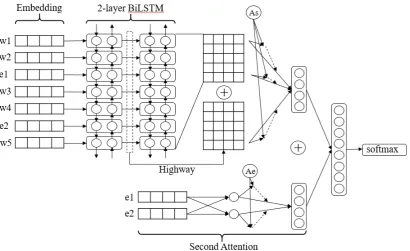
Our method is composed of 6 stages: Preprocess-ing, EmbeddPreprocess-ing, Bidirectional LSTM, Attention, Double attention and Softmax. The whole archi-tecture of the single model is shown in Figure 1.
3.1.1 Preprocessing
We have done some processing on the original training data and test data. The main purpose is to make the data cleaner, reduce the number of un-known words in the dictionary, and do some pro-cessing of error words. The first step is to convert all words into lowercase. Our preliminary view is that uppercase or lowercase has no direct im-pact on offensive language recognition tasks. The second step is to deal with punctuation symbols. We use space as separator to divide sentences into words. But in many cases in data sets, punctuation
1
https://sites.google.com/view/trac1/ home
2https://sites.google.com/site/
abusivelanguageworkshop2017/
symbols and words, as well as punctuation sym-bols and punctuation symsym-bols are closely linked without space. In this way, the system will not be able to recognize them. Just like ”sloth.” or ”!!!”, and we turned them into ”sloth .” and ”! ! !”. The third step is abbreviation processing. We converted ”don’t”, ”you’re” and so on into ”do n’t” and ”you ’re”, because there is no ”don’t” or ”you’re” in the dictionary. We haven’t expanded the abbreviations like ”do not” or ”you are”, be-cause the results may not be unique just like ”I’d” can represent ”I would” or ”I had”. Forth, we also need to separate the emojis refer to the dictionary of emojis. (We will introduce the word dictionary and emoji dictionary in detail in embedding sec-tion). In addition, we regard all numbers as one word.
After completing the above preprocessing, if a word is still detected as an unknown word, we use ekphrasis3 tool (Baziotis et al.,2017) for fur-ther processing. The first step is word segmen-tation. We separate some words together may be a customary expression by spaces. For exam-ple, ”Googlearecorrupt” is turned into ”Google are corrupt”. Second, if the word still does not exist in the dictionary, we do an error correction operation. After all operations, words that do not exist in the dictionary are marked as unknown words.
Step-by-step processing instead of direct batch processing without intermediate detection im-proves reliability and avoids modifying correct ex-pressions to errors.
3.1.2 Embedding Layer
We used a word embedding layer to represent words as vectors. The 200 dimension word vec-tors4is pre-trained by GloVe based on a large cor-pus of Twitter provided byJeffrey et al.(2014). It includes 1,193,514 words and their vector repre-sentations.
A sentence sequence S(w1, w2, ..., wl) is
rep-resented asC(c1, c2, ..., cl), wherewi(i ∈ [1, l])
represents a word, ci represents the vector
corre-sponding to the word. Cis the matrix representa-tion of the sequenceS.
We also use emoji vectors provided by Eisner et al. (2016) to represent the emoji that appears in a sequence. It includes 1,661 emojis used in
3
https://www.github.com/cbaziotis/ ekphrasis
4https://nlp.stanford.edu/projects/
Figure 1: The whole architecture of 2-layer BiLSTM with Double Attention Based Offensive Language Identifi-cation. Where w is word, and e is emoji
Twitter and their 300 dimension vector representa-tions. We have made a PCA dimension reduction on emoji vectors, making 300 dimensions into 200 dimensions to suit word vectors. In addition, all bottom feature representation vector are normal-ized.
3.1.3 Bidirectional LSTM Layer
The structure of one cell in LSTM is shown in Fig-ure 2. Three gated mechanisms of LSTM allows LSTM memory unit to store and access informa-tion for a long time. it express input gate,ft
ex-press forget gate and ot express output gate. ct
express memory cell,stexpress memory state and htexpress hidden state. Where t denotes at time t.
The forward pass of LSTM is shown in (1)-(6).
it=f(Wixt+Uiht−1+Vict−1) (1)
ft=f(Wfxt+Ufht−1+Vfct−1) (2)
ot=f(Woxt+Uoht−1+Voct) (3)
ct=g(Wcxt+UCht−1) (4)
st=ftct−1+itct (5)
ht=otg(ct) (6)
Where xt is the input at time t, f(.) is the
[image:3.595.327.500.367.597.2]sig-moid function,g(.)is the hyperbolic function.W, U and V are trainable weight parameters. In or-der to extract the semantic relationship features of
Figure 2: The structure of one cell in LSTM
sentences before and after, we use Bidirectional LSTM to process a sentence. Forward and
back-ward LSTM obtains hidden states
→
htand
←
ht:
→
ht=
−→
LST M (wt,
→
ht−1) (7)
←
ht=
←−
LST M (wt,
←
Cascade the results of bidirectional hidden state as the result of BiLSTM:
Ht=
→
ht⊕
←
ht (9)
We stack two layers of BiLSTMs. The output of the first layer BiLSTM is used as the input of the second layer. Meanwhile, we consider that the first layer can collect low-level semantic information such as lexical or grammatical information, while the second layer can collect high-level semantic information such as sentiment or offensiveness in-formation. So we added a residual connection be-tween the two layers:
Htf inal=Hlayer1
t ⊕H
layer2
t (10)
3.1.4 Attention Layer
We input the representation of hidden state ob-tained by Bidirectional LSTM layer into attention layer to get sentence coding:
si = X
t
αitHitf inal (11)
Where a is the weight value:
αit=
exp(uTituw) P
texp(uTituw)
(12)
uit=tanh(WwHitf inal+bw) (13)
3.1.5 Double Attention Mechanism
We use another attention mechanism similar to that of encoding sentences to encode emojis in sentences, referring to (ZHANG et al., 2018). If there are emojis in a sentence, we get the cor-responding vector representation from the emojis dictionary mentioned in Section 3.2.2. Then the coding is obtained through the attention mecha-nism:
sei =X t
αeitEi (14)
WhereE is the vector representation of emojis in a sentence.
3.1.6 Softmax Layer
Finally, we concatenate sentence coding and emo-jis coding through the full connection layer. We use the softmax classifier to construct scoring vec-tors for each category and convert them into prob-abilities:
r=s⊕se (15)
ˆ
y= P exp(W r+b) i∈[1,l]exp(Wir+bi)
(16)
Where W and b is the layer’s weights and biases. We use cross-entropy loss function with L2 regu-larization term:
L(ˆy, y) =−
N X
i=1 C X
j=1
yjilog(yˆij) +λ(X θ∈Θ
θ2) (17)
3.2 Data
We only use the training dataset which contains 13,240 tweets provided by SemEval 2019 Task 6 (Zampieri et al., 2019a). Table 1 shows three different levels of tasks and their corresponding amount of data.
A B C Train Test Total
OFF TIN IND 2,407 100 2,507
OFF TIN OTH 395 35 430
OFF TIN GRP 1,074 78 1,152
OFF UNT - 524 27 551
NOT - - 8,840 620 9,460
All 13,240 860 14,100
Table 1: Distribution of label combinations in the data provided by OLID
We have 13,240 tweets to train subtask A. Of these, 4,400 are offensive and 8,840 are non-offensive. There are 4,400 tweets for subtask B. Of these, 3,876 are targeted insult and threats and 524 are untargeted. In 3,876 targeted tweets, 2,407 of them are individual, 1,074 of them are group, and 395 of them are other.
4 Results
In this part, some experimental settings are briefly described. Additionally, we list the experimen-tal results we submitted and compared them with baseline. We use 5-fold cross validation to get 5 same models. Using the probability predicted by these 5 models to do a soft-vote to get the final probability distribution. The highest probability is the predictive class of our system. What’s more, we compare performance on offensive identifica-tion detecidentifica-tion of different models by 5-fold cross validation.
and the learning rate starts at7e−4, decreases to 0.9 times per 20 epoch, always greater than1e−4. Theλof L2 regularization is1e−5
Tables 2, 3 and 4 show the performance of our system on test dataset in subtasks A, B and C, re-spectively. The first 2 or 3 rows of the table show the baseline of the officially provided subtasks.
System F1 (macro) Accuracy
All NOT baseline 0.4189 0.7209
All OFF baseline 0.2182 0.2790
[image:5.595.309.532.64.263.2]Submitted System 0.7684 0.8244
Table 2: The results of Sub-task A we submitted. The system is a 2-layer BiLSTM with Double Attention which is described in Section 3.2
System F1 (macro) Accuracy
All TIN baseline 0.4702 0.8875
All UNT baseline 0.1011 0.1125
Submitted System 0.6381 0.8417
Table 3: The results of Sub-task B we submitted. The system is a 2-layer BiLSTM with Double Attention which is described in Section 3.2. It has different hy-perparameter settings from Sub-task A
System F1 (macro) Accuracy
All GRP baseline 0.1787 0.3662
All IND baseline 0.2130 0.4695
All OTH baseline 0.0941 0.1643
Submitted System 0.5488 0.6338
Table 4: The results of Sub-task C we submitted. The system is a 2-layer BiLSTM with Double Attention which is described in Section 3.2. It has different hy-perparameter settings from Sub-task A and Sub-task B
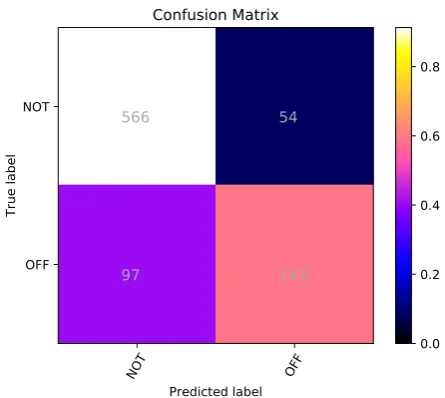
Figures 3, 4 and 5 show the confusion matrix of the classification results of our system on the test dataset in subtasks A, B and C, respectively.
We can clearly see from figures that our sys-tem performs better in category has more training data. This may be because more data in this cate-gory makes the system more inclined to classify these samples correctly in training, not because some categories are easier to identify and others are harder. We used the over-sampling method, but the effect is not obvious. Categories with fewer data quickly reach the state of over-fitting, while those with more data are still under-fitting.
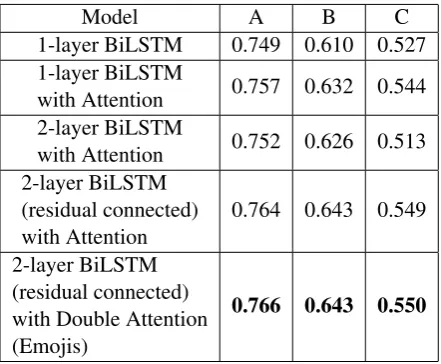
Table 5 shows some comparative experiments
NOT OFF Predicted label NOT
OFF
True label
566
54
97
143
Confusion Matrix
[image:5.595.308.531.320.520.2]0.0 0.2 0.4 0.6 0.8
Figure 3: The confusion matrix of the classification re-sults in Sub-task A
TIN UNT Predicted label TIN
UNT
True label
191
22
16
11
Confusion Matrix
0.0 0.1 0.2 0.3 0.4 0.5 0.6 0.7 0.8
Figure 4: The confusion matrix of the classification re-sults in Sub-task B
on closed validation sets. We use 5-fold cross val-idation, and each data has the same category ratio.
GRP IND OTH Predicted label
GRP
IND
OTH
True label
54
11
13
15
73
12
17
10
8
Confusion Matrix
[image:6.595.76.300.66.262.2]0.0 0.1 0.2 0.3 0.4 0.5 0.6 0.7
Figure 5: The confusion matrix of the classification re-sults in Sub-task C
Model A B C
1-layer BiLSTM 0.749 0.610 0.527
1-layer BiLSTM
with Attention 0.757 0.632 0.544
2-layer BiLSTM
with Attention 0.752 0.626 0.513
2-layer BiLSTM (residual connected) with Attention
0.764 0.643 0.549
2-layer BiLSTM (residual connected) with Double Attention (Emojis)
0.766 0.643 0.550
Table 5: Some comparative experiments on closed val-idation sets
5 Conclusion
This paper introduces a deep learning method Attention-based residual connected BiLSTM with Emojis Attention for SemEval 2019 Task 6: Iden-tifying and Categorizing Offensive Language in Social Media. Our system didn’t get the leading score in the competition. Maybe there are the fol-lowing reasons. Except for the corpus used for pre-training word vectors, we do not use other data for training. Some machine learning models may achieve better results with fewer data. Addition-ally, we think that hyperparameter adjustment in our system is not perfect. Most importantly, we do not associate the characteristics of offensive lan-guage recognition tasks with our model.
[image:6.595.72.293.315.497.2]References
C Baziotis, N Pelekis, and C Doulkeridis. 2017. DataS-tories at SemEval-2017 Task 4: Deep LSTM with Attention for Message-level and Topic-based Senti-ment Analysis. InProceedings of the 11th Interna-tional Workshop on Semantic Evaluation (SemEval-2017).
Jacob Devlin, Ming-Wei Chang, Kenton Lee, and Kristina Toutanova. 2018. BERT: Pre-training of Deep Bidirectional Transformers for Lan-guage Understanding. arXiv e-prints, page arXiv:1810.04805.
Ben Eisner, Tim Rockt¨aschel, Isabelle Augenstein, Matko Boˇsnjak, and Sebastian Riedel. 2016. emoji2vec: Learning Emoji Representations from their Description. In Proceedings of the 4th Interna-tional Workshop on Natural Language. In Proceed-ings of the 4th International Workshop on Natural Language Processing for Social Media at EMNLP 2016 (SocialNLP at EMNLP 2016).
Darja Fiˇser, Tomaˇz Erjavec, and Nikola Ljubeˇsi´c. 2017. Legal Framework, Dataset and Annotation Schema for Socially Unacceptable On-line Discourse Prac-tices in Slovene. In Proceedings of the Workshop Workshop on Abusive Language Online (ALW), Van-couver, Canada.
Bj¨orn Gamb¨ack and Utpal Kumar Sikdar. 2017. Using Convolutional Neural Networks to Classify Hate-speech. In Proceedings of the First Workshop on Abusive Language Online, pages 85–90.
Pennington Jeffrey, Socher Richard, and D. Manning Christopher. 2014. GloVe: Global Vectors for Word Representation. In Proceedings of the Em-pirical Methods in Natural Language Processing (EMNLP), pages 1532–1543.
Ritesh Kumar, Atul Kr. Ojha, Shervin Malmasi, and Marcos Zampieri. 2018. Benchmarking Aggression Identification in Social Media. InProceedings of the First Workshop on Trolling, Aggression and Cyber-bulling (TRAC), Santa Fe, USA.
Shervin Malmasi and Marcos Zampieri. 2017. Detect-ing Hate Speech in Social Media. InProceedings of the International Conference Recent Advances in Natural Language Processing (RANLP), pages 467– 472.
Shervin Malmasi and Marcos Zampieri. 2018. Chal-lenges in Discriminating Profanity from Hate Speech. Journal of Experimental & Theoretical Ar-tificial Intelligence, 30:1–16.
Huei-Po Su, Chen-Jie Huang, Hao-Tsung Chang, and Chuan-Jie Lin. 2017. Rephrasing Profanity in Chi-nese Text. In Proceedings of the Workshop Work-shop on Abusive Language Online (ALW), Vancou-ver, Canada.
Zeerak Waseem, Thomas Davidson, Dana Warmsley, and Ingmar Weber. 2017. Understanding Abuse: A Typology of Abusive Language Detection Subtasks. In Proceedings of the First Workshop on Abusive Langauge Online.
Michael Wiegand, Melanie Siegel, and Josef Rup-penhofer. 2018. Overview of the GermEval 2018 Shared Task on the Identification of Offensive Lan-guage. InProceedings of GermEval.
Marcos Zampieri, Shervin Malmasi, Preslav Nakov, Sara Rosenthal, Noura Farra, and Ritesh Kumar. 2019a. Predicting the Type and Target of Offensive Posts in Social Media. InProceedings of NAACL.
Marcos Zampieri, Shervin Malmasi, Preslav Nakov, Sara Rosenthal, Noura Farra, and Ritesh Kumar. 2019b. SemEval-2019 Task 6: Identifying and Cat-egorizing Offensive Language in Social Media (Of-fensEval). InProceedings of The 13th International Workshop on Semantic Evaluation (SemEval).
Yangsen ZHANG, Jia ZHENG, Gaijuan HUANG, and et al. 2018. Microblog sentiment analysis method based on a double attention model. In Proceed-ings of Tsinghua University(Science and Technol-ogy), volume 58, pages 122–130.
Ziqi Zhang, David Robinson, and Jonathan Tepper. 2018. Detecting Hate Speech on Twitter Using a Convolution-GRU Based Deep Neural Network. In