Proceedings of the SIGDIAL 2018 Conference, pages 214–223, 214
Discourse Coherence in the Wild: A Dataset, Evaluation and Methods
Alice Lai
University of Illinois at Urbana-Champaign∗
Joel Tetreault Grammarly
Abstract
To date there has been very little work on assessing discourse coherence methods on real-world data. To address this, we present a new corpus of real-world texts (GCDC) as well as the first large-scale evaluation of leading discourse coherence algorithms. We show that neural mod-els, including two that we introduce here (SENTAVGand PARSEQ), tend to perform best. We analyze these performance dif-ferences and discuss patterns we observed in low coherence texts in four domains.
1 Introduction
Discourse coherence is an important aspect of text quality. It encompasses how sentences are con-nected as well as how the entire document is orga-nized to convey information to the reader. Devel-oping discourse coherence models to distinguish coherent writing from incoherent writing is useful to a range of applications. An automated coher-ence scoring model could provide writing feed-back, e.g. identifying a missing transition be-tween topics or highlighting a poorly organized paragraph. Such a model could also improve the quality of natural language generation systems.
One approach to modeling coherence is to model the distribution of entities over sentences. The entity grid (Barzilay and Lapata,2005), based on Centering Theory (Grosz et al.,1995), was the first of these models. Extensions to the entity grid include additional features (Elsner and Char-niak,2008,2011;Feng et al.,2014), a graph rep-resentation (Guinaudeau and Strube, 2013; Mes-gar and Strube, 2015), and neural convolutions (Tien Nguyen and Joty,2017). Other approaches have used lexical cohesion (Morris and Hirst,
∗
Research performed while at Grammarly.
1991;Somasundaran et al.,2014), discourse rela-tions (Lin et al.,2011;Feng et al.,2014), and syn-tactic features (Louis and Nenkova,2012). Neural networks have also been successfully applied to coherence (Li and Hovy,2014;Tien Nguyen and Joty,2017;Li and Jurafsky,2017). However, until now, these approaches have not been benchmarked on a common dataset.
Past work has focused on the discourse co-herence of well-formed texts in domains like newswire (Barzilay and Lapata,2005;Elsner and Charniak, 2008) via tasks like sentence ordering that use artificially constructed data. It was un-known how well the best methods would fare on
real-world datathat most people generate. In this work, we seek to address the above de-ficiencies via four main contributions. First, we present a new corpus, the Grammarly Corpus of Discourse Coherence (GCDC), for real-world dis-course coherence. The corpus contains texts the average person might write, e.g. emails and online reviews, each with a coherence rating from expert annotators (see examples in Table 1 and supple-mentary material). Second, we introduce two sim-ple yet effective neural network models to score coherence. Third, we perform the first large-scale benchmarking of 7 leading coherence algorithms. We show that prior models, which performed at a very high level on well-formed and artificially generated data, have markedly lower performance in these new domains. Finally, the data, annotation guidelines, and code have all been made public.1
2 A Corpus for Discourse Coherence
2.1 Related Work
Most previous work in discourse coherence has been evaluated on a sentence ordering task that as-sumes each text is well-formed and perfectly
Score Text
Low Should I be flattered? Even a little bit? And, as for my alibi, well, let’s just say it depends on the snow and the secret service. So, subject to cross for sure. Do you think there could be copycats? Do you think the guy chose that mask or just picked up the nearest one? Please keep me informed as the case unfolds–
On another matter, can you believe Dan Burton will be the chair of one of the House subcommittees we’ll have to deal w? Irony and satire are the only sane responses.
Happy New Year–and here’s hoping for many more stories that make us laugh! High Cheryl,
I just spoke with Vidal Jorgensen. They expect to be on the ground in about 8 months. They have not yet raised enough money to get the project started – the total needed is $6M and they need $2M to get started. Vidal said they process has been delayed because their work in Colombia and China is consuming all their resources at the moment. Once on the ground, they will target the poorest of the poor and go to the toughest areas of Haiti. They anticipate an average loan size of $200 and they expect to reach about 10,000 borrowers in five years. They expect to be profitable in 4-5 years.
Meghann
Table 1: Examples of texts and coherence scores from the Clinton domain.
herent, and any reordering of the same sentences is less coherent. Presented with a pair of texts – the original and a random permutation of the same sentences – a coherence model should be able to identify the original text. More challeng-ing versions of this task (sentence insertion (Elsner and Charniak,2011) and paragraph reconstruction (Lapata,2003;Li and Jurafsky,2017)) all assume that the original text is perfectly coherent.
Datasets for the sentence ordering task tend to use texts that have been professionally writ-ten and exwrit-tensively edited. These have included the Accidents and Earthquakes datasets (Barzilay and Lapata,2005), the Wall Street Journal (Elsner and Charniak,2008,2011;Lin et al.,2011;Feng et al., 2014; Tien Nguyen and Joty, 2017), and Wikipedia (Li and Jurafsky,2017).
Another task, summary evaluation (Barzilay and Lapata, 2005), uses human coherence judg-ments, but include machine-generated texts. Co-herence models are only required to identify which of a pair of texts is more coherent (presumably identifying human-written texts).
The line of work most closely related to our ap-proach is the application of coherence modeling to automated essay scoring. Essays are written by test-takers, not professional writers, so they are not assumed to be coherent. Manual annotation is required to assign the essay an overall quality score (Feng et al., 2014) or to rate the coherence of the essay (Somasundaran et al.,2014;Burstein et al.,2010, 2013). While this line of work goes beyond sentence ordering to examine the qualities of a low-coherence text, it has only been applied to test-taker essays.
In contrast to previous datasets, we collect
writ-ing from non-professional writers in everyday contexts. Rather than using permuted or machine-generated texts as examples of low coherence, we want to investigate the ways in which people try but fail to write coherently. We present a cor-pus that contains texts from four domains, cover-ing a range of coherence, each annotated with a document-level coherence score. In Sections2.2
-2.6, we describe our data collection process and the characteristics of the resulting corpus.
2.2 Domains
For a robust evaluation, we selected domains that reflect what an average person writes on a reg-ular basis: forum posts, emails, and product views. For online forum posts, we sampled re-sponses from the Yahoo Answers L6 corpus2 for theYahoodomain. For emails, we used the State Department’s release of emails from Hillary Clin-ton’s office3 and emails from the Enron Corpus4 to make up ourClintonandEnrondomains. Fi-nally, we sampled reviews of businesses from the Yelp Open Dataset5for ourYelpdomain.
2.3 Text Selection
We randomly selected texts from each domain given a few filters. We want each text to be long enough to exhibit a range of characteristics of local and global coherence, but not so long that the labeling process is tedious for annotators. Therefore, we considered texts between 100 and
2https://webscope.sandbox.yahoo.com/ catalog.php?datatype=l
3https://foia.state.gov/Search/ Results.aspx?collection=Clinton_Email
4
300 words in length. We ignored texts contain-ing URLs (as they often quote writcontain-ing from other sources) and texts with too many line breaks (usu-ally lists).
2.4 Annotation
We collected coherence judgments both from ex-pert raters with prior linguistic annotation expe-rience, as inBurstein et al. (2010) and from un-trained raters via Amazon Mechanical Turk. This allows us to assess the efficacy of using untrained raters for this task. We asked the raters to rate the coherence of each text on a 3-point scale from 1 (low coherence) to 3 (high coherence) given the following instructions, which are based on prior coherence annotation efforts (Barzilay and Lapata,
2008;Burstein et al.,2013):
A text with high coherence is easy to un-derstand, well-organized, and contains only details that support the main point of the text. A text with low coherence is difficult to understand, not well orga-nized, or contains unnecessary details. Try to ignore the effects of grammar or spelling errors when assigning a coher-ence rating.
Expert Rater Annotation We solicited judg-ments from 13 expert raters with previous anno-tation experience. We provided a high-level de-scription of coherence but no detailed rubric, as we wanted them to use their own judgment. We also provided examples of low, medium, and high coherence along with a brief justification for each label. The raters went through a calibration phase during which we provided feedback about their judgments. In the annotation phase, we collected 3 expert rater judgments for each text.
Mechanical Turk Annotation We collected 5 MTurk judgments for each text from a group of 62 Mechanical Turk annotators who passed our qualification test. We again provided a high-level description of coherence. However, we only pro-vided a few examples for each category so as not to overwhelm the annotators.
We were mindful of how the characteristics of each domain might affect the resulting coherence scores. For example, after rating a batch of gen-erally low coherence forum data, business emails may appear to be more coherent. However, our goal is to discover the characteristics of a low co-herence business email or a low coco-herence forum
post, not to compare the two domains. Therefore, we recruited new MTurk raters for each domain so as not to bias their scores. The same 13 expert raters worked on all four domains, but we specifi-cally instructed them to consider whether each text was a coherent documentfor its domain.
2.5 Grammarly Corpus of Discourse Coherence
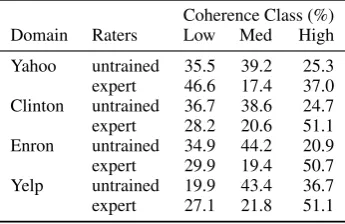
The resulting four domains each contain 1200 texts (1000 for training, 200 for testing). Each text has been scored as {low, medium, high} coher-ence by 5 MTurk raters and 3 expert raters. There is one consensus label for the expert ratings and another consensus label for the MTurk ratings. We computed the consensus label by averaging the in-teger values of the coherence ratings (low = 1, medium = 2, high = 3) over the MTurk or expert ratings and thresholding the mean coherence score (low≤1.8<medium≤2.2<high) to produce a 3-way classification label (Table2). We observed that the MTurk raters tended to label more texts as “medium” coherence than the expert raters. Since the MTurk raters did not go through an extensive training session, they may be less confident in their ratings, defaulting tomediumas the safe option.
Table 3contains type and token counts for the full dataset, and Figure 1 shows the number of paragraphs, sentences, and words per document.
Coherence Class (%) Domain Raters Low Med High
Yahoo untrained 35.5 39.2 25.3 expert 46.6 17.4 37.0 Clinton untrained 36.7 38.6 24.7 expert 28.2 20.6 51.1 Enron untrained 34.9 44.2 20.9 expert 29.9 19.4 50.7 Yelp untrained 19.9 43.4 36.7 expert 27.1 21.8 51.1
Table 2: Distribution of coherence classes as a per-centage of the training data.
Yahoo Clinton Enron Yelp # types 13,235 15,564 13,694 12,201 # tokens 189,444 220,115 223,347 213,852
Table 3: Type and token counts in each domain.
2.6 Annotation Agreement
[image:3.595.330.503.466.578.2]0 200 400 600 800 1000
1 2 3 4 5+ 1−5 6−10 11−20 21+ 100-150 151-200 201-250 251-300
N
um
be
r of
t
ext
s
Yahoo Clinton Enron Yelp
[image:4.595.76.525.61.180.2]Number of paragraphs Number of sentences Number of words
Figure 1: Number of paragraphs, sentences, and words per document.
Domain Raters ICC Weightedκ
Yahoo untrained 0.113±0.024 0.060±0.013 expert 0.557±0.010 0.386±0.009 Clinton untrained 0.270±0.020 0.156±0.013 expert 0.398±0.015 0.250±0.011 Enron untrained 0.141±0.021 0.077±0.012 expert 0.428±0.014 0.273±0.011 Yelp untrained 0.120±0.026 0.069±0.014 expert 0.304±0.015 0.181±0.010
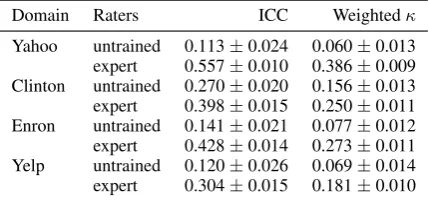
Table 4: Interannotator agreement (mean and stan-dard deviation) on all domains.
simulate two annotators from crowdsourced la-bels. We repeat the simulation 1000 times and report the mean agreement values in Table 4 for both intraclass correlation (ICC) and quadratic weighted Cohen’sκfor an ordinal scale.
The expert raters have fair agreement ( Lan-dis and Koch, 1977) for three of the domains, but agreement among MTurk raters is quite low. These agreement numbers are the result of an ex-tensive annotation development process and em-phasize the difficulty of the task. We recommend that future work in this area leverages raters with a strong annotation background and the time for in-depth instructions. For evaluation, we use the con-sensus label from the expert judgments. For com-parison, we include an experiment using MTurk consensus labels in the supplementary material.
3 Models
We evaluate a range of existing discourse coher-ence models on GCDC: entity-based models, a word embedding graph model, and neural net-work models. These models from previous net-work have been very effective on the sentence ordering task, but have not been used to produce coher-ence scores. We also introduce two new neural sequence models.
3.1 Baseline
We compute the Flesch-Kincaid grade level ( Kin-caid et al.,1975) of each text and treat it as a co-herence score. While Flesch-Kincaid is a readabil-ity measure, previous work has treated readabilreadabil-ity and text coherence as overlapping tasks (Barzilay and Lapata,2008;Mesgar and Strube,2015). For coherence classification, we search over the grade level scores on the training data and select thresh-olds that result in the highest accuracy.
3.2 Entity-based Models
Entity-based models track entity mentions throughout the text. In the majority of our exper-iments, we appliedBarzilay and Lapata (2008)’s coreference heuristic and consider two nouns to be coreferent only if they are identical. AsElsner and Charniak (2011) noted, automatic corefer-ence resolution often fails to improve cohercorefer-ence modeling results. However, we also evaluate the effect of adding an automatic coreference system in Section4.1.
Entity grid (EGRID) The entity grid (Barzilay and Lapata, 2005) is a matrix that tracks entity mentions over sentences. We reimplemented the model fromBarzilay and Lapata (2008), convert-ing the entity grid into a feature vector that ex-presses the probabilities of local entity transitions. We use scikit-learn (Pedregosa et al.,2011) to train a random forest classifier over the feature vectors.
[image:4.595.74.289.226.326.2]out-degree of its graph, so for classification we iden-tify the thresholds that maximize accuracy on the training data.
Entity grid with convolutions (EGRIDCONV) Tien Nguyen and Joty(2017) applied a convolu-tional neural network to the entity grid to capture long-range transitions. We use the authors’ imple-mentation.6
3.3 Lexical Coherence Graph (LEXGRAPH)
The lexical coherence graph (Mesgar and Strube,
2016) represents sentences as nodes of a graph, connecting nodes with an edge if the two sentences contain a pair of similar words (i.e. the cosine sim-ilarity of their pre-trained word vectors is greater than a threshold). From the graph, we can extract a feature vector that expresses the frequency of all
k-node subgraphs. We use the authors’ implemen-tation7and train a random forest classifier over the feature vectors.
3.4 Neural Network Models
We reimplemented a neural network model of co-herence, the sentence clique model, to evaluate its effectiveness on GCDC. We also introduce two new neural network models that are more straight-forward to implement than the clique model.
Sentence clique (CLIQUE) Li and Jurafsky
(2017)’s model operates over cliques of adjacent sentences. For the sentence ordering task, a pos-itive clique is a sequence ofksentences from the original document. A negative clique is created by replacing the middle sentence of a positive clique with a random sentence from elsewhere in the text. The model contains a single LSTM (Hochreiter and Schmidhuber,1997) that takes a sequence of GloVe word embeddings and produces a sentence vector at the final output step. Allksentence vec-tors are concatenated and passed through a final layer to produce a probability that the clique is co-herent. The final coherence score is the average of the scores of all cliques in the document.
We extend CLIQUE to 3-class classification by labeling each clique with the document class la-bel (low, medium, high). To predict the text lala-bel, the model averages the predicted coherence class distributions over all cliques.
6https://github.com/datienguyen/cnn_ coherence
7https://github.com/MMesgar/lcg
Sentence averaging (SENTAVG) To investigate the extent to which sentence order is important in our data, we introduce a neural network model that ignores sentence order. The model contains a sin-gle LSTM that produces a sentence vector (the fi-nal output vector) from a sequence of GloVe em-beddings for the words in that sentence. The doc-ument vector is the average over all sentence vec-tors in that document, and is passed through a hid-den layer and a softmax to produce a distribution over coherence labels.
Paragraph sequence (PARSEQ) The role of
paragraph breaks has not been explicitly discussed in previous work. Models like EGRIDassume that entity transitions have the same weight whether adjacent sentences A and B occur in the same paragraph or different paragraphs. We expect paragraph breaks to be important for assessing co-herence in longer documents.
Therefore, we introduce a paragraph sequence model, PARSEQ, that can distinguish between paragraphs. PARSEQ contains three stacked LSTMs: the first takes a sequence of GloVe em-beddings to produce a sentence vector, the second takes a sequence of sentence vectors to produce a paragraph vector, and the third takes a sequence of paragraph vectors to produce a document vector. The document vector is passed through a hidden layer and a softmax to produce a distribution over coherence labels. A diagram of this model is avail-able in the supplementary material.
4 Evaluation
We evaluate the models on multiple coherence prediction tasks. The best model parameters, re-ported in the supplementary material, are the result of 10-fold cross-validation over the training data.
For all neural models (EGRIDCONV, EGRID -CONV+coref, CLIQUE, SENTAVG, and PARSEQ), the reported results are the mean of 10 runs with different random seeds, as suggested by Reimers and Gurevych(2017).
We indicate (†) when the best neural model re-sult is significantly better (p < 0.05) than the best non-neural result. We use the one-sample Wilcoxon signed rank test and adjusted the p -values to account for the false discovery rate.
4.1 Classification
Accuracy
System Yahoo Clinton Enron Yelp
Majority class 41.0 55.5 44.0 54.0 Baseline 43.5 56.0 52.5 55.0
EGRID 38.0 43.0 46.0 45.5 EGRID+coref 41.5 48.0 47.0 49.0 EGRAPH 40.0 56.0 43.5 53.0 EGRAPH+coref 42.5 55.0 44.0 54.0 EGRIDCONV 47.0 56.3 44.8 54.2 EGRIDCONV+coref 51.0 56.6 44.7 54.0
LEXGRAPH 37.0 51.0 45.0 48.0
CLIQUE 53.5 61.0† 54.4† 49.1 SENTAVG 52.6 58.4 53.2 54.3 PARSEQ 54.9† 60.2 53.2 54.4†
Table 5: Three-way classification results on test.
We report overall accuracy for all systems on pre-dicting the expert rater consensus label (Table5). We repeated this evaluation using the MTurk rater labels and included those results in the supplemen-tary material.
The neural models outperformed the entity-based and lexical graph models. Non-neural mod-els showed mixed results, performing on par with or worse than our baseline. Most models perform poorly on Yelp, worse than the baseline, perhaps because Yelp has the lowest annotator agreement among expert raters.
We also tried adding coreference information for the entity-based methods, as it has been shown to be useful in some prior work (Barzilay and La-pata, 2008;Elsner and Charniak, 2008). For the base entity model experiments, we used Barzi-lay and Lapata (2008)’s heuristic to determine whether two nouns are coreferent. For the+coref setting, we used the Stanford coreference annota-tor (Clark and Manning,2015) as a preprocessing step before computing the entity grid. The coref-erence system yielded consistent performance im-provements of 1–5% accuracy over the corre-sponding heuristic results, indicating that auto-matic coreference resolution can help entity-based models in these domains.
4.2 Score Prediction
A 3-point coherence score might not reflect the range of coherence that actually exists in the data. We can instead present a more fine-grained score prediction task where the gold score is the mean of the three expert rater judgments (low coher-ence = 1, medium = 2, high = 3). In Table 6, we report Spearman’s rank correlation coefficient
Spearmanρ
System Yahoo Clinton Enron Yelp
Baseline 0.089 0.323 0.244 0.200
EGRID 0.110 0.146 0.168 0.121 EGRAPH 0.198 0.366 0.074 0.103 EGRIDCONV 0.204 0.251 0.258 0.104
LEXGRAPH 0.130 0.049 0.273 −0.008
[image:6.595.323.511.518.559.2]CLIQUE 0.474 0.474 0.416 0.304 SENTAVG 0.466 0.505† 0.438 0.311 PARSEQ 0.519† 0.448 0.454† 0.329†
Table 6: Score prediction results on test.
between the gold scores and the predicted coher-ence scores. As in the classification task, the neu-ral methods convincingly outperformed all other methods, with PARSEQthe top performer in three out of four domains.
4.3 Sentence Ordering
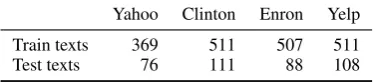
The sentence ordering ranking task is a somewhat artificial evaluation, as a document whose sen-tences have been randomly shuffled does not re-semble a human-written text that is not very co-herent. However, we still want to assess whether good performance on previous sentence ordering datasets translates to GCDC. Since the sentence ordering task assumes well-formed texts, we use only the high coherence texts. As a result, there are fewer texts than for the classification task, as we show below. The number of training examples is 20 times the number of texts, as we generate 20 random permutations for each text.
Yahoo Clinton Enron Yelp
Train texts 369 511 507 511 Test texts 76 111 88 108
Table 7 shows the accuracy of each system on identifying the original text in each (original, permuted) text pair. We leave out the baseline and SENTAVGbecause they ignore sentence order. We also simplify PARSEQ to a sentence sequence model (SENTSEQ) containing only two LSTMs because the sentence ordering task ignores para-graph information. As in the prior two evaluations, the neural models perform best in most domains, although EGRAPHis best on Yahoo.
4.4 Minority Class Classification
sys-Accuracy
System Yahoo Clinton Enron Yelp
Random baseline 50.0 50.0 50.0 50.0
EGRID 55.9 78.2 77.4 62.9 EGRAPH 64.0 75.3 75.9 59.5 EGRIDCONV 54.8 75.5 73.1 58.7
LEXGRAPH 62.5 78.3 77.9 60.8
[image:7.595.319.515.64.128.2]CLIQUE 57.8 89.4† 88.7† 64.6 SENTSEQ 58.3 88.0 87.1 74.2†
Table 7: Sentence ordering results on test data.
System Yahoo Clinton Enron Yelp
Baseline 0.283 0.255 0.341 0.197
EGRID 0.258 0.260 0.294 0.161 EGRAPH 0.308 0.382 0.278 0.117 EGRIDCONV 0.360 0.238 0.279 0.169
LEXGRAPH 0.342 0.094 0.357 0.000
CLIQUE 0.055 0.000 0.077 0.146 SENTAVG 0.481† 0.332 0.393† 0.199 PARSEQ 0.447 0.296 0.373 0.112
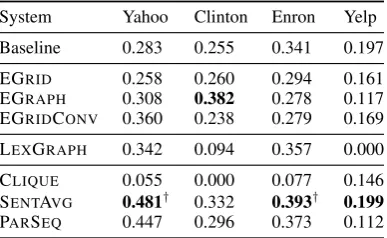
Table 8: Minority class predictions,F0.5 score on
test data.
tem should identify only the most incoherent areas of the text, to ensure that the feedback is not a false positive. To evaluate this scenario, we present a minority class classification problem where only 15-20% of the data is low coherence:
Yahoo Clinton Enron Yelp Low coherence % 30.0 16.6 18.4 14.8
We relabel a text aslow coherenceif at least two expert annotators judged the text to be low coher-ence, and relabel asnot low coherenceotherwise.
We report the F0.5 score of the low coherence
class in Table 8, where precision is emphasized twice as much as recall.8 This is in line with eval-uation standards in other writing feedback appli-cations (Ng et al.,2014). Again, the neural mod-els perform best in most domains. However, the results of this experiment in particular show that there is still a large gap between the performance of these models and what might be required for high-precision real-world applications.
4.5 Cross-Domain Classification
Up to this point, we assumed that the four do-mains are different enough from one another that we should train separate models for each. To test
8Precision and recall are in the supplementary material.
Test
Yahoo Clinton Enron Yelp
T
rain
Yahoo 54.9 56.7 50.6 55.3 Clinton 51.8 60.2 50.7 40.4 Enron 51.5 59.9 53.2 50.8 Yelp 48.3 55.5 44.0 54.4
Table 9: Cross-domain accuracy of PARSEQ on
three-way classification test data.
Test accuracy
Yahoo Clinton Enron Yelp
Train in-domain 54.9 60.2 53.2 54.4 Train all data 58.5 61.0 53.9 56.5
Table 10: Classification accuracy of PARSEQ
when trained on data from all four domains.
this assumption, we train PARSEQ, one of the top performing neural models, in one domain (e.g. Ya-hoo) and evaluate it in a different domain (Clinton, Enron, and Yelp). Table9compares the in-domain results (the diagonal) to the cross-domain results.
While the model’s accuracy generally decreases when transferred to a different domain, sometimes this decrease is not too severe: for example, train-ing on Yahoo/Enron data and testtrain-ing on Clinton data, or training on Yahoo data and testing on Yelp data. It is reasonable that training on one set of business emails (Clinton or Enron) produces a model that can accurately score the coherence of other sets of business emails. Similarly, both Ya-hoo and Yelp contain online text written for public consumption which may share coherence charac-teristics, so it is not surprising that a model trained on Yahoo data works on Yelp (even outperforming the Yelp-trained model).
These results indicate that we might be able to train a better coherence model by combining all our data across multiple domains. We evaluate this theory in Table 10, comparing the results of the PARSEQmodel evaluated in-domain (e.g. trained and tested on Yahoo data) to a model trained on the combined training data from all four domains. With four times as much training data, the perfor-mance of PARSEQimproves in all domains,
indi-cating that better coherence models may be trained from data outside of a specific, narrow domain.
4.6 Discussion
[image:7.595.84.278.221.340.2]outperform-ing the baseline. The entity grids computed from GCDC texts are often extremely sparse, so mean-ingful entity transitions between sentences are in-frequent. In addition, scoring the coherence of a text (either classification or score prediction) is more difficult than the sentence ordering task, where basic entity models do outperform the ran-dom baseline by a reasonable margin. Both the data and the difficulty of the tasks contribute to poor performance from the basic entity models.
The neural network models almost always out-perform other models. This supports Li and Ju-rafsky(2017)’s claim that neural models are bet-ter able to extend to other domains compared to previous coherence models. Our PARSEQ and SENTAVG models are easier to implement than CLIQUEand outperform CLIQUEon a majority of experiments. EGRIDCONV usually does not per-form as well as the other neural models, but it usu-ally improves over EGRID.
Finally, the relative success of SENTAVG,
which ignores sentence order, is evidence that identifying a document’s original sentence order is not the same as distinguishing low and high co-herence documents. The large number of parame-ters in PARSEQ may explain why it is sometimes outperformed by SENTAVG.
5 Analysis
To better understand what distinguishes a low co-herence text from a high coco-herence text, we man-ually analyzed Yahoo and Clinton texts whose labels were unanimously agreed on by all three raters. Regardless of the domain, many low coher-ence texts are not well-organized and appear to be written almost as stream of consciousness. They often lack connectives, resembling a list of points rather than a coherent document.
Incoherent Yahoo texts often contain extremely long sentences, lack paragraph breaks, and veer off-topic without a transition or any connection back to the main point. This is an especially fre-quent occurrence with personal anecdotes.
Low coherence Clinton emails make better use of paragraphs, but they too often lack transitions between topics. In addition, missing information was a primary reason for low coherence scores. We provided the raters with individual emails, not the entire email thread, so raters had less informa-tion than the original recipient of the email. This amplifies the detrimental effects on coherence of
jargon, abbreviation, and missing context. How-ever, overuse of these compression strategies can result in low coherence even for the intended re-cipient, so it is worth modeling their effects.
Across domains, coherent texts have a clear topic that is maintained throughout the text, and they are well-organized, with sentences, para-graphs and sub-topics following a logical order-ing. Connectives, such ashowever, for example,
in turn,also,in additionare used more frequently to assist the structure and flow.
Although sentence order is clearly important, rewriting a disorganized text is not as simple as reordering sentences. Even if changing the loca-tion of one sentence increases coherence, a true fix would still require rewriting that sentence or the surrounding sentences. Our analysis indicates that the sentence reordering task is not a good evalua-tion of whether models can truly be useful to the task of identifying low coherence texts.
6 Conclusion
In this paper, we examine the evaluation of dis-course coherence by presenting a new corpus (GCDC) to benchmark leading methods on real-world data in four domains. While neural mod-els outperform others across multiple evaluations, much work remains before any of these methods can be used for real-world applications. That said, our SENTAVGand PARSEQmodels serve as sim-ple and effective methods to use in future work.
We recommend that future evaluations move away from the sentence ordering task. While it is an easy evaluation to carry out, the performance numbers overpredict the success of those systems in real-world conditions. For example, prior eval-uations (Tien Nguyen and Joty, 2017;Li and Ju-rafsky,2017) report performance numbers around or above 90% accuracy, which contrasts with the much lower figures shown in this paper. In addi-tion, we recommend that future annotation efforts leverage expert raters, preferably with a back-ground in annotation, as this task is difficult for untrained workers on crowdsourcing platforms.
By releasing GCDC, the annotation guidelines, and our code, we hope to encourage future work on more realistic coherence tasks.
Acknowledgments
Ji-wei Li and Mohsen Mesgar for sharing their code. Thanks also to Michael Strube, Annie Louis, Re-becca Hwa, Dimitrios Alikaniotis, Claudia Lea-cock, Courtney Napoles, Jill Burstein, Mirella La-pata, Martin Chodorow, Micha Elsner, and the anonymous reviewers for their helpful comments.
References
Regina Barzilay and Mirella Lapata. 2005.
Mod-eling local coherence: An entity-based approach. In Proceedings of the 43rd Annual Meeting of the Association for Computational Linguis-tics (ACL’05). Association for Computational Lin-guistics, Ann Arbor, Michigan, pages 141–148. https://doi.org/10.3115/1219840.1219858.
Regina Barzilay and Mirella Lapata. 2008.
Mod-eling local coherence: An entity-based ap-proach. Computational Linguistics 34(1):1–34. https://doi.org/10.1162/coli.2008.34.1.1.
Jill Burstein, Joel Tetreault, and Slava Andreyev.
2010. Using entity-based features to model
co-herence in student essays. In Human Lan-guage Technologies: The 2010 Annual Confer-ence of the North American Chapter of the As-sociation for Computational Linguistics. Associa-tion for ComputaAssocia-tional Linguistics, pages 681–684. http://www.aclweb.org/anthology/N10-1099.
Jill Burstein, Joel R. Tetreault, and Martin
Chodorow. 2013. Holistic discourse
co-herence annotation for noisy essay
writ-ing. D&D 4(2):34–52.
http://dad.uni-bielefeld.de/index.php/dad/article/view/2825.
Kevin Clark and Christopher D. Manning. 2015. Entity-centric coreference resolution with model stacking. InAssociation for Computational Linguis-tics (ACL).
Micha Elsner and Eugene Charniak. 2008.
Coreference-inspired coherence modeling.
In Proceedings of ACL-08: HLT, Short
Pa-pers. Association for Computational
Lin-guistics, Columbus, Ohio, pages 41–44.
http://www.aclweb.org/anthology/P/P08/P08-2011.
Micha Elsner and Eugene Charniak. 2011. Extending
the entity grid with entity-specific features. In Pro-ceedings of the 49th Annual Meeting of the Associ-ation for ComputAssoci-ational Linguistics: Human Lan-guage Technologies. Association for Computational Linguistics, Portland, Oregon, USA, pages 125– 129. http://www.aclweb.org/anthology/P11-2022.
Vanessa Wei Feng, Ziheng Lin, and Graeme Hirst.
2014. The impact of deep hierarchical
dis-course structures in the evaluation of text co-herence. In Proceedings of COLING 2014, the 25th International Conference on Compu-tational Linguistics: Technical Papers. Dublin
City University and Association for Computa-tional Linguistics, Dublin, Ireland, pages 940–949. http://www.aclweb.org/anthology/C14-1089.
Barbara J. Grosz, Scott Weinstein, and Aravind K.
Joshi. 1995. Centering: A framework for
modeling the local coherence of discourse.
Computational Linguistics 21(2):203–225.
http://dl.acm.org/citation.cfm?id=211190.211198.
Camille Guinaudeau and Michael Strube. 2013. Graph-based local coherence modeling. In Pro-ceedings of the 51st Annual Meeting of the Association for Computational Linguistics (Vol-ume 1: Long Papers). Association for Computa-tional Linguistics, Sofia, Bulgaria, pages 93–103. http://www.aclweb.org/anthology/P13-1010.
Sepp Hochreiter and J¨urgen
Schmidhu-ber. 1997. Long short-term memory.
Neural Computation 9(8):1735–1780.
https://doi.org/10.1162/neco.1997.9.8.1735.
J. Peter Kincaid, Robert P. Fishburne Jr., Richard L. Rogers, and Brad S. Chissom. 1975. Derivation of new readability formulas (automated readability in-dex, fog count and Flesch reading ease formula) for navy enlisted personnel. Technical Report, DTIC Document.
J. Richard Landis and Gary G. Koch. 1977. The
measurement of observer agreement for cat-egorical data. Biometrics 33(1):159–174. http://www.jstor.org/stable/2529310.
Mirella Lapata. 2003. Probabilistic text
struc-turing: Experiments with sentence ordering.
In Proceedings of the 41st Annual
Meet-ing of the Association for Computational
Linguistics. Association for Computational
Linguistics, Sapporo, Japan, pages 545–552.
https://doi.org/10.3115/1075096.1075165.
Jiwei Li and Eduard Hovy. 2014. A model of
coherence based on distributed sentence repre-sentation. In Proceedings of the 2014 Confer-ence on Empirical Methods in Natural Language Processing (EMNLP). Association for Computa-tional Linguistics, Doha, Qatar, pages 2039–2048. http://www.aclweb.org/anthology/D14-1218.
Jiwei Li and Dan Jurafsky. 2017. Neural net
models of open-domain discourse coherence.
In Proceedings of the 2017 Conference on
Empirical Methods in Natural Language Pro-cessing. Association for Computational
Linguis-tics, Copenhagen, Denmark, pages 198–209.
https://www.aclweb.org/anthology/D17-1019.
Ziheng Lin, Hwee Tou Ng, and Min-Yen Kan.
2011. Automatically evaluating text coherence
Annie Louis and Ani Nenkova. 2012. A coherence model based on syntactic patterns. InProceedings of the 2012 Joint Conference on Empirical Methods in Natural Language Processing and Computational Natural Language Learning. Association for Com-putational Linguistics, Jeju Island, Korea, pages
1157–1168.
http://www.aclweb.org/anthology/D12-1106.
Mohsen Mesgar and Michael Strube. 2015.
Graph-based coherence modeling for assessing read-ability. In Proceedings of the Fourth Joint
Conference on Lexical and Computational
Semantics. Association for Computational
Lin-guistics, Denver, Colorado, pages 309–318.
http://www.aclweb.org/anthology/S15-1036.
Mohsen Mesgar and Michael Strube. 2016.
Lexi-cal coherence graph modeling using word embed-dings. In Proceedings of the 2016 Conference of the North American Chapter of the Association for Computational Linguistics: Human Language Technologies. Association for Computational Lin-guistics, San Diego, California, pages 1414–1423. http://www.aclweb.org/anthology/N16-1167.
Jane Morris and Graeme Hirst. 1991.
Lex-ical cohesion computed by thesaural re-lations as an indicator of the structure of text. Computational Linguistics 17(1):21–48. http://dl.acm.org/citation.cfm?id=971738.971740.
Hwee Tou Ng, Siew Mei Wu, Ted Briscoe,
Christian Hadiwinoto, Raymond Hendy Susanto,
and Christopher Bryant. 2014. The
CoNLL-2014 shared task on grammatical error correc-tion. In Proceedings of the Eighteenth Confer-ence on Computational Natural Language Learn-ing: Shared Task. Association for Computational Linguistics, Baltimore, Maryland, pages 1–14. http://www.aclweb.org/anthology/W14-1701.
Ellie Pavlick and Joel Tetreault. 2016. An
empiri-cal analysis of formality in online communication. Transactions of the Association for Computational Linguistics4:61–74.
F. Pedregosa, G. Varoquaux, A. Gramfort, V. Michel, B. Thirion, O. Grisel, M. Blondel, P. Pretten-hofer, R. Weiss, V. Dubourg, J. Vanderplas, A. Pas-sos, D. Cournapeau, M. Brucher, M. Perrot, and E. Duchesnay. 2011. Scikit-learn: Machine learning
in Python. Journal of Machine Learning Research
12:2825–2830.
Nils Reimers and Iryna Gurevych. 2017.
Report-ing score distributions makes a difference: Per-formance study of LSTM-networks for sequence tagging. In Proceedings of the 2017 Confer-ence on Empirical Methods in Natural Language Processing. Association for Computational Lin-guistics, Copenhagen, Denmark, pages 338–348. https://www.aclweb.org/anthology/D17-1035.
Swapna Somasundaran, Jill Burstein, and Martin
Chodorow. 2014. Lexical chaining for
mea-suring discourse coherence quality in test-taker essays. In Proceedings of COLING 2014, the 25th International Conference on Compu-tational Linguistics: Technical Papers. Dublin City University and Association for Computa-tional Linguistics, Dublin, Ireland, pages 950–961. http://www.aclweb.org/anthology/C14-1090.
Dat Tien Nguyen and Shafiq Joty. 2017.A neural local coherence model. In Proceedings of the 55th An-nual Meeting of the Association for Computational Linguistics (Volume 1: Long Papers). Association for Computational Linguistics, Vancouver, Canada,
pages 1320–1330.