Multiple Aspect Ranking using the Good Grief Algorithm
Benjamin Snyder and Regina Barzilay
Computer Science and Artificial Intelligence Laboratory Massachusetts Institute of Technology
{bsnyder,regina}@csail.mit.edu
Abstract
We address the problem of analyzing mul-tiple related opinions in a text. For in-stance, in a restaurant review such opin-ions may include food, ambience and ser-vice. We formulate this task as a multiple aspect ranking problem, where the goal is to produce a set of numerical scores, one for each aspect. We present an algorithm that jointly learns ranking models for in-dividual aspects by modeling the depen-dencies between assigned ranks. This al-gorithm guides the prediction of individ-ual rankers by analyzing meta-relations between opinions, such as agreement and contrast. We prove that our agreement-based joint model is more expressive than individual ranking models. Our empirical results further confirm the strength of the model: the algorithm provides significant improvement over both individual rankers and a state-of-the-art joint ranking model.
1 Introduction
Previous work on sentiment categorization makes an implicit assumption that a single score can express the polarity of an opinion text (Pang et al., 2002; Turney, 2002; Yu and Hatzivassiloglou, 2003). However, multiple opinions on related matters are often intertwined throughout a text. For example, a restaurant review may express judgment on food quality as well as the service and ambience of the
restaurant. Rather than lumping these aspects into a single score, we would like to capture each aspect of the writer’s opinion separately, thereby providing a more fine-grained view of opinions in the review.
To this end, we aim to predict a set of numeric ranks that reflects the user’s satisfaction for each as-pect. In the example above, we would assign a nu-meric rank from 1-5 for each of: food quality, ser-vice, and ambience.
A straightforward approach to this task would be to rank1the text independently for each aspect, us-ing standard rankus-ing techniques such as regression or classification. However, this approach fails to ex-ploit meaningful dependencies between users’ judg-ments across different aspects. Knowledge of these dependencies can be crucial in predicting accurate ranks, as a user’s opinions on one aspect can influ-ence his or her opinions on others.
The algorithm presented in this paper models the dependencies between different labels via the agreement relation. The agreement relation captures whether the user equally likes all aspects of the item or whether he or she expresses different degrees of satisfaction. Since this relation can often be deter-mined automatically for a given text (Marcu and Echihabi, 2002), we can readily use it to improve rank prediction.
The Good Grief model consists of a ranking model for each aspect as well as an agreement model which predicts whether or not all rank aspects are
1In this paper,rankingrefers to the task of assigning an inte-ger from 1 tokto each instance. This task is sometimes referred to as “ordinal regression” (Crammer and Singer, 2001) and “rat-ing prediction” (Pang and Lee, 2005).
equal. The Good Grief decoding algorithm pre-dicts a set of ranks – one for each aspect – which maximally satisfy the preferences of the individual rankers and the agreement model. For example, if the agreement model predicts consensus but the in-dividual rankers select ranks h5,5,4i, then the de-coder decides whether to trust the the third ranker, or alter its prediction and outputh5,5,5ito be
con-sistent with the agreement prediction. To obtain a model well-suited for this decoding, we also develop a joint training method that conjoins the training of multiple aspect models.
We demonstrate that the agreement-based joint model is more expressive than individual ranking models. That is, every training set that can be per-fectly ranked by individual ranking models for each aspect can also be perfectly ranked with our joint model. In addition, we give a simple example of a training set which cannot be perfectly ranked with-out agreement-based joint inference. Our experi-mental results further confirm the strength of the Good Grief model. Our model significantly outper-forms individual ranking models as well as a state-of-the-art joint ranking model.
2 Related Work
Sentiment ClassificationTraditionally, categoriza-tion of opinion texts has been cast as a binary classi-fication task (Pang et al., 2002; Turney, 2002; Yu and Hatzivassiloglou, 2003; Dave et al., 2003). More recent work (Pang and Lee, 2005; Goldberg and Zhu, 2006) has expanded this analysis to the rank-ing framework where the goal is to assess review polarity on a multi-point scale. While this approach provides a richer representation of a single opinion, it still operates on the assumption of one opinion per text. Our work generalizes this setting to the prob-lem of analyzing multiple opinions – or multiple as-pects of an opinion. Since multiple opinions in a sin-gle text are related, it is insufficient to treat them as separate single-aspect ranking tasks. This motivates our exploration of a new method for joint multiple aspect ranking.
Ranking The ranking, or ordinal regression, problem has been extensivly studied in the Machine Learning and Information Retrieval communities. In this section we focus on two online ranking methods
which form the basis of our approach. The first is a model proposed by Crammer and Singer (2001). The task is to predict a ranky ∈ {1, ..., k} for ev-ery input x ∈ Rn. Their model stores a weight
vectorw ∈ Rn and a vector of increasing
bound-aries b0 = −∞ ≤ b1 ≤ ... ≤ bk−1 ≤ bk = ∞
which divide the real line intoksegments, one for each possible rank. The model first scores each input with the weight vector: score(x) =w·x. Finally, the model locatesscore(x)on the real line and
re-turns the appropriate rank as indicated by the bound-aries. Formally, the model returns the rankr such thatbr−1 ≤ score(x) < br. The model is trained
with the Perceptron Ranking algorithm (or “PRank algorithm”), which reacts to incorrect predictions on the training set by updating the weight and boundary vectors. The PRanking model and algorithm were tested on the EachMovie dataset with a separate ranking model learned for each user in the database. An extension of this model is provided by Basil-ico and Hofmann (2004) in the context of collabora-tive filtering. Instead of training a separate model for each user, Basilico and Hofmann train a joint rank-ing model which shares a set of boundaries across all users. In addition to these shared boundaries, user-specific weight vectors are stored. To compute the score for inputxand user i, the weight vectors for
allusers are employed:
scorei(x) =w[i]·x+ X
j
sim(i, j)(w[j]·x) (1)
where0≤sim(i, j)≤1is the cosine similarity be-tween usersiandj, computed on the entire training set. Once the score has been computed, the predic-tion rule follows that of the PRanking model. The model is trained using the PRank algorithm, with the exception of the new definition for the scoring func-tion.2 While this model shares information between the different ranking problems, it fails to explicitly model relations between the rank predictions. In contrast, our algorithm uses an agreement model to learn such relations and inform joint predictions.
2In the notation of Basilico and Hofmann (2004), this def-inition ofscorei(x)corresponds to the kernelK = (KUid+
3 The Algorithm
The goal of our algorithm is to find a rank assign-ment that is consistent with predictions of individ-ual rankers and the agreement model. To this end, we develop the Good Grief decoding procedure that minimizes the dissatisfaction (grief) of individual components with a joint prediction. In this section, we formally define the grief of each component, and a mechanism for its minimization. We then describe our method for joint training of individual rankers that takes into account the Good Grief decoding pro-cedure.
3.1 Problem Formulation
In an m-aspect ranking problem, we are given a training sequence of instance-label pairs
(x1,y1), ...,(xt,yt), .... Each instance xt is a
feature vector inRn and the labelyt is a vector of
m ranks inYm, where Y = {1, .., k} is the set of possible ranks. Theithcomponent ofytis the rank
for theithaspect, and will be denoted byy[i]t. The
goal is to learn a mapping from instances to rank sets,H : X → Ym, which minimizes the distance
between predicted ranks and true ranks.
3.2 The Model
Ourm-aspect ranking modelcontainsm+ 1 compo-nents: (hw[1],b[1]i, ...,hw[m],b[m]i,a). The first
m components are individual ranking models, one for each aspect, and the final component is the agree-ment model. For each aspecti∈ 1...m,w[i]∈ Rn
is a vector of weights on the input features, and
b[i]∈Rk−1 is a vector of boundaries which divide the real line into k intervals, corresponding to the k possible ranks. The default prediction of the as-pect ranking model simply uses the ranking rule of the PRank algorithm. This rule predicts the rankr such thatb[i]r−1 ≤ scorei(x) < b[i]r.3 The value
scorei(x) can be defined simply as the dot product w[i]·x, or it can take into account the weight vectors
for other aspects weighted by a measure of inter-aspect similarity. We adopt the definition given in equation 1, replacing the user-specific weight vec-tors with our aspect-specific weight vecvec-tors.
3More precisely (taking into account the possibility of ties):
ˆ
y[i] = minr∈{1,..,k}{r:scorei(x)−b[i]r<0}
The agreement model is a vector of weightsa ∈
Rn. A value ofa·x >0predicts that the ranks of
all m aspects are equal, and a value of a·x ≤ 0
indicates disagreement. The absolute value|a·x|
indicates the confidence in the agreement prediction. The goal of the decoding procedure is to predict a joint rank for them aspects which satisfies the in-dividual ranking models as well as the agreement model. For a given input x, the individual model
for aspectipredicts a default rankyˆ[i]based on its
feature weight and boundary vectorshw[i],b[i]i. In
addition, the agreement model makes a prediction regarding rank consensus based ona·x. However,
the default aspect predictionsyˆ[1]. . .yˆ[m]may not
accord with the agreement model. For example, if
a·x>0, butyˆ[i]6= ˆy[j]for somei, j∈1...m, then
the agreement model predicts complete consensus, whereas the individual aspect models do not.
We therefore adopt a joint prediction criterion which simultaneously takes into accountall model components – individual aspect models as well as the agreement model. For each possible predic-tion r = (r[1], ..., r[m]) this criterion assesses the
level ofgriefassociated with theith-aspect ranking
model,gi(x, r[i]). Similarly, we compute the grief
of the agreement model with the joint prediction, ga(x,r)(bothgiandgaare defined formally below).
The decoder then predicts themranks which mini-mize the overall grief:
H(x) = arg min r∈Ym
"
ga(x,r) + m X
i=1
gi(x, r[i]) #
(2) If the default rank predictions for the aspect models,
ˆ
y = (ˆy[1], ...,yˆ[m]), are in accord with the
agree-ment model (both indicating consensus or both in-dicating contrast), then the grief of all model com-ponents will be zero, and we simply outputyˆ. On
the other hand, if ˆyindicates disagreement but the
agreement model predicts consensus, then we have the option of predictingˆy and bearing the grief of
the agreement model. Alternatively, we can predict some consensusy0(i.e. withy0[i] =y0[j],∀i, j) and bear the grief of the component ranking models. The decoder H chooses the option with lowest overall grief.4
com-Now we formally define the measures of grief used in this criterion.
Aspect Model Grief We define the grief of theith -aspect ranking model with respect to a rankr to be the smallest magnitude correction term which places the input’s score into therthsegment of the real line:
gi(x, r) = min|c|
s.t.
b[i]r−1≤scorei(x) +c < b[i]r
Agreement Model Grief Similarly, we define the grief of the agreement model with respect to a joint rankr= (r[1], . . . , r[m])as the smallest correction needed to bring the agreement score into accord with the agreement relation between the individual ranks r[1], . . . , r[m]:
ga(x,r) = min|c|
s.t.
a·x+c >0∧ ∀i, j∈1...m:r[i] =r[j]
∨
a·x+c≤0∧ ∃i, j∈1...m:r[i]6=r[j]
3.3 Training
Ranking modelsPseudo-code for Good Grief train-ing is shown in Figure 1. This traintrain-ing algorithm is based on PRanking (Crammer and Singer, 2001), an online perceptron algorithm. The training is per-formed by iteratively ranking each training inputx
and updating the model. If the predicted rank yˆis
equal to the true ranky, the weight and boundaries vectors remain unchanged. On the other hand, if
ˆ
y6=y, then the weights and boundaries are updated
to improve the prediction forx(step 4.c in Figure 1).
See (Crammer and Singer, 2001) for explanation and analysis of this update rule.
Our algorithm departs from PRanking by con-joining the updates for the mranking models. We achieve this by using Good Grief decoding at each step throughout training. Our decoder H(x) (from
equation 2) uses all the aspect component models
ponent models are comparable. In practice, we take an uncali-brated agreement modela0and reweight it with a tuning param-eter:a=αa0. The value ofαis estimated using the develop-ment set. We assume that the griefs of the ranking models are comparable since they are jointly trained.
as well as the (previously trained) agreement model to determine the predicted rank for each aspect. In concrete terms, for every training instancex, we
pre-dict the ranks of all aspects simultaneously (step 2 in Figure 1). Then, for each aspect we make a separate update based on this joint prediction (step 4 in Fig-ure 1), instead of using the individual models’ pre-dictions.
Agreement modelThe agreement modelais
as-sumed to have been previously trained on the same training data. An instance is labeled with a positive label if all the ranks associated with this instance are equal. The rest of the instances are labeled as nega-tive. This model can use any standard training algo-rithm for binary classification such as Perceptron or SVM optimization.
3.4 Feature Representation
Ranking ModelsFollowing previous work on senti-ment classification (Pang et al., 2002), we represent each review as a vector of lexical features. More specifically, we extract all unigrams and bigrams, discarding those that appear fewer than three times. This process yields about 30,000 features.
Agreement ModelThe agreement model also op-erates over lexicalized features. The effectiveness of these features for recognition of discourse rela-tions has been previously shown by Marcu and Echi-habi (2002). In addition to unigrams and bigrams, we also introduce a feature that measures the maxi-mum contrastive distance between pairs of words in a review. For example, the presence of“delicious” and“dirty”indicate high contrast, whereas the pair “expensive”and“slow”indicate low contrast. The contrastive distance for a pair of words is computed by considering the difference in relative weight as-signed to the words in individually trained PRanking models.
4 Analysis
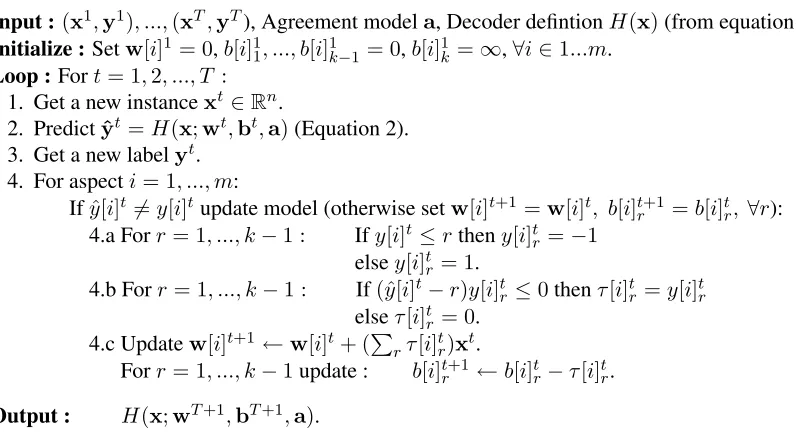
Input :(x1,y1), ...,(xT,yT), Agreement modela, Decoder defintionH(x)(from equation 2). Initialize :Setw[i]1 = 0,b[i]11, ..., b[i]k1−1 = 0,b[i]1k=∞,∀i∈1...m.
Loop :Fort= 1,2, ..., T :
1. Get a new instancext∈Rn.
2. Predictˆyt=H(x;wt,bt,a)(Equation 2).
3. Get a new labelyt.
4. For aspecti= 1, ..., m:
Ifyˆ[i]t6=y[i]tupdate model (otherwise setw[i]t+1=w[i]t, b[i]t+1
r =b[i]tr, ∀r):
4.a Forr = 1, ..., k−1 : Ify[i]t≤rtheny[i]tr=−1
elsey[i]tr= 1.
4.b Forr = 1, ..., k−1 : If(ˆy[i]t−r)y[i]t
r≤0thenτ[i]tr=y[i]tr
elseτ[i]tr= 0.
4.c Updatew[i]t+1 ←w[i]t+ (Prτ[i]tr)xt.
Forr = 1, ..., k−1update : b[i]t+1
[image:5.612.77.476.53.269.2]r ←b[i]tr−τ[i]tr. Output : H(x;wT+1,bT+1,a).
Figure 1: Good Grief Training. The algorithm is based on PRanking training algorithm. Our algorithm differs in the joint computation of all aspect predictionsˆytbased on the Good Grief Criterion (step 2) and
the calculation of updates for each aspect based on the joint prediction (step 4).
a simple illustrative example of a training set which can only be perfectly ranked with the inclusion of an agreement model.
First we introduce some notation. For each train-ing instance (xt,yt), each aspect i ∈ 1...m, and
each rank r ∈ 1...k, define an auxiliary variable
y[i]tr with y[i]tr = −1 if y[i]t ≤ r andy[i]tr = 1
if y[i]t > r. In words,y[i]tr indicates whether the
true rank y[i]t is to the right or left of a potential
rankr.
Now suppose that a training set
(x1,y1), ...,(xT,yT) is perfectly rankable for
each aspect independently. That is, for each aspect i ∈ 1...m, there exists some ideal model
v[i]∗ = (w[i]∗, b[i]∗) such that the signed
dis-tance from the prediction to the rth boundary: w[i]∗ ·xt −b[i]∗r has the same sign as the
auxil-iary variable y[i]tr. In other words, the minimum
margin over all training instances and ranks, γ = minr,t{(w[i]∗·xt−b[i]∗r)y[i]tr}, is no less than zero.
Now for thetthtraining instance, define an agree-ment auxiliary variableat, where at = 1when all
aspects agree in rank and at = −1 when at least
two aspects disagree in rank. First consider the case where the agreement modelaperfectly classifies all
training instances: (a·xt)at > 0,∀t. It is clear
that Good Grief decoding with the ideal joint model
(hw[1]∗,b[1]∗i, ...,hw[m]∗,b[m]∗i,a)will produce
the same output as the component ranking models run separately (since the grief will always be zero for the default rank predictions). Now consider the case where the training data is not linearly separable with regard to agreement classification. Define the mar-gin of the worst case error to beβ= maxt{|(a·xt)|: (a·xt)at <0}. Ifβ < γ, then again Good Grief de-coding will always produce the default results (since the grief of the agreement model will be at mostβin cases of error, whereas the grief of the ranking mod-els for any deviation from their default predictions will be at leastγ). On the other hand, ifβ ≥γ, then the agreement model errors could potentially disrupt the perfect ranking. However, we need only rescale w∗ :=w∗(βγ+)andb∗ :=b∗(βγ+)to ensure that
the grief of the ranking models will always exceed the grief of the agreement model in cases where the latter is in error. Thus whenever independent rank-ing models can perfectly rank a trainrank-ing set, a joint ranking model with Good Grief decoding can do so as well.
hx1,y1i=h(1,0,1), (2,1)i
hx2,y2i=h(1,0,0), (2,2)i
hx3,y3i=h(0,1,1), (1,2)i hx4,y4i=h(0,1,0), (1,1)i
We can interpret these inputs as feature vectors cor-responding to the presence of “good”, “bad”, and “but not” in the following four sentences:
The food wasgood,but notthe ambience. The food wasgood, and so was the ambience. The food wasbad,but notthe ambience. The food wasbad, and so was the ambience. We can further interpret the first rank aspect as the quality of food, and the second as the quality of the ambience, both on a scale of 1-2.
A simple ranking model which only considers the words “good” and “bad” perfectly ranks the food as-pect. However, it is easy to see that no single model perfectly ranks the ambience aspect. Consider any model hw,b = (b)i. Note that w·x1 < b and
w·x2 ≥ b together imply that w3 < 0, whereas
w·x3 ≥ b and w ·x4 < b together imply that w3 > 0. Thus independent ranking models cannot
perfectly rank this corpus.
The addition of an agreement model, however, can easily yield a perfect ranking. With a = (0,0,−5)(which predicts contrast with the presence
of the words “but not”) and a ranking model for the ambience aspect such asw = (1,−1,0),b = (0), the Good Grief decoder will produce a perfect rank.
5 Experimental Set-Up
We evaluate our multi-aspect ranking algorithm on a corpus5of restaurant reviews available on the
web-site http://www.we8there.com. Reviews
from this website have been previously used in other sentiment analysis tasks (Higashinaka et al., 2006). Each review is accompanied by a set of five ranks, each on a scale of 1-5, covering food, ambience, ser-vice, value, and overall experience. These ranks are provided by consumers who wrote original reviews. Our corpus does not contain incomplete data points since all the reviews available on this website con-tain both a review text and the values for all the five aspects.
Training and Testing DivisionOur corpus
con-5Data and code used in this paper are available at
http://people.csail.mit.edu/bsnyder/naacl07
tains 4,488 reviews, averaging 115 words. We ran-domly select 3,488 reviews for training, 500 for de-velopment and 500 for testing.
Parameter TuningWe used the development set to determine optimal numbers of training iterations for our model and for the baseline models. Also, given an initial uncalibrated agreement modela0, we
define our agreement model to be a = αa0 for an appropriate scaling factorα. We tune the value ofα on the development set.
Corpus Statistics Our training corpus contains 528 among55 = 3025possible rank sets. The most
frequent rank set h5,5,5,5,5i accounts for 30.5%
of the training set. However, no other rank set com-prises more than 5% of the data. To cover 90% of occurrences in the training set, 227 rank sets are re-quired. Therefore, treating a rank tuple as a single label is not a viable option for this task. We also find that reviews with full agreement across rank as-pects are quite common in our corpus, accounting for 38% of the training data. Thus an agreement-based approach is natural and relevant.
A rank of 5 is the most common rank for all as-pects and thus a prediction of all 5’s gives aMAJOR -ITY baseline and a natural indication of task
diffi-culty.
Evaluation MeasuresWe evaluate our algorithm and the baseline usingranking loss (Crammer and Singer, 2001; Basilico and Hofmann, 2004). Rank-ing loss measures the average distance between the true rank and the predicted rank. Formally, givenN test instances(x1,y1), ...,(xN,yN) of an
m-aspect ranking problem and the corresponding predictions yˆ1, ...,ˆyN, ranking loss is defined as P
t,i |y[i]
t−yˆ[i]t|
mN . Lower values of this measure
cor-respond to a better performance of the algorithm.
6 Results
Comparison with BaselinesTable 1 shows the per-formance of the Good Grief training algorithm GG
TRAIN+DECODE along with various baselines,
in-cluding the simple MAJORITY baseline mentioned
in section 5. The first competitive baseline,PRANK,
learns a separate ranker for each aspect using the PRank algorithm. The second competitive baseline,
SIM, shares the weight vectors across aspects using
Food Service Value Atmosphere Experience Total MAJORITY 0.848 1.056 1.030 1.044 1.028 1.001 PRANK 0.606 0.676 0.700 0.776 0.618 0.675 SIM 0.562 0.648 0.706 0.798 0.600 0.663
[image:7.612.109.505.56.155.2]GGDECODE 0.544 0.648 0.704 0.798 0.584 0.656 GGTRAIN+DECODE 0.534 0.622 0.644 0.774 0.584 0.632 GGORACLE 0.510 0.578 0.674 0.694 0.518 0.595
Table 1: Ranking loss on the test set for variants of Good Grief and various baselines.
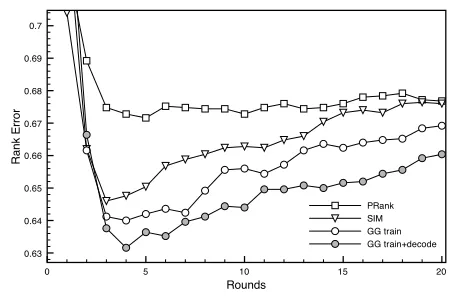
Figure 2: Rank loss for our algorithm and baselines as a function of training round.
Both of these methods are described in detail in Sec-tion 2. In addiSec-tion, we consider two variants of our algorithm: GG DECODE employs the PRank
train-ing algorithm to independently train all component ranking models and only applies Good Grief decod-ing at test time. GG ORACLEuses Good Grief
train-ing and decodtrain-ing but in both cases is given perfect knowledge of whether or not the true ranks all agree (instead of using the trained agreement model).
Our model achieves a rank error of 0.632, com-pared to 0.675 forPRANKand 0.663 forSIM. Both
of these differences are statistically significant at p <0.002by a Fisher Sign Test. The gain in
perfor-mance is observed across all five aspects. Our model also yields significant improvement (p <0.05) over
the decoding-only variant GG DECODE,
confirm-ing the importance of joint trainconfirm-ing. As shown in Figure 2, our model demonstrates consistent im-provement over the baselines across all the training rounds.
Model Analysis We separately analyze our
per-Consensus Non-consensus
PRANK 0.414 0.864
GG TRAIN+DECODE 0.324 0.854
GG ORACLE 0.281 0.830
Table 2: Ranking loss for our model and PRANK
computed separately on cases of actual consensus and actual disagreement.
formance on the 210 test instances where all the target ranks agree and the remaining 290 instances where there is some contrast. As Table 2 shows, we outperform thePRANKbaseline in both cases.
How-ever on the consensus instances we achieve a relative reduction in error of 21.8% compared to only a 1.1% reduction for the other set. In cases of consensus, the agreement model can guide the ranking models by reducing the decision space to five rank sets. In cases of disagreement, however, our model does not provide sufficient constraints as the vast majority of ranking sets remain viable. This explains the perfor-mance of GGORACLE, the variant of our algorithm
with perfect knowledge of agreement/disagreement facts. As shown in Table 1, GGORACLEyields
sub-stantial improvement over our algorithm, but most of this gain comes from consensus instances (see Ta-ble 2).
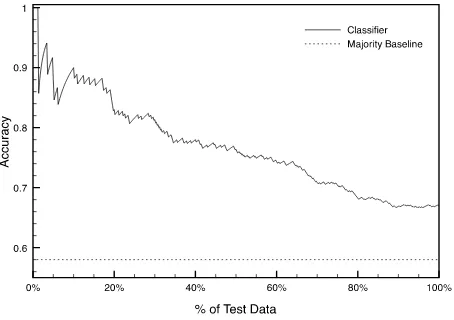
We also examine the impact of the agreement model accuracy on our algorithm. The agreement model, when considered on its own, achieves clas-sification accuracy of 67% on the test set, compared to a majority baseline of 58%. However, those in-stances with high confidence|a·x|exhibit
[image:7.612.74.299.194.343.2]Figure 3: Accuracy of the agreement model on sub-sets of test instances with highest confidence|a·x|.
the agreement model with 90% accuracy, and the third of the data with highest confidence can be clas-sified at 80% accuracy.
This property explains why the agreement model helps in joint ranking even though its overall accu-racy may seem low. Under the Good Grief criterion, the agreement model’s prediction will only be en-forced when its grief outweighs that of the ranking models. Thus in cases where the prediction confi-dence (|a·x|) is relatively low,6the agreement model
will essentially be ignored.
7 Conclusion and Future Work
We considered the problem of analyzing multiple re-lated aspects of user reviews. The algorithm pre-sented jointly learns ranking models for individual aspects by modeling the dependencies between as-signed ranks. The strength of our algorithm lies in its ability to guide the prediction of individual rankers using rhetorical relations between aspects such as agreement and contrast. Our method yields significant empirical improvements over individual rankers as well as a state-of-the-art joint ranking model.
Our current model employs a single rhetorical re-lation – agreement vs. contrast – to model depen-dencies between different opinions. As our
analy-6What counts as “relatively low” will depend on both the value of the tuning parameterαand the confidence of the com-ponent ranking models for a particular inputx.
sis shows, this relation does not provide sufficient constraints for non-consensus instances. An avenue for future research is to consider the impact of addi-tional rhetorical relations between aspects. We also plan to theoretically analyze the convergence prop-erties of this and other joint perceptron algorithms. Acknowledgments
The authors acknowledge the support of the National Sci-ence Foundation (CAREER grant 0448168 and grant IIS-0415865) and the Microsoft Research Faculty Fellowship. Thanks to Michael Collins, Pawan Deshpande, Jacob Eisen-stein, Igor Malioutov, Luke Zettlemoyer, and the anonymous reviewers for helpful comments and suggestions. Thanks also to Vasumathi Raman for programming assistance. Any opin-ions, findings, and conclusions or recommendations expressed above are those of the authors and do not necessarily reflect the views of the NSF.
References
J. Basilico, T. Hofmann. 2004. Unifying collabora-tive and content-based filtering. InProceedings of the ICML, 65–72.
K. Crammer, Y. Singer. 2001. Pranking with ranking. In
NIPS, 641–647.
K. Dave, S. Lawrence, D. Pennock. 2003. Mining the peanut gallery: Opinion extraction and semantic classification of product reviews. InProceedings of WWW, 519–528.
A. B. Goldberg, X. Zhu. 2006. Seeing stars when there aren’t many stars: Graph-based semi-supervised learn-ing for sentiment categorization. In Proceedings of HLT/NAACL workshop on TextGraphs, 45–52. R. Higashinaka, R. Prasad, M. Walker. 2006.
Learn-ing to generate naturalistic utterances usLearn-ing reviews in spoken dialogue systems. InProceedings of COL-ING/ACL, 265–272.
D. Marcu, A. Echihabi. 2002. An unsupervised approach to recognizing discourse relations. InProceedings of ACL, 368–375.
B. Pang, L. Lee. 2005. Seeing stars: Exploiting class relationships for sentiment categorization with respect to rating scales. InProceedings of the ACL, 115–124. B. Pang, L. Lee, S. Vaithyanathan. 2002. Thumbs up?
sentiment classification using machine learning tech-niques. InProceedings of EMNLP, 79–86.
P. Turney. 2002. Thumbs up or thumbs down? semantic orientation applied to unsupervised classsification of reviews. InProceedings of the ACL, 417–424. H. Yu, V. Hatzivassiloglou. 2003. Towards answering