Modeling Communicative Purpose with Functional Style:
Corpus and Features for German Genre and Register Analysis
Thomas Haider
Max Planck Institute for Empirical Aesthetics Frankfurt am Main, Germany
Alexis Palmer University of North Texas
Denton, Texas, USA [email protected]
Abstract
While there is wide acknowledgement in NLP of the utility of document charac-terization by genre, it is quite difficult to determine a definitive set of features or even a comprehensive list of genres. This paper addresses both issues. First, with prototype semantics, we develop a hier-archical taxonomy of discourse functions. We implement the taxonomy by develop-ing a new text genre corpus of contempo-rary German to perform a text based com-parative register analysis. Second, we ex-tract a host of style features, both deep and shallow, aiming beyond linguistically mo-tivated features at situational correlates in texts. The feature sets are used for super-vised text genre classification, on which our models achieve high accuracy. The combination of the corpus typology and feature sets allows us to characterize types of communicative purpose in a compara-tive setup, by qualitacompara-tive interpretation of style feature loadings of a regularized dis-criminant analysis. Finally, to determine the dependence of genre on topics (which are arguably the distinguishing factor of sub-genre), we compare and combine our style models with Latent Dirichlet Allo-cation features across different corpus set-tings with unstable topics.
1 Introduction
Language users exhibit a high degree of variability at all levels of the linguistic system and language use. In this paper, we focus on variation at the level of text (or discourse). Texts vary along nu-merous parameters such asmedium(spoken, writ-ten), topic / domain (e.g. art, science, religion,
government), rhetorical mode(e.g. narration, ar-gumentation, description, exposition), or commu-nicative purpose(e.g. persuade, report, entertain, edify, instruct, express opinion).
Such variational aspects, captured under the termsregisterandgenre, have been central to pre-vious investigations of discourse and textual vari-ation. Both terms have been used to refer to lan-guage variety associated with particular situations of use and, lacking a clear differentiation between the two terms, many studies simply adopt one and disregard the other (cf.Biber et al.,2007, 1.4).
For Biber and Conrad (2009), though, genre,
register and style are different perspectives on a single text. Each dimension can describe the oth-ers, e.g. acommentaryvoices anopinionthat is in-clusive,angryandaloof – it refers to non-specific entities, but avoids deixis and possession.
The cornerstone of our approach is to model textual variation via stylistic features, which we argue is the level at which both genre and register variation can be convincingly modeled.
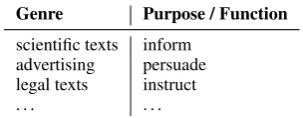
Following Lee(2001), we considerregister as variation according to use in broad societal sit-uations. It describes a functional adaptation to the immediate situational parameters of contex-tual use, as different situations ‘require’ appropri-ate configurations of language. Genre views text by consensus within a culture, as artifacts cate-gorized by purposive goals, distinguished by con-ventionally recognized criteria and hence subject to change as conventions are challenged and re-vised over time. In short (see table 1): genre is described by a conventional label, while regis-teris described through itspervasive features(cf.
Biber and Conrad,2009).
A comprehensive typology of texts at the same level of generality is a research prerequisite for any comparative register analysis. Because cur-rent multi-genre text corpora do not easily
Genre Purpose / Function
scientific texts inform advertising persuade legal texts instruct
[image:2.595.105.257.64.123.2]. . . .
Table 1: Sample genres, with dominant purpose.
mit to functional analysis of types (Section 2), we turn instead to the theoretical framework of
Steen (1999), which promises a general
taxon-omy of discourse. We operationalize the core of Steen’s theory for corpus design, modeling regis-ter variation top-down with prototype semantics to develop a comparative genre taxonomy (Sec-tion 3.1). The taxonomy is then implemented in a general genre/register corpus of contemporary German. (Section3.2).
We employ a wide range of stylistic features for the classification of text, (Section3.3), going beyond previous computational stylometric genre analysis, that has often relied on shallow lexico-syntactic patterns such as function words, surface forms, character / part-of-speech n-grams, etc.,
(Karlgren and Cutting, 1994; Stamatatos et al.,
2000a,b; Koppel et al., 2003; Gries and Shaoul,
2011; Sharoff, 2007; Kanaris and Stamatatos,
2007), extending beyond linguistically motivated features (Biber and Conrad, 2009;Santini,2005) with a fine-grained morphology, psycholinguistic word norms, and topic models. With these feature sets and corpus, we perform supervised genre clas-sification (Section4), showing that results remain high and stable across shifting sets of categories.
A major problem with relying on surface level features - particularly lexical features - is that they tend to capture topical information. Petrenz
and Webber (2011) make a strong case that a
genre classification system should not be suscep-tible to changes in topic/domain. We therefore test topic distributions learned with Latent Dirich-let Allocation (LDA) (Blei et al., 2003) against lexico-syntactic features in such a scenario (Sec-tion 4.4). Finally, we identify functional dimen-sions for characterizing communicative function (register) by examining the features most promi-nently associated with different communicative purposes. (Section5).
2 Selected related work
There are a number of genre-aware corpora for En-glish, but none for contemporary German that go
beyond web-genre, or are freely available. Early examples for English include the Brown corpus
(Francis and Kuˇcera,1964/79) and the
Lancaster-Oslo/Bergen (LOB) corpus (Johansson et al.,
1978). Both were sampled according to library classification systems and contain relatively small numbers of samples distributed over various genre classes of different granularity. MASC1 (Ide,
2008) also balances genre classes over number of tokens. To analyze the variety across texts, one needs to arbitrarily split its documents (to 2000 to-kens, as done byPassonneau(2014)). There is an extensive collection of web-genre corpora (
San-tini,2007;Meyer zu Eißen and Stein,2004;Rehm
et al., 2008; Santini et al., 2010). See Sharoff
and Markert (2010) for an overview and the
suc-cess of Char-4-bin features (later found to be un-stable by Petrenz and Webber (2011)). GECCo is a bilingual (English-German) corpus for in-vestigating cohesion across register (
Lapshinova-Koltunski et al., 2012). It is not freely available.
The DWDS ’Kernkorpus’ for super-genre of 20th century texts is also not available.2
The Hierarchical Genre Corpus (HGC) (Stubbe
and Ringlstetter, 2007) and the British National
Corpus (BNC)3 are designed to offer
representa-tive samples across different genres in a hierarchi-cal fashion. However, the categories of HGC are not clear-cut and focus on web-genre. The BNC is highly imbalanced.
Some additional related work uses features from systemic functional grammar in the tradition of Halliday for text genre classification (Argamon
and Koppel,2010;Argamon et al.,2003;Argamon
and Koppel,2012;Argamon et al.,2007).
3 Method
We present a methodology for corpus driven anal-ysis of situated language use. We achieve this by: 1) building a corpus, and 2) classifying and characterizing situationally-defined text cate-gories, aiming at a comparative register analysis.
3.1 A taxonomy for discourse
Genre follows a categorical paradigm, such that it assigns labels to text. A problem with genre labels is that they can have many different levels of gen-erality, e.g. the genre "academic discourse" is very 1Manually Annotated Sub-Corpus of American English 2http://194.95.188.16/ressourcen/ kernkorpus/
broad, and texts within such a high-level genre cat-egory will show considerable internal variation in their use of language, asBiber(1989) has shown. On a lower level, different genres can be based on many different criteria (domain, topic, partic-ipants, setting, form, etc.), e.g. ‘Western’ vs. ‘Ro-mance’ novels4or ‘Elegy’ vs. ‘Ballad’.5
Steen(1999) develops a solution for this by
ap-plying prototype theory (Rosch,1973) to the con-ceptualization of genre (and hence to the formal-isation of a taxonomy of discourse). A prototype is the most typical instance of a more encompass-ing and varied, fuzzy conceptual category – some instances are more central than others – e.g. the basic-level conceptchairis a prototypical instance of the superordinate conceptfurniture. Function-ally, basic-level concepts are maximally informa-tive (easily recognized, remembered, and learned), whereas subordinate concepts are less richly dif-ferentiated from their respective alternatives (e.g. dentist chair vs. recliner).6 Taylor (1995) finds
that "terms above the basic level are sometimes deviant in some way (e.g. furniture is morphosyn-tactically unusual in that it is uncountable, i.e. one cannot say ‘a furniture’ or ‘furnitures’)".
Steen proposes that we can recognize genres by their cognitive basic-level status: True genres, be-ing basic-level, are maximally distinct from one another. He analyzes the distance of genres in terms of specific attributes (parameters). Biber
(1993, table 1) introduces situational parameters as sampling strata for corpora, which we combine with the parameters ofSteen(1999).
For our corpus design, we use the following pa-rameters, that our features aim to cover, to distin-guish genre: medium / discourse channel (writ-ten, spoken, scripted), factuality (imaginative),
purpose / discourse function (persuade, enter-tain, report, edify, inform, instruct, explain, keep records, reveal self, express attitudes, opinions, etc.), rhetorical mode / discourse type (narra-tion, argumenta(narra-tion, descrip(narra-tion, exposition), par-ticipants(plurality, interactiveness, shared knowl-edge, demographic), topic / domain (art, sci-ence, religion, government, etc.),content(topics, themes, keywords). We do not use setting, for-mality, format, form.
4Distinguised by topic, protagonists, and purpose. 5Distinguished by topic, form, and purpose.
6Steen(1999) also claims superordinates to be less differ-entiated.
3.2 Corpus Design
Genre corpora are faced with the problem of finding an operationalizable definition for each genre and avoiding meaningless miscellaneous categories, i.e. choosing the right granularity of classes. The multitude of possible genre cate-gories makes it impractical to determine a fixed set of classes for a corpus that is representative for all genre. However, for a corpus to be useful for analysis, it needs to include a representative range of classes. We focus on written language that al-lows us to model types of communicative function through genre.
We design our genre corpus in a top-down hi-erarchical fashion as a taxonomy, where super-genre categories are based on the broad so-cial embedding of text. The four super-level categories for written language are taken from the DTA (Deutsches Textarchiv) (Geyken et al.,
2011): Wissenschaft (science), Belletristik (liter-ature), Zeitung (press) and Gebrauchstext (opera-tive text). We add a Gesprochen (spoken)variety to also test our model on a different medium of communication.
We subdivide each super-category into func-tionally dichotomous basic-categories, i.e. maxi-mally distinct prototypical instances, mainly rely-ing oncommunicative purpose/functionas the dis-tinctive attribute for written language. Then we as-sign a basic level-genre to each function, as found in DeReKo7 (Kupietz et al., 2010). The genre
annotation in DeReKo was delivered by the pub-lishers and is not evaluated on annotators, conse-quently only being a ‘silver standard’. Table2 il-lustrates our taxonomy.
To measure human agreement on assigning these categories, we randomly selected 20% of the test set of our 8-way typology for written basic-genre (10 documents per class) for manual an-notation. The three raters were (under)graduate students, native speakers of German, with back-grounds in linguistics (R1,R3) and psychology (R1,R2), employed at the MPIEA8. They were
given minimal instruction on text genre, commu-nicative functions and the purpose of the study. The first eight texts covered all types to make them familiar with the variety.
Super-Genre Genre Dominant purpose Ger. label Comment
Science AcademicPopular science researcheducate Wissensch.Pop. Wiss. Linguistik Online crawlSpektrum d. Wiss.
Literature Novel (epic)Drama narrateperform RomanDrama
Press ReportCommentary reportopinion BerichtKommentar
Reportage coverage Reportage
Operative Text AdvertisingPharma leaflets persuadeinstruct AnzeigenPack.beilage From newspapersRote Liste crawl
[image:4.595.114.487.62.200.2]Spoken SpeechInterview asymmetricsymmetric RedeInterview German Bundestag
Table 2: DeGeKo Genre Taxonomy translated to English
advertising report novel commentary leaflets pop.sci. reportage academic document_length 486.7 736.6 1404.4∗ 788.4 2689.4 933.4 2042.4 3631.6∗∗
avg_sentence_length 12.70 18.77 27.25 19.22 19.04 21.41 17.80 15.83
avg_word_length 5.25 5.38 4.98 5.29 5.66 5.48 4.91 5.24
[image:4.595.115.248.323.378.2]type_token_ratio 0.317 0.265 0.230 0.270 0.269 0.240 0.219 0.294
Table 3:DeGeKo written document stats
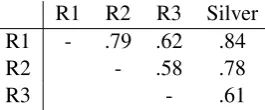
R1 R2 R3 Silver R1 - .79 .62 .84
R2 - .58 .78
R3 - .61
Table 4: Inter-rater agreement, 8-way typology (κ)
the others, and to the silver standard. R1 and R2 show a high level of agreement with each other (κ of .79) and with the silver standard (κof .84 and .78, respectively). R3 shows lower agreement, of-ten confusing academic writing with popular sci-ence.9 A common difficulty for all raters was to
distinguish among the press varieties (report, com-mentary, coverage), as we will also encounter in our experiments.
We propose that a fine-grained topic annotation at document level acts as viable proxy for genre distinction, e.g. advertising text can be sub-categorized to Leisure_Entertainment:Travel ads or Economy_Finance:Banking ads. Topic anno-tation in DeReKo was assigned by a Naive-Bayes classifier trained on the opendirectory10taxonomy
as described byWeiß(2005). Where this annota-tion is not consistent, we use the existing domain annotation to examine genre-internal variation.11
In the press genres, some topics were overly represented in the original population (e.g.
re-9R3 complained of having had a stressful day. 10http://dmoztools.net/
11Domain here is equivalent to the newspaper section in which the text originally appeared (ger.:ressort).
ports on sports clubs). While it can be argued that those are the most prototypical instances of a given genre, we balance those topics in the population to achieve a more ’natural’ topic distribution through sampling, so there is no bias towards certain con-tent. The target is the mean size of topic classes plus one standard deviation.
Table 2 illustrates our taxonomy. For classes with insufficient material in DeReKo to satisfy our sampling criteria (below), we crawl the web (academic & leaflets). Where we still did not re-trieve enough documents (academic & drama), we employ an upsampling technique: we chop doc-uments evenly by three-sentence chunks and dis-perse them according to their original position in the document (i.e., beginning, middle and end are still intact). Due to this upsampling, we cannot use document length as a feature for classification.
analysis otherwise.Biber(1989,1993) argues that a text ‘sample’ should be 2000 tokens large. This is not an issue in our setup, as each class is itself as large as the whole LOB corpus.
As you can see in table3, on average, advertise-ments are the shortest docuadvertise-ments and academic ar-ticles (wissenschaft) are the longest. Superscript ** documents have been upsampled. Also * signi-fies that the size for novels is not entirely trustwor-thy, because this category includes both shortened novels and short stories, skewing the document length distribution. Still, novels have the longest sentences by far. Reports (berichte) dominate in average word length. Advertising (anzeigen) has the highest type-token ratio.
3.3 Feature Design
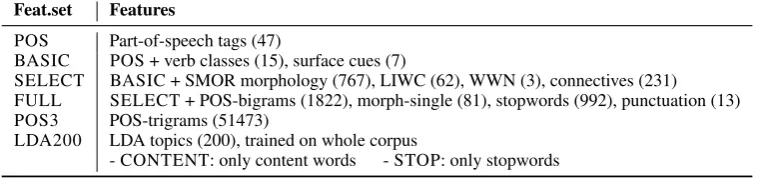
We model style features that are (a) able to dis-tinguish particular usage situations, and (b) based on sufficiently robust linguistic annotation tools. Therefore, we focus on the engineering of fine grained morpho-syntactic features, linguistic lex-icons, word norms and surface forms. To test the topic sensitivity of genre, we also generate topic distributions for documents with Latent Dirichlet Allocation (LDA). Our feature-groups are orga-nized as a nested hierarchy, shown in Table5. In-dividual features are described below. We imple-mented our feature extraction pipeline in python. Each feature is normalized relative to its own indi-vidual group (e.g. pos with pos) per text. Before classification, we use the sklearn StandardScaler.
Preprocessing for feature extraction. We use the Julie Lab Segmenter (Tokenization, Sentences)
(Hahn et al., 2016) and the RF-Tagger
(Lemma-tization, STTS pos-tags, SMOR morphological tags) (Schmid and Laws,2008).
Part-of-Speech Tags We use the Stuttgart-Tübingen Tagset (STTS)12with 47 tags.
Verb Classes German verb classes are retrieved from GermaNet (Hamp et al.,1997;Henrich and
Hinrichs,2010). The GermaNet scheme contains
9,382 unique verbs (including particles and af-fixes) across 15 groups, where a verb can be a member of several groups, totaling 15,327 tokens. For each verb token that we detect, we count every relevant class with equal weight.
12http://www.ims.uni-stuttgart.de/ forschung/ressourcen/lexika/TagSets/ stts-table.html
Surface Cues This is a heterogenous feature-group of linguistic surface cues.
1. Avg. word lengthin # of characters. 2. Avg. sentence lengthin # of words.
3. Type-Token-ratio: The ratio of unique types and tokens thereof. Always between 0 and 1. 4. Alliteration: Two subsequent words share the
same first character (bitterbutter).
5. Assonance: Two subsequent words share the same first vowel (loose goose).
6. Repetition: Minimum four character words recur within a 20 word context. + vari-ant without proper names to exclude speaker roles in drama.
We do not use document length, as we want to learn linguistic information only.
Morphology RF-Tagger (Schmid and Laws,
2008) annotates very fine-grained (767) mor-phological tags according to SMOR (Schmid
et al., 2004). One such feature would be
“VFIN.Full.2.Pl.Pres.Ind” for afull finite verb in second person plural present indicative.
WWN word norms Lahl et al. (2009) crowd-sourced ratings for concreteness, valency and arousal for 2,654 German nouns. We draw the mean for each dimension (0 - 10) per document.
LIWC - word norms The English Linguis-tic Inquiry and Word Count (Tausczik and
Pen-nebaker,2010;Pennebaker et al., 2015) contains
6400 words and stems (and select emoticons). The German version (Wolf et al.,2008) includes 7510 entries. It provides a hierarchical annotation of 68 linguistic and psychological categories, e.g. the wordcriedis part of five categories:sadness, neg-ative emotion, overall affect, verbsandpast focus. Hence, all five will be counted for the document.
Connectives The HDK list of 312 discourse connectives is described in (Versley, 2010). We match connectives by iterating over word n-grams. For connectives with a gap ("entweder ... oder"), we look ahead 20 words. If the right side element returns a match, we include the whole (gapped) connective, otherwise we only count the left side.
Stopwords Our German stopword list is by so-lariz,13 containing 996 inflected wordforms (of
Feat.set Features
POS Part-of-speech tags (47)
BASIC POS + verb classes (15), surface cues (7)
SELECT BASIC + SMOR morphology (767), LIWC (62), WWN (3), connectives (231) FULL SELECT + POS-bigrams (1822), morph-single (81), stopwords (992), punctuation (13) POS3 POS-trigrams (51473)
LDA200 LDA topics (200), trained on whole corpus
[image:6.595.110.492.66.155.2]- CONTENT: only content words - STOP: only stopwords
Table 5: Nested hierarchy of feature sets; numbers quantify individual features.
Latent Dirichlet Allocation - LDA We train gensim (ˇReh˚uˇrek and Sojka, 2010) LDA (Blei
et al., 2003) models on word lemmas, to model
semantic domain. We train on the whole corpus (incl. the test set) and derive the topic distribution for each document (as probabilities). We experi-mented with 50, 100 and 200 topic dimensions, the latter giving best results. For feature generation, a relatively large number of topics is preferred.
3.4 Classification algorithms
For classification, we use Linear Discriminant Analysis (LinDA), a Naive Bayes Multinomial classifier, Random Forest ensemble classifiers (FOREST) and Support Vector Machines (SVM). We train one SVM on 10 dimensions (ordered by explained covariance) of a Principal Component Analysis (PCA), one SVM vanilla version, and lastly, with a feature selection based on ANOVA, selecting the (3-20 percentile) best performing features. All models were optimized for several parameters with a grid search.14 We used the API
of scikit-learn 0.18 (Pedregosa et al.,2011). The algorithms were selected based on their success in the related literature on genre classification. The use of Random Forests and LDA is novel however.
3.5 Characterization algorithms
For the characterization of communicative func-tions, we work with a Linear Discriminant Anal-ysis (LinDA) and a Stochastic Gradient Descent (SGD). A linear model allows us to easily inter-pret feature loadings for each class, as each class is characterized by the linear combination of its fea-ture weights. Also, it can be easily evaluated with a F1 score or a confusion matrix. The general form (1) means that it is easy to see the relative impor-tance and contribution of each feature and to sanity check the model. The equation is solved by calcu-lating a Bayesian objective, i.e. fitting a Gaussian 14Most notably for SVM: C and kernel method. For Forest: Number of trees and their depth.
density distribution.
Ck=Ck0+Ck1X1+Ck2X2+...+CknXn (1)
where Ck is the classification score for group k
andCknare the coefficients for the featuresXn.
The main problem of a linear model is posed by strongly collinear features from different feature groups (PTKZU vs. Part.ZU) that consequently dominate the objective function (they become im-portant for many classes). So we need to apply regularization techniques that allow a noise-free interpretation. But penalizing (e.g. setting vari-ables to zero) with L1 or L2 makes the model less interpretable. This may ignore relevant informa-tion from the dataset. Consequently, we regularize LinDA with a PCA (with 150 dimensions), so that we "align" (near) identical features that load into opposing directions by their covariance. A side-effect is that this also avoids overfitting.15
4 Experiments
Featureset POS BASIC FULL POS3 SELECT. LDA200 LDA200 SELECT.+LDA200 STOP CONTENT
F1 score F1 score F1 score F1 score F1 score F1 score F1 score F1 score
LinDA .70 .77 .30 .28 .80 .73 .79 .86
BAY ESmultinom ? .73 .75 .51 .76 .73 .78 .81
F ORESTentropy .74 .81 .86 .80 .88 .81 .90 .92
F ORESTgini .75 .81 .88 .82 .87 .82 .89 .92
SV MP CA10 .68 .75 .85 .55 .82 .77 .86 time
SV MV ANILLA time .79 .83 .72 .83 time .92 .88
[image:7.595.76.522.62.168.2]SV MANOV A time .70 .88 .77 .86 . . .
Table 6:Supervised classification on DeGeKo’s eight written classes.
4.1 Written Basic-Level
In our corpus, the basic-level written genres are academic, popular science, novel, report, com-mentary, reportage, advertising, and leaflets.
Table6shows the classification results for writ-ten genres. Results shown are for the test set; per-formance is similar (± 2 points) for the dev set. ’time’ means that the classifier did not finish in a reasonable time frame (a day).
For all classifiers, SELECTED and LDA200CONTENT feature sets show the best results. The FOREST classifiers appear to be the most robust to changing the feature set. Overall, the best result is obtained by a vanilla SVM on LDA200CONTENT, on par with FOREST on SELECTED+LDA200CONTENT. Also, the smaller SELECTED set compares well to the larger FULL set, making it the best model for a characterization of communicative function (FULL contains POS2-grams).16 The main confusion between classes is caused by the press varieties, mostly because reports and commentaries are confused for each other, and commentaries confused with many other classes.
Most strikingly, LDA200CONTENT outper-forms SELECTED by 2 - 4 points. This raises the important question of how strongly the genre of a document is influenced by its topics. Petrenz and
Webber (2011) show that some genre
classifica-tion models suffer heavily when the topics present in a given genre during testing are different from those seen in training.
4.2 Including Spoken Classes
Next, we enrich the written basic-genre classes with the spoken varietiessymmetric speech, asym-metric interviews, anddrama, which is written to be spoken. The main difference is that drama 16The bad performance of LinDA_POS3, LinDA_Full, Bayes_POS3 and SVMPCA10_POS3 is likely attributable to a skewed distribution of pos-n-grams.
does not contain spontaneous speech, indicated by monologues. It is also arguable that political speeches – as used here – were prepared in written form to be performed in spoken form.
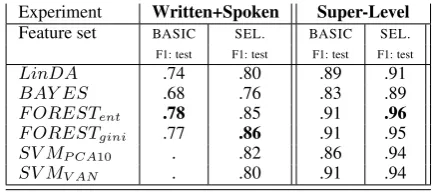
Experiment Written+Spoken Super-Level
Feature set BASIC SEL. BASIC SEL.
F1: test F1: test F1: test F1: test
LinDA .74 .80 .89 .91
BAY ES .68 .76 .83 .89
F ORESTent .78 .85 .91 .96
F ORESTgini .77 .86 .91 .95
SV MP CA10 . .82 .86 .94
SV MV AN . .80 .91 .94
Table 7:Written+spoken (L), Super-genres (R).
The left-hand side of Table 7shows classifica-tion results for the BASIC and the SELECTED feature sets. The richer feature set clearly outper-forms the simpler one. Interestingly, even though we added three classes of spoken material, we do not lose any accuracy over the corpus with only written varieties.
4.3 Written Super-Level
Next, written-language classes are mapped to four coarse-grained super-genres: Presse, Wis-senschaft, BelletristikandGebrauchstext.
[image:7.595.307.524.278.374.2]Topic Class Politik Freizeit_Unterh. Kultur Sport Wirtsch._Finanz. Staat_Gesell. Wissensch.
Bericht train 147 65 88 - - -
-Kommentar train 95 - 180 25 - -
-Reportage train 176 - - - - 118 6
Bericht test - - - 31 19 50
-Kommentar test - 19 - - 14 67
-Reportage test - 89 8 3 - -
-Table 8:DeGeKo Presse Topic Distinct Set # of documents
... Featureset Basic Full Selected LDA Cont retrain LDA Stop full LDA Cont full
Classifier F1 score F1 score F1 score F1 score F1 score F1 score
original LinDA .68 .65 .54 .56 .67 .56
F ORESTentropy .75 .78 .79 .70 .69 .82
SV Mvanilla time .70 .73 .68 .70 .79
distinct LinDA .63 .61 .48 .37 .63 .65
F ORESTentropy .68 .69 .68 .54 .68 .70
[image:8.595.71.523.62.138.2]SV Mvanilla .63 .65 .65 .61 .66 .69
Table 9:DeGeKo Topic Stability Compared Results
4.4 Topic Distinct Set
Theoretically, a text from any given genre can be about any given topic, yet it is clear that co-variances exist between genre and topic, with some genre/topic combinations more likely than others. Because both exploit low-level features to make predictions, a feature indicative of topic benefits a genre classifier through correlations in the training corpus. However, if the topics ad-dressed in a genre can change unpredictably over time, such correlated features can harm perfor-mance. Petrenz and Webber (2011) found that neither character-4-grams nor bag-of-words mod-els actually learn genre, but drop from 98% F1 to 38% (with char4) on three classes when topic is not held stable.
To test whether LDA topics are stable over a changing topic distribution, we create a subcorpus with the three press genre, where the topic anno-tations in our corpus are most reliable. Crucially, the distributions of topics for training data vs. test data are distinct. This yields two corpora: Orig-inal & Distinct. See Table 8 for distribution of documents over topics and genre. See Table9for classification results over changing topics.
We retrain LDA on the subcorpora and com-pare classification results to LDA trained on the full corpus, and against our style features. We find that each model compares unfavorably in the un-stable topic setting, e.g. the FOREST&SELECTED model loses 11 F1 points. In the unlikely case that we have a huge genre corpus available for training LDA, the model is comparable to the style feature set (which would be theoretically possible if we
feed new documents to our gensim model). The retrained LDA model compares badly for all mod-els. This shows that (a) LDA needs as much train-ing data as it can get, and (b) LDA is not robust against changing topics.
5 Characterizing register
A major advantage of our corpus is that we do not need sophisticated covariance metrics for the anal-ysis of stylistic variation. In our setup, we can in-terpret class feature loadings, and we can validate our linear classifier with a simple F1 metric. We achieve .81 F1 score. The error stems mostly from press variety. The details of our register character-ization approach are described in Section3.5.
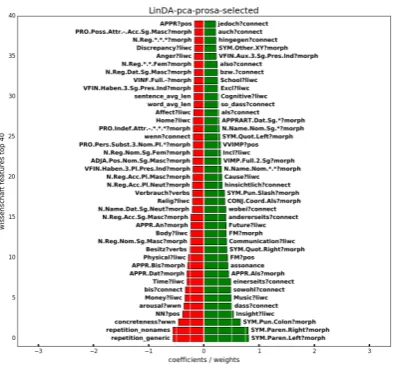
For each class, we retrieve the 80 features with the largest coefficient (40 negative & 40 positive) and use them for a qualitative analysis based on hypotheses formed on prior investigations (Breuer
and Eroms,2009) and to identify feature
agglom-erations that are apparent in a comparative setup (e.g. scientific text uses lots of connectives, par-ticularly contrastive connectives). Figures 1 and
2 show such coefficient plots for advertising and academic writing. We next discuss, for four rep-resentative registers, the features most strongly as-sociated, according to the method just described.
Gebrauchstext / Advertising (persuasion)
(nom-inal style but rarely articles). We find a simple syntax, but lexical diversity(high type/token ratio, short sentences, no sub. conj.) andovert persua-sion(Positive sentiment, Certainty).
Presse / Bericht (report)Reports feature most prominentlypresent tense, passive voice, indirect speech (subjunctive),facts(indicative) and infor-mation (num., art., NN, NE, ADJ). Also, by a positive loading of prepositions, adverbs, reflex-ive pronouns and negative loading of sub. conj., we conjecture abalanced, compact style.
Literature / Novel (storytelling) Storytelling stands out through the use of the past tense and the third person (V.3.past, ’damals’). We also find quitelong sentences(almost 30 words on av-erage), consequently many commas, and an aes-thetic feature:alliteration.
[image:9.595.73.278.327.514.2]Wissenschaft / Academic texts (Linguistik
Figure 1: Feature loading for advertising
Figure 2: Feature loading for academic text
online)Academic writing (unsurprisingly) shows complex expositionandargumentationwith many (contrastive) connectives (dass, sowohl, einer-seits, hinsichtlich, bzw., also), diverse punctua-tion (parentheses, slashes) and the LIWC classes insight, causation, communication. Furthermore, this text genre uses fairlyabstract language, as we find no concreteness and no arousal. We find a lot offoreign material(we use linguistics papers), and a prominentfocus on the future(liwc). Apparently, academic writing is assonant.
6 Conclusion
We have developed a genre taxonomy (for Ger-man) based on prototype semantics that can be used for a comparative register analysis, mod-elling a central aspect of situative text use: com-municative purpose of text.
We find that fine grained morphology, surface cues and psycholinguistic word norms allow us to reason about situational text embedding, while – given enough training data – Latent Dirichlet Allo-cation can approximate genre distinctions, seeing that certain topics are prevalent in most genre cate-gories. However, LDA is not stable over changing topic distributions under constant genre.
Future work should look at the communica-tive/situative function of constituency tree fea-tures, as they have proven to be useful e.g. for au-thorship attribution or deception detection. Also, the dimension of aesthetic style features (fore-grounding) has typically been ignored in register research, as those are not necessarily functional. Given the abundance of material, we should look at press variety only. We have seen that report, commentary and reportage are prone to be con-fused, particularly by linear models. As humans also have a problem here, we have to conclude that they are not as clearly distinguished as other genre. Furthermore, press includes genre cate-gories that are not as prototypical as the ones se-lected here (Dossier, Portrait, Feuilleton, Leitar-tikel). There are promising results (Sharoff,2016) to view genre as topology, not as typology.
Finally, future research might benefit from word embeddings and particularly morphological em-beddings to model stylistic variation.
Acknowledgements
[image:9.595.76.275.552.736.2]Heidelberg, with support of the Leibniz Science Campus (LiMo). We thank Yannick Versley, Katja Markert, Josef Ruppenhofer and Stefan Blohm for helpful discussions and our annotators Elena Va-porova, Sebastien Nicolay and Christian Dueck. Thanks also to the anonymous reviewers for help-ful comments.
References
Shlomo Argamon and Moshe Koppel. 2010. The rest of the story: Finding meaning in stylistic variation. InThe Structure of Style, Springer, pages 79–112. Shlomo Argamon and Moshe Koppel. 2012. Systemic
functional approach to automated authorship analy-sis, a. InJL & Pol’y 21, page 299.
Shlomo Argamon, Moshe Koppel, Jonathan Fine, and Anat Rachel Shimoni. 2003. Gender, genre, and writing style in formal written texts. WALTER DE GRUYTER & CO, volume 23, pages 321–346. Shlomo Argamon, Casey Whitelaw, Paul Chase,
Sob-han Raj Hota, Navendu Garg, and Shlomo Levitan. 2007. Stylistic text classification using functional lexical features. Journal of the American Society for Information Science and Technology58(6):802– 822.
Douglas Biber. 1989. A typology of english texts. Lin-guistics 27.1pages 3–44.
Douglas Biber. 1993. Representativeness in corpus de-sign. Literary and linguistic computing8(4):243– 257.
Douglas Biber, Ulla Connor, and Thomas A Upton. 2007. Discourse on the move: Using corpus analy-sis to describe discourse structure, volume 28. John Benjamins Publishing.
Douglas Biber and Susan Conrad. 2009. Register, genre, and style. Cambridge University Press. David M Blei, Andrew Y Ng, and Michael I Jordan.
2003. Latent dirichlet allocation. the Journal of ma-chine Learning research3:993–1022.
Ulrich Breuer and Hans-Werner Eroms. 2009. Stil und Stilistik. Eine Einführung. Grundlagen der German-istik 45.
Winthrop Nelson Francis and Henry Kuˇcera. 1964/79.
Manual of information to accompany a standard corpus of present-day edited American English, for use with digital computers. Brown University, De-partment of Lingustics.
Alexander Geyken, Susanne Haaf, Bryan Jurish, Matthias Schulz, Jakob Steinmann, Christian Thomas, and Frank Wiegand. 2011. Das deutsche textarchiv: Vom historischen korpus zum aktiven
archiv. Digitale Wissenschaft. Stand und Entwick-lung digital vernetzter Forschung in Deutschland, 20./21. September 2010, Köln. Beiträge der Tagung, 2., ergänzte Fassungpages 157–161.
Stefan Th John Newman Gries and Cyrus Shaoul. 2011. N-grams and the clustering of registers. Em-pirical Language Research Journal 5.1.
Udo Hahn, Franz Matthies, Erik Faessler, and Johannes Hellrich. 2016. Uima-based jcore 2.0 goes github and maven central — state-of-the-art software re-source engineering and distribution of nlp pipelines. Birgit Hamp, Helmut Feldweg, et al. 1997. Germanet-a lexicGermanet-al-semGermanet-antic net for germGermanet-an. InProceedings of ACL workshop Automatic Information Extraction and Building of Lexical Semantic Resources for NLP Applications. pages 9–15.
Verena Henrich and Erhard W Hinrichs. 2010. Gernedit-the germanet editing tool. InACL (System Demonstrations). Citeseer, pages 19–24.
Nancy et al. Ide. 2008. Masc: The manually annotated sub-corpus of american english. InIn Proceedings of the Sixth International Conference on Language Resources and Evaluation (LREC).
S Johansson, G Leech, and H Goodluck. 1978. Man-ual of information to accompany the lancaster-olso/bergen corpus of british english, for use with digital computers .
Ioannis Kanaris and Efstathios Stamatatos. 2007. Web-page genre identification using variable-length char-acter n-grams. InTools with Artificial Intelligence, 2007. ICTAI 2007. 19th IEEE International Confer-ence on. Vol. 2. IEEE.
J. Karlgren and D. Cutting. 1994. Recognizing text genres with simple metrics using discriminant analy-sis. InIn Proc. of the 15th. International Conference on Computational Linguistics (COLING 94). Kyoto, Japan, page 1071 – 1075.
Moshe Koppel, Navot Akiva, and Ido Dagan. 2003. A corpus-independent feature set for style-based text categorization. In IJCAI-2003 Workshop on Com-putational Approaches to Text Style and Synthesis, Acapulco, Mexico.
Marc Kupietz, Cyril Belica, Holger Keibel, and An-dreas Witt. 2010. The german reference corpus dereko: A primordial sample for linguistic research. InLREC.
Olaf Lahl, Anja S Göritz, Reinhard Pietrowsky, and Jessica Rosenberg. 2009. Using the world-wide web to obtain large-scale word norms: 190,212 ratings on a set of 2,654 german nouns. Behavior Research Methods41(1):13–19.
International Conference: Speech and Corpora. Firenze: Firenze University Press.
D. Lee. 2001. Genres, registers, text types, domains, and styles: clarifying the concepts and navigating a path through the bnc jungle. InLanguage Learning and Technology, page 5(3):37–72.
Sven Meyer zu Eißen and Benno Stein. 2004. Genre Classification of Web Pages: User Study and Fea-sibility Analysis. In Susanne Biundo, Thom Früh-wirth, and Günther Palm, editors, Advances in Ar-tificial Intelligence. 27th Annual German Confer-ence on AI (KI 04). Springer, Berlin Heidelberg New York, volume 3228 LNAI ofLecture Notes in Artifi-cial Intelligence, pages 256–269.
R. J. Ide N. Su S. an Stuart J. Passonneau. 2014. Biber redux: Reconsidering dimensions of variation in american english. In COLING, pages (pp. 565– 576).
F. Pedregosa, G. Varoquaux, A. Gramfort, V. Michel, B. Thirion, O. Grisel, M. Blondel, P. Pretten-hofer, R. Weiss, V. Dubourg, J. Vanderplas, A. Pas-sos, D. Cournapeau, M. Brucher, M. Perrot, and E. Duchesnay. 2011. Scikit-learn: Machine learning in Python. Journal of Machine Learning Research
12:2825–2830.
James W Pennebaker, Ryan L Boyd, Kayla Jordan, and Kate Blackburn. 2015. The development and psychometric properties of liwc2015. UT Fac-ulty/Researcher Works.
Philipp Petrenz and Bonnie Webber. 2011. Stable clas-sification of text genres. InComputational Linguis-tics 37.2. pages 385–393.
Georg Rehm, Marina Santini, Alexander Mehler, Pavel Braslavski, Rüdiger Gleim, Andrea Stubbe, Svetlana Symonenko, Mirko Tavosanis, and Vedrana Vidulin. 2008. Towards a reference corpus of web genres for the evaluation of genre identification systems. In
LREC.
Radim ˇReh˚uˇrek and Petr Sojka. 2010. Software Frame-work for Topic Modelling with Large Corpora. In
Proceedings of the LREC 2010 Workshop on New Challenges for NLP Frameworks. ELRA, Valletta, Malta, pages 45–50. http://is.muni.cz/
publication/884893/en.
Eleanor H Rosch. 1973. Natural categories. Cognitive psychology4(3):328–350.
Marina Santini. 2005. Itri-05-02 linguistic facets for genre and text type identification: A description of linguistically-motivated .
Marina Santini. 2007. Automatic identification of genre in web pages. diss. .
Marina Santini, Alexander Mehler, and Serge Sharoff. 2010. Riding the rough waves of genre on the web. InGenres on the Web. Springer Netherlands, pages 3–30.
Helmut Schmid, Arne Fitschen, and Ulrich Heid. 2004. Smor: A german computational morphology cov-ering derivation, composition and inflection. In
LREC.
Helmut Schmid and Florian Laws. 2008. Estimation of conditional probabilities with decision trees and an application to fine-grained pos tagging.
Serge Sharoff. 2007. Classifying web corpora into do-main and genre using automatic feature identifica-tion. InProceedings of the 3rd Web as Corpus Work-shop.
Serge Sharoff. 2016. Functional text dimensions for annotation of web corpora .
Serge Zhili Wu Sharoff and Katja Markert. 2010. The web library of babel: evaluating genre collections. InLREC.
Efstathios Stamatatos, Nikos Fakotakis, and George Kokkinakis. 2000a. Automatic text categorization in terms of genre and author. InComputational lin-guistics 26.4, pages 471–495.
Efstathios Stamatatos, Nikos Fakotakis, and George Kokkinakis. 2000b. Text genre detection using com-mon word frequencies. InProceedings of the 18th conference on Computational linguistics-Volume 2. Association for Computational Linguistics.
Gerard Steen. 1999. Genres of discourse and the defi-nition of literature. Discourse Processes28(2):109– 120.
A. Stubbe and C. Ringlstetter. 2007. Recognizing gen-res. InIn Santini, M. and Sharoff, S., editors, Proc. Towards a Reference Corpus of Web Genres. Yla R Tausczik and James W Pennebaker. 2010. The
psychological meaning of words: Liwc and comput-erized text analysis methods. Journal of language and social psychology29(1):24–54.
John Taylor. 1995. Linguistic categorization: Proto-types in linguistic theory. and Categorization, JR Linguistic Clarendon: Oxford University Press. Yannick Versley. 2010. Discovery of ambiguous and
unambiguous discourse connectives via annotation projection. InProceedings of Workshop on Annota-tion and ExploitaAnnota-tion of Parallel Corpora (AEPC). pages 83–82.
Christian Weiß. 2005. Die thematische erschließung von sprachkorpora. Mannheim: Institut für Deutsche Sprache.(= OPAL-Online publizierte Ar-beiten zur Linguistik, 1/2005).