Argument Relation Classification Using a Joint Inference Model
Yufang Hou and Charles Jochim IBM Research – Ireland
{yhou|charlesj}@ie.ibm.com
Abstract
In this paper, we address the problem of ar-gument relation classification where argu-ment units are from different texts. We de-sign a joint inference method for the task by modelingargument relation classifica-tion andstance classificationjointly. We show that our joint model improves the re-sults over several strong baselines.
1 Introduction
What is a good counterargument or support ar-gument for a given arar-gument? Despite recent advances in computational argumentation, such as argument unit (e.g., claims, premises) min-ing (Habernal and Gurevych, 2015), argumenta-tive relation (e.g., support, attack) prediction be-tween argument units from the same text (Stab and Gurevych,2014;Nguyen and Litman,2016), as well as assessing argument strength of essays (Persing and Ng,2015) or predicting convincing-ness of Web arguments (Habernal and Gurevych,
2016), this question is still an unsolved problem. In this work we focus on the problem of argu-ment relation classification where arguargu-ment units are from different texts, i.e., given a set of argu-ments related to the same topic, we aim to predict relations (e.g.,agreeordisagree) between any two arguments. We are aware of argumentative rela-tions between premises and the conclusion within a structured argument. Instead, here we are inter-ested in modeling relations among atomic argu-ment units in dialogic arguargu-mentation. This task is important for argumentation in debates (Zhang et al., 2016), stance classification (Sridhar et al.,
2015), or persuasion analysis (Tan et al., 2016), among others.
There are various different views on the mean-ing of “support” and “attack” in
argumenta-tion theory (Cayrol and Lagasquie-Schiex, 2005,
2013). In this paper, we use “agree” and “dis-agree” to represent relations between two argu-ments which bear a stance regarding the same topic. Specifically, ifa1 agrees witha2 regarding
the topic tthen a1 anda2 are conflict-free. And
ifa1 disagrees witha2 then they are not
conflict-free.
There is a close relationship betweenargument relation classification and stance classification. First, argument relation classification can bene-fit from knowing the stance information of argu-ments. Specifically, if two arguments hold differ-ent stances with regard to the same topic, then they likely disagree with each other. Likewise, two ar-guments that hold the same stance regarding the same topic tend to agree with each other. Sec-ondly, stance classification can benefit from mod-eling relations between arguments. For instance, we would expect two arguments that disagree with each other to hold different stances.
There has been a large amount of work focusing on stance classification in on-line debate forums by integrating disagreement information between posts connected with reply links (Somasundaran and Wiebe,2009;Murakami and Raymond,2010;
Sridhar et al.,2015). However, disagreement in-formation is mainly used as an auxiliary variable and is not explicitly evaluated. Our goal in this paper is to examine argument relation classifica-tion in dialogic argumentaclassifica-tion. Our task is more challenging because unlike most previous work on disagreement classification, which can explore meta information (e.g., reply links between posts are strong indicators of disagreement), we are only provided with text information (see examples in Table1).
In this paper, we modelargument relation clas-sification and stance classification jointly. We evaluate our model on a dataset extracted from
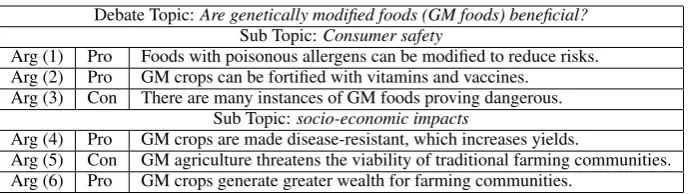
Debate Topic:Are genetically modified foods (GM foods) beneficial? Sub Topic:Consumer safety
Arg (1) Pro Foods with poisonous allergens can be modified to reduce risks. Arg (2) Pro GM crops can be fortified with vitamins and vaccines.
Arg (3) Con There are many instances of GM foods proving dangerous. Sub Topic:socio-economic impacts
Arg (4) Pro GM crops are made disease-resistant, which increases yields.
Arg (5) Con GM agriculture threatens the viability of traditional farming communities. Arg (6) Pro GM crops generate greater wealth for farming communities.
Table 1: Examples of Debatepedia structure: arguments are organized into different sub-topics, each argument holds a stance regarding the topic.
batepedia1. We show that the joint model performs
better than several strong baselines forargument relation classification. To our knowledge, this is the first work applying joint inference on argument relation classification on dialogic argumentation.
2 Related Work
Argument unit mining. Recent achievements in argument unit mining on different genres has provided us with high quality input for argument relation mining. Teufel(1999) proposed an Argu-mentative Zoning model for scientific text. Levy et al. (2014) and Rinott et al. (2015) extracted claims and evidences from Wikipedia respectively.
Habernal and Gurevych(2015) focused on mining argument components from user-generated Web content.Lippi and Torroni(2016) extracted claims from political debates by utilizing speech features. Argumentative relation classification. Most existing work on argumentative relation focuses on classifying relations between argument units of monologic argumentation, from a single text. One line of research (Stab and Gurevych,2014; Pers-ing and Ng,2016;Nguyen and Litman,2016) ex-tracted argument units and predicted relations (i.e., support, attack, none) between argument units in persuasive student essays. Peldszus and Stede
(2015) identified the argument structure of short texts in a bilingual corpus. In contrast, in our work the argument units are from different texts. There-fore, we do not have discourse connectives (e.g., “on the contrary” or “however”) which usually are strong indicators for argument relations.
Cabrio and Villata(2012) used a textual entail-ment system to predict arguentail-ment relations between argument pairs which are extracted from Debate-pedia. An argument pair could be an argument coupled with the subtopic, or an argument coupled
1http://www.debatepedia.org/
with another argument of the opposite stance. Recently, Menini and Tonelli (2016) predicted agreement/disagreement relations between argu-ment pairs of dialogic arguargu-mentation in the po-litical domain. The authors also create a large agreement/disagreement dataset by extracting ar-guments from the same sub-topic of Debatepedia. However, they only consider argument pairs that share a topic keyword. We do not have such con-straints (see Arg (1) and Arg (2) in Table 1). In addition, they use SVM while we do joint infer-ence.
Stance classification. There has been an in-creasing interest on modeling stance in debates (e.g., congressional debates or online political fo-rums) (Thomas et al., 2006; Somasundaran and Wiebe, 2009; Murakami and Raymond, 2010;
Walker et al., 2012;Gottipati et al., 2013;Hasan and Ng, 2014). As discussed in Section1, there is a close relationship between stance classifica-tion and argument relaclassifica-tion classificaclassifica-tion. For in-stance, Sridhar et al. (2015) showed that stance classification in online debate forums can bene-fit from modeling disagreement of the reply links (e.g., you could assume an argument is attacking the preceding argument). In our work, we focus on modeling argument relations.
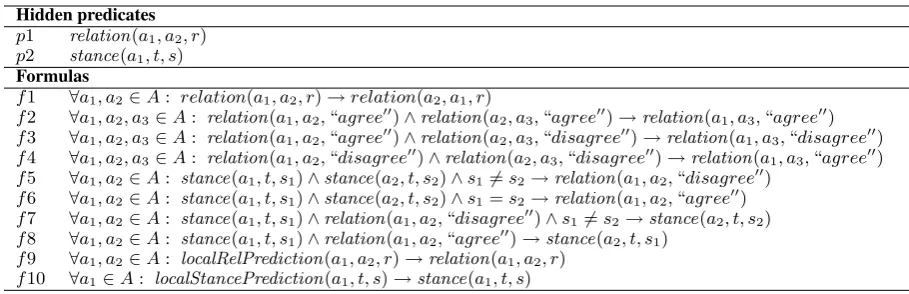
[image:2.595.128.474.60.157.2]Hidden predicates p1 relation(a1, a2, r)
p2 stance(a1, t, s)
Formulas
f1 ∀a1, a2∈A: relation(a1, a2, r)→relation(a2, a1, r)
f2 ∀a1, a2, a3∈A: relation(a1, a2,“agree00)∧relation(a2, a3,“agree00)→relation(a1, a3,“agree00)
f3 ∀a1, a2, a3∈A: relation(a1, a2,“agree00)∧relation(a2, a3,“disagree00)→relation(a1, a3,“disagree00)
f4 ∀a1, a2, a3∈A: relation(a1, a2,“disagree00)∧relation(a2, a3,“disagree00)→relation(a1, a3,“agree00)
f5 ∀a1, a2∈A: stance(a1, t, s1)∧stance(a2, t, s2)∧s16=s2→relation(a1, a2,“disagree00)
f6 ∀a1, a2∈A: stance(a1, t, s1)∧stance(a2, t, s2)∧s1=s2→relation(a1, a2,“agree00)
f7 ∀a1, a2∈A: stance(a1, t, s1)∧relation(a1, a2,“disagree00)∧s16=s2→stance(a2, t, s2)
f8 ∀a1, a2∈A: stance(a1, t, s1)∧relation(a1, a2,“agree00)→stance(a2, t, s1)
f9 ∀a1, a2∈A: localRelPrediction(a1, a2, r)→relation(a1, a2, r)
[image:3.595.70.525.61.208.2]f10 ∀a1∈A: localStancePrediction(a1, t, s)→stance(a1, t, s)
Table 2: Hidden predicates and formulas used for argument relation classification. a1, a2 represent
arguments in the topict.r∈ {agree, disagree},s∈ {pro, con}.
3 Method
As stated in the introduction, our goal isargument relation classificationas opposed to stance classi-fication. Therefore, given a topictand a set of ar-gumentsA which belongs tot, instead of finding the position (i.e., pro orcon) ai (ai ∈ A ) takes
with respect to t, we want to predict the relation (i.e.,agreeordisagree) betweenaiandaj.
The approach we propose tries to make the best use of the topics and arguments by classifying the stances of arguments and the relations between arguments jointly, using Markov logic networks (MLNs).
More specifically, given a topic t and its ar-gument set A we would like to find the stance si for each argument ai and the relation rij
be-tween argumentaiandaj (ai, aj ∈A) jointly. Let
rij be a relation assignment for an argument pair
ai, aj ∈ A, RAbe a relation classification result
for all arguments inA,Rn
Abe the set of all
rela-tion classificarela-tion results forA. Letsabe a stance
prediction for an argumenta∈A,SAbe a stance
prediction result for arguments inA,Sn
Abe the set
of all possible stance prediction results forA. Our joint inference forargument relation classification and stance classificationcan be represented as a log-linear model:
P(RA,SA|A;w) =
exp(w·Φ(A, RA, SA)) P
RA0∈RnA, SA0∈SnAexp(w·Φ(A, RA
0, S A0))
where w is the model’s weight vector, Φ(A, RA, SA) is a “global” feature vector
which takes the entire relation and stance assign-ments for all arguassign-ments in A into account. We defineΦ(A, RA, SA)as:
Φ(A, RA, SA) = X
l∈Fr
X
ai,aj∈A
Φl(ai, aj, rij)
+ X
k∈Fs
X
a∈A
Φk(a, sa)
+ X
g∈Fg
X
ai,aj∈A
Φg(rij, sai, saj)
whereΦl(ai, aj, rij)andΦk(a, sa)are local
fea-ture functions forargument relation classification andstance classification, respectively. The former looks at two argumentsai andaj, the latter at the
argumentaand the stancesa. The global feature
functionΦg(rij, sai, saj)looks at the relation and
stance assignments forai andaj at the same time
(seef5−f8in Table2).
This log-linear model can be represented using Markov logic networks (MLNs). Table 2 shows formulas for modeling the problem in MLNs. p1 andp2are hidden predicates that we predict, i.e., predicting the relation (i.e.,agreeordisagree) be-tweena1anda2, and deciding the stance (i.e.,pro
orcon) ofa1. f1 models the symmetry of
argu-ment relation. f2 models the transitivity of the agree relation. f3 andf4 model agree/disagree relations among three arguments. f5−f8model mutual relation between the two hidden predi-cates, i.e., arguments holding the same/different stance are likely to agree/disagree with each other. f9 and f10 integrate predictions from the local classifier for argument relation classification and stance classification respectively.
4 Experiments
4.1 Dataset
Each debate topic is organized hierarchically. It contains background of the topic and usually a number of subtopics, withproandconarguments for or against each subtopic (see Table1for an ex-ample). An argument typically includes a claim and a few supporting evidences.
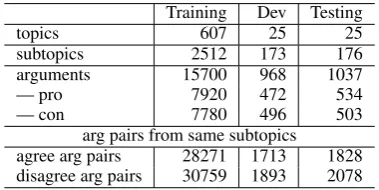
Training Dev Testing
topics 607 25 25
subtopics 2512 173 176
arguments 15700 968 1037
— pro 7920 472 534
— con 7780 496 503
[image:4.595.85.275.155.250.2]arg pairs from same subtopics agree arg pairs 28271 1713 1828 disagree arg pairs 30759 1893 2078 Table 3: Training, development and testing data.
We create a corpus by extracting all subtopics and their arguments from Debatepedia. We pair all arguments from the same subtopic and label ev-ery argument pair as “agree” (for arguments hold-ing the same stance) or “disagree” (for arguments holding the opposite stance). In total we collect data from 657 topics. We reserve 25 topics as the development set and 25 topics as the test set, using the remaining 607 topics for the training set. Table
3gives an overview of the whole corpus.2
4.2 Experimental Setup
Local argument relation classification ( local-Rel). We employ logistic regression to train a local argument relation classification model us-ing agree and disagree pairs from the trainus-ing set. Our local classifier replicates, to the extent possi-ble, the state-of-the-art local stance classifier from
Walker et al.(2012) used bySridhar et al.(2015) as well as the disagreement classifier fromMenini and Tonelli (2016). We include features of uni-grams, all word pairs of the concatenation of two arguments, the overall sentiment of each argu-ment from Stanford CoreNLP (Socher et al.,2013;
Manning et al.,2014), the content overlap of two arguments, as well as the number of negations in each argument using a list of negation cues (e.g., not, no, neither) fromCouncill et al.(2010). We also include three types of dependency features (Anand et al.,2011) which consist of triples from the dependency parse of the argument. Specifi-cally, a basic dependency feature(reli, tj, tk)
en-codes the syntactic relationrelibetween wordstj
andtk. One variant is to replace the head word of
2The dataset and splits will be available on publication.
the relationreli with its part-of-speech tag. The
other variant is replacing tokens in a triple with their polarities (i.e.,+or−) using MPQA dictio-nary of opinion words (Wilson et al.,2005).
localStanceToRel. We again employ logistic
re-gression to train a local stance classification model (localStance) using the same features as in local-Rel. We construct the training instances by pair-ing a topict and all its pro/con arguments in the training set3. During testing, we predict two
argu-ments agree/disagree to each other if they have the same/differences stances regarding the topic.
LSTM+attention. We adapt the attention-based
LSTM model used for textual entailment in
Rockt¨aschel et al. (2016). We use GloVe vec-tors (Pennington et al.,2014) with 100 dimensions trained on Wikipedia and Gigaword as word em-beddings. To avoid over-fitting, we apply dropout before and after the LSTM layer with the proba-bility of 0.1. We train the model with 60 epochs using cross-entropy loss. We use Adam for opti-mization with the learning rate of 0.01.
EDIT. We reimplement the approach for argu-ment relation classification fromCabrio and Vil-lata(2012). Specifically, we train the textual en-tailment system EDIT4 on our training set using
the same configuration used inCabrio and Villata
(2012). We then apply the trained model on the testing dataset.
Joint model. For our approach described in Sec-tion3, we use the output of the two local classifiers (localRelandlocalStance) as the input for formu-las f9 andf10 in Table 2.5 The weights of the
formulas are learned on the dev dataset. We use thebeast6to learn weights for the formulas and to
perform inference.thebeastemploys cutting plane inference (Riedel, 2008) to improve the accuracy and efficiency of MAP inference for Markov logic. 4.3 Results and Discussion
Table4 shows the results of different approaches on argument relation classification. EDIT per-forms the worst among four local classifiers with an accuracy of 0.50. We think this is mainly due to the difference between the corpora, i.e., we don’t
3Although localRel and localStance use the same
fea-tures, we notice that logistic regression can pick up informa-tive features for each task based on different training set (i.e., arg1-arg2 v.s. topic-arg).
4http://edits.fbk.eu/
5Another option is to predictlocalRelandlocalStance
us-ing MLNs. We leave this for future research.
localRel localStanceToRel LSTM+attention EDIT joint
R P F R P F R P F R P F R P F
agree 52.6 61.1 56.6 71.6 58.5 64.4 55.5 56.1 56.0 76.1 47.9 58.8 63.6 63.1 63.3 disagree 70.5 62.8 66.5 55.4 68.9 61.4 62.4 61.4 61.9 27.1 56.3 36.6 67.3 67.7 67.5
Acc. 62.1 63.0 59.1 50.0 65.5
[image:5.595.71.528.61.124.2]Macro F. 61.8 63.6 58.9 51.8 65.4
Table 4: Experimental results of argument relation classification on the testing dataset. Bold indicates statistically significant differences over the baselines using randomization test (p <0.01).
pair an argument with its topic in our argument re-lation classification dataset.
Additionally, the results ofLSTM+attentionare worse than localRel and localStanceToRel. We suspect this is because the amount of our train-ing data is only 1/10 of the SNLI corpus used in
Rockt¨aschel et al.(2016). Also our dataset has a richer lexical variability.
In general, the local model localRel is bet-ter at predicting disagree than agree. The ap-proach localStanceToRel flips this by predicting more argument pairs as agree. Overall, there is a small improvement in accuracy fromlocalRelto localStanceToRel. Our joint model combines the strengths of the two local classifiers and performs significantly better than both of them in terms of accuracy and macro-average F-score (randomiza-tion test,p <0.01).
5 Conclusions
We propose a joint inference model for argument relation classification on dialogic argumentation. The model utilizes the mutual support relations be-tweenargument relation classificationandstance classification. We show that our joint model sig-nificantly outperforms other local models.
References
Pranav Anand, Marilyn Walker, Rob Abbott, Jean E. Fox Tree, Robeson Bowmani, and Michael Mi-nor. 2011. Cats rule and dogs drool!: Classifying stance in online debate. InProceedings of the 2nd Workshop on Computational Approaches to Subjec-tivity and Sentiment Analysis,Portland, Oregon, 24 June 2011, pages 1–9.
Elena Cabrio and Serena Villata. 2012. Combining textual entailment and argumentation theory for sup-porting online debates interactions. InProceedings of the 50th Annual Meeting of the Association for Computational Linguistics,Jeju Island, Korea, 8–14 July 2012, pages 208–212.
Claudette Cayrol and Marie-Christine Lagasquie-Schiex. 2005. On the acceptability of arguments in
bipolar argumentation frameworks. In Llu´ıs Godo, editor, Symbolic and Quantitative Approaches to Reasoning with Uncertainty: 8th European Confer-ence, pages 378–389. Springer Berlin Heidelberg. Claudette Cayrol and Marie-Christine
Lagasquie-Schiex. 2013. Bipolarity in argumentation graphs: Towards a better understanding. International Jour-nal of Approximate Reasoning, 54:876–899. Isaac Councill, Ryan McDonald, and Leonid
Ve-likovich. 2010. What’s great and what’s not: learn-ing to classify the scope of negation for improved sentiment analysis. InProceedings of the Workshop on Negation and Speculation in Natural Language Processing, Uppsala, Sweden, 10 July 2010, pages 51–59.
Pedro Domingos and Daniel Lowd. 2009. Markov Logic: An Interface Layer for Artificial Intelligence. Morgan Claypool Publishers.
Swapna Gottipati, Minghui Qiu, Yanchuan Sim, Jing Jiang, and Noah A. Smith. 2013. Learning topics and positions from Debatepedia. InProceedings of the 2013 Conference on Empirical Methods in Natu-ral Language Processing,Seattle, Wash., 18–21 Oc-tober 2013, pages 1858–1868.
Ivan Habernal and Iryna Gurevych. 2015. Exploit-ing debate portals for semi-supervised argumenta-tion mining in user-generated web discourse. In
Proceedings of the 2015 Conference on Empirical Methods in Natural Language Processing, Lisbon, Portugal, 17–21 September 2015, pages 2127–2137. Ivan Habernal and Iryna Gurevych. 2016. Which ar-gument is more convincing? analyzing and predict-ing convincpredict-ingness of web arguments uspredict-ing bidi-rectional lstm. In Proceedings of the 54th Annual Meeting of the Association for Computational Lin-guistics,Berlin, Germany, 7–12 August 2016, pages 1589–1599.
Kazi Saidul Hasan and Vincent Ng. 2014. Why are you taking this stance? identifying and classifying reasons in ideological debates. InProceedings of the 2014 Conference on Empirical Methods in Natural Language Processing,Doha, Qatar, 25–29 October 2014, pages 751–762.
Yufang Hou, Katja Markert, and Michael Strube. 2013.
Global inference for bridging anaphora resolution.
American Chapter of the Association for Computa-tional Linguistics: Human Language Technologies,
Atlanta, Georgia, 9–14 June 2013, pages 907–917. Ran Levy, Yonatan Bilu, Daniel Hershcovich, Ehud
Aharoni, and Noam Slonim. 2014. Context depen-dent claim detection. InProceedings of the 25th In-ternational Conference on Computational Linguis-tics, Dublin, Ireland, 23–29 August 2014, pages 1489–1500.
Marco Lippi and Paolo Torroni. 2016. Argument min-ing from speech: Detectmin-ing claims in political de-bates. In Proceedings of the 30th Conference on the Advancement of Artificial Intelligence,Phoenix, Arizona, USA, 12–17 February 2016, pages 2979– 2985.
Christopher Manning, Mihai Surdeanu, John Bauer, Jenny Finkel, Steven Bethard, and David McClosky. 2014. The stanford corenlp natural language pro-cessing toolkit. InProceedings of the ACL 2014 Sys-tem Demonstrations, Baltimore, USA, 22–27 June 2014, pages 55–50.
Stefano Menini and Sara Tonelli. 2016. Agreement and disagreement: Comparison of points of view in the political domain. InProceedings of the 26th Inter-national Conference on Computational Linguistics,
Osaka, Japan, 11–16 December 2016, pages 2461– 2470.
Ivan Meza-Ruiz and Sebastian Riedel. 2009. Jointly identifying predicates, arguments and senses using Markov logic. InProceedings of Human Language Technologies 2009: The Conference of the North American Chapter of the Association for Computa-tional Linguistics, Boulder, Col., 31 May – 5 June 2009, pages 155–163.
Akiko Murakami and Rudy Raymond. 2010. Support or oppose? classifying positions in online debates from reply activities and opinion expressions. In
Proceedings of the 23rd International Conference on Computational Linguistics, Beijing, China, 23– 27 August 2010, pages 869–875.
Huy Nguyen and Diane Litman. 2016. Context-aware argumentative relation mining. In Proceedings of the 54th Annual Meeting of the Association for Com-putational Linguistics, Berlin, Germany, 7–12 Au-gust 2016, pages 1127–1137.
Andreas Peldszus and Manfred Stede. 2015. Joint prediction in MST-style discourse parsing for ar-gumentation mining. In Proceedings of the 2015 Conference on Empirical Methods in Natural Lan-guage Processing,Lisbon, Portugal, 17–21 Septem-ber 2015, pages 938–948.
Jeffrey Pennington, Richard Socher, and Christo-pher D. Manning. 2014. Glove: Global vectors for word representation. In Proceedings of the 2014 Conference on Empirical Methods in Natural Language Processing,Doha, Qatar, 25–29 October 2014, pages 1532–1543.
Isaac Persing and Vincent Ng. 2015. Modeling argu-ment strength in student essays. InProceedings of the Joint Conference of the 53th Annual Meeting of the Association for Computational Linguistics and the 7th International Joint Conference on Natural Language Processing, Beijing, China, 26–31 July 2015, pages 543–552.
Isaac Persing and Vincent Ng. 2016. End-to-end ar-gumentation mining in student essays. In Proceed-ings of the 2016 Conference of the North Ameri-can Chapter of the Association for Computational Linguistics: Human Language Technologies, San Diego, California, 12–17 June 2016, pages 1384– 1394.
Hoifung Poon and Pedro Domingos. 2008. Joint unsu-pervised coreference resolution with Markov Logic. InProceedings of the 2008 Conference on Empirical Methods in Natural Language Processing,Waikiki, Honolulu, Hawaii, 25–27 October 2008, pages 650– 659.
Hoifung Poon and Pedro Domingos. 2010. Unsuper-vised ontology induction from text. InProceedings of the 48th Annual Meeting of the Association for Computational Linguistics, Uppsala, Sweden, 11– 16 July 2010, pages 296–305.
Sebastian Riedel. 2008. Improving the accuracy and efficiency of MAP inference for Markov logic. In
Proceedings of the 24th Conference on Uncertainty in Artificial Intelligence, Helsinki, Finland, 9–12 July 2008, pages 468–475.
Ruty Rinott, Lena Dankin, Carlos Alzate Perez, Mitesh M. Khapra, Ehud Aharoni, and Noam Slonim. 2015. Show me your evidence - an auto-matic method for context dependent evidence de-tection. InProceedings of the 2015 Conference on Empirical Methods in Natural Language Process-ing,Lisbon, Portugal, 17–21 September 2015, pages 440–450.
Tim Rockt¨aschel, Edward Grefenstette, Karl Moritz Hermann, Tomas Kocisky, and Phil Blunsom. 2016. Reasoning about entailment with neural attention. In Proceedings of the 4th International Confer-ence on Learning Representations,San Juan, Puerto Rico, 2-4 May 2016.
Richard Socher, Alex Perelygin, Jean Wu, Jason Chuang, Christopher D. Manning, Andrew Ng, and Christopher Potts. 2013. Recursive deep models for semantic compositionality over a sentiment tree-bank. In Proceedings of the 2013 Conference on Empirical Methods in Natural Language Process-ing, Seattle, Wash., 18–21 October 2013, pages 1631–1642.
and the 4th International Joint Conference on Nat-ural Language Processing, Singapore, 2–7 August 2009.
Dhanya Sridhar, James Foulds, Bert Huang, Lise Getoor, and Marilyn Walker. 2015. Joint models of disagreement and stance in online debate. In Pro-ceedings of the Joint Conference of the 53th Annual Meeting of the Association for Computational Lin-guistics and the 7th International Joint Conference on Natural Language Processing, Beijing, China, 26–31 July 2015, pages 116–125.
Christian Stab and Iryna Gurevych. 2014. Identifying argumentative discourse structures in persuasive es-says. In Proceedings of the 2014 Conference on Empirical Methods in Natural Language Process-ing,Doha, Qatar, 25–29 October 2014, pages 46–56. Chenhao Tan, Vlad Niculae, Cristian Danescu-Niculescu-Mizil, and Lillian Lee. 2016. Winning arguments: Interaction dynamics and persuasion strategies in good-faith online discussions. In Pro-ceedings of the 25th World Wide Web Conference,
Montr´eal, Qu´ebec, Canada, 11 – 15 April, 2016, pages 613–624.
Simone Teufel. 1999. Argumentative zoning: Infor-mation extraction from scientific text. Ph.D. thesis, University of Edinburgh.
Matt Thomas, Bo Pang, and Lillian Lee. 2006. Get out the vote: Determining support or opposition from congressional floor-debate transcripts. In Proceed-ings of the 2006 Conference on Empirical Methods in Natural Language Processing,Sydney, Australia, 22–23 July 2006, pages 327–335.
Marilyn A. Walker, Pranav Anand, Robert Abbott, and Ricky Grant. 2012. Stance classification using di-alogic properties of persuasion. InProceedings of the 2012 Conference of the North American Chap-ter of the Association for Computational Linguistics: Human Language Technologies,Montr´eal, Qu´ebec, Canada, 3–8 June 2012, pages 592–596.
Theresa Wilson, Janyce M. Wiebe, and Paul Hoffmann. 2005. Recognizing contextual polarity in phrase-level sentiment analysis. InProceedings of the Hu-man Language Technology Conference and the 2005 Conference on Empirical Methods in Natural Lan-guage Processing, Vancouver, B.C., Canada, 6–8 October 2005, pages 347–354.