Proceedings of the SIGDial 2019 Conference, pages 103–109 103
Scoring Interactional Aspects of Human–Machine Dialog for Language
Learning and Assessment using Text Features
Vikram Ramanarayanan†, Matt Mulholland‡and Yao Qian† Educational Testing Service R&D
†
90 New Montgomery Street, Suite 1500, San Francisco, CA
‡660 Rosedale Rd., Princeton, NJ
<vramanarayanan, mmulholland, yqian>@ets.org
Abstract
While there has been much work in the lan-guage learning and assessment literature on human and automated scoring of essays and short constructed responses, there is little to no work examining text features for scoring of dialog data, particularly interactional as-pects thereof, to assess conversational profi-ciency over and above constructed response skills. Our work bridges this gap by in-vestigating both human and automated ap-proaches towards scoring human–machine text dialog in the context of a real-world language learning application. We collected conversa-tional data of human learners interacting with a cloud-based standards-compliant dialog sys-tem, triple-scored these data along multiple dimensions of conversational proficiency, and then analyzed the performance trends. We fur-ther examined two different approaches to au-tomated scoring of such data and show that these approaches are able to perform at or above par with human agreement for a major-ity of dimensions of the scoring rubric.
Index Terms: dialog systems, computer assisted language learning, conversational assessment, di-alog scoring, intelligent tutoring systems.
1 Introduction
Learning and assessment solutions in today’s ed-ucational marketplace are placing increasing im-portance and resources on developing technolo-gies that are dialogic (as opposed to monologic) in nature. Conversational proficiency is a crucial skill for success in today’s workplace (Weldy and Icenogle, 1997; Oliveri and Tannenbaum, 2019), which makes R&D on technologies that help de-velop and assess this skill important to comple-ment our understanding from sociolinguistics (see for example Young, 2011; Doehler and Pochon-Berger, 2015). Dialog system technologies are
one solution capable of addressing and automat-ing this need by allowautomat-ing learners to practice and improve their interactional compentence at scale (Suendermann-Oeft et al.,2017;Yu et al.,2019). However, such conversational technologies need to be able to provide targeted and actionable feed-back to users in order for them to be useful to learners and widely adopted. Automated scoring of multiple aspects of conversational proficiency is one way to address this need.
While the automated scoring of text and speech data has been a well-explored topic for several years, particularly for essays and short constructed responses in the case of the former (Shermis and Burstein, 2013; Burrows et al., 2015; Madnani et al., 2017) and monolog speech for the latter (Neumeyer et al., 2000; Witt and Young, 2000;
Xi et al., 2012; Bhat and Yoon, 2015), there has been a relative dearth of work on the inter-pretable automated scoring of dialog. Evanini et al. (2015) examined the automatic scoring of pseudo-dialogues, i.e., there were no branching di-alog states; the system’s response was fixed and did not vary based on the learner’s response. Lit-man et al.(2016) developed a system to predict ex-pert human rater scores based on audio signal and fluency features. Ramanarayanan et al. (2017a) analyzed this scoring problem at the level of each response in the dialog (i.e., each turn) instead of the entire conversation and across multiple dimen-sions of speaking proficiency. However, no study has performed a comprehensive examination of the automated scoring of content of whole dia-log responses (with branching) based primarily on text features, based on a comprehensive multidi-mensional rubric and scoring paradigm designed specifically for dialog data, and interaction aspects in particular.
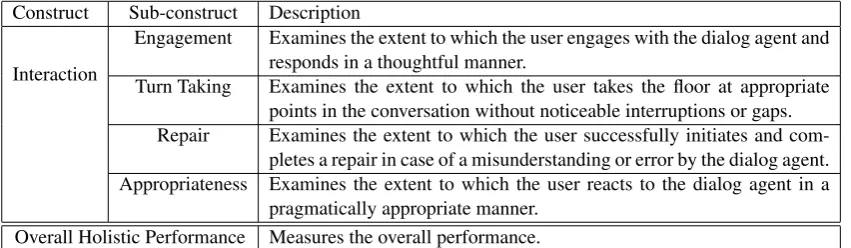
Table 1: Human scoring rubric for interaction aspects of conversational proficiency. Scores are assigned on a Likert scale from 1-4 ranging from low to high proficiency. A score of 0 is assigned when there were issues with audio quality or system malfunction or off-topic or empty responses.
Construct Sub-construct Description
Interaction
Engagement Examines the extent to which the user engages with the dialog agent and responds in a thoughtful manner.
Turn Taking Examines the extent to which the user takes the floor at appropriate points in the conversation without noticeable interruptions or gaps. Repair Examines the extent to which the user successfully initiates and
com-pletes a repair in case of a misunderstanding or error by the dialog agent. Appropriateness Examines the extent to which the user reacts to the dialog agent in a
pragmatically appropriate manner. Overall Holistic Performance Measures the overall performance.
specifically tailored to conversational dialog along multiple dimensions, particularly those focused on interaction, (ii) triple-scoring a selection of dialog data based on this rubric, and finally (iii) examin-ing the performance of two methods for automated scoring of such data – the first a state-of-the-art feature engineering method that passes word and charactern-grams, length and syntax features into multiple state-of-the-art classifiers, and the second a model engineering method that leverages end-to-end memory networks to model dependencies between turn and prompt histories using memory components – and analyzing this performance vis-a-vis human raters. Note that for the purposes of this paper, while our data is spoken dialog, we will focus on text features derived from transcriptions, and therefore will focus on how they can be used to score various aspects of interaction in an inter-pretable manner. A subsequent future analysis will comprehensively examine how these can be com-bined with speech features.
2 Data
2.1 Collection
We crowdsourced, using Amazon Mechanical Turk, the collection of 2288 conversations of non-native speakers interacting with a dialog appli-cation designed to test general English speaking competence in workplace scenarios, and prag-matic skills in particular. The application, dubbed “Request Boss” requires participants to interact with their boss and request a meeting with her to review presentation slides using pragmatically propriate language. To develop and deploy this ap-plication, we leveraged HALEF1, an open-source modular cloud-based dialog system that is com-patible with multiple W3C and open industry
stan-1http://halef.org
dards (Ramanarayanan et al.,2017b). The HALEF dialog system logs speech data collected from par-ticipants to a data warehouse, which are then tran-scribed and scored.
2.2 Human Scoring
In order to understand how well participants per-formed in our conversational task, we had each of the 2288 dialog responses triple scored by hu-man expert raters on a custom-designed rubric. This rubric was iteratively modified and refined to score constructs specific to dialog data2. The final conversational scoring rubric defined 12 sub-constructs under the 3 broad sub-constructs of linguis-tic control, task fulfillment and interaction, apart from an overall holistic score. However, for pur-poses of this first study, we will focus on the rel-atively understudied interaction construct, in par-ticular aspects of engagement, turn-taking, repair and (pragmatic) appropriateness. See Table1for more details. We asked expert raters to score each dialog for each rubric dimension on a scale from 1 to 4, and to assign dialogs that contained no or cor-rupted or significantly off-topic audio responses a score of 0. The expert raters were scoring leaders with significant experience in scoring various spo-ken and written assessments of English language proficiency. We used an automatic randomized de-sign to asde-sign three (out of eight possible) raters to every dialog such that (i) all raters had a com-mensurate number of responses to rate, and (ii) the same group of raters did not rate the same set of files (achieved by randomization; this prevents un-witting biases due to individual raters affecting the overall score analysis).
2
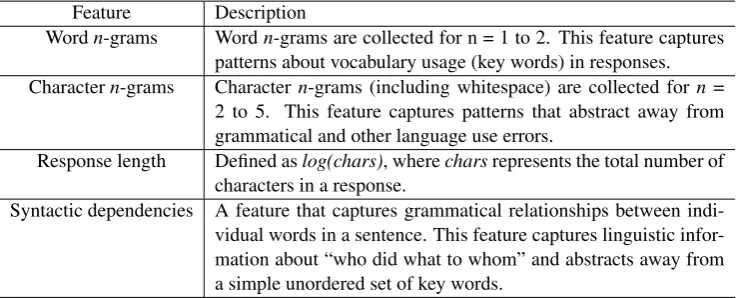
Table 2: c-rater ML features used for machine scoring.
Feature Description
Wordn-grams Wordn-grams are collected for n = 1 to 2. This feature captures patterns about vocabulary usage (key words) in responses. Charactern-grams Charactern-grams (including whitespace) are collected forn=
2 to 5. This feature captures patterns that abstract away from grammatical and other language use errors.
Response length Defined aslog(chars), wherecharsrepresents the total number of characters in a response.
Syntactic dependencies A feature that captures grammatical relationships between indi-vidual words in a sentence. This feature captures linguistic infor-mation about “who did what to whom” and abstracts away from a simple unordered set of key words.
3 Machine Scoring
This section first lays out our setup for inter-pretable machine scoring including details of the feature extraction and machine learning methods. We then analyze human performance (by exam-ining inter-rater statistics) and use this to bench-mark the performance of machine scoring meth-ods. Following standardized convention in auto-mated scoring, we only consider dialogs with a non-zero score to train scoring models (because a separate filtering mode is typically trained to eliminate “unscorable” responses, which include responses with no, garbled or out-of-topic audio data, seeHiggins et al.,2011, for a more detailed motivation and rationale for this approach).
3.1 Feature Engineered Content Scoring
We used a set of features that have been employed in many previously published approaches to build-ing content scorbuild-ing models (see Madnani et al.,
2017,2018, for instance). We refer to this system asc-rater ML; see Table2for more details. All of the features are binary (indicating presence or ab-sence) and try to capture how well responses con-tain (a) the right concepts (approximately captured by words and bigrams), (b) the right syntactic rela-tionships between those concepts (approximately captured by dependency triples), (c) spelling and morphological relations (character n-grams) and (d) length of the response (captured by length fea-tures).
We used SKLL,3an open-source Python pack-age that wraps around the scikit-learn package (Pedregosa et al.,2011) to perform machine learn-ing experiments. We experimented with rescaled linear support vector machine (SVM) and multi-layer perceptron (MLP) regressors. The former
3
https://github.com/EducationalTestingService/skll
allows us to interpret how the algorithm performs, while the latter is used for comparison purposes to understand how deep neural networks might per-form on this task given the data we have. In our case, we found that the SVM classifier beat the MLP across the board, possibly because our fea-ture space is sparse and high-dimensional, con-sisting of binary presence/absence features. We ran 10 fold cross-validation experiments and re-port the best overall results for the SVM system. We used cross entropy (log-loss) as an objective function for optimizing learner performance. We further tuned and optimized the free parameters of each learner using a grid-search method. We com-puted both accuracy and quadratic weighted kappa (which takes into account the ordered nature of the categorical labels) as metrics, reported in Table3.
3.2 End to End Memory Network (MemN2N) architecture
his-Prompt History
LSTM Dense Score
Softmax Weighted sum
Inner Product Inner Product
Embedding B
Current Response Response
History
Embedding Ap
Embedding Cp
Weighted sum
Embedding Ar
Embedding Cr
Softmax
Softmax
Concatenate
RESPONSE
MEMORY PROMPT MEMORY
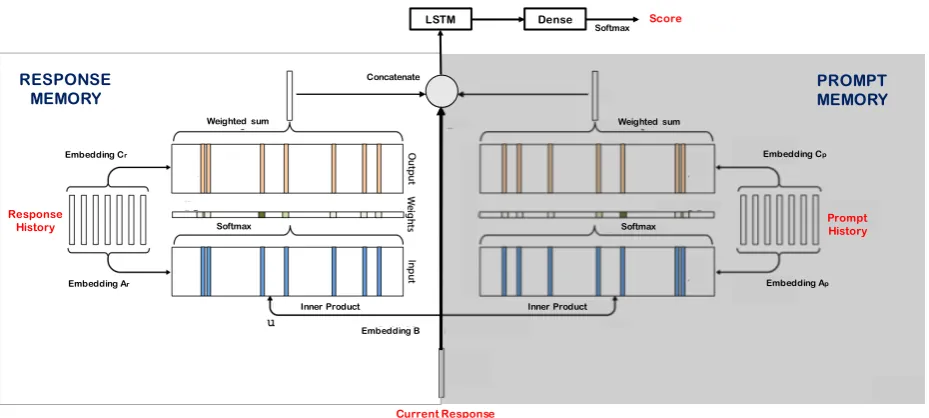
[image:4.595.81.546.64.273.2]Figure 1: Schematic of asingle hopmodule of our modified end-to-end memory network (MemN2N) adapted fromSukhbaatar et al.(2015) for our dialog scoring experiments. Stacking modules on top of each other allows us to model multiple hops.
Table 3: Human and machine score statistics
Construct Sub-construct c-rater ML MemN2N c-rater ML + MemN2N Human Metrics Accuracy QWκ Accuracy QWκ Accuracy QWκ Congerκ Krippendorffα
Interaction
Engagement 0.70 0.70 0.65 0.65 0.71 0.72 0.69 0.72
Turn Taking 0.69 0.67 0.68 0.40 0.71 0.70 0.71 0.74
Repair 0.66 0.60 0.64 0.58 0.67 0.64 0.73 0.72
Appropriateness 0.67 0.67 0.62 0.58 0.67 0.67 0.70 0.72
Overall Holistic Performance 0.69 0.72 0.66 0.65 0.70 0.72 0.75 0.75
tory, prompt history, score) tuple in our case. In other words, we not only embed and learn mem-ory representations between the current response and the history of previous responses, but the his-tory of prior system prompts that have been en-countered thus far; (ii) we used an LSTM instead of a matrix multiplication at the final step of the network before prediction; and (iii) we experi-mented with Google word2vec (Mikolov et al.,
2013) andGloVe(Pennington et al.,2014) initial-izations for word embeddings in addition to ex-perimenting with multiple memory hops. We train the network at the turn level; in other words, for each turn, the training data would consist of an in-put of(response for current turn, response history, prompt history)and an output of thedialog-level score (in other words, each turn is assumed to have the same score as that of the full dialog). During testing, we compute the score for each dialog in the test set as the median of scores predicted by the trained network for each turn in that dialog.
We used a similar crossvalidation setup as de-scribed in§3.1 with the exact same 10 folds with
experiments optimizing a cross-entropy-based ob-jective function as in the earlier case to enable a fair comparison. We tuned hyperparameters of the network using the hyperastoolkit4. This in-cluded the number of neurons in the Dense and
LSTM layers as well as the addition of Dropout
layers after each memory component. We exper-imented with 1, 2 and 3 memory hops and found 2 to be optimal. Interestingly, we also found that initializing the memory embedding matrics with pretrainedGoogle word2vecorGloVeembeddings worked better than randomly-initialized ones for prompt history encoding as compared to response history encoding.
4 Observations and Results
The final two columns of Table3display two inter-rater agreement statistics – Congerκand Krippen-dorffα– for the human expert scores assigned to the data. Recall that each dialog was scored by 3 out of 8 possible raters. We observe a moderate to high agreement between raters for all dimensions
of the scoring rubric, which is not too surprising given that all our raters had significant experience in rating monologic speech data.
Table3also shows the performance of our two different systems in scoring various aspects of in-teraction at the level of the entire dialog. Observe that fusing the MemN2N with the c-rater ML sys-tem leads to a small but significant improvement over either of the systems alone. Additionally, it is interesting to note that the quadratic weighted kappa (QW κ) of the fusion system is in a similar ballpark as the κ andα metrics for human inter-rater agreement, particularly for engagement and turn-taking subscores. While these measures are
not directly comparable, this trend is encouraging nonetheless, suggesting that a combination of n -gram, length, syntactic dependency and memory-based attention over embedding representations of words over the entire dialog are useful in captur-ing at least some aspects of these sub-constructs of interaction. On the other hand, the fusion sys-tem performance for repair and appropriateness subscores is still below par, suggesting that more feature engineering and modeling research is re-quired to model these aspects of interaction. These dimensions of interaction are also harder to pre-dict, given that repair and pragmatic appropriate-ness are more high-level and abstract in nature.
5 Discussion
This paper has examined approaches to both hu-man and machine scoring of text dialogs collected as part of a language learning application, partic-ularly looking at interactional aspects. We ob-served, through careful design of the human scor-ing paradigm, a moderate-to-high agreement be-tween the raters. We further examined two meth-ods for automated scoring of such data – the first a feature engineering method that passes word and charactern-grams, length and syntax features into an SVM based classifier, and the second a model engineering method that leverages end-to-end memory network (MemN2N) to model depen-dencies between turn and prompt histories using memory components – and found that a fusion of both methods performs close to or at par with hu-man inter-rater agreement statistics.
While our results are encouraging, there is still much work ahead in understanding and scoring in-teractional competence. One of the key reasons for this has to do with the fact that the features
were considered were text-based, and it is unclear how some features that don’t directly consider in-formation from audio or visual channels are use-ful in predicting properties related to interaction (engagement, for instance). Repair and appropri-ateness, and even turn taking to a lesser extent are related to proficiency in language use, and hence it makes sense that features such as n-grams and syntax use might be somewhat useful in predict-ing these aspects of interaction. However, some of the results might also be explained by some of our examined features being highly correlated with more interpretable/relevant features. For in-stance, length might be an indication of a more proficient and verbose speaker, which might in turn correlate with a high level of engagement. Nonetheless, an understanding of how meaningful our text-based results are will be incomplete with-out examining features derived from audio (and visual streams, if available), including non-verbal and prosodic cues.
It is also worth mentioning tangentially related work on dialog interaction quality at this point (see for instanceSchmitt and Ultes,2015;Stoyanchev et al., 2019; See et al., 2019). While such work primarily focuses on investigating techniques to measure and improve the quality of the overall di-alog interaction as opposed to providing targeted assessment and feedback on the quality of spo-ken language used during interactions, it might nonetheless be useful to take this body of work into account while developing techniques for au-tomated proficiency scoring.
References
Suma Bhat and Su-Youn Yoon. 2015. Automatic as-sessment of syntactic complexity for spontaneous speech scoring. Speech Communication, 67:42–57.
Steven Burrows, Iryna Gurevych, and Benno Stein. 2015. The eras and trends of automatic short an-swer grading. International Journal of Artificial In-telligence in Education, 25(1):60–117.
Yun-Nung Chen, Dilek Hakkani-T¨ur, G¨okhan T¨ur, Jianfeng Gao, and Li Deng. 2016. End-to-end mem-ory networks with knowledge carryover for multi-turn spoken language understanding. InInterspeech, pages 3245–3249.
S Pekarek Doehler and Evelyne Pochon-Berger. 2015. The development of l2 interactional competence: evidence from turn-taking organization, sequence organization, repair organization and preference or-ganization. Usage-based perspectives on second language learning, 30:233.
Keelan Evanini, Sandeep Singh, Anastassia Loukina, Xinhao Wang, and Chong Min Lee. 2015. Content-based automated assessment of non-native spoken language proficiency in a simulated conversation. In
Proceedings of the Machine Learning for SLU & In-teraction NIPS 2015 Workshop.
Derrick Higgins, Xiaoming Xi, Klaus Zechner, and David Williamson. 2011. A three-stage approach to the automated scoring of spontaneous spoken re-sponses. Computer Speech & Language, 25(2):282– 306.
Diane Litman, Steve Young, Mark Gales, Kate Knill, Karen Ottewell, Rogier van Dalen, and David Vandyke. 2016. Towards using conversations with spoken dialogue systems in the automated assess-ment of non-native speakers of english. In17th An-nual Meeting of the Special Interest Group on Dis-course and Dialogue, page 270.
Nitin Madnani, Aoife Cahill, Daniel Blanchard, Slava Andreyev, Diane Napolitano, Binod Gyawali, Michael Heilman, Chong Min Lee, Chee Wee Leong, Matthew Mulholland, et al. 2018. A ro-bust microservice architecture for scaling automated scoring applications. ETS Research Report Series, 2018(1):1–8.
Nitin Madnani, Anastassia Loukina, and Aoife Cahill. 2017. A large scale quantitative exploration of mod-eling strategies for content scoring. InProceedings of the 12th Workshop on Innovative Use of NLP for Building Educational Applications, pages 457–467.
Tomas Mikolov, Ilya Sutskever, Kai Chen, Greg S Cor-rado, and Jeff Dean. 2013. Distributed representa-tions of words and phrases and their compositional-ity. InAdvances in neural information processing systems, pages 3111–3119.
Leonardo Neumeyer, Horacio Franco, Vassilios Di-galakis, and Mitchel Weintraub. 2000. Automatic scoring of pronunciation quality. Speech communi-cation, 30(2):83–93.
Maria Elena Oliveri and Richard J Tannenbaum. 2019. Are we teaching and assessing the english skills needed to succeed in the global workplace? The Wi-ley Handbook of Global Workplace Learning, pages 343–354.
F. Pedregosa, G. Varoquaux, A. Gramfort, V. Michel, B. Thirion, O. Grisel, M. Blondel, P. Pretten-hofer, R. Weiss, V. Dubourg, J. Vanderplas, A. Pas-sos, D. Cournapeau, M. Brucher, M. Perrot, and E. Duchesnay. 2011. Scikit-learn: Machine learning in Python. Journal of Machine Learning Research, 12:2825–2830.
Jeffrey Pennington, Richard Socher, and Christopher Manning. 2014. Glove: Global vectors for word representation. InProceedings of the 2014 confer-ence on empirical methods in natural language pro-cessing (EMNLP), pages 1532–1543.
Vikram Ramanarayanan, Patrick L Lange, Kee-lan Evanini, Hillary R Molloy, and David Suendermann-Oeft. 2017a. Human and auto-mated scoring of fluency, pronunciation and intonation during human-machine spoken dialog interactions. InINTERSPEECH, pages 1711–1715.
Vikram Ramanarayanan, David Suendermann-Oeft, Patrick Lange, Robert Mundkowsky, Alexei V Ivanov, Zhou Yu, Yao Qian, and Keelan Evanini. 2017b. Assembling the Jigsaw: How Multiple Open Standards Are Synergistically Combined in the HALEF Multimodal Dialog System. In Multi-modal Interaction with W3C Standards, pages 295– 310. Springer.
Alexander Schmitt and Stefan Ultes. 2015. Interaction quality: assessing the quality of ongoing spoken di-alog interaction by expertsand how it relates to user satisfaction.Speech Communication, 74:12–36.
Abigail See, Stephen Roller, Douwe Kiela, and Jason Weston. 2019. What makes a good conversation? how controllable attributes affect human judgments.
arXiv preprint arXiv:1902.08654.
Mark D Shermis and Jill Burstein. 2013. Handbook of automated essay evaluation: Current applications and new directions. Routledge.
Svetlana Stoyanchev, Soumi Maiti, and Srinivas Ban-galore. 2019. Predicting interaction quality in cus-tomer service dialogs. InAdvanced Social Interac-tion with Agents, pages 149–159. Springer.
Sainbayar Sukhbaatar, Jason Weston, Rob Fergus, et al. 2015. End-to-end memory networks. InAdvances in neural information processing systems, pages 2440–2448.
Teresa G Weldy and Marjorie L Icenogle. 1997. A managerial perspective: Oral communi cation com-petency is most important for business students in the workplace jeanne d. maes. The Journal of Busi-ness Communication, 34(1):67–80.
Silke M Witt and Steve J Young. 2000. Phone-level pronunciation scoring and assessment for interac-tive language learning. Speech communication, 30(2):95–108.
Xiaoming Xi, Derrick Higgins, Klaus Zechner, and
David Williamson. 2012. A comparison of two scor-ing methods for an automated speech scorscor-ing sys-tem. Language Testing, 29(3):371–394.
Richard F Young. 2011. Interactional competence in language learning, teaching, and testing. Handbook of research in second language teaching and learn-ing, 2(426-443).