Proceedings of the First Workshop on Abusive Language Online, pages 41–45, Vancouver, Canada, July 30 - August 4, 2017. c2017 Association for Computational Linguistics
One-step and Two-step Classification for Abusive Language Detection
on Twitter
Ji Ho Park and Pascale Fung
Human Language Technology Center
Department of Electronic and Computer Engineering
Hong Kong University of Science and Technology
[email protected], [email protected]
Abstract
Automatic abusive language detection is a difficult but important task for online so-cial media. Our research explores a two-step approach of performing classification on abusive language and then classifying into specific types and compares it with one-step approach of doing one multi-class classification for detecting sexist and racist languages. With a public English Twitter corpus of 20 thousand tweets in the type of sexism and racism, our approach shows a promising performance of 0.827 F-measure by using HybridCNN in one-step and 0.824 F-measure by using logistic re-gression in two-steps.
1
Introduction
Fighting abusive language online is becoming more and more important in a world where online social media plays a significant role in shaping people’s minds (Perse and Lambe, 2016). Never-theless, major social media companies like Twit-ter find it difficult to tackle this problem (Meyer, 2016), as the huge number of posts cannot be mediated with only human resources.
Warner and Hirschberg (2012) and Burnap and Williams (2015) are one of the early researches to use machine learning based classifiers for detect-ing abusive language. Djuric et al., (2015) incor-porated representation word embeddings (Mikolov et al., 2013). Nobata et al. (2016) com-bined pre-defined language elements and word embedding to train a regression model. Waseem (2016) used logistic regression with n-grams and user-specific features such as gender and loca-tion. Davidson et al. (2017) conducted a deeper investigation on different types of abusive lan-guage. Badjatiya et al. (2017) experimented with
deep learning-based models using ensemble gra-dient boost classifiers to perform multi-class clas-sification on sexist and racist language. All ap-proaches have been on one step.
Many have addressed the difficulty of the defi-nition of abusive language while annotating the data, because they are often subjective to individ-uals (Ross et al. 2016) and lack of context (Waseem and Hovy, 2016; Schmidt & Wiegand, 2017). This makes it harder for non-experts to an-notate without having a certain amount of domain knowledge (Waseem, 2016).
In this research, we aim to experiment a two-step approach of detecting abusive language first and then classifying into specific types and com-pare with a one-step approach of doing one multi-class multi-classification on sexist and racist language. Moreover, we explore applying a convolution-al neurconvolution-al network (CNN) to tackle the task of abusive language detection. We use three kinds of CNN models that use both character-level and word-level inputs to perform classification on dif-ferent dataset segmentations. We measure the per-formance and ability of each model to capture characteristics of abusive language.
2
Methodology
We propose to implement three CNN-based mod-els to classify sexist and racist abusive language: CharCNN, WordCNN, and HybridCNN. The ma-jor difference among these models is whether the input features are characters, words, or both.
The key components are the convolutional lay-ers that each computes a one-dimensional convo-lution over the previous input with multiple filter sizes and large feature map sizes. Having different filter sizes is the same as looking at a sentence with different windows simultaneously. Max-pooling is performed after the convolution to
capture the feature that is most significant to the output.
2.1 CharCNN
CharCNN is a modification of the character-level convolutional network in (Zhang et al. 2015). Each character in the input sentence is first trans-formed into a one-hot encoding of 70 characters, including 26 English letters, 10 digits, 33 other characters, and a newline character (punctuations and special characters). All other non-standard characters are removed.
Zhang et al. (2015) uses 7 layers of convolu-tions and max-pooling layers, 2 fully-connected layers, and 1 softmax layer, but we also designed a shallow version with 2 convolutions and max-pooling layers, 1 fully-connected layers, and 1 softmax layers with dropout, due to the relatively small size of our dataset to prevent overfitting.
2.2 WordCNN
WordCNN is a CNN-static version proposed by Kim (2014). The input sentence is first segmented into words and converted into a 300-dimensional embedding word2vec trained on 100 billion words from Google News (Mikolov et al., 2013). Incorporating pre-trained vectors is a widely-used method to improve performance, especially when using a relatively small dataset. We set the em-bedding to be non-trainable since our dataset is small.
We propose to segment some out-of-vocabulary phrases as well. Since the Twitter tweets often contain hashtags such as
#wom-enagainstfeminism and #feminismisawful we use
a wordsegment library (Segaran and Hammer-bacher, 2009) to capture more words.
2.3 HybridCNN
We design HybridCNN, a variation of WordCNN, since WordCNN has the limitation of only taking word features as input. Abusive language often contains either purposely or mistakenly mis-spelled words and made-up vocabularies such as #feminazi.
Therefore, since CharCNN and WordCNN do not use character and word inputs at the same time, we design the HybridCNN to experiment whether the model can capture features from both levels of inputs.
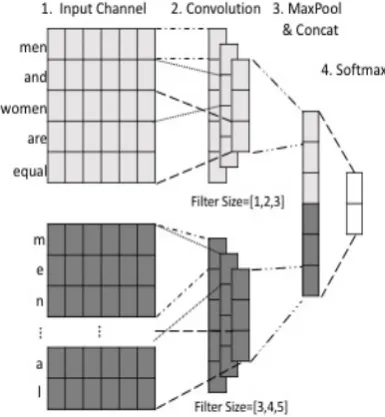
HybridCNN has two input channels. Each channel is fed into convolutional layers with three filter windows of different size. The output of the convolution are concatenated into one vector after 1-max-pooling. The vector is then fed into the fi-nal softmax layer to perform classification (See Figure 1).
3
Experiments
3.1 Datasets
We used the two English Twitter Datasets (Waseem and Hovy, 2016; Waseem, 2016) pub-lished as unshared tasks for the 1st Workshop on Abusive Language Online(ALW1). It contains tweets with sexist and racist comments. Waseem and Hovy (2016) created a list of criteria based on a critical race theory and let an expert annotate the corpus. First, we concatenated the two tasets into one and then divided that into three da-tasets for one-step and two-step classification (Table 1). One-step dataset is a segmentation for multi-class classification. For two-step classifica-tion, we merged the sexism and racism labels into one abusive label. Finally, we created another da-taset with abusive languages to experiment a se-cond classifier to distinguish “sexism” and “rac-ism”, given that the instance is classified as “abu-sive”.
3.2 Training and Evaluation
We performed two classification experiments: 1. Detecting “none”, “sexist”, and “racist”
[image:2.595.319.512.75.284.2]language (one-step)
Figure 1 Architecture of HybridCNN
2. Detecting “abusive language”, then further classifying into “sexist” or “racist” (two-step)
The purpose of these experiments was to see whether dividing the problem space into two steps makes the detection more effective.
We trained the models using mini-batch sto-chastic gradient descent with AdamOptimizer (Kingma and Ba, 2014). For more efficient train-ing in an unbalanced dataset, the mini-batch with a size of 32 had been sampled with equal distri-bution for all labels. The training continued until the evaluation set loss did not decrease any long-er. All the results are average results of 10-fold cross validation.
As evaluation metric, we used F1 scores with precision and recall score and weighted averaged the scores to consider the imbalance of the labels. For this reason, total average F1 might not be-tween average precision and recall.
As baseline, we used the character n-gram lo-gistic regression classifier (indicated as LR on Table 2-4) from Waseem and Hovy (2016), Sup-port Vector Machines (SVM) classifier, and FastText (Joulin et al., 2016) that uses average bag-of-words representations to classify sentenc-es. It was the second best single model on the same dataset after CNN (Badjatiya et al., 2017).
3.3 Hyperparameters
For hyperparameter tuning, we evaluated on the validation set. These are the hyperparmeters used for evaluation.
• CharCNN: Shallow model with 1024 fea-ture units for convolution layers with filter size 4, max-pooling size 3, and L2 regular-ization constant 1 and 2048 units for the fully-connected layer
• WordCNN: Convolution layers with 3 fil-ters with the size of [1,2,3] and feature map size 50, max-pooling, and L2 regular-ization constant 1
• HybridCNN: For the character input channel, convolution layers with 3 filters with size of [3,4,5] and for word input
channel, 3 filters with size of [1,2,3]. Both channels had feature map size of 50, max-pooling, and L2 regularization constant 1.
4
Result and Discussions
4.1 One-step Classification
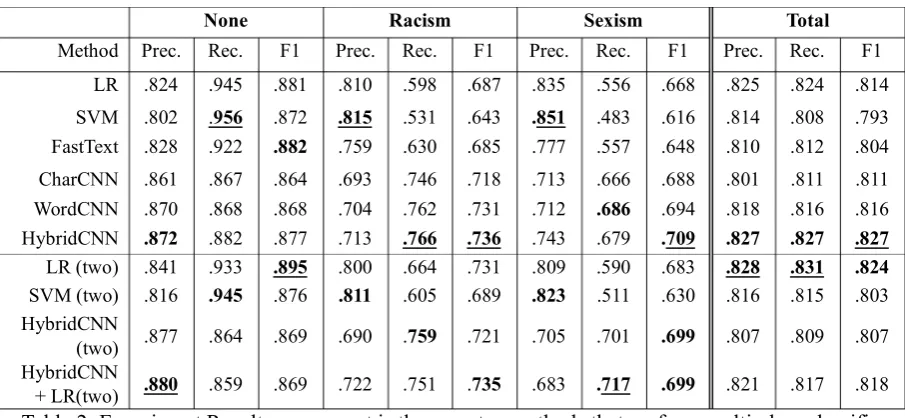
The results of the one-step multi-class classifi-cation are shown in the top part of Table 2.
Our newly proposed HybridCNN performs the best, giving an improvement over the result from WordCNN. We expected the additional character input channel improves the performance. We as-sumed that the reason CharCNN performing worse than WordCNN is that the dataset is too small for the character-based model to capture word-level features by itself.
Baseline methods tend to have high averaged F1 but low scores on racism and sexism labels due to low recall scores.
4.2 Two-step Classification
The two-step approach that combines two bi-nary classifiers shows comparable results with one-step approach. The results of combining the two are shown in the bottom part of Table 3.
Combining two logistic regression classifiers in the two-step approach performs about as well as one-step HybridCNN and outperform one-step logistic regression classifier by more than 10 F1 points. This is surprising since logistic regression takes less features than the HybridCNN.
Furthermore, using HybridCNN on the first step to detect abusive language and logistic re-gression on the second step to classify racism and sexism worked better than just using Hy-bridCNN.
Table 4 shows the results of abusive language classification. HybridCNN also performs best for abusive language detection, followed by WordCNN and logistic regression.
Table 5 shows the results of classifying into sexism and racism given that it is abusive. The second classifier has significant performance in predicting a specific type (in this case, sexism
Dataset One-step Two-step-1 Two-step-2
[image:3.595.142.465.75.121.2]Label None Racism Sexism None Abusive Sexism Racism # 12,427 2,059 3,864 12,427 5,923 2,059 3,864
Table 1: Dataset Segmentation
and racism) of an abusive language. We can de-duce that sexist and racist comments have obvi-ous discriminating features that are easy for all classifiers to capture.
Since the precision and recall scores of the “abusive” label is higher than those of “racism” and “sexism” in the one-step approach, the two-step approach can perform as well as the one-two-step approach.
5
Conclusion and Future work
We explored a two-step approach of combin-ing two classifiers - one to classify abusive lan-guage and another to classify a specific type of sexist and racist comments given that the lan-guage is abusive. With many different machine learning classifiers including our proposed Hy-bridCNN, which takes both character and word features as input, we showed the potential in the two-step approach compared to the one-step ap-proach which is simply a multi-class classifica-tion. In this way, we can boost the performance of simpler models like logistic regression, which is faster and easier to train, and combine different types of classifiers like convolutional neural net-work and logistic regression together depending on each of its performance on different datasets.
We believe that two-step approach has poten-tial in that large abusive language datasets with specific label such as profanity, sexist, racist, ho-mophobic, etc. is more difficult to acquire than those simply flagged as abusive.
For this reason, in the future we would like to explore training the two-step classifiers on sepa-rate datasets (for example, a large dataset with abusive language for the first-step classifier and smaller specific-labelled dataset for the second-step classifier) to build a more robust and detailed abusive language detector.
None Racism Sexism Total
Method Prec. Rec. F1 Prec. Rec. F1 Prec. Rec. F1 Prec. Rec. F1 LR .824 .945 .881 .810 .598 .687 .835 .556 .668 .825 .824 .814 SVM .802 .956 .872 .815 .531 .643 .851 .483 .616 .814 .808 .793 FastText .828 .922 .882 .759 .630 .685 .777 .557 .648 .810 .812 .804 CharCNN .861 .867 .864 .693 .746 .718 .713 .666 .688 .801 .811 .811 WordCNN .870 .868 .868 .704 .762 .731 .712 .686 .694 .818 .816 .816 HybridCNN .872 .882 .877 .713 .766 .736 .743 .679 .709 .827 .827 .827
LR (two) .841 .933 .895 .800 .664 .731 .809 .590 .683 .828 .831 .824
SVM (two) .816 .945 .876 .811 .605 .689 .823 .511 .630 .816 .815 .803 HybridCNN
(two) .877 .864 .869 .690 .759 .721 .705 .701 .699 .807 .809 .807 HybridCNN
[image:4.595.71.524.74.283.2]+ LR(two) .880 .859 .869 .722 .751 .735 .683 .717 .699 .821 .817 .818 Table 2. Experiment Results: upper part is the one-step methods that perform multi-class classifi-cation and lower methods with (two) indicate two-step that combines two binary classifiers. Hy-bridCNN is our newly created model.
Model Prec. Rec. F1
LR .816 .640 .711
SVM .839 .560 .668
FastText .765 .616 .683
CharCNN .743 .674 .707
WordCNN .731 .722 .726
[image:4.595.75.297.460.579.2]HybridCNN .719 .754 .734
Table 3. Results on Abusive Language Detec-tion
Model Prec. Rec. F1
LR .954 .953 .952
SVM .954 .953 .952
FastText .937 .937 .937
CharCNN .941 .941 .941
WordCNN .952 .952 .952
HybridCNN .951 .950 .950
Table 4. Results on Sexist/Racist Classification
[image:4.595.75.299.610.734.2]Acknowledgements
This work is partially funded by CERG16214415 of the Hong Kong Research Grants Council and ITS170 of the Innovation and Technology Commission.
References
Badjatiya, P., Gupta, S., Gupta, M., & Varma, V. (2017). Deep learning for hate speech detection in tweets. Proceedings of the 26th International Conference on World Wide Web Companion, 759-760.
Djuric, N., Zhou, J., Morris, R., Grbovic, M., Rados-avljevic, V., & Bhamidipati, N. (2015). Hate speech detection with comment embeddings. Proceedings of the 24th International Confer-ence on World Wide Web, 29-30.
Joulin, A., Grave, E., Bojanowski, P., & Mikolov, T. (2016). Bag of tricks for efficient text classifi-cation. Proceedings of the 15th Conference of the European Chapter of the Association for Computational Linguistics: Volume 2, Short Papers,
Kim, Y. (2014). Convolutional neural networks for sentence classification . In Proceedings of EMNLP.,
Kingma, D., & Ba, J. (2014). Adam: A method for stochastic optimization. Proceedings of the 3rd In-ternational Conference on Learning Representations (ICLR)
LeCun, Y., Kavukcuoglu, K., & Farabet, C. (2010). Convolutional networks and applications in vi-sion. Circuits and Systems (ISCAS), Proceed-ings of 2010 IEEE International Symposium on, 253-256.
Meyer, R. (2016, 07/21). Twitter's famous racist problem. The Atlantic,
Mikolov, T., Sutskever, I., Chen, K., Corrado, G. S., & Dean, J. (2013). Distributed representations of words and phrases and their compositionali-ty. Advances in Neural Information Processing Systems, 3111-3119.
Nobata, C., Tetreault, J., Thomas, A., Mehdad, Y., & Chang, Y. (2016). Abusive language detection in online user content. Proceedings of the 25th International Conference on World Wide Web, 145-153.
Perse, E. M., & Lambe, J. (2016). Media effects and society Routledge.
Ross, B., Rist, M., Carbonell, G., Cabrera, B., Ku-rowsky, N., & Wojatzki, M. (2017). Measuring the reliability of hate speech annotations: The case of the european refugee crisis In Proceed-ings of the Workshop on Natural Language Processing for ComputerMediated Communica-tion (NLP4CMC), pages 6–9
Schmidt, A., & Wiegand, M. (2017). A survey on hate speech detection using natural language processing. Socialnlp 2017, , 1.
Segaran, T., & Hammerbacher, J. (2009). Beautiful data: The stories behind elegant data solutions " O'Reilly Media, Inc.".
Wang, W., Chen, L., Thirunarayan, K., & Sheth, A. P. (2012). Harnessing twitter" big data" for au-tomatic emotion identification. Privacy, Securi-ty, Risk and Trust (PASSAT), 2012 Internation-al Conference on and 2012 InternationInternation-al Con-fernece on Social Computing (SocialCom), 587-592.
Warner, W., & Hirschberg, J. (2012). Detecting hate speech on the world wide web. Proceedings of the Second Workshop on Language in Social Media, 19-26.
Waseem, Z. (2016). Are you a racist or am I seeing things? annotator influence on hate speech de-tection on twitter. Proceedings of the 1st Work-shop on Natural Language Processing and Computational Social Science, 138-142.
Waseem, Z., & Hovy, D. (2016). Hateful symbols or hateful people? predictive features for hate speech detection on twitter. Proceedings of NAACL-HLT, 88-93.
Zhang, X., Zhao, J., & LeCun, Y. (2015). Character-level convolutional networks for text classifica-tion. Advances in Neural Information Pro-cessing Systems, 649-657.