Prediction of Frame-to-Frame Relations in the FrameNet Hierarchy with
Frame Embeddings
Teresa Botschen§†, Hatem Mousselly-Sergieh†, Iryna Gurevych§† §Research Training Group AIPHES
†Ubiquitous Knowledge Processing (UKP) Lab
Department of Computer Science, Technische Universit¨at Darmstadt
www.aiphes.tu-darmstadt.de, www.ukp.tu-darmstadt.de
Abstract
Automatic completion of frame-to-frame (F2F) relations in the FrameNet (FN) hierarchy has received little attention, al-though they incorporate meta-level com-monsense knowledge and are used in downstream approaches. We address the problem of sparsely annotated F2F rela-tions. First, we examine whether the man-ually defined F2F relations emerge from text by learning text-based frame embed-dings. Our analysis reveals insights about the difficulty of reconstructing F2F rela-tions purely from text. Second, we present different systems for predicting F2F rela-tions; our best-performing one uses the FN hierarchy to train on and to ground em-beddings in. A comparison of systems and embeddings exposes the crucial influence of knowledge-based embeddings to a sys-tem’s performance in predicting F2F rela-tions.
1 Introduction
FrameNet (FN) (Baker et al., 1998) is a lexical-semantic resource manually built by FN experts. It embodies the theory of frame semantics ( Fill-more, 1976): the frames capture units of mean-ing correspondmean-ing to prototypical situations. Be-sides FN’s definitions of frame-specific roles and frame-evoking elements that are used for the task of Semantic Role Labeling, it also contains man-ual annotations for relations that connect pairs of frames. There are thirteenframe-to-frame (F2F) relationsof which five are antonym relations (e.g.
Precedes, Is Preceded by). To give an example, the frame “Waking up” is in relation
Precedes to the frame “Being awake”. Fig-ure 1 further elaborates this example by
demon-strating relationships to additional frames. Table
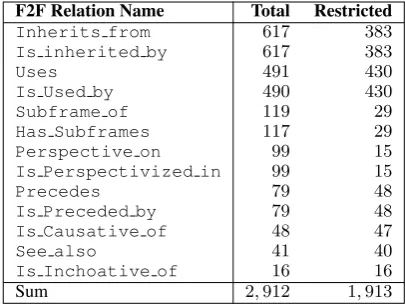
1 lists all F2F relation names with the number of frame pairs for each relation according to the FN hierarchy, and also restricted counts including only frame pairs that have lexical units (LU) in the FN hierarchy (e.g., the frame “Waking up” can be evoked by the LU “awake.v” of the verb “awake”). The FN hierarchy, a report version of FN, does not provide lexical units for125frames (e.g., the frame “Sleep wake cycle” has no LU). In fact, such frames are used as meta-frames for abstrac-tion purposes, thus, they exist only to participate in F2F relations with other frames (Ruppenhofer et al., 2006). In general, each frame pair is con-nected via only one F2F relation with occasional exceptions and the F2F relations situate the frames in semantic space (Ruppenhofer et al.,2006). F2F relations are used in the context of other tasks, such as text understanding (Fillmore and Baker,
2001), paraphrase rule generation for the system LexPar (Coyne and Rambow,2009) and recogni-tion of textual entailment (Aharon et al., 2010). Furthermore, F2F can be used as a form of com-monsense knowledge (Rastogi and Van Durme,
2014).
The incompleteness of the FN hierarchy is a known issue not only at the frame level ( Ras-togi and Van Durme, 2014; Pavlick et al., 2015;
Hartmann and Gurevych, 2013) but also at the
Figure 1: F2F relations example. Gray: FN hier-archy. White arrows: missing in FN hierhier-archy.
F2F Relation Name Total Restricted
Inherits from 617 383
Is inherited by 617 383
Uses 491 430
Is Used by 490 430
Subframe of 119 29
Has Subframes 117 29
Perspective on 99 15
Is Perspectivized in 99 15
Precedes 79 48
Is Preceded by 79 48
Is Causative of 48 47
See also 41 40
Is Inchoative of 16 16
Sum 2,912 1,913
Table 1: F2F relation pair counts and restricted pair counts of frames with lexical units.
F2F relation level. Figure 1 exemplifies a miss-ingprecedence relation: “Fall asleep” is pre-ceded by “Being awake” but inbetween yet
an-other frame could be added, e.g.
“Biologi-cal urge” (evoked by the predicate “tired”). Ras-togi (2014) note a lack of research on automat-ically enriching the F2F relations, which would be beneficial given the large number of possible frame pairs for a relation and their use in other tasks. The automatic annotation of F2F relations involves three difficulties accounted for by the na-ture of FN. First, F2F relation annotations occur sparsely and for the majority of pairs in each re-lation there are few instances (see Table1). Sec-ond, the relations themselves have no direct lexical correspondences in text and hence inferring them from text is not trivial. Third, if a relation involves a frame that does not have any lexical unit (see restricted counts in Table1), this frame does not occur in text and hence inferring this relation from text is even more difficult.
To the best of our knowledge there is no work (a) addressing the emergence of F2F relations from text data or (b) enriching F2F relations auto-matically. We aim to address these problems with the following contributions:
Contributions of the paper
1) We learn text-based frame embeddings and ex-plore their limitations with respect to F2F relations to check whether the manually annotated F2F re-lations can naturally emerge from text. We find that, concerning the methods we explored, the em-beddings have difficulties in showing structures di-rectly corresponding to F2F relations.
2) We transfer the relation prediction task from research on Knowledge Graph Completion to the
case of FN and present our best-performing sys-tem for predicting F2F relations. The syssys-tem in-volves training on the FN hierarchy and uses em-beddings also trained on the FN hierarchy. 3) We generically demonstrate the predictions of our best-performing system for unannotated frame pairs and suggest its application for automatic FN completion on the relation level.
Structure of the paper To start with, Section
2 reviews related research including algorithms and approaches that we will apply to our pur-poses. Next, Section 3 briefly presents the FN data that we will work with. Then, the paper is structured along our contributions: exploration of F2F relations in frame embedding space (Sec 4) and F2F Relation Prediction task (Sec5), includ-ing a demonstration of predictions for unannotated frame pairs (Sec5.3). Finally, Section6discusses our insights and traces options for future work.
2 Related Work
2.1 Frame Embeddings
Frame embeddings for frame identificationTo our knowledge, the only approach learning frame embeddings is a matrix factorization approach in the context of the task of Frame Identification (FrameId), which is the first step in FN Semantic Role Labeling. The state-of-the-art system ( Her-mann et al.,2014) for FrameId projects frames and predicates with their context words into the same latent space by using theWSABIEalgorithm ( We-ston et al.,2011). Two projection matrices (one for frames and one for predicates) are learned using WARP loss and gradient-based updates such that the distance between the predicate’s latent repre-sentation and that of the correct frame are min-imized. Consequently, latent representations of frames will end up close to each other if they are evoked by similar predicates and context words. As the focus of such systems is on the FrameId task, the latent representations of the frames are rather a sub-step contributing to FrameId but not studied further or applied to other tasks. We will extract these frame embeddings and explore them with respect to F2F relations.
Word2Vec embeddings The Neural Network
(NN) architecture of the Word2Vec algorithm
[image:2.595.79.282.62.214.2]There are different tasks specifically designed for the evaluation of word embeddings (Mikolov et al., 2013b). They are formulated as analogy questions about syntax or semantics of the form
“a is to b as c is to ”. Mikolov (2013b) sug-gest avector offset method based on cosine dis-tance to solve these analogy tasks. This assumes that relationships are expressed by vector offsets: given two word pairs (a, b) and(c, d), the ques-tion is to what extent the relaques-tions within the pairs are similar. We will apply this method to frame pairs that are connected via F2F relations in order to find out whether the frame embeddings incor-porate F2F relations.
There is an interest in abstracting away from word embeddings towards embeddings for more coarse grained units: Word2Vec is used to learn embeddings for senses (Iacobacci et al.,2015) or for supersenses (Flekova and Gurevych, 2016). Iacobacci (2015) use the CBOW model on texts annotated with BabelNet senses (Navigli and Ponzetto, 2012). Flekova (2016) use the skip-gram modelon texts with mapped WordNet super-senses (Miller,1990;Fellbaum,1990). For evalu-ation both works are oriented towards Mikolov’s (2013b) analogy tasks and perform qualitative analyses for the top k most similar embeddings for (super)senses or visualize the embeddings in vector space. To have text-based frame embed-dings in line with related work, we will also use theWord2Vecalgorithm to learn an additional ver-sion for frame embeddings.
2.2 Relation Prediction
This task stems from automatic Knowledge Graph Completion (KGC) and is known as “Link Predic-tion” (Bordes et al., 2011, 2012,2013). We will transfer this task to F2F Relation Prediction for frame pairs. For this task, knowledge-based em-beddings are well suited, which are not learned on text but on triples of a KG.
TransE embeddingsWe leverage an embedding learning approach from KGC to obtain embed-dings for frames and for F2F relations that are grounded in the FN hierarchy. In translation mod-els, all entities and relations of the triples of head-entity, relation and tail-entity(h, r, t)are projected into one latent vector space such that the relation-vector connects from the head-relation-vector to the tail-vector as a translating tail-vector operation. TransE
(Bordes et al.,2013) introduced the idea of
mod-eling relations as translations that operate on the embeddings of the entities. The model is formu-lated to minimize| h+r −t |for a training set, with randomly initialized embeddings. The func-tion to minimize resembles the idea of the vector offset by Mikolov (2013b).
Answer selection model Link Prediction is methodologically related to the key-task of An-swer Selection from Question AnAn-swering (QA). The task is to rank a set of possible answer can-didates with respect to a given question (Tan et al.,
2015). State-of-the-art QA models are presented by (Feng et al., 2015) and by (Tan et al., 2015). They jointly learn vector representations for both the questions and the answers. Representations of the same dimensionality in the same space allow one to compute the cosine similarity between these vectors. We will orient ourselves by NN models for Answer Selection in order to adapt the ideas to F2F Relation Prediction. In our case, a question corresponds to a frame pair and an answer corre-sponds to a F2F relation. Optionally, pretrained frame embeddings can be used as initialization.
3 Data
Textual data In order to learn frame embed-dings on textual data with WSABIE orW2V, we take the FrameNet 1.5 sentences provided by the Dependency-Parsed FrameNet Corpus (Bauer et al., 2012) which contains more than 170,000
sentences annotated manually with frame labels for 700 frames. We denote a frame as f where f ∈Ftthe set of frames in the textual data.
Hierarchy data The FN hierarchy lists for each frame of the overall 1,019 frames the F2F rela-tions to other frames. We denote withGthe col-lection of triples (f1, r, f2) (standing for frame
“f1 is in relation r to frame f2”), where f1 and
f2 ∈Fhthe set of frames in the FN hierarchy and
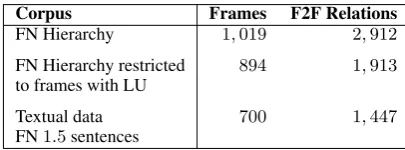
r ∈ R the set of F2F relations. As listed in Ta-ble2, there are 2,912triples in the FN hierarchy with 1,913 triples remaining if considering only those where both frames have lexical units and
Corpus Frames F2F Relations
FN Hierarchy 1,019 2,912
FN Hierarchy restricted 894 1,913
to frames with LU
Textual data 700 1,447
[image:3.595.313.516.670.745.2]FN1.5sentences
with 1,447 triples remaining if considering only those where both frames occur in the textual data. We split the obtained triples whose frames have lexical units into a training and a test set such that the training set contains the first 70% of all the triples for each relation.
Table 2 summarizes frame counts per data
source together with counts of F2F relations where both frames occur in the underlying source.
4 Exploration of Frame Embeddings
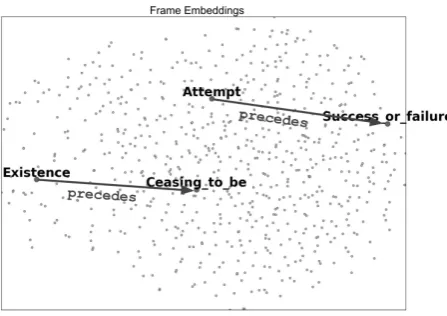
[image:4.595.72.296.568.726.2]We aim at empirically analyzing whether F2F rela-tions from the FN hierarchy are mirrored in frame embeddings learned on frame-labeled text in the context of other tasks. Thus, we want to identify whether a statistical analysis of text-based frame embeddings naturally yields the FN hierarchy. In-deed, the F2F relations are manually annotated by expert linguists but there is no guarantee that F2F relations can be observed in text. If these relations could emerge from raw text it would be reassur-ing for the definitions of the F2F relations that led to annotations of frame pairs and furthermore the annotations could be generated automatically. We hypothesize that distances and directions between frame embeddings learned on textual data can cor-respond to F2F relations. Figure 2 exemplifies this as known from word embeddings by Mikolov (Mikolov et al., 2013a): it highlights two frame pairs that are in the same relation: “Attempt” is in relation precedeswith “Success or failure” and so is “Existence” in relationprecedeswith “Ceasing to be” and the connecting vectors are about the same direction and length.
Figure 2: Intuition for frame embeddings incorpo-rating F2F relations in vector space.
4.1 Methods
WSABIEframe embeddingsConcerning the ma-trix factorization approach for learning text-based frame embeddings, we use the code provided by (Hartmann et al., 2017) as it is publically avail-able. It is leaned on Hermann’s (2014) descrip-tion of their state-of-the-art system and achieves comparable results on FrameId. Our hyperpa-rameter choices are oriented towards (Hartmann et al., 2017): embedding dimension 100, maxi-mum number of negative samples: 100, epochs:
1000 and initial representation of predicate and context: concatenation of pretrained
dependency-based word embeddings (Levy and Goldberg,
2014).
Word2Vec frame embeddings Concerning the NN approach for learning text-based frame em-beddings, we use the Word2Vec implementation in the python library gensim (ˇReh˚uˇrek and Sojka,
2010). To obtain frame embeddings we follow the same steps as if we would learn word embeddings on FN sentences plus we replace all predicates with their frames. For instance, in the sequence
“Officials claim that Iran has produced bombs”
the predicates“claim”and“bombs”are replaced by“STATEMENT”and“WEAPON”respectively. This procedure corresponds to Flekova’s (2016) setup for learning supersense embeddings and our hyperparameter choices are oriented towards their best performing ones: training algorithm: skip-gram model, embedding dimension:300, minimal word frequency: 10, negative sampling of noise words: 5, window size 2, initial learning rate:
0.025and iterations: 10.
Prototypical relation embeddings We denote learned embeddings with −→e1 (for frame f1). We
use the frame embeddings to infer prototypical F2F relation embeddings −→er with the vector
off-set method in the following way: we denote with Irthe relation-specific subset ofGwith all the
in-stances(f1, r, f2)for this relation (see frame pair
counts in Table1). The vector offset−−−→oe1,e2 for two
frames (f1, f2) is the difference of their
embed-dings, see Equation1.
offset{f1, f2}=−→e2 − −→e1 (1)
We denote with Or the relation-specific set of
vector offsets of all (f1, f2) ∈ Ir. We
de-fine the prototypical embedding −→er for a
rela-tion r as the mean over all −−−→oe1,e2 ∈ Or. For
t-SNE-plots (t-distributed Stochastic Neighbor Embed-ding (Maaten and Hinton,2008) algorithm).
Difficulty of associating frame pairs with pro-totypical relationsThe association of the embed-ding of a frame pair−−−→oe1,e2 ∈ Or with the correct
prototypical relation embedding−→er is easier if the
intra-relation variation (i.e. the deviation of frame pair embeddings from their prototypical embed-ding) is smaller than the inter-relation variation (i.e. the distances between prototypical embed-dings). This means, the association is easier if two frame pairs which are members of the same F2F relation, on average, differ less from each other as they would differ from a member of another rela-tion. As a way to capture this difficulty of asso-ciation we compare the mean cosine distance be-tween all prototypical relations embeddings−→er of
allr∈Rto the relation-specific mean cosine dis-tance between the frame pair embeddings in Or
and the prototypical embedding−→er.
4.2 Experiments and Results
Frame embeddingsOnce the frame embeddings are learned, we perform a sanity check for frames and most similar frame embeddings by cosine sim-ilarity. Checking the top 10 most similar frame embeddings confirms that known properties from word or sense embeddings also apply to frame em-beddings: their top 10 most similar frames are semantically related, both for frame embeddings learned withWSABIEand withWord2Vec. This is exemplified in Table3for the two most frequently occurring frames in the text data evoked by nouns (“Weapon”) and by verbs (“Statement”). For both
WSABIE andWord2Vec, in many cases the most similar frames are obviously semantically related (which we marked in bold), with some exceptions where it is hard to judge or related via an
asso-Top10most similar frames
frame WSABIE Word2Vec
Weapon Substance,Shoot projectiles, Military, Substance, Manufacturing,Bearing arms, Operational testing, Toxic substance, Store, Electricity, Hostile encounter, Process completed state, Ingredients, Information, Active substance, Range, Smuggling, Active substance Estimated value, Cause to make progress Statement Evidence, Causation, Reveal secret,Telling, Topic, Chatting, Complaining,Reasoning, Point of dispute, Request, Communication response, Text creation, Awareness,Reassuring, Cognitive connection, Bragging,Questioning, Make agreement on action, Cogitation
Communication
[image:5.595.332.514.71.218.2]Table 3: Top10 most similar frames to two ex-emplary most frequent frames.
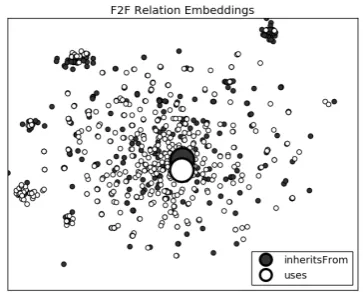
Figure 3: t-SNE plot of embeddings for two most frequent relations. Small: frame pair embeddings (offset). Large: prototypical embeddings (mean).
ciation chain. For the frame “Weapon”, the most similar frames byWord2Vecare weaker compared toWSABIE, however this does not allow a general conclusion over all frames learned withWord2Vec
orWSABIE.
F2F relationsTo check whether the frame embed-dings directly mirror F2F relations, we measure the difficulty of associating frame pairs with the correct prototypical relation embedding.
First, we visualize the frame pair embeddings in the training set and the inferred prototypical relation embeddings in vector space with t-SNE-plots. Figure3depicts examples ofWSABIE em-beddings for the most frequently occurring F2F
re-lationsinherits from anduses, and shows
that the prototypical embeddings are very close to each other, whilst there are no separate relation-specific clusters for frame pairs. Vector space vi-sualizations of embeddings stemming from both,
Word2VecandWSABIE, hint that the embeddings have difficulties in mirroring the F2F relations.
[image:5.595.71.298.599.729.2]Mean distances between WSABIE Word2Vec inter-relation variation 0.73±0.28 0.76±0.28
(between prototypes)
intra-relation variation 0.75±0.04 0.78±0.05
(between frame pairs and their prototypes)
Table 4: Cosine distances between the F2F rela-tion embeddings.
they would differ from a member of another rela-tion.
To sum up, we find that embeddings of frame pairs that are in the same relation do not have a similar vector offset which corresponds to the F2F relation. The FN hierarchy could not be reconstructed by the statistical analysis of text-based embeddings because there is as much intra-relation variation as inter-intra-relation variation. We conclude that, concerning the methods we ex-plored, the frame embeddings learned with WS-ABIE andWord2Vec have difficulties in showing structures in vector space corresponding to F2F relations and that F2F relations might not emerge purely from textual data. Hence, these text-based frame embeddings cannot be used as such to reli-ably infer the correct relation for a frame pair but might need some advanced learning. In the next section, we address the prediction of F2F rela-tions with algorithms involving learning from the knowledge contained in the FN hierarchy.
5 Frame-to-Frame Relation Prediction
We aim at developing a system for finding the correct F2F relation given two frames, which can potentially be used for automatic completion of the F2F relation annotations in the FN hierarchy. This task transfers the principles of Link Predic-tion from KGC to the case of FN. As the pre-vious experiment suggested that text-based frame embeddings do not mirror the F2F relations, we develop a system that learns from the knowl-edge contained in the FN hierarchy and that uses pretrained frame embeddings as input representa-tions. Related work in KGC also demonstrates the strengths of representations trained directly on the KG for this task. For our systems involv-ing learninvolv-ing, we experiment with different em-beddings as input representations: in addition to the text-based frame embeddings, we also learn knowledge-based embeddings for frames and for F2F relations on the structure of the FN hierarchy withTransE, an approach well-known from KGC.
We want to quantify which combination of pre-trained embeddings and system is most promising for the F2F Relation Prediction task.
5.1 Methods
TransEembeddingsIn addition to the text-based frame embeddings, we also learn embeddings for frames as well as for F2F relations by applying the well-known translation modelTransE.TransE
leverages the structure of the knowledge base, which is in our case the FN hierarchy with the collection of the(frame,relation,frame)triples, and learns low dimensional vector representations for frames and for F2F relations in the same space. These embeddings will have the property of be-ing learned explicitly for incorporatbe-ing the anno-tations from the FN hierarchy. Concerning this knowledge-based approach for learning frame and F2F relation embeddings, we use an implementa-tion ofTransEprovided by (Lin et al.,2015) yield-ing embeddyield-ings of dimension50.
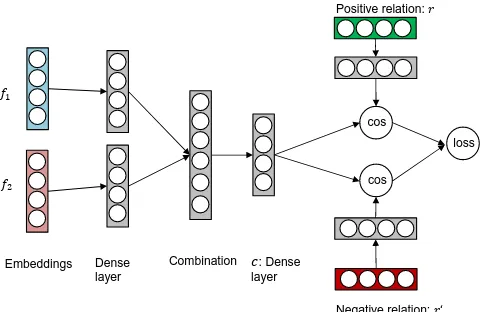
Neural network for relation selection We pro-pose a nonlinear model based on NNs to iden-tify the best F2F relationr between a frame pair
(f1, f2). Figure4demonstrates the proposed NN
architecture. Given a training instance, i.e. a triple (f1, r, f2), we feed a vector representation for each
element into the NN. By default the input vector representations are initialized randomly but they can also stem from a pretraining step (more details in Sec5.2). Within the NN, the initial vector rep-resentations of the two frames are combined into an internal dense layerc, followed by the calcula-tion of the cosine similarity between this
combina-𝑓2
𝑓1
Positive relation: 𝑟
Embeddings Dense layer
cos
cos
loss
Negative relation: 𝑟‘ Combination 𝑐: Dense
[image:6.595.77.290.62.124.2]layer
[image:6.595.307.547.569.725.2]tion and the representation for the F2F relationr. Meanwhile, a negative relationr0 is sampled
ran-domly (by selecting a F2F relation which does not hold between the two frames) and its vector rep-resentation is also fed into the NN. The negative relation is processed as the correct one, yielding a second cosine similarity. Finally, the NN mini-mizes the following ranking loss:
loss = max{0, m−cos(c, r) +cos(c, r0)} (2)
mis a margin andcosis the cosine similarity func-tion. This means, the internal representations are trained to maximize the similarity between frame pair and correct relation and to minimize it for the negative relation. Our hyperparameter choices are: epochs: 550, size of dense layers: 128, dropout:
0.2, margin: 0.1, activation function: hyperbolic tangent, batch size:2, learning rate0.001.
5.2 Experiments and Results
Given a triple(f3, r, f4)from the test set, we want
to predict the correct relation r for (f3, f4). As
described in Sec3, 70% of the triples in the FN hierarchy are used for training. Our systems are:
• 0a): rand.bsl A random guessing baseline that chooses a relation randomly out ofR.
• 0b): maj.bslInformed majority baseline that leverages the skewed distribution in the train-ing set and predicts most frequent relation.
• 1: offA test of the pretrained frame embed-dings (WSABIEandWord2Vec) as introduced in Section 4. It computes the vector offset
−−−→
oe3,e4(therefore “off”) between the test frame
embeddings, measures the similarity with the prototypical mean relation embeddings−→er of
the training set and ranks the relations with respect to similarity (cosine) to output the closest one. No further training with respect to the FN hierarchy.
• 2: regA test of the pretrained frame embed-dings (WSABIEandWord2Vec) as introduced in Section4involving training with respect to the FN hierarchy. It is a multinomial logistic regression model (therefore “reg”) that trains the weights and biases on the training triples. It takes the test frame embeddingse3, e4 as
input and ranks the prediction for a relation via the softmax function.
• 3: NNNN architecture as described in Sec-tion 5.1 for training with respect to the FN hierarchy in the training triples. By
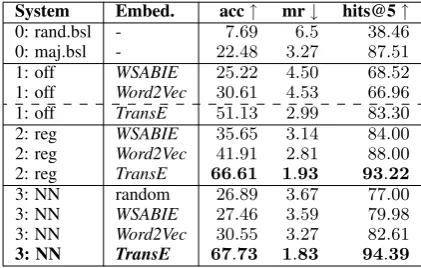
de-fault, it uses randomly initialized input rep-resentations, but it can also take pretrained representations as input: (a) the pretrained frame embeddings (WSABIE andWord2Vec) and inferred prototypical mean relation em-beddings as introduced in Section4 and (b) the TransE frame and relation embeddings trained on the training triples from the FN hierarchy as introduced in Section5.1. To evaluate the predictions of our systems for the F2F Relation Prediction task, we compare the measurements of accuracy, mean rank of the true relation and hits amongst the 5 first predictions, see Table5.
Accuracy measures the proportion of correctly predicted relations amongst all predictions. For the next two measures, not only the one pre-dicted relation is of interest, but the ranked list of all relations with the predicted relation at rank1.
Mean rankmeasures the mean of the rank of the true relation label over all predictions, aiming at low mean rank (best ismr = 1).
Hits@5 measures the proportion of true relation labels ranked in the top5.
The random guessing baseline is a weak base-line that is outperformed by all approaches. The informed majority baseline, however, is a strong baseline given the skewed distribution of F2F re-lations in the FN hierarchy.
A comparison of this strong baseline with sys-tem1using the text-based frame embeddings ( WS-ABIEandWord2Vec) and the similarity with proto-typical relation embeddings, emphasizes the diffi-culties of these embeddings for reconstructing the F2F relations. Concerning accuracy scores, sys-tem1performs slightly better than the strong base-line but concerning the other two measures, mean rank and hits at5, it is the other way round.
An-System Embed. acc↑ mr↓ hits@5↑ 0: rand.bsl - 7.69 6.5 38.46
0: maj.bsl - 22.48 3.27 87.51
1: off WSABIE 25.22 4.50 68.52
1: off Word2Vec 30.61 4.53 66.96
1: off TransE 51.13 2.99 83.30
2: reg WSABIE 35.65 3.14 84.00
2: reg Word2Vec 41.91 2.81 88.00
2: reg TransE 66.61 1.93 93.22
3: NN random 26.89 3.67 77.00
3: NN WSABIE 27.46 3.59 79.98
[image:7.595.310.521.609.743.2]3: NN Word2Vec 30.55 3.27 82.61 3: NN TransE 67.73 1.83 94.39
other point made by system1is the fact that it does not involve training on the triples but is still com-petitive with the strong baseline that leverages the underlying distribution from the triples. This in-dicates that to some extent the textual frame em-beddings still capture useful information for the F2F Prediction Task. In a further step, we also use the embeddings pretrained on the F2F relations of the FN hierarchy (TransE), even if in this set-ting we do not need to calculate prototypical rela-tion embeddings asTransE provides embeddings for frames and relations. Thus, system1uses the
TransEembeddings directly to calculate the simi-larity of the frame embeddings’ vector offset and the relation embeddings. The large improvement in all performance measures shows the strength of knowledge-based embeddings over text-based em-beddings and confirms the difficulty of text-based embeddings in reconstructing the F2F relations.
Performance increases with system 2, the soft-max regression model involving learning. This shows the effect of training with respect to the F2F relations. It indicates that training should be in-volved for leveraging the text-based frame dings in the F2F Prediction Task. Using embed-dings pretrained on the F2F relations of the FN hierarchy (TransE) instead, again leads to a large improvement in all performance measures. This confirms that embeddings designed to incorporate the knowledge from the FN hierarchy are better suited for the F2F relation prediction task and it emphasizes the large improvement over the textual embeddings.
Overall, we achieve best results in all per-formance measures with system 3, the NN ap-proach, in combination with the knowledge-based
TransE embeddings as input representations. In-terestingly, the difference between NN and the re-gression model is only marginal when using the
TransE embeddings, indicating the crucial influ-ence of the knowledge-based embeddings and not necessarily the system. Moreover, when using the text-basedWSABIEandWord2Vecthe softmax re-gression model is stronger than the NN, which might be due to little training data. Furthermore, the randomly initialized embeddings for system
3 could be seen as another baseline which is not only beaten by the knowledge-basedTransE em-beddings but also by the text-basedWSABIE and
[image:8.595.306.519.61.177.2]Word2Vec embeddings in systems 2 and 3. This again indicates the capability of the textual frame
Figure 5: Relation-specific analysis of the best-performing model with respect to accuracy.
embeddings of capturing useful information for the F2F Prediction Task to at least some extent.
The systems could reach higher scores if the split of the data into training and test triples would be done random per relation such that the train and test set have some (random) relation-specific over-lap in frames on the positionf1 in the triple. But
in this case, it would not clear whether the sys-tems would just perform “lexical memorization” as pointed out by (Levy et al.,2015) when the test set contains partial instances that were in the train-ing set. We leave it for future work to contrast and explore different splits, e.g., random split, zero-overlap by relation or by all relations.
To sum up, on the one hand, the results con-firm the conclusions from the exploration in Sec-tion 4: the frame embeddings learned on frame-labeled text in the context of other tasks are not able to reliably mirror the F2F relations, not even when used as input representations to a classifier. On the other hand, our results clearly emphasize the influence of the knowledge-based embeddings on the performance of our best-performing sys-tem. Thus, we propose this NN architecture in combination with the TransE embeddings as the first system for automatic F2F relation annotation for frame pairs in the FN hierarchy.
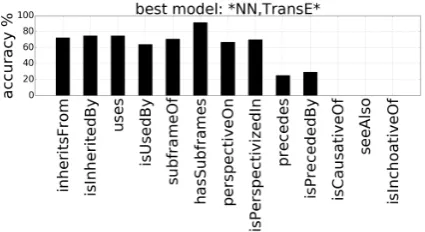
Figure 5 depicts a relation-specific analysis of the best-performing model showing good perfor-mances (above 60% accuracy) for frequent rela-tions, a drop for the less frequentprecedence
relations and no capability at all in predicting in-frequent relations, such as is Causative of,
see Alsoandis Inchoative of.
5.3 Demonstration of Predictions
(f1, f2) top3F2F relation predictions (Biological urge, Subframe of,
[image:9.595.79.285.61.135.2]Sleep wake cycle) Inherits from,Uses (Biological urge, Is Inherited by, Being awake) Precedes,Is Preceded by (Biological urge, Is Inherited by, Fall asleep) Precedes,Is Preceded by
Table 6: F2F relation predictions of best system.
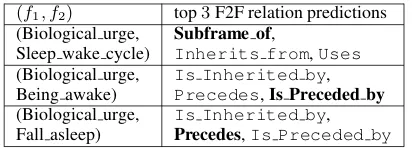
the motivational example from the beginning, Fig-ure1illustrated the incompleteness of the FN hier-archy at the F2F relation level with the example of a possibly missingprecedencerelation from “Being awake” to “Biological urge” (evoked by the predicate “tired”). Table6 displays the top3
F2F relation predictions for the frame pairs around “Biological urge” in the figure. The expected F2F relation (printed bold) is indeed amongst the top
3 predictions of the best performing system for this example, even for theprecedencerelation which is rather underrepresented in the data. If this system was used to make suggestions to hu-man expert annotators, they should be informed about the system being biased against the infre-quent relations. However, it is hard to do a proper manual evaluation as judging the suggested re-lations requires expert knowledge of the defini-tions and annotation best-practices for the F2F re-lations. We propose using the best-performing system for semi-automatic FN completion on the relation level in cooperation with FN annotation experts. The system can be used to make reason-able suggestions of relations for frame pairs and the final decision could be made by experienced FN annotators. This would be a first step towards improving the incompleteness of F2F relation an-notations in FN, which in turn could improve the performance in other tasks that take these F2F re-lations as input.
6 Discussion and Future Work
As the F2F relations of the FN hierarchy did not emerge from frame embeddings learned on frame-labeled text, the F2F relations should be seen as meta-structures not having direct evidence in text. On the one hand, more advanced approaches might be needed to distill F2F relations for frames occurring in raw text, by learning about common-sense knowledge involving frames, and then infer-ring the implicit relations. Here, it could also be helpful to exploit inter-sentential clues e.g., event chains, to enrich the frame embeddings which so
far are built on sentence-level. On the other hand, the automatic completion of F2F relations can rely on knowledge-based embeddings trained on the hierarchy. To this end, an expert evaluation of the best-performing system’s predictions for frame pairs could give clues for further system improve-ments. It could also yield an expert upper bound and may pave the way for developing advanced systems using frame embeddings for the predic-tion of F2F relapredic-tions. Finally, we plan to inves-tigate the case of FN for embeddings learned on both, frame-labeled texts and F2F relation annota-tions. By having such a combination, the limita-tion of the text-based embeddings on frames that have LUs (and hence occur in text) can be over-come as the knowledge-based embeddings also have access to frames without LUs. Last but not least, for different tasks, different representations of frames and relations might be better suited: em-beddings purely learned on text, or emem-beddings purely learned on the FN hierarchy, or a combi-nation of both.
7 Conclusion
We raised the question whether text-based frame embeddings naturally mirror F2F relations in the FN hierarchy. We set up the F2F Relation Pre-diction task as an adaptation of the link prePre-diction task from KGC to the case of FN. Through this task, we quantify the ability of systems and em-beddings to predict F2F relations. The F2F Re-lation Prediction task addresses the need for auto-matically completing F2F relations that are used in down-stream tasks. Our best-performing system for predicting F2F relations is a NN trained on the FN hierarchy and uses knowledge-based embed-dings that by design incorporate the F2F relation. It can be used to suggest more F2F relation anno-tations in the FN hierarchy. The comparison of our different systems and embeddings reveals insights about the difficulty of reconstructing F2F relations purely from text. We encourage the development of advanced systems and embeddings for the F2F Relation Prediction task.
Acknowledgments
References
Roni Ben Aharon, Idan Szpektor, and Ido
Da-gan. 2010. Generating Entailment Rules from
FrameNet. In Proceedings of the ACL 2010 Conference Short Papers. Association for
Computational Linguistics, pages 241–246.
http://www.aclweb.org/anthology/P10-2045.
Collin F Baker, Charles J Fillmore, and John B Lowe.
1998. The Berkeley FrameNet Project. In
Pro-ceedings of the 36th Annual Meeting of the Associ-ation for ComputAssoci-ational Linguistics and 17th Inter-national Conference on Computational Linguistics-Volume 1. Association for Computational Linguis-tics, Montreal, Quebec, Canada, pages 86–90.
https://doi.org/10.3115/980451.980860.
Daniel Bauer, Hagen F¨urstenau, and Owen
Ram-bow. 2012. The Dependency-Parsed FrameNet
Corpus. In Proceedings of the 8th Language Resources and Evaluation Conference (LREC 2012). Istanbul, Turkey, pages 3861–3867.
http://hdl.handle.net/10022/AC:P:21192.
Antoine Bordes, Xavier Glorot, Jason Weston, and
Yoshua Bengio. 2012. Joint Learning of Words
and Meaning Representations for Open-Text Se-mantic Parsing. In Neil D. Lawrence and
Mark Girolami, editors, Proceedings of the
Fif-teenth International Conference on Artificial In-telligence and Statistics. PMLR, La Palma,
Ca-nary Islands, volume 22 of Proceedings of
Machine Learning Research, pages 127–135.
http://proceedings.mlr.press/v22/bordes12.html.
Antoine Bordes, Nicolas Usunier, Alberto Garcia-Duran, Jason Weston, and Oksana Yakhnenko.
2013. Translating Embeddings for Modeling
Multi-relational Data. In C. J. C. Burges, L. Bottou, M. Welling, Z. Ghahramani, and K. Q. Weinberger,
editors,Advances in Neural Information Processing
Systems 26. Curran Associates, Inc., pages 2787– 2795. http://papers.nips.cc/paper/5071-translating-embeddings-for-modeling-multi-relational-data.pdf.
Antoine Bordes, Jason Weston, Ronan Collobert, and
Yoshua Bengio. 2011. Learning Structured
Em-beddings of Knowledge Bases. InProceedings of the Twenty-Fifth AAAI Conference on Artificial In-telligence. AAAI Press, AAAI’11, pages 301–306.
http://dl.acm.org/citation.cfm?id=2900423.2900470.
Bob Coyne and Owen Rambow. 2009. LexPar: A
Freely Available English Paraphrase Lexicon Auto-matically Extracted from FrameNet. In Proceed-ings of the Third IEEE International Conference on Semantic Computing (ICSC 2009). pages 53–58.
https://doi.org/10.1109/ICSC.2009.56.
Christiane Fellbaum. 1990. English Verbs as a
Se-mantic Net. International Journal of Lexicography
3(4):278–301. https://doi.org/10.1093/ijl/3.4.278.
Minwei Feng, Bing Xiang, Michael R Glass,
Li-dan Wang, and Bowen Zhou. 2015.
Apply-ing Deep LearnApply-ing to Answer Selection: A Study and An Open Task. In 2015 IEEE Workshop on Automatic Speech Recognition and Understanding (ASRU). IEEE, pages 813–820.
https://doi.org/10.1109/ASRU.2015.7404872.
Charles J Fillmore. 1976. Frame
Seman-tics and the Nature of Language. An-nals of the New York Academy of Sciences
280(1):20–32.
https://doi.org/10.1111/j.1749-6632.1976.tb25467.x.
Charles J Fillmore and Collin F Baker. 2001. Frame
Semantics for Text Understanding. InProceedings
of WordNet and Other Lexical Resources Workshop, NAACL.
Lucie Flekova and Iryna Gurevych. 2016. Supersense Embeddings: A Unified Model for Supersense Inter-pretation, Prediction, and Utilization. In Proceed-ings of the 54th Annual Meeting of the Association for Computational Linguistics (ACL 2016). Asso-ciation for Computational Linguistics, Berlin, Ger-many, volume Volume 1: Long Papers, pages 2029– 2041.
Silvana Hartmann and Iryna Gurevych. 2013. FrameNet on the Way to Babel: Creating a Bilin-gual FrameNet Using Wiktionary as InterlinBilin-gual
Connection. In Proceedings of the 51st Annual
Meeting of the Association for Computational Lin-guistics (ACL 2013). Association for Computational Linguistics, Stroudsburg, PA, USA, volume 1, pages 1363–1373.
Silvana Hartmann, Ilia Kuznetsov, Teresa Martin, and Iryna Gurevych. 2017. Out-of-domain FrameNet
Semantic Role Labeling. InProceedings of the 15th
Conference of the European Chapter of the Associ-ation for ComputAssoci-ational Linguistics (EACL 2017). Association for Computational Linguistics, pages 471–482.
Karl Moritz Hermann, Dipanjan Das, Jason Weston,
and Kuzman Ganchev. 2014.Semantic Frame
Iden-tification with Distributed Word Representations. In
Proceedings of the 52nd Annual Meeting of the As-sociation for Computational Linguistics (Volume 1: Long Papers). Association for Computational Lin-guistics, Baltimore, Maryland, pages 1448–1458.
http://www.aclweb.org/anthology/P14-1136.
Ignacio Iacobacci, Mohammad Taher Pilehvar, and
Roberto Navigli. 2015. SensEmbed:
Learn-ing Sense EmbeddLearn-ings for Word and Relational Similarity. In Proceedings of the 53rd An-nual Meeting of the Association for Computa-tional Linguistics and the 7th InternaComputa-tional Joint Conference on Natural Language Processing (Vol-ume 1: Long Papers). Association for Computa-tional Linguistics, Beijing, China, pages 95–105.
Omer Levy and Yoav Goldberg. 2014. Dependency-Based Word Embeddings. In Proceedings of the 52nd Annual Meeting of the Association for Compu-tational Linguistics, ACL 2014, June 22-27, 2014, Baltimore, MD, USA, Volume 2: Short Papers. The Association for Computer Linguistics, pages 302– 308. https://doi.org/10.3115/v1/P14-2050.
Omer Levy, Steffen Remus, Chris Biemann, Ido
Da-gan, and Israel Ramat-Gan. 2015. Do Supervised
Distributional Methods Really Learn Lexical Infer-ence Relations? In HLT-NAACL. pages 970–976.
https://doi.org/10.3115/v1/N15-1098.
Yankai Lin, Zhiyuan Liu, Maosong Sun, Yang Liu, and Xuan Zhu. 2015. Learning Entity and Relation Embeddings for Knowledge Graph Completion. In
AAAI. pages 2181–2187.
Laurens van der Maaten and Geoffrey Hinton. 2008.
Visualizing Data using t-SNE. Journal of Machine
Learning Research9(Nov):2579–2605.
Tomas Mikolov, Kai Chen, Greg Corrado, and Jeffrey Dean. 2013a. Efficient Estimation of Word
Repre-sentations in Vector Space. Proceedings of
Work-shop at ICLR.
Tomas Mikolov, Wen-tau Yih, and Geoffrey Zweig.
2013b. Linguistic Regularities in Continuous Space
Word Representations. InProceedings of the 2013 Conference of the North American Chapter of the Association for Computational Linguistics: Human Language Technologies (NAACL-HLT-2013). Asso-ciation for Computational Linguistics, volume 13,
pages 746–751.
https://www.microsoft.com/en- us/research/publication/linguistic-regularities-in-continuous-space-word-representations/.
George A Miller. 1990. Nouns in WordNet:
A Lexical Inheritance System. Interna-tional journal of Lexicography 3(4):245–264.
https://doi.org/10.1093/ijl/3.4.245.
Roberto Navigli and Simone Paolo Ponzetto. 2012.
BabelNet: The automatic construction, evaluation and application of a wide-coverage multilingual se-mantic network. Artificial Intelligence 193:217– 250. https://doi.org/10.1016/j.artint.2012.07.001. Ellie Pavlick, Travis Wolfe, Pushpendre Rastogi,
Chris Callison-Burch, Mark Dredze, and Benjamin Van Durme. 2015. FrameNet+: Fast
Paraphras-tic Tripling of FrameNet. In Proceedings of the
53rd Annual Meeting of the Association for Compu-tational Linguistics and the 7th International Joint Conference on Natural Language Processing (Short Papers). Beijing, China, pages 408–413.
Pushpendre Rastogi and Benjamin Van Durme. 2014.
Augmenting FrameNet Via PPDB. InProceedings
of the Second Workshop on EVENTS: Definition, Detection, Coreference, and Representation. Asso-ciation for Computational Linguistics, Baltimore, Maryland, USA, pages 1–5.
Radim ˇReh˚uˇrek and Petr Sojka. 2010. Software Frame-work for Topic Modelling with Large Corpora. In
Proceedings of the LREC 2010 Workshop on New Challenges for NLP Frameworks. ELRA, Valletta,
Malta, pages 45–50. http://is.muni.cz/
publication/884893/en.
Josef Ruppenhofer, Michael Ellsworth, Miriam RL Petruck, Christopher R Johnson, and Jan Schef-fczyk. 2006. FrameNet II: Extended Theory and Practice. Distributed with the FrameNet data. Ming Tan, Bing Xiang, and Bowen Zhou. 2015.
LSTM-based Deep Learning Models for
Non-factoid Answer Selection. arXiv preprint
arXiv:1511.04108.
Jason Weston, Samy Bengio, and Nicolas Usunier.
2011. WSABIE: Scaling Up to Large Vocabulary
Image Annotation. In Proceedings of the Twenty-Second International Joint Conference on Artifi-cial Intelligence - Volume Volume Three. AAAI Press, Barcelona, Catalonia, Spain, IJCAI’11, pages
2764–2770.