199
Underspecified Universal Dependency Structures
as Inputs for Multilingual Surface Realisation
Simon Mille Universitat Pompeu Fabra
Barcelona, Spain [email protected]
Anja Belz University of Brighton
Brighton, UK
Bernd Bohnet Google Inc. London, UK
Leo Wanner
ICREA and Universitat Pompeu Fabra Barcelona, Spain
Abstract
In this paper, we present the datasets used in the Shallow and Deep Tracks of the First Multilingual Surface Realisation Shared Task (SR’18). For the Shallow Track, data in ten languages has been re-leased: Arabic, Czech, Dutch, English, Finnish, French, Italian, Portuguese, Rus-sian and Spanish. For the Deep Track, data in three languages is made available: En-glish, French and Spanish. We describe in detail how the datasets were derived from the Universal Dependencies V2.0, and re-port on an evaluation of the Deep Track input quality. In addition, we examine the motivation for, and likely usefulness of, deriving NLG inputs from annotations in resources originally developed for Natu-ral Language Understanding (NLU), and assess whether the resulting inputs supply enough information of the right kind for the final stage in the NLG process.
1 Introduction
There has long been an assumption in Natural Language Generation (NLG) that surface realisa-tion can be treated as an independent subtask for which stand-alone, plug-and-play tools can, and should, be created. Early surface realisers such as KPML (Bateman, 1997) and FUF/Surge ( El-hadad and Robin,1996) were ambitious, indepen-dent surface realisation tools for English with wide grammatical coverage. However, the question of how the NLG components addressing the stage be-fore surface realisation were supposed to put to-gether inputs of the level of grammatical sophis-tication required by such tools was never quite
resolved. The success of SimpleNLG (Gatt and Reiter,2009) which had much reduced grammati-cal coverage, but accepted radigrammati-cally simpler inputs demonstrated the importance of this issue.
The recently completed first Multilingual Sur-face Realisation Task (SR’18) (Mille et al.,2018) used for the first time inputs derived from the Uni-versal Dependencies (UDs) (de Marneffe et al.,
2014), a framework which was devised with the aim of facilitating cross-linguistically consistent grammatical annotation, and which has grown into a large-scale community effort involving more than 200 contributors, who have created over 100 treebanks in over 70 languages between them.1 UDs provide a more general and potentially flex-ible input representation for surface realisation (SR). However, their use for NLG has not so far been demonstrated.
In this paper, we present the UD datasets used in the Shallow and Deep Tracks in SR’18, describe the precise conversion processes that were applied to them, and provide an assessment of their qual-ity. Furthermore, we examine (a) the SR task in general, (b) the motivation for, and likely useful-ness of, the derivation of NLG inputs from annota-tions in resources developed for Natural Language Understanding (NLU), (c) whether the resulting inputs supply enough information of the right kind for the final stage in the NLG process, and more tentatively, (d) what role SR is likely to play in the future in the NLG context.
Section 2 presents related work; Section3 de-scribes the datasets used in the two SR’18 tracks, and Section4provides a more procedural account of how the datasets were generated. Section5 as-sesses the quality of the obtained representations,
while Section6 discusses their suitability for SR and NLG more generally. Some conclusions are presented in Section7.
2 Background
With the advent of large-scale treebanks and sta-tistical NLG, surface realisation research turned to the use of treebank annotations, processed in var-ious ways, as inputs to surface realisation. Anno-tation/sentence pairs constitute the training data, and similarity to the original sentences in the tree-bank is the main measure of success. A lot of this work used inputs derived from the Wall Street Journal corpus with varying amounts of infor-mation removed from the parse-tree annotations (Langkilde-Geary, 2002; Nakanishi et al., 2005;
Zhong and Stent,2005;Cahill and van Genabith,
2006; White and Rajkumar, 2009). Because of the variation among inputs, results were not en-tirely comparable. The first Surface Realisation Shared Task (SR’11) (Belz et al.,2011) was thus conceived with the aim of developing a common-ground input representation that would make dif-ferent systems, for the first time, directly com-parable. SR’11 used shallow and deep inputs for its two respective tracks, both derived from CoNLL’08 shared task data, which was in turn de-rived from the WSJ Corpus by automatically con-verting the corresponding Penn TreeBank parse trees to dependency structures (Surdeanu et al.,
2008). While dependency structures offer a more flexible input structure and statistical systems, in principle, offer more robustness, the uptake of such systems as components in embedding NLG systems has been very limited.
Meanwhile, many of the more applied strands of NLG research have tended to bypass an ex-plicit interface to surface realisation, instead map-ping directly from more abstract representations of meaning to surface text. Recently, mostly un-der the aegis of the Generation Challenges series of shared tasks, several large-scale datasets have been made available that pair surface text with more abstract structured inputs, including:
• Weather forecast generation (Weather) dataset (Liang et al.,2009): time series from weather-related measurements;
• Abstract Meaning Representation (AMR) dataset (May and Priyadarshi,2017): abstract predicate-argument graphs that cover several genres;
• WebNLG dataset (Gardent et al.,2017): DB-pedia triples covering properties of 15 DBpe-dia categories;
• E2E dataset (Novikova et al., 2017): attribute-value pairs covering 8 properties related to the restaurant domain.
In all these datasets, the input structures are aligned with English sentences that match their contents. In the case of inputs coming from struc-tured data (e.g. WebNLG, E2E, Weather, above), multiple sentences are generally paired with each input, whereas for the inputs coming from data initially annotated for Natural Language Under-standing tasks (SR’11, AMR), only one reference per input is available. Both types of shared tasks (reusable surface realisation vs. task-specific gen-eration) have been successful in terms of participa-tion levels, and both have sizeable research com-munities behind them, but trainable surface reali-sation as a stand-alone subtask still has a way to go in terms of demonstrating its practical applica-bility.
3 The SR’18 Data
The First Multilingual Surface Realisation Shared Task (SR’18) ran from December 2017 to July 2018. As in SR’11, the shared task comprised two tracks with different levels of difficulty: a Shallow Track, starting from syntactic structures in which word order information has been removed and to-kens have been lemmatised, and a Deep Track, which starts from more abstract structures from which, additionally, functional words (in partic-ular, auxiliaries, functional prepositions and con-junctions) and surface-oriented morphological in-formation have been removed.
1 The the DET DT Definite=Def|PronType=Art 2 det 2 third third ADJ JJ Degree=Pos|NumType=Ord 5 nsubj pass 3 was be AUX VBD Mood=Ind|Number=Sing|Person=3|Tense=Past|VerbForm=Fin 5 aux 4 being be AUX VBG VerbForm=Ger 5 aux pass 5 run run VERB VBN Tense=Past|VerbForm=Part|Voice=Pass 0 root
6 by by ADP IN 8 case
7 the the DET DT Definite=Def|PronType=Art 8 det 8 head head NOUN NN Number=Sing 5 obl
9 of of ADP IN 12 case
10 an a DET DT Definite=Ind|PronType=Art 12 det 11 investment investment NOUN NN Number=Sing 12 compound 12 firm firm NOUN NN Number=Sing 8 nmod
[image:3.595.80.521.60.256.2]13 . . PUNCT . 5 punct
Figure 1: A sample UD structure in English (top: CoNLL-U, bottom: graphical)
1 the DET DT Definite=Def|PronType=Art 2 det 2 third ADJ JJ Degree=Pos|NumType=Ord 3 nsubj pass 3 run VERB VBN Tense=Past|VerbForm=Part|Voice=Pass 0 root 4 be AUX VBD Mood=Ind|Number=Sing|Person=3|Tense=Past|VerbForm=Fin 3 aux 5 be AUX VBG VerbForm=Ger 3 aux pass 6 head NOUN NN Number=Sing 3 obl
7 . PUNCT . 3 punct
8 by ADP IN 6 case
9 the DET DT Definite=Def|PronType=Art 6 det 10 firm NOUN NN Number=Sing 6 nmod 11 an DET DT Definite=Ind|PronType=Art 10 det 12 investment NOUN NN Number=Sing 10 compound
[image:3.595.111.492.289.505.2]13 of ADP IN 10 case
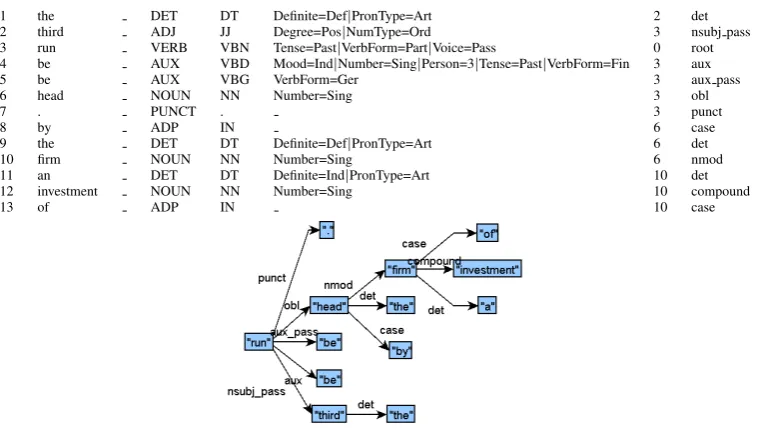
Figure 2: Shallow input (Track 1) derived from UD structure in Figure 1. (top: CoNLL-U, bottom: graphical)
were created automatically for the two tracks. The inputs for each language and track were released in the CoNLL-U format2, together with parallel files that contain a reference sentence for each input. Figures 1, 2 and 3 show a sample orig-inal UD annotation for English, and the corre-sponding inputs for the Shallow and Deep Tracks, respectively, in the 10-column CoNLL-U format (the last two columns generally do not contain information and are thus omitted) and in graph-ical format. The training, development and test data are available athttp://taln.upf.edu/ pages/msr2018-ws/SRST.html#data.
2http://universaldependencies.org/
format.html
3.1 Shallow inputs
Fig-1 third ADJ Degree=Pos 2 A2 2 run VERB Tense=Past|Aspect=Progr 0 ROOT 3 head NOUN Number=Sing|Definiteness=Def 2 A1 4 firm NOUN Number=Sing|Definiteness=Indef 3 A2 5 investment NOUN Number=Sing 4 AM
Figure 3: Deep input (Track 2) derived from UD structure in Figure1. (left: CoNLL-U, righ: graphical)
ures1and2show an original UD structure and a SR’18 Shallow input, respectively.
3.2 Deep inputs
The Deep Track input structures are trees that contain only content words linked by predicate-argument edges, in the PropBank/NomBank (Palmer et al.,2005;Meyers et al.,2004) fashion. The Deep inputs can be seen as closer to a re-alistic application context for NLG systems, in which the component that generates the inputs pre-sumably would not have access to syntactic or language-specific information. At the same time, we used only information found in the UD struc-tures to create the Deep inputs, and tried to keep their structure simple. In Deep inputs, words are not disambiguated, full (semantically loaded) prepositions may be missing, and some argument relations may be underspecified or missing. The next two subsections provide more details about the Deep nodes and edge labels.
3.2.1 Deep nodes
In contrast to the Shallow structures, which con-tain all the (lemmatised) words of the original sen-tence, the Deep structures do not contain func-tional words that can be inferred from another lex-ical unit or from the syntactic structure (such as bound prepositions and conjunctions), or can be represented as a feature on another node (such as auxiliaries, modals, or determiners). For instance (see also Figure1for the first four examples):
• the preposition by in the sentence The third was being run by the head of an investment firmis bound to the English agentive depen-dency in a passive construction;
• the prepositionofinthe head of an investment firmis bound to the nounhead, and indicates the presence of its second argument;
• being in was being run is a passive voice marker, while was is part of the marker for the progressive aspect, associated with the verbrun;
• thein the head can be seen as a marker for nominal definiteness;
• the conjunction (complementiser) that in, e.g.,I demand that you apologise, appears be-cause it connects a finite verbapologiseas an argument of another verbdemand.
Meaningful functional words such as auxiliaries and determiners are represented as attribute/value pairs associated with the relevant nodes, as, e.g., the Aspectfeature on runin Figure 3.3 Features are also used to encode information such as ver-bal tense or nominal number, which are needed for realisation. On the other hand, implicit nodes that have a role in the sentence are explicit in the Deep input: for instance, dummy pronoun nodes for the subject if an originally finite verb has no first argument and no available argument to build a passive or, for a pro-drop language such as Span-ish, dummy pronouns when the first argument of a verb is missing.
3.2.2 Deep edge labels
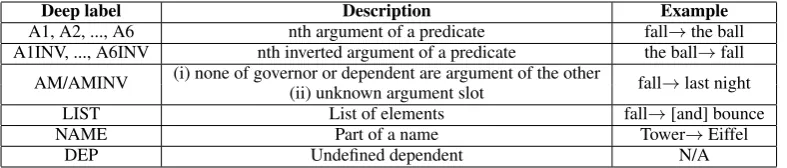
In Deep inputs, content words are linked by predicate-argument labels in the Prop-Bank/NomBank (Palmer et al., 2005; Meyers et al., 2004) fashion, that is, there are core (A1, A2, etc.) and non-core (AM) labels. Additional labels such as LIST or NAME have been added in order to connect all the elements within each sen-tence; see Table 1 for the inventory of relations. This subsection details the main features of the dependencies at this level.
First of all, the first argument is always labeled as A1, that is, there is no external argument A0, as can be found in PropBank and NomBank. For instance, both the verbsfallandfancyhave a rela-tion A1 with their first argument (the ballA1 falls,
MartinA1 fancies Chloe), even though according
to PropBank, the latter has an external argument (MartinA0 fancies Chloe).
3For the available universal features set, see
Deep label Description Example A1, A2, ..., A6 nth argument of a predicate fall→the ball A1INV, ..., A6INV nth inverted argument of a predicate the ball→fall
AM/AMINV (i) none of governor or dependent are argument of the other fall→last night (ii) unknown argument slot
LIST List of elements fall→[and] bounce
NAME Part of a name Tower→Eiffel
[image:5.595.103.497.62.146.2]DEP Undefined dependent N/A
Table 1: Deep labels
Second, in order to maintain the tree struc-ture and account for some cases of shared argu-ments, there can be inverted argument relations. Consider, for instance, the difference betweenthe ballA1 falls, in whichball is the first argument of
fall, andthe fallingA1IN V ball, in whichfall has the ‘inverted first argument’ label, which means thatballis actually the first argument offall. In-verted relations are used also in relative clauses, as e.g., inthe ball that fallsA1IN V; in such a case, the subject (or object) relative pronoun does not ap-pear in the structure, and the antecedent can thus be shared by two predicates, as An and AnINV.
Third, all modifier edges are assigned the same generic label AM. When an edge is underspeci-fied, that is, when there is no predicate-argument relation between two connected nodes, or when there is a predicate-argument relation between two nodes, but it is not known which one specifically, the AM or AMINV label is used. For instance, in the case of nominal adverbials such aslast night, the relation between the governing predicate and
nightis set as an AM. One of the most productive uses of the AM label is for prepositional groups or subordinate clauses, in which UD establishes a direct dependency between the content words that actually does not exist: he will leaveGov after he
finishesDep his work. In this case,finishis estab-lished as an AM ofleave; note that this does not prevent the actual argumental structure from being recovered. Indeed, an edge AM that links a Gover-nor with a Dependent and its A2INV preposition:
Gov Dep Prep
AM A2INV
is equivalent to the preposition being a predicate and the Governor and Dependent being its first and second argument respectively:
Gov Prep Dep
A1 A2
Fourth, there are some edge labels that are not
related to predicate-argument relations: coordi-nated elements are linked by a dedicated edge LIST, compound named entities are linked by the edge NAME, and the edge label DEP is used in case of an unknown relation between two ele-ments. Finally, each argument relation is unique for each predicate: if a predicate has an A2 depen-dent, it cannot have another A2 dependepen-dent, and it cannot be the A2INV dependent of another predi-cate.
In Section4.2below, we describe how the map-ping between surface dependencies and predicate-argument labels was performed.
4 Generating the datasets
Following on from the more declarative descrip-tion of Shallow and Deep inputs in the previous section, this section describes how those input were automatically created from the CoNLL’17 data.
4.1 Adaptation of the original UD structures
For the input to the Shallow Track, the UD struc-tures were processed as follows:
1. the information on word order was removed by randomised scrambling;
2. the words were replaced by their lemmas.
For the Deep Track, additionally:
3. Functional prepositions and conjunctions in argument position, i.e. prepositions and con-junctions that can be inferred from other lex-ical units or from the syntactic structure, were removed; prepositions and conjunctions retained in the Deep representation can be found under an A2INV dependency;
ar cs en es fi fr it nl pt ru train 6,016 66,485 12,375 14,289 12,030 14,529 12,796 12,318 8,325 48,119
[image:6.595.106.494.62.107.2]dev 897 9,016 1,978 1,651 1,336 1,473 562 720 559 6,441 test 676 9,876 2,061 1,719 1,525 416 480 685 476 6,366
Table 2: SR’18 dataset sizes for training, development and test sets.
5. copulas were removed and their two argu-ments connected with each other;
6. Subject and object relative pronouns directly linked to the main relative verb were removed (and instead, the verb is linked to the an-tecedent of the pronoun), and dummy pro-nouns were added.
7. Edge labels were generalised using the labels presented in Section3.2.2;
8. Surface-level morphologically relevant infor-mation as prescribed by syntactic structure or agreement (such as verbal finiteness or ver-bal number) was removed, whereas semantic-level information such as nominal number and verbal tense was retained;
9. Fine-grained POS labels found in some tree-banks (see e.g. column 5 in Figure 2) were removed, and only coarse-grained ones were retained (column 4 in Figures2and3).
4.2 Generation of the inputs
Shallow Track inputs were generated with a Python script from the original UD structures, which were simply scrambled and their words re-placed with lemmas. During the conversion, sen-tences that contained dependencies that only make sense in an analysis context were filtered out (e.g.
reparandum, ororphan); this amounted to around 1.5% of sentences for all languages on average. Table2summarises the final size of the datasets.
Deep Track inputs were then generated by au-tomatically processing the Shallow Track struc-tures using a series of graph-transduction gram-mars (Bohnet and Wanner,2010) that cover steps 3–9 above (in a similar fashion to Mille et al. (2017)), while ensuring a node-to-node correspon-dence between the Deep and Shallow structures.
The graph-transduction grammars are rules that apply to a subgraph of the input structure and pro-duce a part of the output structure. During the ap-plication of the rules, both the input structure (cov-ered by the left-hand side of the rule) and the cur-rent state of the output structure at the moment of application of a rule (i.e., the right-hand side of the
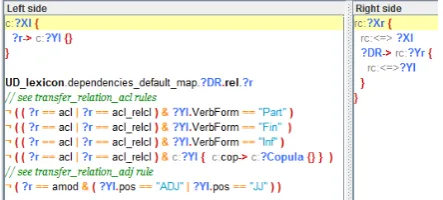
[image:6.595.307.529.515.615.2]rule) are available as context. Figure4shows the rule that assigns deep dependency labels as found in the UD lexicon dictionary; relative clause edges and adjectival modifiers are handled by different rules. The output structure in one transduction is built incrementally: the rules are all evaluated, the ones that have no right-hand side context and that match a part of the input graph are applied, and a first piece of the output graph is built; then the rules are evaluated again, this time with the right-hand side context as well, and another part of the output graph is built; and so on. The transduc-tion is complete when no rule is left that matches the combination of the left-hand side and the right-hand side. At each iteration, the rules are first se-lected and then applied as a cluster, that is, the or-der in which they apply is not important. The only way to force a rule R2 to be applied after a rule R1 (for instance, for building edges after building the nodes) is to establish as R2’s right-side condition elements built by R1: for instance, the rule shown in Figure4will apply only after the rules that build the nodes have applied, since the?Xrand?Yrare marked as right-side context (rc:). This allows the rules to be more generic and to combine with one another in an efficient way.
Figure 4: Sample graph transduction rule
re-Grammars # rules Description
Pre-processing 76 Identify nodes to be removed Identify verbal finiteness and tense
SSynt-Sem 120
Remove idiosyncratic nodes
Establish correspondences with surface nodes
Map UD labels to predicate-argument dependency labels (when possible)
Predict predicate-argument dependency labels (when no direct mapping is available) Replace determiners, modality and aspect markers by attribute-value feature structures
Post-processing 60 Replace duplicated argument relations by best educated guess
[image:7.595.83.517.61.165.2]Identify remaining duplicated core dependency labels (for posterior debugging)
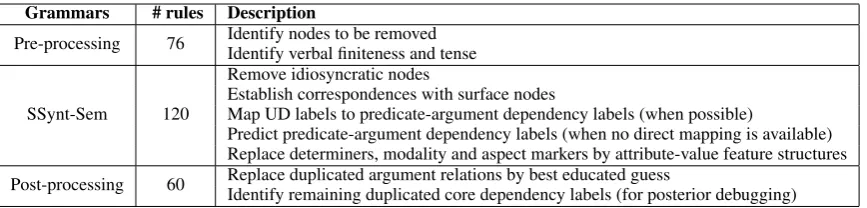
Table 3: Graph-transduction rules for producing the Deep inputs (counts include rules that simply copy node features, constituting about 40 per grammar).
moved (using solely positive conditions) and then to not generate them in the next step, than using rules that generate in one shot only the desired nodes, which would imply complex negative con-ditions. After this pre-processing, with the nodes that are to be removed marked, the core grammar (SSynt-Sem) takes care of establishing edge labels between the remaining nodes and associating the latter with attribute/value pairs. Most UD labels are mapped one-to-one to predicate-argument la-bels. In some cases only, the rules check the syn-tactic context of an edge in order to get a more precise label (e.g., a relative clause in which ac-cording to the structure and the UD label, we know that an argumental relation is holding: if the gov-ernor already has a first and a third arguments, the argumental relation is likely to be an A2). A post-processing grammar takes educated guesses in order to correct obvious labeling errors such as the duplication of an argument for a predicate. The unified cross-language annotation scheme of UD allows the large majority of the rules to be language-independent. Even though the annota-tions are not always consistent, adapting the gram-mars to a new language is relatively easy: most of the language-specific rules concern the processing of auxiliaries and modals, which have to be identi-fied and mapped to theAspectandMoodfeatures.
5 Evaluation of the generated datasets
Since the processing applied to the Shallow in-puts consists only in removing information and is very straightforward. It does not call for an eval-uation. For the Deep Track, however, the changes are much more complex and the quality of the con-version needs to be assessed.
We evaluated the quality of the Deep inputs as follows. One of the authors manually anno-tated about 900 deep tokens (≈75 sentences) in each language (English, French and Spanish), by
post-editing the automatically converted structures correcting any mistakes. Since the same person post-edited all three datasets, the resulting gold-standard is consistent across the languages, even though it does not allow for calculating inter-annotator agreement. Note that the annotation re-mains quite open with respect to some phenom-ena, for which several annotations are considered correct. For instance, AM relations are left under-specified when it is not clear what argument slot is concerned (e.g., appositions, parentheticals, ver-bal/nominal adverbials, etc.); some argumental re-lations are ambiguous and left as such: N→ADJ
is sometimes A1INV, and the adjective is some-times an argument of the noun; numbers (e.g.,ten thousand people) and hours are left as they are in the original annotations.
Once post-edited, the reference structures are compared to the ones produced by the automatic mapping from UD structures, using the LAS eval-uation method of Ballesteros et al. (2015), specif-ically designed to handle the comparison between non-isomorphic trees. Since part of the map-ping consists of adding and/or removing nodes, it often happens that the gold-standard and pre-dicted structures end up with a different number of nodes, which makes evaluation scripts based on a strict node-to-node comparison unusable. Table4
shows the results of the evaluation. Quality is not the same across languages: while English struc-tures obtain an LAS of 79.83, French is more than 6 points lower, and Spanish more than 12. Since, as mentioned in the previous subsection, the map-ping grammars are largely language-independent, and since roughly the same efforts have been ded-icated to each language, it is likely that the LAS numbers reflect the quality of the original UD an-notation.
lemma-LAS English 79.83 French 73.43 Spanish 67.28
Table 4: Evaluation of the quality of the output structures (Labeled Attachment Scores - LAS).
tisation4 errors are not corrected, but structural errors due to original tagging/lemmatising errors are counted. In other words, what is being evalu-ated is how correct the outputs are in terms of de-pendencies and labeling, rather than how well the transduction grammars perform. An error analysis showed that most dependency errors come from the AM relation, which is usually A1, A2, A1INV or A2INV in the reference structures. The system-atic replacement of AM by one of these four labels always results in a drop of the LAS score. That is, in order to improve the quality of the struc-tures, an improvement of the UD structures or a more fine-grained processing (which would imply a large number of rules and the use of detailed lex-icons) would be needed.
The mapping grammars were released together with the SR’18 datasets;5 they can process about 39 sentences per second on an average laptop. The resulting mapping tool allows for automatically annotating large amounts of data. The tool has recently been used to convert about 600,000 En-glish sentences that had been automatically parsed with an off-the-shelf UD parser. This tool is also currently being tested as part of conceptual rela-tion extracrela-tion pipelines in the framework of sev-eral EU projects (see Acknowledgements).
6 Discussion
The UD-derived input structures described in this paper were successfully used in the SR’18 Shared Task, which attracted the participation of eight teams. In the Deep Track, an attempt was made to remove from inputs, as far as possible, the kind of information that cannot come from a deeper level of abstraction, such as, e.g., an ontological rep-resentation. For instance, where it was not pos-sible, or too risky, to predict an argument slot, it was left undefined (AM label). If, because the annotation did not allow for the distinction
be-4As in lexical reflexive verbs in French and Spanish; e.g.
aburrirse’to be bored’ in Spanish, can end up with the lemma
aburrir, that is, without the reflexive marker.
5http://taln.upf.edu/pages/msr2018-ws/
SRST.html#data
tween the two, there was a choice between leaving too many syntactic elements or removing mean-ingful words, the latter option was chosen. In this way, the Deep representations are much closer to the kind that might be used in a generation pipeline that starts from structured data,6 and the tools trained on the present data can potentially be used in an applied NLG pipeline. On the other hand, the inputs can be considered less informa-tive than those used in SR’11, in which onlythat -complementisers andto-infinitives were removed, and predicate-argument labels for nouns and verbs were fully specified (since they came from the NomBank and PropBank manually validated an-notations). However, as is the case with the tec-togrammatical layer of the Prague Dependency Treebank (B¨ohmov´a et al., 2005), in PropBank and NomBank no distinction is made between full and functional (‘semantic’) prepositions.7 In con-trast to AMRs, the Deep inputs do contain tense, number and definiteness information, but links to named entity databases or OntoNotes labels are not provided; in other words, the nodes are not disambiguated. The other difference to AMRs in terms of specificity is that the annotation of shared arguments is incomplete in SR’18 (an argument can only be shared by two predicates in SR’18 Deep inputs), and that the non-core relations are not typed. In terms of abstraction level, AMRs abstract the labels of nominal vs. verbal events, which is not done in the SR’18 dataset. In the SR’18 Shallow inputs, the removal of word order information is problematic for named entities, n-ary coordinations and punctuations, because it is not always possible to reconstruct the word order based on the dependencies. In order to cope with this, in SR’11, the components of named entities were numbered according to their original order, specific features encoded the bracketing informa-tion for punctuainforma-tion signs, and coordinainforma-tions were hierarchical, with each conjunct being a dependent of the previous conjunct.
As a result, the Deep input representation is a compromise between correctness and adequacy in a generation setup. Indeed, the conversion of the
6Note, however, that creating the Deep input structures
from structured data would be far from trivial, since it would imply mapping given properties onto words as used in the UD datasets.
7This subcategorisation information can be partially
UD structures into predicate-argument structures depends not only on the mapping process, but also on the availability of the information in the origi-nal annotation, even though it falls short in some cases: UD structures were not conceived for NLG applications, which is why using them in an NLG context presents considerable challenges. The un-derspecified UD structures created for the SR’18 Shared Task are perhaps as close as we can get to NLG-like meaning representations if all we have to construct inputs are parsing annotations from treebanks. To get even closer, the inputs would have to be enriched from additional sources of in-formation, such as subcategorisation inin-formation, as found in PropBank or Ontonotes.
We may even be moving away from a situa-tion where we have to rely on treebanks to obtain NLG inputs at reasonable cost, as the success of using fully automatically parsed data mentioned above shows. It is conceivable that a future shared task in NLG will involve paired (structured) data and text, plus an automatically created intermedi-ate level of representation comprising underspec-ified UD (UUD) structures enriched with addi-tional information obtained from the structured data level. This would correspond to three linked tracks (data-to-text, data-to-UUD, and UUD-to-text) where one track is the end-to-end task, and the other two tracks are subtasks that can be com-bined to solve the end-to-end task, similar to the GREC’10 shared task competition (Belz and Kow,
2010).
Or it could be argued, perhaps controversially still, that the days of structured linguistic represen-tations in NLG are numbered anyway. The rapid development and spread of highly successful neu-ral approaches to diverse NLG tasks, and the lim-ited success so far of attempts to inject linguistic knowledge directly into neural networks, certainly lends some strength to this point of view. In the meantime, the above tripartite shared-task struc-ture has the potential to accommodate both sys-tems that map directly from data to text without structured representations, and two-component systems with a surface realiser as the second com-ponent.
7 Conclusion
In this paper, we have provided a detailed de-scription of how the inputs to the Shallow and Deep Tracks at the First Multilingual Surface
Re-alisation Task were created by automatically con-verting annotated sentences from Universal De-pendency treebanks V2.0 into Shallow and Deep Track inputs. The important contribution here is the process for creating Deep inputs, where we approximate the kind of abstract meaning repre-sentations used in native NLG tasks. This is not a simple matter of applying a few replacement rules (as it is for the Shallow inputs) with predictably correct results. To assess the quality of the Deep inputs, we conducted an evaluation that showed a labelled agreement score (LAS) of about 80 with human-corrected equivalents for English, display-ing a high level of quality. However, future work will need to look at how to improve this quality further, especially for other languages, as well as to confirm what exactly the right extent of under-specification is for Deep inputs for surface realisa-tion.
A separate question the field needs to address is to what extentShallowunderspecified UD inputs are suitable for surface realisation. More specif-ically, whether it is reasonable to expect other, content-determining, modules in an NLG system to generate such inputs. Finally, an overlapping question is whether inputs of either the Shallow or Deep type provide information that is sufficient for generating fully realised sentences, and if not, how such inputs can be enriched to provide it.
Acknowledgments
The work presented here has been supported in part by three projects funded by the European Commission: V4Design (H2020-779962-RIA), TENSOR (H2020-700024-RIA), and beAWARE (H2020-700475-RIA).
References
Miguel Ballesteros, Bernd Bohnet, Simon Mille, and Leo Wanner. 2015. Data-driven deep-syntactic de-pendency parsing. Natural Language Engineering, pages 1–36.
John Bateman. 1997. Enabling technology for mul-tilingual natural language generation: The KPML development environment. Natural Language En-gineering Journal, 3(1):15–55.
Anja Belz, Michael White, Dominic Espinosa, Eric Kow, Deirdre Hogan, and Amanda Stent. 2011. The first surface realisation shared task: Overview and evaluation results. InProceedings of the 13th Eu-ropean Workshop on Natural Language Generation, ENLG ’11, pages 217–226, Stroudsburg, PA, USA. Association for Computational Linguistics.
Alena B¨ohmov´a, Silvie Cinkov´a, and Eva Hajiˇcov´a. 2005. A manual for tectogrammatical layer anno-tation of the Prague Dependency Treebank (English translation). Technical report, ´UFAL MFF UK, Prague, Czech Republic.
Bernd Bohnet and Leo Wanner. 2010. Open soucre graph transducer interpreter and grammar develop-ment environdevelop-ment. Valletta, Malta.
Aoife Cahill and Josef van Genabith. 2006. Ro-bust PCFG-based generation using automatically ac-quired LFG approximations. In Proceedings of the 21st International Conference on Computational Linguistics and the 44th annual meeting of the Asso-ciation for Computational Linguistics, pages 1033– 1040. Association for Computational Linguistics.
M. Elhadad and J. Robin. 1996. An overview of SURGE: a reusable comprehensive syntactic real-ization component. Technical report, Ben Gurion University in the Negev.
Claire Gardent, Anastasia Shimorina, Shashi Narayan, and Laura Perez-Beltrachini. 2017. Creating train-ing corpora for micro-planners. InProceedings of the 55th Annual Meeting of the Association for Com-putational Linguistics (Volume 1: Long Papers), Vancouver, Canada. Association for Computational Linguistics.
Albert Gatt and Ehud Reiter. 2009. Simplenlg: A re-alisation engine for practical applications. In Pro-ceedings of the 12th European Workshop on Natural Language Generation, pages 90–93. Association for Computational Linguistics.
Irene Langkilde-Geary. 2002. An empirical verifi-cation of coverage and correctness for a general-purpose sentence generator. In Proceedings of the International Natural Language Generation Confer-ence (INLG’02).
Percy Liang, Michael I Jordan, and Dan Klein. 2009. Learning semantic correspondences with less super-vision. InProceedings of the Joint Conference of the 47th Annual Meeting of the ACL and the 4th Interna-tional Joint Conference on Natural Language Pro-cessing of the AFNLP: Volume 1-Volume 1, pages 91–99. Association for Computational Linguistics.
Marie-Catherine de Marneffe, Timothy Dozat, Na-talia Silveira, Katri Haverinen, Filip Ginter, Joakim Nivre, and Christopher D. Manning. 2014. Uni-versal stanford dependencies: A cross-linguistic ty-pology. pages 4585–4592, Reykjavik, Iceland. Eu-ropean Language Resources Association (ELRA). ACL Anthology Identifier: L14-1045.
Jonathan May and Jay Priyadarshi. 2017. Semeval-2017 task 9: Abstract meaning representation parsing and generation. In Proceedings of the 11th International Workshop on Semantic Evalua-tion (SemEval-2017), pages 534–543, Vancouver, Canada. Association for Computational Linguistics.
Adam Meyers, R. Reeves, C. Macleod, R. Szekely, V. Zielinska, B. Young, and R. Grishman. 2004. The NomBank project: An interim report. In HLT-NAACL 2004 Workshop: Frontiers in Corpus Anno-tation, Boston, MA, May 2004, pages 24–31.
Simon Mille, Anja Belz, Bernd Bohnet, Yvette Gra-ham, Emily Pitler, and Leo Wanner. 2018. The First Multilingual Surface Realisation Shared Task (SR’18): Overview and Evaluation Results. In Pro-ceedings of the 1st Workshop on Multilingual Sur-face Realisation (MSR), 56th Annual Meeting of the Association for Computational Linguistics (ACL), pages 1–12, Melbourne, Australia.
Simon Mille, Roberto Carlini, Ivan Latorre, and Leo Wanner. 2017. UPF at EPE 2017: Transduction-based deep analysis. In Shared Task on Extrinsic Parser Evaluation (EPE 2017), pages 80–88, Pisa, Italy.
Simon Mille and Leo Wanner. 2015. Towards large-coverage detailed lexical resources for data-to-text generation. InProceedings of the First International Workshop on Data-to-text Generation, Edinburgh, Scotland.
Hiroko Nakanishi, Ysuke Miyao, and Jun’ichi Tsujii. 2005. Probabilistic models for disambiguation of an HPSG-based chart generator. InProceedings of the International Workshop on Parsing Technologies.
Jekaterina Novikova, Ondrej Duˇsek, and Verena Rieser. 2017. The E2E dataset: New challenges for end-to-end generation. In Proceedings of the 18th Annual Meeting of the Special Interest Group on Discourse and Dialogue, Saarbr¨ucken, Germany. ArXiv:1706.09254.
Martha Palmer, Daniel Gildea, and Paul Kingsbury. 2005. The proposition bank: An annotated cor-pus of semantic roles. Computational Linguistics, 31(1):71–105.
Mihai Surdeanu, Richard Johansson, Adam Meyers, Llu´ıs M`arquez, and Joakim Nivre. 2008. The CoNLL-2008 shared task on joint parsing of syn-tactic and semantic dependencies. InProceedings of the International Conference on Computational Lin-guistics and the Annual Meeting of the Association for Computational Linguistics (COLING-ACL’08).
Daniel Zeman, Martin Popel, Milan Straka, Jan Ha-jic, Joakim Nivre, Filip Ginter, Juhani Luotolahti, Sampo Pyysalo, Slav Petrov, Martin Potthast, et al. 2017. Conll 2017 shared task: multilingual parsing from raw text to universal dependencies. Proceed-ings of the CoNLL 2017 Shared Task: Multilingual Parsing from Raw Text to Universal Dependencies, pages 1–19.