The one and the many: effects of the cell adhesion
molecule pathway on neuropsychological function
in psychosis
A. Hargreaves1, R. Anney1, C. O’Dushlaine1, K. K. Nicodemus1, Schizophrenia Psychiatric Genome-Wide Association Study Consortium (PGC-SCZ)†, Wellcome Trust Case Control Consortium 2†, M. Gill1, A. Corvin1, D. Morris1and Gary Donohoe1,2*
1Neuropsychiatric Genetics Research Group, Department of Psychiatry, Institute of Molecular Medicine and Trinity College Institute of Neuroscience, Trinity College Dublin, Republic of Ireland
2School of Psychology, National University of Ireland, Galway, Republic of Ireland
Background.Genetic studies of single gene variants have been criticized as providing a simplistic characterization of the genetic basis of illness risk that ignores the effects of other variants within the same biological pathways. Of candidate biological pathways for schizophrenia (SZ), the cell adhesion molecule (CAM) pathway has repeatedly been linked to both psychosis and neurocognitive dysfunction. Here we tested, using risk allele scores derived from the Schizophrenia Psychiatric Genome-Wide Association Study Consortium (PGC-SCZ), whether alleles within the CAM pathway were correlated with poorer neuropsychological function in patients.
Method. In total, 424 patients with psychosis were assessed in areas of cognitive ability typically found to be impaired in SZ: intelligence quotient, memory, working memory and attentional control. CAM pathway genes were identified using the Kyoto Encyclopedia of Genes and Genomes (KEGG) database. Alleles within these genes identified as significantly associated with SZ risk in the PGC-SCZ were then used to calculate a CAM pathway-based polygenic risk allele score for each patient and these scores were tested for association with cognitive ability.
Results. Increased CAM pathway polygenic risk scores were significantly associated with poorer performance on meas-ures of memory and attention, explaining 1–3% of variation on these measmeas-ures. Notably, the most strongly associated single nucleotide polymorphism (SNP) in the CAM pathway (rs9272105 withinHLA-DQA1) explained a similar amount of variance in attentional control, but not memory, as the polygenic risk analysis.
Conclusions. These data support a role for the CAM pathway in cognitive function, both at the level of individual SNPs and the wider pathway. In so doing these data highlight the value of pathway-based polygenic risk score studies as well as single gene studies for understanding SZ-associated deficits in cognition.
Received 21 June 2013; Revised 20 September 2013; Accepted 21 September 2013
Key words:Cell adhesion molecules, cognition, gene,HLA-DQA1, pathway, psychosis, schizophrenia.
Introduction
The involvement of cell adhesion molecules (CAMs) in the pathophysiology of schizophrenia (SZ) has long been hypothesized. Genes encoding CAMs play an important role in neurodevelopmental processes in-cluding axonal and dendritic growth and brain seg-mentation (e.g. cadherin-4,CDH4; Wang et al. 2009), cell–cell binding (e.g. cadherin-7, CDH7; Soronen et al. 2010) and synapse formation (e.g. neurexin; Dean et al. 2003). Disruption of several CAM genes
has been reported in patients with psychosis, including de novocopy number variants in neurexin-1 (NRXN1) (Rujescu et al. 2009; Kirov et al. 2012), neuroligin-2 (Sunet al.2011) and several others [including members of the DLG (Discs large) gene family; Kirovet al.2012], each of which has been associated with increased illness risk.
Genes encoding CAMs have also been shown to have an impact on cognitive function. A synthetic peptide derived from the neuronal CAM has been found to influence memory consolidation in an ani-mal model at both behavioural and hippocampal neuron phenotypes (Cambonet al. 2004). In patients, Soronen et al. (2010) found that the gene CDH7 is associated with variation in performance on mea-sures of working memory and visual attention in patients with bipolar disorder. Contactin-associated * Address for correspondence: Professor G. Donohoe, National
University of Ireland, Galway, Republic of Ireland. (Email: [email protected])
protein-like-2 (CNTNAP2), which encodes a member of the neurexin family, has been implicated in SZ and associated with epilepsy and intellectual disability (Friedmanet al.2008). The mechanism by which CAMs influence cognition is unknown, particularly whether this occurs via the same biological pathway as is asso-ciated with increased psychosis risk.
In addition to the study of single variants, research-ers have recently begun to focus on methods to extract data from multiple variants. These include approaches that examine whether associated single nucleotide polymorphisms (SNPs) are more likely to come from biologically related genes, termed pathway analysis. In a recent pathway analyses by our group of three in-dependent Genome-Wide Association Study (GWAS) datasets, we identified using an enrichment of genetic association signals in psychosis for SNPs that were tagged to genes defined as members of the CAMs pathway [Kyoto Encyclopedia of Genes and Gen-omes (KEGG) Identifier: HSA04514; O’Dushlaine et al. 2011]. Evidence for involvement of CAM path-ways has also emerged from two other recent studies taking different analytical approaches (Jia et al. 2012; Lipset al.2012). A second approach, termed polygenic risk score analysis, has been designed to investigate whether illness-associated SNPs from one study (e.g. of SZ) can explain phenotypic variance in an indepen-dent sample using either the same illness phenotype (International Schizophrenia Consortium et al. 2009) or a related phenotype (e.g. cognition; McIntoshet al.
2013). This analysis approach indicates that the com-posite effect of many small genetic variants contribute substantially to SZ variance (about 25%; International Schizophrenia Consortium et al. 2009; Kirov et al.
2012). Polygenic analysis has also provided further evi-dence of genetic overlap between related phenotypes; for example, McIntosh et al.(2013) recently reported that polygenic SZ risk scores could be used to explain variance in longitudinal measures of age-related changes in cognitive function.
The purpose of the present study was to investigate the effects of common variants within the CAM path-way on neuropsychological function in patients with psychosis using a combination of pathway and poly-genic analysis. We hypothesized that an additive effect of risk allele load from genetic variants located within the CAM pathway would account for a significant percentage of the variance in neuropsychological function in patients. To test this hypothesis we based our analysis on recent case-control analysis from the Schizophrenia Psychiatric Genome-Wide Association Study Consortium (PGC-SCZ) (Ripke et al. 2011). Selecting all SNP variants located within genes from the CAM pathway [defined in our previous work (KEGG Identifier: HSA04514)], we calculated a
pathway-specific polygenic risk score based on the number of risk alleles they carried. We then deter-mined the amount of variance in patients’ neuropsy-chological function explained by these scores. Finally, we compared the amount of variance explained from the full polygenic analysis to the amount of vari-ance explained by individual variants from four CAM-related genes that were most strongly associated with SZ risk in the PGC case-control analysis: major histocompatibility complex, class II, DQ α−1 (HLA-DQA1), CDH4, NRXN1 and CNTNAP2. In doing so we sought to determine both whether poly-genic risk scores from the CAM pathway were sig-nificantly associated with neuropsychological perform-ance and, if so, how the amount of variperform-ance explained compared with that explained by individual risk variants within the pathway. Given the previous use of polygenic analysis in SZ and psychosis more broadly, a secondary question for our study was whether any significant associations observed were specific to SZ cases, or were shared across the broader psychosis phenotype.
Method
Neuropsychological sample characteristics
severity. This was calculated based on a factor analysis of Operational Criteria Checklist for Psychotic Illness (OPCRIT; McGuffin et al. 1991), as previously de-scribed for this sample (Cummings et al. 2013). All assessments were conducted in accordance with the relevant ethics committees’approval from each partici-pating site. All patients were of Irish ancestry (i.e. four grandparents born in Ireland) and all provided written informed consent.
Cognitive assessment
All patients completed a full neuropsychological as-sessment battery designed to target the cognitive deficits typically reported in SZ–namely deficits in general cognitive function, memory function, working memory and attentional control. Where possible, both a verbal measure and a visuospatial measure of each construct were included.
Pre-morbid and current general cognitive function-ing (intelligence quotient; IQ) was measured usfunction-ing the Wechsler Test of Adult Reading and selected sub-tests (Vocabulary, Similarities, Block Design and Matrix Reasoning) from the Wechsler Adult Intelli-gence Scale, 3rd edition (Wechsler, 1997a). Verbal memory and visual episodic memory were assessed using the logical memory subtest from the Wechsler
Memory Scale, 3rd edition (WMS-III; Wechsler,
1997b) and the Paired Associate Learning task from the Cambridge Automated Neuropsychological Test Battery (CANTAB; Robbins et al. 1994), respectively. Working memory was assessed using the Spatial Working Memory Task from the CANTAB and Let-ter–Number Sequencing from the WMS-III. Atten-tional control was assessed using the Continuous Performance Task, identical pairs version (CPT-IP; Cornblatt et al. 1988) and the Sustained Attention to Response Task (SART; Robertson,1994).
Genotyping
Genetic analysis for patient samples was conducted on DNA extracted from whole blood. SNP data for these samples were available from a recent genome-wide association study using the Affymetrix SNP Array 6.0 as previously described (Bellenguezet al.2012).
Calculating risk allele load
[image:3.595.72.522.86.335.2]Polygenic scores for variants located within the CAM pathway were calculated in four steps. First, all avail-able SNPs within 20 kb of genes in the CAM pathway were identified. CAM pathway genes were identified based on data from the KEGG database as previously described by us (O’Dushlaine et al. 2011). A total of
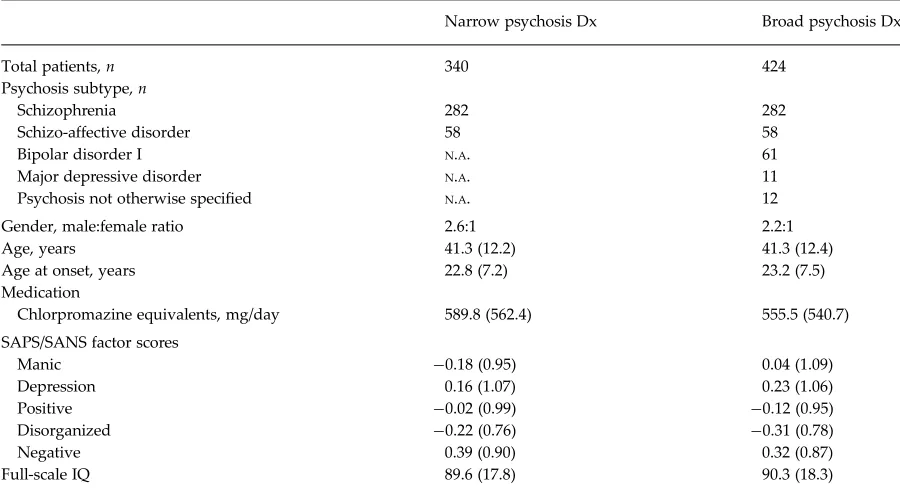
Table 1. Patient demographic characteristics
Narrow psychosis Dx Broad psychosis Dx
Total patients,n 340 424
Psychosis subtype,n
Schizophrenia 282 282
Schizo-affective disorder 58 58
Bipolar disorder I N.A. 61
Major depressive disorder N.A. 11
Psychosis not otherwise specified N.A. 12
Gender, male:female ratio 2.6:1 2.2:1
Age, years 41.3 (12.2) 41.3 (12.4)
Age at onset, years 22.8 (7.2) 23.2 (7.5)
Medication
Chlorpromazine equivalents, mg/day 589.8 (562.4) 555.5 (540.7)
SAPS/SANS factor scores
Manic −0.18 (0.95) 0.04 (1.09)
Depression 0.16 (1.07) 0.23 (1.06)
Positive −0.02 (0.99) −0.12 (0.95)
Disorganized −0.22 (0.76) −0.31 (0.78)
Negative 0.39 (0.90) 0.32 (0.87)
Full-scale IQ 89.6 (17.8) 90.3 (18.3)
Dx, Diagnosis;N.A., not applicable; SAPS, Scale for the Assessment of Positive Symptoms; SANS, Scale for the Assessment of Negative Symptoms, IQ, intelligence quotient.
132 genes were identified (see online Supplementary Table S1);five of these could not be tagged with geno-typed SNPs using the above criteria. Second, alleles within these SNPs were identified as risk or non-risk using data from the PGC-SCZ analysis accord-ing to three different thresholds: p< 10–5, p< 0.05 and p< 0.5. Using a variety of threshold cut-off points for determining risk is in line with procedures used in previous polygenic analysis (International Schizo-phrenia Consortium et al. 2009). Regarding the three thresholds we selected, these are arbitrary and were pragmatically selected to reflect a distribution includ-ing strong (10 × 10–5), nominal (0.05) and non-sig-nificant baseline (0.5) associations. The SNPs were all coded so that the ‘target’ allele was the one posi-tively associated with SZ; hence, the directionality (increased risk) is the same for all SNPs. Third, to ac-count for differences between variants in the effect size of the association with illness, each risk allele was weighted as the log10of the effect size described in the PGC dataset [WSNP= log10 (ORPGC)] (where W = weight and OR = odds ratio). Included variants were not linkage disequilibrium (LD)-pruned; while the strengths and weaknesses of LD-pruning are debat-able, examining all available data including markers in partial LD with other SNPs in the study may in-corporate additional signals that would be missed by pruning the data at an arbitrary correlation threshold. Inclusion of all variants has previously been recom-mended to capture all variation associated with risk (International Schizophrenia Consortium, 2009). Finally, a risk score for each individual was calculated based on the number of weighted risk alleles they carried at each of the three p value thresholds using the equation: score (p< threshold) =Σj(SSNP)/(j–m), where j= number of SNPs at p< threshold, m= number of SNPs with missing genotypes andS= SNP score = allele count * W, where W = weight for each risk allele = log (OR). A risk score for each of the CAM SNPs was calcu-lated as (SSNP= WSNP× risk allele count). The number of missing genotypes was consistently low within eachpvalue threshold [forp< 10–5it was 6 (2.5%), for p< 0.05 it was 44 (0.85%), and for p< 0.5 it was 254 (0.49%)].
Single gene variant selection
As we hypothesized that polygenic risk scores would better explain variance in neuropsychological function than would be explained by single SNP analyses, we planned to follow up any significant neurocognitive
findings from the CAM polygenic analysis by charac-terizing the effects of single SNPs within the CAM pathway on neurocognition. To do this, we selected the most strongly associated single SNPs from each
of the four CAM genes most strongly associated with SZ risk in the PGC analysis. These were:HLA-DQA1 [rs9272105; OR 0.87, p= 9.97 × 10⁻⁹],CDH4(rs2427104; OR 0.90, p= 0.00006), NRXN1 (rs1819972; OR 1.1, p= 0.0004) and CNTNAP2 (rs1548743; OR 0.92, p= 0.0005). Selecting these four variants for analysis was based on an arbitrary cut-off point for statistical association with SZ ofp40.0005. Furthermore, while 11 other HLA genes exceeded this cut-off threshold we only included the most strongly associated given the high LD in this region.
Statistical analysis
Associations between CAM pathway polygenic risk allele scores and the phenotypes of IQ, episodic memory, working memory and attention were tested in a series of multiple regression analyses implemented in SPSS 17 (SPSS Inc., 2008). In each case, scores for each neuropsychological subtest were entered as de-pendent variables, and where appropriate age and gender were entered on thefirst step of the analysis as effects of no interest, followed by CAM pathway risk allele score on the second step. Exactly the same approach was taken in the analysis of the single var-iants, with the risk genotype score (0, 1, or 2 alleles) in each case replacing the polygenic score as the inde-pendent variable. TheR2value, or variance explained, was calculated between these nested models; namely, a model containing the intercept plus gender and age (when appropriate) and the model containing these same terms plus the pathway score. We report this pathway score-specific R2 plus the corresponding F test p value. Finally, effect sizes for all significant effects were calculated using Cohen’s din ClinTools software for Windows (version 4, 2005; http://www. clintools.com) to enable comparison between the poly-genic scores analysis and analysis of the individual SNPs considered.
Results
higher on the manic scale than the narrow psychosis group. No between-group differences were observed in medication dosage as measured by chlorpromazine equivalents.
The effects of CAM pathway risk allele load on cognition
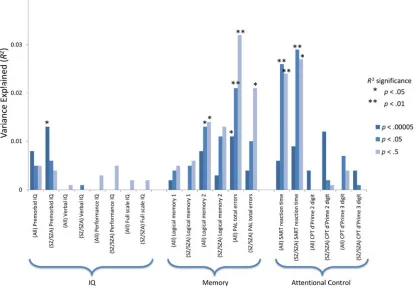
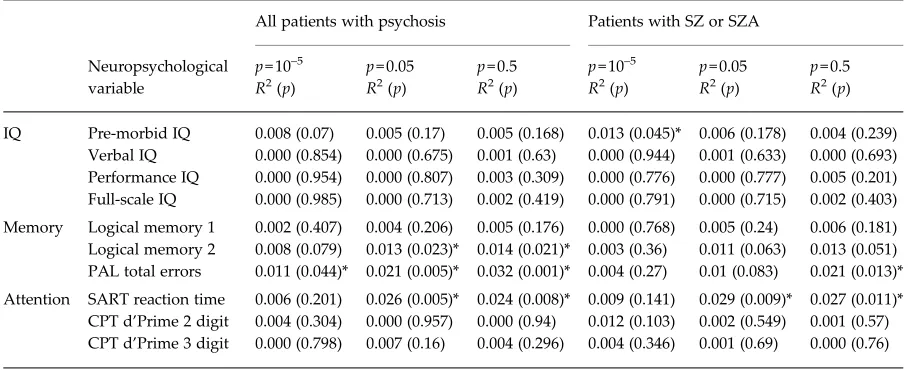
R2change and pvalues from the regression analyses for each of the three cognitive domains of IQ, memory and attention by CAM pathway risk allele load are pre-sented inFig. 1andTable 2. Across both narrow-sense and broad-sense psychosis groups, higher polygenic risk scores within the CAM pathway were significantly associated with deficits in both memory function (as measured by the CANTAB paired associate learning test) and sustained attention (as measured by the SART). For the broad diagnoses groups, CAM path-way risk allele load was also associated with poorer verbal episodic memory function as measured by the WMS-III logical memory task. In the narrow psychosis group, this effect was observed at trend level only. By contrast, the narrow psychosis group showed a nom-inal association between preserved pre-morbid IQ and higher CAM pathway risk polygenic scores (but only for SNPs thresholded at p= 10–5), whereas this
association was only observed at trend level in the broad psychosis group. The amount of variance in cog-nitive performance explained by CAM pathway poly-genic risk scores ranged between 1 and 3% in regression models that were significant, with the high-est percentage of variance explained on the SART attentional control task. Calculated effect sizes (Cohen’s d) for this variance explained ranged from 0.23 to 0.37 with a mean effect size of 0.29.
Cognitive analysis of SZ-associated individual SNPs
within the CAM pathway genesHLA-DQA1, CDH4,
NRXN1andCNTNAP2
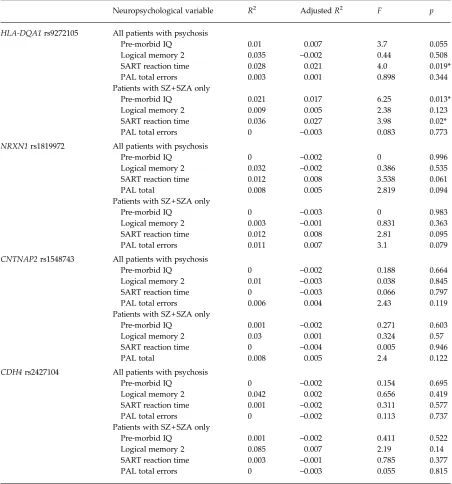
[image:5.595.74.492.74.362.2]We next tested whether variance in neurocognitive function explained by CAM pathway scores was com-parable with that explained by individual SNPs within the CAM pathway. As described above, this was based on the analysis of SNPs within each of the four genes most strongly associated with SZ risk in the PGC analysis: rs9272105 within HLA-DQA1, rs2427104 within CDH4, rs1819972 within NRXN1 and rs1548743 within CNTNAP2 (see Table 3). Only the HLA-DQA1 SNP (the most strongly associated CAM pathway SNP from the PGC analysis and the only vari-ant achieving genome-wide associated significance)
was observed to be associated with variation in neuro-cognitive performance–specifically attentional control in both the narrow and broad diagnosis groups, and pre-morbid IQ in the narrow diagnosis group only. No association with memory function was observed. None of the other variants within CDH4, NRXN1or CNTNAP2 was associated with variation on any of these three neurocognitive measures. Similarly, a com-bined regression analysis that included all four SNPs failed to explain a significant amount of variation on any of these three neurocognitive measures.
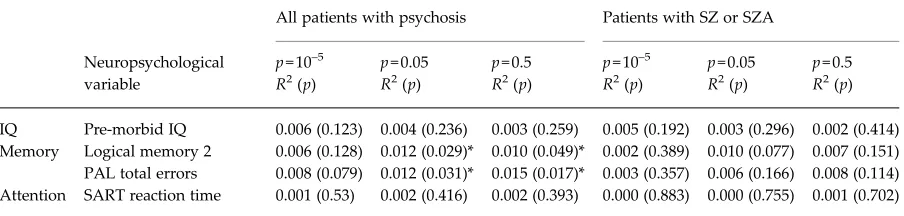
Given the significant contribution of rs9272105 to explaining variation in neuropsychological function-ing, we re-ran our CAM pathway polygenic regression analysis to exclude all variants at this gene locus (resulting in the exclusion of three SNPs). When we re-calculated CAM pathway polygenic risk allele load scores minus these threeHLA-DQA1variants, the as-sociation between the CAM polygenic score and mem-ory largely remained significant (see Table 4). By comparison the association with attentional control was no longer significant. The nominal association with pre-morbid IQ seen in the narrow diagnosis group using the p= 10–5 threshold also became non-significant.
Discussion
This study used polygenic risk allele scores derived from the PGC-SCZAQ8 case-control analysis to inves-tigate whether risk variants within the CAM path-way were associated with poorer neuropsychological
function amongst 424 patients with either narrow-sense or broad-narrow-sense psychosis. We further compared the variation in neuropsychological performance ex-plained by CAM pathway polygenic risk allele scores to the individual CAM pathway variants iden-tified by the PGC as most strongly associated with SZ risk (CDH4, NRXN1, HLA-DQA1andCNTNAP2). Based on these analyses we found that: (1) polygenic scores for the CAM pathway explained a statistically significant proportion of variance in neuropsychologi-cal function; (2) one risk SNP–HLA-DQA1–was also individually associated with variation in neuropsycho-logical function; and (3) after removal of this gene from the polygenic analysis, polygenic risk scores continued to explain variants in memory, but not attentional con-trol. To our knowledge this is thefirst study to charac-terize the effects on neurocognition of risk variants within the CAM pathway–or any other pathway–in patients with SZ.
[image:6.595.71.525.86.271.2]A specific criticism of the single variant approach in studying both illness phenotypes and intermediate phenotypes (including cognition) is that as illness risk is polygenically determined (International Schizophrenia Consortiumet al.2009) the function of single variants cannot be understood in isolation from either other risk variants or from the biological path-ways in which they function. In this context, we investi-gated both whether pathway-based risk estimates significantly account for variation in neuropsycho-logical deficits and, if so, how the amount of variance explained compares with that explained by individual SNP genotypes. When compared with results from
Table 2. CAM pathway polygenic score regression analysis for each neuropsychological variablea
Neuropsychological variable
All patients with psychosis Patients with SZ or SZA
p= 10–5 p= 0.05 p= 0.5 p= 10–5 p= 0.05 p= 0.5
R2(p) R2(p) R2(p) R2(p) R2(p) R2(p)
IQ Pre-morbid IQ 0.008 (0.07) 0.005 (0.17) 0.005 (0.168) 0.013 (0.045)* 0.006 (0.178) 0.004 (0.239) Verbal IQ 0.000 (0.854) 0.000 (0.675) 0.001 (0.63) 0.000 (0.944) 0.001 (0.633) 0.000 (0.693) Performance IQ 0.000 (0.954) 0.000 (0.807) 0.003 (0.309) 0.000 (0.776) 0.000 (0.777) 0.005 (0.201) Full-scale IQ 0.000 (0.985) 0.000 (0.713) 0.002 (0.419) 0.000 (0.791) 0.000 (0.715) 0.002 (0.403)
Memory Logical memory 1 0.002 (0.407) 0.004 (0.206) 0.005 (0.176) 0.000 (0.768) 0.005 (0.24) 0.006 (0.181) Logical memory 2 0.008 (0.079) 0.013 (0.023)* 0.014 (0.021)* 0.003 (0.36) 0.011 (0.063) 0.013 (0.051) PAL total errors 0.011 (0.044)* 0.021 (0.005)* 0.032 (0.001)* 0.004 (0.27) 0.01 (0.083) 0.021 (0.013)*
Attention SART reaction time 0.006 (0.201) 0.026 (0.005)* 0.024 (0.008)* 0.009 (0.141) 0.029 (0.009)* 0.027 (0.011)* CPT d’Prime 2 digit 0.004 (0.304) 0.000 (0.957) 0.000 (0.94) 0.012 (0.103) 0.002 (0.549) 0.001 (0.57) CPT d’Prime 3 digit 0.000 (0.798) 0.007 (0.16) 0.004 (0.296) 0.004 (0.346) 0.001 (0.69) 0.000 (0.76)
CAM, Cell adhesion molecule; SZ, schizophrenia; SZA, schizo-affective disorder; IQ, intelligence quotient; PAL, Paired Associate Learning; SART, Sustained Attention to Response Task; CPT, Continuous Performance Task.
a
single SNP analysis from the four most strongly asso-ciated CAM pathway genes, CAM pathway polygenic scores explained a greater percentage of variance in memory function than the HLA-DQA1 SNP most strongly associated with risk in the PGC analysis, and this variance explained was undiminished after the HLA-DQA1 SNP was removed from the polygenic
score analysis. For attentional control, however, vari-ation on this variable was better explained by the SNP than the pathway.
[image:7.595.72.524.86.570.2]The CAM pathway has previously been implicated in a variety of neurocognitive processes, including memory. Consistent with this, an association with vari-ation on a neurocognitively associated phenotype has
Table 3. Regression analysis for SNPs withinHLA-DQA1, NRXN1, CNTNAP2andCDH4
Neuropsychological variable R2 AdjustedR2 F p
HLA-DQA1rs9272105 All patients with psychosis
Pre-morbid IQ 0.01 0.007 3.7 0.055
Logical memory 2 0.035 –0.002 0.44 0.508
SART reaction time 0.028 0.021 4.0 0.019*
PAL total errors 0.003 0.001 0.898 0.344
Patients with SZ + SZA only
Pre-morbid IQ 0.021 0.017 6.25 0.013*
Logical memory 2 0.009 0.005 2.38 0.123
SART reaction time 0.036 0.027 3.98 0.02*
PAL total errors 0 –0.003 0.083 0.773
NRXN1rs1819972 All patients with psychosis
Pre-morbid IQ 0 –0.002 0 0.996
Logical memory 2 0.032 –0.002 0.386 0.535
SART reaction time 0.012 0.008 3.538 0.061
PAL total 0.008 0.005 2.819 0.094
Patients with SZ + SZA only
Pre-morbid IQ 0 –0.003 0 0.983
Logical memory 2 0.003 –0.001 0.831 0.363
SART reaction time 0.012 0.008 2.81 0.095
PAL total errors 0.011 0.007 3.1 0.079
CNTNAP2rs1548743 All patients with psychosis
Pre-morbid IQ 0 –0.002 0.188 0.664
Logical memory 2 0.01 –0.003 0.038 0.845
SART reaction time 0 –0.003 0.066 0.797
PAL total errors 0.006 0.004 2.43 0.119
Patients with SZ + SZA only
Pre-morbid IQ 0.001 –0.002 0.271 0.603
Logical memory 2 0.03 0.001 0.324 0.57
SART reaction time 0 –0.004 0.005 0.946
PAL total 0.008 0.005 2.4 0.122
CDH4rs2427104 All patients with psychosis
Pre-morbid IQ 0 –0.002 0.154 0.695
Logical memory 2 0.042 0.002 0.656 0.419
SART reaction time 0.001 –0.002 0.311 0.577
PAL total errors 0 –0.002 0.113 0.737
Patients with SZ + SZA only
Pre-morbid IQ 0.001 –0.002 0.411 0.522
Logical memory 2 0.085 0.007 2.19 0.14
SART reaction time 0.003 –0.001 0.785 0.377
PAL total errors 0 –0.003 0.055 0.815
SNP, Single nucleotide polymorphism;HLA-DQA1, major histocompatibility complex, class II, DQα−1;NRXN1, neurexin-1;
CNTNAP2, contactin-associated protein-like-2;CDH4, cadherin-4; IQ, intelligence quotient; SART, Sustained Attention to Response Task; PAL, Paired Associate Learning; SZ, schizophrenia; SZA, schizo-affective disorder.
been reported for three of the four individual genes characterized: CDH4 has been associated with total brain volume (Seshadri et al. 2007), NRXN1 with white matter volume (Voineskos et al. 2011) and CNTNAP2with language processing (Koset al.2012). This is the first study to our knowledge that specifi -cally implicates theHLA-DQA1gene in neuropsycho-logical performance in humans. Beyond these single variant analyses, this is the first study to our knowl-edge that demonstrates the relevance of CAM genes to cognition at the pathway level. Specifically, it high-lights the role of previously identified SZ risk variants within the CAM pathway on cognition in a manner that goes beyond the effects of individual variants. While making this point, two caveats regarding the in-volvement ofHLA-DQA1are relevant. First, while the HLA-DQA1gene is located within the KEGG cell ad-hesion pathway, its demonstrated roles in cell adad-hesion have been confined to the immune system. This is note-worthy because a role for immune-related major histo-compatibility complex class 1 molecules in neuronal plasticity (which is strongly linked to learning and memory) has long been speculated (Shatz, 2009). It should, of course, also be noted that HLA-DQA1 resides in an area of strong LD encompassing many genes, many of which are not involved in cell ad-hesion. In summary, therefore, while this study high-lights the role of CAM genes in cognition, the observed cognitive effects ofHLA-DQA1may occur in-dependently of this pathway.
This finding that pathway-based polygenic risk scores for SZ explain variance in cognition is relevant to the recent debate regarding the genetic overlap be-tween cognitive performance and SZ in particular and psychosis in general. While a high degree of over-lap between cognitive deficits and SZ has previously been inferred from twin studies (Toulopoulou et al.
2007), recent evidence by Fowleret al.(2012) has sug-gested that this may not be quite as high when based on non-biased epidemiological samples. In a polygenic analysis of age-related changes in cognition in healthy adults over time, McIntosh et al. (2013) found that polygenic scores (again based on the PGC-SCZ data-set) significantly predicted about 1% variance in cogni-tive change. In the present study we extend these
findings by demonstrating that polygenic risk scores also predict variance in SZ-related cognitive deficits in patients (about 3%). Furthermore, by focusing on a previously implicated biological pathway our data highlight the relevance of polygenic risk in the CAM pathway, in particular to cognitive deficits in this group. The CAM pathway is unlikely to be unique in this regard–polygenic risk scores analysis based on other pathways is likely to also be informative about cognitive deficits in this group. For example, a recent study by Greenwoodet al. (2011) of 94 candidate SZ genes suggests that glutamate pathway genes are also likely to be important. The approach taken in our study is equally applicable to the study of these other pathways, and may well be informative not just for explaining cognitive deficits in patients, but also for explaining the genetic architecture of cognition in the healthy population.
Conclusion
[image:8.595.73.525.99.207.2]In conclusion this study, building on previous literature adopting either pathway-based or polygenic-based approaches to psychosis risk and cognitive dys-function, investigated the role of pathway-specific risk variants in the cognitive deficits associated with psy-chosis. The data support a role for the CAM pathway in memory formation and attention-related reaction time. The data also provided evidence that a single
Table 4. Recomputation of the regression analyses for the CAM pathway polygenic risk scores without three SNPs mapped to the
HLA-DQA1gene
Neuropsychological variable
All patients with psychosis Patients with SZ or SZA
p= 10–5 p= 0.05 p= 0.5 p= 10–5 p= 0.05 p= 0.5
R2(p) R2(p) R2(p) R2(p) R2(p) R2(p)
IQ Pre-morbid IQ 0.006 (0.123) 0.004 (0.236) 0.003 (0.259) 0.005 (0.192) 0.003 (0.296) 0.002 (0.414) Memory Logical memory 2 0.006 (0.128) 0.012 (0.029)* 0.010 (0.049)* 0.002 (0.389) 0.010 (0.077) 0.007 (0.151) PAL total errors 0.008 (0.079) 0.012 (0.031)* 0.015 (0.017)* 0.003 (0.357) 0.006 (0.166) 0.008 (0.114) Attention SART reaction time 0.001 (0.53) 0.002 (0.416) 0.002 (0.393) 0.000 (0.883) 0.000 (0.755) 0.001 (0.702)
CAM, Cell adhesion molecule; SNP, single nucleotide polymorphism;HLA-DQA1, major histocompatibility complex, class II, DQα−1; SZ, schizophrenia; SZA, schizo-affective disorder; IQ, intelligence quotient; PAL, Paired Associate Learning; SART, Sustained Attention to Response Task.
SNP–in HLA-DQA1–was also associated with vari-ation in attentional control, and to a lesser extent pre-morbid IQ, in psychotic patients. In doing so, this study demonstrates the feasibility of pathway-specific polygenic risk analysis to studying an intermediate phenotype for psychosis, while at the same time sug-gesting that single gene analysis nonetheless continues to be informative about gene effects on cognition.
Supplementary material
For supplementary material accompanying this paper visit http://dx.doi.org/10.1017/S0033291713002663.
Acknowledgements
We thank all patients and staff who participated in the collection of patient data. We thank Professor Ted Dinan, Professor Kieran Murphy, Professor John Waddington, Professor Colm McDonald, Professor Eadbhard O’Callaghan, and Dr Anthony O’Neil for their participation in recruitment of samples. Re-cruitment of the participants was supported by funding awards; funding for this study was provided by the Wellcome Trust Case Control Consortium 2 project (no. 085475/B/08/Z and 085475/Z/08/Z), the Wellcome Trust (no. 072894/Z/03/Z, 090532/Z/09/Z and 075491/Z/04/B) and Science Foundation Ireland (SFI) to A.C. and M.G. and a Health Research Board (Ireland) grant to G.D. (HRA/2009/197). The work of K.K.N. is supported by Science Foundation Ireland and Marie Curie Actions (COFUND).
Members of Wellcome Trust Case Control Consortium 2 and Schizophrenia Psychiatric GWAS Consortium co-authors can be found in the online Supplementary material.
Declaration of Interest
None.
References
Bellenguez C, Bevan S, Gschwendtner A, Spencer CC, Burgess AI, Pirinen M, Jackson CA, Traylor M, Strange A, Su Z, Band G, Syme PD, Malik R, Pera J, Norrving B, Lemmens R, Freeman C, Schanz R, James T, Poole D, Murphy L, Segal H, Cortellini L, Cheng YC, Woo D, Nalls MA, Muller-Myhsok B, Meisinger C, Seedorf U, Ross-Adams H, Boonen S, Wloch-Kopec D, Valant V, Slark J, Furie K, Delavaran H, Langford C, Deloukas P, Edkins S, Hunt S, Gray E, Dronov S, Peltonen L, Gretarsdottir S, Thorleifsson G, Thorsteinsdottir U, Stefansson K, Boncoraglio GB, Parati EA, Attia J, Holliday E, Levi C, Franzosi MG, Goel A, Helgadottir A, Blackwell JM, Bramon E, Brown MA, Casas JP, Corvin A,
Duncanson A, Jankowski J, Mathew CG, Palmer CN, Plomin R, Rautanen A, Sawcer SJ, Trembath RC, Viswanathan AC, Wood NW, Worrall BB, Kittner SJ, Mitchell BD, Kissela B, Meschia JF, Thijs V, Lindgren A, Macleod MJ, Slowik A, Walters M, Rosand J, Sharma P, Farrall M, Sudlow CL, Rothwell PM, Dichgans M, Donnelly P, Markus HS(2012). Genome-wide association study identifies a variant in HDAC9 associated with large vessel ischemic stroke.Nature Genetics44, 328–333.
Cambon K, Hansen SM, Venero C, Herrero AI, Skibo G, Berezin V, Bock E, Sandi C(2004). A synthetic neural cell adhesion molecule mimetic peptide promotes synaptogenesis, enhances presynaptic function, and facilitates memory consolidation.Journal of Neuroscience24, 4197–4204.
Cornblatt BA, Risch NJ, Faris G, Friedman D, Erlenmeyer-Kimling L(1988). The Continuous
Performance Test, identical pairs version (CPT-IP): I. New
findings about sustained attention in normal families.
Psychiatry Research26, 223–238.
Cummings E, Donohoe G, Hargreaves A, Moore S, Fahey C, Dinan TG, McDonald C, O’Callaghan E, O’Neill FA, Waddington JL, Murphy KC, Morris DW, Gill M, Corvin A(2013). Mood congruent psychotic symptoms and specific cognitive deficits in carriers of the novel
schizophrenia risk variant at MIR-137.Neuroscience Letters
532, 33–38.
Dean C, Scholl FG, Choih J, DeMaria S, Berger J, Isacoff E, Scheiffele P(2003). Neurexin mediates the assembly of presynaptic terminals.Nature Neuroscience6, 708–716. First M, Spitzer R, Gibbon M, Williams J(2002).Structured
Clinical Interview for DSM-IV-TR Axis I Disorders, Research Version, Patient Edition(SCID-I/P). Biometrics Research, New York State Psychiatric Institute: New York.
Fowler T, Zammit S, Owen MJ, Rasmussen F(2012). A population-based study of shared genetic variation between premorbid IQ and psychosis among male twin pairs and sibling pairs from Sweden.Archives of General Psychiatry69, 460–466.
Friedman JI, Vrijenhoek T, Markx S, Janssen IM, van der Vliet WA, Faas BH, Knoers NV, Cahn W, Kahn RS, Edelmann L, Davis KL, Silverman JM, Brunner HG, van Kessel AG, Wijmenga C, Ophoff RA, Veltman JA(2008). CNTNAP2 gene dosage variation is associated with schizophrenia and epilepsy.Molecular Psychiatry13, 261–266.
Greenwood TA, Lazzeroni LC, Murray SS, Cadenhead KS, Calkins ME, Dobie DJ, Green MF, Gur RE, Gur RC, Hardiman G, Kelsoe JR, Leonard S, Light GA, Nuechterlein KH, Olincy A, Radant AD, Schork NJ, Seidman LJ, Siever LJ, Silverman JM, Stone WS, Swerdlow NR, Tsuang DW, Tsuang MT, Turetsky BI, Freedman R, Braff DL(2011). Analysis of 94
candidate genes and 12 endophenotypes for schizophrenia from the Consortium on the Genetics of Schizophrenia.American Journal of Psychiatry168, 930–946.
Sullivan PF, Sklar P (2009).Common polygenic variation contributes to risk of schizophrenia and bipolar disorder.
Nature460, 748–752.
Irish Schizophrenia Genomics Consortium(2012).
Genome-wide association study implicates HLA-C*01:02 as a risk factor at the major histocompatibility complex locus in schizophrenia.Biological Psychiatry72, 620–628. Jia P, Wang L, Fanous AH, Chen X, Kendler KS, Zhao Z
(2012). A bias-reducing pathway enrichment analysis of genome-wide association data confirmed association of the MHC region with schizophrenia.Journal of Medical Genetics
49, 96–103.
Kirov G, Pocklington AJ, Holmans P, Ivanov D, Ikeda M, Ruderfer D, Moran J, Chambert K, Toncheva D, Georgieva L, Grozeva D, Fjodorova M, Wollerton R, Rees E, Nikolov I, van de Lagemaat LN, Bayes A, Fernandez E, Olason PI, Bottcher Y, Komiyama NH, Collins MO, Choudhary J, Stefansson K, Stefansson H, Grant SG, Purcell S, Sklar P, O’Donovan MC, Owen MJ
(2012).De novoCNV analysis implicates specific abnormalities of postsynaptic signalling complexes in the pathogenesis of schizophrenia.Molecular Psychiatry17, 142–153.
Kos M, van den Brink D, Snijders TM, Rijpkema M, Franke B, Fernandez G, Hagoort P(2012). CNTNAP2 and language processing in healthy individuals as measured with ERPs.PLOS ONE7, e46995.
Lips ES, Cornelisse LN, Toonen RF, Min JL, Hultman CM, Holmans PA, O’Donovan MC, Purcell SM, Smit AB, Verhage M, Sullivan PF, Visscher PM, Posthuma D
(2012). Functional gene group analysis identifies synaptic gene groups as risk factor for schizophrenia.Molecular Psychiatry17, 996–1006.
McGuffin P, Farmer A, Harvey I(1991). A polydiagnostic application of operational criteria in studies of psychotic illness: development and reliability of the OPCRIT system.
Archives of General Psychiatry48, 764–770.
McIntosh AM, Gow A, Luciano M, Davies G, Liewald DC, Harris SE, Corley J, Hall J, Starr JM, Porteous DJ, Tenesa A, Visscher PM, Deary IJ(2013). Polygenic risk for schizophrenia is associated with cognitive change between childhood and old age.Biological Psychiatry73, 938–943. O’Dushlaine C, Kenny E, Heron E, Donohoe G, Gill M, Morris D, Corvin A(2011). Molecular pathways involved in neuronal cell adhesion and membrane scaffolding contribute to schizophrenia and bipolar disorder susceptibility.Molecular Psychiatry16, 286–292.
Ripke S, Sanders AR, Kendler KS, Levinson DF, Sklar P, Holmans PA, Lin DY, Duan J, Ophoff RA,
Andreassen OA, Scolnick E, Cichon S, St Clair D, Corvin A, Gurling H, Werge T, Rujescu D, Blackwood DH, Pato CN, Malhotra AK, Purcell S, Dudbridge F, Neale BM, Rossin L, Visscher PM, Posthuma D, Ruderfer DM, Fanous A, Stefansson H, Steinberg S, Mowry BJ, Golimbet V, De Hert M, Jonsson EG, Bitter I, Pietilainen OP, Collier DA, Tosato S, Agartz I, Albus M, Alexander M, Amdur RL, Amin F, Bass N, Bergen SE, Black DW, Borglum AD, Brown MA, Bruggeman R, Buccola NG, Byerley WF, Cahn W, Cantor RM, Carr VJ,
Catts SV, Choudhury K, Cloninger CR, Cormican P, Craddock N, Danoy PA, Datta S, de Haan L, Demontis D, Dikeos D, Djurovic S, Donnelly P, Donohoe G, Duong L, Dwyer S, Fink-Jensen A, Freedman R, Freimer NB, Friedl M, Georgieva L, Giegling I, Gill M, Glenthoj B, Godard S, Hamshere M, Hansen M, Hansen T, Hartmann AM, Henskens FA, Hougaard DM,
Hultman CM, Ingason A, Jablensky AV, Jakobsen KD, Jay M, Jurgens G, Kahn RS, Keller MC, Kenis G, Kenny E, Kim Y, Kirov GK, Konnerth H, Konte B, Krabbendam L, Krasucki R,et al. (2011). Genome-wide association study identifiesfive new schizophrenia loci.
Nature Genetics43, 969–976.
Robbins TW, James M, Owen AM, Sahakian BJ, McInnes L, Rabbitt P(1994). Cambridge Neuropsychological Test Automated Battery (CANTAB): a factor analytic study of a large sample of normal elderly volunteers.Dementia5, 266–281.
Robertson I(1994).Sustained Attention to Response Task (SART). Trinity College Dublin: Dublin.
Rujescu D, Ingason A, Cichon S, Pietilainen OP, Barnes MR, Toulopoulou T, Picchioni M, Vassos E, Ettinger U, Bramon E, Murray R, Ruggeri M, Tosato S, Bonetto C, Steinberg S, Sigurdsson E, Sigmundsson T, Petursson H, Gylfason A, Olason PI, Hardarsson G, Jonsdottir GA, Gustafsson O, Fossdal R, Giegling I, Moller HJ, Hartmann AM, Hoffmann P, Crombie C, Fraser G, Walker N, Lonnqvist J, Suvisaari J, Tuulio-Henriksson A, Djurovic S, Melle I,
Andreassen OA, Hansen T, Werge T, Kiemeney LA, Franke B, Veltman J, Buizer-Voskamp JE, Sabatti C, Ophoff RA, Rietschel M, Nothen MM, Stefansson K, Peltonen L, St Clair D, Stefansson H, Collier DA
(2009). Disruption of the neurexin 1 gene is
associated with schizophrenia.Human Molecular Genetics
18, 988–996.
Seshadri S, DeStefano AL, Au R, Massaro JM, Beiser AS, Kelly-Hayes M, Kase CS, D’Agostino RB Sr, Decarli C, Atwood LD, Wolf PA(2007). Genetic correlates of brain aging on MRI and cognitive test measures: a genome-wide association and linkage analysis in the Framingham Study.
BMC Medical Genetics8(Suppl. 1), S15.
Shatz CJ(2009). MHC class I: an unexpected role in neuronal plasticity.Neuron64, 40–45.
Soronen P, Ollila HM, Antila M, Silander K, Palo OM, Kieseppa T, Lonnqvist J, Peltonen L,
Tuulio-Henriksson A, Partonen T, Paunio T(2010). Replication of GWAS of bipolar disorder: association of SNPs near CDH7 with bipolar disorder and visual processing.MolecularPsychiatry15, 4–6.
SPSS(2008).SPSS 16.0 Command Syntax Reference. SPSS Inc.: Chicago.
Sun C, Cheng MC, Qin R, Liao DL, Chen TT, Koong FJ, Chen G, Chen CH(2011). Identification and functional characterization of rare mutations of the neuroligin-2 gene (NLGN2) associated with schizophrenia.Human Molecular Genetics20, 3042–3051.
overlap between neurocognition and schizophrenia: genetic modeling in twin samples.Archives of General Psychiatry64, 1348–1355.
Voineskos AN, Lett TA, Lerch JP, Tiwari AK, Ameis SH, Rajji TK, Muller DJ, Mulsant BH, Kennedy JL(2011). Neurexin-1 and frontal lobe white matter: an overlapping intermediate phenotype for schizophrenia and autism spectrum disorders.PLoS One6, e20982.
Wang K, Zhang H, Ma D, Bucan M, Glessner JT, Abrahams BS, Salyakina D, Imielinski M, Bradfield JP, Sleiman PM, Kim CE, Hou C, Frackelton E, Chiavacci R, Takahashi N, Sakurai T, Rappaport E, Lajonchere CM, Munson J, Estes A, Korvatska O, Piven J, Sonnenblick LI, Alvarez Retuerto AI, Herman EI, Dong H, Hutman T,
Sigman M, Ozonoff S, Klin A, Owley T, Sweeney JA, Brune CW, Cantor RM, Bernier R, Gilbert JR, Cuccaro ML, McMahon WM, Miller J, State MW, Wassink TH, Coon H, Levy SE, Schultz RT, Nurnberger JI, Haines JL, Sutcliffe JS, Cook EH, Minshew NJ, Buxbaum JD, Dawson G, Grant SF, Geschwind DH, Pericak-Vance MA, Schellenberg GD, Hakonarson H(2009). Common genetic variants on 5p14.1 associate with autism spectrum disorders.Nature459, 528–533.
Wechsler D(1997a).Wechsler Adult Intelligence Test, 3rd edn (WAIS-III). Harcourt Assessment: San Antonio.