Proceedings of NAACL-HLT 2018, pages 942–952
Neural Syntactic Generative Models with Exact Marginalization
Jan Buys1,2and Phil Blunsom1,3
1Department of Computer Science, University of Oxford
2Paul G. Allen School of Computer Science & Engineering, University of Washington 3DeepMind
[email protected], [email protected]
Abstract
We present neural syntactic generative mod-els with exact marginalization that support both dependency parsing and language mod-eling. Exact marginalization is made tractable through dynamic programming over shift-reduce parsing and minimal RNN-based fea-ture sets. Our algorithms complement previ-ous approaches by supporting batched train-ing and enabltrain-ing online computation of next word probabilities. For supervised depen-dency parsing, our model achieves a state-of-the-art result among generative approaches. We also report empirical results on unsuper-vised syntactic models and their role in lan-guage modeling. We find that our model for-mulation of latent dependencies with exact marginalization do not lead to better intrinsic language modeling performance than vanilla RNNs, and that parsing accuracy is not cor-related with language modeling perplexity in stack-based models.
1 Introduction
We investigate the feasibility of neural syntactic generative models with structured latent variables in which exact inference is tractable. Recent mod-els have added structure to recurrent neural net-works at the cost of giving up exact inference, or through using soft structure instead of latent vari-ables (Dyer et al., 2016; Yogatama et al., 2016; Grefenstette et al., 2015). We propose genera-tive models in which syntactic structure is mod-elled with a discrete stack which can be marginal-ized as a latent variable through dynamic program-ming. This enables us to investigate the trade-off between model expressivity and exact marginal-ization in probabilistic models based on recurrent neural networks (RNNs).
While Long Short-term Memory (Hochreiter and Schmidhuber, 1997) (LSTM) RNNs have
driven strong improvements in intrinsic language modelling performance, they fail at capturing cer-tain long-distance dependencies, such as those required for modelling subject-verb agreement (Linzen et al.,2016) or performing synthetic trans-duction tasks based on context-free grammars (Grefenstette et al., 2015). We propose genera-tive models, based on transition-based dependency parsing (Nivre, 2008), a widely used framework for incremental syntactic parsing, that are able to capture desirable dependencies.
Our generative approach to dependency parsing encodes sentences with an RNN and estimate tran-sition and next word probability distributions by conditioning on a small number of features resented by RNN encoder vectors. In contrast to pre-vious syntactic language models such as RNNG (Dyer et al., 2016), marginal word probabilities can be computed both online and exactly. A GPU implementation which exploits parallelization en-ables unsupervised learning and fast training and decoding. The price of exact inference is that our models are less expressive than RNNG, as the re-currence is not syntax-dependent.
Our generative models are based on the arc-eager and arc-hybrid transition systems, with O(n3) dynamic programs based on Kuhlmann
et al. (2011). Previous work on dynamic pro-gramming for transition-based parsing either re-quired approximate inference due to a too high polynomial order run-time complexity (Huang and Sagae,2010), or had too restrictive feature spaces to be used as accurate models (Kuhlmann et al., 2011;Cohen et al., 2011). Recent work showed that bidirectional RNNs enable accurate graph-based and transition-graph-based dependency parsing using minimal feature spaces (Kiperwasser and Goldberg, 2016; Cross and Huang, 2016; Dozat and Manning, 2017). Shi et al. (2017) further showed that under this approach exact decoding
ROOT The girls from school play football det
nsubj
case nmod root
[image:2.595.308.526.63.253.2]obj
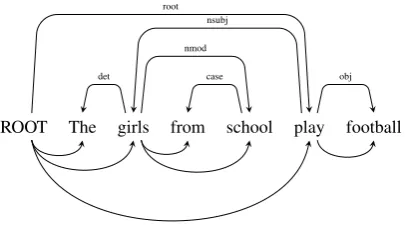
Figure 1: A dependency tree (arcs above words) to-gether with dependencies captured by the generative model for word prediction (arcs below words).
and globally-normalized discriminative training is tractable with dynamic programming.
While discriminative neural network-based models obtain state-of-the-art parsing accura-cies (Dozat and Manning,2017), generative mod-els for structured prediction have a number of ad-vantages: They do not suffer from label bias or explaining away effects (Yu et al., 2017), have lower sample complexity (Yogatama et al.,2017), are amenable to unsupervised learning and can model uncertainty and incorporate prior knowl-edge through latent variables.
As a supervised parser our model obtains state of the art performance in transition-based gener-ative dependency parsing. While its intrinsic lan-guage modelling performance is worse than that of a well-tuned vanilla RNN, we see that the formu-lation of the generative model has a large impact on both the informedness of the syntactic structure and the parsing accuracy of the model. Further-more, there is a discrepancy between the model structure most suitable for parsing and for lan-guage modeling. Our analysis shows that there ex-ist informative syntactically-motivated dependen-cies which LSTMs are not capturing, even though our syntactic models are not able to predict them accurately enough during online processing to prove language modelling performance. Our im-plementation is available athttps://github. com/janmbuys/ndp-parser.
2 Generative shift-reduce parsing
We start by defining a shift-reduce transition sys-tem which does not predict dependency arcs, but simply processes the words in a sentence left to right through shifting words onto a stack and re-ducing (popping) them from the stack. We define
Stackσ Indexβ−1 Prediction
ROOT ROOT sh(The)
ROOT, The The la(det)
ROOT The sh(girls)
ROOT, girls girls sh(from)
ROOT, girls, from from la(case)
ROOT, girls from sh(school)
ROOT, girls, school school ra(nmod)
ROOT, girls school la(nsubj)
ROOT school sh(play)
ROOT, play play sh(football)
ROOT, play, football football ra(obj)
ROOT, play football ra(root)
ROOT football re
Table 1: Arc-hybrid transition system derivation for the sentence “The girls from school play football.” The transitions are shift (sh), reduce (re), left-arc (la) and right-arc (ra).
a generative model for this transition system and a dynamic program to perform inference over all possible shift-reduce transitions to process a given sentence. An example dependency tree is given in Figure1, along with the dependencies our genera-tive model is capturing when making word predic-tions. The arc-hybrid transition sequence for the example is given in Table1.
Let sentence w0:n be a sequence of words,
where w0 is always the designated root symbol
ROOT and wn the end-of-sentence symbol EOS.
The state variables of the transition system are the stackσ, consisting of word indexes, and a current word indexβ, also referred to as the buffer. The first and second elements on the stack are referred to as σ0 and σ1, respectively. We use the nota-tion σ|j to indicate thatj is on top of the stack. The initial state(σ, β)is([0],1)and the final state
is ([], n). There are two transition actions, shift
andreduce. Shift updates the transition state from
(σ, j) to (σ|j, j + 1). Reduce changes the state
from(σ|i, j)to(σ, j).
2.1 Generative model
The generative model for this transition system is defined by a probability distribution overw,
p(w) =X
t
p(w0:n,t0:2n), (1)
wheret0:2nis a transition sequence that processes
[image:2.595.78.281.65.178.2]end-of-sentence symbol is generated implicitly when
ROOTis reduced from the stack.
The sentence is encoded left-to-right by an LSTM RNN taking the word embedding of the last predicted word as input at each time step, indepen-dent oft. The RNN hidden statesh0:nrepresent
each sentence position in its linear context. The probability of a shift action and the word that it predicts is
ptr(sh|hσ0, hβ−1)pgen(w|hσ0, hβ−1).
Reduce is predicted with probability ptr(re|hσ0, hβ−1) = 1−ptr(sh|hσ0, hβ−1).
The transition and word probability distribu-tions are estimated by non-linear output layers that take the context-depending RNN representations of positions in the transition system as input,
ptr =sigmoid(rTrelu(Wtshσ0+Wtbhβ−1)) (2) pgen=softmax(RTtanh(Wgshσ0 +Wtbhβ−1)),
(3)
whereRand theW’s are neural network parame-ter matrices andris a parameter vector.
The model has two ways of representing con-text: The RNN encoding, which has a recency bias, and the stack, which can represent long range dependencies and has a syntactic distance bias. The choice of RNN states (corresponding to stack elements) to condition on is restricted by our goal of making the dynamic programming tractable.
We propose two formulations of the generative model: In the first, referred to asstack-next, shift generates the word pushed on the stack, which is currently at positionβ, as in the equations above. In the second formulation, referred to as buffer-next, shift generates the word at positionβ+1, i.e.,
the next word on the buffer. The first formulation has a more intuitive generative story as the genera-tion of a word is condigenera-tioned on the top of the stack when it is generated (see Table 1), but the sec-ond formulation has the advantage that transition predictions are conditioned on the current word at positionβ, which is more informative for parsing predictions. Models are defined using stack-next
unless stated otherwise.
2.2 Dynamic program
We now define a dynamic program for this model, based on the algorithms proposed by Kuhlmann
et al.(2011) and their application to generative de-pendency parsing (Cohen et al.,2011).
The key to the dynamic program is the decom-position of the transition sequence intopush com-putations. Each push computation is a sequence of transitions which results in a single node hav-ing been pushed to the stack. The simplest push computation is a single shift operation. Push com-putations can be composed recursively: combin-ing two consecutive push computations followed by a reduce transition yields a new push opera-tion. Therefore the derivation of a sentence under the transition system can be seen as a composition of push computations.
Items in the deduction system (Shieber et al., 1995) of the dynamic program have the form[i, j],
which has the interpretation that there exists a push computation between actionsak andal such that
β = i at time stepk andσ0 = iand β = j at time step l. In the deduction system [0,1] is an
axiom, [0, n] is the goal and the deduction rules
corresponding to the transitions are
[i, j−1]→[j−1, j] (shift) [i, k][k, j]→[i, j] (reduce).
The marginal probability distribution is com-puted by defining the inside score I(i, j) =
p(wi:j−1)for every deduction system item. Com-puting the sentence probability corresponds to computing the inside score of the goal,I(0, n) =
p(w0:n−1), followed by computing the final re-duce probability.
Reduce probabilities are computed conditioned on positionskandj, which are accessible through the dynamic program deduction rule. However the shift probabilities cannot be computed at theshift
rule for deducing [j −1, j], as it does not have
access there to the top of the stack. One solution is to extend the deduction system to a three-tuple that can track the value of an additional position, leading to aO(n4)dynamic program. InsteadShi
et al.(2017) showed that the computation can be performed in the O(n3) algorithm by computing
the shift probability of wordk during thereduce deduction, as it was generated wheniwas on top of the stack. The inside algorithm is given in Al-gorithm1.
To train the model without supervised transition sequences, we can optimize the negative log like-lihood ofp(w0:n)directly with gradient-based
Algorithm 1Inside algorithm for the shift-reduce transition-based generative model.
1: I(0,1)←1 2: forj= 2, . . . , ndo 3: I(j−1, j)←1 4: fori=j−2, . . . ,0do 5: fork=i+ 1, . . . , j−1do
6: T(k)←ptr(sh|hi, hk−1)pgen(wk|hi, hk−1) 7: end for
8: I(i, j)←Pjk−=1i+1I(i, k)I(k, j)ptr(re|hk, hj−1)T(k) 9: end for
10:end for
11:returnI(0, n) +ptr(re|h0, hn−1)
is equivalent to computing the gradients with the outside algorithm (Eisner,2016). For decoding we perform Viterbi search over the dynamic program by maximizing rather than summing over different split positions (values ofkwhen reducing).
The buffer-next generative formulation, where shift generates the next wordβ, can also be com-puted with the dynamic program. Herew1 is pre-dicted at the initial state inI(0,1), while the
end-of-sentence token is generated explicitly when a shift action results in buffer being set to position n, regardless of the state of the stack.
3 Transition-based dependency parsing The arc-eager (Nivre, 2008) and arc-hybrid (Kuhlmann et al., 2011) transition systems for projective dependency parsing use the same shift-reduce operations but predict left- and right-arcs at different time steps. We propose gen-erative models for these transition systems based on the dynamic program for shift-reduce parsing proposed above, again followingKuhlmann et al. (2011). For supervised training we optimize the joint probability distribution p(w,t), where an
oracle is used to derive transition sequence t
from the training examples. In cases of spurious ambiguity arcs are added as soon as possible.
3.1 Arc-hybrid parser
The arc-hybrid transition system has three actions: Shift, left-arc and right-arc (see Table 2 for def-initions). Left-arc and right-arc are both reduce actions, but they add arcs between different word pairs. Arc label predictions are conditioned on the same context as transition predictions. Right-arc adds a dependency of which σ1 is the head, but the dynamic program does not allow conditioning on it when making transition decisions. However, we found that this does not actually decrease per-formance.
The dynamic program for the arc-hybrid parser has the same structure as the shift-reduce model. The marginal probability is independent of arc di-rectionality, as it does not influence future deci-sions. Consequently unsupervised training based on this model cannot learn to predict arc direc-tions. Exact decoding is performed with the Viterbi algorithm: At every item[i, j]the highest
scoring arc direction is recorded. After the most likely transition sequence is extracted, arc labels are predicted greedily.
3.2 Arc-eager parser
The arc-eager parser has four transitions, as de-fined in Table 2. Shift andright-arcare shift ac-tions, whileleft-arcandreduceare reduce actions. However the two reduce actions, reduce and left-arc, are always mutually exclusive; the former is only valid if the stack top has already been as-signed a head (through a previous right-arc) and the latter only if the stack top is not headed. To keep track of which actions are valid, the state configuration and the dynamic program are aug-mented to record whether elements on the stack are headed. As with arc-hybrid, we decompose the transition probability into deciding between shift-ing and reducshift-ing, and then predictshift-ing direction-ality. In this case, the shift decision decomposes into shift andright-arc transitions, where shift is implicitly deciding that the shifted word will be reduced through a left-arc. Consequently the only real difference between the hybrid and arc-eager transition systems under dynamic program-ming is the information conditioned on when arc directionality is predicted.
A different deduction system is defined for arc-eager, although it follows the same structure as the shift-reduce one. Items have the form[ic, j],
where c is a binary variable indicating whether nodeiis headed. The axiom and goal are[00, n]
and[00,1], respectively. The deduction rules are
[ic, j]→[j0, j+ 1] (shift)
[ic, j]→[j1, j+ 1] (right-arc)
[ic, k][k0, j]→[ic, j] (left-arc) [ic, k][k1, j]→[ic, j] (reduce)
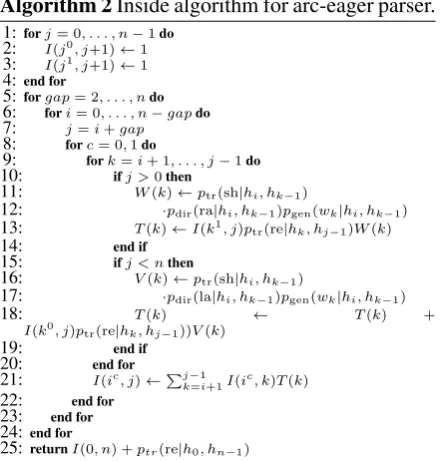
The inside algorithm for arc-eager parsing is given in Algorithm2. The algorithm is structured such that the inner loop computations (lines8−22)
Action State before State after Arc added Probability
Shift (σ|i, j) (σ|i|j, j+ 1) - ptr(sh|hi, hj−1)pgen(wj|hi, hj−1) Left-arc (σ|i, j) (σ, j) j→i ptr(re|hi, hj−1)pdir(la|hi, hj−1) Right-arc (σ|l|i, j) (σ|l, j) l→i ptr(re|hi, hj−1)pdir(ra|hi, hj−1)
Shift (σ|ib, j) (σ|ib|j0, j+ 1) - p
tr(sh|hi, hj−1)pdir(la|hi, hj−1)pgen(wj|hi, hj−1) Right-arc (σ|ib, j) (σ|ib|j1, j+ 1) i→j p
tr(sh|hi, hj−1)pdir(ra|hi, hj−1)pgen(wj|hi, hj−1)
Left-arc (σ|i0, j) (σ, j) j→i p
tr(re|hi, hj−1)
Reduce (σ|i1, j) (σ, j) - p
[image:5.595.72.293.219.450.2]tr(re|hi, hj−1)
Table 2: The arc-hybrid (above) and arc-eager (below) transition systems. States represent (stack, current index).
Algorithm 2Inside algorithm for arc-eager parser. 1: forj= 0, . . . , n−1do
2: I(j0, j+1)
←1 3: I(j1, j+1)
←1 4: end for
5: forgap= 2, . . . , ndo 6: fori= 0, . . . , n−gapdo 7: j=i+gap
8: forc= 0,1do
9: fork=i+ 1, . . . , j−1do 10: ifj >0then
11: W(k)←ptr(sh|hi, hk−1)
12: ·pdir(ra|hi, hk−1)pgen(wk|hi, hk−1) 13: T(k)←I(k1, j)p
tr(re|hk, hj−1)W(k) 14: end if
15: ifj < nthen
16: V(k)←ptr(sh|hi, hk−1)
17: ·pdir(la|hi, hk−1)pgen(wk|hi, hk−1)
18: T(k) ← T(k) +
I(k0, j)p
tr(re|hk, hj−1))V(k) 19: end if
20: end for 21: I(ic, j)
←Pjk−=1i+1I(i
c, k)T(k)
22: end for 23: end for 24:end for
25:returnI(0, n) +ptr(re|h0, hn−1)
GPU implementation. Atβ=n, the dynamic
pro-gram is restricted to allow only reduce transitions, requiring the remaining stack elements (apart from
ROOT) to be headed. The Viterbi algorithm again follows the same structure as the inside algorithm: For every item[ic, j]the highest scoring splitting
itemkb is recorded, wherekis the splitting point andbindicates whether wordk is headed or not, which corresponds to whether a reduce or left-arc is performed.
4 Experiments
We follow the standard setup for English depen-dency parsing, training on sections 2-21 of the
Penn Treebank (PTB) Wall Street Journal cor-pus, using section 22 for development and
sec-tion 23 for testing. Dependency trees follow the
Stanford dependency (SD) representation (version 3.3.0) used in recent parsing research (Chen and Manning, 2014; Dyer et al., 2015). We also re-port some results using the older representation
ofYamada and Matsumoto(2003) (YM). We fol-low Buys and Blunsom (2015b) and Dyer et al. (2016) in replacing training singletons and un-known words in the test set with unun-known word class tokens based to their surface forms, follow-ing the rules implemented in the Berkeley parser.1
Our models are implemented in PyTorch, which constructs computation graphs dynamically.2
Dur-ing trainDur-ing, sentences are shuffled at each epoch, and minibatches are constructed of sentences of the same length. We base the hyperparameters of our models primarily on the language models of Zaremba et al.(2014). Models are based on two-layer LSTMs with embedding and hidden state size 650with dropout of 0.5 on the RNN inputs
and outputs. For all models weights are initial-ized randomly from the uniform distribution over
[−0.05,0.05]. Gradient norms are clipped to5.0.
The supervised parsers are trained with batch size
16, with an initial learning rate 1.0, which is
de-creased by a factor of 1.7 for every epoch after 6 initial epochs. The sequential LSTM baseline
is trained with the same parameters, except that the learning rate decay is1.4. The unsupervised models are trained with an initial learning rate0.1,
which is decreased by a factor of 2.0 for every
epoch, with batch size8.
We train and execute our models on a GPU, obtaining significant speed improvements over CPUs. For supervised training we also perform batch processing: After the sentences are encoded with an RNN, we extract the inputs to the transi-tion, word and relation prediction models across the batch, and then perform the neural network computations in parallel. The supervised models’ training speed is about3minutes per epoch.
1http://github.com/slavpetrov/
berkeleyparser
Model Greedy Exact Arc-Hybrid uniRNN 84.12/81.54 84.21/81.61 Arc-Eager uniRNN 79.90/77.67 81.37/79.08 Arc-Hybrid biRNN 92.85/90.42 92.89/90.47 Arc-Eager biRNN 92.82/90.63 92.90/90.68
Arc-Hybrid Gen stack-next 56.98/52.22 82.77/78.01 Arc-Hybrid Gen buffer-next 85.25/82.83 91.19/88.66
[image:6.595.74.294.63.154.2]Arc-Eager Gen buffer-next 80.79/78.56 87.34/84.84
Table 3: PTB development set parsing results (SD dependencies), reporting unlabelled and labelled at-tachment scores (UAS/LAS). Discriminative models (above the line) use either unidirectional or bidirec-tional RNNs.
Model SD YM
Buys and Blunsom(2015b) 90.10/87.74 90.16/88.83
Titov and Henderson(2007) 91.43/89.02 90.75/89.29
Arc-eager 88.20/85.91 87.61/86.36
Arc-hybrid 91.01/88.54 90.71/88.68
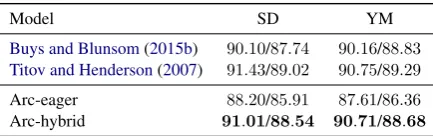
Table 4: PTB test set parsing results with supervised generative models, on the Stanford (SD) andYamada
and Matsumoto(2003) (YM) dependencies. The
mod-els from Buys and Blunsom (2015b) and Titov and Henderson (2007) were retrained to make results di-rectly comparable.
4.1 Parsing
In order to benchmark parsing performance, we train discriminative baselines using the same fea-ture space as the generative models. Unidirec-tional or bidirecUnidirec-tional RNNs can be used; we see that the bidirectional encoder is crucial for accu-racy (Table3). The performance of our implemen-tation is on par with than that of the arc-hybrid transition-based parser of Kiperwasser and Gold-berg (2016), which obtains 93.2/91.2 UAS/LAS
on the test set against 93.29/90.83 for our
arc-hybrid model. State of the art parsing perfor-mance is95.7%/94.1UAS/LAS (Dozat and
Man-ning,2017).
Exact decoding is only marginally more ac-curate than greedy decoding, giving further evi-dence of the label bias problem. Andor et al. (2016) similarly showed that a locally normalised model without lookahead features cannot ob-tain good performance even with beam-search (81.35% UAS), while their globally normalised
model can reach close to optimal performance without look-ahead. Shi et al.(2017) showed that globally normalised training improves the accu-racy of these discriminative models.
Exact decoding is crucial to the performance of
ROOT Another $ 20 billion would be raised through treasury bonds
Figure 2: Sentence with dependencies induced by the unsupervised model.
the generative models (Table 3). They are much more accurate than the unidirectional discrimina-tive models, which shows that the word prediction model benefits parsing accuracy. The arc-hybrid model is more accurate than arc-eager, as was the case for the unidirectional discriminative models. This can be explained by arc-eager making attach-ment decisions earlier in the transition sequence than arc-hybrid, which means that it has access to less context to condition these predictions on.
Our best generative model outperforms a pre-vious incremental generative dependency parser based on feed-forward neural networks and ap-proximate inference (Buys and Blunsom, 2015b) (Table4). It is competitive with a previous RNN-based generative parser with a much more com-plex architecture than our model, including recur-rent connections based on parsing decision (Titov and Henderson, 2007). Our exact decoding algo-rithm is also actually faster than the beam-search approaches for previous models, as it is imple-mented on GPU. Our arc-hybrid model parses7.4
sentences per second, against4sentences per sec-ond forBuys and Blunsom(2015b) and approxi-mately1sentence per second for Titov and
Hen-derson(2007).
[image:6.595.72.289.236.304.2]Model Perplexity
Interpolated Kneser-Ney 5-gram 170.09
Sequential LSTM (unbatched) 118.69
Sequential LSTM (batched) 100.67
Buys and Blunsom(2015b) 138.62
RNNG (Kuncoro et al.,2017) 101.2
[image:7.595.71.290.62.190.2]Supervised (SD) shift-reduce buffer-next 111.53 Supervised (SD) shift-reduce stack-next 107.61 Unsupervised shift-reduce stack-next 125.20
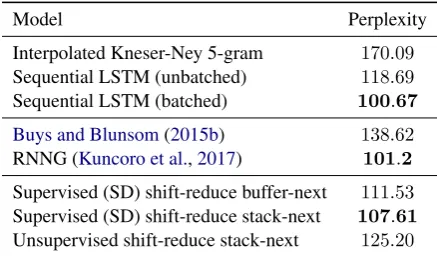
Table 5: Language modelling perplexity results on the PTB parsing test set.
4.2 Language modelling
We apply our model to language modelling with both supervised and unsupervised training. The supervised models are trained as arc-hybrid parsers; the performance of arc-eager is almost identical as arc labels and directionality are not predicted. The unsupervised model is trained with only shift and reduce transitions as latent.
We evaluate language models with a sentence i.i.d. assumption. In contrast, the standard evalu-ation setup for RNN language models treats the entire corpus as single sequence. To evaluate the consequence of the sentence independence as-sumption, we trained a model on the most widely used PTB language modelling setup (Chelba and Jelinek, 2000;Mikolov et al., 2011), which uses a different training/testing split and preprocessing which limits the vocabulary to10k. Our baseline
LSTM obtains92.71test perplexity on this setup,
against78.4ofZaremba et al.(2014), which uses the same hyperparameters without a sentence i.i.d. assumption. The syntactic neural language model ofEmami and Jelinek(2005) obtained131.3.
Results are reported in Table 5. Perplexity is obtained by exponentiating the negative log likeli-hood per token; end of sentence symbols are pre-dicted but excluded from the token counts. As baselines without syntactic structure we use the in-terpolated Kneser-Neyn-gram model (Kneser and Ney, 1995) and vanilla LSTMs, trained with or without batching.
The LSTM baselines already outperform the syntactic feed-forward neural model ofBuys and Blunsom (2015b). We see that there is a sig-nificant difference between training with or with-out mini-batching for the baseline; similarly our model’s perplexities also improve when trained
with batching. The batched baseline performs slightly better than Recurrent Neural Network Grammars (RNNG) (Dyer et al., 2016;Kuncoro et al., 2017), a constituency syntax-based RNN language model trained without batching.3
The results show that our syntactic language models perform slightly worse than the LSTM baseline. We experimented with different de-pendency representations on the development set, including SD, YM and Universal Dependen-cies (Nivre et al.,2016). We found little difference in language modelling performance between the dependency representations. Unsupervised train-ing does not lead to better perplexity than the su-pervised models; however, due to much longer training times we did less hyperparameter tuning for the unsupervised model.
4.3 Analysis
We further analyze the probability distribution that our model is learning by calculating some perplexity-related quantities. We compare the per-plexity of the marginal distribution p(w) to the perplexity based only on the most likely transition sequencea=argmaxp(w,a), based on either the
joint distributionp(w,a)or the conditional distri-bution p(w|a). Note that while the former is a
bound on the marginal perplexity, the latter is not a true perplexity but simply helps us to quantify the contribution of the syntactic structure to reducing the uncertainty in the prediction.
The results (Table 6) show that the difference between the joint and marginal perplexities are rel-atively small for the supervised models, indicat-ing that the distribution is very peaked around the most likely parse trees. However the conditional quantity shows that the syntactic structure encoded by the stack-next model is much more informa-tive than that of the buffer-next model, although the only difference between them is the choice of elements to condition on when predicting the next word. Although thestack-nextmodel has a better marginal perplexity, the disadvantage is that it has more uncertainty in the syntactic structure it is pre-dicting (as can be seen by lower parsing accuracy) even though that structure is more informative.
The strength of RNNG over our approach is that it computes a compositional representation of
Model Argmax parse Argmax parse Marginal ppl joint ppl conditional ppl RNNG (Dyer et al.,2016) 104.10 107.58 41.60
Supervised (SD) shift-reduce buffer-next 111.53 120.09 102.28
Supervised (SD) shift-reduce stack-next 107.61 119.20 71.27
Unsupervised shift-reduce stack-next 125.20 350.01 169.87
Table 6: Language modelling perplexity analysis on the PTB test set.
the stack and the partially constructed parse tree, while our model can only make use of the position on top of the stack and otherwise has to rely on the sequentially computed RNN representations. The disadvantage of RNNG is that inference can only be performed over entire sentences, as the pro-posal distribution for their importance sampling method is a discriminative parser. Exact inference allows our models to estimate next word probabil-ities from partially observed sequences.
5 Related work
5.1 Syntactic generative models
Chelba and Jelinek (2000) and Emami and Je-linek (2005) proposed incremental syntactic lan-guage models that predict binarized constituency trees with a shift-reduce model, parameterized by interpolated n-gram smoothing and feed-forward neural networks, respectively. Language mod-elling probabilities were approximated incremen-tally using beam-search.Rastrow et al.(2012) ap-plied a transition-based dependency n-gram lan-guage model to speech recognition. These models obtained perplexity improvements primarily when interpolated with standard n-gram models, and were not employed as parsers.
Henderson (2004) proposed an incremental constituency parser based on recurrent neural net-works that have additional connections to previous recurrent states based on the parser configuration at each time step. The generative version of this model was more accurate than the discriminative one.Titov and Henderson(2007) applied a similar approach to dependency parsing. Buys and Blun-som(2015a) andBuys and Blunsom(2015b) pro-posed generative syntactic models that are applied to both dependency parsing and language mod-elling, using Bayesian and feed-forward neural networks, respectively. Recurrent Neural Network Grammar (RNNG) (Dyer et al.,2016) is a
genera-tive transition-based constituency parser based on stack LSTMs (Dyer et al.,2015), that was also ap-plied as a language model.
Recently,Shen et al.(2017) proposed an RNN-based language model that uses a soft gating mechanism to learn structure that can be inter-preted as constituency trees, reporting strong lan-guage modelling performance. There has also been work on non-incremental syntactic language modelling: Mirowski and Vlachos (2015) pro-posed a dependency neural language model where each word is conditioned on its ancestors in the dependency tree, and showed that this model achieves strong performance on a sentence com-pletion task.
5.2 Neural models with latent structure
There have been a number of recent proposals for neural abstract machines that augment RNNs with external memory, including stacks and other data structures that are operated on with differentiable operations to enable end-to-end learning. Neural Turing machines (Graves et al., 2014) have read-write memory that is updated at each timestep. Grefenstette et al.(2015) proposed a neural stack that is operated on with differentiable push and pop computations.
along with projectivity constraints. The soft head selection learned by the model is used as features in an attention-based decoder.
Reinforcement learning has been proposed to learn compositional tree-based representations in the context of an end task (Andreas et al., 2016; Yogatama et al.,2016), but this approach has high variance and provide no guarantees of finding op-timal trees.
6 Conclusion
We proposed a new framework for generative models of syntactic structure based on recurrent neural networks. We presented efficient algo-rithms for training these models with or without supervision, and to apply them to make online predictions for language modelling through exact marginalization. Results show that the model ob-tains state-of-the-art performance on supervised generative dependency parsing, but does not ob-tain better intrinsic language modelling perfor-mance than a standard RNN.
Acknowledgments
We thank members of the Oxford NLP group for discussions, Yejin Choi for valuable feedback, and the anonymous reviewers for their comments.
References
Daniel Andor, Chris Alberti, David Weiss, Aliaksei Severyn, Alessandro Presta, Kuzman Ganchev, Slav Petrov, and Michael Collins. 2016. Globally
normalized transition-based neural networks. In
Proceedings of ACL. Association for Computational Linguistics, Berlin, Germany, pages 2442–2452.
http://www.aclweb.org/anthology/ P16-1231.
Jacob Andreas, Marcus Rohrbach, Trevor Darrell, and
Dan Klein. 2016. Learning to compose neural
networks for question answering. InProceedings
of NAACL. pages 1545–1554. http://www.
aclweb.org/anthology/N16-1181.
Yonatan Bisk and Julia Hockenmaier. 2015. Probing the linguistic strengths and limitations of unsuper-vised grammar induction. InProceedings of ACL. Beijing,China, pages 1395–1404.
Jan Buys and Phil Blunsom. 2015a. A Bayesian model for generative transition-based dependency parsing. InProceedings of the 3rd International Conference on Dependency Linguistics (Depling).
Jan Buys and Phil Blunsom. 2015b. Generative incre-mental dependency parsing with neural networks. In
Proceedings of ACL-IJCNLP (short papers). pages 863–869.
Ciprian Chelba and Frederick Jelinek. 2000. Struc-tured language modeling. Computer Speech & Lan-guage14(4):283–332.
Danqi Chen and Christopher D Manning. 2014. A fast and accurate dependency parser using neural net-works. InEMNLP.
Shay B. Cohen, Carlos G´omez-Rodr´ıguez, and Giorgio Satta. 2011. Exact inference for generative proba-bilistic non-projective dependency parsing. In Pro-ceedings of EMNLP. pages 1234–1245.
James Cross and Liang Huang. 2016. Incremental parsing with minimal features using bi-directional LSTM. InProceedings of ACL. page 32.
Timothy Dozat and Christopher D. Manning. 2017. Deep biaffine attention for neural dependency pars-ing. In Proceedings of ICLR. http://arxiv.
org/abs/1611.01734.
Chris Dyer, Miguel Ballesteros, Wang Ling, Austin Matthews, and Noah A. Smith. 2015. Transition-based dependency parsing with stack long
short-term memory. In Proceedings of ACL.
pages 334–343. http://www.aclweb.org/
anthology/P15-1033.
Chris Dyer, Adhiguna Kuncoro, Miguel Ballesteros, and Noah A. Smith. 2016. Recurrent neural network grammars. InProceedings of NAACL.
Jason Eisner. 2016. Inside-outside and
forward-backward algorithms are just backprop (tutorial pa-per). In Proceedings of the Workshop on Struc-tured Prediction for NLP. Association for Computa-tional Linguistics, Austin, TX, pages 1–17. http:
//aclweb.org/anthology/W16-5901.
Ahmad Emami and Frederick Jelinek. 2005. A
neu-ral syntactic language model. Machine
Learn-ing 60(1-3):195–227. https://doi.org/10.
1007/s10994-005-0916-y.
Alex Graves, Greg Wayne, and Ivo Danihelka.
2014. Neural turing machines. arXiv preprint
arXiv:1410.5401.
Edward Grefenstette, Karl Moritz Hermann, Mustafa Suleyman, and Phil Blunsom. 2015. Learning to
transduce with unbounded memory. In Advances
in Neural Information Processing Systems. pages 1828–1836.
James Henderson. 2004. Discriminative training of a neural network statistical parser. InProceedings of ACL. Association for Computational Linguistics, page 95.
Sepp Hochreiter and J¨urgen Schmidhuber. 1997.
Long short-term memory. Neural computation
Liang Huang and Kenji Sagae. 2010. Dynamic
pro-gramming for linear-time incremental parsing. In
Proceedings of ACL. pages 1077–1086. http://
www.aclweb.org/anthology/P10-1110.
Yoon Kim, Carl Denton, Luong Hoang, and Alexan-der M. Rush. 2017. Structured attention networks. InProceedings of ICLR.
Eliyahu Kiperwasser and Yoav Goldberg. 2016. Sim-ple and accurate dependency parsing using bidirec-tional lstm feature representations. Transactions of the Association for Computational Linguistics
4:313–327.
Dan Klein and Christopher D Manning. 2004. Corpus-based induction of syntactic structure: Models of de-pendency and constituency. InACL. pages 478–586.
Reinhard Kneser and Hermann Ney. 1995. Improved
backing-off for m-gram language modeling. In
ICASSP. IEEE, volume 1, pages 181–184.
Marco Kuhlmann, Carlos G´omez-Rodr´ıguez, and Gior-gio Satta. 2011. Dynamic programming algorithms for transition-based dependency parsers. In Pro-ceedings of ACL. pages 673–682.
Adhiguna Kuncoro, Miguel Ballesteros, Lingpeng Kong, Chris Dyer, Graham Neubig, and Noah A. Smith. 2017. What do recurrent neural network
grammars learn about syntax? In Proceedings of
EACL. Association for Computational Linguistics, Valencia, Spain, pages 1249–1258. http://www.
aclweb.org/anthology/E17-1117.
Tal Linzen, Emmanuel Dupoux, and Yoav Goldberg. 2016. Assessing the ability of lstms to learn syntax-sensitive dependencies. Transactions of the Association for Computational Linguistics 4:521–
535. https://www.transacl.org/ojs/
index.php/tacl/article/view/972.
Tom´aˇs Mikolov, Stefan Kombrink, Luk´aˇs Burget, Jan ˇCernock`y, and Sanjeev Khudanpur. 2011. Exten-sions of recurrent neural network language model. InICASSP. IEEE, pages 5528–5531.
Piotr Mirowski and Andreas Vlachos. 2015. Depen-dency recurrent neural language models for
sen-tence completion. CoRRabs/1507.01193. http:
//arxiv.org/abs/1507.01193.
Joakim Nivre. 2008. Algorithms for deterministic in-cremental dependency parsing. Computational Lin-guistics34(4):513–553.
Joakim Nivre, Marie-Catherine de Marneffe, Filip Gin-ter, Yoav Goldberg, Jan Hajiˇc, Christopher D Man-ning, Ryan McDonald, Slav Petrov, Sampo Pyysalo, Natalia Silveira, et al. 2016. Universal dependencies v1: A multilingual treebank collection. InTenth In-ternational Conference on Language Resources and Evaluation (LREC 2016).
Pushpendre Rastogi, Ryan Cotterell, and Jason Eisner. 2016. Weighting finite-state transductions with neu-ral context. InProceedings of NAACL.
Ariya Rastrow, Mark Dredze, and Sanjeev
Khu-danpur. 2012. Efficient structured language
modeling for speech recognition. In
INTER-SPEECH. http://interspeech2012.org/
accepted-abstract.html?id=1436.
Yikang Shen, Zhouhan Lin, Chin-Wei Huang, and Aaron C. Courville. 2017. Neural language
model-ing by jointly learnmodel-ing syntax and lexicon. CoRR
abs/1711.02013. http://arxiv.org/abs/
1711.02013.
Tianze Shi, Liang Huang, and Lillian Lee. 2017. Fast(er) exact decoding and global training for transition-based dependency parsing via a minimal feature set. InProceedings of the 2017 Conference on Empirical Methods in Natural Language Pro-cessing. Association for Computational Linguistics,
Copenhagen, Denmark, pages 12–23. https://
www.aclweb.org/anthology/D17-1002.
Stuart M Shieber, Yves Schabes, and Fernando CN Pereira. 1995. Principles and implementation of de-ductive parsing. The Journal of logic programming
24(1):3–36.
Valentin I Spitkovsky, Hiyan Alshawi, and Daniel Ju-rafsky. 2010. From baby steps to leapfrog: how less is more in unsupervised dependency parsing. In Human Language Technologies: The 2010 An-nual Conference of the North American Chapter of the Association for Computational Linguistics. pages 751–759.
Ivan Titov and James Henderson. 2007. A
la-tent variable model for generative dependency
parsing. In Proceedings of the Tenth
In-ternational Conference on Parsing Technologies.
pages 144–155. http://www.aclweb.org/
anthology/W/W07/W07-2218.
Ke M. Tran, Yonatan Bisk, Ashish Vaswani, Daniel
Marcu, and Kevin Knight. 2016. Unsupervised
neural hidden markov models. In Proceedings
of the Workshop on Structured Prediction for NLP. Association for Computational Linguistics,
Austin, TX, pages 63–71. http://aclweb.
org/anthology/W16-5907.
Hiroyasu Yamada and Yuji Matsumoto. 2003. Statis-tical dependency analysis with support vector ma-chines. InProceedings of the International Confer-ence on Parsing Technologies. volume 3.
D. Yogatama, C. Dyer, W. Ling, and P. Blunsom. 2017. Generative and discriminative text
classi-fication with recurrent neural networks. CoRR
abs/1703.01898. http://arxiv.org/abs/
Dani Yogatama, Phil Blunsom, Chris Dyer, Edward Grefenstette, and Wang Ling. 2016. Learning to compose words into sentences with reinforcement learning.CoRRabs/1611.09100.
Lei Yu, Phil Blunsom, Chris Dyer, Edward Grefen-stette, and Tomas Kocisky. 2017. The neural noisy channel. Proceedings of ICLR.
Lei Yu, Jan Buys, and Phil Blunsom. 2016. Online seg-ment to segseg-ment neural transduction. In Proceed-ings of EMNLP. pages 1307–1316.
Wojciech Zaremba, Ilya Sutskever, and Oriol Vinyals. 2014. Recurrent neural network regularization.
CoRR abs/1409.2329. http://arxiv.org/