Proceedings of NAACL-HLT 2018, pages 2060–2069
Dialogue Learning with Human Teaching and Feedback in End-to-End
Trainable Task-Oriented Dialogue Systems
Bing Liu1∗, Gokhan T¨ur2, Dilek Hakkani-T¨ur2, Pararth Shah2, Larry Heck3†
1Carnegie Mellon University, Pittsburgh, PA, USA
2Google Research, Mountain View, CA,USA3Samsung Research, Mountain View, CA, USA
[email protected],{dilekh,pararth}@google.com, {gokhan.tur,larry.heck}@ieee.org
Abstract
In this work, we present a hybrid learn-ing method for trainlearn-ing task-oriented dialogue systems through online user interactions. Pop-ular methods for learning task-oriented dia-logues include applying reinforcement learn-ing with user feedback on supervised pre-training models. Efficiency of such learning method may suffer from the mismatch of di-alogue state distribution between offline train-ing and online interactive learntrain-ing stages. To address this challenge, we propose a hybrid imitation and reinforcement learning method, with which a dialogue agent can effectively learn from its interaction with users by learn-ing from human teachlearn-ing and feedback. We design a neural network based task-oriented dialogue agent that can be optimized end-to-end with the proposed learning method. Ex-perimental results show that our end-to-end dialogue agent can learn effectively from the mistake it makes via imitation learning from user teaching. Applying reinforcement learn-ing with user feedback after the imitation learning stage further improves the agent’s ca-pability in successfully completing a task.
1 Introduction
Task-oriented dialogue systems assist users to complete tasks in specific domains by understand-ing user’s request and aggregate useful informa-tion from external resources within several dia-logue turns. Conventional task-oriented diadia-logue systems have a complex pipeline (Rudnicky et al.,
1999;Raux et al.,2005;Young et al.,2013) con-sisting of independently developed and modularly connected components for natural language un-derstanding (NLU) (Mesnil et al., 2015;Liu and Lane, 2016; Hakkani-T¨ur et al., 2016), dialogue state tracking (DST) (Henderson et al., 2014c; ∗Work done while the author was an intern at Google. †Work done while at Google Research.
Mrkˇsi´c et al., 2016), and dialogue policy learn-ing (Gasic and Young,2014;Shah et al.,2016;Su et al.,2016,2017). These system components are usually trained independently, and their optimiza-tion targets may not fully align with the overall system evaluation criteria (e.g. task success rate and user satisfaction). Moreover, errors made in the upper stream modules of the pipeline propa-gate to downstream components and get amplified, making it hard to track the source of errors.
To address these limitations with the con-ventional task-oriented dialogue systems, re-cent efforts have been made in designing end-to-end learning solutions with neural network based methods. Both supervised learning (SL) based (Wen et al., 2017; Bordes and Weston,
2017;Liu and Lane, 2017a) and deep reinforce-ment learning (RL) based systems (Zhao and Es-kenazi, 2016; Li et al., 2017; Peng et al., 2017) have been studied in the literature. Comparing to chit-chat dialogue models that are usually trained offline using single-turn context-response pairs, task-oriented dialogue model involves reasoning and planning over multiple dialogue turns. This makes it especially important for a system to be able to learn from users in an interactive manner. Comparing to SL models, systems trained with RL by receiving feedback during users interac-tions showed improved model robustness against diverse dialogue scenarios (Williams and Zweig,
2016;Liu and Lane,2017b).
A critical step in learning RL based task-oriented dialogue models is dialogue policy learn-ing. Training dialogue policy online from scratch typically requires a large number of interactive learning sessions before an agent can reach a satis-factory performance level. Recent works ( Hender-son et al.,2008;Williams et al., 2017;Liu et al.,
2017) explored pre-training the dialogue model using human-human or human-machine dialogue
corpora before performing interactive learning with RL to address this concern. A potential draw-back with such pre-training approach is that the model may suffer from the mismatch of dialogue state distributions between supervised training and interactive learning stages. While interacting with users, the agent’s response at each turn has a di-rect influence on the distribution of dialogue state that the agent will operate on in the upcoming di-alogue turns. If the agent makes a small mistake and reaches an unfamiliar state, it may not know how to recover from it and get back to a normal dialogue trajectory. This is because such recovery situation may be rare for good human agents and thus are not well covered in the supervised train-ing corpus. This will result in compoundtrain-ing er-rors in a dialogue which may lead to failure of a task. RL exploration might finally help to find cor-responding actions to recover from a bad state, but the search process can be very inefficient.
To ameliorate the effect of dialogue state distri-bution mismatch between offline training and RL interactive learning, we propose a hybrid imitation and reinforcement learning method. We first let the agent to interact with users using its own pol-icy learned from supervised pre-training. When an agent makes a mistake, we ask users to correct the mistake by demonstrating the agent the right ac-tions to take at each turn. This user corrected dia-logue sample, which is guided by the agent’s own policy, is then added to the existing training cor-pus. We fine-tune the dialogue policy with this di-alogue sample aggregation (Ross et al.,2011) and continue such user teaching process for a number of cycles. Since asking for user teaching at each dialogue turn is costly, we want to reduce this user teaching cycles as much as possible and continue the learning process with RL by collecting simple forms of user feedback (e.g. a binary feedback, positive or negative) only at the end of a dialogue.
Our main contributions in this work are:
• We design a neural network based task-oriented dialogue system which can be op-timized end-to-end for natural language un-derstanding, dialogue state tracking, and dia-logue policy learning.
• We propose a hybrid imitation and reinforce-ment learning method for end-to-end model training in addressing the challenge with dia-logue state distribution mismatch between of-fline training and interactive learning.
The remainder of the paper is organized as fol-lows. In section 2, we discuss related work in building end-to-end task-oriented dialogue sys-tems. In section 3, we describe the proposed model and learning method in detail. In Section 4, we describe the experiment setup and discuss the results. Section 5 gives the conclusions.
2 Related Work
Popular approaches in learning task-oriented dialogue include modeling the task as a par-tially observable Markov Decision Process (POMDP) (Young et al.,2013). RL can be applied in the POMDP framework to learn dialogue policy online by interacting with users (Gaˇsi´c et al.,2013). The dialogue state and system action space have to be carefully designed in order to make the policy learning tractable (Young et al.,
2013), which limits the model’s usage to restricted domains.
Recent efforts have been made in designing end-to-end solutions for task-oriented dialogues, inspired by the success of encoder-decoder based neural network models in non-task-oriented con-versational systems (Serban et al.,2015;Li et al.,
2016). Wen et al. (Wen et al.,2017) designed an end-to-end trainable neural dialogue model with modularly connected system components. This system is a supervised learning model which is evaluated on fixed dialogue corpora. It is un-known how well the model performance gener-alizes to unseen dialogue state during user inter-actions. Our system is trained by a combina-tion of supervised and deep RL methods, as it is shown that RL may effectively improve dialogue success rate by exploring a large dialogue action space (Henderson et al.,2008;Li et al.,2017).
Bordes and Weston (2017) proposed a task-oriented dialogue model using end-to-end memory networks. In the same line of research, people ex-plored using query-regression networks (Seo et al.,
2016), gated memory networks (Liu and Perez,
be critical in improving dialogue success in task completion.
Dhingra et al. (2017) proposed an end-to-end RL dialogue agent for information access. Their model focuses on bringing differentiability to the KB query operation by introducing a “soft” re-trieval process in selecting the KB entries. Such soft-KB lookup is prone to entity updates and ad-ditions in the KB, which is common in real world information systems. In our model, we use sym-bolic queries and leave the selection of KB enti-ties to external services (e.g. a recommender sys-tem), as entity ranking in real world systems can be made with much richer features (e.g. user pro-files, location and time context, etc.). Quality of the generated symbolic query is directly related to the belief tracking performance. In our pro-posed end-to-end system, belief tracking can be optimized together with other system components (e.g. language understanding and policy) during interactive learning with users.
Williams et al. (2017) proposed a hybrid code network for task-oriented dialogue that can be trained with supervised and reinforcement learn-ing. They show that RL performed with a super-vised pre-training model using labeled dialogues improves learning speed dramatically. They did not discuss the potential issue of dialogue state distribution mismatch between supervised pre-training and RL interactive learning, which is ad-dressed in our dialogue learning framework.
3 Proposed Method
Figure 1 shows the overall system architecture of the proposed end-to-end task-oriented dialogue model. We use a hierarchical LSTM neural net-work to encode a dialogue with a sequence of turns. User input to the system in natural lan-guage format is encoded to a continuous vector via a bidirectional LSTM utterance encoder. This user utterance encoding, together with the encoding of the previous system action, serves as the input to a dialogue-level LSTM. State of this dialogue-level LSTM maintains a continuous representation of the dialogue state. Based on this state, the model generates a probability distribution over candidate values for each of the tracked goal slots. A query command can then be formulated with the state tracking outputs and issued to a knowledge base to retrieve requested information. Finally, the system produces a dialogue action, which is conditioned
on information from the dialogue state, the esti-mated user’s goal, and the encoding of the query results . This dialogue action, together with the user goal tracking results and the query results, is used to generate the final natural language system response via a natural language generator (NLG). We describe each core model component in detail in the following sections.
3.1 Utterance Encoding
We use a bidirectional LSTM to encode the user utterance to a continuous representation. We refer to this LSTM as the utterance-level LSTM. The user utterance vector is generated by concatenat-ing the last forward and backward LSTM states. LetUk = (w1, w2, ..., wTk)be the user utterance at turnk withTk words. These words are firstly
mapped to an embedding space, and further serve as the step inputs to the bidirectional LSTM. Let
− →
ht and ←h−t represent the forward and backward
LSTM state outputs at time step t. The user ut-terance vectorUkis produced by:Uk = [−→hTk,
←−
h1], where−→hTkand
←−
h1are the last states in the forward and backward LSTMs.
3.2 Dialogue State Tracking
Dialogue state tracking, or belief tracking, main-tains the state of a conversation, such as user’s goals, by accumulating evidence along the se-quence of dialogue turns. Our model maintains the dialogue state in a continuous form in the dialogue-level LSTM (LSTMD) statesk.skis
up-dated after the model processes each dialogue turn by taking in the encoding of user utteranceUkand
the encoding of the previous turn system output Ak−1. This dialogue state serves as the input to the dialogue state tracker. The tracker updates its es-timation of the user’s goal represented by a list of slot-value pairs. A probability distributionP(lm
k)
is maintained over candidate values for each goal slot typem∈M:
sk= LSTMD(sk−1, [Uk, Ak−1]) (1)
P(lmk |U≤k, A<k) = SlotDistm(sk) (2)
where SlotDistm is a single hidden layer MLP
withsoftmaxactivation over slot typem∈M.
3.3 KB Operation
User: Movie for the day after tomorrow, please
System: Ok, what time do you prefer?
Bi-LSTM Utterance Encoder
LSTM
Dialogue State Knowledge Base
Policy Network Natural Language
Generator request(time)
System dialogue act at turn k
Query results encoding User utterance
encoding at turn k System dialogue act
embedding at turn k-1
time=none date=Thursday
[image:4.595.91.505.67.218.2]Dialogue State Tracking
Figure 1: Proposed end-to-end task-oriented dialogue system architecture.
produced by replacing the tokens in a query com-mand template with the best hypothesis for each goal slot from the dialogue state tracking output. Alternatively, an n-best list of API calls can be generated with the most probable candidate values for the tracked goal slots. In interfacing with KBs, instead of using a soft KB lookup as in (Dhingra et al.,2017), our model sends symbolic queries to the KB and leaves the ranking of the KB entities to an external recommender system. Entity rank-ing in real world systems can be made with much richer features (e.g. user profiles, local context, etc.) in the back-end system other than just fol-lowing entity posterior probabilities conditioning on a user utterance. Hence ranking of the KB en-tities is not a part of our proposed neural dialogue model. In this work, we assume that the model re-ceives a ranked list of KB entities according to the issued query and other available sources, such as user models.
Once the KB query results are returned, we save the retrieved entities to a queue and encode the re-sult summary to a vector. Rather then encoding the real KB entity values as in (Bordes and Weston,
2017;Eric and Manning,2017), we only encode a summary of the query results (i.e. item availabil-ity and number of matched items). This encoding serves as a part of the input to the policy network.
3.4 Dialogue Policy
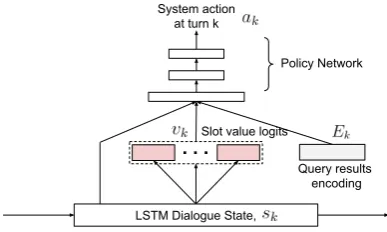
A dialogue policy selects the next system action in response to the user’s input based on the cur-rent dialogue state. We use a deep neural network to model the dialogue policy. There are three in-puts to the policy network, (1) the dialogue-level LSTM statesk, (2) the log probabilities of
candi-date values from the belief trackervk, and (3) the
LSTM Dialogue State, System action
at turn k
Policy Network
Query results encoding Slot value logits
Figure 2: Dialogue state and policy network.
encoding of the query results summaryEk. The
policy network emits a system action in the form of a dialogue act conditioning on these inputs:
P(ak|U≤k, A<k, E≤k) = PolicyNet(sk, vk, Ek)
(3) wherevkrepresents the concatenated log
probabil-ities of candidate values for each goal slot,Ekis
the encoding of query results, andPolicyNetis a
single hidden layer MLP withsoftmax activation
function over all system actions.
The emitted system action is finally used to pro-duce a system response in natural language format by combining the state tracker outputs and the re-trieved KB entities. We use a template based NLG in this work. The delexicalised tokens in the NLG template are replaced by the values from either the estimated user goal values or the KB entities, de-pending on the emitted system action.
3.5 Supervised Pre-training
[image:4.595.316.510.266.382.2]in a continuous form that is fully differentiable, and the entire system (utterance encoding, dia-logue state tracking, and policy network) can be trained end-to-end.
We first train the system in a supervised man-ner by fitting task-oriented dialogue samples. The model predicts the true user goal slot values and the next system action at each turn of a dia-logue. We optimize the model parameter setθby minimizing a linear interpolation of cross-entropy losses for dialogue state tracking and system ac-tion predicac-tion:
min θ
K
X
k=1
−h M
X
m=1
λlmlogP(lkm∗|U≤k,A<k,E<k;θ)
+λalogP(a∗k|U≤k,A<k,E≤k;θ)
i
(4)
where λs are the linear interpolation weights for the cost of each system output. lmk∗ is the ground truth label for the tracked user goal slot typem∈ M at thekth turn, anda∗kis the true system action in the corpus.
3.6 Imitation Learning with Human Teaching
Once obtaining a supervised training dialogue agent, we further let the agent to learn interactively from users by conducting task-oriented dialogues. Supervised learning succeeds when training and test data distributions match. During the agent’s interaction with users, any mistake made by the agent or any deviation in the user’s behavior may lead to a different dialogue state distribution than the one that the supervised learning agent saw dur-ing offline traindur-ing. A small mistake made by the agent due to this covariate shift (Ross and Bagnell,
2010;Ross et al., 2011) may lead to compound-ing errors which finally lead to failure of a task. To address this issue, we propose a dialogue imi-tation learning method which allows the dialogue agent to learn from human teaching. We let the supervised training agent to interact with users us-ing its learned dialogue policyπθ(a|s). With this,
we collect additional dialogue samples that are guided by the agent’s own policy, rather than by the expert policy as those in the supervised train-ing corpora. When the agent make mistakes, we ask users to correct the mistakes and demonstrate the expected actions and predictions for the agent to make. Such user teaching precisely addresses
Algorithm 1 Dialogue Learning with Human Teaching and Feedback
1: Train model end-to-end on dialogue samples Dwith MLE and obtain policyπθ(a|s).eq 4 2: forlearning iterationk= 1 :Kdo
3: Run πθ(a|s) with user to collect new
dialogue samplesDπ
4: Ask user to correct the mistakes in the tracked user’s goal for each dialogue turn inDπ
5: Add the newly labeled dialogue samples to the existing corpora:D←D∪Dπ 6: Train model end-to-end on Dand obtain
an updated policyπθ(a|s) .eq 4 7: end for
8: forlearning iterationk= 1 :N do
9: Runπθ(a|s)with user for a new dialogue 10: Collect user feedback as rewardr
11: Update model end-to-end and obtain an
updated policyπθ(a|s) .eq 5 12: end for
the limitations of the currently learned dialogue model, as these newly collected dialogue samples are driven by the agent’s own policy. Specifically, in this study we let an expert user to correct the mistake made by the agent in tracking the user’s goal at the end of each dialogue turn. This new batch of annotated dialogues are then added to the existing training corpus. We start the next round of supervised model training on this aggregated corpus to obtain an updated dialogue policy, and continue this dialogue imitation learning cycles.
3.7 Reinforcement Learning with Human Feedback
encour-age the encour-agent to complete the task in fewer steps. In this work, we only use task-completion as the metric in designing the dialogue reward. One can extend it by introducing additional factors to the reward functions, such as naturalness of interac-tions or costs associated with KB queries.
To encourage the agent to explore the dialogue action space, we let the agent to follow a softmax policy during RL training by sampling system ac-tions from the policy network outputs. We apply REINFORCE algorithm (Williams, 1992) in op-timizing the network parameters. The objective function can be written as Jk(θ) = Eθ[Rk] = EθhPKt=0−kγtrk+t
i
, withγ ∈[0,1)being the
dis-count factor. With likelihood ratio gradient esti-mator, the gradient of the objective function can be derived as:
∇θJk(θ) =∇θEθ[Rk] =X
ak
πθ(ak|sk)∇θlogπθ(ak|sk)Rk
=Eθ[∇θlogπθ(ak|sk)Rk]
(5)
This last expression above gives us an unbiased gradient estimator.
4 Experiments
4.1 Datasets
We evaluate the proposed method on DSTC2 (Henderson et al., 2014a) dataset in restaurant search domain and an internally collected dialogue corpus1 in movie booking domain. The movie
booking dialogue corpus has an average number of 8.4 turns per dialogue. Its training set has 100K di-alogues, and the development set and test set each has 10K dialogues.
The movie booking dialogue corpus is gener-ated (Shah et al., 2018) using a finite state ma-chine based dialogue agent and an agenda based user simulator (Schatzmann et al.,2007) with nat-ural language utterances rewritten by real users. The user simulator can be configured with differ-ent personalities, showing various levels of ran-domness and cooperativeness. This user simula-tor is also used to interact with our end-to-end training agent during imitation and reinforcement learning stages. We randomly select a user profile
1The dataset can be accessed via https:
//github.com/google-research-datasets/ simulated-dialogue
when conducting each dialogue simulation. Dur-ing model evaluation, we use an extended set of natural language surface forms over the ones used during training time to evaluate the generalization capability of the proposed end-to-end model in handling diverse natural language inputs.
4.2 Training Settings
The size of the dialogue-level and utterance-level LSTM state is set as 200 and 150 respectively. Word embedding size is 300. Embedding size for system action and slot values is set as 32. Hidden layer size of the policy network is set as 100. We use Adam optimization method (Kingma and Ba,
2014) with initial learning rate of 1e-3. Dropout rate of 0.5 is applied during supervised training to prevent the model from over-fitting.
In imitation learning, we perform mini-batch model update after collecting every 25 dialogues. System actions are sampled from the learned pol-icy to encourage exploration. The system action is defined with the act and slot types from a dia-logue act (Henderson et al., 2013). For example, the dialogue act “conf irm(date =monday)” is mapped to a system action “conf irm date” and a candidate value “monday” for slot type “date”. The slot types and values are from the dialogue state tracking output.
In RL optimization, we update the model with every mini-batch of 25 samples. Dialogue is con-sidered successful based on two conditions: (1) the goal slot values estimated from dialogue state tracking fully match to the user’s true goal values, and (2) the system is able to confirm with the user the tracked goal values and offer an entity which is finally accepted by the user. Maximum allowed number of dialogue turn is set as 15. A positive reward of +15.0 is given at the end of a success-ful dialogue, and a zero reward is given to a failed case. We apply a step penalty of -1.0 for each turn to encourage shorter dialogue for task completion.
4.3 Supervised Learning Results
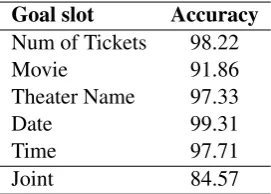
results using RNN (Henderson et al.,2014b) and neural belief tracker (NBT) (Mrkˇsi´c et al.,2016). In the movie booking domain, our model also achieves promising performance on both individ-ual slot tracking and joint slot tracking accuracy. Instead of using ASR hypothesis as model input as in DSTC2, here we use text based input which has much lower noise level in the evaluation of the movie booking tasks. This partially explains the higher DST accuracy in the movie booking do-main comparing to DSTC2.
Model Area Food Price Joint
RNN 92 86 86 69
RNN+sem. dict 92 86 92 71
NBT 90 84 94 72
Our SL model 90 84 92 72
Table 1: Dialogue state tracking results on DSTC2
Goal slot Accuracy Num of Tickets 98.22
Movie 91.86
Theater Name 97.33
Date 99.31
Time 97.71
[image:7.595.308.525.63.214.2]Joint 84.57
Table 2: DST results on movie booking dataset
4.4 Imitation and RL Results
Evaluations of interactive learning with imitation and reinforcement learning are made on metrics of (1) task success rate, (2) dialogue turn size, and (3) DST accuracy. Figures3, 4, and 5 show the learning curves for the three evaluation metrics. In addition, we compare model performance on task success rate using two different RL training settings, the end-to-end training and the policy-only training, to show the advantages of perform-ing end-to-end system optimization with RL.
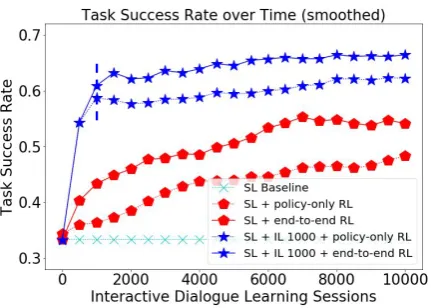
Task Success Rate As shown in the learning curves in Figure3, the SL model performs poorly. This might largely due to the compounding er-rors caused by the mismatch of dialogue state dis-tribution between offline training and interactive learning. We use an extended set of user NLG templates during interactive evaluation. Many of the test NLG templates are not seen by the super-vised training agent. Any mistake made by the agent in understanding the user’s request may lead to compounding errors in the following dialogue
Figure 3: Interactive learning curves on task success rate.
turns, which cause final task failure. The red curve (SL + RL) shows the performance of the model that has RL applied on the supervised pre-training model. We can see that interactive learning with RL using a weak form of supervision from user feedback continuously improves the task success rate with the growing number of user interactions. We further conduct experiments in learning dia-logue model from scratch using only RL (i.e. with-out supervised pre-training), and the task success rate remains at a very low level after 10K dialogue simulations. We believe that it is because the di-alogue state space is too complex for the agent to learn from scratch, as it has to learn a good NLU model in combination with a good policy to complete the task. The yellow curve (SL + IL 500 + RL) shows the performance of the model that has 500 episodes of imitation learning over the SL model and continues with RL optimization. It is clear from the results that applying imitation learning on supervised training model efficiently improves task success rate. RL optimization af-ter imitation learning increases the task success rate further. The blue curve (SL + IL 1000 + RL) shows the performance of the model that has 1000 episodes of imitation learning over the SL model and continues with RL. Similarly, it shows hints that imitation learning may effectively adapt the supervised training model to the dialogue state distribution during user interactions.
[image:7.595.112.248.333.430.2]Figure 4: Interactive learning curves on average dia-logue turn size.
number of dialogue turns. The red curve with RL applied directly after supervised pre-training model gives the lowest average number of turns at the end of the interactive learning cycles, com-paring to models with imitation dialogue learn-ing. This seems to be contrary to our observa-tion in Figure 3 that imitation learning with hu-man teaching helps in achieving higher task suc-cess rate. By looking into the generated dialogues, we find that theSL + RLmodel can handle easy tasks well but fails to complete more challenging tasks. Such easy tasks typically can be handled with fewer number of turns, which result in the low average turn size for the SL + RL model. On the other hand, the imitation plus RL models attempt to learn better strategies to handle those more challenging tasks, resulting in higher task success rates and also slightly increased dialogue length comparing toSL + RLmodel.
Dialogue State Tracking Accuracy Similar to the results on task success rate, we see that itation learning with human teaching quickly im-proves dialogue state tracking accuracy in just a few hundred interactive learning sessions. The joint slots tracking accuracy in the evaluation of SL model using fixed corpus is 84.57% as in Table
[image:8.595.76.289.62.212.2]4.3. The accuracy drops to 50.51% in the interac-tive evaluation with the introduction of new NLG templates. Imitation learning with human teach-ing effectively adapts the neural dialogue model to the new user input and dialogue state distributions, improving the DST accuracy to 67.47% after only 500 imitation dialogue learning sessions. Another encouraging observation is that RL on top of SL model and IL model not only improves task suc-cess rate by optimizing dialogue policy, but also
Figure 5: Interactive learning curves on dialogue state tracking accuracy.
Figure 6: Interactive learning curves on task success rate with different RL training settings.
further improves dialogue state tracking perfor-mance. This shows the benefits of performing end-to-end optimization of the neural dialogue model with RL during interactive learning.
[image:8.595.309.525.256.410.2]4.5 Human User Evaluations
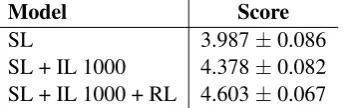
We further evaluate the proposed method with human judges recruited via Amazon Mechanical Turk. Each judge is asked to read a dialogue be-tween our model and user simulator and rate each system turn on a scale of 1 (frustrating) to 5 (opti-mal way to help the user). Each turn is rated by 3 different judges. We collect and rate 100 dialogues for each of the three models: (i) SL model, (ii) SL model followed by 1000 episodes of IL, (iii) SL and IL followed by RL. Table3lists the mean and standard deviation of human scores overall sys-tem turns. Performing interactive learning with imitation and reinforcement learning clearly im-proves the quality of the model according to hu-man judges.
Model Score
SL 3.987±0.086
SL + IL 1000 4.378±0.082
[image:9.595.96.269.298.352.2]SL + IL 1000 + RL 4.603±0.067
Table 3: Human evaluation results. Mean and standard deviation of crowd worker scores (between 1 to 5).
5 Conclusions
In this work, we focus on training task-oriented dialogue systems through user interactions, where the agent improves through communicating with users and learning from the mistake it makes. We propose a hybrid learning approach for such sys-tems using end-to-end trainable neural network model. We present a hybrid imitation and rein-forcement learning method, where we firstly train a dialogue agent in a supervised manner by learn-ing from dialogue corpora, and continuously to improve it by learning from user teaching and feedback with imitation and reinforcement learn-ing. We evaluate the proposed learning method with both offline evaluation on fixed dialogue cor-pora and interactive evaluation with users. Exper-imental results show that the proposed neural dia-logue agent can effectively learn from user teach-ing and improve task success rate with imitation learning. Applying reinforcement learning with user feedback after imitation learning with user teaching improves the model performance further, not only on the dialogue policy but also on the dialogue state tracking in the end-to-end training framework.
References
Antoine Bordes and Jason Weston. 2017. Learning end-to-end goal-oriented dialog. In International
Conference on Learning Representations.
Bhuwan Dhingra, Lihong Li, Xiujun Li, Jianfeng Gao, Yun-Nung Chen, Faisal Ahmed, and Li Deng. 2017. Towards end-to-end reinforcement learning of dia-logue agents for information access. InACL. Mihail Eric and Christopher D Manning. 2017. A
copy-augmented sequence-to-sequence architecture gives good performance on task-oriented dialogue. InEACL.
Milica Gaˇsi´c, Catherine Breslin, Matthew Henderson, Dongho Kim, Martin Szummer, Blaise Thomson, Pirros Tsiakoulis, and Steve Young. 2013. On-line policy optimisation of bayesian spoken dialogue systems via human interaction. InICASSP.
Milica Gasic and Steve Young. 2014. Gaussian pro-cesses for pomdp-based dialogue manager optimiza-tion. IEEE/ACM Transactions on Audio, Speech,
and Language Processing.
Dilek Hakkani-T¨ur, G¨okhan T¨ur, Asli Celikyilmaz, Yun-Nung Chen, Jianfeng Gao, Li Deng, and Ye-Yi Wang. 2016. Multi-domain joint semantic frame parsing using bi-directional rnn-lstm. In Inter-speech.
James Henderson, Oliver Lemon, and Kallirroi Georgila. 2008. Hybrid reinforcement/supervised learning of dialogue policies from fixed data sets.
Computational Linguistics.
Matthew Henderson, Blaise Thomson, and Jason Williams. 2013. Dialog state tracking challenge 2 &
3. http://camdial.org/˜mh521/dstc/.
Matthew Henderson, Blaise Thomson, and Jason Williams. 2014a. The second dialog state tracking challenge. InSIGDIAL.
Matthew Henderson, Blaise Thomson, and Steve Young. 2014b. Robust dialog state tracking using delexicalised recurrent neural networks and unsu-pervised gate. InIEEE SLT.
Matthew Henderson, Blaise Thomson, and Steve Young. 2014c. Word-based dialog state tracking with recurrent neural networks. InSIGDIAL.
Filip Jurˇc´ıˇcek, Blaise Thomson, and Steve Young. 2012. Reinforcement learning for parameter esti-mation in statistical spoken dialogue systems. Com-puter Speech & Language26(3):168–192.
Diederik Kingma and Jimmy Ba. 2014. Adam: A method for stochastic optimization. InInternational
Conference on Learning Representations.
Xuijun Li, Yun-Nung Chen, Lihong Li, and Jianfeng Gao. 2017. End-to-end task-completion neural dia-logue systems. arXiv preprint arXiv:1703.01008.
Bing Liu and Ian Lane. 2016. Joint online spoken lan-guage understanding and lanlan-guage modeling with recurrent neural networks. InSIGDIAL.
Bing Liu and Ian Lane. 2017a. An end-to-end trainable neural network model with belief tracking for task-oriented dialog. InInterspeech.
Bing Liu and Ian Lane. 2017b. Iterative policy learning in end-to-end trainable task-oriented neural dialog models. InProceedings of IEEE ASRU.
Bing Liu, Gokhan Tur, Dilek Hakkani-Tur, Pararth Shah, and Larry Heck. 2017. End-to-end optimiza-tion of task-oriented dialogue model with deep rein-forcement learning. InNIPS Workshop on Conver-sational AI.
Fei Liu and Julien Perez. 2017. Gated end-to-end memory networks. InEACL.
Gr´egoire Mesnil, Yann Dauphin, Kaisheng Yao, Yoshua Bengio, Li Deng, Dilek Hakkani-Tur, Xi-aodong He, Larry Heck, Gokhan Tur, Dong Yu, et al. 2015. Using recurrent neural networks for slot fill-ing in spoken language understandfill-ing. IEEE/ACM Transactions on Audio, Speech and Language Pro-cessing (TASLP).
Nikola Mrkˇsi´c, Diarmuid O S´eaghdha, Tsung-Hsien Wen, Blaise Thomson, and Steve Young. 2016. Neural belief tracker: Data-driven dialogue state tracking.arXiv preprint arXiv:1606.03777.
Baolin Peng, Xiujun Li, Lihong Li, Jianfeng Gao, Asli Celikyilmaz, Sungjin Lee, and Kam-Fai Wong. 2017. Composite task-completion dialogue policy learning via hierarchical deep reinforcement learn-ing. InProceedings of EMNLP.
Antoine Raux, Brian Langner, Dan Bohus, Alan W Black, and Maxine Eskenazi. 2005. Lets go pub-lic! taking a spoken dialog system to the real world. InInterspeech.
St´ephane Ross and Drew Bagnell. 2010. Efficient re-ductions for imitation learning. In Proceedings of the thirteenth international conference on artificial intelligence and statistics. pages 661–668.
St´ephane Ross, Geoffrey J Gordon, and Drew Bagnell. 2011. A reduction of imitation learning and struc-tured prediction to no-regret online learning. In In-ternational Conference on Artificial Intelligence and Statistics. pages 627–635.
Alexander I Rudnicky, Eric H Thayer, Paul C Constan-tinides, Chris Tchou, R Shern, Kevin A Lenzo, Wei Xu, and Alice Oh. 1999. Creating natural dialogs in the carnegie mellon communicator system. In Eu-rospeech.
Jost Schatzmann, Blaise Thomson, Karl Weilhammer, Hui Ye, and Steve Young. 2007. Agenda-based user simulation for bootstrapping a pomdp dialogue sys-tem. InNAACL-HLT.
Minjoon Seo, Ali Farhadi, and Hannaneh Hajishirzi. 2016. Query-regression networks for machine com-prehension. arXiv preprint arXiv:1606.04582. Iulian V Serban, Alessandro Sordoni, Yoshua Bengio,
Aaron Courville, and Joelle Pineau. 2015. Build-ing end-to-end dialogue systems usBuild-ing generative hi-erarchical neural network models. arXiv preprint
arXiv:1507.04808.
Pararth Shah, Dilek Hakkani-T¨ur, Liu Bing, and Gokhan T¨ur. 2018. Bootstrapping a neural conver-sational agent with dialogue self-play, crowdsourc-ing and on-line reinforcement learncrowdsourc-ing. In
NAACL-HLT.
Pararth Shah, Dilek Hakkani-T¨ur, and Larry Heck. 2016. Interactive reinforcement learning for task-oriented dialogue management. InNIPS 2016 Deep Learning for Action and Interaction Workshop. Pei-Hao Su, Pawel Budzianowski, Stefan Ultes,
Mil-ica Gasic, and Steve Young. 2017. Sample-efficient actor-critic reinforcement learning with supervised data for dialogue management. InSIGDIAL. Pei-Hao Su, Milica Gasic, Nikola Mrksic, Lina
Rojas-Barahona, Stefan Ultes, David Vandyke, Tsung-Hsien Wen, and Steve Young. 2016. On-line active reward learning for policy optimisation in spoken di-alogue systems. InACL.
Tsung-Hsien Wen, David Vandyke, Nikola Mrkˇsi´c, Milica Gaˇsi´c, Lina M. Rojas-Barahona, Pei-Hao Su, Stefan Ultes, and Steve Young. 2017. A network-based end-to-end trainable task-oriented dialogue system. InEACL.
Jason D Williams, Kavosh Asadi, and Geoffrey Zweig. 2017. Hybrid code networks: practical and efficient end-to-end dialog control with supervised and rein-forcement learning. InACL.
Jason D Williams and Geoffrey Zweig. 2016. End-to-end lstm-based dialog control optimized with su-pervised and reinforcement learning. arXiv preprint
arXiv:1606.01269.
Ronald J Williams. 1992. Simple statistical gradient-following algorithms for connectionist reinforce-ment learning. Machine learning.
Steve Young, Milica Gaˇsi´c, Blaise Thomson, and Ja-son D Williams. 2013. Pomdp-based statistical spo-ken dialog systems: A review. Proceedings of the IEEE101(5):1160–1179.
Tiancheng Zhao and Maxine Eskenazi. 2016. Towards end-to-end learning for dialog state tracking and management using deep reinforcement learning. In