Proceedings of NAACL-HLT 2018, pages 777–786
Collective Entity Disambiguation with Structured Gradient Tree Boosting
Yi Yang Ozan Irsoy Kazi Shefaet Rahman
Bloomberg LP New York, NY 10022
{yyang464+oirsoy+krahman7}@bloomberg.net
Abstract
We present a gradient-tree-boosting-based structured learning model for jointly disam-biguating named entities in a document. Gra-dient tree boosting is a widely used machine learning algorithm that underlies many top-performing natural language processing sys-tems. Surprisingly, most works limit the use of gradient tree boosting as a tool for regu-lar classification or regression problems, de-spite the structured nature of language. To the best of our knowledge, our work is the first one that employs the structured gradient tree boosting (SGTB) algorithm for collective en-tity disambiguation. By defining global fea-tures over previous disambiguation decisions and jointly modeling them with local features, our system is able to produce globally opti-mized entity assignments for mentions in a document. Exact inference is prohibitively ex-pensive for our globally normalized model. To solve this problem, we propose Bidirectional Beam Search with Gold path (BiBSG), an ap-proximate inference algorithm that is a variant of the standard beam search algorithm. BiBSG makes use of global information from both past and future to perform better local search. Experiments on standard benchmark datasets show that SGTB significantly improves upon published results. Specifically, SGTB outper-forms the previous state-of-the-art neural sys-tem by near 1% absolute accuracy on the pop-ular AIDA-CoNLL dataset.1
1 Introduction
Entity disambiguation (ED) refers to the process of linking an entity mention in a document to its corresponding entity record in a reference knowl-edge base (e.g., Wikipedia or Freebase). As a core information extraction task, ED plays an impor-tant role in the language understanding pipeline, underlying a variety of downstream applications 1When ready, the code will be published athttps:// github.com/bloomberg/sgtb.
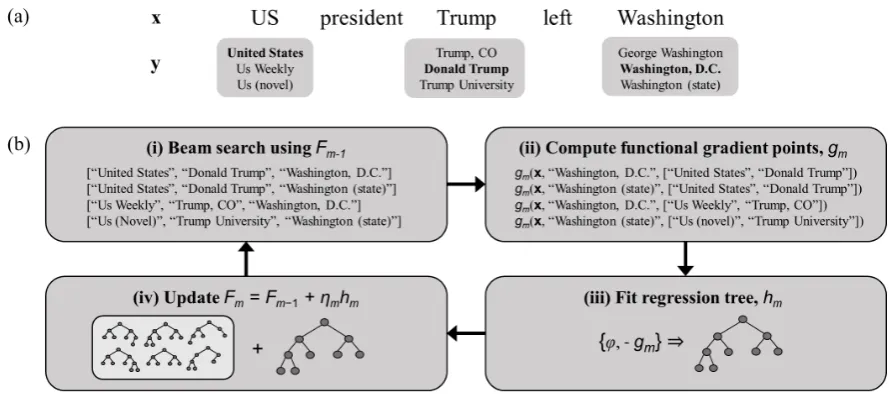
such as relation extraction (Mintz et al., 2009; Riedel et al.,2010), knowledge base population (Ji and Grishman, 2011; Dredze et al., 2010), and question answering (Berant et al.,2013;Yih et al., 2015). This task is challenging because of the inherent ambiguity between mentions and the re-ferred entities. Consider, for example, the men-tion ‘Washington’, which can be linked to a city, a state, a person, an university, or a lake (Fig. 1).
Fortunately, simple and effective features have been proposed to capture the ambiguity that are designed to model the similarity between a mtion (and its local context) and a candidate en-tity, as well as the relatedness between entities that co-occur in a single document. These are typically statistical features estimated from entity-linked corpora, and similarity features that are pre-computed using distance metrics such as co-sine. For example, a key feature for ED is the
prior probabilityof an entity given a specific men-tion, which is estimated from mention-entity co-occurrence statistics. This simple feature alone can yield 70% to 80% accuracy on both news and Twitter texts (Lazic et al.,2015;Guo et al.,2013). To capture the non-linear relationships between the low-dimensional dense features like statistical features, sophisticated machine learning models such as neural networks and gradient tree boost-ing are preferred over linear models. In particu-lar, gradient tree boosting has been shown to be highly competitive for ED in recent work (Yang and Chang, 2015; Yamada et al., 2016). How-ever, although achieving appealing results, exist-ing gradient-tree-boostexist-ing-based ED systems typ-ically operate on each individual mention, with-out attempting to jointly resolve entity mentions in a document together. Joint entity disambigua-tion has been shown to significantly boost perfor-mance when used in conjunction with other ma-chine learning techniques (Ratinov et al., 2011; Hoffart et al., 2011). However, how to train a
global gradient tree boosting model that produces coherent entity assignments for all the mentions in a document is still an open question.
In this work, we present, to the best of our knowledge, the first structured gradient tree boost-ing (SGTB) model for collective entity disam-biguation. Building on the general SGTB frame-work introduced by Yang and Chang(2015), we develop a globally normalized model for ED that employs a conditional random field (CRF) ob-jective (Lafferty et al., 2001). The model per-mits the utilization of global features defined be-tween the current entity candidate and the entire decision history for previous entity assignments, which enables the global optimization for all the entity mentions in a document. As discussed in prior work (Smith and Johnson,2007;Andor et al., 2016), globally normalized models are more ex-pressive than locally normalized models.
As in many other global models, our SGTB model suffers from the difficulty of computing the partition function (normalization term) for training and inference. We adopt beam search to address this problem, in which we keep track of multiple hypotheses and sum over the paths in the beam. In particular, we propose Bidirectional Beam Search with Gold path (BiBSG) technique that is specif-ically designed for SGTB model training. Com-pared to standard beam search strategies, BiBSG reduces model variance and also enjoys the advan-tage in its ability to consider both past and future information when predicting an output.
Our contributions are:
• We propose a SGTB model for collectively
disambiguating entities in a document. By jointly modeling local decisions and global structure, SGTB is able to produce globally optimal entity assignments for all the men-tions.
• We present BiBSG, an efficient algorithm for
approximate bidirectional inference. The al-gorithm is tailored to SGTB models, which can reduce model variance by generating more point-wise functional gradients for es-timating the auxiliary regression models.
• SGTB achieves state-of-the-art (SOTA) re-sults on various popular ED datasets, and it outperforms the previous SOTA systems by 1-2% absolute accuracy on the AIDA-CoNLL (Hoffart et al.,2011) dataset.
2 Model
In this section, we present a SGTB model for col-lective entity disambiguation. We first formally define the task of ED, and then describe a struc-tured learning formalization for producing glob-ally coherent entity assignments for mentions in a document. Finally, we show how to optimize the model using functional gradient descent.
For an input document, assume that we are given all the mentions of named entities within it. Also assume that we are given a lexicon that maps each mention to a set of entity candidates in a given reference entity database (e.g., Wikipedia or Freebase). The ED system maps each mention in the document to an entry in the entity database. Since a mention is often ambiguous on its own (i.e., the lexicon maps the mention to multiple en-tity candidates), the ED system needs to lever-age two types of contextual information for dis-ambiguation: local information based on the en-tity mention and its surrounding words, and global information that exploits the document-level co-herence of the predicted entities. Note that model-ing entity-entity coherence is very challengmodel-ing, as the long-range dependencies between entities cor-respond to exponentially large search space.
We formalize this task as a structured learning problem. Letxbe a document withT target
men-tions, andy = {yt}Tt=1 be the entity assignments of the mentions in the document. We useS(x,y) to denote the joint scoring function between the input document and the output structure. In tradi-tional NLP tasks, such as part-of-speech tagging and named entity recognition, we often rely on low-order Markov assumptions to decompose the global scoring function into a summation of lo-cal functions. ED systems, however, are often re-quired to model nonlocal phenomena, as any pair of entities is potentially interdependent. There-fore, we choose the following decomposition:
S(x,y) = T
X
t=1
F(x, yt,y1:t−1), (1)
whereF(x, yt,y1:t−1)is a factor scoring function. Specifically, a local prediction yt depends on all theprevious decisions,y1:t−1in our model, which resembles recurrent neural network (RNN) mod-els (Elman, 1990; Hochreiter and Schmidhuber, 1997).
Figure 1: (a) Example documentxwith entity candidates for each mention (gold entities are inbold); (b) them-th SGTB update iteration: (i) conduct beam search to sample candidate entity sequences (§3), (ii) compute point-wise functional gradients for each candidate sequence, (iii) fit a regression tree to the negative functional gradient points with input features,φ, (iv) update the factor scoring function,F, by adding the trained regression tree.
distribution over possible output structures as fol-lows:
p(y|x) = exp{
PT
t=1F(x, yt,y1:t−1)}
Z(x) , (2)
where
Z(x) = X
y0∈Gen(x) exp{
T
X
t=1
F(x, yt0,y1:0 t−1)}
and Gen(x) is the set of all possible sequences of entity assignments depending on the lexicon.
Z(x) is then a global normalization term. As shown in previous work, globally normalized models are very expressive, and also avoid the label bias problem (Lafferty et al., 2001; Andor et al.,2016). The inference problem is to find
arg max
y∈Gen(x)
p(y|x) = arg max
y∈Gen(x) T
X
t=1
F(x, yt,y1:t−1).
(3)
2.1 Structured gradient tree boosting
An overview of our SGTB model is shown inFig. 1. The model minimizes the negative log-likelihood of the data,
L(y∗, S(x,y)) =−logp(y∗|x)
= logZ(x)−S(x,y∗), (4)
wherey∗is the gold output structure.
In a standard CRF, the factor scoring func-tion is typically assumed to have this form:
F(x, yt,y1:t−1) = θ>φ(x, yt,y1:t−1), where
φ(x, yt,y1:t−1) is the feature function and θ are the model parameters. The key idea of SGTB is that, instead of defining a parametric model and optimizing its parameters, we can directly opti-mize the factor scoring function F(·) iteratively by performing gradient descent in function space. In particular, supposeF(·) =Fm−1(·)in them-th iteration, we will updateF(·)as follows:
Fm(x, yt,y1:t−1) =Fm−1(x, yt,y1:t−1)
−ηmgm(x, yt,y1:t−1), (5)
where
gm(x, yt,y1:t−1) =
∂L(y∗, S(x,y))
∂F(x, yt,y1:t−1)) =p(y1:t|x)−1[y1:t=y1:∗t]
(6)
is the functional gradient,ηm is the learning rate, and 1[·] represents an indicator function, which returns 1 if the predicted sequence matches the gold one, and 0otherwise. We initialize F(·) to 0(F0(·) = 0).
We can approximate the negative func-tional gradient −gm(·) with a regression tree model hm(·) by fitting the training data
{φ(x(i), y(i) t ,y
(i)
1:t−1)} to the point-wise negative functional gradients (also known as residuals)
{−gm(x(i), yt(i),y (i)
[image:3.595.73.518.61.258.2]function can be obtained by
F(x, yt,y1:t−1) = M
X
m=1
ηmhm(x, yt,y1:t−1),
(7) wherehm(x, yt,y1:t−1)is called a basis function. We setηm= 1in this work.
3 Training
Training the SGTB model requires computing the point-wise functional gradients with respect to training documents and candidate entity se-quences. This is challenging, due to the exponen-tial output structure search space. First, we are not able to enumerate all possible candidate entity se-quences. Second, computing the conditional prob-abilities shown inEq. 6is intractable, as it is pro-hibitively expensive to compute the partition func-tionZ(x)inEq. 2. Beam search can be used to ad-dress these problems. We can compute point-wise functional gradients for candidate entity sequences in the beam, and approximately compute the parti-tion funcparti-tion by summing over the elements in the beam.
In this section, we present a bidirectional beam search training algorithm that always keeps the gold sequence in the beam. The algorithm is tai-lored to SGTB, and improves standard training methods in two aspects: (1) it reduces model vari-ance by collecting more point-wise function gra-dients to train a regression tree; (2) it leverages information from both past and future to conduct better local search.
3.1 Beam search with gold path
The early update (Collins and Roark, 2004) and LaSO (Daum´e III and Marcu,2005;Xu and Fern, 2007) strategies are widely adopted with beam search for updating model parameters in previous work. Both methods keep track of the location of the gold path in the beam while decoding a train-ing sequence. A gradient update step will be taken if the gold path falls out of the beam at a specific time steptor after the last step T. Adapting the
strategies to SGTB training is straightforward. We will compute point-wise functional gradients for all candidate entity sequences after time stepT or
when the gold sequence falls out the beam. Both early update and LaSO are typically applied to on-line learning scenarios, in which model parame-ters are updated after passing one or a few training sequences.
SGTB training, however, fits the batch learning paradigm. In each training epoch, a SGTB model will be updated only once using the regression tree model fit on the point-wise negative functional gradients. The gradients are calculated with re-spect to the output sequences obtained from beam search. We propose a simple training strategy that computes and collects point-wise functional gra-dients at every step of a training sequence. In addition, instead of passively monitoring the gold path, we always keep the gold path in the beam to ensure that we have valid functional gradients at each time step. The new beam search training method, Beam Search with Gold path (BSG), gen-erates much more point-wise functional gradients than early update or LaSO, which can reduce the variance of the auxiliary regression tree model. As a result, SGTB trained with BSG consistently out-performs early update or LaSO in our exploratory experiments, and it also requires fewer training epochs to converge.2
3.2 Bidirectional beam search
During beam search, if we consider a decision made at time step t, the joint probability p(y|x) can be factorized aroundtas follows:
p(y|x) =p(y1:t−1|x)·p(yt|y1:t−1,x)
·p(yt+1:T|yt,y1:t−1,x).
(8)
Traditional beam search performs inference in a unidirectional (left-to-right) fashion. Since the beam search at time steptconsiders only the beam
sequences that were committed to so far,{y1:t−1}, it effectively approximates the above probability by assuming that all futures are equally likely, i.e.
p(yt+1:T|yt,y1:t−1,x) is uniform. Therefore, at any given time, there is no information from the future when incorporating the global structure.
In this work, we adopt a Bidirectional Beam Search (BiBS) methodology that incorporates multiple beams to take future information into ac-count (Sun et al., 2017). It makes two simplify-ing assumptions that better approximate the joint probability above while remaining tractable: (1) future predictions are independent of past predic-tions given yt; (2)p(yt) is uniform. These yield the following approximation:
p(yt+1:T|yt,y1:t−1,x) =p(yt+1:T|yt,x)
∝p(yt|yt+1:T,x)·p(yt+1:T|x). (9)
2Early update and LaSO perform similarly, thus we only
Substituting this back intoEq. 8therefore yields:
p(y|x)∝p(y1:t−1|x)·p(yt|y1:t−1,x)
·p(yt|yt+1:t,x)·p(yt+1:T|x), (10)
which decomposes into multiplication of a for-ward probability and a backfor-ward probability. In (Sun et al.,2017), these are retrieved from for-ward and backfor-ward recurrent networks, whereas in our work we use the joint scores (log proba-bilities shown in Eq. 1) computed for partial se-quences from forward and backward beams.
Algorithm 1:Bidirectional Beam Search with Gold path (BiBSG)
Input :input documentx, candidate sequences{y}, joint scoring functionS(x,yt1:t2)
Output:beam sequence setC C← ∅
whilenot convergeddo
//forward beam search
fort= 1,· · ·, Tdo C(F)
←top-By1:t[S(x,y1:t) +S(x,yT:t)]
//add gold subsequence C(F)
←C(F)
∪ {y∗
1:t}
C←C∪C(F)
end
//backward beam search
fort=T,· · ·,1do
C(B)
←top-ByT:t[S(x,yT:t) +S(x,y1:t)]
//add gold subsequence C(B)
←C(B)
∪ {y∗T:t}
C←C∪C(B)
end end
The full inference algorithm, Bidirectional Beam Search with Gold path (BiBSG), is pre-sented in Alg. 1. When performing the forward pass to update the forward beam, forward joint scores, S(x,y1:t), are computed with respect to current forward beam, and backward joint scores,
S(x,yT:t), are computed with respect to previous backward beam. A similar procedure is used for the backward pass. The search converges very fast, and we use two rounds of bidirectional search as a good approximation. Finally, SGTB-BiBSG compares the conditional probabilitiesp(y(·)|x)of the best scoring output sequencesy(F)andy(B)
ob-tained from the forward and backward beams. The final prediction is the sequence with the higher conditional probability score.
4 Implementation
We provide implementation details of our SGTB systems, including entity candidate generation,
adopted local and global features, and some efforts to make training and inference faster.
4.1 Candidate selection
We use a mention prior pˆ(y|x) to select en-tity candidates for a mention x.
Follow-ingGanea and Hofmann(2017), the prior is com-puted by averaging mention prior probabilities built from mention-entity hyperlink statistics from Wikipedia3 and a large Web corpus (Spitkovsky
and Chang,2012). Given a mention, we select the top30entity candidates according topˆ(y|x).
We also use a simple heuristic proposed byGanea and Hofmann(2017) to improve candi-date selection for persons: for a mentionx, if there
are mentions of persons that containxas a
contin-uous subsequence of words, then we consider the candidate set obtained from the longest mention for the mentionx.
4.2 Features
The feature function φ(x, yt,y1:t−1) can be
de-composed into the summation of a local feature function φL(x, yt) and a global feature function
φG(yt,y1:t−1).
Local features We consider standard local fea-tures that have been used in prior work, includ-ing mention priors p(y|x) obtained from differ-ent resources; differ-entity popularity features based on Wikipedia page view count statistics;4 named
en-tity recognition (NER) type features given by an in-house NER system trained on the CoNLL 2003 NER data (Tjong Kim Sang and De Meulder, 2003); entity type features based on Freebase type information; and three textual similarity features proposed byYamada et al.(2016).5
Global features Three features are utilized to characterize entity relationships: entity-entity co-occurrence counts obtained from Wikipedia, and two cosine similarity scores between entity vectors based on entity embed-dings from (Ganea and Hofmann, 2017) and Freebase entity embeddings released by Google6
3We use a Wikipedia snapshot as of Feb. 2017.
4We obtain the statistics of Feb. 2017 and Dec. 2011
from https://dumps.wikimedia.org/other/ pagecounts-ez/merged/.
5We obtain embeddings jointly trained for words and
en-tities from (Ganea and Hofmann,2017).
respectively. We denote the entity-entity features between entitiesytandyt0 asφE(yt, yt0).
At steptof a training sequence, we quantify the
coherence ofytwith respect to previous decisions
y1:y−1 by first extracting entity-entity features be-tweenytandyt0 where1 ≤ t0 ≤ t−1, and then aggregating the information to have a global fea-ture vectorφG(yt,y1:t−1)of a fixed length:
φG(yt,y1:t−1) = t−1
X
t0=1
φE(yt, yt0)
t−1
⊕maxt−1
t0=1 φE(yt, yt0),
where⊕denotes concatenation of vectors.
4.3 Efficiency
Global models are powerful and effective, but of-ten at a cost of efficiency. We discuss ways to speed up training and inference for SGTB models. Many of the adopted features such as mention priors and entity-entity co-occurrences can be ex-tracted once and retrieved later with just a hash map lookup. The most expensive features are the cosine similarity features based on word and en-tity embeddings. By normalizing the embeddings to have a unit norm, we can obtain the similarity features using dot products. We find this simple preprocessing makes feature extraction faster by two orders of magnitude.
SGTB training can be easily parallelized, as the computation of functional gradients are indepen-dent for different documents. During each train-ing iteration, we randomly split traintrain-ing docu-ments into different partitions, and then calculate the point-wise functional gradients for documents of different partitions in parallel.
5 Experiments
In this section, we evaluate SGTB on some of the most popular datasets for ED. After describing the experimental setup, we compare SGTB with previous state-of-the-art (SOTA) ED systems and present our main findings in§5.3.
5.1 Data
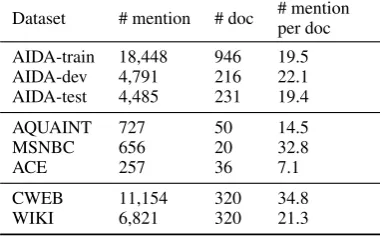
We use six publicly available datasets to validate the effectiveness of SGTB. AIDA-CoNLL ( Hof-fart et al., 2011) is a widely adopted dataset for ED based on the CoNLL 2003 NER dataset (Tjong Kim Sang and De Meulder, 2003). It is
Dataset # mention # doc # mentionper doc AIDA-train 18,448 946 19.5 AIDA-dev 4,791 216 22.1 AIDA-test 4,485 231 19.4
AQUAINT 727 50 14.5
MSNBC 656 20 32.8
ACE 257 36 7.1
CWEB 11,154 320 34.8
[image:6.595.320.512.66.184.2]WIKI 6,821 320 21.3
Table 1: Statistics of the ED datasets used in this work.
further split into training (AIDA-train), de-velopment (AIDA-dev), and test (AIDA-test) sets.7 AQUAINT (Milne and Witten, 2008),
MSNBC (Cucerzan, 2007), and ACE (Ratinov et al., 2011) are three datasets for Wikification, which also contain Wikipedia concepts beyond named entities. These datasets were recently cleaned and updated byGuo and Barbosa(2016). WIKI and CWEB are automatically annotated datasets built from the ClueWeb and Wikipedia corpora byGuo and Barbosa (2016). The statis-tics of these datasets are available inTable 1.
5.2 Experimental settings
Following previous work (Guo and Barbosa,2016; Ganea and Hofmann,2017), we evaluate our mod-els on both in-domain and cross-domain testing settings. In particular, we train our models on train set, tune hyperparameters on AIDA-dev set, and test on AIDA-test set (in-domain test-ing) and all other datasets (cross-domain testtest-ing). We follow prior work and report in-KB accuracies for AIDA-test and Bag-of-Title (BoT) F1 scores for the other test sets.
Two AIDA-CoNLL specific resources have been widely used in previous work. In order to have fair comparisons with these works, we also adopt them only for the AIDA datasets. First, we use a mention prior obtained from aliases to candi-date entities released byHoffart et al.(2011) along with the two priors described in§4.1. Second, we
also experiment with PPRforNED, an entity can-didate selection system released byPershina et al. (2015). It is unclear how candidates were pruned, but the entity candidates generated by this sys-tem have high recall and low ambiguity, and they contribute to some of the best results reported for AIDA-test (Yamada et al.,2016;Sil et al.,2018).
7AIDA-dev and AIDA-test are also referred as AIDA-a
Competitive systems We implement four com-petitive ED systems, and three of them are based on variants of our proposed SGTB algorithm.8
Gradient tree boostingis a local model that em-ploys only local features to make independent de-cisions for every entity mention. Note that our lo-cal model is different from that presented by Ya-mada et al.(2016), where they treat ED as binary classification for each mention-entity pair. SGTB-BSis a Structured Gradient Tree Boosting model trained with Beam Search with early update strat-egy.SGTB-BSGuses Beam Search with Gold path training strategy presented in§3.1. Finally, SGTB-BiBSG exploits Bidirectional Beam Search with Gold path to leverage information from both past and future for better local search.
In addition, we compare against best published results on all the datasets. To ensure fair compar-isons, we group results according to candidate se-lection system that different ED systems adopted.
Parameter tuning We tune all the hyperparam-eters on the AIDA-dev set. We use recommended hyperparameter values from scikit-learn to train regression trees, except for the maximum depth of the tree, which we choose from{3,5,8}. Af-ter a set of preliminary experiments, we select the beam size from {3,4,5,6}. The best values for the two hyperparameters are3and4respectively. As mentioned in§2, the learning rate is set to1. We train SGTB for at most500epochs (i.e., fit at most 500 regression trees). During training, we check the performance on the development set ev-ery25epochs to perform early stopping. Training takes3hours for SGTB-BS and SGTB-BSG, and takes9hours for SGTB-BiBSG on 16 threads.
5.3 Results
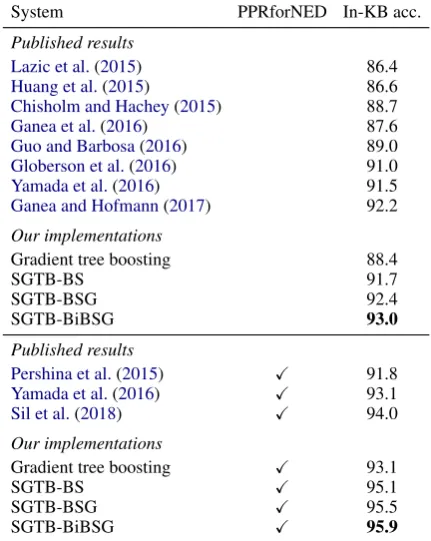
In-domain results In-domain evaluation results are presented in Table 2. As shown, SGTB achieves much better performance than all pre-viously published results. Specifically, SGTB-BiBSG outperforms the previous SOTA sys-tem (Ganea and Hofmann, 2017) by0.8% accu-racy, and improves upon the best published results when employing the PPRforNED candidate selec-tion system by 1.9% accuracy. Global informa-tion is clearly useful, as it helps to boost the per-formance by2-4points of accuracy, depending on the candidate generation system. In terms of beam 8Our implementations are based on the scikit-learn
pack-age (Pedregosa et al.,2011).
System PPRforNED In-KB acc.
Published results
Lazic et al.(2015) 86.4
Huang et al.(2015) 86.6
Chisholm and Hachey(2015) 88.7
Ganea et al.(2016) 87.6
Guo and Barbosa(2016) 89.0
Globerson et al.(2016) 91.0
Yamada et al.(2016) 91.5
Ganea and Hofmann(2017) 92.2
Our implementations
Gradient tree boosting 88.4
SGTB-BS 91.7
SGTB-BSG 92.4
SGTB-BiBSG 93.0
Published results
Pershina et al.(2015) X 91.8
Yamada et al.(2016) X 93.1
Sil et al.(2018) X 94.0
Our implementations
Gradient tree boosting X 93.1
SGTB-BS X 95.1
SGTB-BSG X 95.5
[image:7.595.307.523.65.336.2]SGTB-BiBSG X 95.9
Table 2: In-domain evaluation: in-KB accuracy results on the AIDA-test set. Checked PPRforNED indicates that the system uses PPRforNED (Pershina et al.,2015) to select candidate entities.The best results are inbold.
search training strategies, BiBSG consistently out-performs BSG and beam search with early update. By employing more point-wise functional gradi-ents to train the regression trees and leveraging global information from both past and future to carry on local search, BiBSG is able to find bet-ter global solutions than albet-ternative training strate-gies.
System AQUAINT MSNBC ACE CWEB WIKI Published results
Fang et al.(2016) 88.8 81.2 85.3 -
-Ganea et al.(2016) 89.2 91.0 88.7 -
-Milne and Witten(2008) 85.0 78.0 81.0 64.1 81.7
Hoffart et al.(2011) 56.0 79.0 80.0 58.6 63.0
Ratinov et al.(2011) 83.0 75.0 82.0 56.2 67.2
Cheng and Roth(2013) 90.0 90.0 86.0 67.5 73.4
Guo and Barbosa(2016) 87.0 92.0 88.0 77.0 84.5
Ganea and Hofmann(2017) 88.5 93.7 88.5 77.9 77.5
Our implementations
Gradient tree boosting 90.3 91.1 89.2 78.8 75.0
SGTB-BS 90.5 92.4 88.9 81.7 76.4
SGTB-BSG 89.4 92.5 88.6 81.7 78.4
SGTB-BiBSG 89.9 92.6 88.5 81.8 79.2
Table 3: Cross-domain evaluation: Bag-of-Title (BoT) F1 results on ED datasets. The best results are inbold.
6 Related work
Entity disambiguation Most ED systems con-sist of a local component that models relatedness between a mention and a candidate entity, as well as a global component that produces coherent en-tity assignments for all mentions within a docu-ment. Recent research has largely focused on joint resolution of entities, which is usually performed by maximizing the global topical coherence be-tween entities. As discussed above, directly op-timizing the coherence objective is computation-ally intractable, and several heuristics and approx-imations have been proposed to address the prob-lem.Hoffart et al.(2011) use an iterative heuristic to remove unpromising mention-entity edges. Ya-mada et al.(2016) employ a two-stage approach, in which global information is incorporated in the second stage based on local decisions from the first stage. Approximate inference techniques have been widely adopted for ED.Cheng and Roth (2013) use an integer linear program (ILP) solver. Belief propagation (BP) and its variant loopy be-lief propagation (LBP) have been used by Ganea et al. (2016) andGanea and Hofmann(2017) re-spectively. We employ another standard approx-imate inference algorithm, beam search, in this work. To make beam search a better fit for SGTB training, we propose BiBSG that improves beam search training on stability and effectiveness.
Structured gradient tree boosting Gradient tree boosting has been used in some of the most accurate systems for a variety of classification and regression problems (Babenko et al., 2011; Wu et al.,2010;Yamada et al.,2016). However, gradi-ent tree boosting is seldom studied in the context
of structured learning, with only a few exceptions. Dietterich et al.(2004) propose TreeCRF that re-places the linear scoring function of a CRF with a scoring function given by a gradient tree boost-ing model. TreeCRF achieves comparable or bet-ter results than CRF on some linear chain struc-tured prediction problems. Bagnell et al. (2007) extend the Maximum Margin Planning (MMP; Ratliff et al., 2006) algorithm to structured predic-tion problems by learning new features using gra-dient boosting machines. Yang and Chang(2015) present a general SGTB framework that is flex-ible in the choice of loss functions and specific structures. They also apply SGTB to the task of tweet entity linking with a special non-overlapping structure. By decomposing the structures into lo-cal substructures, exact inference is tractable in all the aforementioned works. Our work shows that we can train SGTB models efficiently and effec-tively even with approximate inference. This ex-tends the utility of SGTB models to a wider range of interesting structured prediction problems.
7 Conclusion and future work
and it also achieves SOTA results on many other ED datasets even in the cross-domain evaluation setting. SGTB is a family of structured learning algorithms that can be potentially applied to other core NLP tasks. In the future, we would like to in-vestigate the effectiveness of SGTB on other infor-mation extraction tasks, such as relation extraction and coreference resolution.
8 Acknowledgments
We thank Prabhanjan Kambadur and other people in the Bloomberg AI team for their valuable com-ments on earlier version of this paper. We also thank the NAACL reviewers for their helpful feed-back. This work also benefitted from discussions with Mark Dredze and Karl Stratos.
References
Daniel Andor, Chris Alberti, David Weiss, Aliaksei Severyn, Alessandro Presta, Kuzman Ganchev, Slav Petrov, and Michael Collins. 2016. Globally nor-malized transition-based neural networks. In Pro-ceedings of the Association for Computational Lin-guistics (ACL).
Boris Babenko, Ming-Hsuan Yang, and Serge Be-longie. 2011. Robust object tracking with online multiple instance learning. Pattern Analysis and Machine Intelligence, IEEE Transactions on.
JA Bagnell, Joel Chestnutt, David M Bradley, and Nathan D Ratliff. 2007. Boosting structured predic-tion for imitapredic-tion learning. In Neural Information Processing Systems (NIPS).
Jonathan Berant, Andrew Chou, Roy Frostig, and Percy Liang. 2013. Semantic parsing on freebase from question-answer pairs. InProceedings of Em-pirical Methods for Natural Language Processing (EMNLP).
Xiao Cheng and Dan Roth. 2013. Relational inference for wikification. InProceedings of Empirical Meth-ods for Natural Language Processing (EMNLP).
Andrew Chisholm and Ben Hachey. 2015. Entity dis-ambiguation with web links. Transactions of the As-sociation for Computational Linguistics3.
Michael Collins and Brian Roark. 2004. Incremental parsing with the perceptron algorithm. In Proceed-ings of the Association for Computational Linguis-tics (ACL).
Silviu Cucerzan. 2007. Large-scale named entity dis-ambiguation based on wikipedia data. In Proceed-ings of Empirical Methods for Natural Language Processing (EMNLP).
Hal Daum´e III and Daniel Marcu. 2005. Learning as search optimization: Approximate large margin methods for structured prediction. InProceedings of the International Conference on Machine Learn-ing (ICML).
Thomas G Dietterich, Adam Ashenfelter, and Yaroslav Bulatov. 2004. Training conditional random fields via gradient tree boosting. In Proceedings of the International Conference on Machine Learning (ICML).
Mark Dredze, Paul McNamee, Delip Rao, Adam Ger-ber, and Tim Finin. 2010. Entity disambiguation for knowledge base population. InProceedings of the Association for Computational Linguistics (ACL). Jeffrey L Elman. 1990. Finding structure in time.
Cog-nitive science14(2).
Wei Fang, Jianwen Zhang, Dilin Wang, Zheng Chen, and Ming Li. 2016. Entity disambiguation by knowledge and text jointly embedding. In Proceed-ings of the Conference on Natural Language Learn-ing (CoNLL).
Octavian-Eugen Ganea, Marina Ganea, Aurelien Luc-chi, Carsten Eickhoff, and Thomas Hofmann. 2016. Probabilistic bag-of-hyperlinks model for entity linking. In Proceedings of the International Con-ference on World Wide Web (WWW).
Octavian-Eugen Ganea and Thomas Hofmann. 2017. Deep joint entity disambiguation with local neural attention. InProceedings of Empirical Methods for Natural Language Processing (EMNLP).
Amir Globerson, Nevena Lazic, Soumen Chakrabarti, Amarnag Subramanya, Michael Ringaard, and Fer-nando Pereira. 2016. Collective entity resolution with multi-focal attention. InProceedings of the As-sociation for Computational Linguistics (ACL). Stephen Guo, Ming-Wei Chang, and Emre Kiciman.
2013. To link or not to link? a study on end-to-end tweet entity linking. In Proceedings of the North American Chapter of the Association for Computa-tional Linguistics (NAACL).
Zhaochen Guo and Denilson Barbosa. 2016. Robust named entity disambiguation with random walks.
Semantic Web.
Sepp Hochreiter and J¨urgen Schmidhuber. 1997. Long short-term memory.Neural computation9(8). Johannes Hoffart, Mohamed Amir Yosef, Ilaria
Bor-dino, Hagen F¨urstenau, Manfred Pinkal, Marc Span-iol, Bilyana Taneva, Stefan Thater, and Gerhard Weikum. 2011. Robust disambiguation of named entities in text. InProceedings of Empirical Meth-ods for Natural Language Processing (EMNLP). Hongzhao Huang, Larry Heck, and Heng Ji. 2015.
Heng Ji and Ralph Grishman. 2011. Knowledge base population: Successful approaches and challenges. InProceedings of the Association for Computational Linguistics (ACL).
John Lafferty, Andrew McCallum, and Fernando CN Pereira. 2001. Conditional random fields: Prob-abilistic models for segmenting and labeling se-quence data. In Proceedings of the International Conference on Machine Learning (ICML).
Nevena Lazic, Amarnag Subramanya, Michael Ring-gaard, and Fernando Pereira. 2015. Plato: A selec-tive context model for entity resolution. Transac-tions of the Association for Computational Linguis-tics.
David Milne and Ian H Witten. 2008. Learning to link with wikipedia. In Proceedings of the ACM con-ference on Information and knowledge management (CIKM).
Mike Mintz, Steven Bills, Rion Snow, and Dan Juraf-sky. 2009. Distant supervision for relation extrac-tion without labeled data. InProceedings of the As-sociation for Computational Linguistics (ACL).
Fabian Pedregosa, Ga¨el Varoquaux, Alexandre Gram-fort, Vincent Michel, Bertrand Thirion, Olivier Grisel, Mathieu Blondel, Peter Prettenhofer, Ron Weiss, Vincent Dubourg, et al. 2011. Scikit-learn: Machine learning in python. Journal of Machine Learning Research.
Maria Pershina, Yifan He, and Ralph Grishman. 2015. Personalized page rank for named entity disam-biguation. In Proceedings of the North American Chapter of the Association for Computational Lin-guistics (NAACL).
Lev Ratinov, Dan Roth, Doug Downey, and Mike An-derson. 2011. Local and global algorithms for dis-ambiguation to wikipedia. InProceedings of the As-sociation for Computational Linguistics (ACL).
Nathan D Ratliff, J Andrew Bagnell, and Martin A Zinkevich. 2006. Maximum margin planning. In
Proceedings of the International Conference on Ma-chine Learning (ICML).
Sebastian Riedel, Limin Yao, and Andrew McCallum. 2010. Modeling relations and their mentions with-out labeled text. Machine learning and knowledge discovery in databases.
Avirup Sil, Gourab Kundu, Radu Florian, and Wael Hamza. 2018. Neural cross-lingual entity linking. InProceedings of the National Conference on Arti-ficial Intelligence (AAAI).
Noah A Smith and Mark Johnson. 2007. Weighted and probabilistic context-free grammars are equally ex-pressive. Computational Linguistics.
Valentin I Spitkovsky and Angel X Chang. 2012. A cross-lingual dictionary for english wikipedia con-cepts. In Proceedings of the Language Resources and Evaluation Conference (LREC).
Qing Sun, Stefan Lee, and Dhruv Batra. 2017. Bidi-rectional beam search: Forward-backward inference in neural sequence models for fill-in-the-blank im-age captioning. InProceedings of the IEEE Confer-ence on Computer Vision and Pattern Recognition (CVPR).
Erik F Tjong Kim Sang and Fien De Meulder. 2003. Introduction to the conll-2003 shared task: Language-independent named entity recognition. In Proceedings of the North American Chapter of the Association for Computational Linguistics (NAACL).
Qiang Wu, Christopher JC Burges, Krysta M Svore, and Jianfeng Gao. 2010. Adapting boosting for in-formation retrieval measures. Information Retrieval
.
Yuehua Xu and Alan Fern. 2007. On learning linear ranking functions for beam search. InProceedings of the International Conference on Machine Learn-ing (ICML).
Ikuya Yamada, Hiroyuki Shindo, Hideaki Takeda, and Yoshiyasu Takefuji. 2016. Joint learning of the em-bedding of words and entities for named entity dis-ambiguation. InProceedings of the Conference on Natural Language Learning (CoNLL).
Yi Yang and Ming-Wei Chang. 2015. S-mart: Novel tree-based structured learning algorithms applied to tweet entity linking. InProceedings of the Associa-tion for ComputaAssocia-tional Linguistics (ACL).