Proceedings of NAACL-HLT 2018, pages 442–452
Abstract Meaning Representation for Paraphrase Detection
Fuad Issa† Marco Damonte† Shay B. Cohen† Xiaohui Yan‡ Yi Chang‡
†School of Informatics, University of Edinburgh, 10 Crichton Street, Edinburgh EH8 9AB, UK ‡Huawei Technologies, San Jose, CA 95050, USA
[email protected] [email protected]
[email protected] {yanxiaohui2,yi.chang}@huawei.com
Abstract
Abstract Meaning Representation (AMR) parsing aims at abstracting away from the syn-tactic realization of a sentence, and denoting only its meaning in a canonical form. As such, it is ideal for paraphrase detection, a problem in which one is required to specify whether two sentences have the same meaning. We show that na¨ıve use of AMR in paraphrase de-tection is not necessarily useful, and turn to describe a technique based on latent seman-tic analysis in combination with AMR parsing that significantly advances state-of-the-art re-sults in paraphrase detection for the Microsoft Research Paraphrase Corpus. Our best results in the transductive setting are 86.6% for accu-racy and 90.0% for F1measure.
1 Introduction
Abstract Meaning Representation (AMR) parsing focuses on the conversion of natural language sen-tences into AMR graphs, aimed at abstracting away from the surface realizations of the sentences while preserving their meaning.
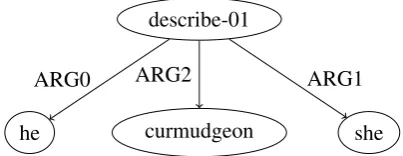
We make a first step towards showing that AMR can be used in practice for a task that requires identifying the canonicalization of language: para-phrase detection. In a “perfect world” using AMR to test for paraphrasing relation of two sentences should be simple. It would require finding the two AMR parses for each of the sentences, and then checking whether they are identical. Since AMR is aimed at abstracting away from the surface form which is used to express meaning, two sentences should be paraphrases only if they have identical AMRs. For instance, the three sentences:
1. He described her as a curmudgeon, 2. His description of her: curmudgeon,
3. She was a curmudgeon, according to his de-scription.
describe-01
he curmudgeon she
[image:1.595.315.517.217.295.2]ARG0 ARG2 ARG1
Figure 1: AMR graph for “He described her as a cur-mudgeon”, “His description of her: curmudgeon” and “She was a curmudgeon, according to his description”
should result in the same AMR graph as shown in Figure1.
However, in practice, things are different. First, there are no known AMR parsers that really distil only the meaning in text. For example, predicates which have interchangeable meaning use differ-ent AMR concepts, and there are errors that exist because of the machine learning techniques that are used for learning the parsers from data. Fi-nally, even human annotations do not yield per-fect AMRs, as the interannotator agreement re-ported in the literature for AMR is around 80% (Banarescu et al.,2013).
Second, meaning is often contextual, and it is not fully possible to determine the corresponding AMR parse just by looking at a given sentence. Entity mentions denote different entities in differ-ent contexts, and similarly predicates and nouns are ambiguous and depend on context. As such, one cannot expect to use AMR in the transparent way mentioned above to identify paraphrase rela-tions. However, we demonstrate in this paper that AMR can be used in a “softer” way to detect such relations.
Evaluation of AMR parsers is traditionally per-formed using the Smatch score (Cai and Knight,
2013). However,Damonte et al.(2017) argue that more ad-hoc metrics can be useful for advancing AMR research. Paraphrase detection can be seen
as a further benchmark for AMR parsers, high-lighting their ability of abstracting away from syn-tax and representing the core concepts expressed in the sentence. In order to advance research in AMR and its applications, it is important to have metrics that reflect on the ability of AMR graphs to have impact on subsequent tasks. In this work we therefore use two different AMR parsers, com-paring them throughout all experiments.
2 Background
AMRs are rooted, edge labeled, node labeled, di-rected graphs. They are biased towards the En-glish language and rely on PropBank (Kingsbury and Palmer, 2002) for the definition of the main events in the sentence. Nodes in an AMR graph represent events and concepts, while edges repre-sent the relationships between them. Banarescu et al.(2013) state that AMR are aimed at canon-icalizing multiple ways of expressing the same idea, which could be of great assistance to solve the problem of paraphrase detection. However, this goal is not entirely achieved in practice, and it will take long for AMR parsers to mature and achieve such canonicalization. At the moment, for example, even a simple pair of sentences such as “the boy desires the cake” and the “the boy wants the cake” would not have the same canonical form by state-of-the-art AMR parsers.
While some researchers (Fodor, 1975) have doubted the practical possibility of canonicalizing language or finding identical paraphrases in En-glish or otherwise, much work in NLP has been devoted to the problem of paraphrase identifica-tion (Mitchell and Lapata,2010;Baroni and Lenci,
2010; Socher et al., 2011;Guo and Diab, 2012;
Ji and Eisenstein,2013) and more weakly, finding entailment between sentences and phrases (Dagan et al., 2006; Bos and Markert, 2005; Harabagiu and Hickl,2006;Lewis and Steedman, 2013). In this work, we use the AMRs parsed for given sentences as a mean to extract useful information and train paraphrase detection classifiers on top of them.
2.1 Latent Semantic Analysis
Our work falls under the category of distribu-tional methods for paraphrase detection (Turney and Pantel, 2010;Mihalcea et al.,2006;Mitchell and Lapata, 2010; Guo and Diab, 2012; Ji and Eisenstein, 2013) such as with latent semantic
analysis (LSA, Landauer et al.,1998). The main principle behind this approach is to detect se-mantic similarity through distributional represen-tations for a given sentence and its potential para-phrase, where these representations are compared against each other according to some similarity metric or used as features with a discriminative classification method (Mihalcea et al.,2006;Guo and Diab,2012;Ji and Eisenstein,2013).
LSA is indeed one of the main tools in ob-taining such distributional representations for the problem of paraphrase detection. Most often, TF-IDF weighting has been used for building the sentence-term matrix, butJi and Eisenstein(2013) have shown that a significant improvement can be achieved in detecting similarity if one re-weights the sentence-term matrix differently. Indeed, this is one of our main contributions: we build on previous work on LSA for paraphrase detection and propose a technique to re-weight a sentence-conceptmatrix based on the AMR graphs for the given sentences. More details on the use of LSA for paraphrase detection appear in Section4.
2.2 AMR Parsing
AMR parsing is the task of converting natural lan-guage sentences into AMR graphs, which are Di-rected Acyclic Graphs (DAGs) in all cases except a few rare controversial cases. This task embeds several common NLP problems together, such as named entity recognition, sentential-level corefer-ence resolution, semantic role labeling and word-sense disambiguation. Several parsers for AMR have been recently developed (Flanigan et al.,
2014;Wang et al., 2015; Peng et al., 2015;Pust et al., 2015; Goodman et al., 2016; Rao et al.,
2015;Vanderwende et al.,2015;Artzi et al.,2015;
Barzdins and Gosko,2016a;Zhou et al.,2016; Da-monte et al., 2017; Barzdins and Gosko, 2016b;
Konstas et al.,2017). Shared tasks were also orga-nized in order to push forward the state-of-the-art (May,2016;May and Priyadarshi,2017).
infer whether one meaning representation is log-ically implied by others) and canonicalization (the ability to map several surface forms, such as para-phrases, into a single unique meaning representa-tion). In this paper, we evaluate AMR on its ability to canonicalize language through its assistance in deciding whether two sentences are paraphrases.
We note that this test is masked by the accuracy of the AMR parsers we use, which indeed do not give always fully correct predictions. These errors in our paraphrase detection due to the accuracy of the AMR parser are different than those which originate in an inherent difficulty of representing paraphrases using AMR because of the limitations of the formalism and the annotation guidelines that AMR follows.
We experiment with two AMR parsers for which a public version is available. The first is JAMR (Flanigan et al.,2014), which is a graph-based approach to AMR parsing. It works by per-forming two steps on the input sentence: concept identification and relation identification. The for-mer discovers the concept fragments correspond-ing to span of words in the sentence, while the latter finds the optimal spanning connected sub-graph from the concepts identified in the first step. The concept identification step has quadratic complexity and the relation identification step is
O(|V|2log|V|), with|V|being the set of nodes in
the AMR graph.
The second is AMREager (Damonte et al.,
2017), which is a transition-based parser that works by scanning the string left-to-right and building the graph as the scan proceeds. This transition-based system is akin to the depen-dency parsing transition-system ArcEager of
Nivre(2004), only without constraints that ensure that the resulting structure is a tree. In addition, there are operations that make the system create additional non-projective structures by checking after transition step whether siblings should be connected together with an edge. The complex-ity of AMREager is linear in the length of the sentence. AMREager was extended to other lan-guages (Damonte and Cohen,2018), and we leave it for future work to test the utility of AMR for paraphrase detection in these languages.
3 Problem Formulation
Let S be a set of sentences. We are given input data in the form of (x(1i), x2(i), b(i)) for i ∈ [n]
wherenis the number of training examples,x(ji)∈ S,j∈ {1,2}andb(i) ∈ {0,1}is a binary
indica-tor that tells whetherx(1i)is a paraphrase ofx(2i).
The goal is to learn a classifier
c:S × S → {0,1}
that tells for unseen instances whether the pair of sentences given as input are paraphrases of each other. We denote by[n]the set{1, . . . , n}.
4 Latent Semantic Analysis for Paraphrase Detection
The first step in our approach is the construction of lower-dimensional representations for the sen-tences in the training data. We use latent semantic analysis to get the sentence representations, which are then used to detect paraphrases using a classi-fier. More specifically, given a set of sentences
S = {x(ji) | j ∈ {1,2}, i ∈ [n]}, we build a
sentence-term matrixTsuch thatTk`indicates the
use of the`th word in the kth sentence inS. The
number of rows is the number of sentences in the dataset and the number of columns is the vocabu-lary size. This follows previous work with the use of LSA for paraphrasing (Guo and Diab,2012;Ji and Eisenstein,2013).
As a baseline, we experiment with two ways of assigning the values to the matrix:
• Tk` is the count of the `th word in the kth
sentence:
Tk`= count(`, k)
• Tk` is the term frequency-inverse document
frequency (TF-IDF) for thekth sentence with
respect to the`th word. TF-IDF is commonly
used in Information Retrieval to score words in a document and combines the frequency of the words in a document with the rarity of the term across documents. With TF-IDF, in order to have a high score, concepts must ap-pear in this sentence and not in many others. In that case, we define:
Tk`= count(`, k)×
n
csent(`, k)
wherecount(`, k)gives the count of the `th
number of sentences which contain the `th word:
csent(`, k) =|{k∈[|S|] : count(k, `)>0}|.
The AMR-based systems of Section 5 build upon this by re-weightingTk` with terms
depend-ing on the AMRs of the sentences.
For paraphrasing, previous work (Ji and Eisen-stein, 2013) has also considered the transductive setting (Gammerman et al.,1998), which we also use in our experiments. In the transductive setting,
Salso includes the sentences on which we expect
to perform the final evaluation for the purpose of learning the latent representations. Note that, in this case, the labels b(i) are not used in the
pro-cess of constructing word representations. In the inductive setting, on the other hand, the sentences in the testing set are not included in training and we project them instead using the LSA projection matrices onto the latent space learned to find their representations.
Once we constructed the matrixT, we perform
truncated singular value decomposition (SVD) on it, such that:
T ≈UΣV>
whereU ∈ Rk×m, V ∈ R`×m andΣ ∈ Rm×m
is a diagonal matrix of singular values. The final sentence representations are the rows of theU
ma-trix which range over the sentences and have m
dimensions.
The output of this process is a functionf:S → Rmwhich attaches to each sentence a
representa-tion. The idea behind LSA is that this matrix de-composition will make semantically similar sen-tences to appear close in the latent space, hence alleviating the problem of data sparsity and mak-ing it easier to detect when two sentences are para-phrases of each other.
Once we construct the sentence representations from the training data (either in the inductive or the transductive setting) we use the functionf to
map each pair of sentences from the training data
(x(1i), x(2i)) to two vectors f(x(1i)) +f(x(2i)) and |f(x(1i)) − f(x(2i))| (where the absolute value is taken coordinate-wise) and then concatenate them into a feature vector φ(x(1i), x(2i)), which is then
used as input to a support vector machine (SVM) classifier (Ji and Eisenstein,2013).1
5 Abstract Meaning Representation Features
The main hypothesis tested in this work is that AMR can be useful in deciding whether two sen-tences are paraphrases of each other. We investi-gate two ways to use AMR information to better inform the classifier: similarity-based and LSA-based.
5.1 Graph Similarity and Bag of AMR Concepts
An obvious way to use AMR information is to just compute the similarity between the two graphs and use the score as an additional feature. As a score we use Smatch, which computes the overlap in terms of recall, precision and F-score between two unaligned graphs by finding the alignments between the graphs that maximizes the overlap. The alignment step is necessary because in AMR multiple nodes can have the same labels and ar-bitrary variable names are used to distinguish be-tween them. Smatch is the standard metric to eval-uate the overlap between AMR graphs. The score returned by Smatch is used as a single additional feature for the SVM.
The amount of overlap in the AMR nodes of the two graphs can be a good indicator of whether the sentences are paraphrases of each other. To test this hypothesis, we extract the unordered sets of AMR nodes and use the Jaccard similarity co-efficient as a feature. This is directly related to the concept identification step of the AMR parsing process, which is concerned with generating and labeling the nodes of the AMR graph. Concept identification is arguably one of the most challeng-ing part of AMR parschalleng-ing as the mappchalleng-ing between word spans and AMR nodes is not trivial ( Wer-ling et al.,2015). It is often considered as the first stage in the AMR parsing pipeline and it is there-fore reasonable to attempt using its intermediate results. We choose Jaccard as a metric for bag of concepts overlap following previous work in para-phrase detection (Achananuparp et al.,2008;
Be-1We note that while the NLP community has largely
rant and Liang,2014).
We note that while this approach of using AMR to detect paraphrase may sound plausible, it does not perform very well. As such, we compare and contrast this as an AMR baseline with the ap-proach that makes use of PageRank with TF-IDF reweighting for LSA, as described next.
5.2 PageRank and TF-IDF Reweighting for LSA
The main idea is to re-weight the LSA sentence-term matrix T (Section 4) according to a proba-bility distribution over the AMR nodes, which we accomplish by means of PageRank (Page et al.,
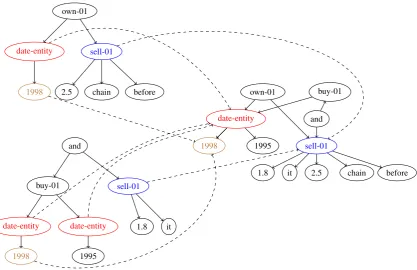
1999). The utility of re-weighting terms in the sentence-term matrix has been previously proved (Turney and Pantel,2010). PageRank is a method, originally developed for web pages, for ranking nodes in a graph according to their impact on other nodes. The algorithm works iteratively by adjust-ing at each iteration the score of each node based on the number and scores of nearby nodes that is connected to it, until convergence. Prior to apply-ing PageRank, we merge the two graphs by col-lapsing the concepts in the two graphs that have the same labels, similarly to Liu et al. (2015), as shown in Figure 2. We then compute the PageRank score for each node in the merged graph and multiply them by the corresponding frequency count of that concept in the sentence-term matrix. The graph merging step is necessary in order to en-sure that overlapping concepts obtain high PageR-ank scores. The PageRPageR-ank step applied to the merged graph ensures that this importance prop-agates to nearby nodes.
For a given graphG= (V, E), PageRank takes
as input a list of edges between nodes:
E={(ni, mi)},∀i= 0, . . . , n
n=|E|
and outputs a PageRank score for each node by solving the following equations with respect to
PG(·):
PG(n) = X
m∈I(n)
PG(m)
l(m)
where I(n) are the input edges to noden and l(m)is the number of edges coming out ofm.
For each concept of the merged AMR graph, we computeTk`, the weight for the LSA matrix
intro-duced in Section4, as follows:
Tk` = PG(l, k)×count(l, k)
wherePG(l, k)is the PageRank of`th concept for thekth sentence.
As a baseline for the PageRank system, the TF-IDF re-weighting scheme, as described in Sec-tion4, is also used to re-weight the AMR concepts.
6 Experiments
We now describe the experiments that we devised to discover whether AMR is useful for paraphrase detection. For AMR parsing, we used the JAMR2
version published for SemEval 2016 (Flanigan et al., 2016), reporting 0.67 Smatch score on LDC2015E86 and the first and only version avail-able for AMREager,3obtaining 0.64 Smatch score
on the same dataset. First, we discuss experi-ments where the AMRs are used as a mean to ex-tract additional sparse features for a SVM classi-fier. Then we turn to LSA to construct a represen-tation of the sentence based on the reweighting on the AMR nodes achieved through either PageR-ank or TF-IDF. Results show how the latter, which builds on state-of-the-art systems for this task, is a much more promising approach. Finally, we an-alyze how performance changes as a function of the number of dimensions used in the truncated matrix.
For evaluation, we use the Microsoft Research Paraphrase Corpus (Dolan et al., 2004). We use 70% of the dataset as training data and 30% as a test set. The total number of sentence pairs in the corpus is 5,801.
6.1 Graph Similarity and Bag of AMR Concepts
The Bag of words (BOW) baseline consists of a SVM that takes into account one single feature: the Jaccard score between the BOW representa-tions for the two sentences, i.e., one-hot vectors indicating whether each word in the vocabulary is used or not. The use of the single Jaccard fea-ture means that for the linear kernel we just learn a threshold on the score.
We note that the addition of the similarity-based features does not suffice to outperform the BOW baseline, as described in Table1. Unlike Smatch, the bag of concepts feature does not need to find a, possibly wrong, alignment between the two graphs
2JAMR is available from https://github.com/
jflanigan/jamr.
3AMREager is available fromhttp://cohort.inf.
own-01
date-entity sell-01
1998 2.5 chain before
and
buy-01 sell-01
date-entity date-entity
1998 1995
1.8 it
own-01
and
sell-01 buy-01
date-entity
1998 1995
[image:6.595.83.501.63.333.2]1.8 it 2.5 chain before
Figure 2: Visualization of the graph merging procedure for the sentenceYucaipa owned Dominick’s before selling the chain to Safeway in 1998 for$2.5 billion. (above) andYucaipa bought Dominick’s in 1995 for$693 million and sold it to Safeway for$1.8 billion in 1998.(below). The “date-entity”, “sell-01” and “1998” nodes in the two AMR graphs on the left are merged in the resulting graph on the right.
because it considers the node labels only. Inter-estingly, the addition of the bag of concepts fea-ture is beneficial only for AMREager. It is indeed worth noting the different behaviors of the two parsers: when using the Smatch score only, JAMR reports slightly higher numbers than AMREager. However, when using the bag of concepts features too, AMREager is considerably better than JAMR, which is unexpected as the concept identification performance of the two parsers is reported to be identical (Damonte et al.,2017).
There is also some variability with the kernel used for the SVM classifier. The polynomial ker-nel does consistently better than the RBF and lin-ear kernel. This means that a low-level interaction between the sentence representations does exist (when trying to determine whether they are para-phrases), but a higher order interaction, such as implied with RBF, is not necessary to be modeled.
6.2 PageRank and TF-IDF Reweighting for LSA
We now turn to experiments involving LSA as a mean to represent the candidate paraphrases. In
this set of experiments, the baseline consists of using TF-IDF to weight the bag of words in the sentence-term matrix.
transduc-kernel acc. P R F1
Smatch
+
BOC
AMREager
linear 65.8 81.8 62.9 71.1 poly 68.5 75.4 78.3 76.8 rbf 65.0 84.0 58.8 69.2
JAMR
linear 63.4 79.4 61.0 69.0 poly 64.9 76.0 69.3 72.5 rbf 61.8 82.0 55.3 65.9
Smatch
AMREager
linear 63.8 79.4 61.7 69.5 poly 67.8 72.0 84.7 77.8 rbf 61.6 81.2 55.3 65.8
JAMR
linear 63.5 77.8 63.5 69.9 poly 68.1 71.6 86.5 78.3 rbf 62.0 0.80 57.4 66.9
BO
W linear 68.1 84.1 64.3 72.9
[image:7.595.78.286.60.287.2]poly 72.7 77.8 82.7 80.2 rbf 68.1 84.1 64.3 72.9
Table 1: Baseline results for paraphrase detection with AMR and with bag-of-words (BOW). “linear,” “poly” and “rbf” denote the kernel which is used with a support vector machine classifier. “Smatch” denotes the use of the additional graph similarity feature and “BOC” the use of the additional Jaccard score on the bag of concept. Best result in each column is in bold.
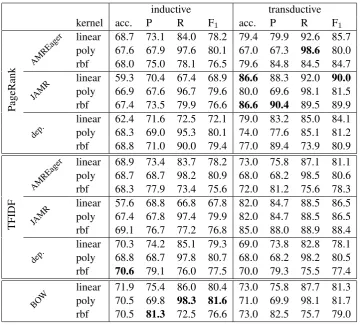
tive case, the AMRs provided by JAMR are help-ful with both TF-IDF and PageRank, while the graphs provided by AMREager give good results only for the PageRank scheme. The best result is achieved with JAMR, PageRank and a linear ker-nel for the SVM classifier.
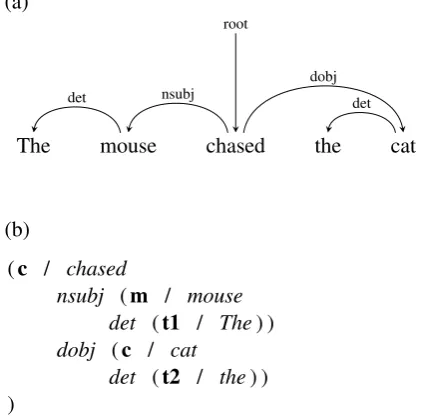
We wanted to test in our experiments whether the same gains that are achieved with AMR pars-ing can also be achieved with just a syntactic parser. To test that, we parsed the paraphrase dataset with a dependency parser and reduced the syntactic parse trees to AMR graphs (meaning, we represented the dependency trees as graphs by rep-resenting each word as a node and labeled depen-dency relations as edges). Figure3gives an exam-ple of such conversion. As can be see, the AMR-like representation for the dependency trees retains words such as determiners (“the”). It also uses a different set of relations, as reflected by the edge labels that the dependency parser returns.
We chose to do this reduction instead of directly building a classifier that makes use of the depen-dency trees to ensure we are conducting a con-trolled experiment in which we precisely compare the use of syntax for paraphrase against the use of semantics. Once the syntactic trees are converted
(a)
The mouse chased the cat
root
nsubj dobj
det det
(b)
(c / chased
nsubj (m / mouse det (t1 / The) ) dobj (c / cat
[image:7.595.311.522.66.276.2]det (t2 / the) ) )
Figure 3: An example of a dependency tree (a) con-verted to an AMR graph (b).
to AMR graphs, the same code is used to run the experiments as in the case of AMR parsing, with both the PageRank and TF-IDF reweighting set-tings. We used the dependency parser from the Stanford CoreNLP (Manning et al., 2014). The results are given in Table3, under “dep.” As can be seen, these results lag behind the bag-of-words model in the inductive case and the AMR models in the transductive case. This could be attributed to AMR parsers better abstracting away from the surface form than dependency parsers.
System acc. F1
Most common class 66.5 79.9
Mitchell and Lapata(2010) 73.0 82.3
Baroni and Lenci(2010) 73.5 82.2
Socher et al.(2011) 76.8 83.6
Guo and Diab(2012) 71.5 NR
Ji and Eisenstein(2013) (ind.) 80.0 85.4
[image:7.595.310.524.490.630.2]Ji and Eisenstein(2013) (trans.) 80.4 86.0 Our paper (inductive) 68.7 80.9 Our paper (transductive) 86.6 90.0
Table 2: Comparison of our results with previous work (“NR” stands for “not reported”). All work mentioned above was done in the inductive setting, except for Ji and Eisenstein (2013), which, like us, was done in both settings.
inductive transductive kernel acc. P R F1 acc. P R F1
PageRank
AMREager
linear 68.7 73.1 84.0 78.2 79.4 79.9 92.6 85.7 poly 67.6 67.9 97.6 80.1 67.0 67.3 98.6 80.0 rbf 68.0 75.0 78.1 76.5 79.6 84.8 84.5 84.7
JAMR
linear 59.3 70.4 67.4 68.9 86.6 88.3 92.0 90.0 poly 66.9 67.6 96.7 79.6 80.0 69.6 98.1 81.5 rbf 67.4 73.5 79.9 76.6 86.6 90.4 89.5 89.9
dep.
linear 62.4 71.6 72.5 72.1 79.0 83.2 85.0 84.1 poly 68.3 69.0 95.3 80.1 74.0 77.6 85.1 81.2 rbf 68.8 71.0 90.0 79.4 77.0 89.4 73.9 80.9
TFIDF
AMREager
linear 68.9 73.4 83.7 78.2 73.0 75.8 87.1 81.1 poly 68.7 68.7 98.2 80.9 68.0 68.2 98.5 80.6 rbf 68.3 77.9 73.4 75.6 72.0 81.2 75.6 78.3
JAMR
linear 57.6 68.8 66.8 67.8 82.0 84.7 88.5 86.5 poly 67.4 67.8 97.4 79.9 82.0 84.7 88.5 86.5 rbf 69.1 76.7 77.2 76.8 85.0 88.0 88.9 88.4
dep.
linear 70.3 74.2 85.1 79.3 69.0 73.8 82.8 78.1 poly 68.8 68.7 97.8 80.7 68.0 68.2 98.2 80.5 rbf 70.6 79.1 76.0 77.5 70.0 79.3 75.5 77.4
BOW
[image:8.595.119.480.60.385.2]linear 71.9 75.4 86.0 80.4 73.0 75.8 87.7 81.3 poly 70.5 69.8 98.3 81.6 71.0 69.9 98.1 81.7 rbf 70.5 81.3 72.5 76.6 73.0 82.5 75.7 79.0
Table 3: LSA experiments in the inductive and transductive settings, with two different reweighting schema: “PageRank” and “TF-IDF”. “linear,” “poly” and “rbf” denote the kernel for the SVM. “dep.” denotes the use of syntactic parsing instead of semantic parsing.
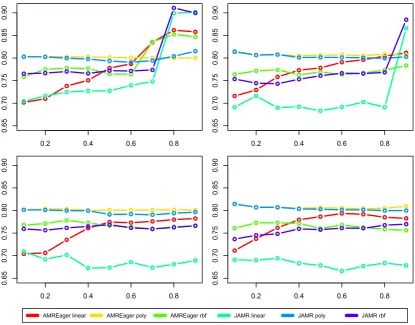
truncated matrixU (Section4). More specifically,
on the x axis of the plots we havem/l, wherem
is the number of columns in the truncated matrix andlthe number of words in the vocabulary. The
plot shows that the performance stays stable for inductive inference. With transductive inference, however, performance peaks whenmis very close
to the vocabulary size. This shows that, in order to achieve good results, it is not necessary to re-move a large number of columns from the origi-nal sentence-term matrix. The plot gives us more evidence on how the inductive setting is not ideal for the AMR-based approach. For the TF-IDF re-weighting, the systems that show a considerably different behavior are JAMR with linear and RBF kernels, where we show clear peaks for the trans-ductive case. For PageRank also the AMREager systems with linear and RBF kernel follow this trend. In general the polynomial kernel is the one less affected by this variable.
Table2shows that our best result for the trans-ductive case, which we obtain with JAMR and PageRank, outperforms the current state of the art
for paraphrase detection in the transductive set-ting. This is not true for the inductive case, prov-ing the preference of the AMR-based LSA ap-proach for the former setting.
7 Conclusion
We described an approach to incorporate an AMR parser output into the detection of paraphrases. Our method works by merging two graphs that need to be tested for a paraphrase relation, and then re-weighting a sentence-term matrix by the PageRank values of the nodes in the merged graph. We find that our method gives significant improve-ments over state of the art in paraphrase detection in the transductive setting, showing that AMR is indeed helpful for this task. We further show that the inductive settings is instead not ideal for this type of approach.
0.2 0.4 0.6 0.8
0.65
0.70
0.75
0.80
0.85
0.90
0.2 0.4 0.6 0.8
0.65
0.70
0.75
0.80
0.85
0.90
0.2 0.4 0.6 0.8
0.65
0.70
0.75
0.80
0.85
0.90
0.2 0.4 0.6 0.8
0.65
0.70
0.75
0.80
0.85
0.90
[image:9.595.91.507.60.385.2]AMREager linear AMREager poly AMREager rbf JAMR linear JAMR poly JAMR rbf
Figure 4: Plots of F1measure as a function ofm/l, wheremis the number of columns in the truncated matrix and lthe number of words in the vocabulary. The top plots are in the transductive setting (with the left using PageRank
and the right using TF-IDF weighting) while the bottom plots are in the inductive setting.
paraphrase relations. In our experiments, the over-all best result was achieved by JAMR. More gen-erally, our results show that JAMR has been more helpful in the transductive setting and in the first set of experiment when using the Smatch score only, while AMREager wins the comparison in the inductive case as well as in the first set of experi-ments when using both the Smatch score and the bag of concepts score as additional features.
Acknowledgments
The authors would like to thank the three anonymous reviewers for their helpful comments. This research was supported by a grant from Bloomberg, a grant from Huawei Technologies and by the EU H2020 project SUMMA, under grant agreement 688139.
References
Palakorn Achananuparp, Xiaohua Hu, and Xiajiong Shen. 2008. The evaluation of sentence similarity measures. InProceedings of DaWaK.
Yoav Artzi, Kenton Lee, and Luke Zettlemoyer. 2015. Broad-coverage CCG semantic parsing with AMR.
Proceedings of EMNLP.
Laura Banarescu, Claire Bonial, Shu Cai, Madalina Georgescu, Kira Griffitt, Ulf Hermjakob, Kevin Knight, Philipp Koehn, Martha Palmer, and Nathan Schneider. 2013. Abstract meaning representation for sembanking. Linguistic Annotation Workshop.
Marco Baroni and Alessandro Lenci. 2010. Dis-tributional memory: A general framework for corpus-based semantics. Computational Linguistics
36(4):673–721.
Guntis Barzdins and Didzis Gosko. 2016a. RIGA at SemEval-2016 task 8: Impact of smatch extensions and character-level neural translation on AMR pars-ing accuracy. arXiv preprint arXiv:1604.01278.
Guntis Barzdins and DIdzis Gosko. 2016b. Riga: Im-pact of smatch extensions and character-level neural translation on AMR parsing accuracy. Proceedings of SemEval.
Johan Bos and Katja Markert. 2005. Recognising tex-tual entailment with logical inference. In Proceed-ings of HLT/EMNLP.
Shu Cai and Kevin Knight. 2013. Smatch: an evalua-tion metric for semantic feature structures. Proceed-ings of ACL.
Ido Dagan, Oren Glickman, and Bernardo Magnini. 2006. The pascal recognising textual entailment challenge. In Machine learning challenges. evalu-ating predictive uncertainty, visual object classifica-tion, and recognising tectual entailment, Springer, pages 177–190.
Marco Damonte and Shay B. Cohen. 2018. Cross-lingual abstract meaning representation parsing.
Proceedings of NAACL.
Marco Damonte, Shay B. Cohen, and Giorgio Satta. 2017. An incremental parser for abstract meaning representation. InProceedings of EACL.
Bill Dolan, Chris Quirk, and Chris Brockett. 2004. Un-supervised construction of large paraphrase corpora: Exploiting massively parallel news sources. In Pro-ceedings of COLING.
Jeffrey Flanigan, Chris Dyer, Noah A Smith, and Jaime Carbonell. 2016. CMU at SemEval-2016 task 8: Graph-based AMR parsing with infinite ramp loss.
Proceedings of SemEval.
Jeffrey Flanigan, Sam Thomson, Jaime G Carbonell, Chris Dyer, and Noah A Smith. 2014. A discrim-inative graph-based parser for the abstract meaning representation. Proceedings of ACL.
Jerry A Fodor. 1975. The language of thought, vol-ume 5. Harvard University Press.
Alexander Gammerman, Volodya Vovk, and Vladimir Vapnik. 1998. Learning by transduction. In Pro-ceedings of AUAI.
James Goodman, Andreas Vlachos, and Jason Narad-owsky. 2016. Noise reduction and targeted explo-ration in imitation learning for abstract meaning rep-resentation parsing. Proceedings of ACL.
Weiwei Guo and Mona Diab. 2012. Modeling sen-tences in the latent space. InProceedings of ACL. Sanda Harabagiu and Andrew Hickl. 2006. Methods
for using textual entailment in open-domain ques-tion answering. InProceedings of COLING/ACL. Yangfeng Ji and Jacob Eisenstein. 2013.
Discrimina-tive improvements to distributional sentence similar-ity. InProceedings of EMNLP.
Paul Kingsbury and Martha Palmer. 2002. From tree-bank to proptree-bank. Proceedings of LREC.
Ioannis Konstas, Srinivasan Iyer, Mark Yatskar, Yejin Choi, and Luke Zettlemoyer. 2017. Neural amr: Sequence-to-sequence models for parsing and gen-eration. arXiv preprint arXiv:1704.08381.
Thomas K. Landauer, Peter W. Foltz, and Darrell La-ham. 1998. An introduction to latent semantic anal-ysis. Discourse Processes25:259–284.
Mike Lewis and Mark Steedman. 2013. Combin-ing distributional and logical semantics. Transac-tions of the Association for Computational Linguis-tics1:179–192.
Fei Liu, Jeffrey Flanigan, Sam Thomson, Norman Sadeh, and Noah A Smith. 2015. Toward abstrac-tive summarization using semantic representations.
Proceedings of NAACL.
Christopher D. Manning, Mihai Surdeanu, John Bauer, Jenny Finkel, Steven J. Bethard, and David Mc-Closky. 2014. The Stanford CoreNLP natural lan-guage processing toolkit. InProceedings of ACL.
Jonathan May. 2016. Semeval-2016 task 8: Meaning representation parsing. InProceedings of SemEval.
Jonathan May and Jay Priyadarshi. 2017. Semeval-2017 task 9: Abstract meaning representation pars-ing and generation. InProceedings of SemEval.
Rada Mihalcea, Courtney Corley, Carlo Strapparava, et al. 2006. Corpus-based and knowledge-based measures of text semantic similarity. InProceedings of AAAI.
Jeff Mitchell and Mirella Lapata. 2010. Composition in distributional models of semantics.Cognitive sci-ence34(8):1388–1429.
Joakim Nivre. 2004. Incrementality in determinis-tic dependency parsing. Workshop on Incremental Parsing: Bringing Engineering and Cognition To-gether.
Lawrence Page, Sergey Brin, Rajeev Motwani, and Terry Winograd. 1999. The pagerank citation rank-ing: Bringing order to the web. Technical report, Stanford InfoLab.
Xiaochang Peng, Linfeng Song, and Daniel Gildea. 2015. A synchronous hyperedge replacement gram-mar based approach for AMR parsing. Proceedings of CoNLL.
Michael Pust, Ulf Hermjakob, Kevin Knight, Daniel Marcu, and Jonathan May. 2015. Using syntax-based machine translation to parse english into abstract meaning representation. arXiv preprint arXiv:1504.06665.
Sudh Rao, Yogarshi Vyas, Hal Daume III, and Philip Resnik. 2015. Parser for abstract meaning represen-tation using learning to search. arXiv:1510.07586
.
Richard Socher, Jeffrey Pennington, Eric H Huang, Andrew Y Ng, and Christopher D Manning. 2011. Semi-supervised recursive autoencoders for predict-ing sentiment distributions. In Proceedings of
Peter D Turney and Patrick Pantel. 2010. From fre-quency to meaning: Vector space models of se-mantics. Journal of artificial intelligence research
37:141–188.
Lucy Vanderwende, Arul Menezes, and Chris Quirk. 2015. An AMR parser for English, French, German, Spanish and Japanese and a new AMR-annotated corpus.Proceedings of NAACL-HLT.
Chuan Wang, Nianwen Xue, and Sameer Pradhan. 2015. Boosting transition-based AMR parsing with refined actions and auxiliary analyzers.Proceedings of ACL.
Keenon Werling, Gabor Angeli, and Christopher Man-ning. 2015. Robust subgraph generation improves abstract meaning representation parsing. arXiv preprint arXiv:1506.03139.
Junsheng Zhou, Feiyu Xu, Hans Uszkoreit, Weiguang QU, Ran Li, and Yanhui Gu. 2016. AMR parsing with an incremental joint model. InProceedings of