Event Nugget and Event Coreference Annotation
Zhiyi Song
a, Ann Bies
a, Stephanie Strassel
a, Joe Ellis
a, Teruko Mitamura
b, Hoa Dang
c,
Yukari Yamakawa
b, Sue Holm
ba
Linguistic Data Consortium, University of Pennsylvania,
3600 Market Street, suite 810, Philadelphia, PA 19104, USA
{zhiyi, bies, strassel,
joellis}@ldc.upenn.edu
b
Language Technologies Institute, Carnegie Mellon University,
6711 Gates-Hillman Center, 5000 Forbes Ave., Pittsburgh, PA 15213, USA
[email protected]
,
[email protected]
,
s
[email protected]
c
National Institute of Standards and Technology, 100 Bureau Drive, Gaithersburg, MD 20899,
USA
[email protected]
Abstract
In this paper, we describe the event nugget an-notation created in support of the pilot Event Nugget Detection evaluation in 2014 and in support of the Event Nugget Detection and Co-reference open evaluation in 2015, which was one of the Knowledge Base Population tracks within the NIST Text Analysis Conference. We present the data volume annotated for both training and evaluation data for the 2015 eval-uation as well as changes to annotation in 2015 as compared to that of 2014. We also analyze the annotation for the 2015 evaluation as an ex-ample to show the annotation challenges and consistency, and identify the event types and subtypes that are most difficult for human an-notators. Finally, we discuss annotation issues that we need to take into consideration in the future.
1
Introduction
The Text Analysis Conference (TAC) is a series of workshops organized by the National Institute of Standards and Technology (NIST), aiming to en-courage research in natural language processing (NLP). The Knowledge Base Population (KBP)
tracks of TAC encourage the development of sys-tems that can match entities mentioned in natural texts with those appearing in a knowledge base and extract information about entities from a document collection and add it to a new or existing knowledge base. Starting in 2014, TAC KBP added a track for event evaluation. The goal of the TAC KBP Event track is to extract information about events such that the information would be suitable as input to a knowledge base.
Event Nugget (EN) evaluation, as one of the eval-uation tasks in the TAC KBP event track, aims to evaluate system performance on EN detection and EN coreference (Mitamura & Hovy, 2015). An event nugget, as defined by the task, includes a text extent that instantiates an event, a classification of event type and subtype, and an indication of the re-alis of the event. This is different from nuggets (Voorhees, 2003; Babko-Malaya, et al, 2012) and the Summary Content Units (SCU) described in (Nenkova and Passnoneau, 2004; Nenkova et al, 2007) where nuggets and SCU are units of meaning (usually in the form of a sentential clause) which not only includes the main verb/word that instantiates an event, but also all arguments.
In this paper, we describe the event nugget anno-tation to support the pilot EN Detection evaluation
in 2014 and in support of the EN Detection and Co-reference TAC KBP open evaluation in 2015. We discuss changes to the annotation in 2015 as com-pared to that of 2014 and present the data volume annotated for both training and evaluation data for the 2015 evaluation. We analyze the annotation for the 2015 evaluation data to show the annotation and consistency challenges, identify the event types and subtypes that are most difficult for human annota-tors, and finally discuss annotation issues that we need to take into consideration in the future.
2
Event Nugget Evaluation in TAC KBP
The EN evaluation was introduced in 2014 and run as a pilot evaluation, which sought to serve two pur-poses. One was to measure event detection by
per-formers’systems in the Deep Exploration and Fil-tering of Text (DEFT) program of the Defense Ad-vanced Research Projects Agency (DARPA, 2012). The program aims to address remaining capability gaps in state-of-the-art natural language processing technologies related to inference, causal relation-ships and anomaly detection. The other purpose of the pilot, however, was to test run the evaluation framework before opening it up to the full TAC KBP community. The Pilot EN evaluation had one evaluation task:
EN Detection: Participating systems must identify all relevant Event Mention instances
in English texts, categorize each mention’s
Event types/subtype and identify its realis value (ACTUAL, GENERIC, or OTHER). As the pilot was considered a success, EN was added to the roster of full-fledged evaluation tracks for TAC KBP 2015, with some modifications to in-corporate lessons learned from the pilot and to better align with the other TAC KBP 2015 event-related evaluations – Event Argument Linking (EAL) (Freedman, 2014 & 2015) – and also the Entities, Relations and Events (ERE) data provided to KBP participants for training purposes. The EN evalua-tion in TAC KBP 2015 included two new tasks in addition to EN Detection:
EN Detection and Coreference: Participating systems must identify not only the event nug-get, but also full event coreference links. Full Event Coreference is identified when two or more event nuggets refer to the same event.
EN Coreference: Participating systems must identify full event coreference links, given the annotated event nuggets in the text. ERE was developed as an annotation task that would be supportive of multiple research directions and evaluations in the DEFT program, and that would provide a useful foundation for more special-ized annotation tasks like inference and anomaly. The resulting ERE annotation task has evolved over the course of the program, from a fairly lightweight treatment of entities, relations and events in text (Light ERE), to a richer representation of phenom-ena of interest to the program (Rich ERE) (Song, et al., 2015). In ERE Event annotation, each event mention has annotation of event type and subtype, its realis attribute, any of its arguments or partici-pants that are present, anda required “trigger” string
in the text; furthermore, event mentions within the same document are coreferenced into event hoppers (Song, et al., 2015). EN annotation includes all of these annotations, except the annotation of event ar-guments.
The EN task in 2014 adapted the event annotation guidelines from the Light ERE annotation task (Aguilar, et al., 2014) by incorporating modifica-tions by the evaluation coordinators that focused on the text extents establishing valid references to events, clarifications on transaction event types, and the additional annotation of event realis attributes, which indicated whether each event mention was asserted (Actual), generic or habitual (Generic), or some other category, such as future, hypothetical, negated, or uncertain (Other) (Mitamura, et al., 2015) .
3
Event Nugget Annotation
In this section, we describe the EN annotation as well as the major differences between the 2014 and 2015 annotation tasks.
3.1
Event TriggerAn event trigger span is the textual extent within a sentence that indicates a reference to a valid event of a limited set of event types and subtypes. In the 2014 EN task, the trigger span was defined as a se-mantically meaningful unit which could be either a single word (main verb, noun, adjective, adverb) or a continuous or discontinuous multi-word phrase (Mitamura et al., 2015). For the 2015 EN evalua-tion, trigger span was redefined as the smallest, con-tiguous extent of text (usually a word or phrase) that most saliently expresses the occurrence of an event. This change brings consistency to the EN annota-tion of event trigger with approaches taken in Au-tomatic Content Extraction (ACE) (LDC, 2005) as well as Light and Rich ERE (Song et al, 2015). Ad-ditionally, we see improved annotation consistency in terms of event trigger extent, as shown in Figure 1 of section 5.1. Unlike in the 2014 EN annotation,
annotators for the 2015 data were allowed to ‘dou-ble tag’ event triggers in order to indicate that a
given text extent referred to more than one event type/subtype, which was usually used to indicate the presence of an obligatorily inferred event. Double tagging was also used for certain types of coordina-tion. For example, given the following text:
Cipriani was sentenced to life in prison for the murder of Renault chief George Besse in 1986 and the head of government arms sales Rene Audran a year earlier.
In 2015 EN annotation, the word “murder” would
be the trigger for two Life.Die events, one with the
victim “George Besse” and the other with “Rene Audran” as well as two Conflict.Attack events, one
occurring in 1986 and the other in 1985. In 2014
EN annotation, the word “murder” would be the
trigger for only one Conflict.Attack event.
3.2
Event TaxonomyEN annotation and evaluation focus on a limited in-ventory of event types and subtypes, as defined in ERE, based on Automatic Content Extraction (Dod-dington et al., 2004; Walker et al., 2006; Aguilar et
al., 2014; Song et al., 2015). The 2014 EN evalua-tion covered the inventory of event types and sub-types from Light ERE, including 8 event sub-types and 33 subtypes.
The 2015 evaluation added a new event type (Manufacture) and four new subtypes – Move-ment.TransportArtifact, Contact.Broadcast, Con-tact.Contact, Transaction.Transaction – which aligned the EN event ontology with that of Rich ERE in order to take advantage of the existing Rich ERE annotated data as training data. The EN anno-tation task also adopted a new approach for applying the Contact event subtype categorizations, which had been developed for Rich ERE data creation ef-forts. Instead of having annotators categorize the subtypes directly, Contact event mentions were la-beled with attributes to describe formality (Formal,
Informal, Can’t Tell), scheduling (Planned, Spont
a-neous, Can’t Tell), medium (In-person,
Not-in-per-son, Can’t Tell), and audience (Two-way, One-way,
Can’t Tell). Contact event subtypes were
automati-cally generated based on the annotated attributes. This change added increased granularity to the Con-tact events and captured more subtypes, which had been requested by data users, and it also allowed the annotation to provide information at two levels, the attribute level and the traditional event subtype level, which may support more robust system devel-opment.
3.3
Event CoreferenceThe final change to the 2015 EN evaluation as com-pared to the 2014 pilot was the added requirement of event coreference. Again following the Rich ERE task, EN annotation in 2015 adopted the notion of
their realis mood differed, as long as they referred to the same event with the same type and subtype. For example, in the following two sentences:
The White House didn’t confirm Obama’s
trip {Movement.TransportPerson, Other} to Paris for the Climate Summit last year.
Obama went {Movement.TransportPer-son, Actual} to Paris for the Climate Sum-mit.
The first event nugget’s realis label is Other while
the second event nugget is Actual. From the context, we know that both nuggets are talking about the same trip to Paris, so even though they have differ-ent realis labels, they still belong to the same evdiffer-ent hopper.
4
Training and Evaluation Data
In this section, we present the training and evalua-tion data annotated to support the EN evaluaevalua-tion in 2015.
4.1
Training DataDue to the changes in Rich ERE event annotation (and hence 2015 EN annotation) as compared to EN annotation in 2014, the 2014 evaluation data set was re-annotated so that the annotation matched the Rich ERE standard. Additionally Rich ERE annota-tion is created as a core resource for the DEFT pro-gram and TAC KBP evaluation, aiming to provide a valuable resource for multiple evaluations. Rich ERE annotation includes exhaustive annotation of Entities, Relations, Events and Event Hoppers, and 2015 EN annotation shares the Rich ERE annotation guidelines for Events, with the exception that Events and Event hoppers in Rich ERE also include the annotation of event arguments. Table 1 lists the total training data volume available for the 2015 EN evaluation.
Table 1: Training Data Volume for 2015 Event Nugget.
4.2
Evaluation DataSource data for the 2015 EN evaluation was a subset of the documents selected for EAL evaluation, which had been manually selected to ensure cover-age of all event types and subtypes for that evalua-tion. Tokenization of the source documents was also provided. Unlike the 2014 data, in which annotation was performed on pre-tokenized text, in 2015 to-kenization was performed as a post-annotation pro-cedure, using tool kits provided by evaluation coor-dinators.
In order to reduce the impact of low recall on an-notation consistency, which had proven problematic in the pilot and in previous event annotation efforts (Mitamura et al., 2015), gold standard EN data was produced by first having two annotators perform EN annotation (which included the creation of event hoppers) independently for each document (referred to as first pass 1 or FP1, and first pass 2 or FP2, be-low), which was followed by an adjudication pass conducted by a senior annotator to resolve disagree-ments and add annotation that was otherwise missed in one of the first passes. The EN annotation team consisted of nine annotators, six of whom were also adjudicators, and care was taken to ensure that an-notators did not adjudicate their own files. Follow-ing adjudication of all documents, a corpus-wide quality control pass was also performed. In this pass, annotators manually scanned a list of all event triggers to review event type and subtype values and all event hoppers to make sure that event mentions in the same hopper have same type and subtype value. All identified outliers were then manually re-viewed in context, and corrected if needed.
Table 2: Evaluation Data Volume for 2015 Event Nugget.
The evaluation data set consists of 202 docu-ments with a total word count of 88,652. The gold standard annotation has a total of 6,438 event nug-gets and 4,125 event hoppers in total. Table 2 shows the profile of the evaluation dataset.
Appendix 1 shows the distribution of each type-subtype in the evaluation data. Conflict.Attack has the highest representation (591 event nuggets) while
Annotation Genre Files Words EN Hoppers
EN and Coref NW 81 27,897 2,219 1,461
EN and Coref DF 77 97,124 4,319 1,874
Rich ERE DF 240 156,041 4,192 3,044
Rich ERE NW 48 23,999 1,571 1,099
Total 446 305,061 12,301 7,478
Annotation Genre Files Words EN Hoppers
EN and Coref NW 98 49,319 3,788 2,440
EN and Coref DF 104 39,333 2,650 1,685
Business.EndOrg has the lowest count (6). With the two newly added contact subtypes (Contact and Broadcast), there are altogether 1,491 contact event nuggets (23%), with 1,101 Contact.Contact and Contact.Broadcast combined (17%). Each event nugget is labeled with one of the three realis attrib-utes: actual, generic and other. Table 3 shows the distribution of event nugget realis annotation by genres.
realis NW DF
actual 2,508 1,595
generic 603 539
other 677 516
[image:5.612.326.553.68.202.2]total 3,788 2,650
Table 3: Event Nugget counts by realis attributes in NW
and DF genres.
5
Inter-annotator Agreement and
Annota-tion Challenges
Subsequent analysis of inter-annotator agreement in the EN 2015 evaluation data indicates that several challenges remain to be addressed.
5.1
Inter-annotator AgreementAnnotation consistency is generally in line with what we expect due to the complex nature of event recognition. The changes in the approach to the an-notation task that were described above appear to have made some improvements, as shown in Figure 1, which compares the overall inter-annotator agree-ment (IAA) on first pass EN annotation in 2014 and 2015. Compared with 2014, IAA F1 score in 2015
improved by 5% in event trigger detection (“plain”
in Figure 3) and realis attribute labelling. There is only 1% of improvement on event type and subtype classification. Regarding event coreference, which was new in 2015, the IAA F1 score was 67.63%. Below are a few examples indicating disagreement in event trigger, event typing and realis attributes:
Trigger extent mismatch:
[image:5.612.121.253.184.270.2] She met the insurance investment magnate Shelby Cullom Davis on a train (FP1: Move-ment.TransportPerson) to (FP2: Move-ment.TransportPerson) Geneva in 1930.
Figure 1: Inter-annotator agreement on first pass EN
an-notation in 2014 and 2015.
Mention type/subtype mismatch:
Dr. Yusuf Sonmez whom he called a notori-ous international organ trafficker. (FP1: Movement.TransportArtifact; FP2: Transac-tion.TransferOwnership)
Realis Attribute mismatch:
The wealthy, ailing patients who were to re-ceive (FP1: Actual; FP2: Other) the organs flew to Pristina.
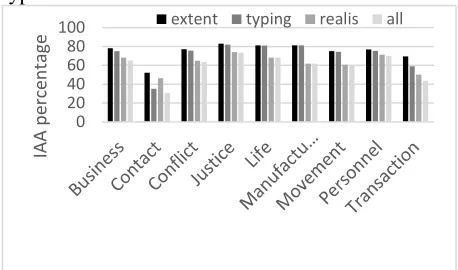
Some types scored better than others. As ex-pected, Contact and Transaction event types have the lowest consistency. Figure 2 displays the IAA F1 scores on first pass EN annotation by event types.
Figure 2: Inter-annotator agreement on first pass EN
anno-tation 2015 by event types
5.2
TaggabilityThe annotation consistency can be attributed not only to disagreement in terms of event trigger, clas-sification of event type and subtypes, realis attrib-utes, but also misses and false alarms. Determining whether or not an event is taggable (i.e., recall) has always been a difficult issue in event annotation tasks, and some event types and subtypes still
ap-0 20 40 60 80 100
extent typing realis all
IAA
pe
rc
en
ta
ge
2015 F1 2014 F1
0 20 40 60 80 100
IAA
pe
rc
en
ta
ge
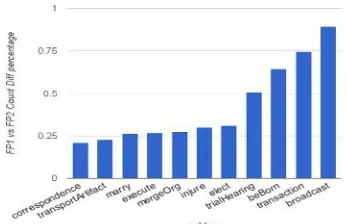
[image:5.612.312.541.418.553.2]pear to be more heavily affected than others. To bet-ter understand the issue, we calculated the level of disagreement for event taggability by dividing the difference of event type-subtype counts in FP1 and FP2 by the event type-subtype count produced in the adjudication pass. Seventeen type-subtypes vary be-tween FP1 and FP2 at a percentage below 10%, in-cluding Life.Divorce and Conflict.Attack, with some type-subtypes showing a high level of disa-greement. As indicated in Figure 3, there are 12 type-subtypes with 20% or higher disagreement be-tween FP1 and FP2, four of which are over 50%.
Figure 3: Difference of Event Nugget Occurrence between
FP1 and FP2 over Adjudicated Occurrence.
Below are a few examples indicating disagree-ment in terms of taggability:
Miss:
where she created (Business.StartOrg) the Davis Museum and Cultural Center.
False Alarm:
She also owned (Transaction.TransferOwner-ship) a home in Northeast Harbor, Maine
5.3
Contact Event TypeFigure 4: First pass inter-annotator agreement, including and
excluding contact events.
One main change that we made in 2015 was the an-notation of contact events, aiming to support a wider range of potential subtypes and also to improve an-notation consistency. The subtypes were automati-cally determined based on the annotation of attrib-utes in contact events, rather than by having annota-tors make a direct decision about contact subtypes.
There are 1479 event nuggets annotated with the contact type, which is 23% of all event nuggets in the evaluation data set. Contact.Broadcast and Con-tact.Contact are two of the most common subtypes. The consistency of the Contact event type annota-tion still poses challenges. As indicated in Figure 4, overall annotator consistency in both 2014 and 2015 improve when excluding the contact type from the comparison.
The consistency of contact events alone is much lower as compared with the other event types. This could be attributed to the taggability question of cer-tain verbs. We have specified in the annotation
guidelines that speech verbs such as “said” and
“told” are taggable event triggers. We also specified that when there were multiple speech verbs instan-tiating the same contact event, only the first one is taggable. However, annotators vary in implement-ing this rule, as shown in the followimplement-ing example:
A spokesman for the Investigative
Commit-tee, a branch of the prosecutor’s office,said (FP1: Contact.Broadcast) in an interview (FP2: Contact.Broadcast) in Izvestia.
One positive thing we can see is that the changes in 2015 did improve the annotation consistency for contact events in 2015, but there is still room for further improvement, especially in the consistency of subtype classification of the Contact event type.
5.4
Double TaggingDouble tagging is quite common in the EN evalua-tion data set, due to the high frequency of Con-flict.Attack/Life.Die, Transaction.TransferMoney and Transaction.TransferOwnership events. Alto-gether, 575 pairs out of 6440 event nuggets were double tagged (18%). Most of the double tagging cases are the result of the same trigger instantiating different event type-subtypes. Only 12 pairs of double tagging cases are the result of event argu-ment conjunction. Figure 5 shows the distribution of event subtype counts involved in double tag-ging.
0 20 40 60 80 100
IAA
pe
rc
en
ta
ge
[image:6.612.69.298.508.688.2]Double tagging was added to address the issue of inconsistency in event type categorization for triggers that may instantiate two or more event types and subtypes. Further analysis is needed to show whether allowing double tagging improves annotation consistency.
Figure 5: Distribution of event subtype of double tagging.
6
Annotation Challenges
One big challenge that annotators face is how to handle inferred events. Even though the annotation guidelines specifically instruct annotators not to tag any inferred events, whether an event mention is in-ferred not only depends on interpretation of the con-text, but also the meaning of the event triggers. Cou-pled with double tagging, this becomes a bigger
is-sue. For example, in “He then trafficked a large quatity of cocaine to the US.”, “trafficked” as
de-fined as “buy or sell something illegally”is a trigger of Transaction.TransferOwnership event, but with
the context of “to the US”, it also indicates that the
cocaine as been transported to the US. So it can also be a trigger for Movement.TransportArtifact event. One can argue that the Movement.TransportArtifact event is inferred, but it is still elusive to draw the boundary of inference.
As mentioned above, Contact event type poses a lot of difficulty and inference is one of the factors that contributes to this difficulty. The guidelines specify that regular speech verbs such as “say”, “tell”, and “speak” would be triggers for contact event types, but don’t specify the other categories of
reporting verbs, such as “argue”, “advise”, “order”, or“testify”, which involve more complicated inter-pretation. Some reporting verbs have not only the speech aspects, but also performative aspects, e.g.,
“testify”, and“threaten”. The question of whether to double tag such verbs (one for the contact type and
one for the performative action) requires further dis-cussion and clarification.
7
Conclusion and Future Work
In this paper, we described the annotation and eval-uation of event nuggets and coreference in the TAC KBP evaluation. Annotated data has been distrib-uted to DEFT and TAC KBP performers, and will be made available to the wider community as part of the Linguistic Data Consortium (LDC) catalog.
By analyzing the inter-annotator agreement be-tween the two independent first pass annotations, we learned that some event types and subtypes are more difficult for annotators than others with re-spect to recall. We also learned that annotation con-sistency for event triggers has improved with the adoption of a minimal extent rule for event triggers in 2015 as compared with the maximal semantic
ex-tent unit rule in 2014’s EN annotation, but inference is still a big challenge. Additionally, the contact event type still poses considerable difficulty. The addition of contact event attributes improved anno-tation consistency in 2015 as compared with that of 2014, but there is still room for improvement.
The detection and coreference of event nuggets provides an anchor for detecting event arguments and event-event relations. EN evaluation in TAC KBP 2015 attracted participation from 17 institu-tions, and NIST will continue to run an open evalu-ation of EN as part of the event track in TAC KBP 2016. The EN evaluation tasks will expand from English to multilingual, including Chinese and Spanish. Due to the scarcity of training data for some event types and subtypes, the set of event types and subtypes for the evaluation in 2016 will be reduced from 33 in 2014 evaluation and 38 in 2015 evaluation to 18 event types and subtypes.
Acknowledgments
implied, of Air Force Research Laboratory and De-fense Advanced Research Projects Agency or the U.S. Government.
References
Jacqueline Aguilar, Charley Beller, Paul McNamee, Ben-jamin Van Durme, Stephanie Strassel, Zhiyi Song, Joe Ellis. 2014. A Comparison of the Events and Relations Across ACE, ERE, TAC-KBP, and FrameNet Annota-tion Standards. ACL 2014: 52nd Annual Meeting of the Association for Computational Linguistics, Balti-more, June 22-27. 2nd Workshop on Events:
Defini-tion, DetecDefini-tion, Coreference, and Representation.
Olga Babko-Malaya, Greg P. Milette, Michael K. Schnei-der, Sarah Scogin: Identifying Nuggets of Information in GALE Distillation Evaluation. In Proceedings of
the Fourth International Conference on Language Re-sources and Evaluation (LREC 2012), Istanbul, May
21-27.
DARPA. 2012. Broad Agency Announcement: Deep Ex-ploration and Filtering of Text (DEFT). Defense Ad-vanced Research Projects Agency, DARPA-BAA-12-47.
George Doddington, Alexis Mitchell, Mark Przbocki, Lance Ramshaw, Stephanie Strassel, and Ralph Weischedel. 2004. The Automatic Content Extraction (ACE) program–tasks, data, and evaluation. In
Pro-ceedings of the Fourth International Conference on Language Resources and Evaluation (LREC 2004),
Lisbon, May 24-30.
Joe Ellis, Jeremy Getman, Dana Fore, Neil Kuster, Zhiyi Song, Ann Bies, Stephanie Strassel. 2015. Overview of Linguistic Resources for the TAC KBP 2015 Eval-uations: Methodologies and Results. In Proceedings of
TAC KBP 2015 Workshop, National Institute of Stand-ards and Technology, Gaithersburg, Maryland, USA,
November 16-17, 2015.
Marjorie Freedman. 2015. TAC: Event Argument and Linking Evaluation task Description. http://www.nist.gov/tac/2015/KBP/Event/Argu- ment/guidlines/EventArgumentAndLinkingTask-Description.v09.pdf
Marjorie Freedman and Ryan Gabbard. 2014. Overview of the Event Argument Evaluation. In Proceedings of
TAC KBP 2014 Workshop, National Institute of Stand-ards and Technology, Gaithersburg, Maryland, USA,
November 17-18, 2014.
Linguistic Data Consortium. 2005. ACE (Automatic-Content Extraction) English Annotation Guidelines for Events Version 5.4.3.
Zhengzhong Liu, Teruko Mitamura, Eduard Hovy. 2015. Evaluation Algorithms for Event Nugget Detection: A pilot Study. 3rd Workshop on EVENTS: Definition,
Detection, Coreference, and Representation, at the
2015 Conference of the North American Chapter of the Association for Computational Linguistics - Hu-man Language Technologies (NAACL HLT 2015). Teruko Mitamura, Eduard Hovy. 2015. TAC KBP Event
Detection and Coreference Tasks for English. http://cairo.lti.cs.cmu.edu/kbp/2015/event/Event_Me ntion_Detection_and_Coreference-2015-v1.1.pdf. Teruko Mitamura, Yukari Yamakawa, Sue Holm, Zhiyi
Song, Ann Bies, Seth Kulick, Stephanie Strassel. 2015. Event Nugget Annotation: Processes and Issues.
3rd Workshop on EVENTS: Definition, Detection, Co-reference, and Representation, at the 2015 Conference
of the North American Chapter of the Association for Computational Linguistics - Human Language Tech-nologies (NAACL HLT 2015).
Ani Nenkova and Rebecca Passonneau. 2004. Evaluating content selection in summarization: the pyramid method. In Proceedings of the Human Language Tech-nology Conference– North American chapter of the Association for Computational Linguistics annual meeting (NAACL-HLT 2004).
Ani Nenkova, Rebecca Passonneau, and Kathleen McKe-own. 2007. The pyramid method: Incorporating hu-man content selection variation in summarization evaluation. ACM Trans. Speech Lang. Process., 4(2):4.
Zhiyi Song, Ann Bies, Tom Riese, Justin Mott, Jonathan Wright, Seth Kulick, Neville Ryant, Stephanie Stras-sel, Xiaoyi Ma. 2015. From Light to Rich ERE: Anno-tation of Entities, Relations, and Events. 3rd Workshop
on EVENTS: Definition, Detection, Coreference, and Representation, at the 2015 Conference of the North
Appendix
Event subtype distribution in Event Nugget 2015 Evaluation data 0 100 200 300 400 500 600 at tac k co nt ac t tr an sf er M on ey br oad cas t tr an sp or tP er so n di e ar re st Jai l en dP os iti on m ee t tr an sf er O w ne rs hi p se nt en ce tr ia lH ear in g ch ar ge In di ct de m on st rat e re le as eP ar ol e co rr es po nd en ce ex ec ut e co nv ic t st ar tP os iti on ar tif ac t in ju re m ar
ry sue
el ec t ap pe al tr an sp or tA rt ifac t tr an sac tio n no m in at e ex tr ad ite par do n di vo rc e fin e de cl ar eB an kr up tc y st ar tO rg m er ge O rg ac qu it be Bo rn en dO rg