Proceedings of the Biomedical NLP Workshop associated with RANLP 2017, pages 55–63,
Towards Confidence Estimation for
Typed Protein-Protein Relation Extraction
Camilo Thorne and Roman Klinger
Institut f¨ur Maschinelle Sprachverarbeitung University of Stuttgart, Stuttgart, Germany
{firstname.lastname}@ims.uni-stuttgart.de
Abstract
Systems which build on top of informa-tion extracinforma-tion are typically challenged to extract knowledge that, while correct, is not yet well-known. We hypothesize that a good confidence measure for relational information has the property that such teresting information is found between in-formation extracted with very high con-fidence and very low concon-fidence. We discuss confidence estimation for the do-main of biomedical protein-protein rela-tion discovery in biomedical literature. As facts reported in papers take some time to be validated and recorded in biomedi-cal databases, such task gives rise to large quantities of unknown but potentially true candidate relations. It is thus important to rank them based on supporting evidence rather than discard them. In this paper, we discuss this task and propose differ-ent approaches for confidence estimation and a pipeline to evaluate such methods. We show that the most straight-forward approach, a combination of different con-fidence measures from pipeline modules seems not to work well. We discuss this negative result and pinpoint potential fu-ture research directions.
1 Introduction
The ever increasing body of biomedical litera-ture has motivated a growing interest over the past 20 years in natural language processing (NLP) and information extraction (IE) techniques to retrieve, organize and index the knowledge it contains (Rodriguez-Esteban,2009;Subramaniam et al., 2003). It has also spurred a number of (shared) tasks and system competitions of which
the best known are the BioNLP Shared Task1 and the BioCreative challenge2. Relevant subtasks include named entity recognition (NER, Leaman and Gonzalez, 2008), entity linking and normal-ization to unique database identifiers (Zheng et al., 2014), event (EE,Bj¨orne and Salakoski,2015) and relation extraction (RE,Tymoshenko et al.,2012; Airola et al.,2008;Choi,2016). The overall goal is to identify biomedical entity mentions, disam-biguate them w.r.t. biomedical databases and to identify mentioned biomedical relations and, cru-cially,discovernew relations which are not avail-able in structured resources yet.
When solving biomedical RE and IE tasks, the standard focus is to build systems that achieve high precision and recall at identifying known relations in gold standards or in biomedical databases and ontologies. This focus usually over-looks a key dimension for relation discovery: ex-tractionrelevanceortrust. Indeed, when applied to new text in the form of, e.g., recently pub-lished biomedical papers or papers from transver-sal domains such as bioinformatics, most discov-ered relations can arguably be expected to come up as “false”, without being per se false – but unrecorded in gold standards. In other words, discovered relations fall under one of three cate-gories: (1) plainly true relations (as per biomedical gold standards) (2)interestingrelations that might be true or false. (3) plainly false relationships (as per biomedical gold standards). Our hypothesis is that a useful confidence measure estimates the quality of relations in this order, as we exemplify in Figure1.
In such a scenario, rather than dismissing all such unknown (but interesting) relations, the goal is to return a ranking based on extraction
confi-1http://2016.bionlp-st.org/ 2http://www.biocreative.org/
dence(Cullota and McCallum,2004). Confidence typically refers to some kind of scoring – for in-stance a real number. This brings forth the prob-lem of confidence estimation. While it is clear that the confidence of a relation extracted from biomedical text should be a function of the dif-ferent sources of evidence on which it relies, it is unclear (Q1) how to define a global confidence estimator for biomedical relation extraction, and (Q2) how to evaluate it.
We hypothesize that relation discovery confi-dence scores rely on three main kinds of sources:
S1: The (aggregated) confidence scores of the in-dividual modules of the RE pipeline.
S2: The internal graph structure of the discovered relations.
S3: Evidence gathered from external knowledge sources, such as textual evidence or knowl-edge retrieved or inferred from structured knowledge sources (biomedical ontologies and databases).
In this paper we outline a first attempt to answer questions (Q1) and (Q2) for the domain of protein-protein relations and events, focusing on approach S1. The main contributions of this paper are: (1) We build a distantly supervised RE pipeline based on BANNER (Leaman and Gonzalez,2008) for NER, TEES (Bj¨orne and Salakoski,2015) for EE and RE, and GNAT and Gnorm (Hacken-berg et al., 2011; Wei et al., 2015) to link pro-tein mentions to the STRING propro-tein interaction database (von Mering et al., 2005), to distantly determine the truth and falsity of the discovered typed protein-protein relations. (2) We define confidence measures for each component of our pipeline and analyze their impact on relation pre-diction. (3) Finally, we propose and compare sev-eral global confidence estimators that aggregate over these scores.
2 Evidence Sources for Confidence
As said in the introduction, there are main sources of evidence for biomedical relation discovery and extraction, namely: prediction confidence (S1), graph analytics of the discovered relations (S2) and domain knowledge gathering (S3). We dis-cuss these in the following.
S1 Modules (e.g., NER or EE systems) in state-of-the-art systems are typically underpinned by
IL-6 positive STAT-3 regulation
... ... TIPE2 negative Snail2
regulation ... ... growth positive WSC
factor regulation domain ... ...
true
interesting
[image:2.595.328.515.61.199.2]false
Figure 1: Discovered protein-protein (typed) rela-tions. Notice how the bottom example is plainly false (it states a regulation among hormones), and the top one is plainly true (a known regulation). We assume the one in the middle to represent a more interesting result, as this fact is not in the STRING database; however, PubMed/MEDLINE abstract 28186089 mentions it (“(...) TIPE2 (...) downregulated (...) Snail2 (...)”).
supervised classifiers that in addition to a pre-diction, return a probability (e.g., logistic classi-fiers) or a so-called margin (e.g., linear discrimi-nant classifiers). We would expect interesting re-lations whose individual components (e.g., entities and events) were identified with a higher score, to stand a higher chance of being true. To this end, one can employ confidence mixtures (Iversen et al., 2008; Dawid et al., 1995). Given k ex-perts, each returning a confidence valueci ∈ R,
i= 1. . . k, aconfidence aggregationis a function
ϕ(·) such thatc = ϕ(c1, . . . , ck), wherec ∈ R is theglobal confidencescore. Global confidences thus aggregate partial confidences assigned to the partial tasks into which a complex task such as re-lation discovery can be broken down, to produce a global score. This method, the one actually de-scribed in this paper, can be seen as a baseline con-fidence estimator for biomedical RE.
tech-niques generally aim at predicting new edges (bi-nary relations) in entity graphs via techniques such as similarity computation, weighted by properties such as the centrality or prominence of the con-nected entities – a measure that can be seen as a kind of confidence score. One can also exploit shortest path statistics among detected proteins (lengths of the paths, number of paths), as, intu-itively the more relations between two proteins, the more likely that a specific relation holds. S3 Last but not least, external knowledge sources can be used to, alone or in combination with the previous two methods, derive confidence estimators for biomedical relation discovery. In-deed, the STRING database itself describes a net-work of protein interactions, which can be com-bined with the interaction network built at dis-covery and extraction time to gather further, gold standard graph theoretical evidence for discov-ered interactions. Another possibility is to use techniques from the knowledge base population and enrichment communities such as Wick et al. (2013), reasoning over domain constraints and on whether discovered interactions satisfy or violate them (e.g., the third example in Figure1is clearly false because its arguments are not proteins). Fi-nally, one can also gathertextual evidence, using techniques borrowed from cognitive systems such as IBM Watson (Murdock et al., 2012), exploit-ing PubMed/MEDLINEitself to derive lexical evi-dence.
3 Experiments
In this section, we describe our confidence esti-mation experiments for typed proteprotein in-teraction extraction and discovery. We refer to an
orderedtriplerel= (p1, r, p2), whereris an event
or relation type denoting adirected relation (e.g., an expression, an inhibition) between proteinsp1
andp2astyped interaction. Note that this task is a
subtask of event extraction (Kim et al.,2009) and an extension to protein-protein interaction detec-tion (PPIs), where we want to predict if a protein pair (in any order) interacts in some way (Choi, 2016;Airola et al.,2008). Our whole pipeline is depicted in Figure2.
3.1 Datasets
We used two main datasets in our experiments: Firstly, a large subset of MEDLINEfrom May 1992 to May 2017 (PMIDs 1376980 to 28211214). We
ignore languages other than English, and entries without abstract. We also disregarded abstracts that do not contain any mentions to protein or genes. This corpus consists of 40,911,675 tokens in 1,939,915 abstracts.
Secondly, to distantly evaluate discovered rela-tions, we use the STRING database (von Mering et al.,2005), which describes protein-protein rela-tions. STRING was built by integrating different databases (including the Gene Ontology (GO) and the Kyoto Encyclopedia of Genes and Genomes (KEGG)) and expert-curated text-mining-based information. STRING covers around 9.6 million protein entries and 1.3 billion interaction entries of 2031 unique organisms species. We focus on the subset of human proteins and their interactions. For network analysis, we use a Neo4j3 graph database. From STRING, we use 20,458 unique genes/proteins with 6,013,567 unique typed inter-actions. They refer to 17,538 EntrezGene IDs.
3.2 Relation Extraction
To extract and discover relations in the MED -LINE subset, we rely on two well-known state-of-the-art systems for protein and gene detection and protein-protein event and relation extraction, namely BANNER and TEES (Leaman and Gon-zalez,2008;Bj¨orne and Salakoski,2015).
BANNER is linear-chain conditional random field (CRF) NER system, that relies on an array of pre-trained models, dictionary and gold corpora for training and prediction. It uses the BIO format to spot the beginning (B) and constituent words (I) of a protein mention, and tokens that lie outside (O) mentions. For this paper, we use a gene detec-tion model trained on the GNormPlus4gene gold corpus (Wei et al.,2015), which achieves 83 % F1.
Please note that we run BANNER separately from TEEs and realign the results in a separate step in the pipeline (see Figure2).
TEES is a biomedical RE system, underpinned by a multiclass support vector machine (SVM). It relies on BANNER as a subcomponent to de-tect entities and on the BioNLP 2013 shared task data to estimate SVMs that detect (1) event triggering words and their GENIA event types: regulations, positive regulations, negative regula-tions, (de)phosphorilations (2) the arguments of
3https://neo4j.com/
Figure 2: Overview of the relation extraction pipeline described in this paper (full pipeline).
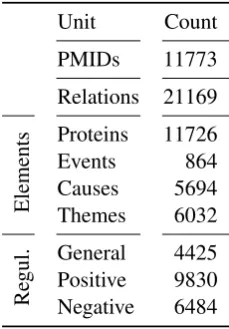
Unit Count PMIDs 11773 Relations 21169
Elements
Proteins 11726 Events 864 Causes 5694 Themes 6032
Re
gul. GeneralPositive 44259830 Negative 6484
Table 1: Event/Relation extraction statistics. “Events” refers to event trigger words, “Relations” refers to a relational structure connecting typed
events to cause–theme protein pairs by TEES, as in Figure3. All counts are unique counts.
the event or relation: its first argument (cause) and its second argument (theme). It can also detect complex event structures, event structures contain-ing nested events, which we currently disregard. For each of its predictions, TEES returns a confi-dence value in the form of an SVM margin (dis-tance of the trigger or protein to its separating hy-perplane). TEES achieves 50.74 % F1.
3.3 Relation Normalization
In order to verify if a candidate typed relation oc-curs in STRING, and to build (silver) standards for experimental analysis, we define a mapping from (M1) a protein mentionpto acanonicalform (norm(p)), i.e., STRING protein unique identi-fiers (UIDs), and (M2) a relation/event type r to a STRING interaction type (ev(r)).
Protein matching Task (M1) is known in biomedical literature as theprotein normalization
task. It has been object of active research since the early 2000s, giving rise to the BioCreative Gene Normalization (GN) shared task. In this paper, we use two state-of-the-art GN systems, GNAT (Hackenberg et al., 2011), with a perfor-mance of 86.7 % F1and GNorm (Wei et al.,2015),
with a performance of 86.4 % F1. We denote this
method by gnN(p), for each GN system N and protein mentionp. GNAT and GNorm normalize gene/protein mentions to EntrezGene UIDs, which cover a subset of STRING protein UIDs.
Therefore, in order to increase normalization recall, we resorted to a disambiguation-based method. We relied on a STRING RESTful web-service5 that returns, given a protein mention p, a list of possible STRING canonical matches, to-gether with a gloss (a small textual definition), to build a custom bag-of-words disambiguation method, that ranks candidates by computing the cosine similarity of the gloss and the sentence in which the mention occurs. We denote this method by lk(p).
This gave rise to a protein normalization method for protein mentionspsummarized by:
normN(p)=
gnN(p), if gnN(p)↓,
lk(p), if gnN(p)↑,lk(p)↓,
NA, if gnN(p)↑,lk(p)↑,
(1)
for N ∈ {GNAT,GNorm}. By ↑ (resp. ↓) we mean that the method returns no canonical (resp. returns a canonical) STRING UID for mentionp.
[image:4.595.123.238.265.430.2]Western blot analysis showed that IL-6increased JKA, STAT3, p-STAT3 and VEGF-C protein levels in the gastric cancer cells. (pmid 26750536) Positive_regulation
increased:160.61
IL-6 (9606.ENSP00000258743):0.99 cause:6.27
[image:5.595.97.451.76.182.2]STAT3 (9606.ENSP00000264657):0.87 theme:7.32
Figure 3: Protein-protein relational structure extracted by our pipeline for the first relation from Figure1. The leave nodes represent the protein entities, labeled with their STRING UID and BANNER confidence. The internal node represents the event in which they participate as arguments, labeled with its TEES recognition confidence. The labels on its outgoing edges represent cause–theme TEES labeling of its protein arguments, and its TEES confidence. Finally, the root represents the predicted event type.
Note that GNAT and GNorm were tuned for dis-tinct, though related GN subtasks, namely human GN and cross species GN, and can produce differ-ent results. If no normalization method returns a STRING UID, we consider the canonical protein for mentionpundefined (NA).
Event type matching To deal with (M2), we relied on the other hand on a simple rule-based method, that maps the three GENIA event types returned by TEES GENIA event types to typed and directed interactions in STRING: protein in-hibitions, activations and expressions. As a GE-NIA event type r may correspond to more than one STRING interaction, we map them tosetsof interactions with
ev(r)=
{inhibitits}, ifr=R−,
{expresses,activates}, ifr=R+, {expresses,activates}
∪{inhibits} , ifr=R.
(2)
In other words, a TEES relation typer (a regula-tionR, a negative regulationR−, or a positive reg-ulationR+) will be mapped to (sets of) STRING
protein inhibitions, expressions and activations. Relation matching For N∈ {GNAT,GNorm}, we determine a positive match for a candidate relation (triple) (p1, r, p2) if for at least a value
t∈ev(r)the triple(normN(p1), t,normN(p2))
oc-curs in the STRING database, negative otherwise. If normN(pi), for i ∈ {1,2}, returns no canoni-cal STRING UID, we discard the candidate alto-gether. As GNAT and GNorm produce different
normalizer norm. relations positive
GNAT* 11723 973
GNormPlus* 8639 544
Table 2: Silver standards obtained with our nor-malization methods. By the asterisk we mean the GN system plus our backoffs. By “norm. rela-tions” we mean the number of relational structures for which protein pairs and event types could be normalized to STRING interaction types and pro-tein UIDs and by “positive” to those that actually match interactions in STRING.
results, rather than aggregating results, we gen-erated two separate silver standards, summarized by Table2. Both cover around 1/2 of the original dataset of candidates and both are skewed towards negative matches.
3.4 Confidence Estimation
In this subsection we describe our global confi-dence estimation models. These models aggregate confidence values returned by the key components of our pipeline, namely, BANNER and TEES for proteins, and event/event types, as shown in Fig-ure3.
Component-wise confidence For every RE candidate triple rel = (p1, r, p2)we compute the
following confidence values:
tin an abstract with BIO labels(st, . . . , st+k), de-fined by:
cfγt(p) =
k Y
i=t
γi(si) (3)
(resp., cfγc(p)for cause mentions) whereγi(si) =
αi(si) · βi(si)/P(w0, . . . , wi; Λ) is the normal-ized product of the forward and backward Viterbi lattice probabilities of label si ∈ {B,I} at po-sition i, computed from BANNER’s underlying CRF modelΛ, andwi is a word token. This mea-sure basically characterizes the likelihood that a given span of MEDLINE tokens is indeed a pro-tein.
From TEES, we use event-level confidence based on the margins in the SVM, namely cfev(r),
cfc(p1) and cft(p2) for event (type), cause, and
theme predictions.
In summary, we use fivecomponent-wise con-fidence features for a relation triple rel = (p1, r, p2), namely, the BANNER product gamma
probability of theme proteins, the TEES margin value for theme proteins, the BANNER product gamma probability of cause proteins, the TEES margin value for cause proteins, and the TEES margin value for events/event types.
Confidence aggregation Different confidence sources will have a different impact on their global aggregate (Iversen et al., 2008; Dawid et al., 1995). Such impact can be quantified as aweight, seta prioriora posterioriby training a classifier over gold (or silver) data and plugging into the ag-gregates the inferred weights (Liu et al., 2012). For the experiments described in this paper we chose the latter, and trained a logistic classifier over our silver MEDLINE datasets (see the next subsection for a detailed description), and used its coefficients ~θ to compute the weights we~ by (1) measuring their impact on classification de-viance (see Table5), and (2) normalizing the val-ues to a number between0and1. We propose two fundamentally different methods to aggregate the separate confidence values to one measure for a triplerel.
The first method assumes that global confi-dence is a linear combination of component-wise confidences for a relation rel (cfm, with
m ∈ {γt, γc,ev, c(p1), t(p2)}), namely, their (weighted) average:
cfavg= 15 ·
X
m
wem·cfm (4)
The second method assumes that each component-wise confidence is totally inde-pendent of each other (and hence independence for each pipeline prediction), and defines global confidence as a(weighted) product:
cfprod=
Y
m
wem·cfm (5)
We considered also unweighted versions of the confidence aggregators, by considering unit weightswe~ = (1,1,1,1,1)T, that assign the same importance to all component-wise confidences. Evaluation To evaluate our approach, we re-lied on a number of different strategies and com-binations thereof. In particular, we split our two silver GNAT and GNORM datasets SN, into two disjoint trainTN and testEN subsets. Given how unbalanced our data is, we, in addition, resam-pled the training sets by (1) oversampling positive matches, and (2) undersampling negative matches until we obtained two balanced training setsSGNAT andSGNormeach of 2000 relations. For testing, we kept a set of 1000 unresampled relations each.
To learn the weights~θof the confidence aggre-gation models and hence of component-wise con-fidences, we trained a logistic classifier over each of our silver standards:
P(t0=1|~c)=(1 + exp(−X
m
θm·cfm))−1 (6)
where t0 = 1 if normalized triple rel is in STRING, m ∈ {γt, γc,ev, c(p1), t(p2)} and
~c = (cfγt,cfγc,cfev,cfc(p1),cft(p2))T. The
pa-rameters ~θwere learned by maximizing the like-lihood L(~θ;TN) = Qjπ(~c(j);~θ)r0(j) · (1 −
train datasetT test datasetE F1
gnat train test gnat 0.688
gnorm train test gnat 0.658
gnat train test gnorm 0.766 gnorm train test gnorm 0.733
cfγc>0.978?
cfγt>0.997?
cfγc>0.993?
cfev>80.959? n= 961
t/f:40%/60%
n= 305
t/f:75%/25%
n= 224
t/f:65%35%
n= 236
t/f:40%/60% t/f:n60%/40%= 274
no yes
yes no
yes no
no yes
cfγc>0.84?
cfγc>1?
cft>4.361?
n= 697
t/f:40%/60% n= 429
t/f:38%/62%
n= 246
t/f:63%/37%
n= 628
t/f :59%/41%
no yes
yes no
[image:7.595.77.523.58.270.2]no yes
Figure 4: Right: J48 decision tree for the GNAT silver standard (training set). Left: J48 decision tree for the GNorm silver standard (training set). Nodes correspond to the component-wise confidence features defined in Section3.4. The higher a component-wise confidence, the higher its information gain. Notice how, in general, we observe a higher gain for TEES confidence scores, plus some contribution coming from the BANNER confidence of theme proteins. We used for both models a pruning setup whereby we imposed each tree leave to contain at least 150 relations. In the visualization, the leaves describe also the distribution of positive (t) and negative (f) matches for each bin, and their sizen(triples per bin).
estimator Kendallτ p-value cfprod (unweig.) 0.041 0.127
cfprod 0.041 0.127
cfavg (unweig.) 0.032 0.210
[image:7.595.335.498.409.502.2]cfavg 0.050 0.056
Table 4: Correlation-based evaluation of the con-fidence aggregation models. In bold, the model with the highestτ value. No test was statistically significant (although one came close top= 0.05). In all cases, this indicates absence of correlation with linking judgments. Unweighted models were obtained by considering uniform weights (viz.,
~
we= (1,1,1,1,1)T).
π(~c(j);~θ))1−r0(j)
via iterative weighted least squares. We tested each of the two ensuing lo-gistic models over each of the two test datasets, and chose the model with the highest F1, as seen
in Table3.
The confidence estimation models themselves were evaluated following a methodology pro-posed byCullota and McCallum(2004) to evalu-ate entity-level confidence measures: measure the correlation between matching judgments and
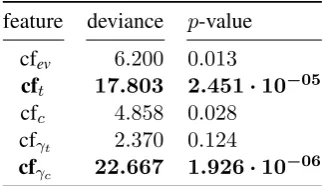
rela-feature deviance p-value cfev 6.200 0.013
cft 17.803 2.451·10−05 cfc 4.858 0.028
cfγt 2.370 0.124
cfγc 22.667 1.926·10−06
Table 5: ANOVA/Analysis of deviance table for the best logistic model from Table3(χ2-test). In
bold, the features with greater impact, both statis-tically significant withp <0.01.
tion confidence. Ideally, one would expect a bias in confidence towards positive matches. In this pa-per, we considered Kendall’sτ correlation, which is rank-sensitive and robust to ties.
[image:7.595.95.268.410.489.2]vari-ance/deviance6over the (optimal) logistic model’s features. On the other hand, we inferred two de-cision trees over our two training sets. Dede-cision trees rank component-wise confidences cfm, w.r.t.
information gain. We used the J48 decision tree classifier7, that discretizes continuous variables.
4 Results and Discussion
The results of our confidence aggregation experi-ments are summarized by Tables3–5and Figure4. As Table3 shows, the best logistic model was obtained over the GNAT training dataset. Inter-estingly, the best result arose from cross-testing, when be tested it of the GNorm dataset test corpus. We conjecture that this might be due to a slightly better generalization capacity of the GNAT nor-malizer, as opposed to GNorm.
Regarding our confidence estimation models however, as Table4 shows, our analysis returned no observable correlation (all τ values are close to zero), but without reaching statistical signifi-cance. Furthermore, of all estimators, the best (al-beit by a very small margin) estimator was aver-age, weighted confidence. We interpret this neg-ative result to mean that aggregating confidences alone, disregarding: (1) the performance and/or confidence of the different normalizations meth-ods (2) the structural properties of discovered re-lations, and (3) additional evidence gathered from external sources is simply not enough to define meaningful confidence estimators.
Finally, as shown by Table5and Figure4both the ANOVA and decision-tree/information gain analysis point out that the most informative fea-tures were the BANNER and TEES confidences for the arguments – the theme (2nd argument) and the cause (1st argument) – of protein-protein rela-tional structures. Interestingly event (TEES) con-fidences do not seem to play a major role. This however seems consistent with the fact that TEES models are optimized for recognizing theme-event and cause-event pairs (by leveraging on the depen-dency parse tree of the sentence), a harder task than that of event recognition.
It suggests that while the aggregation of component-wise confidences is not a good global 6Logistic models are known in statistical literature as gen-eralized linear models; in such cases rather than analyzing er-ror variance as for linear models, one analyzesdeviance, viz., prediction error.
7Weka (http://www.cs.waikato.ac.nz/ml/ weka/) for our logistic and J48 models.
confidence estimator, including them as features of a more complex model encompassing a wider array of evidence sources might still be useful. It also suggests that normalization confidence – the last step in the pipeline – should be taken into ac-count as the confidence values coming from pro-tein recognition have the most impact.
5 Conclusions & Future Work
In this paper we have proposed a confi-dence estimation methodology for biomedical protein-protein typed interaction discovery from PubMed/MEDLINE abstracts. Measuring confi-dence or trust is important because in this set-ting not all false positives – interactions that are not known to occur in biomedical databases – may be necessarily false. This sorting by con-fidence should satisfy key criteria, namely that true matches should be scored high, clearly false matches low, and “interesting” relations some-where in between.
To do so, we have proposed a pipeline that builds upon state-of-the-art protein NER, protein-protein EE and RE and GN systems, to dis-cover and distantly evaluate against the STRING database protein-protein typed interactions. Then, we have described a number of baseline confi-dence estimation techniques that aggregate the confidence prediction scores of the pipeline’s components.
Our experiments and correlation analysis show that, while the prediction confidence of modules in later stages of the pipeline seems to influence more positive decisions, confidence aggregation is not enough to define estimation models satisfying the criteria mentioned. We conjecture that this is due to the fact that prediction confidence alone does not provide sufficient evidence to rank relations. Also, in this work, the confidence of normaliza-tion was not fully addressed. As further work we plan to focus on more complex evidence gathering methods.
References
Antti Airola, Sampo Pyysalo, Jari Bj¨orne, Tapio Pahikkala, Filip Ginter, and Tapio Salakoski. 2008. All-paths graph kernel for protein-protein interac-tion extracinterac-tion with evaluainterac-tion of cross-corpus learn-ing. BMC Bioinformatics9(Suppl 11):S2.
Dennis Wilkinson And, Dennis Wilkinson, and Bernardo A. Huberman. 2003. A method for find-ing communities of related genes. InProceedings of the National Academy of Sciences of the United States of America. pages 5241–5248.
Jari Bj¨orne and Taio Salakoski. 2015. Tees 2.2:
Biomedical event extraction for diverse corpora.
BMC Bioinformatics16(16):S4.
Sung-Pil Choi. 2016. Extraction of proteinprotein in-teractions (PPIs) from the literature by deep con-volutional neural networks with various feature em-beddings.Journal of Information Science.
Aron Cullota and Andrew McCallum. 2004. Confi-dence estimation for information extraction. In Pro-ceedings of the 2004 Conference of the North Amer-ican Chapter of the Association for Computational Linguistics. HLT-NAACL ’04, pages 109–112. A. Dawid, M. DeGroot, J. Mortera, Roger Cooke,
S. French, C. Genest, M. Schervish, D. Lindley, K. McConway, and R. Winkler. 1995. Coherent combination of experts’ opinions. TEST: An Offi-cial Journal of the Spanish Society of Statistics and Operations Research4(2):263–313.
J¨og Hackenberg, Marin Gerner, Maximilian Haeus-sler, Ill´es Solt, Conrad Plake, Martin Schroder, Graciela Gonzalez, Goran Nenadic, and Casey M. Bergman. 2011. The GNAT library for local and remote gene mention normalization. Bionformatics
27(19):2769–2771.
Edwin S Iversen, Giovanni Parmigiani, and Sin-ing Chen. 2008. Multiple model evaluation ab-sent the gold standard through model combina-tion. Journal of the American Statistical Association
103(483):897–909.
Jin-Dong Kim, Tomoko Ohta, Sampo Pyysalo, Yoshi-nobu Kano, and Jun’ichi Tsujii. 2009. Overview of BioNLP ’09 shared task on event extraction. In
Proceedings of the Workshop on Current Trends in Biomedical Natural Language Processing: Shared Task. BioNLP ’09, pages 1–9.
Robert Leaman and Graciela Gonzalez. 2008. BAN-NER: An executable survey of advances in biomed-ical named entity recognition. InProceedings of the 2008 Pacific Symposium on Biocomputing. PSB ’08, pages 652–63.
Ryan N. Lichtenwalter, Jake T. Lussier, and Nitesh V. Chawla. 2010. New perspectives and methods in link prediction. In Proceedings of the 16th ACM SIGKDD International Conference on Knowledge
Discovery and Data Mining. KDD ’10, pages 243– 252.
X. Liu, Amol Ghorpade, Y. L. Tu, and W. J. Zhang. 2012. A novel approach to probability distribution aggregation. Information Science188:269–275. J. William Murdock, James Fan, Adam Lally, Hideki
Shima, and Branimir Boguraev. 2012. Textual ev-idence gathering and analysis. IBM Journal of Re-search and Development56(3):8.
Jiajie Peng, Kun Bai, Xuequn Shang, Guohua Wang, Hansheng Xue, Shuilin Jin, Liang Cheng, Yadong Wang, and Jin Chen. 2017. Predicting disease-related genes using integrated biomedical networks.
BMC genomics18(1):1043.
Raul Rodriguez-Esteban. 2009. Biomedical Text Min-ing and Its Applications. PLoS Comput Biol5(12). L. Venkata Subramaniam, Sougata Mukherjea, Pankaj
Kankar, Biplav Srivastava, Vishal S. Batra, Pa-sumarti V. Kamesam, and Ravi Kothari. 2003. Information extraction from biomedical literature: Methodology, evaluation and an application. In Pro-ceedings of the Twelfth International Conference on Information and Knowledge Management. CIKM ’03, pages 410–417.
Kateryna Tymoshenko, Swapna Somasundaran, Vinod-kumar Prabhakaran, and Vinay Shet. 2012. Rela-tion mining in the biomedical domain using entity-level semantics. In Proceedings of the 20th Eu-ropean Conference on Artificial Intelligence. ECAI ’12, pages 780–785.
Christian von Mering, Lars J. Jensen, Berend Snel, Sean D. Hooper, Markus Krupp, Mathidel Foglierini, Nelly Jouffre, Martijn A. Huynen, and Peer Bork. 2005. STRING: Known and predicted protein-protein associations, integrated and trans-ferred across organisms. Nucleic Acids Research
33(Suppl. 1):D433–D437.
Chih-Husuan Wei, Hung-Yu Kao, and Zhiyoung
Lu. 2015. GNomrPlus: An integrative
ap-proach for tagging genes, gene families, and
pro-tein domains. BioMed Research International
2015(2015):ID 918710.
Michael L. Wick, Sameer Singh, Ari Kobren, and An-drew McCallum. 2013. Assessing confidence of knowledge base content with an experimental study in entity resolution. In Proceedings of the 2013 Workshop on Automated Knowledge Base
Construc-tion. AKBC@CIKM ’13, pages 13–18.