88
Towards Best Experiment Design for Evaluating Dialogue System Output
Sashank Santhanam and Samira Shaikh Computer Science
University of North Carolina at Charlotte Charlotte, NC, USA
{ssantha1,sshaikh2}@uncc.edu
Abstract
To overcome the limitations of automated met-rics (e.g. BLEU, METEOR) for evaluating dialogue systems, researchers typically use human judgments to provide convergent evi-dence. While it has been demonstrated that human judgments can suffer from the incon-sistency of ratings, extant research has also found that the design of the evaluation task affects the consistency and quality of human judgments. We conduct a between-subjects study to understand the impact of four experi-ment conditions on human ratings of dialogue system output. In addition to discrete and continuous scale ratings, we also experiment with a novel application of Best-Worst scaling to dialogue evaluation. Through our system-atic study with 40 crowdsourced workers in each task, we find that using continuous scales achieves more consistent ratings than Likert scale or ranking-based experiment design. Ad-ditionally, we find that factors such as time taken to complete the task and no prior expe-rience of participating in similar studies of rat-ing dialogue system outputpositively impact consistency and agreement amongst raters.
1 Introduction and Related Work
A tremendous amount of recent research has fo-cused on approaches towards generating responses for conversations in an open-domain setting (Rad-ford et al., 2019; Xing et al., 2018; Wolf et al., 2019). An equally challenging task for natural lan-guage generation systems is evaluating the quality of the generated responses. Evaluation of gener-ated output is typically conducted using a com-bination of crowdsourced human judgments and automated metrics adopted from machine trans-lation and text summarization (Liu et al., 2016; Novikova et al., 2017). However, studies con-ducted by Liu et al.(2016) and Novikova et al.
(2017) show that the automated metrics have
poor correlation with human judgments. Despite their shortcomings, automated metrics like BLEU, ROUGE, and METEOR are used due to a lack of alternative metrics. This puts a major imper-ative on obtaining high-quality crowdsourced hu-man judgments. Previous research which employs crowdsourced judgments has focused on metrics includingease of answering,information flowand
coherence(Li et al.,2016;Dziri et al.,2018), natu-ralness(Asghar et al.,2018),interestingness (As-ghar et al., 2017; Santhanam and Shaikh, 2019),
fluencyorreadability(Zhang et al.,2018), engage-ment(Venkatesh et al., 2018). While experiment designs primarily use Likert scales, Belz and Kow (2010) argue that discrete scales, such as the Lik-ert scales, can be unintuitive and cLik-ertain individu-als may avoid extreme values in their judgments. Prior research has also shown that use of contin-uous scales is more viable for language evalua-tion (Novikova et al.,2018;Belz and Kow,2011). Such evidence places more emphasis on a care-ful study towards obtaining reliable and consistent human ratings for dialogue evaluation.
To address this research problem, we focus on a systematic comparison of four experimental con-ditions by incorporatingcontinuous, relativeand ranking scalesfor obtaining crowdsourced human judgments. In this initial study, we evaluate the use of two metrics:ReadabilityandCoherence.
Our key findings are:
1. Use of Likert scales results in the lowest inter-rater consistency and agreement when compared to other experiment conditions 2. Use of continuous scales results in higher
inter-rater consistency and agreement 3. Raters who have no prior experience in
Our findings have the potential to help the research community in the design of their evaluation tasks to obtain higher quality human judgments for nat-ural language generation output.
2 Data and Models
We used the Reddit conversation corpus to train our models. The Reddit conversation corpus, made available by Dziriet al. (2018), consists of data extracted from 95 top-ranked subreddits that discuss various topics such as sports, news, educa-tion and politics. The corpus contains 9M train-ing examples, 500K development dialogues and 400K dialogues as test data.1 We trained three models on the Reddit conversational dataset de-scribed below. All the pre-trained models and sup-porting analysis code along with user study data are available athttps://www.github.com/ sashank06/INLG_eval. The models trained for this study include:
• Seq2Seq: Simple encoder-decoder model
with attention mechanism (Bahdanau et al.,2014)
•HRED:Hierarchical Encoder-Decoder
(Ser-ban et al., 2016) which incorporates an utterance and intra-utterance layer to model context.
• THRED: Topic Augmented Hierarchical
Encoder-Decoder(Dziri et al., 2018) which uses topic words along with a hierarchical encoder-decoder to produce a response.
3 Metrics
For this initial study, we focus on two metrics, readability and coherence. These metrics are among those essential to evaluate the quality of generated responses (Novikova et al.,2017;Dziri et al.,2019). We describe an automated method to compute each metric.
Readabilityor Fluency measures the linguistic
quality of text and helps quantify the difficulty of understanding the text for a reader (Gatt and Krah-mer, 2018; Novikova et al., 2017). We use the Flesch Reading Ease (FRE) (Kincaid et al.,1975) that counts the number of words, syllables and sentences in the text.2 Higher readability scores indicate that utterance is easier to read and com-prehend.
Coherencemeasures the ability of the dialogue
system to produce responses consistent with the topic of conversation (Venkatesh et al.,2018). To
1
https://github.com/nouhadziri/THRED 2https://bit.ly/1IZ0FG4
calculate coherence, we use the method proposed by Dziriet al. (2018). This metric computes the cosine similarity on embedding vectors of gener-ated response and target while accounting for dull and generic responses through a penalty factor.
To overcome the issue of dull and generic re-sponses, Dziriet al.(2018) induce a penalty factor which takes into account
P = 1 + log 2 +L
0
2 +L00 (1)
where L0 indicates the length of response after dropping stop words and punctuation and L00 in-dicates the length of non-dull parts of the response after dropping stop words. The penalized semantic similarity (SS) score is then calculated as:
SS(utti,j, respi) =P ×(1−cos(utti,j, respi) (2) whereirepresents the index of the dialogue in the dataset andjdenotes index of the utterance in the conversation history.
4 Experiment Designs
In our study, we use three well-known question types of Likert Scale, Magnitude Estimation and Best-Worst Ranking. We chose these questions types to investigate as these are commonly used across various language evaluation tasks (Belz and Kow,2011;Asghar et al.,2018;Novikova et al., 2018;Kiritchenko and Mohammad,2017) . With the help of these three types of questions, we de-sign four rating procedures that are explained be-low.
Likert Scale (LS): is typically used in
experi-ments for crowdsourcing human evaluation of di-alogue systems (Asghar et al.,2018;Lowe et al., 2017). In our experiment, we ask the raters to rate the generated responses on a 6-point scale, follow-ing Novikovaet al. (2018) (where 1 is the lowest and 6 is the highest on the metrics of readability and coherence).
Rank-Based Magnitude Estimation (RME):
Prior research by Belz and Kow (2011) demon-strates through six separate experiments that con-tinuous scales are more viable and offer distinct advantages over discrete scales in evaluation tasks. Recently, Novikova et al. (2018) adopted mag-nitude estimation by providing the rater with a
standard (reference utterance) as 100 since the ref-erence utterance was produced by humans and is considered as gold-standard. The crowd-sourced workers are asked to provide a score relative to 100 (from 0 to 999) for three system-generated outputs.
Biased Magnitude Estimation (BME): Our
third experiment design is biased magnitude es-timation (BME). The main difference between RME and BME method is that the standard value we provide for the reference utterance is not uni-formly set to 100 for all examples, but instead cal-culated by automated methods (explained in Sec-tion3). Our motivation to do so is to understand if
anchoring biasmay affect the ratings when
judg-ments are made relative to a fixed value (100) or relative to a value calculated by automated means. Anchoring bias is the tendency to rely too heavily on one piece of information offered (the “anchor”, in this case, the number 100) when making deci-sions (Kahneman,2016).
Best-Worst Scaling (BWS): Our last
experi-ment condition is best-worst scaling (BWS) in which raters are asked to rank the generated re-sponses in order of best to worst on both metrics (readability and coherence). This approach has previously been used to estimate emotion intensity and has been demonstrated to produce high qual-ity and consistent judgments from humans (Kir-itchenko and Mohammad,2017).
Each task includes 50 randomly sampled con-versations from the test set in our corpus along with generated responses from the three models and the ground truth (reference utterance). For each task, we collected ratings from 40 workers with Master qualifications through Amazon Me-chanical Turk.
5 Experiment Results
We organize our findings along five main research questions (RQs) outlined in this section. In the following section, we report on statistical signif-icance using two-way ANOVAs on the between-subject ratings across the four experiment condi-tions (Tables1–7).
RQ1: What is the effect of experiment
de-sign on the reliability on human ratings? We
use intra-class correlation (ICC) to measure the re-liability across multiple raters (Shrout and Fleiss, 1979;Landis and Koch, 1977). To compare the scores obtained from magnitude estimation
ex-Likert RME BME BWS
ICC-C Readability 0.75 0.95† 0.83 0.75 Coherence 0.83 0.92 0.81 0.80
[image:3.595.310.522.63.141.2]ICC-A Readability 0.59 0.95† 0.83 0.75 Coherence 0.77 0.92 0.81 0.80
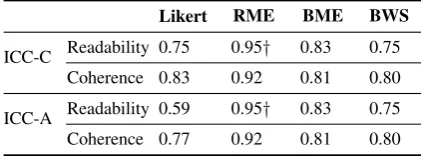
Table 1: ICC scores on the metrics of readability and coherence for each experiment design. All values are statistically significant p-value<0.001 except those in-dicated by†. n=40 for all four designs.
periments to the ratings from the task using dis-crete Likert scales, we perform a normalization of the magnitude estimation scores on a logarithmic scale as suggested by Bardet al.(1996).
Table 1 represents the ICC scores on consis-tency (ICC-C) and agreement (ICC-A) for our four experiment tasks. We observe that use of Mag-nitude Estimation with anchors (RME or BME) results in more reliable ratings than using Likert Scale or using Best-Worst ranking (BWS). This re-sult is consistent with prior research by Novikova
et al.(2018) and Belz and Kow (2011).
RQ2: Does time taken to complete the
sur-vey influence reliability of the rankings?To
an-alyze RQ2, we calculated the total time spent by each participant from the start to the end of the ex-periment. We found that BME task had longest on average time to completion (43 minutes), fol-lowed by RME (42.8 minutes) and Likert scale (33 minutes; Best-Worst ranking had shortest average completion time (32.5 minutes). We then test the hypothesis that raters who spent longer than aver-age time on the task would be more reliable in their ratings than those who completed in less than av-erage time. Table2represents the ICC scores for raters who spent higher than average time for the task, while Table3represents scores for raters who spent less than average time. Surprisingly, we find that consistency and agreement among raters who spend less than average time is higher than those who spend more time, for the Likert, BME or BWS experiment designs. When using the RME design, raters who spend more time have higher consistency and agreement.
experi-Likert
(n=15)
RME
(n=16)
BME
(n=15)
BWS
(n=16)
ICC-C Readability 0.58 0.93 0.51 0.62 Coherence 0.74 0.85 0.55 0.64
[image:4.595.307.526.64.151.2]ICC-A Readability 0.52 0.93 0.51 0.62 Coherence 0.69 0.86 0.56 0.64
Table 2: ICC scores when participants spendabove av-erage time. All values in this table are statistically sig-nificant with p-value<0.001
Likert
(n=25)
RME
(n=24)
BME
(n=25)
BWS
(n=24)
ICC-C Readability 0.61 0.88 0.81 0.65 Coherence 0.66 0.85 0.75 0.76
ICC-A Readability 0.36 0.88 0.81 0.66 Coherence 0.55 0.85 0.75 0.76
Table 3: ICC scores when participants spendbelow av-erage time. All values in this table are statistically sig-nificant with p-value<0.001
ence taking part in studies (a) to evaluate dialogue system output; and (b) to engage with a conversa-tional agent.
Tables 4 and 5 show how reliable the ratings from the participants based on their prior expe-rience of taking part in studies about evaluating conversational response. We find that participants who have not taken part in prior studies are more consistent and have a higher agreement score than participant who have prior experience. These re-sults are also validated by Tables 6 and7 which shows that participants with no prior experience of engaging with conversational agents are more consistent and reliable.
Likert
(n=15)
RME
(n=7)
BME
(n=18)
BWS
(n=13)
ICC-C Readability 0.45 0.37 0.51 0.54 Coherence 0.38 0.48 0.55 0.63
[image:4.595.72.290.65.151.2]ICC-A Readability 0.35 0.38 0.52 0.55 Coherence 0.32 0.49 0.55 0.63
Table 4: ICC scores when participantshave prior ex-perience evaluating dialogue system output. All values statistically significant at p-value<0.001.
RQ4: How well do automated methods to calculate readability and coherence correlate
with human ratings? We report on correlation
between readability and coherence scores that are
Likert
(n=25)
RME
(n=33)
BME
(n=22)
BWS
(n=27)
ICC-C Readability 0.71 0.95† 0.83 0.70 Coherence 0.82 0.92 0.76 0.72
[image:4.595.72.290.210.297.2]ICC-A Readability 0.50 0.95† 0.83 0.70 Coherence 0.75 0.92 0.77 0.72
Table 5: ICC scores when participants do not have prior experience evaluating dialogue system output. All values statistically significant at p-value<0.001 ex-cept those indicated by†.
Likert
(n=18)
RME
(n=11)
BME
(n=23)
BWS
(n=18)
ICC-C Readability 0.46 0.69 0.60 0.57 Coherence 0.44 0.65 0.62 0.67
[image:4.595.307.526.221.309.2]ICC-A Readability 0.37 0.69 0.61 0.57 Coherence 0.38 0.65 0.62 0.67
Table 6: ICC scores when participantshaveprior expe-rience engaging with conversational agents. All values statistically significant at p-value<0.001.
Likert
(n=22)
RME
(n=29)
BME
(n=17)
BWS
(n=22)
ICC-C Readability 0.70 0.95† 0.84 0.67 Coherence 0.82 0.91 0.76 0.68
[image:4.595.307.526.367.455.2]ICC-A Readability 0.48 0.95† 0.84 0.67 Coherence 0.75 0.91 0.76 0.68
Table 7: ICC scores when participants do not have prior experience engaging with conversational agents. All values statistically significant at p-value<0.001 ex-cept those indicated by†.
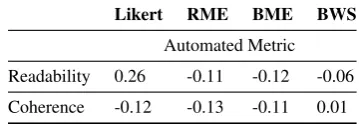
calculated using automated methods (outlined in Section 3) with the human ratings in Table 8. Readability scores were computed using the Flesh Reading Ease (Kincaid et al.,1975) and coherence scores were computed based on method proposed by Dziri et al. (2018). We observe that the au-tomated metrics for Readability (Kincaid et al., 1975) and Semantic Similarity (Dziri et al.,2018) show low correlation to human judgments ratings.
Likert RME BME BWS
Automated Metric
Readability 0.26 -0.11 -0.12 -0.06
Coherence -0.12 -0.13 -0.11 0.01
[image:4.595.325.505.667.729.2]RQ5: Is there any correlation between rat-ings of readability and coherence for each of
the four experiment conditions? To
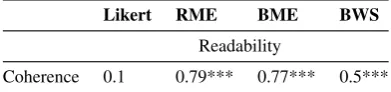
evalu-ate whether there is any correlation between the ratings obtained for readability and coherence through of four experimental designs, we report the Spearman correlation values in Table 9. We find that there is high correlation between the hu-man ratings of readability and coherence obtained through RME and BME (statistically significant). One likely factor affecting correlation may be an-choring bias towards the fixed value of the stan-dard utterance provided in RME (100) and refer-ence value provided in BME. We aim to investi-gate this further in future work.
Likert RME BME BWS
Readability
[image:5.595.83.279.278.324.2]Coherence 0.1 0.79*** 0.77*** 0.5***
Table 9: Spearman correlation between the ratings of readability and coherence obtained on four different ex-periment designs. *** p-value<0.001
6 Conclusion and Future Work
In this paper, we present our work on designing a systematic experiment with four experiment con-ditions to evaluate the output of dialogue systems. Different from prior work where a similar study was conducted with output from goal-oriented systems (Novikova et al.,2018), our study focuses on evaluating output in open-domain situations. Consistent with prior findings, metrics calculated using automated methods (Dziri et al.,2019) were found to have a negative correlation with human judgments (c.f. Table 8). This finding points to the need for more effective automated metrics.
We find that that use of continuous scales to obtain crowdsourced ratings provides more con-sistent and reliable ratings than ratings obtained through Likert scales or Best-Worst scaling. This finding is consistent with prior work conducted by Novikova et al. (2018). Novel in our study was the testing of the Best-Worst scaling method to evaluate responses against one another. Although the Best-Worst scaling method has been shown to be effective in obtaining crowdsourced ratings of emotions (Kiritchenko and Mohammad,2017), we did not find it to be effective in this study. We aim to investigate further whether this finding can be reproduced in a different experiment.
Further, we were able to identify the effects of time taken to complete the task on rating relia-bility. We find that workers who spent less than average time on the task had higher consistency (for the Likert, BME and BWS experiment condi-tions) than did the workers who spent more than average time. This finding is counter-intuitive, we expect that spending more time would positively impact inter-rater consistency. Our first step in the analysis of the effects of time taken on reliability included analyzing data from workers who spent more or less than average time, which offers ad-mittedly a limited perspective; an interesting next step would be to more thoroughly study the effects of time taken on reliability by taking into account the full distribution of the time spent data.
We also find that lack of prior experience of evaluating open-domain dialogue system output results in more reliable ratings. One potential ex-planation for this could be that workers may have pre-conceived notions based on their past experi-ence. One limitation of our current study is that al-though we had output from three separate models, we conducted the study using data from one cor-pus. Reproducing our findings across additional corpora, additional metrics and other experiment designs would help substantiate these findings fur-ther. An analysis of the interaction effects between independent variables such as time taken and prior experience would also help strengthen the findings of our study.
By using a larger sample size (n=40), we are able to make claims about statistical significance across experiment conditions. In future work, we plan to evaluate the impact of cognitive biases such as anchoring and confirmation bias in-depth and how it affects consistency and reliability along with testing continuous scale ratings with no ref-erence value.
Acknowledgments
References
Nabiha Asghar, Pascal Poupart, Jesse Hoey, Xin Jiang, and Lili Mou. 2018. Affective neural response gen-eration. In European Conference on Information Retrieval, pages 154–166. Springer.
Nabiha Asghar, Pascal Poupart, Xin Jiang, and Hang Li. 2017. Deep active learning for dialogue genera-tion. InProceedings of the 6th Joint Conference on Lexical and Computational Semantics (*SEM 2017), pages 78–83, Vancouver, Canada. Association for Computational Linguistics.
Dzmitry Bahdanau, Kyunghyun Cho, and Yoshua Ben-gio. 2014. Neural machine translation by jointly learning to align and translate. arXiv preprint arXiv:1409.0473.
Ellen Gurman Bard, Dan Robertson, and Antonella So-race. 1996. Magnitude estimation of linguistic ac-ceptability. Language, pages 32–68.
Anja Belz and Eric Kow. 2010. Comparing rating scales and preference judgements in language eval-uation. InProceedings of the 6th International Nat-ural Language Generation Conference, pages 7–15. Association for Computational Linguistics.
Anja Belz and Eric Kow. 2011. Discrete vs. continu-ous rating scales for language evaluation in nlp. In
Proceedings of the 49th Annual Meeting of the Asso-ciation for Computational Linguistics: Human Lan-guage Technologies: short papers-Volume 2, pages 230–235. Association for Computational Linguis-tics.
Nouha Dziri, Ehsan Kamalloo, Kory Mathewson, and Osmar Zaiane. 2019. Evaluating coherence in dia-logue systems using entailment. InProceedings of the 2019 Conference of the North American Chap-ter of the Association for Computational Linguistics: Human Language Technologies, Volume 1 (Long and Short Papers), pages 3806–3812, Minneapolis, Minnesota. Association for Computational Linguis-tics.
Nouha Dziri, Ehsan Kamalloo, Kory W Mathewson, and Osmar Zaiane. 2018. Augmenting neural re-sponse generation with context-aware topical atten-tion. arXiv preprint arXiv:1811.01063.
Albert Gatt and Emiel Krahmer. 2018. Survey of the state of the art in natural language generation: Core tasks, applications and evaluation. Journal of Artifi-cial Intelligence Research, 61:65–170.
Daniel Kahneman. 2016. 36 heuristics and biases. Sci-entists Making a Difference: One Hundred Eminent Behavioral and Brain Scientists Talk about Their Most Important Contributions, page 171.
J Peter Kincaid, Robert P Fishburne Jr, Richard L Rogers, and Brad S Chissom. 1975. Derivation of new readability formulas (automated readability in-dex, fog count and flesch reading ease formula) for navy enlisted personnel.
Svetlana Kiritchenko and Saif Mohammad. 2017. Best-worst scaling more reliable than rating scales: A case study on sentiment intensity annotation. In
Proceedings of the 55th Annual Meeting of the As-sociation for Computational Linguistics (Volume 2: Short Papers), pages 465–470, Vancouver, Canada. Association for Computational Linguistics.
J Richard Landis and Gary G Koch. 1977. The mea-surement of observer agreement for categorical data.
biometrics, pages 159–174.
Jiwei Li, Will Monroe, Alan Ritter, Dan Jurafsky, Michel Galley, and Jianfeng Gao. 2016. Deep rein-forcement learning for dialogue generation. In Pro-ceedings of the 2016 Conference on Empirical Meth-ods in Natural Language Processing, pages 1192– 1202. Association for Computational Linguistics.
Chia-Wei Liu, Ryan Lowe, Iulian Serban, Mike Nose-worthy, Laurent Charlin, and Joelle Pineau. 2016. How not to evaluate your dialogue system: An em-pirical study of unsupervised evaluation metrics for dialogue response generation. InProceedings of the 2016 Conference on Empirical Methods in Natural Language Processing, pages 2122–2132. Associa-tion for ComputaAssocia-tional Linguistics.
Ryan Lowe, Michael Noseworthy, Iulian Vlad Ser-ban, Nicolas Angelard-Gontier, Yoshua Bengio, and Joelle Pineau. 2017. Towards an automatic Tur-ing test: LearnTur-ing to evaluate dialogue responses. In Proceedings of the 55th Annual Meeting of the Association for Computational Linguistics (Volume 1: Long Papers), pages 1116–1126, Vancouver, Canada. Association for Computational Linguistics.
Jekaterina Novikova, Ondˇrej Duˇsek, Amanda Cer-cas Curry, and Verena Rieser. 2017. Why we need new evaluation metrics for NLG. In Proceedings of the 2017 Conference on Empirical Methods in Natural Language Processing, pages 2241–2252, Copenhagen, Denmark. Association for Computa-tional Linguistics.
Jekaterina Novikova, Ondˇrej Duˇsek, and Verena Rieser. 2018. RankME: Reliable human ratings for natu-ral language generation. InProceedings of the 2018 Conference of the North American Chapter of the Association for Computational Linguistics: Human Language Technologies, Volume 2 (Short Papers), pages 72–78, New Orleans, Louisiana. Association for Computational Linguistics.
Alec Radford, Jeff Wu, Rewon Child, David Luan, Dario Amodei, and Ilya Sutskever. 2019. Language models are unsupervised multitask learners.
Sashank Santhanam and Samira Shaikh. 2019. A sur-vey of natural language generation techniques with a focus on dialogue systems-past, present and future directions.arXiv preprint arXiv:1906.00500.
end-to-end dialogue systems using generative hier-archical neural network models. InThirtieth AAAI Conference on Artificial Intelligence.
Patrick E Shrout and Joseph L Fleiss. 1979. Intraclass correlations: uses in assessing rater reliability. Psy-chological bulletin, 86(2):420.
Anu Venkatesh, Chandra Khatri, Ashwin Ram, Fen-fei Guo, Raefer Gabriel, Ashish Nagar, Rohit Prasad, Ming Cheng, Behnam Hedayatnia, Ange-liki Metallinou, et al. 2018. On evaluating and comparing conversational agents. arXiv preprint arXiv:1801.03625.
Thomas Wolf, Victor Sanh, Julien Chaumond, and Clement Delangue. 2019. Transfertransfo: A transfer learning approach for neural network based conversational agents. arXiv preprint arXiv:1901.08149.
Chen Xing, Yu Wu, Wei Wu, Yalou Huang, and Ming Zhou. 2018. Hierarchical recurrent attention net-work for response generation. In Thirty-Second AAAI Conference on Artificial Intelligence.