Udapi: Universal API for Universal Dependencies
Martin Popel, Zdenˇek Žabokrtský, Martin Vojtek
Charles University, Faculty of Mathematics and Physics Malostranské námˇestí 25, Prague
{popel,zabokrtsky}@ufal.mff.cuni.cz, [email protected]
Abstract
Udapi is an open-source framework pro-viding an application programming inter-face (API) for processing Universal De-pendencies data. Udapi is available in Python, Perl and Java. It is suitable both for full-fledged applications and fast prototyping: visualization of dependency trees, format conversions, querying, edit-ing and transformations, validity tests, de-pendency parsing, evaluation etc.
1 Introduction
Universal Dependencies (UD)1 is a project that seeks to develop cross-linguistically consistent treebank annotation, by both providing annota-tion guidelines and releasing freely available tree-banks. Two years after the first release, UD ver-sion 2 (UDv2) of the guidelines was published, accompanied by the UDv2.0 release of the data: 70 treebanks for 50 languages, with 12M words in total, contributed by 145 treebank developers.2
The steady growth of the UD popularity results in an increased need for tools compatible with UD and its native data format CoNLL-U. Such tools are needed by both the treebank developers and users of the treebanks. Thanks to the simplicity of CoNLL-U, simple tasks can be performed with ad-hoc scripts or even standard Unix tools (sed, cut, grepetc.). However, there are several dis-advantages of these ad-hoc solutions:
• They tend to be suboptimal regarding speed and memory, thus discouraging more fre-quent large-scale experiments.
• The code is less readable because the main logic is mixed with boilerplate.
1http://universaldependencies.org 2http://hdl.handle.net/11234/1-1983
• It is easy to forget handling edge cases.3 • Ad-hoc solutions are difficult to maintain
once they outgrow the original simple task. We present Udapi – a framework providing an API for processing UD, which should solve the above-mentioned problems. Udapi implementa-tion is available in Python, Perl and Java. In this paper, we focus on the Python implementation be-cause it currently has the best support and largest user community. The Perl and Java implemen-tations are kept harmonized with the Python im-plementation as much as the differences between these programming languages allow.
The API is object-oriented and covers both pro-cessing units (§3.1) and data representation (§3.2). The development of Udapi is hosted at GitHub.4 Anyone is welcome to contribute.
2 Example use cases
Udapi can be used both as Python library and via the command-line interfaceudapy. This section gives examples of the latter.
2.1 Parsing
echo "John loves Mary." | udapy \ read.Sentences tokenize.Simple \ udpipe.En tokenize=0 write.Conllu
In this example, udapy executes a pipeline (called scenario in Udapi) with four processing units (called blocks): read.Sentences reads plain text from the standard input, one sentence per line; tokenize.Simpledoes a naïve tok-enization;udpipe.Enapplies a UDPipe (Straka et al., 2016) model for English tagging (filling
3For example, when deleting a node in a middle of a sen-tence, we must reindex the ID, HEAD and DEPS columns, delete enhanced dependencies referring to the node, re-attach or delete possible dependents of the node and if it was part of a multi-word token, make sure the token is still valid.
4 See http://udapi.github.iofor further info, documentation and a hands-on tutorial.
attributes upos, lemma and feats) and parsing (deprel and head). The parametertokenize=0 instructs UDPipe to skip tokenization. Finally, write.Conllu writes the parsed sentences to the standard output in the CoNLL-U format.
In practice, we recommend to use UDPipe’s in-ternal tokenization andudapy -s as a shortcut for appendingwrite.Conlluto the scenario:
echo "John loves Mary." | udapy -s \ read.Sentences udpipe.En
2.2 Visualization
cat latin-sample.conllu | udapy \
write.TextModeTrees attributes=form,upos
If no reader block is provided,read.Conllu is used by default. Block write.TextMode Treesis very useful for fast visualization of de-pendency trees in terminal and tracking changes in vimdiff. As the example above shows, it can render non-projectivities, it has a parameter for specifying the node attributes to be printed and it uses color highlighting in the terminal.
For longer documents, it is handy to use a pager (less -R)5 so one can search attributes of all nodes with regular expressions. The short-cut udapy -T stands for write.TextMode Trees color=1and printing the default set of attributesform,uposanddeprel:
udapy -T < latin-sample.conllu | less -R
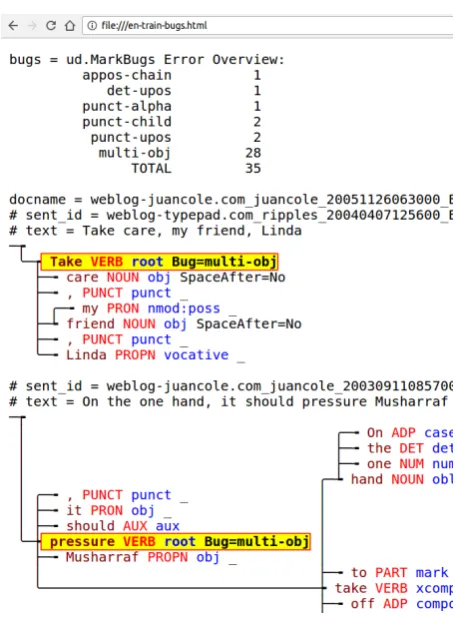
Similarly,udapy -His a shortcut for a (static) HTML version of this writer (see Figure 1) and-A is a shortcut for printing all attributes. Runudapy --helpto learn more shortcuts.
Block write.Html also generates a HTML file, but it uses JavaScript for traditional-style tree rendering, tooltips, SVG export button, highlight-ing alignments between the sentence and nodes and possibly also between nodes of word-aligned parallel sentences, see Figure 2.
Block write.Tikz generates a LATEX code, suitable for inclusion in papers, see Figure 3.
[image:2.595.307.535.62.371.2]5The-Rflag ensures the ANSI colors are displayed.
Figure 1: write.TextModeTreesHtml ex-ample output with a sex-ample of annotation errors (and overall statistics) found byud.MarkBugs.
Figure 2: write.Html example output with a sample of Czech-English parallel treebank CzEng (Bojar et al., 2016) converted to the UD style.
John loves Mary . PROPN VERB PROPN PUNCT
nsubj root
[image:2.595.73.291.217.374.2]dobj punct
[image:2.595.310.534.442.574.2]2.3 Format conversions
Udapi can be used for converting between various data formats. In addition to the native CoNLL-U format and to the visualization layouts mentioned in Section 2, Udapi currently supports SDParse (popularized by Stanford dependencies and Brat)6 and VISL-cg7formats as illustrated below:
udapy write.Vislcg < x.conllu > x.vislcg udapy read.Vislcg write.Sdparse \
< x.vislcg > x.sdparse
2.4 Querying and simple edits
There are two online services for querying the re-leased UD treebanks: SETS by the University of Turku8 and PML-TQ by the Charles University.9 The SETS querying language is easier to learn, but less expressive than the PML-TQ language.
Udapi offers an alternative where queries are specified in Python and may use all the methods defined in the API, thus being suitable even for complex queries. For example, using the method is_nonprojective(), we can find all non-projective trees in a CoNLL-U file, and mark the non-projective edges with a label “nonproj” stored in the MISC column (so the dependent node will be highlighted byudapy -T):
cat in.conllu | udapy -T \ util.Filter mark=nonproj \
keep_tree_if_node='node.is_nonprojective()' The same can be achieved using util.Mark and the-Mshortcut, which instructs the writer to print only trees that are “marked”:
cat in.conllu | udapy -TM util.Mark \ node='node.is_nonprojective()'
Block util.Eval can execute arbitrary Python code, so it can be used not only for query-ing, but also for simple (ad-hoc) editing. For ex-ample, we can delete the subtypes of dependency relations and keep only the universal part:10
cat in.conllu | udapy -s util.Eval \ node='node.deprel = node.udeprel' \ > out.conllu
For better reusability and maintainability, we recommend to store more complex edits in sep-arate Python modules. For instance, module udapi.block.my.editwith classEditwill be available viaudapyasmy.Edit.
6http://brat.nlplab.org/
7http://visl.sdu.dk/visl/vislcg-doc.html 8http://bionlp-www.utu.fi/dep_search/ 9http://lindat.cz
10So e.g.acl:relclis changed toacl.
2.5 Validation
UD treebanks are distributed with an offi-cial validate.py script, which checks the CoNLL-U validity and also treebank-specific re-strictions (e.g. a set of allowed deprel sub-types). Udapi currently does not attempt to du-plicate this format validation because it tries to keep CoNLL-U loading as fast as possible, check-ing only the most critical properties, such as ab-sence of cycles in dependencies. Udapi can also be used for non-UD treebanks,11 which use a dif-ferent set of values for UPOS, DEPREL etc., so a strict non-optional validation is not desired.
UD website features also content validation
available as an online service.12 It is basi-cally a special case of querying, with a set of tests formalized as queries. For example, the multi-obj test searches for nodes with two or more (direct) objects or clausal com-plements. This can be implemented in Udapi as follows: len([n for n in node.children if n.deprel in {'obj', 'ccomp'}]) > 1.
Although some tests may occasionally bring false alarms (finding a construction which is not forbidden by the UD guidelines), it is worth check-ing the results of tests with most hits for a given treebank as these often signal real errors or in-consistencies. For example, the twomulti-obj hits highlighted in Figure 1 are both annotation (or conversion) errors: In the first sentence,friend
should have deprelvocativeandLindashould de-pend on it as appos. In the second sentence, it
should be a subject (nsubj) instead of object. The tree visualization also sets off the erroneous non-projectivity, where On the one hand should de-pend onpressure.
Block ud.MarkBugsis an improved version of the online content validation with higher preci-sion and coverage. Treebank developers can ap-ply ud.MarkBugs on their data offline (before pushing a new version on GitHub, or on secret test data), so it complements the online validation. It is possible to apply only some tests using parameters testsandskip:
udapy -HAM ud.MarkBugs skip='no-NumType' \ < in.conllu > bugs.html
11 The reader block read.Conllu can load even CoNLL-X and CoNLL-2007 formats, using the optional pa-rameterattributeslisting the column names.
12http://universaldependencies.org/
2.6 UDv2 conversion
When the UDv2 guidelines were released, there were many treebanks annotated in the UDv1 style. Luckily, most of the changes could be at least par-tially automatized. Some of the changes were sim-ple renaming of labels, e.g. CONJ → CCONJ, which is easy to implement in any tool. Some of the changes were more difficult to implement correctly, e.g. conversion of ellipsis from the old
remnantstyle to the neworphanstyle.
Block ud.Convert1to2 has been success-fully used for converting five UDv2 treebanks: Bulgarian, Romanian, Galician, Russian and Irish. Blockud.Google2udconverts data for 15 lan-guages from a pre-UDv1 style used by Google.
2.7 Other use cases
Block ud.SetSpaceAfter uses heuristic rules to add the attribute SpaceAfter=No, while ud.SetSpaceAfterFromText does the same based on the raw text. Even more advanced isud.ComplyWithText, which can also adapt the annotation so it matches the raw text, e.g. by reverting the normalization of word forms.13
Block ud.AddMwt splits multi-word tokens into words based on language-specific rules – there are subclasses for several languages, e.g. ud.cs.AddMwtfor Czech.
Overall statistics (number of words, empty words, multi-word tokens, sentences) can be printed withutil.Wc. Advanced statistics about nodes matching a given condition (relative to other nodes) can be printed withutil.See.
For evaluation,eval.Parsingcomputes the standard UAS and LAS, while eval.F1 com-putes Precision/Recall/F1 of various attributes based on the longest common subsequence.
Tree projectivization and deprojectiviza-tion (Nivre and Nilsson, 2005) can be performed using transform.Proj and transform.Deproj.
3 Design and Implementation
The primary focus of Udapi is simplicity of use and speed. The amount of effort spent on design-ing specialized data structures, micro-optimizdesign-ing the speed and memory critical parts (e.g. loading
13 There are several treebanks which use ‘‘TeX-like quotes’’ instead of the “quotes” used in the raw text or which normalize numbers by deleting the thousand separa-tors. However, the UDv2 quidelines require word forms to match exactly the raw text.
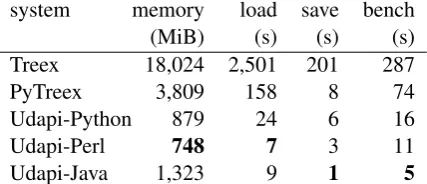
system memory load save bench (MiB) (s) (s) (s) Treex 18,024 2,501 201 287
PyTreex 3,809 158 8 74
Udapi-Python 879 24 6 16
Udapi-Perl 748 7 3 11
[image:4.595.310.524.64.156.2]Udapi-Java 1,323 9 1 5
Table 1: Memory and speed comparison. We measured performance of individual implementa-tions on loading and saving from/to CoNLL-U, and on a benchmark composed of iterating over all nodes, reading and writing node attributes, changing the dependency structure, adding and removing nodes, and changing word order. We used cs-ud-train-l.conllu from UDv1.2 (68 MiB, 41k sentences, 800k words).
CoNLL-U, iterating over all nodes sorted by word order while allowing changes of the word order too) and other technical issues was much bigger than the effort spent on the use cases described in Section 2.
For example, to provide access to struc-tured attributes FEATS and MISC (e.g. node .feats['Case'] = 'Nom') while allowing access to the serialized data (e.g. node.feats = 'Case=Nom|Person=1'), Udapi maintains both representations (string and dict) and synchro-nizes them transparently, but lazily.
Table 1 shows a benchmark of 5 frameworks: Treex (Perl), PyTreex (Python 2) and three imple-mentations of Udapi (Python 3, Perl, Java 8).14
The full description of the API is available on-line.15 The following two sections summarize only the most important classes and methods.
3.1 Classes for data processing
Block. A block is the smallest processing unit that can be applied on UD data. Block classes implement usually some reasonably limited and well-defined tasks, often corresponding to the classical NLP components (tokenization, tagging, parsing. . . ), but there can be blocks for purely technical tasks (such as for feature extraction).
14https://github.com/ufal/treex
https://github.com/ufal/pytreex https://github.com/udapi/udapi-python https://github.com/udapi/udapi-perl https://github.com/udapi/udapi-java
Run. The Run class instance corresponds to a sequence of blocks (also called scenario) that are to be applied on data one after another. Such scenarios can compose very complex NLP pipelines. This class offers also the support for the command-line interfaceudapy.
3.2 Classes for data representation
Document. A document consists of a sequence of bundles, mirroring a sequence of sentences in a typical natural language text. A document in-stance can be composed programatically or can be loaded from (or stored to) a CoNLL-U file.
Bundle. A bundle corresponds to a sentence, possibly in more forms or with different represen-tations, such as sentence-tuples from parallel cor-pora, or paraphrases in the same language or alter-native analyses (e.g. parses produced by different parsers). If there are more trees in a bundle, they must be distinguished by a so calledzone(a label which contains the language code).
Root. A root is a special (artificial) node that is added to the top of a CoNLL-U tree in the Udapi model. The root serves as a representant of the whole tree (e.g. it bears the sentence’s identi-fier). The root’s functionality partially overlaps with functionality of nodes (e.g., it has methods children and descendants), but differs in other aspects (its lemma cannot be set, its lin-ear position is always 0, it has methods for cre-ating and accessingmultiword tokens, computing the sentence text (detokenized), accessing the tree-level CoNLL-U comments, etc.).
Node. The Node class corresponds to a node of a dependency tree. It provides access to all the CoNLL-U-defined attributes. There are methods for tree traversal (parent, root, children, descendants); word-order traversal (next_node, prev_node); tree manipulation (parent setter) including word-order changes (shift_after_node(x), shift_before_subtree(x), etc.); and utility methods: is_descendant_of(x), is_nonprojective(), precedes(x), is_leaf(), is_root(), get_attrs([]), compute_text(),print_subtree().
Some methods have optional arguments, e.g., child = node.create_child(form= "was", lemma="be") for creating a new node with given attributes or node.remove(
children="rehang") for removing a node but keeping its children by re-attaching them to the parent of the removed node.16
4 Related work
Treex (Popel and Žabokrtský, 2010) is a Perl NLP framework focusing on MT and multi-layer anno-tation in the PDT (Bejˇcek et al., 2013) style. It is the only framework we are aware of with at least partial support for UD and CoNLL-U. NLTK (Bird et al., 2009) is a popular framework focus-ing on teachfocus-ing NLP and Python, with no UD sup-port yet.17 GATE (Cunningham et al., 2011)18is a family of Java tools for NLP and IR. There is a converter from CoNLL-U to GATE documents.19
Brat (Stenetorp et al., 2012) is an online editor (without full CoNLL-U support) and conllu.js20is a related JavaScript library used in the embedded CoNLL-U visualizations on the UD website.
5 Conclusion
Most of the current Udapi applications are focused on treebank developers. In future, we would like to focus also on other users, including NLP stu-dents, linguists and other researchers to make UD data more useful for them.
We hope Udapi will also serve as a common repository of interoperable NLP tools.
Acknowledgments
This work has been supported by projects GA15-10472S (Manyla), GAUK 1572314, and SVV 260 451. We thank the two anonymous re-viewers for helpful feedback.
References
[Bejˇcek et al.2013] Eduard Bejˇcek, Eva Hajiˇcová, Jan Hajiˇc, Pavlína Jínová, Václava Kettnerová, Veronika Koláˇrová, Marie Mikulová, Jiˇrí Mírovský, Anna Nedoluzhko, Jarmila Panevová, Lucie Poláková, Magda Ševˇcíková, Jan Štˇepánek, and Šárka Zikánová. 2013. Prague Dependency Treebank 3.0. LINDAT/CLARIN digital library at the Institute of Formal and Applied Linguistics, Charles University in Prague.
16See footnote 3.
17github.com/nltk/nltk/issues/875 18https://gate.ac.uk
19https://github.com/GateNLP/
corpusconversion-universal-dependencies
[Bird et al.2009] Steven Bird, Ewan Klein, and Edward Loper. 2009. Natural Language Processing with Python. O’Reilly Media, Inc., 1st edition.
[Bojar et al.2016] Ondˇrej Bojar, Ondˇrej Dušek, Tom Kocmi, Jindˇrich Libovický, Michal Novák, Martin Popel, Roman Sudarikov, and Dušan Variš. 2016. CzEng 1.6: Enlarged Czech-English Parallel Cor-pus with Processing Tools Dockered. In Petr Sojka, Aleš Horák, Ivan Kopeˇcek, and Karel Pala, editors, Text, Speech, and Dialogue: 19th International Con-ference, TSD 2016, number 9924 in Lecture Notes in Computer Science, pages 231–238, Cham / Hei-delberg / New York / Dordrecht / London. Masaryk University, Springer International Publishing.
[Cunningham et al.2011] Hamish Cunningham, Diana Maynard, Kalina Bontcheva, Valentin Tablan, Ni-raj Aswani, Ian Roberts, Genevieve Gorrell, Adam Funk, Angus Roberts, Danica Damljanovic, Thomas Heitz, Mark A. Greenwood, Horacio Saggion, Jo-hann Petrak, Yaoyong Li, and Wim Peters. 2011. Text Processing with GATE (Version 6).
[Nivre and Nilsson2005] Joakim Nivre and Jens Nils-son. 2005. Pseudo-projective dependency parsing. In Proceedings of the 43rd Annual Meeting on As-sociation for Computational Linguistics, ACL ’05, pages 99–106, Stroudsburg, PA, USA. Association for Computational Linguistics.
[Popel and Žabokrtský2010] Martin Popel and Zdenˇek Žabokrtský. 2010. TectoMT: modular NLP frame-work. Advances in Natural Language Processing, pages 293–304.
[Stenetorp et al.2012] Pontus Stenetorp, Sampo Pyysalo, Goran Topi´c, Tomoko Ohta, Sophia Anani-adou, and Jun’ichi Tsujii. 2012. brat: a web-based tool for nlp-assisted text annotation. InProceedings of the Demonstrations at the 13th Conference of the European Chapter of the Association for Computa-tional Linguistics, pages 102–107. Association for Computational Linguistics.