IIT (BHU): System Description for LSDSem’17 Shared Task
Pranav Goel and Anil Kumar Singh
Department of Computer Science and Engineering Indian Institute of Technology (BHU), Varanasi, India
{pranav.goel.cse14, aksingh.cse}@iitbhu.ac.in
Abstract
This paper describes an ensemble system submitted as part of the LSDSem Shared Task 2017 - the Story Cloze Test. The main conclusion from our results is that an approach based on semantic similarity alone may not be enough for this task. We test various approaches and compare them with two ensemble systems. One is based on voting and the other on logistic regres-sion based classifier. Our final system is able to outperform the previous state of the art for the Story Cloze test. Another very interesting observation is the performance of sentiment based approach which works almost as well on its own as our final en-semble system.
1 Introduction
The Story Cloze Test (Mostafazadeh et al., 2016) is a recently introduced framework to evaluate story understanding and script learning. Represen-tation of commonsense knowledge is major theme in Natural Language Processing and is also impor-tant for this task. The organizers provide a train-ing corpus called the ROCStories dataset (we will refer to it as the Story Cloze corpus or dataset). It consists of very simple 98161 everyday life stories (combining the spring and winter training sets). All stories consist of five sentences which capture ‘causal and temporal common sense relations be-tween daily events’. The validation and test sets contain 1871 samples each, where each sample contains the first four sentences (the context) of the story, and the system has to complete the story by choosing the fifth sentence (the correct ending) out of the two alternatives provided.
Some of the approaches described in (Mostafazadeh et al., 2016) are used as it
is in our system, while some approaches not tried before in the context of this task (to the best of our knowledge) also form parts of our final ensemble models. Most approaches tried before and also in our experiments rely directly or indirectly on the idea of using semantic similarity of the context and the ending to make the decision. The results point to the conclusion that semantic similarity (at least on its own) may be inadequate as an approach for the Story Cloze test.
Our final system is an ensemble combining the different approaches we tried. It achieves an accu-racy of 60.45 on the test set.
The paper is structured as follows. The next sec-tion describes various experiments and approaches we tried. Section 3 describes how the different approaches come together to form the system we submitted. Section 4 looks at the various results and draws inferences to make our point. Section 5 presents a small error analysis. Finally, Section 6 presents the conclusions and discusses possible future work.
2 Approaches
We tried five different approaches, out of which four are directly or indirectly utilizing the idea of semantic similarity between the context and the ending. Some past approaches are mentioned here again to enable readers to view them as seman-tic similarity based approaches, and to use their performance in our observations and conclusion. We give a brief description of our experiments be-low. The results (performance measured using ac-curacy which is simply the correct cases divided by the total number of test cases) of all the sepa-rate approaches are presented in Table 1.
1. Gensim (Average Word2Vec): Chooses the hypothesis with the closest average word2vec (Mikolov et al., 2013) embedding
to the average word2vec embedding of the context. The concept of semantic similarity is at the very center of this approach. We tried three different variations of this ap-proach:
a) Training on the Story Cloze training corpus:This is the same as in (Mostafazadeh et al., 2016) except that we train on the winter training set as well, which makes the corpus size about two times the one used previously. Removing the stop words, keeping a context window of 10 words and vector dimensional-ity of 300 gave us the results reported in Table 1.
b) Training on Google news corpus:
Google has released its pre-trained word vec-tors, trained on a news corpus with a vocab-ulary of about three million words, which is much larger than the Story Cloze corpus (which contains about 35k unique words). Thus, we decided to explore if the larger set could potentially result in better representa-tion and performance.
c)Learning the representation of a poten-tial connective word between the context and the ending: The idea is that a connec-tive with a particular ‘sense’ (probably tem-poral or causal in the Story Cloze training set) could perfectly link the context and the end-ing. We modified all the stories such that a manually introduced symbol (like ‘CCC’: not in the vocabulary) separates the first four sen-tences from the fifth sentence, and its repre-sentation is learned by training a word2vec model on the data. On the test and valida-tion set, the hypothesis whose representavalida-tion is the closest to the sum of the vectors of the context and the connective symbol is cho-sen as the prediction. The intuition comes from the implicit connective sense classifica-tion task for the Shallow Discourse Parsing problem (Xue et al., 2015). Context window size 100 and dimensionality 300 were found to be the optimal hyperparameters in our ex-periments.
Combining the above three – called word2vec (combined) approach – through simple voting produced slightly better results than with any individual variation (as can be seen in Table 1), and thus we used this
combined approach in our ensemble model. 2. Skip-thoughts Model: The skip-thoughts
model’s (Kiros et al., 2015) sentence embed-ding of the context and the alternatives is again compared like the Gensim model, and thus this approach also revolves around se-mantic similarity.
3. Gensim Doc2Vec: Distributed representa-tion of documents and sentences extends the concept of word vectors to larger textual units (Le and Mikolov, 2014). A host of vari-ations were tried (as provided by Python’s Gensim functionality ( ˇReh˚uˇrek and Sojka, 2010)). The distributed bag of words model (dbow) along with a context window of three words was found to give the best results for this approach (Table 1). This approach is again trying to model semantic similarity via sentence embedding.
4. Siamese LSTM:We also implement a deep neural network model for assessing the se-mantic similarity between a pair of sen-tences. It uses a Siamese adaptation of the Long Short-Term Memory (LSTM) net-work (Mueller and Thyagarajan, 2016). The model is implemented as in the paper - using the SICK training set and Google word2vec, with the weights optimized as per the Se-mEval 2014 task on semantic similarity of sentences (Marelli et al., 2014). This is one of the current state of the art models for cap-turing semantic similarity.
5. Sentiment: In this approach, we choose the hypothesis that matches the average sen-timent of the context. We use NLTK VADER Sentiment Analyzer (Hutto and Gilbert, 2014) instead of the Stanford Core NLP tool for sentiment analysis by (Man-ning et al., 2014) as used in (Mostafazadeh et al., 2016) due to notably better results (Ta-ble 1). In our experiments on the valida-tion set, matching sentiment of the full con-text instead of just the last one/two/three sen-tence(s) gives the best performance for this approach. This approach does not use seman-tic similarity.
3 The Ensemble Model
perfor-Gensim word2vec
Skip-thoughts doc2vecGensim SiameseLSTM Sentiment Story
cloze
Google word vectors
Using potential connective
rep.
Combined
Validation 0.58 0.577 0.571 0.593 0.536 0.547 0.549 0.608
Test 0.571 0.568 0.576 0.584 0.552 0.546 0.551 0.582
[image:3.595.78.520.233.337.2]0.539 - - - 0.552 - - 0.522
Table 1: Results for individual approaches (last row represents results on the test set for corresponding approach in (Mostafazadeh et al., 2016)
Approaches involving semantic similarity (logistic regression on validation set)
All approaches (includes sentiment) Baseline Weighted majority voting
(Final system submission for validation set
spring 2016)
Logistic regression on validation set (Final system submission
for test set spring 2016)
Validation - 0.626 - 0.604
Test 0.587 0.601 0.605 0.585
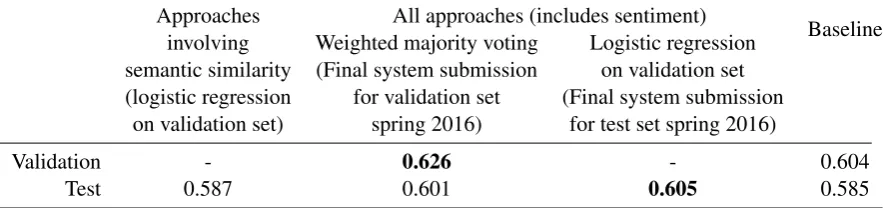
Table 2: Results for the best ensemble models
mances of each on the validation set. This cre-ation of an ‘ensemble’ model was also tried with-out using the sentiment approach, so as to ob-serve the best possible performance when only our approaches which involve semantic similarity are combined. We report only the best performing combinations (out of all possible combinations of approaches reported above) here:
a) Voting based ensemble: We use weighted majority voting, with prediction from senti-ment approach counted twice, and predictions from Siamese LSTM, word2vec (combined) and doc2vec counted once each. The idea is to im-prove the performance of sentiment approach (the best individual performer) by changing its predic-tion when all the other three approaches predict a different ending. It may be noted that such voting based methods did not lead to improvement (over combined word2vec) when combinations of only semantic similarity based approaches were used.
b) Applying a supervised machine learning algorithm: We used the predictions from senti-ment, Siamese LSTM and word2vec (combined) approaches on the validation set as features, with the actual validation set labels as targets and train a machine learning classifier on them. Then this classifier predicts the test set labels (with the same set of features created for test set). Logistic
re-gression (C=0.1) gave the best performance in this method (more than decision tree based methods and naive bayes, and also slightly better than SVM for test as well as validation data). This is the sys-tem which formed our final submission. Addition-ally, combining predictions of doc2vec, word2vec, skip-thoughts, and Siamese LSTM in the exact same way gave us the best performance in the case of using only semantic similarity based ap-proaches (see Table 2).
Baseline: We compare our submitted system with the best performing model on the ROCStories dataset for the Story Cloze task (Mostafazadeh et al., 2016) in Table 2.
4 Results and Discussion
We discuss insights and observations gained from the results of our ensemble system and of the in-dividual approaches obtained on the Story Cloze validation and test sets.
further increase in the Story Cloze training data itself may help by giving us better repre-sentations. However, comparing with results in (Mostafazadeh et al., 2016), doubling the size of training set results in about 3-4% in-crease in performance (Table 1). For further increase, trying different approaches might be better.
2. Improved performance of the sentiment approach: For the sentiment approach, us-ing NLTK VADER sentiment analyzer tool for getting polarity scores works notably better by outperforming the Stanford Core NLP (Manning et al., 2014) tool used in (Mostafazadeh et al., 2016) by about 6-7% (the last column of Table 1). As discussed in (Hutto and Gilbert, 2014), the VADER tool is about as accurate in most domains and op-timal for the social media domain while being quite simple and more efficient. It happens to work surprisingly well in the context of this task though we do not conclude that it is a better approach as compared to (Socher et al., 2013) approach to sentiment analysis as uti-lized in Stanford Core NLP tool in general. 3. General performance:Our best system
(en-semble of sentiment and various semantic similarity based approaches) outperforms the previous best system (using DSSM, as given in (Mostafazadeh et al., 2016)) by about 2% (accuracy on both validation and test sets) (refer to Table 2). Most of the individ-ual approaches (Table 1) show performance that hovers around 60% accuracy (or below). Since they are basically all based on seman-tic similarity (except the sentiment base ap-proach), the results indicate that we may need to approach the Story Cloze test from a very different direction.
4. Semantic vs. sentiment similarity: We can see from Table 1 that the simple sentiment based approach basically outperforms all the semantic similarity based approaches. Even combining those approaches seems barely better than just the sentiment approach (Ta-ble 2). This could indicate either the lack of effectiveness of semantic similarity or the fact that sentiment based approach is quite effective. Since our sentiment based ap-proach does not rely on training corpus and
is unlikely to improve with more data (since no learning is involved), we are inclined to-wards the former inference: Semantic simi-larity alone may not be enough for the Story Cloze test.
5. Negative results of the Siamese LSTM:
Siamese LSTM is a deep neural network trained to capture semantic similarity and gave state of the art results on the data for SemEval 2014 shared task on semantic simi-larity. However, it does not perform well for this task, supporting our conclusion.
6. Insignificant boost in performance by en-semble system: Our final ensemble model (Table 2, last column) offers hardly any im-provement over the individual sentiment ap-proach (Table 1, last column). This may indi-cate that the sentiment and semantic similar-ity based approaches are not complementary.
5 Error Analysis
Context Incorrect Ending Correct Ending
Franny did not particularly like all of the immigration happening. She thought immigrants were coming to cause social problems. Franny was upset when an immigrant moved in next door. The immigrant, Sal, was kind and became friends with Franny.
Franny ended up
getting deported . Franny learned to examineher prejudices.
Feliciano went olive picking with his grandmother. While they picked, she told him stories of his ancestors. Before he realized it, the sun was going down. They took the olives home and ate them together.
The pair then went out
to pick olives. Feliciano was happy abouthis nice day.
Table 3: Examples of stories incorrectly predicted by our model as well as all individual approaches
It is interesting to note how the sentiment ap-proach fails in both the examples. NLTK Vader rates ‘getting deported’ as neutral while giving a highly negative rating for ‘prejudice’. The context is only slightly negative, since the positivity in the last sentence (which talks about Sal being ‘nice’ and the act of ‘becoming friends’) offsets the neg-ativity of the previous sentences somewhat. We can see that perhaps the very use of sentiment is not appropriate for example 1. In example 2, the context and the incorrect ending are both neutral, while the correct ending is very positive, hence similarity in sentiment gives an error, but realiz-ing that the context would give rise to a positive ending would have worked.
6 Conclusions and Future Work
We described our submitted system for the Story Cloze test, which combines simple sentiment based approach with a variety of semantic simi-larity based methods. By highlighting individual and ensemble model results as well as the observa-tions arising from them, we have tried to establish the apparent lack of effectiveness of solely seman-tic similarity based approaches for this task. This is validated by various experiments and especially the performance of the current state of the art ap-proach for semantic similarity (Siamese LSTM).
Also, an effective future approach should probably be more sophisticated than our sentiment based approach, which does not learn from the training data in any way.
We do not claim that semantic similarity or sen-timent based approaches are of no help as they may certainly complement the performances of fu-ture approaches. However, they do not seem to be enough on their own, though it is certainly possi-ble that some other semantic similarity based mod-els designed for the Story Cloze training set per-form better than our approaches.
While word vectors, sentiment based approach and skip-thoughts sentence embeddings had al-ready been discussed as possible approaches be-fore, we also look at two approaches which have not been tried before for this task, namely Siamese LSTM and Gensim Doc2Vec.
References
Clayton J. Hutto and Eric Gilbert. 2014. Vader: A parsimonious rule-based model for sentiment anal-ysis of social media text. InProceeding of Eighth International AAAI Conference on Weblogs and So-cial Media.
Ryan Kiros, Yukun Zhu, Ruslan R. Salakhutdinov, Richard Zemel, Raquel Urtasun, Antonio Torralba, and Sanja Fidler. 2015. Skip-thought vectors. In Proceedings of Advances in neural information pro-cessing systems, pages 3294–3302.
Quoc V. Le and Tomas Mikolov. 2014. Distributed representations of sentences and documents. In Pro-ceeding of ICML, volume 14, pages 1188–1196.
Christopher D. Manning, Mihai Surdeanu, John Bauer, Jenny Rose Finkel, Steven Bethard, and David Mc-Closky. 2014. The stanford corenlp natural lan-guage processing toolkit. InProceedings of the ACL (System Demonstrations), pages 55–60.
Marco Marelli, Luisa Bentivogli, Marco Baroni, Raf-faella Bernardi, Stefano Menini, and Roberto Zam-parelli. 2014. Semeval-2014 task 1: Evaluation of compositional distributional semantic models on full sentences through semantic relatedness and textual entailment. InProceedings of the 8th International Workshop on Semantic Evaluation (SemEval).
Tomas Mikolov, Ilya Sutskever, Kai Chen, Greg S. Cor-rado, and Jeff Dean. 2013. Distributed representa-tions of words and phrases and their compositional-ity. InProceeding of Advances in neural informa-tion processing systems, pages 3111–3119.
Nasrin Mostafazadeh, Nathanael Chambers, Xiaodong He, Devi Parikh, Dhruv Batra, Lucy Vanderwende, Pushmeet Kohli, and James Allen. 2016. A cor-pus and cloze evaluation for deeper understanding of commonsense stories. InProceedings of NAACL-HLT, pages 839–849.
Jonas Mueller and Aditya Thyagarajan. 2016. Siamese recurrent architectures for learning sentence similar-ity. InProceeding of AAAI, pages 2786–2792.
Radim ˇReh˚uˇrek and Petr Sojka. 2010. Software Framework for Topic Modelling with Large Cor-pora. InProceedings of the LREC 2010 Workshop on New Challenges for NLP Frameworks, pages 45– 50, Valletta, Malta, May. ELRA. http://is.
muni.cz/publication/884893/en.
Richard Socher, Alex Perelygin, Jean Y. Wu, Jason Chuang, Christopher D. Manning, Andrew Y. Ng, Christopher Potts, et al. 2013. Recursive deep models for semantic compositionality over a senti-ment treebank. InProceedings of the conference on empirical methods in natural language processing (EMNLP), volume 1631, page 1642. Citeseer.