Language and Task Independent Text Categorization
with Simple Language Models
Fuchun Peng Dale Schuurmans Shaojun Wang
School of Computer Science, University of Waterloo
200 University Avenue West, Waterloo, Ontario, Canada, N2L 3G1
{
f3peng, dale, sjwang
}
@cs.uwaterloo.ca
Abstract
We present a simple method for language inde-pendent and task indeinde-pendent text categoriza-tion learning, based on character-leveln-gram language models. Our approach uses simple information theoretic principles and achieves effective performance across a variety of lan-guages and tasks without requiring feature se-lection or extensive pre-processing. To demon-strate the language and task independence of the proposed technique, we present experimen-tal results on several languages—Greek, En-glish, Chinese and Japanese—in several text categorization problems—language identifica-tion, authorship attribuidentifica-tion, text genre classifi-cation, and topic detection. Our experimental results show that the simple approach achieves state of the art performance in each case.
1
Introduction
Text categorization concerns the problem of automati-cally assigning given text passages (paragraphs or doc-uments) into predefined categories. Due to the rapid ex-plosion of texts in digital form, text categorization has become an important area of research owing to the need to automatically organize and index large text collections in various ways. Such techniques are currently being ap-plied in many areas, including language identification, authorship attribution (Stamatatos et al., 2000), text genre classification (Kesseler et al., 1997; Stamatatos et al., 2000), topic identification (Dumais et al., 1998; Lewis, 1992; McCallum, 1998; Yang, 1999), and subjective sen-timent classification (Turney, 2002).
Many standard machine learning techniques have been applied to automated text categorization problems, such as naive-Bayes classifiers, support vector machines, lin-ear least squares models, neural networks, and K-nlin-earest
neighbor classifiers (Yang, 1999; Sebastiani, 2002). A common aspect of these approaches is that they treat text categorization as a standard classification problem, and thereby reduce the learning process to two simple steps: feature engineering, and classification learning over the feature space. Of these two steps, feature engineering is critical to achieving good performance in text categoriza-tion problems. Once good features are identified, almost any reasonable technique for learning a classifier seems to perform well (Scott, 1999).
trary thresholds and conducting a heuristic greedy search to find good feature sets. Finally, by treating text cate-gorization as a classical classification problem, standard approaches can ignore the fact that texts are written in natural language, meaning that they have many implicit regularities that can be well modeled with specific tools from natural language processing.
In this paper, we propose a straightforward text cate-gorization learning method based on learning category-specific, character-level, n-gram language models. Al-though this is a very simple approach, it has not yet been systematically investigated in the literature. We find that, surprisingly, we obtain competitive (and often superior) results to more sophisticated learning and feature con-struction techniques, while requiring almost no feature engineering or pre-processing. In fact, the overall ap-proach requires almost no language specific or task spe-cific pre-processing to achieve effective performance.
The success of this simple method, we think, is due to the effectiveness of well known statistical language mod-eling techniques, which surprisingly have had little sig-nificant impact on the learning algorithms normally ap-plied to text categorization. Nevertheless, statistical lan-guage modeling is also concerned with modeling the se-mantic, syntactic, lexicographical and phonological regu-larities of natural language—and would seem to provide a natural foundation for text categorization problems. One interesting difference, however, is that instead of explic-itly pre-computing features and selecting a subset based on arbitrary decisions, the language modeling approach simply considers all character (or word) subsequences occurring in the text as candidate features, and implic-itly considers the contribution of every feature in the fi-nal model. Thus, the language modeling approach com-pletely avoids a potentially error-prone feature selection process. Also, by applying character-level language mod-els, one also avoids the word segmentation problems that arise in many Asian languages, and thereby achieves a language independent method for constructing accurate text categorizers.
2
n
-Gram Language Modeling
The dominant motivation for language modeling has tra-ditionally come from speech recognition, but language models have recently become widely used in many other application areas.
The goal of language modeling is to predict the prob-ability of naturally occurring word sequences, s = w1w2...wN; or more simply, to put high probability on
word sequences that actually occur (and low probability on word sequences that never occur). Given a word se-quencew1w2...wN to be used as a test corpus, the quality
of a language model can be measured by the empirical
perplexity and entropy scores on this corpus
Perplexity = N
v u u tYN
i=1
1
Pr(wi|w1...wi−1)
(1)
Entropy = log2 Perplexity (2)
where the goal is to minimize these measures.
The simplest and most successful approach to lan-guage modeling is still based on then-gram model. By the chain rule of probability one can write the probability of any word sequence as
Pr(w1w2...wN) = N
Y
i=1
Pr(wi|w1...wi−1) (3)
An n-gram model approximates this probability by assuming that the only words relevant to predicting Pr(wi|w1...wi−1)are the previousn−1words; i.e.
Pr(wi|w1...wi−1) = Pr(wi|wi−n+1...wi−1)
A straightforward maximum likelihood estimate of n-gram probabilities from a corpus is given by the observed frequency of each of the patterns
Pr(wi|wi−n+1...wi−1) = #(wi−n+1...wi)
#(wi−n+1...wi−1) (4)
where #(.) denotes the number of occurrences of a spec-ified gram in the training corpus. Although one could at-tempt to use simplen-gram models to capture long range dependencies in language, attempting to do so directly immediately creates sparse data problems: Using grams of length up tonentails estimating the probability ofWn events, whereW is the size of the word vocabulary. This quickly overwhelms modern computational and data re-sources for even modest choices ofn (beyond 3 to 6). Also, because of the heavy tailed nature of language (i.e. Zipf’s law) one is likely to encounter noveln-grams that were never witnessed during training in any test corpus, and therefore some mechanism for assigning non-zero probability to noveln-grams is a central and unavoidable issue in statistical language modeling. One standard ap-proach to smoothing probability estimates to cope with sparse data problems (and to cope with potentially miss-ingn-grams) is to use some sort of back-off estimator.
Pr(wi|wi−n+1...wi−1)
=
ˆ
Pr(wi|wi−n+1...wi−1),
if#(wi−n+1...wi)>0
β(wi−n+1...wi−1)×Pr(wi|wi−n+2...wi−1),
otherwise
where
ˆ
Pr(wi|wi−n+1...wi−1) = discount#(wi−n+1...wi)
#(wi−n+1...wi−1)
(6)
is the discounted probability andβ(wi−n+1...wi−1)is a
normalization constant
β(wi−n+1...wi−1) =
1− X
x∈(wi−n+1...wi−1x)
ˆ
Pr(x|wi−n+1...wi−1)
1− X
x∈(wi−n+1...wi−1x)
ˆ
Pr(x|wi−n+2...wi−1)
(7)
The discounted probability (6) can be computed with different smoothing techniques, including absolute smoothing, Good-Turing smoothing, linear smoothing, and Witten-Bell smoothing (Chen and Goodman, 1998). The details of the smoothing techniques are omitted here for simplicity.
The language models described above use individual words as the basic unit, although one could instead con-sider models that use individual characters as the ba-sic unit. The remaining details remain the same in this case. The only difference is that the character vocabu-lary is always much smaller than the word vocabuvocabu-lary, which means that one can normally use a much higher order,n, in a character-leveln-gram model (although the text spanned by a character model is still usually less than that spanned by a word model). The benefits of the character-level model in the context of text classification are several-fold: it avoids the need for explicit word seg-mentation in the case of Asian languages, it captures im-portant morphological properties of an author’s writing, it models the typos and misspellings that are common in informal texts, it can still discover useful inter-word and inter-phrase features, and it greatly reduces the sparse data problems associated with large vocabulary models. In this paper, we experiment with character-level models to achieve flexibility and language independence.
3
Language Models as Text Classifiers
Our approach to applying language models to text cat-egorization is to use Bayesian decision theory. Assume we wish to classify a text D into a categoryc ∈ C =
{c1, ..., c|C|}. A natural choice is to pick the categoryc
that has the largest posterior probability given the text. That is,
c∗= arg max
c∈C{Pr(c|D)} (8)
Using Bayes rule, this can be rewritten as
c∗= arg max
c∈C{Pr(D|c) Pr(c)} (9)
= arg max
c∈C{Pr(D|c)} (10)
= arg max
c∈C
nYN
i=1
P rc(wi|wi−n+1...wi−1)
o
(11)
where deducing Eq. (10) from Eq. (9) assumes uniformly weighted categories (since we have no other prior knowl-edge). Here,Pr(D|c)is the likelihood ofDunder cate-goryc, which can be computed by Eq. (11). Likelihood is related to perplexity and entropy by Eq. (1) and Eq. (2). Therefore, our approach is to learn a separate language model for each category, by training on a data set from that category. Then, to categorize a new textD, we sup-ply D to each language model, evaluate the likelihood (or entropy) ofDunder the model, and pick the winning category according to Eq. (10).
The inference of an n-gram based text classifier is very similar to a naive-Bayes classifier. In fact,n-gram classifiers are a straightforward generalization of naive-Bayes: A uni-gram classifier with Laplace smoothing corresponds exactly to the traditional naive-Bayes clas-sifier. However,n-gram language models, for largern, possess many advantages over naive-Bayes classifiers, in-cluding modeling longer context and applying superior smoothing techniques in the presence of sparse data.
4
Experimental Comparison
We now proceed to present our results on several text categorization problems on different languages. Specif-ically, we consider language identification, Greek author-ship attribution, Greek genre classification, English topic detection, Chinese topic detection and Japanese topic de-tection.
For the sake of consistency with previous re-search (Aizawa, 2001; He et al., 2000; Stamatatos et al., 2000), we measure categorization performance by the
overall accuracy, which is the number of correctly
iden-tified texts divided by the total number of texts consid-ered. We also measure the performance with Macro
F-measure, which is the average of the F-measures across
all categories. F-measure is a combination of precision and recall (Yang, 1999).
4.1 Language Identification
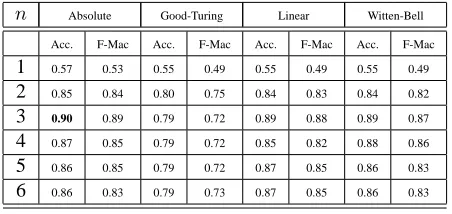
n Absolute Good-Turing Linear Witten-Bell
Acc. F-Mac Acc. F-Mac Acc. F-Mac Acc. F-Mac
1 0.57 0.53 0.55 0.49 0.55 0.49 0.55 0.49
2 0.85 0.84 0.80 0.75 0.84 0.83 0.84 0.82
3 0.90 0.89 0.79 0.72 0.89 0.88 0.89 0.87
4 0.87 0.85 0.79 0.72 0.85 0.82 0.88 0.86
5 0.86 0.85 0.79 0.72 0.87 0.85 0.86 0.83
[image:4.612.73.299.73.180.2]6 0.86 0.83 0.79 0.73 0.87 0.85 0.86 0.83
Table 1: Results on Greek authorship attribution
even when they are based on the same character set.1 In
our experiments, we considered one chapter of Bible that had been translated into 6 different languages: English, French, German, Italian, Latin and Spanish. In each case, we reserved twenty sentences from each language for testing and used the remainder for training. For this task, with only bi-gram character-level models and any smoothing technique, we achieved 100% accuracy.
4.2 Authorship Attribution
The second text categorization problem we examined was author attribution. A famous example is the case of the
Federalist Papers, of which twelve instances are claimed
to have been written both by Alexander Hamilton and James Madison (Holmes and Forsyth, 1995). Authorship attribution is more challenging than language identifica-tion because the difference among the authors is much more subtle than that among different languages. We sidered a data set used by (Stamatatos et al., 2000) con-sisting of 20 texts written by 10 different modern Greek authors (totaling 200 documents). In each case, 10 texts from each author were used for training and the remain-ing 10 for testremain-ing.
The results using different orders of n-gram models and different smoothing techniques are shown in Table 1. With 3-grams and absolute smoothing, we observe 90% accuracy. This result compares favorably to the 72% accuracy reported in (Stamatatos et al., 2000) which is based on linear least square fit (LLSF).
4.3 Text Genre Classification
The third problem we examined was text genre classifi-cation, which is an important application in information retrieval (Kesseler et al., 1997; Lee et al., 2002). We con-sidered a Greek data set used by (Stamatatos et al., 2000) consisting of 20 texts of 10 different styles extracted from various sources (200 documents total). For each style, we used 10 texts as training data and the remaining 10 as test-ing.
1
Language identification from speech is much harder.
n Absolute Good-Turing Linear Witten-Bell
Acc. F-Mac Acc. F-Mac Acc. F-Mac Acc. F-Mac
1 0.31 0.55 0.30 0.54 0.30 0.54 0.30 0.54
2 0.86 0.86 0.60 0.52 0.82 0.81 0.86 0.86
3 0.77 0.75 0.65 0.59 0.79 0.77 0.85 0.85
4 0.69 0.65 0.58 0.50 0.74 0.69 0.76 0.74
5 0.66 0.61 0.56 0.49 0.69 0.66 0.73 0.70
6 0.62 0.57 0.49 0.53 0.67 0.63 0.71 0.68
7 0.63 0.58 0.49 0.53 0.66 0.62 0.70 0.68
Table 2: Results on Greek text genre classification
The results of learning ann-gram based text classifier are shown in Table 2. The 86% accuracy obtained with bi-gram models compares favorably to the 82% reported in (Stamatatos et al., 2000), which again is based on a much deeper NLP analysis.
4.4 Topic Detection
The fourth problem we examined was topic detection in text, which is a heavily researched text categorization problem (Dumais et al., 1998; Lewis, 1992; McCallum, 1998; Yang, 1999; Sebastiani, 2002). Here we demon-strate the language independence of the language mod-eling approach by considering experiments on English, Chinese and Japanese data sets.
4.4.1 English Data
The English 20 Newsgroup data has been widely used in topic detection research (McCallum, 1998; Rennie, 2001).2 This collection consists of 19,974 non-empty documents distributed evenly across 20 newsgroups. We use the newsgroups to form our categories, and randomly select 80% of the documents to be used for training and set aside the remaining 20% for testing.
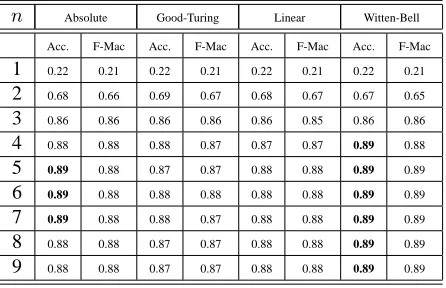
In this case, as before, we merely considered text to be a sequence of characters, and learned character-level n-gram models. The resulting classification accuracies are reported in in Table 3. With 3-gram (or higher order) models, we consistently obtain accurate performance, peaking at 89% accuracy in the case of 6-gram models with Witten-Bell smoothing. (We note that word-level models were able to achieve 88% accuracy in this case.) These results compare favorably to the state of the art re-sult of 87.5% accuracy reported in (Rennie, 2001), which was based on a combination of an SVM with error correct output coding (ECOC).
4.4.2 Chinese Data
Chinese topic detection is often thought to be more challenging than English, because words are not white-space delimited in Chinese text. This fact seems to
2
n Absolute Good-Turing Linear Witten-Bell
Acc. F-Mac Acc. F-Mac Acc. F-Mac Acc. F-Mac
1 0.22 0.21 0.22 0.21 0.22 0.21 0.22 0.21
2 0.68 0.66 0.69 0.67 0.68 0.67 0.67 0.65
3 0.86 0.86 0.86 0.86 0.86 0.85 0.86 0.86
4 0.88 0.88 0.88 0.87 0.87 0.87 0.89 0.88
5 0.89 0.88 0.87 0.87 0.88 0.88 0.89 0.89
6 0.89 0.88 0.88 0.88 0.88 0.88 0.89 0.89
7 0.89 0.88 0.88 0.87 0.88 0.88 0.89 0.89
8 0.88 0.88 0.87 0.87 0.88 0.88 0.89 0.89
9 0.88 0.88 0.87 0.87 0.88 0.88 0.89 0.89
Table 3: Topic detection results on English 20 Newsgroup data
n Absolute Good-Turing Linear Witten-Bell
Acc. F-Mac Acc. F-Mac Acc. F-Mac Acc. F-Mac
1 0.77 0.77 0.76 0.77 0.76 0.76 0.77 0.77
2 0.80 0.80 0.80 0.80 0.79 0.79 0.80 0.80
3 0.80 0.80 0.81 0.81 0.80 0.80 0.80 0.80
4 0.80 0.80 0.81 0.81 0.81 0.80 0.80 0.80
Table 4: Chinese topic detection results
require word segmentation to be performed as a pre-processing step before further classification (He et al., 2000). However, we avoid the need for explicit segmen-tation by simply using a character leveln-gram classifier. For Chinese topic detection we considered a data set investigated in (He et al., 2000). The corpus in this case is a subset of the TREC-5 data set created for research on Chinese text retrieval. To make the data set suitable for text categorization, documents were first clustered into 101 groups that shared the same headline (as indicated by an SGML tag) and the six most frequent groups were selected to make a Chinese text categorization data set. In each group, 500 documents were randomly selected for training and 100 documents were reserved for testing. We observe over 80% accuracy for this task, using bi-gram (2 Chinese characters) or higher order models. This is the same level of performance reported in (He et al., 2000) for an SVM approach using word segmentation and feature selection.
4.4.3 Japanese Data
Japanese poses the same word segmentation issues as Chinese. Word segmentation is also thought to be neces-sary for Japanese text categorization (Aizawa, 2001), but we avoid the need again by considering character level language models.
We consider the Japanese topic detection data inves-tigated by (Aizawa, 2001). This data set was
con-n Absolute Good-Turing Linear Witten-Bell
Acc. F-Mac Acc. F-Mac Acc. F-Mac Acc. F-Mac
1 0.33 0.29 0.34 0.29 0.34 0.29 0.34 0.29
2 0.66 0.62 0.66 0.61 0.66 0.63 0.66 0.62
3 0.75 0.72 0.75 0.72 0.76 0.73 0.75 0.72
4 0.81 0.77 0.81 0.76 0.82 0.76 0.81 0.77
5 0.83 0.77 0.83 0.76 0.83 0.76 0.83 0.77
6 0.84 0.76 0.83 0.75 0.83 0.75 0.84 0.77
7 0.84 0.75 0.83 0.74 0.83 0.74 0.84 0.76
[image:5.612.75.298.72.216.2]8 0.83 0.74 0.83 0.73 0.83 0.73 0.84 0.76
Table 5: Japanese topic detection results
verted from the NTCIR-J1 data set originally created for Japanese text retrieval research. The data has 24 cate-gories. The testing set contains 10,000 documents dis-tributed unevenly between categories (with a minimum of 56 and maximum of 2696 documents per category). This imbalanced distribution causes some difficulty since we assumed a uniform prior over categories. Although this is easily remedied, we did not fix the problem here. Never-theless, we obtain experimental results in Table 5 that still show an 84% accuracy rate on this problem (for 6-gram or higher order models). This is the same level of per-formance as that reported in (Aizawa, 2001), which uses an SVM approach with word segmentation, morphology analysis and feature selection.
5
Analysis
The perplexity of a test document under a language model depends on several factors. The two most influential fac-tors are the order,n, of then-gram model and the smooth-ing technique used. Different choices will result in differ-ent perplexities, which could influence the final decision in using Eq. (10). We now experimentally assess the in-fluence of each of these factors below.
5.1 Effects ofn-Gram Order
accu-1 2 3 4 5 6 7 8 0.2
0.3 0.4 0.5 0.6 0.7 0.8 0.9
order n or n−gram model
Overall accuracy
[image:6.612.90.283.73.227.2]Greek authorship attribution Greek genre classification English Topic Detection Chinese Topic Detection Japanese Topic Detection
Figure 1: Influence of the order non the classification performance
1 2 3 4 5 6 7 8 9
3 4 5 6 7 8 9 10 11
order n or n−gram model
Entropy
[image:6.612.328.524.140.301.2]Greek authorship attribution Greek genre classification English Topic Detection Chinese Topic Detection Japanese Topic Detection
Figure 2: The entropy of differentn-gram models
racy begins to decrease and entropy begins to increase as the sparse data problems begin to set in. Interest-ingly, the effect is more pronounced in some experiments (Greek genre classification) but less so in other experi-ments (topic detection under any language). The sensi-tivity in the Greek genre case could still be attributed to the sparse data problem (the over-fitting problem in genre classification could be more serious than the other prob-lems, as seen from the entropy curves).
5.2 Effects of Smoothing Technique
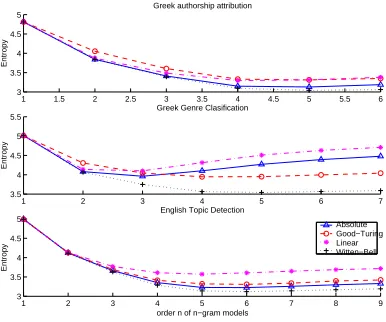
Another key factor affecting the performance of a lan-guage model is the smoothing technique used. Figures 3 and 4 show the effects of smoothing techniques on clas-sification accuracy and testing entropy (Chinese topic de-tection and Japanese topic dede-tection are not shown in the figure to save space).
Here we find that, in most cases, the smoothing tech-nique does not have a significant effect on text catego-rization accuracy, because of the small vocabulary size of
1 1.5 2 2.5 3 3.5 4 4.5 5 5.5 6 0.4
0.6 0.8 1
Greek authorship attribution
Overall Accuracy
1 2 3 4 5 6 7
0.2 0.4 0.6 0.8 1
Greek Genre Clasification
Overall Accuracy
1 2 3 4 5 6 7 8 9
0.2 0.4 0.6 0.8 1
English Topic Detection
Overall Accuracy
order n of n−gram models
[image:6.612.88.284.276.434.2]Absolute Good−Turing Linear Witten−Bell
Figure 3: Influence of smoothing on accuracy
1 1.5 2 2.5 3 3.5 4 4.5 5 5.5 6 3
3.5 4 4.5 5
Greek authorship attribution
Entropy
1 2 3 4 5 6 7
3.5 4 4.5 5 5.5
Greek Genre Clasification
Entropy
1 2 3 4 5 6 7 8 9
3 3.5 4 4.5 5
English Topic Detection
Entropy
order n of n−gram models
Absolute Good−Turing Linear Witten−Bell
[image:6.612.330.523.469.630.2]character leveln-gram models. However, there are two exceptions—Greek authorship attribution and Greek text genre classification—where Good-Turing smoothing is not as effective as other techniques, even though it gives better test entropy than some others. Since our goal is to make a final decision based on the ranking of perplexi-ties, not just their absolute values, a superior smoothing method in the sense of perplexity reduction (i.e. from the perspective of classical language modeling) does not necessarily lead to a better decision from the perspec-tive of categorization accuracy. In fact, in all our exper-iments we have found that it is Witten-Bell smoothing, not Good-Turing smoothing, that gives the best results in terms of classification accuracy. Our observation is con-sistent with previous research which reports that Witten-Bell smoothing achieves benchmark performance in char-acter level text compression (Bell et al., 1990). For the most part, however, one can use any standard smooth-ing technique in these problems and obtain comparable performance, since the rankings they produce are almost always the same.
5.3 Relation to Previous Research
In principle, any language model can be used to perform text categorization based on Eq. (10). However,n-gram models are extremely simple and have been found to be effective in many applications. For example, character level n-gram language models can be easily applied to any language, and even non-language sequences such as DNA and music. Character level n-gram models are widely used in text compression—e.g., the PPM model (Bell et al., 1990)—and have recently been found to be effective in text classification problems as well (Teahan and Harper, 2001). The PPM model is a weighted lin-ear interpolation n-gram models and has been set as a benchmark in text compression for decades. Building an adaptive PPM model is expensive however (Bell et al., 1990), and our back-off models are relatively much sim-pler. Using compression techniques for text categoriza-tion has also been investigated in (Benedetto et al., 2002), where the authors seek a model that yields the minimum compression rate increase when a new test document is introduced. However, this method is found not to be gen-erally effective nor efficient (Goodman, 2002). In our ap-proach, we evaluate the perplexity (or entropy) directly on test documents, and find the outcome to be both effec-tive and efficient.
Many previous researchers have realized the impor-tance ofn-gram models in designing language indepen-dent text categorization systems (Cavnar and Trenkle, 1994; Damashek, 1995). However, they have used n-grams as features for a traditional feature selection pro-cess, and then deployed classifiers based on calculating feature-vector similarities. Feature selection in such a
classical approach is critical, and many required proce-dures, such as stop word removal, are actually language dependent. In our approach, alln-grams are considered as features and their importance is implicitly weighted by their contribution to perplexity. Thus we avoid an error prone preliminary feature selection step.
6
Conclusion
We have presented an extremely simple approach for lan-guage and task independent text categorization based on character leveln-gram language modeling. The approach is evaluated on four different languages and four differ-ent text categorization problems. Surprisingly, we ob-serve state of the art or better performance in each case. We have also experimentally analyzed the influence of two factors that can affect the accuracy of this approach, and found that for the most part the results are robust to perturbations of the basic method. The wide appli-cability and simplicity of this approach makes it imme-diately applicable to any sequential data (such as natu-ral language, music, DNA) and yields effective baseline performance. We are currently investigating more chal-lenging problems like multiple category classification us-ing the Reuters-21578 data set (Lewis, 1992) and subjec-tive sentiment classification (Turney, 2002). To us, these results suggest that basic statistical language modeling ideas might be more relevant to other areas of natural lan-guage processing than commonly perceived.
7
Acknowledgments
Research supported by Bell University Labs and MI-TACS.
References
A. Aizawa. 2001. Linguistic Techniques to Improve the Performance of Automatic Text Categorization. In
Proceedings of the Sixth Natural Language Processing Pacific Rim Symposium (NLPRS2001).
T. Bell, J. Cleary, and I. Witten. 1990. Text Compression. Prentice Hall.
D. Benedetto, E. Caglioti, and V. Loreto. 2002. Lan-guage Trees and Zipping. Physical Review Letters, 88.
W. Cavnar, J. Trenkle. 1994. N-Gram-Based Text Categorization. Proceedings of 3rd Annual Sympo-sium on Document Analysis and Information Retrieval (SDAIR-94).
M. Damashek. 1995. Gauging Similarity with N-Grams: Language-Independent Categorization of Text?.
Sci-ence, Vol. 267, 10 February, 843 - 848
S. Dumais, J. Platt, D. Heckerman and M. Sahami. 1998. Inductive Learning Algorithms And Representations For Text Categorization. In Proceedings of ACM
Con-ference on Information and Knowledge Management (CIKM98), Nov. 1998, pp. 148-155.
J. Goodman. 2002. Comment on Language Trees and Zipping. Unpublished Manuscript.
J. He, A. Tan, and C. Tan. 2000. A Comparative Study on Chinese Text Categorization Methods. In Proceedings
of PRICAI’2000 International Workshop on Text and Web Mining, p24-35.
D. Holmes, and R. Forsyth. 1995. The Federalist Revis-ited: New Directions in Authorship Attribution.
Liter-ary and Linguistic Computing, 10, 111-127.
B. Kessler, G. Nunberg and H. Sch¨uze. 1997. Automatic Detection of Text Genre. Proceedings of the
Thirty-Fifth Annual Meeting of the Association for Computa-tional Linguistics (ACL1997).
Y. Lee and S. Myaeng. 2002. Text Genre Classifica-tion with Genre-Revealing and Subject-Revealing Fea-tures. Proceedings of ACM SIGIR Conference on
Re-search and Development in Information Retrieval (SI-GIR2002).
D. Lewis. 1992. Representation and Learning in Infor-mation Retrieval Phd thesis, Computer Science Dept-ment, Univ. of Massachusetts.
A. McCallum and K. Nigam. 1998. A Comparison of Event Models for Naive Bayes Text Classification.
Proceedings of AAAI-98 Workshop on ”Learning for Text Categorization”, AAAI Presss.
J. Rennie. 2001. Improving Multi-class Text Classifi-cation with Naive Bayes. Master’s Thesis. M.I.T. AI Technical Report AITR-2001-004. 2001.
S. Scott and S. Matwin. 1999. Feature Engineering for Text Classification. In Proceedings of the Sixteenth
In-ternational Conference on Machine Learning (ICML’ 99), pp. 379-388.
F. Sebastiani. 2002. Machine learning in automated text categorization. ACM Computing Surveys, 34(1):1-47.
E. Stamatatos, N. Fakotakis and G. Kokkinakis. 2000. Automatic Text Categorization in Terms of Genre and Author. Computational Linguistics, 26 (4), 471-495.
W. Teahan and D. Harper. 2001. Using Compression-Based Language Models for Text Categorization. Pro-ceedings of 2001 Workshop on Language Modeling and Information Retrieval.
P. Turney. 2002. Thumbs Up or Thumbs Down? Seman-tic Oritentation Applied to Unsupervised Classification of Reviews. Proceedings of 40th Annual Conference of
Association for Computational Linguistics (ACL 2002)