Combining multiple information types in Bayesian word segmentation
Gabriel Doyle and Roger Levy Department of Linguistics University of California, San Diego
La Jolla, CA 92093, USA {gdoyle,rlevy}@ucsd.edu
Abstract
Humans identify word boundaries in continu-ous speech by combining multiple cues; exist-ing state-of-the-art models, though, look at a single cue. We extend the generative model of Goldwater et al (2006) to segment using sylla-ble stress as well as phonemic form. Our new model treats identification of word boundaries and prevalent stress patterns in the language as a joint inference task. We show that this model improves segmentation accuracy over purely segmental input representations, and recov-ers the dominant stress pattern of the data. Additionally, our model retains high perfor-mance even without single-word utterances. We also demonstrate a discrepancy in the per-formance of our model and human infants on an artificial-language task in which stress cues and transition-probability information are pit-ted against one another. We argue that this dis-crepancy indicates a bound on rationality in the mechanisms of human segmentation.
1 Introduction
For an adult speaker of a language, word segmen-tation from fluid speech may seem so easy that it barely needed to be learned. However, pauses in speech and word boundaries are not well cor-related (Cole & Jakimik, 1980), word boundaries are marked by a conspiracy of partially-informative cues (Johnson & Jusczyk, 2001), and different lan-guages mark their boundaries differently (Cutler & Carter, 1987). This makes the problem of unsuper-vised word segmentation acquisition, whether by a computational model or an infant, a daunting task.
Effective segmentation relies on the flexible in-tegration of multiple types of segmentation cues, among them statistical regularities in phonemes and prosody, coarticulation, and allophonic variation. In-fants begin using multiple segmentation cues within their first year of life (Johnson & Jusczyk, 2001). Despite this, many state-of-the-art models look at only one type of information: phonemes.
In this study, we expand an existing model to incorporate multiple cues, leading to an improve-ment in segimprove-mentation performance and opening new ways of investigating human segmentation acquisi-tion. On the latter point, we show that rational learn-ers can learn to segment without encountering words in isolation, and that human learners deviate from ra-tionality in certain segmentation tasks.
2 Previous work
The prevailing unsupervised word segmentation sys-tems (e.g., Brent, 1999; Goldwater, Griffiths, & Johnson, 2006; Blanchard & Heinz, 2008) use only phonemic information to segment speech. However, human segmenters use additional information types, notably stress information, in their segmentation. We present an overview of these phonemic mod-els here before discussing the prosodic model ex-pansion. A more complete review is available in Goldwater (2007).
2.1 Goldwater et al (2006)
The Goldwater et al model is related to Brent (1999)’s model, both of which use strictly phone-mic information to segment. The model assumes that the corpus is generated by a Dirichlet process over
word bigrams.1 We present a basic overview here, based on Sect. 5.5 of Goldwater, 2007. To generate the wordwi given the preceding wordwi−1:
1. Decide if bigrambi=hwi−1, wiiis novel
2. Ifbinon-novel, drawbifrom bigram lexicon
3. Ifbinovel, decide whetherwiis novel
a. Ifwinon-novel, drawwi from word lexicon
b. Ifwi novel, drawwi from word-generating
distributionP0.
The Dirichlet process first decides whether to draw a non-novel (“nn”) bigram, with probability proportional to the number of times the previous word has appeared in the corpus:
p(hwi−1, wiinn|wi−1) =
nhwi−1,·i
nhwi−1,·i+α1
, (1)
where nhx,yi is the token count for bigram hx, yi. If the bigram is non-novel, word wi is drawn in
proportion to the number of times it has appeared afterwi−1in the corpus:
p(wi =x|hwi−1, wiinn) =
nhwi−1,xi
nhwi−1,·i
(2)
If the bigram is novel, this could either be due to
wibeing a novel word or due towibeing an existing
word that had not appeared with wi−1 before. The
probability ofwi being a non-novel wordxis
p(wi=x, winn|
hwi−1, wii
novel ) =
bh·,wii
(bh·,·i+α0)
,
(3) where bh.,.i is the count of word bigram types. Finally, if wi is a new word, its phonemic form is
generated from a distribution P0. In the Goldwater
et al model, this distribution is simply the product of the unigram probabilities of the phonemes, P(σj),
times the probability of a word boundary,p#, to end
the word:
p(wi=σ1· · ·σM|
wi
novel ) =p#(1−p#)
M−1QP(σ
j)
(4)
1
We will only discuss the bigram model here because it is more appropriate from both a cognitive perspective (it posits la-tent hierarchical structure) and engineering perspective (it seg-ments more accurately) than the unigram model.
To segment an observed corpus, the model Gibbs samples over the possible word boundaries (utter-ance boundaries are assumed to be word bound-aries).2The exchangability of draws from a Dirichlet process allows for Gibbs sampling of each possible boundary given all the others.
2.2 A cognitively-plausible variant
Phillips and Pearl (2012) make these Bayesian seg-mentation models more cognitively plausible in two ways. The first is to move from phonemes to syl-lables as the base representational unit from which words are constructed, as infants learn to categorize syllables before phonemes (Eimas, 1999). The sec-ond is to add memory and processing constraints on the learner. They find that syllable-based segmen-tation is better than phoneme-based segmensegmen-tation in the bigram model (though worse in the unigram model), and that, counter-intuitively, the constrained learner outperforms the unconstrained learner. This improvement appears to be driven by better perfor-mance in segmenting more common words. In this work, we adopt the syllabified representation but re-tain the unconstrained rational learner assumption.
2.3 Other multiple-cue models
Some previous models have incorporated multiple cues, specifically the phonemic and stress infor-mation that our model will use. Two prominent examples are Christiansen, Allen, and Seidenberg (1998)’s connectionist model and Gambell and Yang (2006)’s algebraic model. The connectionist model places word boundaries where the combination of phonemic and stress information predict likely ut-terance boundaries, but does not include an explicit sense of “word”, and performs only modestly on the segmentation task (boundary F-scores of .40-.45). The algebraic model also underperforms the Bayesian model (Phillips & Pearl, 2012) unless it includes the heuristic that there is a word bound-ary between any two stressed syllables. Our model presents a more general and completely unsuper-vised approach to segmentation with multiple cue-types.
2The model assumes that utterance boundaries are generated
In general, joint inference is becoming more com-mon in language acquisition problems and has been shown to improve performance over single-feature inference. Examples include joint inference of a lexicon and phonetic categories (Feldman, Grif-fiths, & Morgan, 2009), joint inference of syntactic word order and word reference (Maurits, Perfors, & Navarro, 2009), and joint inference of word mean-ings and speaker intentions in child-directed speech (Frank, Goodman, & Tenenbaum, 2009).
3 Model design
Our model changes P0 from a single-cue
distribu-tion, generating only phonemes, to a multiple-cue distribution that generates a stress form as well. This can improve segmentation performance and allows the investigation of rational segmentation behavior in a multiple-cue world.
In the original model, P0(wi = σ1· · ·σM) ∝ Q
jP(σj), where P(σj) is the frequency of the
phoneme σj. In the multiple-cue model, we first
generate a phonemic form wi, then assign a stress
patternsito it.
P0(wi, si) =PW(wi)PS(si|M)
=p#(1−p#)M−1
M Y
j
P(σj)PS(si|M) (5)
The phonemic formwi has the same
product-of-segments probability as the Goldwater et al model, butσj are now syllables instead of phonemes. We
discuss the rationale behind this change in the next section.
The phonemic form is generated first, and the stress form is then drawn as a multinomial over all possible stress patterns with the same number of syl-lables aswi. The stress distributionPS is a
multino-mial distribution over word-length stress templates.
PS can be learned by the model based on a
Dirich-let prior, but for simplicity in the present implemen-tation, we estimate PS as the plus-one-smoothed
frequency of the stress patterns in the current seg-mentation. There are two stress levels (stressed or unstressed), and2M possible stress templates for a word of lengthM.3
3We do not assume that each word has one and only one
Unlike phonemic forms, stress patterns are drawn as a whole word. This allows the model to capture a wide range of stress biases, although it prevents the model from generalizing biases across different word lengths. A potential future change toPS that
would allow for better generalization is discussed in Section 6.
3.1 On syllabification and stress
We change from segmenting on phonemes to seg-menting on syllables in order to more easily imple-ment stress information, which is a supersegimple-mental feature most appropriately located on syllables. Syl-labified data has been used in some previous mod-els of segmentation, especially those using stress information or syllable-level transition probabilities (Christiansen et al., 1998; Swingley, 2005; Gambell & Yang, 2006; Phillips & Pearl, 2012).
For studying human word segmentation, Phillips and Pearl argue syllabified speech may be a more cognitively plausible testing ground. 3-month-old infants appear to have categorical representa-tions of syllables (Eimas, 1999), three months be-fore word segmentation appears (Borfeld, Morgan, Golinkoff, & Rathbun, 2005), and seven months before phoneme categorization (Werker & Tees, 1984). In addition, syllabification is assumed in much work on human word segmentation, especially in artificial-language studies (e.g., Thiessen & Saf-fran, 2003), which calculate statistical cues at the syllable level.
The assumption that syllable boundaries are known affects the baseline performance of the model, as it reduces the number of possible word boundary locations (since a word boundary is nec-essarily a syllable boundary). As such performance over syllabified data cannot be directly compared to performance on non-syllabified data.
It may seem that syllabification is so closely tied to word segmentation that including the former in a model of the latter leaves little to the model. How-ever, the determinants of syllable boundaries are not the same as those for word boundaries. The
lem of assigning syllable boundaries is a question of deciding where a boundary goes between two syl-lable nuclei, with the assumption that there must be a boundary there. The problem of assigning word boundaries is a question of deciding whether there is a boundary between two syllable nuclei, and if so, where it is. Knowing the syllable boundaries reduces the set of possible word boundaries, but does not di-rectly address the question of how likely a boundary is. The difference in these tasks is supported by the three-month gap between syllable and word identifi-cation in infants.
4 Data
We use the Korman (1984) training corpus, as com-piled by Christiansen et al. (1998), in this study. This is a 24493-word corpus of English spoken by adults to infants aged 6–16 weeks.4 Phonemes, stresses, and syllable boundaries are the same as those used by Christiansen et al, which were based on citation forms in the MRC Psycholinguistic Database. All monosyllabic words were coded as stressed. Only utterances for which all words had citation forms were included.
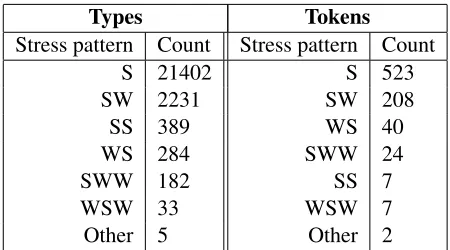
This corpus is largely monosyllabic (87.3% of all word tokens), and heavily biased toward initial stress (89.2% of all multisyllable word tokens). No word is longer than three syllables, and most words have only one stressed syllable. A breakdown of the cor-pus by stress pattern is given in Table 1. This mono-syllabic bias is an inherent property of English, not idiosyncratic to this corpus. The Bernstein-Ratner child-directed corpus is also over 80% monosyl-labic. We expect that the results of segmentation on child-directed data will extend to adult speech, as the adult-directed corpus used by Gambell and Yang (2006) has an average word length of 1.17 syllables.
5 Experiments
We test the model on three problems. First, we show that the addition of stress information improves seg-mentation performance compared to a stress-less model. Next, we apply the model to a question in human segmentation acquisition. Finally, we look at
4Approximately 150 word tokens from the original corpus
were omitted in our version of the corpus due to a disparity between recorded number of syllables and number of stresses.
Types Tokens
Stress pattern Count Stress pattern Count
S 21402 S 523
SW 2231 SW 208
SS 389 WS 40
WS 284 SWW 24
SWW 182 SS 7
WSW 33 WSW 7
[image:4.612.314.539.53.178.2]Other 5 Other 2
Table 1: Corpus stress patterns by types and tokens, showing an initial-stress bias in all lengths.
a task where the rational model deviates from human performance.
5.1 Parameter setting
The model has four free parameters: α0 and α1,
which affect the likelihood of new words and bi-grams, respectively, andp#andp$, which affect the
expected likelihood of word and utterance bound-aries. Following Goldwater, Griffiths, and Johnson (2009), we setα0 = 20, α1 = 100,p# = 0.8and p$ = 0.5in all experiments.5
In all cases, the model performed five indepen-dent runs of 20000 iterations of Gibbs sampling the boundaries for the full corpus. Simulated annealing was performed during the burn-in period to improve convergence. All performance measures are reported as the mean of these five runs.
Performance is measured as word, boundary, and lexicon precision, recall, and F-scores. A word is matched iff both of its true boundaries are marked as boundaries and no internal boundaries are marked as word boundaries. Boundary counts omit utterance boundaries, which are assumed to be word bound-aries. Lexical counts are based on word type counts.
5.2 Stress improves performance
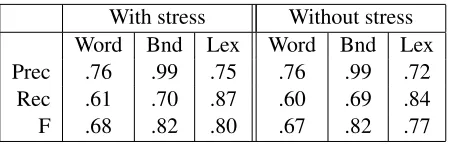
We begin by showing that including a second cue type improves segmentation performance. We compare segmentation on a corpus with the at-tested stress patterns to that of a corpus with-out stress. With stress information included in the model, word/boundary/lexicon F-scores are
5
With stress Without stress Word Bnd Lex Word Bnd Lex Prec .76 .99 .75 .76 .99 .72 Rec .61 .70 .87 .60 .69 .84 F .68 .82 .80 .67 .82 .77
Table 2: Precision, recall, and F-score over corpora with and without stress information available. Stress informa-tion especially improves lexical performance.
.68/.82/.80. Without stress, performance drops to .67/.82/.77.6Full results are given in Table 2.
Stress information primarily improves lexicon performance, along with a small improvement in token segmentation. Accounting for stress reduces both false positives and negatives in the lexicon; the fact that the lexical improvement is greater than that for words or boundaries suggests that much of the improvement rests is on rare words.
These effects are small but significant. For word token performance, we performed a paired t-test on utterance token F-scores between the with- and without-stress models. This difference was signif-icant (t = 11.28, df = 8125, p < .001). We performed a similar utterance-by-utterance test on boundaries; again a small singificant improvement was found (t = 8.92, df = 6084, p < .001). To assess lexicon performance, we calculated for each word type in the gold-standard lexicon the propor-tion of the five trials in which that word appeared in the learned lexicon for the two models. We then examined the words where the proportions differed between the models. 89 true words appeared more often in the with-stress lexicons; 40 appeared more often in the without-stress lexicons. (683 appeared equally often in both.) By a sign test, this is signif-icant at p < .001. We also tested lexicon perfor-mance with a binomial test on the two models’ lexi-con accuracy; this result was marginal (p=.06).
The explicit tracking of stress information also improves the model’s acquisition of the stress bias of the language. Acquisition of the stress bias is poten-tially useful for generalization; stress patterns can be used for an initial segmentation if few or none of the words are familiar. In practice, we see children use
6
Recall that due to the syllabified data, these results are not directly comparable to unsyllabified results in previous work.
their stress biases to segment new words from En-glish speech (Jusczyk, Houston, & Newsome, 1999) as well as artificial languages (Thiessen & Saffran, 2003).
We assess the learned stress bias by dividing up the corpus as the model has segmented it, and count the number of tokens with SW versus WS stress pat-terns.7With stress representation, the learned stress bias is 6.77:1, and without stress representation, the stress bias is lower, at 6.33:1. Although these are both underestimates of the corpus’s true stress bias (7.86:1), the stressed model is stronger and a better estimate of the true value.
The model’s performance can be compared to various baselines, but perhaps the strongest is one with every syllable boundary being a word bound-ary. This baseline represents a shift from boundary
precisionbeing at ceiling (as in the model) to bound-ary recallbeing at ceiling. In fact, due to the pre-ponderance of monosyllabic words in English child-directed speech, this baseline outperforms the model on word and boundary F-scores (.68 and .82 in the model, .82 and .91 in the baseline). However, the baseline’s lexicon is much worse than the model’s (F=.80 in the with-stress model, F=.64 in the base-line), and the baseline fails to learn anything about the language’s stress biases. In addition, the base-line oversegments, whereas both the model and in-fant segmenters undersegment (Peters, 1983). This raises an important question about what the model should seek to optimize: though the baseline is more accurate by token, no structure is learned; type per-formance is more important if we want to learn the underlying structure.
5.3 Are isolated words necessary?
We next use this model to test the necessity of iso-lated words in rational word segmentation. It is not immediately obvious how human learners begin to segment words from fluid speech. Stress biases and other phonological cues are dominant in all but the earliest of infant word segmentation (Johnson & Jusczyk, 2001). This raises a chicken-and-egg prob-lem; if the cues infants favor to segment words, such as stress biases, are dependent on the words of the
7
language, how do they learn enough words to deter-mine the cues’ biases?
One existing proposal is that human learners de-velop their stress biases based on words frequently heard in isolation (Jusczyk et al., 1999). In En-glish, these include names and common diminutives (e.g.,mommy,kitty) that generally have initial stress. These single-word utterances could offer the seg-menter an initial guess of the stress bias, by suppos-ing that short utterances are ssuppos-ingle words and record-ing their stress patterns. The most common stress patterns in short utterances could then be used as an initial guess at the stress bias to bootstrap other words and thereby improve the learned stress bias.
We test the rational learner’s need for such ex-plicit bootstrapping by learning to segment a corpus with all single-word utterances removed. The corpus is produced by excising all single-word utterances from the Korman corpus. This results in a 22081-word corpus, 10% fewer tokens than in the original. However, it does not substantially change the lexi-con; the number of distinct word types only drops from 811 to 806.
We compare performance only on ambiguous boundaries and lexicon, as these are comparable between the corpora, and find that the model per-forms almost equally well. Without single-word ut-terances, boundary and lexical F-scores are .81 and .80, compared to .82 and .80 with single-word utter-ances. This shows that rational learners are able to segment even without the possibility of bootstrap-ping stress patterns from single-word utterances.
5.4 Bounded rationality in human segmentation
Lastly, we use this model to examine rational per-formance in a multiple-cue segmentation task. We show that humans’ segmentation does not adhere to these predictions, suggesting a bound on human ra-tionality in word segmentation.
We consider an artificial language study by Thiessen and Saffran (2003). In this study, infants are exposed to an artificial language consisting of four bisyllabic word types uttered repeatedly with-out pauses. Each syllable appears in only one word type, so within-word transition probabilities are al-ways 1, while across-word transition probabilities are less than 0.5. Segmentation strategies that
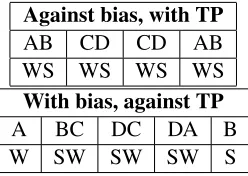
hy-Against bias, with TP
AB CD CD AB
WS WS WS WS
With bias, against TP
A BC DC DA B
[image:6.612.365.489.54.142.2]W SW SW SW S
Table 3: Examples of segmenting an artificial language according to transition probabilities (top) or stress bias (bottom), when the true words have weak-strong stress. Vertical lines represent word boundaries. The top mentation produces a smaller lexicon, but the bottom seg-mentation produces primarily words with the preferred stress pattern.
pothesize word boundaries at low transition proba-bilities or that seek to minimize the lexicon size will segment out the four word types as expected.
Segmentation in the experiment is complicated by the presence of stress in the artificial language. De-pending on the condition, the words are either all strong-weak or all weak-strong. In the first condi-tion, segmenting according to transition probabili-ties, lexicon size, or English stress bias favors the same segmentation. In the second condition, though, segmenting by the English stress bias to yield a lex-icon of strong-weak words requires boundaries in the middle of the words. The segmenter must decide whether transition probabilities or preferred stress patterns are more important in segmentation. This situation is illustrated in Table 3, with a corpus con-sisting of two word types,AB andCD, each with weak-strong stress.
Thiessen and Saffran found that seven-month-old English-learning infants consistently segmented according to the transition probabilities, regardless of stress. However, nine-month-olds segmented ac-cording to the English stress bias, even if this meant going against the transition probabilities.
lexi-con, all of whose words have the dispreferred stress pattern.
To judge by the Korman corpus, English has a stress bias of approximately 7:1 in favor of SW bi-syllabic stress over WS.8If human segmentation be-havior follows the rational model, the model should predict segmentation to favor strong-weak words over the transition probabilities when the stress bias is approximately this strong.
We test this rationality hypothesis with a smaller version of the Thiessen and Saffran artificial lan-guage, consisting of 48 tokens.9 In one version, all tokens have the preferred SW pattern, and in the other all tokens have the dispreferred WS pat-tern. We then adjust the PS distribution such that
PS(SW|M = 2) = b∗PS(W S|M = 2), where
bis the bias ratio. We run the model otherwise the same as in the previous experiments, except with 10 runs instead of 5.
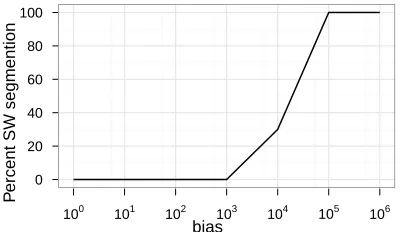
Contrary to this hypothesis, the model’s segmen-tation with b = 7 was the same whether the true words were strong-weak or weak-strong. In all ten runs, transition probabilities dictated the segmenta-tion. To switch to stress-based segmentation, the bias must be orders of magnitude greater than the English bias. Figure 1 shows the proportions of runs in the weak-strong condition that show segmentation ac-cording to the stress bias, as the bias increases by factors of 10. Whenb= 10000, three of the ten runs segmented according to the stress bias; below that, the stress bias did not affect the rational model’s seg-mentation.
Why is this? In the Bayesian model, the stress bias of a language affects only thePS(si|M)term in the P0 distribution, so non-novel words are not
penal-ized for their stress pattern. The model pays only once to create a word; once the word is generated, no matter how a priori implausible the word was, it may be cheaply drawn again as a non-novel word. This effect can be illustrated with a brief calculation. Consider a corpus built from four bisyllabic word types (AB, CD, EF, GH), each appearingNtimes. If
8
The specific bias varies from corpus to corpus, but this ap-pears to be a representative value.
9
The 48 tokens come from four word types, with two types appearing 16 times and the other two appearing 8 times, mim-icking the relative frequencies of Thiessen and Saffran’s lan-guages. Their test language had 270 tokens.
bias
P
ercent SW segmention 0
20 40 60 80 100
[image:7.612.319.519.63.179.2]100 101 102 103 104 105 106
Figure 1: Percentage of runs segmented with the stress bias, against transition probabilities, as bias varies. At English-level biases, the rational model still overrules the stress bias when segmenting.
the corpus is segmented against the transition proba-bilities, the resulting lexicon will have 16 bisyllabic word types (BA, BC, BE, BG, DA, etc.), each occur-ring approximately N4 times.
The probability of the against-bias corpus (CW S)
is proportional to the probability of generating the four word types, and then drawing them non-novelly from the lexicon.10 (To simplify the calculations, we use the unigram version of the Goldwater et al model.)
p(CW S)∝PW4 PS(W S)4(N!)4 1
4N! (6)
The first two terms are the probability of gen-erating the four word types (Eqn. 5);11 the second two terms are the Dirichlet process draws from the existing lexicon N times each (Eqn. 2). By comparison, the probability of the with-bias corpus
CSW depends on generating the 16 word types, and
drawing each non-novelly N4 times.
p(CSW)∝PW16PS(SW)16 N
4!
16 1
4N! (7)
Given an SW bias b and a uniform distribution over syllables (soPW = 641), we find:
p(CW S) p(CSW)
= 6412(b+ 1)
12
b16
(N!)4
(N4!)16 (8)
10It is also possible to generate this corpus by re-drawing the
words novelly, but this is much less likely than non-novel draws.
11Because all syllables have equal unigram probabilities, the
This equation shows that the rational model is heavily biased toward the segmentation that fits the transition probabilities. Increasing the stress bias b
or decreasing the number of observed word tokens makes the rational model more likely to segment with the stress bias (against transition probabilities), but as we see in the experimental results, the stress bias must be very strong to overcome the efficient lexicon that the transition probability segmentation provides.
Since humans do not show this same inherent bias (or quickly lose it as they acquire the stress bias), we can ask how humans deviate from ratio-nality. One possibility is that humans simply do not segment in this Bayesian manner. However, previ-ous work (Frank, Goldwater, Griffiths, & Tenen-baum, 2010) has shown that human word segmen-tation shows similar behavior to a resource-limited Bayesian model. Equation 8 suggests that human segmentation could deviate from rationality by hav-ing an effectively stronger bias than English would suggest (reducing the first fraction)12 or, as with Phillips and Pearl’s constrained learners, by having effectively less input than the model assumes (reduc-ing the second fraction).
6 Future work
Introducing stress into the Bayesian segmentation model suggests a few additional expansions. One possibility is to add other cues into the genera-tive model via P0. Any cue that is based on the
word itself can be added in this way, with little change to the general model structure. Phonotactics can be added using an n-gram distribution for P0
(Blanchard & Heinz, 2008). Coarticulation between adjacent phonemes is also used in human segmen-tation (Johnson & Jusczyk, 2001), so theP0
distri-bution could predict higher within-word coarticula-tion. Integrating additional cues used by human seg-menters extends the investigation of the bounds on rationality in human segmentation and in balancing multiple conflicting cues.
12A potential source of an inflated bias is infants’ preference
for strong-weak patterns. Jusczyk, Cutler, and Redanz (1993) found English-hearing infants listened longer to strong-weak patterns than weak-strong. This could lead to overestimation of the stress bias by making possible strong-weak segmentations more prominent in the segmenter’s mind.
A more complex view of the stress system of a language may also be useful. One possibility is to place a Dirichlet prior over the stress templates and allow PS to be learned as a latent variable in the
model. Another possibility is to treat the stress tem-plates more generally; in the present implementa-tion, knowledge of the preferred stress patterns for word of one length tells the segmenter nothing about preferred stress patterns in another length. Cross-linguistically common stress rules (e.g., those that place stress a certain number of syllables from the left or right edge of a word) can be coded intoPSto
improve generalization. Each rule dictates a specific stress pattern for each word length. When a word is generated in the Dirichlet process, the generative model would decide whether to assign stress accord-ing to one of these rules or to assign lexical stress from a default multinomial distribution. (This “de-fault” distribution would handle idiosyncratic stress assignments, as one might see with names or mor-phologically complex words, like Spanish reflexive verbs.) A sparse prior over these rules, asymmetri-cally weighted against the default category, will en-courage the model to explain as much of the ob-served stress patterns as possible with a few domi-nant rules, improving the phonological structure that the segmenter learns.
7 Conclusion
Effective word segmentation combines multiple fac-tors to make predictions about word boundaries. We extended an existing Bayesian segmentation model to account for two factors, phonemes and stress, when segmenting. This improves segmentation per-formance and opens up new possibilities for compar-ing rational segmentation and human segmentation.
Acknowledgments
This research was partially supported by an Alfred P. Sloan Fellowship to RL and by NSF award 0830535. We also appreciate the feedback of the reviewers and the members of the UCSD Computational Psy-cholinguistics Lab.
References
Blanchard, D., & Heinz, J. (2008). Improving word segmentation by simultaneously learn-ing phonotactics. In Proceedings of CoNLL
(pp. 65–72).
Borfeld, H., Morgan, J., Golinkoff, R., & Rath-bun, K. (2005). Mommy and me: familiar names help launch babies into speech-stream segmentation. Psychological Science,16(4), 298–304.
Brent, M. R. (1999). An efficient, probabilistically sound algorithm for segmentation and word discovery. Machine Learning,34, 71–105. Christiansen, M. H., Allen, J., & Seidenberg, M. S.
(1998). Learning to segment speech using multiple cues: A connectionist model. Lan-guage and Cognitive Processes,13, 221–268. Cole, R., & Jakimik, J. (1980). A model of speech
perception. In Perception and production of fluent speech (pp. 136–163). Hillsdale, NJ: Erlbaum.
Cutler, A., & Carter, D. (1987). The predominance of strong initial syllables in the English vocab-ulary.Comp. Speech Lang.,2, 133–142. Eimas, P. (1999). Segmental and syllabic
representa-tions in the perception of speech by young in-fants.Journal of the Acoustic Society of Amer-ica,105, 1901–1911.
Elsner, M., Goldwater, S., & Eisenstein, J. (2012). Bootstrapping a unified model of lexical and
phonetic acquisition. In Proceedings of the 50th annual meeting of the ACL.
Feldman, N., Griffiths, T., & Morgan, J. (2009). Learning phonetic categories by learning a lexicon. In Proceedings of the 31st annual conference on cognitive science.
Frank, M., Goldwater, S., Griffiths, T., & Tenen-baum, J. (2010). Modeling human perfor-mance in statistical word segmentation. Cog-nition.
Frank, M., Goodman, N., & Tenenbaum, J. (2009). Using speakers’ referential intentions to model early cross-situational word learning.
Psychological Science,20, 579–585.
Gambell, T., & Yang, C. (2006). Word segmen-tation: Quick but not dirty. (Unpublished manuscript)
Goldwater, S. (2007). Nonparametric Bayesian models of lexical acquisition. Unpublished doctoral dissertation, Brown Univ.
Goldwater, S., Griffiths, T., & Johnson, M. (2006). Contextual dependencies in unsupervised word segmentation. In Proceedings of Col-ing/ACL.
Goldwater, S., Griffiths, T. L., & Johnson, M. (2009). A Bayesian framework for word seg-mentation: Exploring the effects of context.
Cognition,112, 21–54.
Johnson, E., & Jusczyk, P. (2001). Word segmen-tation by 8-month-olds: When speech cues count more than statistics. J. of Memory and Language,44, 548–567.
Jusczyk, P., Cutler, A., & Redanz, N. (1993). Pref-erence for predominant stress patterns of En-glish words. Child Development, 64, 675– 687.
Jusczyk, P., Houston, D., & Newsome, M. (1999). The beginnings of word segmentation in English-learning infants. Cognitive Psychol-ogy,39, 159–207.
Korman, M. (1984). Adaptive aspects of mater-nal vocalizations in differing contexts at ten weeks. First language,5, 44–45.
Maurits, L., Perfors, A., & Navarro, D. (2009). Joint acquisition of word order and word reference. InProceedings of 31st annual conference of the Cognitive Science Society.
acqui-sition: Monographs in applied psycholinguis-tics. Cambridge Univ. Press.
Phillips, L., & Pearl, L. (2012). “less is more” in Bayesian word segmentation: When cogni-tively plausible learners outperform the ideal. InProceedings of the 34th annual conference of the cognitive science society.
Rytting, C. A., Brew, C., & Fosler-Lussier, E. (2010). Segmenting words from natural speech: subsegmental variation in segmental cues. Journal of Child Language, 37, 513– 543.
Swingley, D. (2005). Statistical clustering and the contents of the infant vocabulary. Cognitive Psychology,50, 86–132.
Thiessen, E. D., & Saffran, J. R. (2003). When cues collide: Use of stress and statistical cues to word boundaries by 7- to 9-month-old infants.
Developmental Psychology,39(4), 706–716. Werker, J., & Tees, R. (1984). Cross-language