Distributional semantic models for the evaluation of disordered language
Masoud Rouhizadeh†, Emily Prud’hommeaux◦, Brian Roark†, Jan van Santen† †Center for Spoken Language Understanding, Oregon Health & Science University
◦Center for Language Sciences, University of Rochester
{rouhizad,vansantj}@ohsu.edu, {emilypx,roarkbr}@gmail.com
Abstract
Atypical semantic and pragmatic expression is frequently reported in the language of children with autism. Although this atypicality often manifests itself in the use of unusual or un-expected words and phrases, the rate of use of such unexpected words is rarely directly measured or quantified. In this paper, we use distributional semantic models to automat-ically identify unexpected words in narrative retellings by children with autism. The classi-fication of unexpected words is sufficiently ac-curate to distinguish the retellings of children with autism from those with typical develop-ment. These techniques demonstrate the po-tential of applying automated language anal-ysis techniques to clinically elicited language data for diagnostic purposes.
1 Introduction
Autism spectrum disorder (ASD) is a neurodevelop-mental disorder characterized by impaired commu-nication and social behavior. Although the symp-toms of ASD are numerous and varied, atypical and idiosyncratic language has been one of the core symptoms observed in verbal individuals with autism since Kanner first assigned a name to the disorder (Kanner, 1943). Atypical language cur-rently serves as a diagnostic criterion in many of the most widely used diagnostic instruments for ASD (Lord et al., 2002; Rutter et al., 2003), and the phe-nomenon is especially marked in the areas of seman-tics and pragmaseman-tics (Tager-Flusberg, 2001; Volden and Lord, 1991).
Because structured language assessment tools are not always sensitive to the particular atypical seman-tic and pragmaseman-tic expression associated with ASD, measures of atypical language are often drawn from spontaneous language samples. Expert manual an-notation and analysis of spontaneous language in young people with ASD has revealed that children and young adults with autism include significantly more bizarre and irrelevant content (Loveland et al., 1990; Losh and Capps, 2003) in their narratives and more abrupt topic changes (Lam et al., 2012) in their conversations than their language-matched typ-ically developing peers. Most normed clinical in-struments for analyzing children’s spontaneous lan-guage, however, focus on syntactic measures and developmental milestones related to the acquisition of vocabulary and syntactic structures. Measures of semantic and pragmatic atypicality in spontaneous language are rarely directly measured. Instead, the degree of language atypicality is often determined via subjective parental reports (e.g., asking a par-ent whether their child has ever used odd phrases (Rutter et al., 2003)) or general impressions dur-ing clinical examination (e.g., ratdur-ing the child’s de-gree of “stereotyped or idiosyncratic use of words or phrases” on a four-point scale (Lord et al., 2002)). This has led to a lack of reliable and objective infor-mation about the frequency of atypical language use and its precise nature in ASD.
In this study, we attempt to automatically detect instances of contextually atypical language in spon-taneous speech at the lexical level in order to quan-tify its prevalence in the ASD population. We first determine manually the off-topic, surprising, or
appropriate words in a set of narrative retellings elicited in a clinical setting from children with ASD and typical development. We then apply word rank-ing methods and distributional semantic modelrank-ing to these narrative retellings in order to automatically identify these unexpected words. The results indi-cate not only that children with ASD do in fact pro-duce more semantically unexpected and inappropri-ate words in their narratives than typically develop-ing children but also that our automated methods for identifying these words are accurate enough to serve as an adequate substitute for manual annota-tion. Although unexpected off-topic word use is just one example of the atypical language observed in ASD, the work presented here highlights the poten-tial of computational language evaluation and analy-sis methods for improving our understanding of the linguistic deficits associated with ASD.
2 Data
Participants in this study included 37 children with typical development (TD) and 21 children with autism spectrum disorder (ASD). ASD was diag-nosed via clinical consensus according to the DSM-IV-TR criteria (American Psychiatric Association, 2000) and the established threshold scores on two diagnostic instruments: the Autism Diagnostic Ob-servation Schedule (ADOS) (Lord et al., 2002), a semi-structured series of activities designed to allow an examiner to observe behaviors associated with autism; and the Social Communication Question-naire (SCQ) (Rutter et al., 2003), a parental ques-tionnaire. None of the children in this study met the criteria for a language impairment, and there were no significant between-group differences in age (mean=6.4) or full-scale IQ (mean=114).
The narrative retelling task analyzed here is the
Narrative Memory subtest of the NEPSY (Korkman et al., 1998), a large and comprehensive battery of tasks that test neurocognitive functioning in chil-dren. The NEPSY Narrative Memory (NNM) sub-test is a narrative retelling sub-test in which the subject listens to a brief narrative, excerpts of which are shown in Figure 1, and then must retell the narra-tive to the examiner. The NNM was administered to each participant in the study, and each partici-pant’s retelling was recorded and transcribed. Us-ing Amazon’s Mechanical Turk, we also collected a large corpus of retellings from neurotypical adults, who listened to a recording of the story and provided written retellings. We describe how this corpus was used in Section 3, below.
Two annotators, blind to the diagnosis of the ex-perimental subjects, identified every word in each retelling transcript that was unexpected or inappro-priate given the larger context of the story. For in-stance, in the sentenceT-rex could smell things, both T-rex and smellwere marked as unexpected, since there is no mention of either concept in the story. In a seemingly more appropriate sentence,the boy sat up off the bridge, the wordbridgeis considered un-expected since the boy is trapped up in a tree rather than on a bridge.
3 Methods
We start with the expectation that different retellings of the same source narrative will share a common vocabulary and semantic space. The presence of words outside of this vocabulary or semantic space in a retelling may indicate that the speaker has strayed from the topic of the story. Our approach for automatically identifying these unexpected words relies on the ranking of words according to the strength of their association with the target topic of the corpus. The word association scores used in the
Figure 1: Excerpts from the NNM narrative.
ranking are informed by the frequency of a word in the child’s retelling relative to the frequency of that word in other retellings in the larger corpus of retellings. These association measures are similar to those developed for the information retrieval task of topic modeling, in which the goal is to identify topic-specific words – i.e., words that appear fre-quently in only a subset of documents – in order to cluster together documents about a similar topic. Details about how these scores are calculated and in-terpreted are provided in the following sections.
The pipeline for determining the set of unusual words in each retelling begins by calculating word association scores, described below, for each word in each retelling and ranking the words according to these scores. A threshold over these scores is de-termined for each child using leave-one-out cross validation in order to select a set of potentially un-expected words. This set of potential unun-expected words is then filtered using two external resources that allow us to eliminate words that were not used in other retellings but are likely to be semantically related to topic of the narrative. This final set of words is evaluated against the set of manually iden-tified words in order determine the accuracy of our unexpected word classification.
3.1 Word association measures
Before calculating the word association measures, we tokenize, downcase, and stem (Porter, 1980) the transcripts and remove all punctuation. We then use two association measures to score each word in each child’s retelling: tf-idf, the term frequency-inverse document frequency measure (Salton and Buckley, 1988), and the log odds ratio (van Rijsbergen et al., 1981). We use the following formulation to calcu-latetf-idf for each child’s retellingiand each word in that retellingj, wherecij is the count of wordj
in retellingi;fjis the number of retellings from the
full corpus of child and adult retellings containing that wordj; andDis the total number of retellings in the full corpus (Manning et al., 2008):
tf-idfij = (
(1 + logcij) logDfj ifcij ≥1
0 otherwise
The log odds ratio, another association measure used in information retrieval and extraction tasks, is
the ratio between the odds of a particular word, j, appearing in a child’s retelling, i, as estimated us-ing its relative frequency in that retellus-ing, and the odds of that word appearing in all other retellings, again estimated using its relative frequency in all other retellings. Letting the probability of a word appearing in a retelling bep1 and the probability of that word appearing in all other retellings bep2, we can express the odds ratio as follows:
odds ratio= odds(p1) odds(p2)
= p1/(1−p1) p2/(1−p2)
A largetf-idf or log odds score indicates that the word j is very specific to the retellingi, which in turn suggests that the word might be unexpected or inappropriate in the larger context of the NNM nar-rative. Thus we expect that the words with higher as-sociation measure scores are likely to be the words that were manually identified as unexpected in the context of the NNM narrative.
3.2 Application of word association measures
op-erating point that maximizes the unexpected word identification accuracy in terms of F-measure. For each child, the threshold is found using the data from all of the other children. This threshold is then ap-plied to the ranked word list of the held-out child. All words above this threshold are potential unex-pected words, while all words below this threshold are considered to be expected and appropriate in the context of the NNM narrative. Table 1 shows the recall, precision, and F-measure using the two word association measures discussed here. We see that these two techniques result in high recall at the ex-pense of precision. The next stage in the pipeline is therefore to use external resources to eliminate any semantically appropriate words from the set of po-tentially unexpected or inappropriate words gener-ated via thresholding on thetf-idf or log odds score.
3.3 Filtering with external resources
Recall that the corpus of retellings used to gener-ate the word association measures described above, is very small. It is therefore quite possible that a child may have used an entirely appropriate word that by chance was never used by another child or one of the neurotypical adults. One way of increas-ing the lexical coverage of the corpus of retellincreas-ings is through semantic expansion using an external re-source. For each word in the set of potential un-expected words, we located the WordNet synset for that word (Fellbaum, 1998). If any of the WordNet synonyms of the potentially unexpected word was present in the source narrative or in one of the adult retellings, that word was removed from the set of unexpected words.
In the final step, we used the CHILDES corpus of transcripts of children’s conversational speech (MacWhinney, 2000) to generate topic estimates for each remaining potentially unexpected word. For each of these words, we located every utterance in the CHILDES corpus containing that potentially un-expected word. We then measured the association of that word with every other open-class word that appeared in an utterance with that word using the log likelihood ratio (Dunning, 1993). The 20 words from the CHILDES corpus with the highest log like-lihood ratio (i.e., the words most strongly associ-ated with the potentially unexpected word), were as-sumed to collectively represent a particular topic. If
more than two of the words in the vector of words representing this topic were also present in the NNM source narrative or the adult retellings, the word that generated that topic was eliminated from the set of unexpected words.
We note that the optimized threshold described in Section 3.2, above, is determined after filtering. There is therefore potentially a different threshold for each condition tested, and hence we do not nec-essarily expect precision to increase and recall to decrease after filtering. Rather, since the threshold is selected in order to optimize F-measure, we ex-pect that if the filtering is effective, F-measure will increase with each additional filtering condition ap-plied.
4 Results
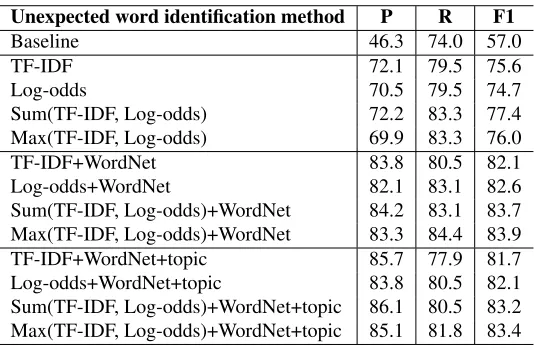
We evaluated the performance of our two word rank-ing techniques, both individually and combined by taking either the maximum of the two measures or the sum, against the set of manually annotations de-scribed in Section 2. In addition, we report the re-sults of applying these word ranking techniques in combination with the two filtering techniques. We compare these results with a simple baseline method in which every word used in a retelling that is never used in another retelling is considered to be unex-pected. Table 1 shows the precision, accuracy, and F-measure of these approaches. We see that all of the more sophisticated unexpected word identifica-tion approaches outperform the baseline by a wide margin, and thattf-idf and log odds perform compa-rably under the condition without filtering and both filtering conditions. Filtering improves F-measure under both word ranking schemes, and combining the two measures results in further improvements under both filtering conditions. Although apply-ing topic-estimate filterapply-ing yields the highest preci-sion, the simple WordNet-based approach results in the highest F-measure and a reasonable balance be-tween precision and recall.
Unexpected word identification method P R F1
Baseline 46.3 74.0 57.0
TF-IDF 72.1 79.5 75.6
Log-odds 70.5 79.5 74.7
[image:5.612.173.440.58.233.2]Sum(TF-IDF, Log-odds) 72.2 83.3 77.4 Max(TF-IDF, Log-odds) 69.9 83.3 76.0 TF-IDF+WordNet 83.8 80.5 82.1 Log-odds+WordNet 82.1 83.1 82.6 Sum(TF-IDF, Log-odds)+WordNet 84.2 83.1 83.7 Max(TF-IDF, Log-odds)+WordNet 83.3 84.4 83.9 TF-IDF+WordNet+topic 85.7 77.9 81.7 Log-odds+WordNet+topic 83.8 80.5 82.1 Sum(TF-IDF, Log-odds)+WordNet+topic 86.1 80.5 83.2 Max(TF-IDF, Log-odds)+WordNet+topic 85.1 81.8 83.4
Table 1: Accuracy of unexpected word identification.
types produced by children with ASD were marked as unexpected, while only 2.5% of words produced by children with TD were marked as unexpected, a significant difference (p < 0.01, using a one-tailed t-test). This significant between-group difference in rate of unexpected word use holds even when using the automated methods of unexpected word identification, with the best performing unexpected word identification method estimating a mean of 6.6% in the ASD group and 2.5% in the TD group (p <0.01).
5 Conclusions and future work
The automated methods presented here for rank-ing and filterrank-ing words accordrank-ing to their distribu-tions in different corpora, which are adapted from techniques originally developed for topic modeling in the context of information retrieval and extrac-tion tasks, demonstrate the utility of automated ap-proaches for the analysis of semantics and pragmat-ics. We were able to use these methods to iden-tify unexpected or inappropriate words with high enough accuracy to replicate the patterns of unex-pected word use manually observed in our two di-agnostic groups. This work underscores the poten-tial of automated techniques for improving our un-derstanding of the prevalence and diagnostic utility of linguistic features associated with ASD and other communication and language disorders.
In future work, we plan to use a development set to determine the optimal number of topical words to select during the topic estimate filtering stage of the pipeline in order to maintain improvements in
precision without a loss in recall. We would also like to investigate using part-of-speech, word sense, and parse information to improve our approaches for both semantic expansion and topic estimation. Although the rate of unexpected word use alone is unlikely to provide sufficient power to classify the two diagnostic groups investigated here, we expect that it can serve as one feature in an array of fea-tures that capture the broad range of semantic and pragmatic atypicalities observed in the spoken lan-guage of children with autism. Finally, we plan to apply these same methods to identify the confabula-tions and topic shifts often observed in the narrative retellings of the elderly with neurodegenerative con-ditions.
Acknowledgments
This work was supported in part by NSF Grant #BCS-0826654, and NIH NIDCD grant #1R01DC012033-01. Any opinions, findings, con-clusions or recommendations expressed in this pub-lication are those of the authors and do not necessar-ily reflect the views of the NSF or the NIH.
References
American Psychiatric Association. 2000. DSM-IV-TR: Diagnostic and Statistical Manual of Mental Disor-ders. American Psychiatric Publishing, Washington, DC.
Christian Fellbaum. 1998. WordNet: An Electronic Lex-ical Database. MIT Press, Cambridge, MA.
Leo Kanner. 1943. Autistic disturbances of affective content.Nervous Child, 2:217–250.
Marit Korkman, Ursula Kirk, and Sally Kemp. 1998. NEPSY: A developmental neuropsychological assess-ment. The Psychological Corporation, San Antonio. Yan Grace Lam, Siu Sze, and Susanna Yeung. 2012.
Towards a convergent account of pragmatic language deficits in children with high-functioning autism: De-picting the phenotype using the pragmatic rating scale. Research in Autism Spectrum Disorders, 6:792797. Catherine Lord, Michael Rutter, Pamela DiLavore, and
Susan Risi. 2002. Autism Diagnostic Observation Schedule (ADOS). Western Psychological Services, Los Angeles.
Molly Losh and Lisa Capps. 2003. Narrative ability in high-functioning children with autism or asperger’s syndrome.Journal of Autism and Developmental Dis-orders, 33(3):239–251.
Katherine Loveland, Robin McEvoy, and Belgin Tunali. 1990. Narrative story telling in autism and down’s syndrome.British Journal of Developmental Psychol-ogy, 8(1):9–23.
Brian MacWhinney. 2000. The CHILDES project: Tools for analyzing talk. Lawrence Erlbaum Associates, Mahwah, NJ.
Christopher D. Manning, Prabhakar Raghavan, and Hin-rich Sch¨utze. 2008. Introduction to information re-trieval. Cambridge University Press.
M.F. Porter. 1980. An algorithm for suffix stripping. Program, 14(3):130–137.
Michael Rutter, Anthony Bailey, and Catherine Lord. 2003. Social Communication Questionnaire (SCQ). Western Psychological Services, Los Angeles. Gerard Salton and Christopher Buckley. 1988.
Term-weighting approaches in automatic text retrieval. In-formation Processing and Management, 24(5):513– 523.
Helen Tager-Flusberg. 2001. Understanding the lan-guage and communicative impairments in autism. In-ternational Review of Research in Mental Retardation, 23:185–205.
C.J. van Rijsbergen, D.J. Harper, and M.F. Porter. 1981. The selection of good search terms. Information Pro-cessing and Management, 17(2):77–91.