SemEval-2017 Task 11: End-User Development using Natural Language
Juliano Efson Sales, Siegfried Handschuh, Andr´e Freitas Department of Computer Science and Mathematics
University of Passau, Germany
{juliano-sales, siegfried.handschuh, andre.freitas}@uni-passau.de
Abstract
This task proposes a challenge to support the interaction between users and appli-cations, micro-services and software APIs using natural language. It aims to support the evaluation and evolution of the discus-sions surrounding the application natural language processing techniques within the context of end-user natural language pro-gramming, under scenarios of high lexical and semantic heterogeneity.
1 Introduction
The specific syntax of traditional programming languages and the user effort associated with find-ing, understanding and integrating multiple inter-faces within a software development task, defines the intrinsic complexity of programming. De-spite the widespread demand for automating ac-tions within a digital environment, even the ba-sic software development tasks require previous (usually extensive) software development exper-tise. Domain experts processing data, analysts au-tomating recurrent tasks, or a businessman testing an idea on the web depend on the mediation of programmers to materialise their demands, inde-pendently of the simplicity of the task to be ad-dressed and on the availability of existing services and libraries.
Recent advances in natural language process-ing brprocess-ing the opportunity of improvprocess-ing the interac-tion between users and software artefacts, support-ing users to program tasks ussupport-ing natural language-based communication. This ability to match users’ actions intents and information needs to formal actions within anapplication programming inter-face (API), using the semantics of natural lan-guage as the mediation layer between both, can drastically impact the accessibility of software
de-velopment. Despite the fact that some software development tasks with stricter requirements will always depend on the precise semantic definition of programming languages, there is a vast spec-trum of applications with softer formalisation re-quirements. This subset of applications can be de-fined and built with the help of natural language descriptions.
This SemEval task aims to develop the state-of-the-art discussions and techniques concerning the semantic interpretation of natural language com-mands and user action intents, bridging the seman-tic gap between users and software artefacts. The practical relevance of the challenge lies in the fact that addressing this task supports improving the accessibility of programming (meaning a system-atic specification of computational operations) to a large spectrum of users which have the demand for increasing automation within some specific tasks. Moreover, with the growing availability of soft-ware artefacts, such as APIs and services, there is a higher demand to support the discoverabil-ity of these resources, i.e. devising principled se-mantic interpretation approaches to sese-mantically match interface descriptions with the intent from users.
The proposed task also intersects with demands from the field of robotics, as part of the human-robot interaction area, which depends on a sys-tematic ability to address user commands that lie beyond navigational tasks.
From the point-of-view of computational lin-guistics, this challenge aims to catalyse the dis-cussions in the following dimensions:
• Semantic parsing of natural language com-mands;
• Semantic representation of software inter-faces;
• Statistical and ontology-based semantic matching techniques;
• Compositional models for natural language command interpretation (NLCI);
• Machine learning models for NLCI;
• API/Service composition and associated planning techniques;
• Linguistic aspects of user action intents.
2 Commands & Programming in Natural Language
The use of natural language to instruct robots and computational systems, in general, is an active re-search area since the 70’s and 80’s (Maas and Sup-pes,1985;Guida and Tasso,1982) (and within ref-erences). Initiatives vary over a large spectrum of application domains including operating system’s functions (Manaris and Dominick,1993), web ser-vices choreography (Englmeier et al.,2006), mo-bile programming by voice (Amos Azaria,2016), domain-specific natural programming languages (Pane and Myers, 2006), industrial robots ( Sten-mark and Nugues,2013) and home care assistants. The variability of domains translates into a wide number of research communities comprising dif-ferent foci and being expressed by distinct terms such asnatural language interfaces,end-user de-velopment, natural programming, programming by exampleandtrigger-action development. Some of these terms embrace wide domains, also includ-ing non-verbal (visual) approaches.
2.1 Semantic Parsing & Matching
The interpretation of natural language commands is typically associated with the task of parsing the natural language input to an internal representa-tion of the target system. This internal represen-tation is usually associated with an-ary predicate-argument structure which represents the interface for an action within the system. The identification of which action the command refers to and its po-tential parameters are at the centre of this task.
Taking as an example the natural language com-mand:
Please convert US$475 to the Japanese currency and send this value to John Smith by SMS.
We can conceptualise the challenges involved in the command interpretation process in three di-mensions: command chunking, term type identi-fication and semantic matching. The chunking dimension comprises the identification of terms and segments in the original sentence that can po-tentially map to the system actions and parame-ters. The example command embodies two ac-tions: converting currencyandsending SMS. For the first action, the command interpreter needs to identify the currencies involved in the transaction and the financial amount (term type identification). Other semantic interpretation processes might be involved. In the case of the second action, be-sides identifyingJohn Smithas the message’s re-ceiver, the interpreter also needs to resolve the co-reference ofthis valueto the currency conversion result and instantiate it as a parameter in the con-tent of the message. This first level of interpre-tation of the command would generate an output such as:
SEQUENCY{
ACTION: [ convert currency ]
PARAMS: [US$ 475] - [(to) Japanese currency]
ACTION: [ send sms ]
PARAMS: [this value] - [(to) John Smith]
}
The matching processcorresponds to the map-ping between terms from the user vocabulary to the terms used in the internal representation of the system (the API). In the given example, the system should find an action that can convert currencies and another that can send SMS messages.
In the example, depending on the parametri-sation of the command interface, the value [US$
475] needs to be split into two parameters, and these parts, mapped to the internal vocabulary of the system (US$ need to be interpreted as USD whileJapanese currencyneeds to be translated to JPY. For the second action, similarly, John Smith will be used to retrieve a phone number from a user personal data source.
The final execution command is the result of the matching processing, as shown below:
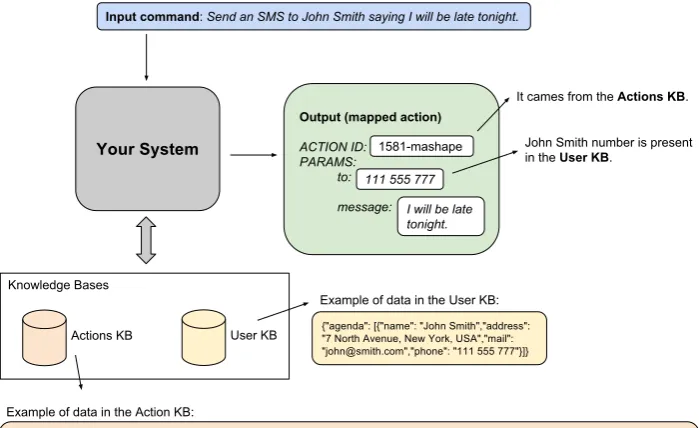
Figure 1: An overview of the task.
from: “USD”
to: “JPY”
from amount: 475
The task can be addressed using different semantic interpretation abstractions: shallow parsing, lambda-calculus-based semantic parsing (Artzi et al., 2014), compositional-distributional models (Freitas and Curry, 2014;Freitas, 2015), information retrieval approaches (Sales et al., 2016). Additionally, pre-processing techniques such as clausal disembedding (Niklaus et al., 2016) and co-reference resolution are central com-ponents within the task.
While approaches and test collections empha-sising the shallow parsing aspect of the problem are more present in the literature (Section3), oth-ers focusing on a semantic matching process in-volving a broader vocabulary gap (Furnas et al., 1987) are less prevalent. Part of this can be ex-plained by the domain-specific nature of previous works (e.g. focus on spatial commands (Dukes, 2014)).
In contrast, this task emphasises the creation of a test collection targeting an open domain sce-nario, with a large-scale set of target actions, as-sessing the ability of command interpretation ap-proaches to address a larger vocabulary gap. This scenario aims to instantiate a real use case for
end-user natural language programming, since the ac-tion knowledge base used in the test collecac-tion maps to real-world APIs and so a semantic inter-preter developed over this test collection can be-come a concrete end-user programming environ-ment.
3 Similar Initiatives
Most of the applications related to the parsing of natural language commands are within the context of human-robot interaction. TheHuman Robot In-teraction Corpus(HuRIC) describes a list of spo-ken commands between humans and robots. It is composed of three datasets which were devel-oped under the context of three different events. They are annotated using Frame Semantics to-gether with Holistic Spatial Semantics (Bastianelli et al.,2014).
Artzi et al. (2014) and Tellex et al. (2014) give a more focused contribution in the interpretation of spatial elements. In both cases, the vocabulary variability is more constrained. Similar vocabu-lary variability assumptions are present in Thoma-son et al. (2015) and Azaria et al. (2016).
within a spatial region.
The proposed task can be contrasted with these previous initiatives in the following dimensions: (i) more comprehensive knowledge base of ac-tions, (ii) generic (open domain) user program-ming scenarios and (iii) exploration of the inter-action between inter-actions and user personal informa-tion (Secinforma-tion4).
The work that has more similarity with this test collection is the problem defined by Quirk et al. (2015) under theifttt.complatform, which targets the creation of an if-then receipt from a natural language description provided by the user. The first difference between the two tasks is the fact that, while the program structure is limited to if-then recipes in Quirk et al., other more complex structures are supported in this task. Secondly, in the case of Quirk et al., the task requires only the mapping of the actions that comprise the recipe, keeping aside the instantiation of the parameter values, while our proposed task emphasises both. Finally, the presence of these two characteristics introduces the challenge of mapping co-references and metonymy within the task.
4 Task Definition
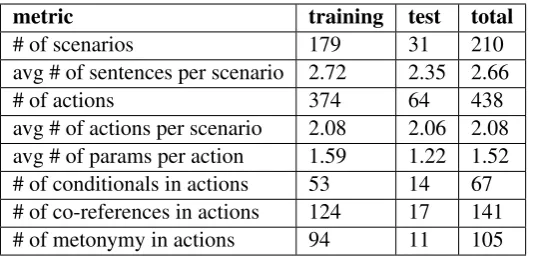
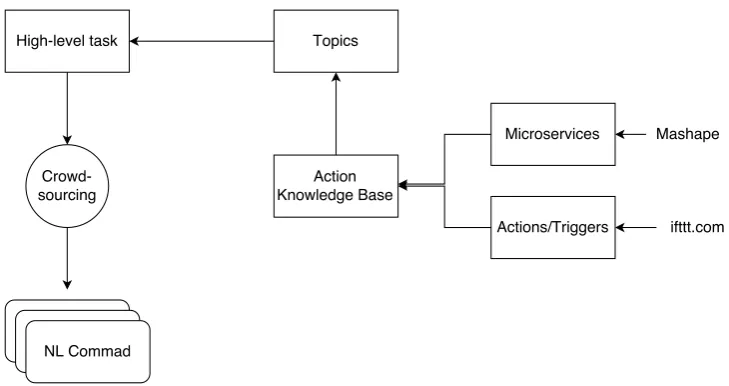
The task comprises 210 scenarios which consist of a total of 438 natural language commands. Fig-ures1and2depicts an overview of the task. A sce-nario is a set of sentences that defines a program in natural language. The excerpt below shows an example of a scenario:
“When a message from Enrico Hernan-dez arrives, get the necklace price; Con-vert it from Chilean Pesos to Euro; If it costs less than 100 EUR, send to him a message asking him to buy it; If not, write saying I am not interested.”
Associated with each scenario, there is a pro-gram which is composed of actions from the Ac-tion Knowledge Base (AcAc-tion KB). In addiAc-tion to the actions, the program also uses If and Foreach constructors, having the same seman-tics commonly expressed in programming lan-guages to define the execution flow.
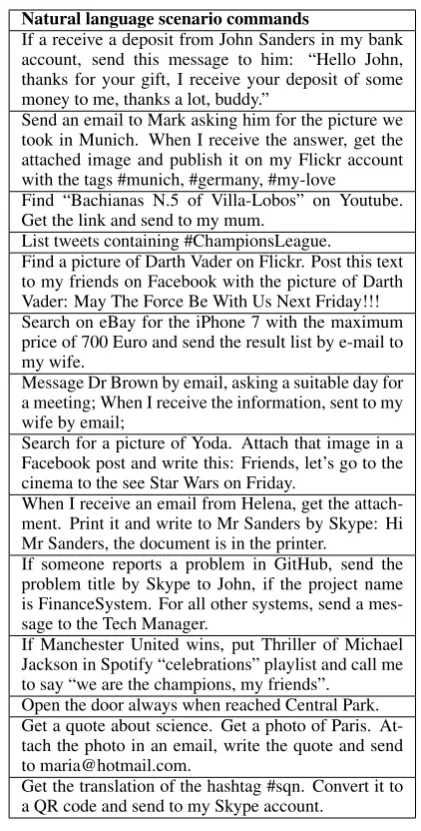
Like a programming language function, an ac-tion can have input parameters and return values. Table1shows examples of natural language com-mands describing scenarios.
Natural language scenario commands
If a receive a deposit from John Sanders in my bank account, send this message to him: “Hello John, thanks for your gift, I receive your deposit of some money to me, thanks a lot, buddy.”
Send an email to Mark asking him for the picture we took in Munich. When I receive the answer, get the attached image and publish it on my Flickr account with the tags #munich, #germany, #my-love
Find “Bachianas N.5 of Villa-Lobos” on Youtube. Get the link and send to my mum.
List tweets containing #ChampionsLeague.
Find a picture of Darth Vader on Flickr. Post this text to my friends on Facebook with the picture of Darth Vader: May The Force Be With Us Next Friday!!! Search on eBay for the iPhone 7 with the maximum price of 700 Euro and send the result list by e-mail to my wife.
Message Dr Brown by email, asking a suitable day for a meeting; When I receive the information, sent to my wife by email;
Search for a picture of Yoda. Attach that image in a Facebook post and write this: Friends, let’s go to the cinema to the see Star Wars on Friday.
When I receive an email from Helena, get the attach-ment. Print it and write to Mr Sanders by Skype: Hi Mr Sanders, the document is in the printer.
If someone reports a problem in GitHub, send the problem title by Skype to John, if the project name is FinanceSystem. For all other systems, send a mes-sage to the Tech Manager.
If Manchester United wins, put Thriller of Michael Jackson in Spotify “celebrations” playlist and call me to say “we are the champions, my friends”.
Open the door always when reached Central Park. Get a quote about science. Get a photo of Paris. At-tach the photo in an email, write the quote and send to [email protected].
[image:4.595.310.521.58.474.2]Get the translation of the hashtag #sqn. Convert it to a QR code and send to my Skype account.
Table 1: Examples of natural language commands describing scenarios.
The values of the parameters map to constants (e.g. integer numbers, string values) or to tags, which represent returning data from previously ex-ecuted actions. There are two types of tags.
• <returnX> The return tag represents the content returned by the action X, where X is a sequential identifier.
• <item>The item tag is used only in the con-text of Foreach constructors. It represents an iterated item.
Both types of tags have some additional naming assumptions in order to simplify the syntax of the generated program. Examples of valid tags are:
• <item>.url - represent the attribute url of the item.
In addition to the scenarios, the test collection consists of:
• Action KB: The set of available API func-tions along with their respective documen-tation. The information describing the API functions does not follow a strict pattern. While some documentation has rich natural language descriptions or show usage exam-ples, others are succinct and just contain the frame and parameter names. The same oc-curs concerning data format, data type and re-turning data. This test collection reflects the variability and heterogeneity that we find in real-world APIs.
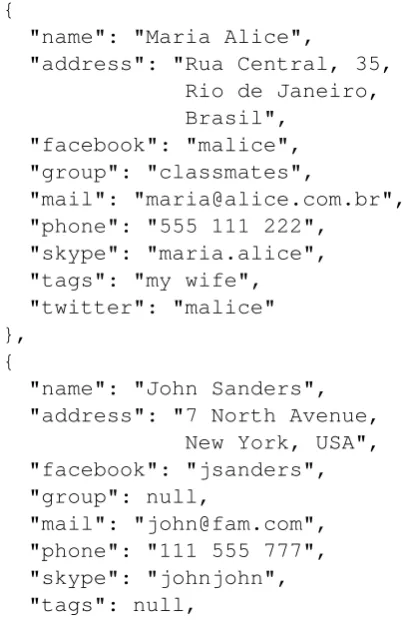
• User KB: A personal user information dataset, which is necessary to make com-mands more natural by supporting co-reference resolution. It allows commands like “Call John”, once the system can iden-tify the proper phone number from the User KB.
An example excerpt of the User KB is described below:
[ {
"name": "Maria Alice",
"address": "Rua Central, 35, Rio de Janeiro, Brasil",
"facebook": "malice", "group": "classmates",
"mail": "[email protected]", "phone": "555 111 222",
"skype": "maria.alice", "tags": "my wife", "twitter": "malice" },
{
"name": "John Sanders", "address": "7 North Avenue,
New York, USA", "facebook": "jsanders", "group": null,
"mail": "[email protected]", "phone": "111 555 777", "skype": "johnjohn", "tags": null,
id action name(params*)
700000 make a payment(invoice) 600603 send an email(attachment url) 700002 read file content(file) 700003 extract content(info) 503679 convert(to)
700005 get contacts(group)
600490 upload public photo from url(tags) 700006 search image on Flickr(query) 700007 search video on YouTube(query) 600431 create a link post(link url) 601733 post a tweet with image(image url) 700008 tweets from search(search for) 502328 directions(starting)
600352 new item from search(search terms) 600979 share a link(image url)
700009 create calendar item(which day?) 600761 print document(document url) 601535 post message(user name) 500797 convert-file(file)
700011 any new post by someone(user) 600591 any new issue(user)
601206 new article in section(section) 600187 add a bitlink(url)
601732 post a tweet(tweet text) 601888 picture of the day(section) 600840 add photo to album(album name) 600408 new final score(team)
601684 new story from section(which section?) 600596 create an issue(body)
601791 air quality changed(device) 503062 search(depart-date) 502335 check(text)
[image:5.595.312.520.59.426.2]600326 take snapshots(which camera?) 503155 get-top-definition(hashtag)
Table 2: Examples of action frames used in the scenarios.
"twitter": "jsanders" },
... ]
The natural language scenarios, Action KB and User KB are all described using JSON as a serialisation format. The Action KB is com-posed of about 3800 micro-services from Mashape (mashape.com) and 1900 actions and triggers from the ifttt.com platform. APIs from Mashape and ifttt.com are public, and their instantiation for the challenge was approved by the platform owners.
[image:5.595.84.286.457.773.2]metric training test total
# of scenarios 179 31 210
avg # of sentences per scenario 2.72 2.35 2.66
# of actions 374 64 438
[image:6.595.167.434.61.190.2]avg # of actions per scenario 2.08 2.06 2.08 avg # of params per action 1.59 1.22 1.52 # of conditionals in actions 53 14 67 # of co-references in actions 124 17 141 # of metonymy in actions 94 11 105
Table 3: Metrics about the scenarios, actions and the associated natural language command.
4.1 Annotation
The scenarios containing the natural language commands were created using high-level task de-scriptions. These high-level task descriptions were sent to a crowdsourcing platform (CrowdFlower), in which workers were requested to express in nat-ural language the commands which entail the sce-nario descriptions. Motivated by those scesce-nario descriptions, the users proposed a set of com-mands which addresses the specification.
The excerpt below shows an example of a sce-nario description:
You are arranging a meeting with some people in Andre’s office. Adamantios is coming for that meeting, but he does not know how to drive in Passau. Addition-ally, you do not know where the office is. One possible output for that description is: • Ask Andre for the address of his office; • Make a map from the university to it;
• Send the map to Adamantios including driv-ing directions.
For each scenario description, in average ten workers were invited to suggest the natural lan-guage commands. The crowdsourcing process was followed by a data curation process which dis-carded 70% of the commands due to low quality issues. The other part of the sample was reviewed to correct misspelling and adjusted to comply with the task requirements while preserving the original syntactic structure and vocabulary.
5 Analysis of The Task Complexity The task aims to explore vocabulary and syn-tactic structure variation within the natural
lan-guage commands. It also targets the orches-tration of different natural language processing techniques, including syntactic parsing, semantic role labelling, fine-grained semantic approxima-tion and co-reference resoluapproxima-tion.
5.1 Semantic approximation
Different actions and parameters can be expressed using distinct lexicalizations (synonymy) and ab-straction levels. For example:
“If someone reports a problem in GitHub, sendthe problem’sheadlineby Skype to John.”
In the examples, the action in the knowledge base is expressed as “any new issue”, while in-tended “headline” in the returned value is ex-pressed as “Issue Title”. Given the context, it is expected the system to be able to identify the equivalence between the pairs of terms (problem, issue) and (title,headline).
5.2 Syntactic variation
Additionally, interpreters are expected to cope with syntactic variation.
“If Manchester United wins, call me.”
“Get ready to call me in the case of vic-tory of Manchester United.”
5.3 Co-reference and metonymy resolution
Figure 2: The scenario creation workflow.
“If an issue is created, sendits content to theTech Manager.”
This excerpt shows both cases. The bold its
makes reference toan issue, whileTech Manager
is a metonymy for the Tech Manager’s email ([email protected] according to the user KB).
6 Evaluation
The final dataset contains commands and their as-sociated mappings to the Action KB. Given a com-mand in natural language, it is expected that the participating systems provide:
• The correct action;
• The correct mapping of text chunks in the natural commands to parameters;
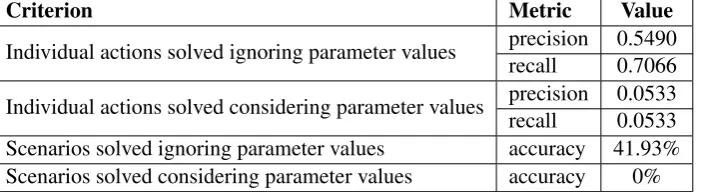
The participating systems were evaluated con-sidering four criteria:
1. Resolved individual actions ignoring param-eter values;
2. Resolved individual actions considering pa-rameter values;
3. Resolved scenarios ignoring parameter val-ues;
4. Resolved scenarios considering parameter values.
Criteria 1 and 2 are quantified by using preci-sion and recall, while 3 and 4 are quantified by the
percentage of the total number of scenarios which were addressed.
Participating teams were allowed to use exter-nal linguistic resources and exterexter-nal tools such as taggers and parsers.
7 Participants and Results
Initially, nine teams demonstrated interest in the tasks, but only one participated in the challenge.
Kubis et al. (2017) proposed the EUDAMU system, which implements an action ranking model based on TF/IDF and a type matching sys-tem.
The EUDAMU system is composed of a pipeline divided into six steps. It starts by pre-processing the dataset using three tools (NLTK, Core-NLP and SyntaxNet). In the pre-processing step, natural language commands are tokenized and each token is enriched with its lemma, part-of-speech and named entity labels. Addition-ally, it also adds the constituent and dependency structures associated with the commands. The fi-nal pre-processing step annotates the commands with types which supports the system to resolve co-references between the actions and references from the User KB. The same procedure (with the exception of the last step) is applied for the Action KB.
Criterion Metric Value
Individual actions solved ignoring parameter values precision 0.5490recall 0.7066
[image:8.595.127.478.64.160.2]Individual actions solved considering parameter values precision 0.0533recall 0.0533 Scenarios solved ignoring parameter values accuracy 41.93% Scenarios solved considering parameter values accuracy 0%
Table 4: Results from Kubis et al.
model to rank the actions. The model was indexed using all textual content present in the Action KB, plus the actions which were mapped with in the training mappings file. The next step is the Ref-erence Matcherthat is designed to identify which output of a given action act as the parameters of a subsequent action. The next step is the Param-eter Matcher. It infers parameter and value types which can serve as a support to the action match-ing process. Finally, based on the knowledge gen-erated and stored in the previous steps, the rule-based Statement Mapper provides a list of up to 10 elements of possible matching action instances. Additional details of the proposed method can be found in the original paper (Kubis et al., 2017). Table4shows its results.
While the proposed solution has a high re-call for the number of resolved actions, it fails mainly in providing the correct value for all the required parameters. Two types of linguistic set-tings showed to be more challenging:
• Description of commands split into two sen-tences. For example:
“Get the price of the book The In-telligent Investor. If it costs less than 25 Euros, buy it.”
where “25 Euros” is the parameter value of the action defined in the first sentence. • Capturing actions with more
specific/fine-grained semantics. For example: “Once I have bet my running dis-tance target of the week, set my current weight as 100 Kg in Fitbit.” where the system ignored the temporal expression“of the week” and suggested the “Daily step goal achieved” instead of “Weekly distance goal reached” action. A second example of the same case is expressed in the command:
“Suspend the execution of my Sam-sung washer.”
where the term “Samsung” was ignored when selecting actions.
8 Summary
In the Semeval 2017 Task 11 we developed a test collection to support the creation of seman-tic interpretation methods for end-user program-ming environments. The test collection focuses on the following features in comparison with existing approaches: (i) open domain, (ii) large syntactic and vocabulary variability, (iii) dependent of co-reference and metonymy resolution. Moreover, as the test collection uses APIs available on the open web, it can be used to build real end-user pro-gramming environments. While there is space for the improvement of the precision and recall on the identification of the command actions, the main challenge remains in the matching of the parame-ters between natural language commands and the API.
References
Jayant Krishnamurthy Tom M. Mitchel Amos Azaria. 2016. Instructable intelligent personal. In Proceed-ings of the Thirtieth AAAI Conference on Artificial Intelligence. AAAI’16.
Yoav Artzi, Dipanjan Das, and Slav Petrov. 2014.
Learning compact lexicons for ccg semantic pars-ing. In Proceedings of the 2014 Confer-ence on Empirical Methods in Natural Language Processing (EMNLP). Association for Computa-tional Linguistics, Doha, Qatar, pages 1273–1283.
http://www.aclweb.org/anthology/D14-1134.
Loftsson, Bente Maegaard, Joseph Mariani, Asun-cion Moreno, Jan Odijk, and Stelios Piperidis, ed-itors, Proceedings of the Ninth International Con-ference on Language Resources and Evaluation (LREC’14). European Language Resources Associ-ation (ELRA), Reykjavik, Iceland.
Kais Dukes. 2014. Semeval-2014 task 6: Super-vised semantic parsing of robotic spatial commands. In Proceedings of the 8th International Workshop on Semantic Evaluation (SemEval 2014). Asso-ciation for Computational Linguistics and Dublin City University, Dublin, Ireland, pages 45–53.
http://www.aclweb.org/anthology/S14-2006.
Kurt Englmeier, Javier Pereira, and Josiane Mothe. 2006. Choreography of web services based on nat-ural language storybooks. InProceedings of the 8th International Conference on Electronic Commerce: The New e-Commerce: Innovations for Conquering Current Barriers, Obstacles and Limitations to Con-ducting Successful Business on the Internet. ACM, New York, NY, USA, ICEC ’06, pages 132–138.
https://doi.org/10.1145/1151454.1151485.
Andr´e Freitas. 2015. Schema-agnostic queries over large-schema databases: a distributional semantics approach. PhD Thesis.
Andre Freitas and Edward Curry. 2014. Natural language queries over heterogeneous linked data graphs: A distributional-compositional semantics approach. InProceedings of the 19th International Conference on Intelligent User Interfaces. ACM, New York, NY, USA, IUI ’14, pages 279–288.
https://doi.org/10.1145/2557500.2557534.
George W. Furnas, Thomas K. Landauer, Louis M. Gomez, and Susan T. Dumais. 1987. The vocabulary problem in human-system
com-munication. Commun. ACM 30(11):964–971.
https://doi.org/10.1145/32206.32212.
Giovanni Guida and Carlo Tasso. 1982. Nli: a robust interface for natural language person-machine communication. International Jour-nal of Man-Machine Studies 17(4):417 – 433.
https://doi.org/http://dx.doi.org/10.1016/S0020-7373(82)80042-4.
Marek Kubis, Pawel Skorzewski, and Tomasz Zi-etkiewicz. 2017. EUDAMU at SemEval-2017 Task 11: Action ranking and type matching for end-user development. In”Proceedings of the 11th Interna-tional Workshop on Semantic Evaluation (SemEval-2017)”. Association for Computational Linguistics.
Robert Elton Maas and Patrick Suppes. 1985. Natural-language interface for an instructable robot. International Journal of Man-Machine Studies 22(2):215 – 240.
https://doi.org/http://dx.doi.org/10.1016/S0020-7373(85)80071-7.
Bill Z. Manaris and Wayne D. Dominick. 1993. Nalige: a user interface manage-ment system for the developmanage-ment of natural language interfaces. International Journal of Man-Machine Studies 38(6):891 – 921.
https://doi.org/http://dx.doi.org/10.1006/imms.1993.1042. Christina Niklaus, Bernhard Bermeitinger, Siegfried
Handschuh, and Andr´e Freitas. 2016. A sentence simplification system for improving relation extrac-tion. InProceedings of COLING 2016, the 26th In-ternational Conference on Computational Linguis-tics: System Demonstrations. The COLING 2016 Organizing Committee, Osaka, Japan, pages 170– 174. http://aclweb.org/anthology/C16-2036. John F. Pane and Brad A. Myers. 2006. ”End
User Development”, ”Springer Netherlands”, ”Dor-drecht”, chapter ”More Natural Programming Languages and Environments”, pages ”31–50”.
https://doi.org/”10.1007/1-4020-5386-X 3”. Chris Quirk, Raymond Mooney, and Michel Galley.
2015.Language to code: Learning semantic parsers for if-this-then-that recipes. InProceedings of the 53rd Annual Meeting of the Association for Com-putational Linguistics (ACL-15). Beijing, China, pages 878–888. http://www.cs.utexas.edu/users/ai-lab/pub-view.php?PubID=127514.
Juliano Efson Sales, Andre Freitas, Brian Davis, and Siegfried Handschuh. 2016. A compositional-distributional semantic model for searching com-plex entity categories. In Proceedings of the Fifth Joint Conference on Lexical and Computa-tional Semantics. Association for Computational Linguistics, Berlin, Germany, pages 199–208.
http://anthology.aclweb.org/S16-2025.
M. Stenmark and P. Nugues. 2013. Natural language programming of industrial robots. In Robotics (ISR), 2013 44th International Symposium on. pages 1–5. https://doi.org/10.1109/ISR.2013.6695630. Jesse Thomason, Shiqi Zhang, Raymond Mooney,
and Peter Stone. 2015. Learning to interpret natural language commands through human-robot dialog. In Proceedings of the 24th International Conference on Artificial Intelli-gence. AAAI Press, IJCAI’15, pages 1923–1929.
http://dl.acm.org/citation.cfm?id=2832415.2832516. Matthew R. Walter, Sachithra Hemachandra, Bianca