Exploring use of the Bridge21 model as a 21
stCentury method of Continuing Professional
Development (CPD) in Computer Science (CS)
for Teachers in Ireland
2019
Lorraine Fisher
B.A (RGU), Pg. Dip (RGU), M.Sc. (RGU), M.Sc. (DUB)
i
Declaration
I declare that this thesis has not been submitted as an exercise for a degree at this or any other university and it is entirely my own work.
I agree to deposit this thesis on the University’s open access institutional repository or allow the library to do so on my behalf, subject to Irish Copyright Legislation and Trinity College Library conditions of use and acknowledgement.
Signed:
___________________________________________________________________________
ii
Acknowledgements
For Niamh and Mike
To Professor Brendan Tangney and Dr Jake Rowan Byrne
School of Computer Science and Statistics, Trinity College Dublin, University of Dublin, Ireland
To Dr Katriona O’Sullivan
School of Education, National University of Ireland, Maynooth, Ireland
For my colleagues in Bridge21.ie, Centre for Research into I.T. in Education (CRITE), Trinity Access Programme, University College Dublin, Scouting Ireland, OurKidsCode.ie, and Google,
Inc.
iii
Dedication
In memory of Donald Kirkpatrick (1924-2014)
“I also hope that you acknowledge and remember the power of genuine person-to-person interaction in training and evaluation. Surveys and technologies are fine, but the bridges that
you build with your trainees and their managers, and the conversations you have with them,
will add humanness to training content and evaluation data” (Kirkpatrick, 2016, p. xi).
“Science is an ongoing process. It never ends. There is no single ultimate truth to be achieved,
after which all the scientists can retire. And because this is so, the world is far more interesting,
both for the scientists and for the millions of people in every nation who, while not professional
iv
Tables
Table 1 Research Questions ... 5
Table 2 Bridge21 Pedagogical Model (Lawlor et al., 2018)... 7
Table 3 Bridge21 Activity Model (Byrne, Fisher, & Tangney, 2016) ... 7
Table 4 Kirkpatrick (1994) Levels... 9
Table 5 SWOT Analysis applied to Kirkpatrick (1994)... 11
Table 6 Philosophical Approach adapted from Crotty (1998) ... 12
Table 7 Methodological Approach Adapted from Yin (2003) ... 13
Table 8 Kirkpatrick (1994) Adapted for Bridge21 CS CPD Evaluation ... 14
Table 9 Search Strategy Applied to Databases ... 23
Table 10 Meta-Synthesis Model and Procedure ... 24
Table 11 Computer Programming Difficulties (Du Boulay, 1986) ... 31
Table 12 Common Programming Mistakes (Du Boulay, 1986) ... 35
Table 13 Barriers to Learning Programming ... 37
Table 14 Barriers to Teaching Programming (Robins et al., 2003) ... 39
Table 15 Rational for Collaborative, Project-Based Teaching in CS ... 42
Table 16 Collaborative CS CPD Model for Teachers (Sentance & Csizmadia, 2017b) ... 52
Table 17 Comparison between Guskey (2000) and Kirkpatrick Model (1956) ... 63
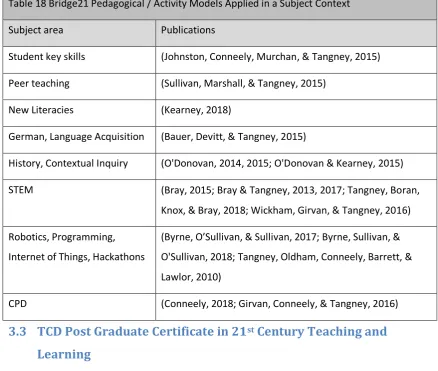
Table 18 Bridge21 Pedagogical / Activity Models Applied in a Subject Context ... 77
Table 19 TCD Pg. Cert 21st Century Teaching and Learning Module List (TCD, 2018) ... 79
Table 20 Ontological Paradigms Adapted from Guba and Lincoln (2000) ... 85
Table 21 Interpretivist Research Designs adapted from Creswell (2005) ... 90
Table 22 CPD and School Samples ... 93
Table 23 Table Shell Linking Research Questions to Data Sets (Miles and Huberman, 1994) .... 98
Table 24 Piloting CPD and School Questionnaires ... 103
Table 25 Validity Framework for Case Study adapted from Yin (2003) ... 110
Table 26 Data Analysis Model ... 115
Table 27 Logical Models for Developing Concepts (LeCompte & Schensul, 2013) ... 120
Table 28 Using a Taxonomy to Guide Coding (LeCompte & Schensul, 1999) ... 127
v
Table 30 Reaction Post-Workshop Variables All Years ... 140
Table 31 Reaction Variables – Mean – Year on Year ... 144
Table 32 Learning Outcome Pre-Workshop Variables adapted from TCD (2017) ... 155
Table 33 Learning Outcome Post-Workshop Variables adapted from TCD (2017) ... 156
Table 34 Learning Outcome Variables – Mean – Year on Year ... 162
Table 35 Module Workshop and Paired Matched Sub-Sample Size ... 168
Table 36 Wilcoxon (1945) Signed Rank Test First Pre Learning Outcome Results ... 172
Table 37 Wilcoxon (1945) Signed Rank Test Last Post Learning Outcome Results ... 172
Table 38 Behavioural Intention Post-Workshop Variable All Years ... 177
Table 39 Intention to use Bridge21 All Years ... 177
Table 40 Post Workshop Intentions – Year on Year Results ... 178
Table 41 Bridge21 CS CPD Computing Workshops Attended by CPD Teachers ... 187
Table 42 Bridge21 elements (Lawlor et al., 2018; Lawlor et al., 2013; Lawlor et al., 2016) .... 190
Table 43 Barriers Post CPD Variables (Hogarty, Lang, & Kromrey, 2003; Kirkpatrick, 2007) ... 194
Table 44 Other Methods for Teaching Computing (Sentance & Csizmadia, 2017a) ... 200
vi
Figures
Figure 3-1 Bridge21 Learning Pod Space (Reprinted with Permission, CPD Teacher, 2013) ... 73
Figure 3-2 Bridge21 Brainstorming Computers in Every Day Life Activity Example... 75
Figure 3-3 Bridge21 Auditorium Space (Reprinted with Permission, CPD Teacher, 2013) ... 76
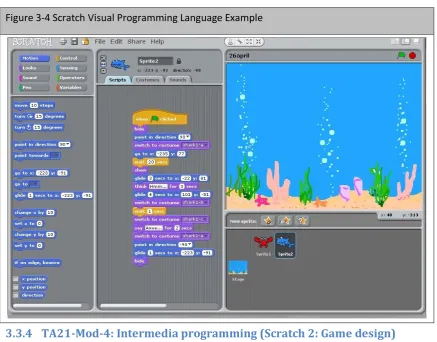
Figure 3-4 Scratch Visual Programming Language Example ... 81
Figure 3-5 Using the Python programming language to activate a switch ... 83
Figure 4-1 Quantitative Research Database IBM SPSS ... 107
Figure 4-2 Qualitative Research Database QSR International NVIVO ... 107
Figure 4-3 Ethics Database – Microsoft Excel ... 108
Figure 6-1 Teacher CPD Demographics Age Profile... 138
Figure 6-2 CPD Workshop Module Frequency Analysis ... 139
Figure 6-3 Reaction Variable Analysis – Summary - All Years ... 140
Figure 6-4 Reaction Post-Workshop Variables Year 1 ... 145
Figure 6-5 Reaction Post-Workshop Variables Year 1 / Year 2 ... 146
Figure 6-6 Reaction Post-Workshop Variables Year 2 / Year 3 ... 147
Figure 6-7 Reaction Post-Workshop Variables Year 3 / Year 4 ... 148
Figure 6-8 Reaction Post-Workshop Variables Year 4 / Year 5 ... 149
Figure 6-9 A Team working on a Bridge21 Computing Activity (Fisher et al., 2016) ... 151
Figure 6-10 Pre Workshop Learning Outcome Variable Analysis – Summary ... 157
Figure 6-11 Post Workshop Learning Outcome Variable Analysis – Summary ... 157
Figure 6-12 Learning Outcome Post-Workshop Variables Year 2 ... 163
Figure 6-13 Learning Outcome Post-Workshop Variables Year 2 / Year 3 ... 164
Figure 6-14 Learning Outcome Pre and Post-Workshop Variables Year 4 ... 165
Figure 6-15 Learning Outcome Pre and Post-Workshop Variables Year 5 ... 166
Figure 6-16 Teachers Programming in Scratch using the Raspberry Pi (Byrne, Fisher, & Tangney, 2015b) ... 174
Figure 6-17 Intentions Post-Workshop Variables Year 3, 4 and 5... 179
Figure 6-18 Teachers Operating Scratch using Makey-Makey Controllers ... 181
Figure 6-19 Breakdown of Primary and Post-Primary Teacher Sample ... 188
vii
Figure 6-21 Analysis of the First Four Bridge21 Elements used for Teaching CS ... 191
Figure 6-22 Analysis of the Second Four Bridge21 Elements used for Teaching CS ... 192
Figure 6-23 Barrier Variable Analysis – First Four Variables ... 195
Figure 6-24 Barrier Variable Analysis – Second Four Variables ... 196
Figure 6-25 Barrier Variable Analysis – Remaining Four Variables ... 197
Figure 6-26 Other Methods Variable Analysis – First Four Variables ... 200
viii
Contents
1 INTRODUCTION ... 1
RESEARCH CONTEXT ... 1 1.1
RESEARCH QUESTIONS... 5 1.2
BRIDGE21 CS CPD PROGRAMME ... 6 1.3
EVALUATION THEORY AND CPD EVALUATION ... 8 1.4
METHODOLOGICAL APPROACH ... 12 1.5
ANALYTICAL APPROACH ... 15 1.6
SUMMARY FINDINGS ... 17 1.7
ROAD MAP ... 19 1.8
2 LITERATURE REVIEW ... 21
LITERATURE REVIEW METHODOLOGY... 21 2.1
EDUCATIONAL TECHNOLOGY CONTEXT ... 25 2.2
LEARNING AND TEACHING PROGRAMMING ... 34 2.3
PROFESSIONAL DEVELOPMENT IN STEM AND CS ... 45 2.4
PROGRAMME EVALUATION DESIGN AND METHODS ... 55 2.5
LIMITATIONS ... 68 2.6
3 BRIDGE21 CS CPD CONTEXT ... 69
COMPUTING AND THE IRISH CONTEXT ... 69 3.1
BRIDGE21 ... 71 3.2
TCD POST GRADUATE CERTIFICATE IN 21ST
CENTURY TEACHING AND LEARNING ... 77 3.3
SUMMARY ... 83 3.4
4 METHODOLOGICAL APPROACH ... 84
PHILOSOPHICAL FRAMEWORK ... 84 4.1
ix METHODOLOGICAL APPROACH ... 88 4.3
APPLYING YIN’S (2003) CASE STUDY PROTOCOL ... 92 4.4
APPLYING YIN’S (2003) DATA COLLECTION PRINCIPLES ... 103 4.5
APPLYING YIN’S (2003) CASE STUDY VALIDITY FRAMEWORK ... 109 4.6
LIMITATIONS ... 113 4.7
5 ANALYTICAL FRAMEWORK ... 115
THEORIES FOR ANALYSING DATA ... 115 5.1
ANALYSING MIXED METHODS DATA SETS ... 118 5.2
USING LOGICAL MODELS TO GUIDE ANALYSIS ... 120 5.3
STATISTICS AND ANALYSIS OF QUANTITATIVE DATA ... 122 5.4
THE ROLE OF CODING IN QUALITATIVE DATA ANALYSIS ... 124 5.5
MAPPING EACH OF KIRKPATRICK LEVELS TO THE DATA ANALYSIS MODEL ... 127 5.6
ALGORITHMS USED TO PROCESS QUANTITATIVE AND QUALITATIVE DATA SETS ... 129 5.7
SUMMARY ... 133 5.8
6 FINDINGS ... 135
UNITS OF DATA ANALYSIS ... 135 6.1
TEACHERS’ REACTIONS TO THE CPD WORKSHOP CONTENT ... 137 6.2
CONTENT KNOWLEDGE DEVELOPED BY TEACHERS ... 153 6.3
STRATEGIES TEACHERS INTEND USING FOR TEACHING COMPUTING ... 176 6.4
TEACHING COMPUTING IN SCHOOLS ... 186 6.5
ELEMENTS OF THE BRIDGE21 MODEL USED FOR TEACHING COMPUTING ... 189 6.6
LIMITATIONS WITH IMPLEMENTING BRIDGE21 ... 208 6.7
SUMMARY ... 209 6.8
7 DISCUSSION ... 211
TEACHING CS IN A 21ST
x BRIDGE21 CS CPD PROGRAMME AIMS AND OBJECTIVES ... 215 7.2
REVISITING THE RESEARCH QUESTIONS ... 216 7.3
TEACHERS’ PERCEPTIONS OF THE BRIDGE21 MODEL ... 216 7.4
TEACHER EXPERIENCES OF USING THE BRIDGE21 MODEL ... 227 7.5
RESEARCH LIMITATIONS ... 233 7.6
RESEARCH CONCLUSIONS ... 234 7.7
RESEARCH CONTRIBUTIONS ... 236 7.8
AREAS FOR FURTHER WORK ... 237 7.9
8 REFERENCES ... 238
9 APPENDIX ... 294
CS CPD PARTICIPANT CONSENT SHEET ... 294 9.1
CS CPD PARTICIPANT INFORMATION SHEET ... 295 9.2
CS CPD PARTICIPANT ATTENDANCE, ETHICS, AND DATA SET ... 296 9.3
CS CPD REACTION VARIABLES ADAPTED FROM KRISTIANSEN (2007) ... 298 9.4
CS CPD INTENTION VARIABLES ADAPTED FROM KRISTIANSEN, (2007) ... 300 9.5
CS CPD LEARNING OUTCOME VARIABLES ADAPTED FROM TCD (2017)... 300 9.6
CS CPD LEARNING PRE OUTCOMES QUESTIONNAIRE EXAMPLE 1 ... 304 9.7
CS CPD LEARNING POST OUTCOMES QUESTIONNAIRE EXAMPLE 2 ... 305 9.8
CS CPD REACTIONS/INTENTIONS POST QUESTIONNAIRE EXAMPLE 3... 306 9.9
CS CPD FIELD NOTE TEMPLATE ADAPTED FROM EMERSON (1995) ... 307 9.10
TEACHING COMPUTING IN SCHOOLS VARIABLES AND SCALES ... 308 9.11
TEACHING COMPUTING IN SCHOOLS QUESTIONNAIRE ... 311 9.12
QUALITATIVE DATA ANALYSIS CODING EXAMPLES ... 319 9.13
QUANTITATIVE DATA ANALYSIS STATISTICS TABLES ... 324 9.14
VISUAL LITERATURE MAPS... 354 9.15
xi
Abstract
Across Europe there is strong push to teach Computer Science (CS) in post-primary schools (Forbes & Messina, 2002). Sentance and Csizmadia (2017a) advise that CS is perceived as a difficult subject, and call for Continuing Professional Development (CPD) to empower teachers (both in terms of the subject content knowledge and pedagogical approaches) to teach CS. Students struggle with transferring computing concepts from one context to another (Pea, 1987), while teachers lack the specialist pedagogical content knowledge to teach the subject (M. Webb et al., 2017). Traditional CPD programmes are criticised for using didactic methods, which are perceived to limit the sharing of expertise and the development of content
knowledge, which can be used in a practical context.
Bridge21 is a collaborative, project-based, technology-mediated pedagogical model designed to facilitate 21st Century learning experiences which nurture student autonomy (Lawlor, Marshall, & Tangney, 2016). The Bridge21 pedagogical model supports collaborative, technology-mediated, project-based learning, and is used in a number of post-primary schools across Ireland. Trinity College Dublin (TCD) provides CPD for teachers specialising in 21st Century Teaching and Learning, using the Bridge21 model to deliver Computational Thinking, Programming, and Hardware modules. The aim of the CPD is to equip teachers with the content knowledge and the practical expertise for teaching CS. The adaptation of the Bridge21 model as a CS CPD method provides an opportunity to explore what impact a 21st Century approach to professional learning (covering the combined elements of facilitation, teamwork, project-based and technology-mediated learning) plays in equipping teachers with the pedagogical content knowledge, confidence and expertise to teach computing.
xii Two research questions are addressed in this thesis. The first question explores what are teachers perceptions of the Bridge21 model as a method of CPD; with further questions investigating what are teachers’ reactions to the CPD workshop content?; what content knowledge did teachers learn?; and what strategies did teachers intend using for teaching computing? A second research question examined what are teachers’ experiences of using the Bridge21 model to teach computing; with a further question investigating what elements of the Bridge21 model did teachers identify as most relevant for teaching computing in practice?
The CPD results confirm that teacher perceptions of the CPD, involving the use of the Bridge21 model as a method for learning computing, were positive. Teachers’ reactions to the workshop content were positive, with teachers self-reporting gains in content knowledge, and confidence in facilitating collaborative, project-based, technology-mediated activities.
Teachers also reported that the CPD met their expectations and that they intended using what they had learned in teaching computing.
The school results confirm that teachers’ experience of teaching computing following the Bridge21 model, led to an observed increase in student engagement in computing. Teachers also observed an increase in student autonomy, with students taking the lead in computing projects, assisting peers, and working together to share computing knowledge and expertise.
Three contributions emerged from the research. First, the research findings confirm that using the Bridge21 model in a CPD context played a core role in assisting teachers’ master CS content knowledge and methods. Second, research evidence is provided which reports that teachers observed an increase in student engagement in computing through the use of the Bridge21 model. And third, that the adaptation of the Kirkpatrick (1994) training programme evaluation framework provided a structure for investigating teacher perceptions and
1
1
Introduction
This chapter begins by describing the research context, with further analysis exploring the issues around teaching computing, both internationally and in Ireland. The research questions are then described and this is followed by a summary of the research contributions. An overview of the Bridge21 Computer Science (CS) Continuing Professional Development (CPD) programme follows which provides a summary of the research context. The methodological approach includes a description of the philosophical frameworks used to govern data collection. The analytical approach covers the algorithms that were designed to process quantitative and qualitative data sets. The final section provides a summary of the findings, with this chapter concluding with a road map to the topics covered in remaining chapters.
Research Context
1.1
There is a strong push, both nationally and internationally, to teach Computer Science (CS) in schools. Across the EU, member states are introducing computing into post-primary systems (Forbes & Messina, 2002) with conferences such as the European Computer Science Summit (2018) and databases covering European Commission Computer Science Projects (EC, 2018) providing exemplars in teaching and learning computing in a pan European context. The EC (2017) argues that computer programming, also referred to as ‘Coding,’ “enhances creativity, teaches people to cooperate, to work together across physical and geographical boundaries
and to communicate in a universal language” (p. 1). In Ireland, work is underway to implement a new syllabus in Coding for primary schools (NCCA, 2018c) with a lower secondary short course in Coding already published and available for teaching (NCCA, 2014a) and an upper secondary advanced curricula in Computer Science published, which is being rolled out from September 2018 in forty post-primary schools (NCCA, 2018c). The rapid introduction of computing across primary and secondary schools in Ireland has generated the need for high quality professional development to assist teachers in their preparation to teach computing. In recognition of this need, the Irish Government’s Action Plan for Education 2016-2019
2
1.1.1
CPD for Teaching Computing
This research takes place against a backdrop of significant educational reform in Ireland. The recent push to teach CS, both nationally and internationally, has created the need for CPD which equips teachers with the content knowledge, subject expertise and the confidence to teach CS (Mishra & Henriksen, 2018). Traditional didactic methods, using lectures and textbooks, are perceived to limit teachers in their ability to help students understanding computing concepts and methods (Hazzan, Lapidot, & Ragonis, 2014). In response to this teachers are looking for new pedagogical approaches which utilise collaboration, projects and technology-mediated activities to engage students in computing and computational activities (Grover & Pea, 2018; Shah et al., 2013).
Grover and Pea (2018) remind us that the “twenty-first century is arguably the century of computing” (p. 20). Grover and Pea continue that “collaboration and creativity, now seen as cross-cutting skills for the twenty-first century learner, are also viewed as CT (Computational
Thinking) practices that often require a unique flavour in a CT context” (2018, p. 34). Shah et al. (2013) add that teachers need to be empowered in using methods which create opportunities for students to gain confidence in collaborative, project-based learning experiences that they can use to express their creativity. Access to ‘peer relationships’ in the computer science classroom are stressed as important for helping students engage with computing and programming concepts (Shah et al., 2013, p. 265). This thesis provides results which suggest that a 21st century approach to CS CPD (which uses a collaborative, project-based approach to professional learning) empowers teachers to teach CS, with teachers reporting that 21st
3 (2017a) agree that a collaborative, project-based and activity led approach to learning offers one way for teachers to help students explore the meaning of computing.
Traditional CPD programmes are criticised for using what are perceived as didactic or lecture based ‘chalk and talk’ methods which fail to give teachers opportunities to direct their own learning (Taylor, 2018). In a computing context, lectures and problem solving continue to play an important role in enabling teachers to cover content that students need to learn (Lister et al., 2007). However computing is also a practical subject, involving students in the
development of projects and the design, testing and implementation of computing artefacts (Hazzan et al., 2014). Teaching computing not only requires a blend of methods; it requires an innovative approach which encourages collaboration, giving students’ the chance to
demonstrate their conceptual understanding of computing content as well as the ability to implement computing tasks.
As a consequence of this, CPD programmes are emerging which aim to provide learning experiences designed to give teachers the opportunity to explore strategies which encourage collaboration, project-based, and student-centred learning (Hargreaves & O'Connor, 2018). Collaborative professional development programmes provide learning experiences which encourage teachers to share their content knowledge as well as their professional practices (Kennedy, 2011). Collaborative programmes in computing are built around problem solving tasks, and involve teachers working in teams to build computing artefacts, giving teachers practical experience in computing processes and programming languages (Sentance & Csizmadia, 2017a). A collaborative, project-based approach to learning computing aims to facilitate the sharing of ideas, with peers encouraged to share professional experiences, present concepts, and reflect on their learning (Walker, 2018).
Sentance and Csizmadia (2017a) advise that computing topics, including
Computational Thinking and programming are difficult to teach, and highlight two professional challenges that impact teacher preparation. The first challenge relates to understanding what assistance teachers need to develop computing pedagogical content knowledge (M. Webb et al., 2017) and the second concerns helping teachers develop the confidence to use facilitation and collaborative, project-based methods for teaching computing (Caspersen, 2018).
4 (2017); and Sentance, Humphreys, and Dorling (2014) add that it is essential that we evaluate professional development programmes to ensure that the pedagogical approaches that are used within CPD programmes support teachers make the changes that they want to make in their teaching and professional practice.
Research exploring the impact of a facilitator led, collaborative, project-based approach to learning reveals that “working in small groups motivates the students to discuss solutions and learn from each other” (Nørmark, Thomsen, & Torp, 2008, p. 241). Furthermore, Nørmark et al. (2008) observe that collaborative learning experiences provide an alternative to
‘traditional’ teaching experiences, by giving students the opportunity to direct their learning (Devenyi et al., 2018). In a Computer Science context, CS CPD programmes are incorporating collaborative, project-based methods to encourage teachers to their share experiences and to assist each other develop CS content knowledge for use in their teaching (e.g., Cutts et al., 2017; Decker, McGill, Ravitz, Snow, & Zarch, 2018; Ravitz, Stephenson, Parker, & Blazevski, 2017; Sentance et al., 2014).
5
Research Questions
1.2
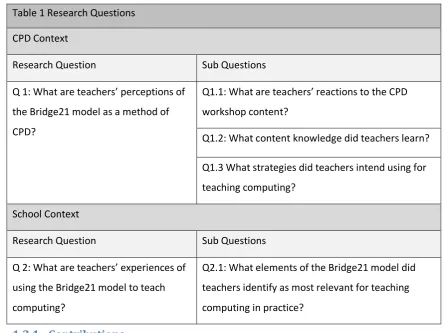
[image:18.595.87.533.359.692.2]Sentance and Csizmadia (2017a) suggest that teachers need assistance in preparing to teach computing. The creation of a new primary school Coding curricula (NCCA, 2018c) in addition to a lower secondary short in Coding (NCCA, 2014a) and the roll out of an upper secondary advanced curricula in Computer Science (NCCA, 2018c) across Ireland, make it imperative to understand what supports teachers need to introduce and teach computing in schools. The adaptation of the Bridge21 model as a CS CPD method generates an opportunity to investigate what impact a collaborative, project-based, and student-centred approach to professional learning plays in equipping teachers with the content knowledge, confidence, and expertise to teach computing. Two research questions are explored in this dissertation. The first question explores teachers’ perception of the CPD offering, including reactions to the content, teacher perceptions of their learning and intentions to use the content in teaching CS. The second question explores teachers’ experiences of using what they learned in the form of the Bridge21 model and the CPD content to teach CS in schools (Table 1).
Table 1 Research Questions CPD Context
Research Question Sub Questions
Q 1: What are teachers’ perceptions of the Bridge21 model as a method of CPD?
Q1.1: What are teachers’ reactions to the CPD workshop content?
Q1.2: What content knowledge did teachers learn? Q1.3 What strategies did teachers intend using for teaching computing?
School Context
Research Question Sub Questions
Q 2: What are teachers’ experiences of using the Bridge21 model to teach computing?
Q2.1: What elements of the Bridge21 model did teachers identify as most relevant for teaching computing in practice?
1.2.1
Contributions
6 that a the Bridge21 approach to professional learning acts as a method for equipping teachers with the computing content knowledge, the practical expertise, and the confidence to teach computing.
The second contribution emerged from research conducted with a self-selecting sub-sample of N = 385 teachers who attended the CPD on their experience in schools. The results provide evidence of teachers using the Bridge21 model elements of facilitation, collaborative learning, and contextualised learning tasks. The results also provide insights into barriers (lack of technical infrastructure and further assistance with lesson planning) as well as successes, with teachers self-reporting an observed increase in student engagement though applying the Bridge21 model.
Finally, a third contribution comes through adapting Kirkpatrick’s (1994) work to create a theoretical framework to explore teacher reactions and perceptions of their learning and the impact that the CPD had on teaching computing in schools. Chapter 3 provides a theoretical overview of the Bridge21 CS CPD context and workshop design, with chapter 5 describing each of the instruments.
Bridge21 CS CPD Programme
1.3
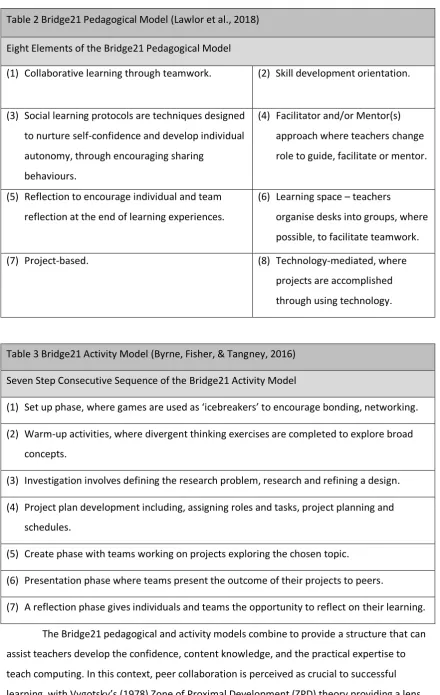
Bridge21 is a social constructivist model of 21st Century Teaching and Learning developed in TCD (Lawlor, 2016), which is used by post-primary teachers to encourage collaborative, team-based, technology-mediated learning in their subject teaching (Lawlor et al., 2018). The Bridge21 pedagogical model contains eight elements (Table 2, p. 7), which combine to create collaborative, project-based, technology-mediated teaching and learning experiences. A Bridge21 learning experience seeks to encourage students to work collaboratively to complete tasks, with facilitators interacting with students, and asking questions, to nurture individual autonomy. Bridge21 learning experiences involve teachers switching role from that of leader, to the role of mentor and guide, with students encouraged to take individual responsibility for their learning (Lawlor et al., 2018).
7 Table 2 Bridge21 Pedagogical Model (Lawlor et al., 2018)
Eight Elements of the Bridge21 Pedagogical Model
(1) Collaborative learning through teamwork. (2) Skill development orientation.
(3) Social learning protocols are techniques designed to nurture self-confidence and develop individual autonomy, through encouraging sharing
behaviours.
(4) Facilitator and/or Mentor(s) approach where teachers change role to guide, facilitate or mentor.
(5) Reflection to encourage individual and team reflection at the end of learning experiences.
(6) Learning space – teachers
organise desks into groups, where possible, to facilitate teamwork.
(7) Project-based. (8) Technology-mediated, where
projects are accomplished through using technology.
Table 3 Bridge21 Activity Model (Byrne, Fisher, & Tangney, 2016) Seven Step Consecutive Sequence of the Bridge21 Activity Model
(1) Set up phase, where games are used as ‘icebreakers’ to encourage bonding, networking. (2) Warm-up activities, where divergent thinking exercises are completed to explore broad
concepts.
(3) Investigation involves defining the research problem, research and refining a design. (4) Project plan development including, assigning roles and tasks, project planning and
schedules.
(5) Create phase with teams working on projects exploring the chosen topic.
(6) Presentation phase where teams present the outcome of their projects to peers.
8 through which to explore the role of collaboration in equipping teachers with the confidence, knowledge and practical expertise to teach computing. Vygotsky (1978) describes the ZPD as the “distance between the actual developmental level as determined by independent problem solving and the level of potential development as determinedthrough problem solving under
adult guidance or in collaboration with more capable peers” (1978, p. 87). Vygotsky’s (1978) formulation of ZPD theory proposes that knowledge is socially constructed and is further strengthened through meaningful problem solving in collaboration with more knowledgeable peers. Bridge21 learning experiences are structured to support the social construction of knowledge through peer collaboration. The researcher draws from ZPD theory to explore the role of peer collaboration as a method for equipping teachers with the confidence,
pedagogical content knowledge, and expertise to teach computing.
Trinity College Dublin (TCD) is using the Bridge21 pedagogical model in a CS CPD programme. This programme is designed for in-service primary and post-primary teachers planning to teach computing. Teachers can select computing workshop modules covering computing concepts including Computational Thinking, Programming, and Hardware. Each computing workshop uses the Bridge21 pedagogical model in its delivery, with teachers learning computing through working together to complete computing activities, collaborating on projects, and completing technology-mediated tasks supported by their peers (TCD, 2017).
Evaluation Theory and CPD Evaluation
1.4
Worthern (1968) argues that it is difficult to evaluate the impact that educational theories have on professional learning interventions in a CPD context. Stake (1983a) suggests that researchers should use models to help clarify the educational theory that is to be evaluated. Stufflebeam (1983) shares the view that models are essential for guiding evaluation designs that are used to evaluate the role that theory plays in social programmes. Cronback (1983a) further advises that researchers should use models to evaluate theory as it relates to programme performance, which is a view shared by Guskey (2000), who argues strongly for using models in CPD evaluations to create links between teacher experiences, teacher feedback and the development of programme outcomes.
9 transform practice. Further evaluation models created by Stake (1983b), Stufflebeam (1983) and Scriven (1991b) propose that evaluations provide an opportunity to explore the impact of CPD programmes on teacher professional practice over time. Guskey (2000) and Kirkpatrick (1994) provide evaluation models which explore links between CPD learning outcomes and ‘on the job performance’. Having reviewed each of these models, the researcher shares the view proposed by Bernthal (1995), who argues that Kirkpatrick is distinct from other models in its simplicity and capacity to explore learning transfer from one context to another.
1.4.1
Adapting Kirkpatrick to Evaluate Bridge21 CS CPD Programme
Kirkpatrick (1994) provides a four level evaluation framework which links learner perception with their experience of applying training in context. Kirkpatrick (1994) describes his four level framework as “a sequence of ways to evaluate programs. Each level is important. As you move from one level to the next, the process becomes more difficult and time consuming, but it also
provides more valuable information. None of the levels should be bypassed simply to get to the
level that the trainer considers the most important” (p. 21). Table 4, p. 9 – 10, provides a description of the Kirkpatrick (1994) framework, and a definition of each level in the sequence in the order in which they are used. Implementing Kirkpatrick involves a mixed methods approach to data collection (Mosson et al., 2019; Wang & Chang, 2019), with Broad (1997) providing guidelines for exploring self-assessed or self-reported learning.
Table 4 Kirkpatrick (1994) Levels Training Environment Context
Level Description Purpose Kirkpatrick (1994) definition 1 Reactions Participant
reactions to the training.
“Evaluation on this level measures how those who participate in the program react to it. I call it a
measure of customer satisfaction” (Kirkpatrick, 1994, p. 21).
2 Learning Learning in terms of changes in attitudes, skills and knowledge.
Evaluation on this level explores the “extent to which participants change attitudes, improve
knowledge, and / or increase skill as a result of
10 Table 4 Kirkpatrick (1994) Levels continued
Work Place Context
Level Description Purpose Kirkpatrick (1994) definition 3 Behaviours Changes in
behaviour as a result of attending the training.
Evaluation on this level explores “the extent to which change in behaviour has occurred because
the participant attending the training program” (Kirkpatrick, 1994, p. 22).
4 Results Impact of the training on job performance and outcomes.
“Results can be defined as the final results that occurred because the participants attended the
program” (Kirkpatrick, 1994, p. 22).
Kirkpatrick’s (1994) four level framework has been previously applied in a CPD context to explore teacher perceptions of their teaching performance (Naugle, Naugle, & Naugle, 2000), teacher perceptions of their learning outcomes (Coldwell & Simkins, 2011) and student perceptions of their learning outcomes (Lawless & Pellegrino, 2007). The Kirkpatrick (1994) level framework has also been used to evaluate CPD in General Medicine (Shen, Yufe, Saadatfard, Sockalingam, & Wiljer, 2017), Dentistry (Ratka‐Krüger et al., 2018), Pharmacy (Kheir & Wilbur, 2018), and Surgery (Dort et al., 2018). Moreover, Smidt, Balandin, Sigafoos, and Reed (2009) argue that “the Kirkpatrick model provides one technique for appraisal of the evidence for any reported training program and could be used to evaluate whether a training
program is likely to meet the needs and requirements of both the organisation implementing
the training and the staff who will participate” (p. 266).
A perceived strength of Kirkpatrick (1994) is its ease of implementation, its ability to explore knowledge ‘transfer ’and behavioural change and the impact of the training on practice as well as its capacity to link learning with performance. Broad (1997) further argues that Kirkpatrick provides the capacity to explore change in learning outcomes over time. The adaptation of the Bridge21 model as a CS CPD method generates an opportunity to adapt Kirkpatrick (1994) to explore what impact a collaborative approach to professional learning plays in equipping teachers with the content knowledge, the confidence and practical and professional expertise to teach computing over time.
11 the model as well as highlight opportunities and perceived threats to implementation
(Humphrey, 2005). Arguments for adapting the Kirkpatrick (1994) model rest with its perceived simplicity, with researchers able to adapt each level to organisational needs. Weaknesses include the difficulty in addressing causality between levels (Holton, 1996), accommodating summative and formative forms of assessment (Bates, 2004), and limited opportunities to adapt the model once implemented (Kaufman, Keller, & Watkins, 1996). Table 5 SWOT Analysis applied to Kirkpatrick (1994)
Strengths What is “good in the present?” (Humphrey, 2005, p. 7)
Guskey (2000) argues that a strength lies in its “simplicity and practicality which has made it the foundation of training programme evaluations in
business around the world” (p. 55).
Weaknesses What is “bad in the present?” (Humphrey, 2005, p. 7)
Bates (2004) argues that a weakness is its inability “to effectively address both the summative question (Was training effective?) and the formative
question (How can training be modified in ways that increase its potential for
effectiveness?)” (p. 341).
Opportunity What is “good in the future?” (Humphrey, 2005, p. 7)
Coldwell and Simkins (2011) suggest that the model provides the capacity to explore ‘knowledge transfer’ from one context to another, with further ‘levels’ exploring the demonstration of learning in a practical and professional context.
Threats What is “bad in the future?” (Humphrey, 2005, p. 7)
Kaufman et al. (1996) caution that “the threat, which flows from misuse, comes from the fear that performance data will be used for blaming and not
for fixing or learning” (p. 8).
12 through attending the training as well as self-reported experiences of using the content in the work place (Naugle et al., 2000).
Methodological Approach
1.5
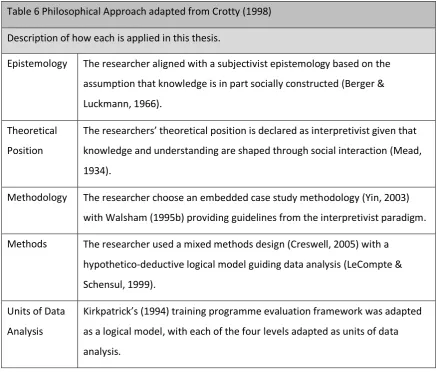
This section provides the theoretical approach underpinning the design of the research methodology, which will be applied to answer the research questions (Table 6). Crotty (1998) suggests that researchers consider using a framework to represent the choice making process used to formulate the research design. Crotty (1998) continues that “the justification of our choice and particular use of methodology and methods is something that reaches into the
assumptions about reality that we bring to our work. To ask about these assumptions is to ask
[image:25.595.65.504.385.758.2]about our theoretical perspective” (p. 2). While criticised for forcing the researcher to commit early to making philosophical decisions (Barkway, 2001), such a framework proves useful for helping to clarify relationships between Epistemological Beliefs and the Theoretical Position, the Methodological Perspective, Research Methods, and Units of Data Analysis. What follows is an adaptation of Crotty’s (1998) framework showing connections between the theories and methods applied in this thesis.
Table 6 Philosophical Approach adapted from Crotty (1998) Description of how each is applied in this thesis.
Epistemology The researcher aligned with a subjectivist epistemology based on the assumption that knowledge is in part socially constructed (Berger & Luckmann, 1966).
Theoretical Position
The researchers’ theoretical position is declared as interpretivist given that knowledge and understanding are shaped through social interaction (Mead, 1934).
Methodology The researcher choose an embedded case study methodology (Yin, 2003) with Walsham (1995b) providing guidelines from the interpretivist paradigm. Methods The researcher used a mixed methods design (Creswell, 2005) with a
hypothetico-deductive logical model guiding data analysis (LeCompte & Schensul, 1999).
Units of Data Analysis
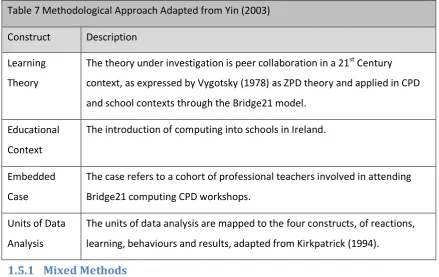
13 The philosophical approach informs the selection of the research methodology (Table 7). Having declared as an interpretivist, what follows is a summary of the justification for the use of an embedded case study methodology (Yin, 2003) applied from an interpretivist position (Walsham, 1995b). The rational for selecting this philosophical approach and associated methods is provided in section 4.1. An embedded case study methodology and underlying design proposed by Yin (2003) provided an overarching framework enabling the researcher to link learning theory to the educational context, the context with the case, and the case to units of data analysis.
Table 7 Methodological Approach Adapted from Yin (2003) Construct Description
Learning Theory
The theory under investigation is peer collaboration in a 21st Century context, as expressed by Vygotsky (1978) as ZPD theory and applied in CPD and school contexts through the Bridge21 model.
Educational Context
The introduction of computing into schools in Ireland.
Embedded Case
The case refers to a cohort of professional teachers involved in attending Bridge21 computing CPD workshops.
Units of Data Analysis
The units of data analysis are mapped to the four constructs, of reactions, learning, behaviours and results, adapted from Kirkpatrick (1994).
1.5.1
Mixed Methods
Having set out the parameters of an embedded case study methodology, this section makes the case for using a mixed methods approach to data collection. A mixed methods approach to data collection facilitates the synthesis of mixed methods data sets (Creswell, 2005), with statistical results providing indicators which inform the development of qualitative
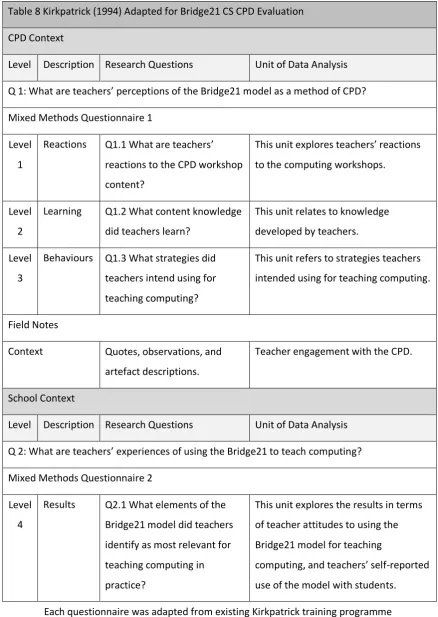
14 Table 8 Kirkpatrick (1994) Adapted for Bridge21 CS CPD Evaluation
CPD Context
Level Description Research Questions Unit of Data Analysis Q 1: What are teachers’ perceptions of the Bridge21 model as a method of CPD? Mixed Methods Questionnaire 1
Level 1
Reactions Q1.1 What are teachers’ reactions to the CPD workshop content?
This unit explores teachers’ reactions to the computing workshops.
Level 2
Learning Q1.2 What content knowledge did teachers learn?
This unit relates to knowledge developed by teachers. Level
3
Behaviours Q1.3 What strategies did teachers intend using for teaching computing?
This unit refers to strategies teachers intended using for teaching computing.
Field Notes
Context Quotes, observations, and artefact descriptions.
Teacher engagement with the CPD.
School Context
Level Description Research Questions Unit of Data Analysis Q 2: What are teachers’ experiences of using the Bridge21 to teach computing? Mixed Methods Questionnaire 2
Level 4
Results Q2.1 What elements of the Bridge21 model did teachers identify as most relevant for teaching computing in practice?
This unit explores the results in terms of teacher attitudes to using the Bridge21 model for teaching
computing, and teachers’ self-reported use of the model with students. Each questionnaire was adapted from existing Kirkpatrick training programme instrumentation (Kirkpatrick, 2007). A self-selecting sample of N = 1,215 teachers attending N
15 = 819 teachers completing a corresponding post-workshop questionnaire, generating N = 1,112 completions, achieving a workshop response rate of 92%. A further self-selecting sample of N = 385 teachers who attended at least one computing workshop between January 2014 and June 2018, and had given consent to be contacted, were invited to complete a follow-up questionnaire exploring teaching computing in schools. Questionnaire data from N = 64 teachers was processed, generating a 17% response rate.
1.5.2
CS CPD Workshop Questionnaire Variables
The first mixed methods questionnaire was completed by teachers at the start and at the end of each CPD workshop. The questionnaire contained Likert scales exploring demographics, and teacher reactions to the workshop content, teacher perception of the learning outcomes, and teacher intentions to use elements of the Bridge21 model. A further qualitative section asked teachers to report on key learnings taken from the workshop, perceived use of the workshop content in teaching, and intended changes to practice as a result of attending the CPD.
Appendix 9.4, 9.5 and 9.6 provide the variable tables outlining question design and mapping to Kirkpatrick (1994).
1.5.3
Teaching Computing in Schools Questionnaire Variables
The second mixed methods questionnaire was completed by teachers, ranging between six months to five years since last attending a CPD computing workshop. Part one of the
questionnaire contained ethics, background, and consent information as well as demographics questions, covering primary/secondary teachers attending the CPD and computing within the curriculum. The first section of the questionnaire explored Bridge21 elements used for teaching CS with subsequent sections exploring perceived barriers to using the Bridge21 model; other methods used for teaching CS, and areas of the Bridge21 model requiring further CPD. A second section explored teaching computing in schools covering examples from teachers reporting on use of the Bridge21 model and its impact on student engagement in a computing context. Appendix 9.11 provides the variable tables outlining the scales and question mapping to the Kirkpatrick (1994) model.
Analytical Approach
1.6
16 removed from their original context (Blumer, 1969). Hypothetico-deductive analytical models start from a position of theory (Lincoln & Guba, 1985) which in this case is the use of the Bridge21 model as a CS CPD method.
1.6.1
Processing Quantitative then Qualitative Data
LeCompte and Schensul (1999) suggest identifying categories to be addressed through analysis. Kirkpatrick’s (1994) training programme evaluation framework levels were adapted as categories or units of data analysis. Having established categories to organise data collection, LeCompte and Schensul (1999) then suggest establishing procedures to process quantitative and qualitative data sets. In the case of quantitative results, the researcher calculated the sum, mean and percentages values from Likert scaled results (Oppenheim, 2000). Percentage values are given as representations or indicators which are used to gauge positive and negative responses against each Likert variable (Joshi, Kale, Chandel, & Pal, 2015). Cronbach (1951) Alpha Coefficient values were calculated for each Likert scale to provide an estimate of the reliability or consistency of scale items. Further statistical analysis using the Wilcoxon (1945) signed rank text was performed on pair matched pre and post learning outcome results to explore the ‘significance’ of the difference reported between medians, pre and post, and therefore confirming an increase or decrease between learning scores.
1.6.2
Comparative (Pattern) Coding of Quantitative Data
LeCompte and Schensul (1999) recommend using a comparative coding process known as pattern coding to reduce large qualitative data sets into meaningful clusters. Pattern coding is used to compare and merge concepts into themes. Having established initial themes,
LeCompte and Schensul (2013) advise repeating coding within each theme (Stadler, 2004) to accommodate merging and to allow for the emergence of contrasting themes. Pattern coding enabled the researcher to add new codes, remove old codes, and merge existing codes given that “codes will change and develop as field experience continues” (Miles & Huberman, 1994, p. 61). The re-coding process also involved the re-categorisation of the data into new themes or for existing themes to be removed from the data set.
1.6.3
Validity Framework
Having defined the processes used to analyse the data, the researcher faces a further
17 Kirkpatrick (1994), with levels mapped to the research questions, then units of data analysis mapped to each of the research instruments. Yin (2003) then suggests using logical models to establish internal validity.
The researcher followed a hypothetico-deductive approach to data analysis with percentages and themes used to demonstrate internal validity through providing the capacity for theoretical abstraction. Yin (2003) then recommends choosing a methodology, which can be replicated to establish external validity. The researcher applied Yin’s (2003) embedded case study design as the methodology, and used Yin’s (2003) case study protocol to structure reporting. Cronbach (1951) Alpha Coefficient values were calculated for each Likert scaled items which provides an estimate of the reliability and consistency of a scale, with pattern coding used to generate themes from text analysis (LeCompte & Schensul, 1999). The Wilcoxon (1945) signed rank test used to verify the statistical significance of the change in median values reported between pre and post-workshop learning outcome results.
Summary Findings
1.7
The adaptation of the Bridge21 model as a CS CPD method generates an opportunity to understand what impact a 21st Century approach to CS CPD (covering facilitator led,
collaborative, project-based and technology-mediated learning) plays in equipping teachers with the content knowledge, confidence, and expertise to teach computing. Two research questions were designed to examine teacher perceptions and experiences of collaborative CS CPD (Table 1, p. 5).
The Bridge21 CPD workshops brought teachers together to learn computing and to develop practical expertise in planning programming activities for use in teaching. Encouraging teachers to learn as part of a team, motivated teachers to seek assistance from peers to clarify concepts or to demonstrate procedures, with facilitators on hand to moderate the social exchange of ideas, practices, and concepts and to ensure that teachers obtained answers to their questions. Working in a team also created an opportunity for teachers to share prior content knowledge as well as to ask for help from colleagues where content knowledge gaps emerged, with teachers also reacting positively to the workshops and leaving with a practical understanding of computing concepts.
18 revealed needing more time to develop deeper content knowledge and more time to develop CS activities, with further research needed to explore the longer-term impact of using the Bridge21 model in schools.
Teachers who used Bridge21 to teach CS in their classrooms reported students being more confident in learning together and taking control of their learning. Teacher attitudes towards teaching computing were also reported as positive, with teachers empowered to teach computing and motivated to share computing expertise with colleagues. Teachers provided examples demonstrating use of the Bridge21 model as a method for increasing student engagement, with teachers facilitating students in teams demonstrating projects and confidently discussing the outcome of computing projects with peer groups. However, teachers indicated the need for further assistance with evaluating, planning, and implementing computing learning experiences and future activities.
To conclude, these findings show that a facilitator driven, collaborative, technology-mediated and project-based approach to CS CPD supports the process of equipping teachers with the content knowledge, the technical expertise, and the confidence to teach CS. The CPD results confirm that the Bridge21 pedagogical and activity models provide a scaffolding structure capable of assisting teachers develop the confidence, the content knowledge, and the practical expertise to teach computing. Teachers enjoyed the freedom to learn with colleagues and the opportunity to explore how computing content and teaching methods covered in a CPD context can be applied in a classroom context. Recommendations include more CPD activities covering core programming concepts, expanding modules to cover advanced topics, and investing in building CS communities, which support teachers in a classroom, school, and national capacity.
The above findings combine to produce three research contributions. The first contribution emerged through constructing an evidence base from research conducted with a self-selecting sample of N = 1,215 teachers attending Bridge21 CPD computing workshops over a five year period (from January 2014 until June 2018). These results confirm that a Bridge21 approach to professional learning acts as a process which can help to equip teachers with content knowledge, and the confidence to teach computing using a collaborative, and project-based approach.
The second contribution emerged from research conducted with a self-selecting sub-sample of N = 385 primary and post-primary and teachers who attended the CPD and are now involved in teaching computing in schools. These results provide evidence of teachers
19 of facilitation, collaborative learning, and contextualised learning tasks to engage students in computing. These results provide insights into barriers (lack of technical infrastructure, time to practice programming and further assistance with lesson planning) as well as successes, with teachers self-reporting an observed increase in student engagement though applying the Bridge21 model.
A third contribution comes through adapting the Kirkpatrick (1994) training
programme evaluation framework as a methodology for exploring teacher perceptions and their experiences of a facilitated, collaborative, technology-mediated, project-based approach to professional development in a computing context. Adapting the Kirkpatrick framework provided a structure for investigating teacher perceptions and experiences of 21st Century CS CPD in schools in Ireland.
Road Map
1.8
The chapters that follow describe the steps followed to review the literature and construct research questions, design a research intervention, apply methods of analysis and produce research findings.
Chapter 2: Literature Review
This chapter contains the methodology supporting the development of the literature review as well as a discussion of four themes, which emerged through evaluation and analysis. The first theme explores use of technology in education, investigating the applied use of technology in STEM and CS teaching. The second theme explores learning and teaching programming, with analysis examining emerging strategies for teaching programming. The third theme examines the role of professional development and its application in STEM and CS contexts. The fourth and final theme examines programme evaluation theory design and methods, both applied in a STEM professional development context and within CS professional leaning programmes. Chapter 3: Bridge21 CS CPD Context
20 Chapter 4: Methodological Approach
This chapter summarises the philosophical approach structured according to Crotty’s (1998) framework, which links theories of reality and knowledge to field work. An embedded case study methodology was used to structure fieldwork (Yin, 2003), with a mixed method design guiding data collection (Creswell, 2005) and Kirkpatrick’s (1994) four level evaluation
framework adapted as units of data analysis linked to research instruments. A description of the embedded case study methodology is provided, including Yin’s (2003) protocols which were followed to collect data from CPD and school contexts. The remaining sections cover instrument design, data collection including ethics, and the validity framework applied to data. Chapter 5: Analytical Framework
This chapter covers data analysis procedures and provides the logical model and the data processing techniques used to analyse quantitative and qualitative data sets. The first three sections cover theory and processes used to analyse quantitative and qualitative data sets. Having explored general theories, the particular strategies used for processing quantitative and qualitative data sets in this thesis are discussed, covering the mapping used to link instruments and data sets to the Kirkpatrick (1994) model as well as the algorithms that were used to process each of the data sets collected in CPD and school contexts.
Chapter 6: Findings
This chapter presents the research findings in full, placing them in context with the problem statement and organised under each of Kirkpatrick’s (1994) four evaluation levels which were adapted as units of data analysis. The first part explores the research findings, which were gathered from self-selecting samples of teachers attending Bridge21 CS CPD computing workshops. The second part examines findings, which were gathered from self-selecting samples of teachers reporting on their experience of using the Bridge21 model to teach CS in a school context, with teachers providing examples of the models impact on student learning. Chapter 7: Discussion
This chapter explores the findings in context, revisiting the research questions, the research contributions, recommendations for further research and limitations. The discussion is organised according to the research questions, and starts by revisiting the problem statement and rational for teaching computing. The aims and objectives of the Bridge21 CS CPD
21
2
Literature Review
This literature review aims to understand what issues teachers face in preparing to teach computing. Sentance and Csizmadia (2017a) identify computing as a difficult topic to teach and highlight two professional challenges impacting teachers in their computing preparation. Thus the first challenge concerns understanding what assistance teachers need to develop computing content knowledge (M. Webb et al., 2017) and the second challenge relates to helping teachers develop the confidence to use relevant methods for teaching computing topics including programming (Caspersen, 2018). With teachers in Ireland facing the challenge of preparing to teach CS, this review implements a methodology designed to identify what supports teachers need to prepare for teaching CS.
This chapter provides a description of the process followed to develop the theoretical rational for designing research questions and methods used to explore teachers perceptions and experiences of a particular model of 21st Century CS CPD. The first section covers the methodology used to source and analyse literature included for evaluation and review. Four themes emerged through the literature evaluation process. The first theme explores the use of technology in an educational context and implications for teachers integrating technology into STEM and CS lessons. The second theme examines barriers to learning and teaching
programming, and explores proposals for teaching strategies to make programming content and processes accessible to learners. The third theme explores the role of professional development and its function in preparing teachers to teach computing and programming content .The fourth theme examines programme evaluation theory, with the aim of identifying models that are used for evaluating CDP programmes in computing.
Literature Review Methodology
2.1
A literature review presents an analysis of research in order to extend our understanding of a particular topic. It involves analysing theories to reveal a lack of theory or to explain the use of theory in a different context (Booth, Sutton, & Papaioannou, 2016). Literature review
methodologies help the researcher build a strong theoretical base for designing research (Rowe, 2014). It is against the content of the literature review that the researcher confirms or rejects theories based on their relevance (Littell, Corcoran, & Pillai, 2008). Thus care must be taken to select a literature review methodology which helps the researcher develop their theoretical claims (Cooper, 2010).
22 category uses statistical frameworks to compare and aggregate quantitative results (Paré, Trudel, Jaana, & Kitsiou, 2015). The second category uses thematic frameworks to code and cluster related topics into general themes (Onwuegbuzie & Weinbaum, 2017). The third category combines statistical and thematic analysis (Arrowsmith, Lau‐Walker, Norman, & Maben, 2016). Each methodology aims to help the researcher make sense of concepts through a systematic process, with meta-synthesis providing a framework to explore statistical and thematic content (Whittemore & Knafl, 2005).
What differentiates meta-synthesis from other literature review methodologies is the capacity to combine qualitative and quantitative results (Coorey, Neubeck, Mulley, & Redfern, 2018). The meta-synthesis process involves using comparison to merge concepts into themes (Noblit & Hare, 1988). Originally established as a technique for generating theory (Phillips, Koehler, Rosenberg, & Zunica, 2017), Stern and Harris (1985) adapted meta-synthesis as a process for developing explanatory models (Teague & Roe, 2008). Examples include using meta-synthesis to generate metaphors (Tom, 2015) and themes (Melcer & Isbister, 2018) as well as new theoretical models (Melcer & Isbister, 2018) with Tondeur et al. (2012) arguing for expanding qualitative meta-synthesis to include statistical analysis. The researcher adapted a meta-synthesis methodology based on the rational provided by Tondeur et al. (2012) and Coorey et al. (2018) who call for analysing statistics and themes to provide a balanced view.
2.1.1
Meta-Synthesis Methodology
The rational for choosing a meta-synthesis methodology was based on the need to use a framework capable of merging quantitative and qualitative results. Traditionally, literature reviews are constructed to analyse qualitative or quantitative results, following particular procedures, which govern the syntheses of themes or the aggregation of statistical results. Given the requirement to explore themes and statistics together, the researcher adapted an existing literature review methodological approach (qualitative meta-synthesis) which provides the capacity to facilitate the retrieval, evaluation, and the ‘meta’ synthesis of qualitative themes and quantitative results.
23 literature screening and evaluation procedures applied to retrieved content. The third phase involved meta-synthesis, consisting of coding and theming retrieved results, and the fourth involved the construction of a conceptual model.
The first step involved developing a search strategy (Table 9). The search strategy was constructed through deconstructing keywords in the problem statement into Boolean
operators (AND, OR, NOT). Boolean terms were entered across educational and computing databases (TCD online library, ERIC, ACM, IEEE, Sage Journals Online, Science Direct, Taylor and Francis, and JSTOR), with saved searches and alerts activated to capture new publications. Table 9 Search Strategy Applied to Databases
Educational (AND) Technology (AND) Information, Communication, Technologies (AND), In-Service, Post-Primary, Teaching, 21st Century Teaching and Learning; (AND) Teaching (AND) Learning (AND) Computer Science (AND) Programming; (AND) Collaboration (AND) Continuing Professional Development (AND) Programme Evaluation (AND) Theory (AND) CPD Evaluation.
The researcher followed what Bujaki and Richardson (1997) call a ‘citation trail’, with search results returning initial citations linking to further citations. Literature from peer reviewed journals and conference papers as well as monographs in English were included, with non-peer reviewed literature excluded from further review. The search parameters for full text papers was set to capture citations published between 2000 and 2018, with the timeline extended to 1900 for monographs. Chen (2017) confirms that a twenty-year period provides suitable scope for exploring changes in theory over time. The search strategy returned N = 1,973 items. Cooper (2010) defines literature reviews as providing exhaustive, exhaustive with selective citation, representative, central or pivotal reports. The researcher defines this review as providing ‘representative’ coverage of computing education themes, which includes a ‘sample that typifies larger groups of articles’ (Cooper, 2010, p. 110).
24 theories. The researcher followed this process for five years, corresponding with time spent in the field. This process generated N = 1,324 items.
The researcher then adapted evaluation criteria used by Atkins et al. (2008) to explore theoretical links between retrieved papers. Using the markers of ‘Yes’, ‘No’ or ‘Unclear’, helped the researcher further reduce the data set to N = 612 items, with the researcher then using visual mapping software to cluster papers sharing the same theoretical approach into groupings. Appendix 9.15 provides a series of visual maps which show themes which emerged from analysing the literature. These themes became headings which were used to structure the literature review. Acknowledging bias in the coding and theming process (Coombs, 1994), the researcher re-evaluated papers during literature searching, with more relevant papers replacing less relevant papers (Lincoln, 2002). Concept mapping also enabled the researcher to create a visual representation of themes, which emerged through analysis (Appendix 9.15).
Four themes emerged through using the meta-synthesis methodology (Table 10). The first theme examined the educational use of technology and strategies for using technology to enrich STEM and CS teaching. The second theme explored perceived barriers to learning and teaching computing, and strategies for teaching programming. The third theme examined professional development in general and in a STEM and CS context. The fourth theme investigated evaluation theory, covering frameworks used in CPD programme evaluation, including STEM and CS CPD. These themes formed the structure of the literature review. Table 10 Meta-Synthesis Model and Procedure
Section Sub-Themes Section Themes
2.2.1 Technology Enhanced STEM Teaching 2.2 Theme 1 - Educational Technology Context 2.2.2 Factors Influencing Teaching Computer
Science
2.3.1 Current Strategies for Teaching Programming
2.3 Theme 2 - Learning and Teaching Programming 2.3.2 Emerging Strategies for Teaching
Programming
2.4.1 STEM Professional Development 2.4 Theme 3 - Professional Development in STEM and CS
2.4.2 Computer Science Professional Development
2.5.1 Evaluating STEM Professional Development 2.5 Theme 4 - Programme Evaluation Design and Methods
25
2.1.2
Limitations
Structuring the literature review using meta-synthesis, helped the researcher to obtain good understanding of broad issues related to the problem area (Cooper, 2010). Using this methodology, the researcher was able to explore broad concepts in the quantitative and qualitative literature, before proceeding to take a more in-depth look at specific issues. This approach proved crucial in so far that the researcher had qualifications in librarianship, information analysis, and technology enhanced learning as well as twenty-five years professional experience as a technology analysist, but lacked the practical experience of teaching computing in schools. In summary, a ‘meta-synthesis’ approach to coding and theming concepts in the literature, familiarised the researcher with domain-based issues before starting work on the design of the study methodology (Noblit & Hare, 1988).
Educational Technology Context
2.2
Teaching in the 21st Century is perceived as exciting and challenging. Teachers face the initial challenge of integrating technology in lessons and the subsequent challenge of using methods which involve students taking more responsibility for their learning (Henriksen & Mishra, 2018). Significant developments in learning theory have been made since Skinner (1968) initially experimented with using technology to assist students learn procedural knowledge and further proposed using computers as teacher replacements for presenting content to students (Skinner, 1961). A new paradox has emerged, with teachers now spending more time supervising students using technology, while teachers are struggling to maintain the balance between teaching, and using technology to enhance student learning (Comi, Argentin, Gui, Origo, & Pagani, 2017).
Advancements in educational technologies have created new opportunities for teachers to design learning activities, which involve students taking more responsibility for their learning (Admiraal et al., 2017; Avidov-Ungar & Forkosh-Baruch, 2018). One example can be seen through teachers using projects to encourage students to use technology to bring together information from different sources around a theme (Atherton, 2018). Integrating technology into learning activities is complex (i.e., Boulton, 2017; J. Harris, Phillips, Koehler, & Rosenberg, 2017; Kale, 2018) and one of the difficulties teachers may encounter is a lack of confidence (Pareja Roblin et al., 2018).
26 making choices (B. Kim, Park, & Baek, 2009). Thus teachers are looking for help to integrate technology into teaching in ways which enable students to lead in learning activities (Esteve-Faubel, Martin, & Junda, 2018). Teachers are seeking help to design tasks, which enable students to master skills, which enable them to learn independently, and exercise choice making (Angeli, 2013; Laurillard, 2013; Little, 1995).
There are a number of educational frameworks, which can help teachers integrate technology into teaching. Some of the most well-known are 21st Century Learning frameworks such as the SAMR model (Puentedura, 2006), the P21 Framework (2017) or the UNESCO ICT Competency Framework for Teachers (2011). The SAMR model provides guidelines for teachers seeking to enhance teaching through using technology-mediated tasks (Puentedura, 2006). While the P21 Framework (2017) includes lesson plans for teachers intending to develop activities which involve students using technology to complete tasks such a searching for information or creating technology artefacts. The UNESCO ICT Competency Framework for Teachers (2011) provides overarching policy direction for governments and their educational systems seeking to integrate technology into teaching and learning. Both the SAMR, and P21 Framework in particular, as well as the other 21st Century learning frameworks evaluated by Dede (2010) support the integration of technology into teaching and provide teachers with a way to combine facilitation, projects and teamwork into lessons, with the aim of equipping students with the skills and confidence to learn independently.
Over the past forty years, the educational use of technology has evolved considerably (Mishra & Henriksen, 2018). For example, students are perceived as confident users of digital technologies, with students using mobile technologies and internet resources to communicate with peers and interact with a technology-mediated world (Zawacki-Richter & Latchem, 2018). However, in contrast to this, teachers are struggling with integrating technology into their teaching (Henriksen, Richardson, & Mehta, 2017). In other work contexts, the integration of technology into everyday jobs ranges from improving productivity to disrupting the traditional paradigm (Bevan, Brinkley, Cooper, & Bajorek, 2018). However the same cannot be said for teaching, with Gil-Flores, Rodríguez-Santero, and Torres-Gordillo (2017) asking why are teachers still struggling with integrating technology into their teaching and Olofsson, Lindberg, and Fransson (2017) calling for more research to understand what supports teachers need to become confident users of technology and empowered in the classroom use of digital tools.
27 technology is not a new phenomenon (N. Davis et al., 1997; Duval, Sharples, & Sutherland, 2017; Passey, 2006). Twenty years ago (1997) predicted that teachers would use technology to reduce the time that was spent presenting content to their students through “additional or alternative source of knowledge and information” (p. 15). Ten years later Passey (2006) cautions that there is a “clear need for teachers to know how each form of ICT (Information Communication Technology) supports precise aspects of learning in each subject area, topic
and activity” (p. 139). Today teachers are still exploring how to integrate technology i