Forfás
Forfás, its Sister
Agencies and Advisory
Councils
Functions
Forfás Board Members
Chairman’s Statement
Chief Executive’s Report
Overview
Activities in 2003
The Irish National
Accreditation Board
Statutory Obligations
Forfás Management
Structure and Advisory
Councils
Reports Published by
Forfás 2003–2004
Financial Statements
>
>
>
>
>
>
>
>
>
>
>
>
>
Forfás is the national
policy and advisory board
for enterprise, trade,
science, technology
and innovation.
To the Minister for Enterprise, Trade and Employment
Pursuant to the Industrial Development Act, 1993, Forfás herewith presents its report and accounts for the year ended December 31 2003.
Do Aire Fiontar, Trádála agus Fostaíochta
De bhun an Achta um Fhorbairt Tionscail, 1993, tá a thurascáil agus a chuntais don bhlian dar chríoch 31 Nollaig, 2003, a dtíolacadh leis seo ag Forfás.
Peter Cassells
Chairman
Martin Cronin
FORFÁS PROVIDES RESEARCH SUPPORT & SECRETARIAT
SCIENTIFIC
RESEARCH
INWARD
INVESTMENT
IRISH OWNED
ENTERPRISE
ENTERPRISE TRADE SCIENCE TECHNOLOGY INNOVATION
THE NCC REPORTS TO THE TAOISEACH ON KEY COMPETITIVENESS ISSUES
THE EGFSN ALSO REPORTS TO THE MINISTER FOR EDUCATION AND SCIENCE
Department of the Taoiseach
Roinn an Taoisigh
ADVISORY COUNCILS
Forfás
Mission Statement
To lead the development of public policy for
the promotion of enterprise and technological
development in Ireland for the benefit of all by:
advising on policy to sustain competitiveness
and growth; and
supporting and maintaining cohesion among
the development agencies of the Department
of Enterprise, Trade and Employment.
Note: Illustrative Chart Only
>
Réamhrá
Is é Forfás an bord náisiúnta um polasaí agus comhairle le haghaidh fiontraíochta, trádála, eolaíochta, teicneolaíochta agus nuála. Is é an comhlacht é a bhfuil comhactaí dlíthiúla an stáit maidir le cur chun cinn tionscail agus forbairt teicneolaíochta dílsithe ann. Is é an comhlacht é freisin trína dtiomnaítear cumhachtaí ar Fhiontraíocht Éireann le tionscail dúchais a chur chun cinn agus ar ghníomhaireacht Forbartha Tionscail na hÉireann (GFT Éireann) le hinfheistíocht isteach sa tír a chur chun tosaigh.
Is iad feighmeanna Fhorfáis:
>
comhairle a chur ar an Aire ó thaobh cúrsaí a bhaineann le forbairt tionscail sa Stát;>
comhairle maidir le forbairt agus comhordú polasaithe a chur ar fáil d’Fhiontraíocht Éireann, d’GFT Éireann, Fondúireacht Eolaíochta Éireann agus d’aon fhoras eile dá leithéid (a bunaíodh go reachtúil) a d’fhéadfadh an tAire a ainmniú trí ordú;>
forbairt na tionsclaíochta, na teicneolaíochta, na margaíochta agus acmhainní daonna a spreagadh sa Stát;>
bunú agus forbairt gnóthas tionsclaíoch ón iasacht a spreagadh sa Stát ; agusFunctions
Forfás is the national policy and advisory board for enterprise, trade, science, technology and innovation. It is the body in which the State’s legal power for industrial promotion and technological development have been vested. It is also the body through which powers are delegated to Enterprise Ireland for the promotion of indigenous industry and to IDA Ireland for the promotion of inward investment. Science Foundation Ireland was established as a third agency of Forfás in July 2003.
The broad functions of Forfás are to:
>
advise the Minister on matters relating to the development of industry in the State;>
advise on the development and co-ordination of policy for Enterprise Ireland, IDA Ireland, Science Foundation Ireland and such other bodies (established or under statute) as the Minister may by order designate;>
encourage the development of industry, technology, marketing and human resources in the State;>
encourage the establishment and development in the State of industrial undertakings from outside the State; and> > > > > > > > > > > > > > > > > > > > > > > > > > > > > > > > > > > > > > > > > > > > > > >ENTERPRISE
>
>TRADE >SCIENCE>TECHNOLOGY >INNOVATION>>
Contents
Forfás Board Members
6
Chairman’s Statement
7
Chief Executive’s Report
11
Overview 17
Activities in 2003
27
The Irish National Accreditation Board
50
Statutory Obligations
52
Forfás Management Structure and Advisory Councils 55
Reports Published by Forfás 2003– 2004
63
1 2 3 4
5 6 7 8 9
10 11 12 13
14
1 Peter Cassells
Chairman
2 Martin Cronin
Chief Executive, Forfás
3 Sean Dorgan
Chief Executive, IDA Ireland
4 Paul Haran
Secretary General, Department of Enterprise, Trade and Employment
5 Dr William Harris1 Director General, Science Foundation Ireland
6 Prof. Michael Hillery
Emeritus Professor of Engineering, University of Limerick
7 Rody Molloy
Director General, FÁS
8 William Murphy
Partner, Tynan Dillon and Company
9 Feargal O’Rourke
Partner, Taxation, Pricewaterhouse Coopers
10 Frank Ryan2
Chief Executive, Enterprise Ireland
11 Dr Don Thornhill3
Chairman, Higher Education Authority
12 Toni Wall
Managing Director, Wall 2 Wall Ltd
13 Jane Williams
Managing Director, The Sia Group Ltd
14 Michael O’Leary
Secretary to the Board
Dan Flinter resigned from the Board with effect from 21 October 2003
8 William Murphy
Chairman
1 Peter Cassells
6 Prof. Michael Hillery
13 Jane Williams
14 Michael O’Leary
Secretary to the Committee
The dislocation suffered by those who lose out
to competition and technological change can
be tackled with policies to equip people with
new skills and training required for the next
generation of enterprise.”
“
Peter Cassells
The Irish economy is going through a period of transition. Technological change and competition for investment and jobs from lower cost locations are intensifying. This presents great opportunities and challenges for Ireland’s economy and society. The downside of these developments can be all too clear. Many industrial activities that prospered until recently in Ireland have succumbed to technological obsolescence or competition from lower cost locations. During the 1990s, less than seven per cent of jobs in companies supported by the enterprise development agencies were lost each year. Since 2000, the rate of job loss has increased to almost 11 per cent, placing strains on individuals, their families and wider communities.
We must also realise how change can enrich our society and raise our living standards. While many jobs have been lost over the past 10 years, even more higher-skilled and better-paid jobs have been created. Our successful integration in the global economy has banished the twin economic scourges of the 1980s – involuntary emigration and unemployment. International competition has encouraged our efforts to increase efficiency across the economy through organisational change and technological innovation, which enabled our growth in living standards. Greater economic dynamism has increased resources for investment in public services. The dislocation suffered by those who lose out can be tackled with policies to equip people with new skills and training required for the next generation of enterprise. In this sense, a competitive and dynamic economy and social progress are two sides of the same coin.
Our strategy going forward must be informed by the certainty that overseas competition and technological change will continue to intensify. There is little reason to suspect that the pace of industrial restructuring and job turnover will ease. As some industries mature and decline, the emergence and growth of others will be required to replace them. This is the nature of modern economies.
But this process does not always happen automatically. Ireland’s own experience in the 1980s, and the experience of other countries and regions more recently, shows that when key industries go into decline there is no guarantee that they will be replaced by others that offer equal opportunities for employment and wealth creation.
This is why the work of Forfás and the development agencies is more important today than ever before. In today’s world, our only long term security is our ability to anticipate and adapt to change. Only when the State, industry and social partners work closely together to shape Ireland’s response to competition and technological change across a range of public policies can we be confident that the globalisation process will work in our favour.
“
“ As some industries mature
and decline, the emergence
and growth of others will be
required to replace them.
This is the nature of modern
economies.”
It is also appropriate during
Ireland’s Presidency to comment
on the important role that the
EU co-operation can play in
supporting jobs and prosperity
in Ireland and the other
In 2003, the Forfás management team and staff continued to play a pivotal role in this regard, most notably by advising on and co-ordinating joint State-industry initiatives in a range of areas including:
>
The introduction of a tax credit for industry investment in research and development;>
Measures to reduce inflation and halt the decline in our costcompetitiveness;
>
The development of long-term strategies for the provision ofskills pivotal to our move towards a knowledge economy;
>
Measures to support the commercialisation of publicly-fundedresearch; and
>
The identification of significant opportunities in the digital content industry for Irish-based companies.On May 1 2004, under the watch of Ireland’s Presidency of the European Council, the European Union (EU) will take on ten new members in the largest and most ambitious expansion in the Union’s 50-year history. This enlargement marks a historic unification of Europe and its peoples.
It is also a great economic opportunity for Ireland. We must look past the short-term competitive pressure that enlargement will pose for a small number of sectors of Irish industry, and seek to take advantage of the longer-term opportunities from the creation of the world’s largest single market in goods and services. Instead of seeing EU enlargement to the east as increasing Ireland’s peripherality at the edge of Europe, we should see ourselves as occupying a strategic position at the centre of a large and growing transatlantic market in goods and services.
It is also appropriate during Ireland’s Presidency to comment on the important role that EU co-operation can play in supporting jobs and prosperity in Ireland and the other Member States. The EU Lisbon Agenda, agreed in 2000, set out a programme of actions for the European Community and its Member States in the fields of scientific research, infrastructure investment, innovation and entrepreneurship, all designed to make Europe the most competitive knowledge-based economy in the world by 2010. In 2003, Forfás worked intensively with the Department of Enterprise, Trade and Employment to shape and exploit EU initiatives in the areas of infrastructure, skills and scientific research, and trade to support the needs of Irish industry and workers.
Acknowledgements
During 2003, Forfás received significant support from the Taoiseach, Mr Bertie Ahern, T.D., from the Tánaiste and Minister for Enterprise, Trade and Employment, Ms Mary Harney, T.D., and from other Government Ministers and Departments in carrying out its work. I wish to take this opportunity to acknowledge this substantial support and its expression in the range of Government policies and publications aimed at the further development of the enterprise sector in Ireland.
As Chairman, I would like to express my thanks and appreciation to my fellow Board Members, in particular Mr Dan Flinter who retired from the Board in October. Dan has been at the forefront of the promotion and development of Irish enterprise for over a decade and he has made an extraordinary and lasting contribution. I would also like to take this opportunity to welcome Dr William Harris, Dr Don Thornhill and Mr Frank Ryan, who were appointed to the Board of Forfás during the year.
In July 2003 the Industrial Development (Science Foundation Ireland) Act 2003 was passed, establishing Science Foundation Ireland on a statutory basis. Until then Science Foundation Ireland (SFI) had operated as a sub-committee of Forfás. I would like to thank Mr Brian Sweeney who guided SFI while it was a committee of Forfás. I would also like to take this opportunity to thank the Chairperson of the Board of SFI, Dr Patrick Fottrell, the Board and staff of SFI and wish them every success in their endeavours as they move forward with their agenda to build a globally competitive scientific and engineering research base in support of Ireland’s long-term competitiveness.
I also want to thank many other organisations which contributed to the work of Forfás during the year, in particular the members of the following groups:
>
The Irish National Accreditation Board (INAB), chaired by Dr Máire C.Walsh>
Discover Science and Engineering, chaired by Mr Leo Enright>
The Expert Group on Future Skills Needs (EGFSN), chaired by Dr Daniel O’Hare>
The Irish Council for Science, Technology and Innovation (ICSTI), chaired by Dr Edward Walsh>
The National Competitiveness Council (NCC), chaired byDr O’Hare stepped down as Chairperson of the EGFSN in late 2003 and I would like to take this opportunity to recognise his substantial and valuable contribution to national skills planning and development during his four year Chairmanship. Ms Anne Heraty has been appointed as his successor for a period of three years.
Finally, I want to thank Mr Martin Cronin, the Chief Executive, his management team and staff for their continued dedication and hard work throughout the year. Independent customer feedback from a range of public and private sector stakeholders confirms the high esteem in which Forfás and its staff are held, in terms of their professionalism, responsiveness and intellectual rigour. During 2003 Forfás reiterated its commitment to the modernisation agenda over the term of the Sustaining Progress Agreement and set in place plans to ensure that it continues to successfully meet its clients’ needs. I am confident that the Forfás team can make substantial contributions towards the goal of moving Ireland to the next stage of its economic and social development.
Peter Cassells
Chairman
We must place a sharp focus on enterprise
policy in 2004 and respond to radically changed
domestic and global economic environments.
The past 10 years brought an unprecedented
rate of change in both the domestic cost base
and the number of competitors for trade
and investment.”
“
Martin Cronin
“ Against the background of
a fragile global economy,
the Irish enterprise sector
displayed an impressive
degree of resilience and
flexibility in 2003.”
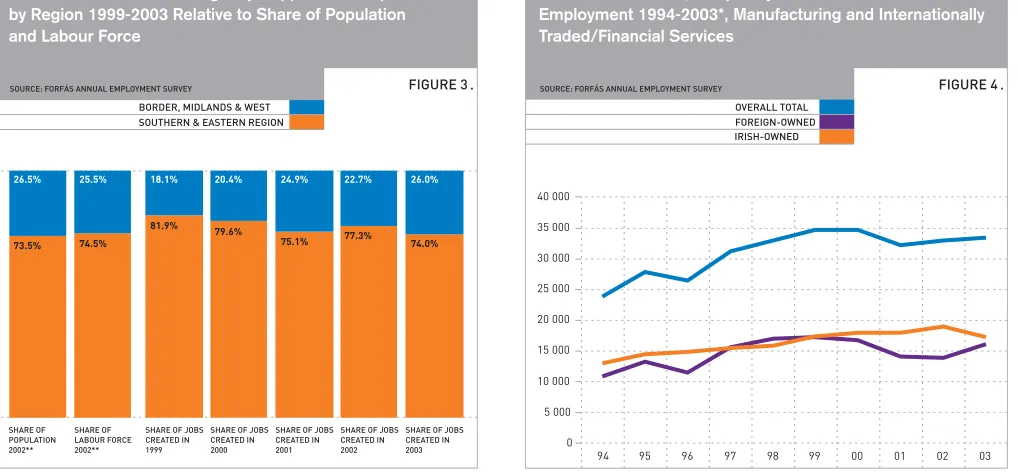
The balance of employment between Dublin and the regions has remained fairly static over the past number of years, with Dublin accounting for just less than one third of total employment among agency-supported companies. The Border, Midlands and West (BMW) region has, however, increased its share of job gains in recent years. In 1999 the BMW region accounted for 18.1 per cent of gross job gains in agency-assisted companies. This share increased to 26 per cent in 2003, which is more in line with the region’s share of population (26.5 per cent). As other jobs have been lost there has been a slight decrease (from 25 per cent in 1999 to 23.9 in 2003) in the share of overall employment in agency-supported companies in the BMW region.
The manufacturing sector accounted for all of the net decrease in agency-supported employment in 2003. Within the internationally traded services sector, job gains and losses were in balance, with 8,500 job gains and losses. In contrast, there were 14,000 jobs created in manufacturing, but they were more than outweighed by losses of 21,500. The computer and electronics sector accounted for almost half of the net decrease. The textile sector and the paper and printing sector also witnessed significant net decreases in employment with approximately 1,000 jobs being lost in each.
The decline in overall employment by Ireland’s industrial sectors reflects three principal factors:
>
Weak demand for goods manufactured in Ireland from our majortrading partners, particularly during the first half of the year.
A weak global trade recovery in 2002 was followed by a near stagnation of trade flows in the first six months of 2003, reflecting slow growth in OECD countries and in particular Western Europe. EU imports of telecoms and office equipment (including computers) – a key Irish export – declined by 9 per cent in 2002 and further in 2003. Uncertainty about global economic prospects further
Economic Overview
Against the background of a fragile global economy, the Irish enterprise sector displayed an impressive degree of resilience and flexibility in 2003. Gross National Product (GNP) grew by an estimated 3 per cent last year, over three times the average EU growth rate and up from near zero growth in 2002. Overall employment levels in the economy rose by over 44,000 to 1.82 million during the year and unemployment fell to 4.6 per cent in the final quarter. This was a particularly strong performance given that most developed countries experienced falls in employment during the same period.
Ireland’s economic expansion in 2003 was led by growth in domestic consumption, infrastructure investment and house-building. This meant that the employment growth took place in the public sector, private services and the construction industry, rather than in the more export-oriented industrial sectors supported by the enterprise development agencies.
>
Increasing competition for investment projects from low-cost Asian and central and eastern European locations.Foreign Direct Investment (FDI) inflows to central and eastern Europe last year reached an historic high of over $30 billion. FDI flows to the Asia-Pacific region also increased marginally, from $95 billion in 2002 to $99 billion in 2003. Of this, $57 billion went to China, marking another record for that country. In the 1990s, China’s trade growth was three times faster than global trade and between 2000 and 2002 its exports and imports rose by 30 per cent, while world trade stagnated.
The emergence of China and other low cost locations has transformed international competition for global trade and investment flows, and not just for labour-intensive assembly operations. Many of these countries are offering special low rates of corporation tax and other direct incentives. They have an increasingly sophisticated skills supply to attract mobile FDI flows, thereby impacting the competitive advantage that Ireland has held for several decades on these dimensions. There is now a growing track record of medium to high-end manufacturing and services activities across the value chain – from research, design through manufacturing, marketing and sales – in countries that were previously regarded as being too under developed for these activities.
>
The high cost of doing business in Ireland.As domestic costs rose during the 1997-2001 period, the cost competitiveness of our manufacturing and internationally trading services industries was protected only by a weak currency. The euro appreciation by 21 per cent against the U.S. dollar and eight per cent against UK sterling over 2003 means, however, that this artificial support for national competitiveness has now been removed.
According to the Central Bank, the price level in Ireland is now 12 per cent above the EU average. Ireland’s cost competitiveness, taking into account both exchange rate developments and the higher rate of inflation in Ireland vis-à-vis our major trading partners, disimproved by 14 per cent between 1999 and 2003. Ireland’s high costs arise from an over-shoot of prices and wages and the increasing cost of key business inputs, such as insurance, energy and waste.
Ireland’s Future Competitive Challenge
There are now clear signs of an international economic recovery, with growth gathering pace in the United States, Asia and, more recently, Europe. While there remain some risks, most economists are predicting a substantial pickup in world trade and investment in 2004. This is favourable to an export-oriented country like Ireland. Exploiting this opportunity requires Irish policy-makers and industry leaders to tackle three challenges.
>
Firstly, sustaining and growing existing industries in Ireland will require Irish policy-makers and social partners to reverse the decline in cost competitiveness through a sustained commitment to policies that deliver a rate of inflation below that of our main trading partners.This could be achieved through a combination of wage moderation, a vigorous competition policy, increased public sector efficiency, better land planning and a budgetary policy that eschews raising indirect taxes.
Recovering Ireland’s cost competitiveness must be the first, but not the sole, priority of the broader economic strategy. The changed domestic and global economic context suggests that Ireland’s decade-old enterprise policy formula, based around the advantages of a plentiful supply of skilled labour, a broadly attractive and moderate cost business environment, access to the single European market, macroeconomic stability and a favourable tax regime, may no longer suffice in sustaining the competitiveness and growth of the internationally trading sectors.
>
In this regard, a second challenge facing Irish policy-makers is the need to continue Ireland’s transition to a more dynamic, enterprising and productive economy by putting in place coherent and consistent policies in the areas of education, entrepreneurship, enterprise development, research and innovation. Our priority should be to reinforce the development of higher skill, innovation-driven activities in which our firms can be major players and can build truly distinctive competencies.Ireland is already a major player in many areas of business with long-term potential including, for example, communications software, medical devices, food ingredients and financial services. Future enterprise policy should be organised around the need to support these and other sectors that can continue to prosper in the Irish business environment. We can achieve this through the provision of well designed and responsive regulatory and taxation systems, through adequate alignment of our investments in scientific research and technologies of importance to enterprise, and through a higher education system that provides the most excellent and relevant education and training.
>
Finally, moving Ireland to the next stage of economic development is not solely the job of Government, as many of the actions required are outside the remit of policy-makers.There is also an agenda for, among others, industry associations, trade unions, universities and the managers of individual Irish firms. Irish managers need to consistently orient company strategies towards greater levels of innovation and the provision of higher value goods and services. This will require development of greater market understanding and selling skills, closer collaboration with universities and research institutes and increased investments in R&D, skills, modern production and logistics technology and IT. This approach is necessary to develop business advantages through innovation that are less vulnerable to competition from low cost countries.
Activities of Forfás
In 2003, Forfás undertook policy research and initiatives to address many of these challenges. We provided research and logistical support to the Enterprise Strategy Group, established by the Tánaiste, Ms Mary Harney, T.D. and chaired by Mr Eoin O’Driscoll. The Group is reviewing Ireland’s Enterprise Strategy in the context of the opportunities and challenges likely to arise over the next decade, to formulate a vision and strategy which will enable Ireland to consolidate and build on the successes of the past ten years. Forfás has devoted considerable resources during 2003 to assisting the Group in its work and it is anticipated that its report will be completed by mid 2004.
Other key initiatives in 2003 aimed at addressing these challenges in which Forfás played a significant role include:
>
The introduction of an R&D tax credit for enterprise;>
The development of broadband communications in Ireland, particularly in relation to the reduction of costs and increasing the availability of services in regional locations;>
The development of long-term strategies for the provision of skills pivotal to our move towards a knowledge economy;>
Identification of priorities for research and innovation; for example, our ability to translate research into commercial success and the creation of an environment which proactively supports knowledge and innovation driven activity;These and previous policy initiatives are making the Irish business environment more attractive to increasingly complex and skilled activities – activities that in turn support better jobs throughout the country that are less vulnerable to overseas competition. 2003 has provided considerable evidence of this with Ireland being selected as the location of choice for knowledge driven businesses such as Google, Pfizer, ABB and eBay. Irish companies such as Cape Technologies, DigiSoft.tv, Vistamed and many others are also successfully engaging in high skill activities here.
Much has been achieved over the past decade. Incomes and living standards have improved; unemployment has been dramatically reduced; significant progress has been made in the provision of national infrastructure; public debt is now amongst the lowest in the EU and we have created a solid foundation of internationally-trading companies. This is an excellent position from which to tackle the challenges which have begun to emerge. If we act now to promote enhanced competitiveness the Irish economy will be well placed to take advantage of a global economic recovery. Only in this way will Ireland generate the wealth required to address wider economic and social development.
Forfás has been involved in a large number of projects addressing a wide variety of issues during 2003, with the objective of making a substantial contribution to the development of public policy for the promotion of enterprise and technological development in Ireland. I would like to thank all the staff of Forfás for their hard work, dedication and professionalism in working towards this goal.
Martin Cronin
Chief Executive
Employment in Agency-Supported
Companies
Total full-time employment in companies under the remit of IDA Ireland, Enterprise Ireland, Shannon Development and Údarás na Gaeltachta amounted to 297,500 in 2003, a decrease of almost 7,500 on the previous year. 2003 is the third year running in which there has been a net decrease in employment in agency-supported companies. This has resulted in 19,000 less jobs in manufacturing and internationally-traded services compared to the peak employment level of 316,500 recorded in 2000. It should be noted, however, that employment in these agency-supported companies is still one third higher than it was at the start of the ten year period shown in
Figure 1when employment stood at 224,000.
The net decrease of 7,500 jobs in 2003 comprises a net job loss of 4,250 in foreign-owned companies and a net job loss of 3,250 in Irish-owned companies. Employment in foreign-owned
companies in manufacturing and international services stood at just under 150,000 at the end of 2003. This is 15,000 less than its recent peak level reached in 2000 but is still 42,000 (40 per cent) higher than the number employed at the start of the ten year period. Employment among Irish-owned companies in manufacturing and international services amounted to 148,000 at the end of 2003. This is 5,000 less than its recent peak level reached in 2001 but is still more than 30,000 (26 per cent) higher than the number employed at the start of the ten year period examined in Figure 1.
Figure 2highlights some of the dynamic underlying the net change in employment. Just over 22,500 jobs were created in manufacturing and internationally-traded services in 2003 but these job gains were offset by job losses of 30,000 during the same period. The manufacturing sector accounted for all of the net decrease in employment in 2003. Within internationally-traded services, job gains and losses balanced each other out with approximately 8,500 job gains and the same number of job losses. In contrast, there were approximately 14,000 jobs created in manufacturing but these were more than outweighed by job losses of 21,500. The computer/electronics sector accounted for almost half of this net decrease. The textile sector and the paper and printing sector also witnessed significant net decreases in employment with approximately one thousand jobs being lost in both sectors.
Figure 2shows that the net decrease in employment from 2001 onwards is in marked contrast to the situation that pertained in the latter half of the 1990s when gross job gains surpassed job losses by a significant margin. The difference between gains and losses reached its peak in 2000 when gross job gains of 45,000 far exceeded the job losses of 21,000 recorded in that year.
Job Gains, Losses and Net Change in Permanent Full-Time Employment 1994-2003, Manufacturing and Internationally Traded/Financial Services
SOURCE: FORFÁS ANNUAL EMPLOYMENT SURVEY FIGURE 2 . GROSS JOB GAINS
NET CHANGE GROSS JOB LOSSES
-30 000 -20 000 -10 000 0 10 000 20 000 30 000 40 000 50 000 23,034 26,146 28,173 30,524 32,227 35,983 44,874 29,816 27,446 22,769
-15,973 -15,486 -15,599 -14,502 -17,746 -21,501 -20,873 -30,119 7,061 10,660 12,574 16,022 14,481 14,482 24,001 -3,775 -7,889 -7,350
Permanent Full-Time Employment 1994-2003 Manufacturing and Internationally Traded/ Financial Services
[image:19.595.46.550.527.781.2]Regional Distribution of Employment
Creation
Figure 3shows the distribution of jobs created in agency-supported companies between the Southern and Eastern Region (Objective 1 in Transition) and the Border, Midlands and West region4. The Border, Midlands and West (BMW) region has tended in the past to perform less satisfactorily than the rest of the country in terms of increasing and sustaining its employment in manufacturing and internationally-traded services.
The chart shows that the BMW region accounts for 26.5 per cent of the population and 25.5 per cent of the labour force. In 1999, the region accounted for 18.1 per cent of gross job gains in agency-assisted companies. In 2003, this share had increased to 26.0 per cent which is more in line with the region’s share of population.
Given that other jobs have been lost at the same time, there has been a slight decrease in the share of overall employment in agency-supported companies in the BMW region during the period examined. The BMW region accounted for 25.0 per cent of total employment in 1999 and this dropped to 23.9 per cent in 2003.
Part-Time, Temporary and Short-Term
Contract Employment
In addition to the 297,500 persons employed full-time in manufacturing and internationally traded services, 33,500 persons were also employed in part-time, temporary and short-term contract positions in 2003. Employment in this category has grown over the last decade and now accounts for just over 10 per cent of all jobs in agency-supported companies. Taking the two categories of employment together (permanent full-time and temporary/part-time), there are now 331,000 persons employed in agency-supported companies, up from 248,000 in 1994.
4The regional divide used is the classification used by the European Union for regional aid
purposes. The counties in the Southern and Eastern region are Dublin, Kildare, Meath, Wicklow, Carlow, Kilkenny, Waterford, Wexford, Cork, Kerry, Clare, Limerick and Tipperary. The Border, Midlands and West region accounts for the other 13 counties.
Trends in Part-Time, Temporary and Short-Term Contract Employment 1994-2003*, Manufacturing and Internationally Traded/Financial Services
*Excludes companies under the remit of Shannon Development
SOURCE: FORFÁS ANNUAL EMPLOYMENT SURVEY FIGURE 4 . OVERALL TOTAL
FOREIGN-OWNED IRISH-OWNED
94 95 96 97 98 99 00 01 02 03
5 000 0 10 000 15 000 20 000 25 000 30 000 35 000 40 000
Share of Jobs Created in Agency-Supported Companies by Region 1999-2003 Relative to Share of Population and Labour Force
SOURCE: FORFÁS ANNUAL EMPLOYMENT SURVEY FIGURE 3 . BORDER, MIDLANDS & WEST
SOUTHERN & EASTERN REGION
26.5% 73.5% SHARE OF POPULATION 2002** 25.5% 74.5% SHARE OF LABOUR FORCE 2002** 18.1% 81.9%
SHARE OF JOBS CREATED IN 1999
20.4%
79.6%
SHARE OF JOBS CREATED IN 2000
24.9%
75.1%
SHARE OF JOBS CREATED IN 2001
22.7%
77.3%
SHARE OF JOBS CREATED IN 2002
74.0%
26.0%
SHARE OF JOBS CREATED IN 2003
[image:20.595.45.554.474.710.2]Expenditure by Agency-Supported Firms
in the Irish Economy
Data relating to the direct expenditure of agency-supported companies in 2002 were compiled by Forfás and the agencies concerned (IDA Ireland, Enterprise Ireland, Shannon Development and Údarás na Gaeltachta) during 2003. These data highlight the contribution made by agency-supported companies to the economy by way of their direct expenditure on payroll costs, Irish raw materials and services purchased in Ireland.
In overall terms, agency-supported companies spent €34.2
billion in the Irish economy in 2002. This is made up of €10.8 billion on payroll costs, €14.4 billion spent on raw materials produced in Ireland and €9.0 billion on Irish-supplied services
(energy, telecommunications etc.). Table 1shows that both the
aggregate output and expenditure of agency-supported companies were relatively flat between 2001 and 2002. This mirrors other indicators of general economic activity and contrasts sharply with the situation in the late 1990s when the output and expenditure of these companies were increasing at double-digit rates.
Irish-owned firms accounted for €16.7 billion of the total expenditure of €34.2 billion in 2002 and foreign-owned firms accounted for the
other €17.5 billion. Expenditure by Irish-owned firms within the
Irish economy equated to 71 per cent of sales in 2002 whereas expenditure by foreign-owned firms equated to 23 per cent of its reported output. This is accounted for by the fact that Irish-owned firms are more likely to source their raw materials within Ireland and is also a reflection of the very high reported sales figures of some foreign-owned companies in sectors such as chemicals and electronics.
Direct Expenditure of Agency-Supported Firms in the Irish Economy
SOURCE: ANNUAL BUSINESS SURVEY OF ECONOMIC IMPACT, CO-ORDINATED BY FORFÁS AND ADMINISTERED BY THE SURVEY UNIT, ESRI TABLE 1 .
SALES €M 23,371 23,588 74,461 75,753 97,832 99,341 1.5 %
PAYROLL COSTS €M 4,495 4,616 6,311 6,224 10,806 10,840 0.3 %
IRISH RAW MATERIALS €M 8,790 8,878 5,708 5,497 14,498 14,375 - 0.9 %
IRISH SERVICES €M 3,173 3,183 5,774 5,772 8,947 8,955 0.1 %
DIRECT EXPENDITURE IN THE ECONOMY €M 16,458 16,677 17,793 17,493 34,251 34,170 -0.2 %
DIRECT EXPENDITURE AS % SALES % 70.4% 70.7% 23.9% 23.1% 35.0% 34.4% –
FOREIGN-OWNED FIRMS ALL FIRMS
IRISH-OWNED FIRMS
2001 2002 2001 2002
Corporation Tax Payments
In addition to their expenditure in the economy, manufacturing and internationally-traded services companies provide a very significant direct return to the Exchequer by way of corporation tax payments.
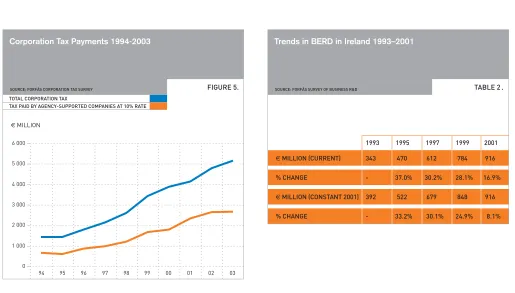
The total corporation tax yield from all sources was €5.2 billion in 20035, an increase of 7.5 per cent on the previous year. It is estimated that agency-supported companies paying tax at the 10 per cent rate (including companies in the International Financial Services Centre [IFSC ]) accounted for €2.7 billion (52 per cent) of this total.
Corporation Tax Payments 1994-2003
SOURCE: FORFÁS CORPORATION TAX SURVEY FIGURE 5. TOTAL CORPORATION TAX
TAX PAID BY AGENCY-SUPPORTED COMPANIES AT 10% RATE
94 95 96 97 98 99 00 01 02 03
0 1 000 2 000 3 000 4 000 5 000 6 000
€MILLION
5Source: Exchequer Returns for 2003 – Department of Finance
Business Expenditure on Research
and Development (BERD)
Table 2and Figure 6present details on the aggregate level of BERD in Ireland from 1993 to 2001. From this it can be seen that a total of €916.8 million was spent on R&D activity in Ireland in 2001 by the business sector. This represents a growth in nominal figures of 167 per cent between 1993 and 2001. In constant 2001 terms the 1993 base is €392 million. This means that there has been a real growth in BERD of 134 per cent over the period in question. It is clear that very high levels of growth were recorded in the early to mid 1990s – biennial rates of the order of 30 per cent.
Trends in BERD in Ireland 1993–2001
TABLE 2 .
€ MILLION (CURRENT) 343 470 612 784 916
% CHANGE - 37.0% 30.2% 28.1% 16.9%
€ MILLION (CONSTANT 2001) 392 522 679 848 916
% CHANGE - 33.2% 30.1% 24.9% 8.1% 1993 1995 1997 1999 2001
[image:22.595.40.555.428.721.2]Figure 7presents information on R&D expenditure broken down by industrial sector. Five main sectors accounted for as much as 85 per cent of BERD in 2001. These were: Electrical & Electronic equipment (37.5 per cent); Software & Computer related activities (27.5 per cent); Pharmaceuticals (7.7 per cent); Instruments (6.5 per cent); Food, Drink & Tobacco (5.5 per cent).
This growth rate slowed somewhat between 1997 and 1999 (to 25 per cent) and stood at 8 per cent in real terms between 1999 to 2001 (representing a nominal growth of 17 per cent over that period). It is clearly difficult to sustain biennial growth rates comparable to the levels experienced in the early 1990s, coming off such a rapidly expanding base.
[image:23.595.46.551.254.511.2]Trends in Business Expenditure on Research & Development 1993-2001, in constant and current prices
FIGURE 6 .
CURRENT PRICES €M CONSTANT PRICES €M
93 343 392
522
679
848
784
917
612
470
95 97 99 01
0 200 400 600 800 1 000
€ MILLION
SOURCE: FORFÁS SURVEY OF BUSINESS R&D
ELECTRICAL + ELECTRONICS INSTRUMENTS SOFT/COMPUTER
OTHER SECTORS FOOD, DRINK & TOBACCO PHARMACEUTICALS
FIGURE 7.
BERD = €916.8 M
27.5% 37.5%
6.5%
15.3% 5.5% 7.7%
Distribution of BERD in 2001 by main sector
Higher Education Expenditure on Research and Development, as a percentage of GNP, 1990-2000
SOURCE: FORFÁS SURVEY OF R&D IN THE HIGHER EDUCATION SECTOR FIGURE 8. HERD IN CONSTANT 2000 PRICES €MS
HERD IN CURRENT PRICES €MS % GNP
90 92 94 96 98 00
0 50 100 150 200 250
81
63
112
093
141
121
171
153
219
204
238
HERD AS A PERCENTAGE OF GNP
0.20% 0.26% 0.29%
0.30% 0.30% 0.27% €MILLION
Higher Education Research Expenditure (HERD) analysed by performer 1994–2000, (€M)
SOURCE: FORFÁS SURVEY OF R&D IN THE HIGHER EDUCATION SECTOR TABLE 3 .
UNIVERSITIES 099.4 082% 129.8 085% 169.2 083% 191.6 081%
PROGRAMMES IN ADVANCED TECHNOLOGY 016.0 013% 016.9 011% 021.0 010% 022.4 009%
INSTITUTES OF TECHNOLOGY 005.7 005% 006.4 004% 013.5 007% 024.0 010%
TOTAL (HERD) 121.1 100% 153.1 100% 203.7 100% 238.1 100%
HERD (CONSTANT PRICES) 140.8 – 170.7 – 218.6 – 238.1 –
1994 1996
€M % €M %
1998 2000
€M % €M %
Research and Development in the Higher
Education Sector
Table 3shows the total expenditure on R&D in the Higher Education sector (HERD) and the distribution between the main R&D performers for the period 1994 to 2000. The total expenditure
on HERD reached €238 million in 2000.
The universities are the dominant performers of R&D and continue to account for just over 80 per cent of HERD in 2000 and 90 per cent if the Programmes in Advanced Technologies (PATs) are included. The Institutes of Technology increased their relative share of HERD to a level of 10 per cent in 2000. This continues a strong growth since 1996. In contrast the PATs continued a slow decline in terms of their relative share of HERD which is now at 9 per cent.
Figure 8illustrates the trends in expenditure since 1990. Expenditure
on HERD reached €238 million in 2000, up from €204 million in
1998. This represents a real increase of 9 per cent over the period 1998 to 2000, or a real annual growth rate of 4.4 per cent. This compares with a real increase of 82 per cent over the period 1994 to 2000, equivalent to a 9.2 per cent real annual growth rate.
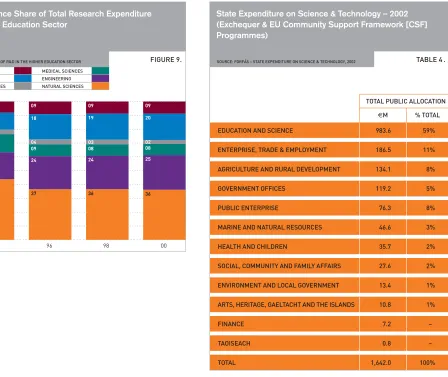
Expenditure on R&D was recorded in six broad fields of academic activity; these are Natural Sciences, Engineering, Social Sciences, Humanities, Medical Sciences and Agricultural Sciences. All six fields experienced real increases in expenditure over the six-year period to 2000. The most significant increase occurred in Social Sciences which increased its relative share of total R&D expenditure from 13 per cent in 1994 to 20 per cent in 2000. The relative share of Natural Sciences decreased from 44 per cent in 1994 to 36 per cent in 2000. Relative shares of other fields remain broadly unchanged between 1998 and 2000. These findings are depicted in Figure 9.
State Expenditure on Science
and Technology, 2002
The Forfás annual publication State Expenditure on Science & Technology shows that Government allocations to scientific and technological activities in 2002 amounted to €1,884.3 million, an increase of €191.4 million, or 11.3 per cent over 2001 levels.
This is accounted for by an increase in public funds (Exchequer & EU), which rose from €1,464 million in 2001 to an allocation of
€1,642 million in 2002. The balance of €242 million arises from
[image:25.595.98.546.348.725.2]income earned from the activities of the Departments and agencies.
FIGURE 9. HUMANITIES SOCIAL AGRICULTURAL SCIENCES MEDICAL SCIENCES ENGINEERING NATURAL SCIENCES 08 13 02 94 09 24 37 18 09 04 96 09 24 36 03 19 08 98 09 25 20 36 08 02 00 010 000 020 030 040 050 060 070 080 090 100 10 22 44
Field of Science Share of Total Research Expenditure in the Higher Education Sector
SOURCE: FORFÁS SURVEY OF R&D IN THE HIGHER EDUCATION SECTOR
State Expenditure on Science & Technology – 2002 (Exchequer & EU Community Support Framework [CSF] Programmes)
TABLE 4 .
EDUCATION AND SCIENCE 983.6 59%
ENTERPRISE, TRADE & EMPLOYMENT 186.5 11%
AGRICULTURE AND RURAL DEVELOPMENT 134.1 8%
GOVERNMENT OFFICES 119.2 5%
PUBLIC ENTERPRISE 76.3 8%
MARINE AND NATURAL RESOURCES 46.6 3%
HEALTH AND CHILDREN 35.7 2%
SOCIAL, COMMUNITY AND FAMILY AFFAIRS 27.6 2%
ENVIRONMENT AND LOCAL GOVERNMENT 13.4 1%
ARTS, HERITAGE, GAELTACHT AND THE ISLANDS 10.8 1%
FINANCE 7.2 –
TAOISEACH 0.8 –
TOTAL 1,642.0 100%
€M % TOTAL TOTAL PUBLIC ALLOCATION
SOURCE: FORFÁS – STATE EXPENDITURE ON SCIENCE & TECHNOLOGY, 2002
The Department of Enterprise, Trade and Employment increase reflects a build up in expenditures to Forfás to fund Science
Foundation Ireland which was up €32.7 million in 2002 over the
2001 outturn (€2.3 million). Additional funding from the Department of Education and Science relates to expenditures under the Programme for Research in Third Level Institutions. The Department of Agriculture & Rural Development includes an increment of €8.5 million in the level of funding for research in the fields of agricultural production and food processing, via Teagasc.
Figure 10depicts the sources of funds for total public R&D expenditure over the past decade. The most notable aspect is that exchequer funding has significantly increased its percentage of the total funding from 48 per cent in 1992 to 72 per cent in 2002, which is an increase in real terms of €240 million (296 per cent) since 1992. This represents an annual growth rate of 14.8 per cent over the last decade in exchequer funding. The contribution of EU Community Support Framework programmes has decreased in real terms from €75 million in 2000 to €28 million in 2002. There has been a significant downturn in the contribution of EU Community Support Framework programmes since 2000. In real terms this
amounts to a decrease of €47 million between 2000 and 2002.
81 30 56 69 90 63 33 98 69 60 89 64 72 105 59 78 103 71 85 146 84 82 136 86 75 193 84 33 270 102 28 321 94 0 50 100 150 200 250 300 350 400 450
92 93 94 95 96 97 98 99 00 01 02
Sources of Total Public R&D Funding 1992-2002 (€M)
FIGURE 10 .
[image:26.595.43.284.438.653.2] [image:26.595.310.550.467.707.2]EARNED INCOME CSF EXCHEQUER SOURCE: FORFÁS – STATE EXPENDITURE ON SCIENCE & TECHNOLOGY, 2002
€ MILLION
Research and Development
in the Public Sector
As research and development is a very important component of total Science and Technology (S&T) spend, a separate report on R&D is prepared in addition to the Total S&T Budget Report. Altogether, R&D represents about a quarter of public science & technology expenditure
and the 2002 budget allocation amounts to €348.4 million, an
increase of €58.4 million over the 2001 outturn.
The levels of R&D performed in the various Government Departments and their agencies do not match the total amounts they fund. An individual Department or its agencies might perform little or no R&D themselves while providing funding to other performers in either the public or private sectors.
The allocation for performance of R&D in 2002 is €118.8 million, up from €104.1 million in 2001. This figure includes €12.2 million which is earned income, so that the public funds invested in R&D
performed in the public sector amount to €106.6 million in 2002,
compared with €91.4 million in 2001.
In terms of public funding the Departments and their agencies are allocating €348 million to R&D in 2002 up from €290 million in 2001. The allocations for 2002 are up by 20 per cent, or €58 million on 2001 outturn figures. The major contributors to this increased funding are:
>
Department of Enterprise, Trade and Employment: €22.6 million>
Department of Education and Science: €13.9 million>
Department of Agriculture and Rural Development: €13.3 millionPublic Funding of R&D, 2001-2002 (€M)
TABLE 5 .
2001 2002
OUT-TURN ALLOCATION
EXCHEQUER 258.3 320.8
EU CSF 31.7 27.6
TOTAL PUBLIC 290.0 348.4
EARNED INCOME 97.9 94.2
TOTAL 387.9 442.6
Building Ireland’s Science, Technology and
Innovation Capability
>
European Research Area (ERA) Action Plan
>
European Research Excellence
>
Tax Credit for Research and Development (R&D)
>
EU Sixth Framework Programme (FP6)
>
Research Overheads
>
Women in Science
>
European Molecular Biology Laboratory
>
National Code of Practice for Management of
Intellectual Property from 100 per cent Publicly
Funded Research
>
ICSTI Statement on State Expenditure Priorities
>
Nanotechnology
>
Embedding the PharmaChem Industry in Ireland
>
Starting Salaries for Science and Engineering
Graduates
>
Innovation Networks in Ireland
>
Intellectual Property and Technology Transfer
>
Product, Process and Services Innovation
>
8th National Innovation Conference
>
Science Awareness
Enterprise and Technological Development in Ireland for the Benefit of All
>
Building Ireland’s Science, Technology and Innovation Capability
>
Developing Policy to Contribute to a Dynamic Enterprise Sector
>
Influencing Conditions to Sustain Ireland’s Competitiveness
Developing Policy to Contribute
to a Dynamic Enterprise Sector
>
Enterprise Strategy Group
>
National Spatial Strategy and National
Development Plan
>
Mid-Term Review of the National
Development Plan
>
Delivery of Broadband to Regional Centres
>
Waste Management
>
Energy
>
www.infrastructure.ie
>
Property Rights
>
Business Expansion Scheme/Seed Capital Scheme
>
Review of the County and City Enterprise Boards
>
The Enterprise Areas Scheme
>
Sectoral Strategies – Information Communication
Technologies (ICT) and Digital Content
>
Skills
-
Biotechnology
-
ICT
-
Engineering
-
Construction
-
Financial Services
-
Logistics
-
Generic Skills
Influencing Conditions to Sustain Ireland’s
Competitiveness
>
Annual Competitiveness Report and Competitiveness
Challenge
>
Consumer Pricing Report
>
Statement on Inflation
>
World Trade Organisation Negotiations
>
International Trade: Market Share
>
International Trade and Investment Report 2003
>
National Trade Strategy Statement
Future prosperity depends on making Ireland attractive for knowledge-driven enterprise and on strengthening our engineering, science and research capability. In recent years Ireland has achieved a five fold increase in public investment in research and development and innovation. This shows Ireland’s commitment to developing as a knowledge-based economy, but it also presents the significant challenge of ensuring that these investments are productive and efficient and that they deliver real economic and social benefit for Ireland. In this regard, Forfás provided policy advice on the following areas of priority in 2003:
European Research Area (ERA) Action Plan
Forfás undertook an extensive and wide-ranging
consultation process with stakeholders from industry,
academia and public funding bodies to develop a
European Research Area Action Plan for Ireland.
The large and growing competitiveness gap between Europe and the USA and Japan was recognised by the EU Heads of State in Lisbon in 2000, who agreed a series of policy measures to establish Europe as “…the most competitive and dynamic knowledge-based economy in the world, capable of sustainable economic growth, with more and better jobs and greater social cohesion.” The development of a European Research Area (ERA), which would increase co-ordination of Member State research policies and create an internal market in research, was one of the key measures agreed.
To maintain momentum towards the development of the ERA, the EU Heads of State agreed a target in Barcelona in 2002 for Europe to increase its gross expenditure on R&D from 1.9 per cent to 3 per cent of GDP by 2010, with two-thirds of the increase to come from the business sector. Each Member State is required to develop an action plan to set out its contribution to this target for Europe. Ireland’s Gross Expenditure on R&D is currently 1.4 per cent of GNP.
In early 2003, the Tánaiste and Minister for Enterprise, Trade and Employment announced the establishment of a high level Inter-departmental Steering Group to assess the implications of the key ERA policy initiatives and to prepare an Irish Action Plan. The Group is chaired by the Department of Enterprise, Trade and Employment. At the request of this Steering Group, Forfás undertook an extensive and wide-ranging consultation process with stakeholders from industry, academia and public funding bodies, examining in particular the issues relating to business and public expenditure on R&D and the business environment for research.
The Group concluded that Ireland is not currently performing to the levels of R&D required for a truly innovative and sustainable knowledge based economy, but that there is a window of opportunity for Ireland to increase its efforts further and to perform to its potential. Ireland has the potential to double its R&D expenditure over the period to 2010, with the major part of the increase coming from the business sector. The Group made recommendations to address a range of policy objectives, including:
>
The need to increase the quality and quantity of humanresources in the sciences and to promote research excellence. The Group estimated that Ireland will require an additional 12,500 researchers over the period to 2010, just over half of which can be produced in Ireland, leaving a shortfall of about 5,000;
>
A supportive environment for research, including intellectual property management, financial markets and fiscal supports;>
Measures to stimulate specific company R&D, including improved industry-academic linkages and the attraction of mobile enterprise R&D;>
Increased policy coherence and institutional partnership for national Science, Technology and Innovation (STI) policy formulation and implementation.The Group’s report is to be published in 2004.
European Research Excellence
During 2003, Forfás worked closely with the Department
of Enterprise, Trade and Employment on how best to
promote the quality of basic research in Europe.
Achieving research excellence in Europe is a key priority of the European Research Area initiative. The debate on the quality of basic research in Europe gained momentum during 2003 as a number of European scientific organisations sought to focus the discussion on mechanisms to achieve this priority.
As a contribution to the debate, the Irish Council for Science, Technology and Innovation (ICSTI) in November 2003 published a Statement on the issue and specifically identified a number of questions that the European Commission should address in a forthcoming Communication, including:
>
the value added by additional investment in fundamentalresearch at European level;
>
the relevance of additional funding for basic research to achieving the European Research Area (ERA) target of research expenditure of three per cent of GDP;>
the respective roles of national governments and the EUin supporting fundamental research;
>
criteria to justify EU support for such research;>
the extent to which fundamental, non-targeted researchcan be supported under the current EU Treaty;
>
the appropriate basis for competition in the area of fundamental research;>
the possible sources of funding for competitive researchat EU level.
Forfás’ work on this issue culminated in the design of and input to a major policy Symposium on “Europe’s Search for Excellence in Basic Research” in early 2004 held in Dublin Castle under the Irish Presidency of the EU. Organised on behalf of the Department of Enterprise, Trade and Employment, the Symposium achieved consensus on the value added of a European initative to award grants to individual research teams, based on competitive peer review, with the sole selection criterion of excellence.
Tax Credits for Research and Development (R&D)
Forfás, in conjunction with Enterprise Ireland and IDA
Ireland, submitted proposals to the Department of
Enterprise, Trade and Employment for a tax credit for
R&D as part of the Budget 2004 deliberations. The
Minister for Finance announced the introduction of a
20 per cent tax credit for qualifying expenditure on
R&D in the Budget 2004.
Through the creation of new knowledge and ideas, research and development (R&D) will contribute towards a more innovative and knowledge-intensive economy. Internationally, fiscal incentives in the form of tax credits or enhanced allowances are widely used to stimulate private sector R&D. Seventeen OECD Member States currently offer such incentives.
Forfás, in conjunction with Enterprise Ireland and IDA Ireland, submitted proposals to the Department of Enterprise, Trade and Employment for a tax credit for consideration as part of the Budget 2004 deliberations. In line with these proposals, the Minister for Finance announced the introduction of a 20 per cent tax credit for qualifying expenditure on R&D in Budget 2004. The tax credit is designed to enhance the attractiveness of Ireland as a location for R&D activity. Particularly in the case of foreign-owned companies, the presence of R&D activities should assist in embedding manufacturing activities in Ireland.
EU Sixth Framework Programme (FP6)
During 2003, Forfás undertook an evaluation and made
recommendations to improve the support structures for
promoting FP6.
The Sixth Framework Programme (FP6) for Research and Technological Development and Demonstration is the European Union’s main instrument for the funding of research in Europe. The total funding available for research is €16.3 billion over the period 2002 to 2006. Initial indications for Ireland in FP6 are that its participation is above FP5.
The Department of Enterprise, Trade and Employment has accorded a high priority to promoting an increased participation by Irish researchers and firms in FP6. Forfás, on behalf of the Office of Science and Technology (OST), provides policy advice and monitors Irish participation in the EU Framework Programmes.
In early 2003, the Department of Enterprise, Trade and Employment requested Forfás to undertake an ex-ante evaluation of the support structures for promoting FP6. This includes 28 national delegates and national contact points (NCPs) drawn from 12 Government Departments, development and funding agencies and the university sector. An FP6 National Information and Support Unit, located within Enterprise Ireland, has two permanent staff. The FP6 Co-ordination Group, which meets quarterly, involves the national delegates and national contact points and is chaired by the Department of Enterprise, Trade and Employment and supported by Forfás.
The recommendations of the evaluation included
(i) the preparation of a statement of resources and activities by
relevant Government Departments, agencies and research bodies outlining their approach to promoting and targeting Irish participation in FP6;
(ii) a more proactive role for the FP6 National Information and Support Unit, to include a partner searching support system and provision of targeted training courses for potential applicants;
(iii) funding assistance be provided to higher education and industry to prepare proposals. As a first step Enterprise Ireland is to provide funding for co-ordinators of higher education proposals that will have an Irish industry involvement of up to €20,000. Feasibility funding of €15,000 will continue to be available for companies;
(iv) a more proactive role for the National Contact Points, to include advice on specific proposals, liaison with the EU on proposals and convening clinics with successful FP participants; and
(v) enhanced resources to promote the full potential of the Human Resources & Mobility Programme for industry to promote the opportunities to indigenous and overseas industry in Ireland.
An implementation group, chaired by the Department of Enterprise, Trade and Employment and supported by Forfás is monitoring progress on the recommendations.
Research Overheads
A Steering Group of research funding bodies and third
level institutions, established by Forfás and the Higher
Education Authority, recommended the payment of
standard overhead rates in the performance of publicly
funded research.
Substantially increased investment by Government in research has meant that there are increasing demands on the overall resources and facilities of third-level and research institutions. For the future sustainability of research programmes, provision needs to be made to ensure that the indirect cost of overheads generated by the expansion of research programmes are appropriately reimbursed in the funding of research.
In order to examine the issues involved and bring forward recommendations, a Steering Group of research funding bodies and third level institutions was established by Forfás and the Higher Education Authority (HEA). The principle that payments should be made for overheads incurred in the carrying out of publicly funded research was accepted by all of the key stakeholders as critical to developing a world class research capacity in Ireland. The Steering Group reviewed existing practice in Ireland and internationally.
The report of the Steering Group recommends that in the first instance a rate of 30 per cent of modified total direct costs (total costs less equipment) of the research project be paid towards overheads/indirect costs for laboratory-based research and that 25 per cent of modified direct costs be paid for desk-based research. This recommendation is now being implemented by a number of the research funding agencies, including Science Foundation Ireland. Institutions need to work towards installing the necessary accounting systems to enable them to determine individual overhead rates.
Women in Science
Forfás, on behalf of the Office of Science and
Technology at the Department of Enterprise, Trade and
Employment, conducted a review of the key issues in
relation to the take-up and representation of women in
science, engineering and technology (SET) education
and careers in Ireland.
A country can undertake increased research and innovation activity only if it has the necessary human resources. Around the world, the demand for researchers and technicians is continually growing, driven by increases in research by industry and increasing research activity in universities and other public sector organisations. This issue is critical for Ireland. Some 12,500 additional researchers will need to be engaged in the country by 2010 if Ireland is to achieve its targets for growth in research and development activity.
At the request of the Office of Science and Technology in the Department of Enterprise, Trade and Employment, Forfás conducted a review in 2003 of the key issues in relation to the take-up and representation of women in science, engineering and technology (SET) education and careers in Ireland. This review was based on an analysis of existing data and initiatives and consultation with representatives from industry, academia and Government Departments and agencies.
Ireland compares well relative to other European countries in women in science and technology, although there is potential for further improvement. At Leaving Certificate level, with the exception of chemistry and biology, science, engineering and technology subjects are taken by considerably more males than females. However, at third level, in 2001, approximately 48 per cent of science graduates in Ireland were female compared to a European average of 41 per cent. In 2002, over 50 per cent of science graduates were female. Similarly, the uptake of science, mathematics and computing PhD programmes in 2002 was 50 per cent female, which is among the highest in Europe.
In the case of engineering, the uptake of both primary and higher engineering degree courses by females is low. Only 18 per cent of engineering graduates in Ireland in 2001 were female, which was slightly below the European average of 21 per cent.
Women currently account for less than a quarter of industrial researchers and most of these are employed in support roles.
The Forfás report set out a number of recommendations for co-ordinated public and private sector initiatives to encourage the uptake of the sciences by girls at second level, to increase female participation in engineering and to increase the representation of women in research careers, particularly in senior positions and decision-making roles.
National Code of Practice for Management of
Intellectual Property from 100 per cent Publicly
Funded Research
Ireland’s future prosperity and international competitiveness
requires that publicly funded research be available to
industry for commercialisation. ICSTI developed and
published a National Code of Practice for Management
of Intellectual Property from 100 per cent publicly
funded research.
The Irish Council for Science Technology and Innovation (ICSTI) has over a number of years strongly advocated the need to increase the commercialisation and exploitation of intellectual property (IP) generated from publicly funded research for economic and social well-being. Transparent, certain and consistent procedures for managing IP are key to transferring the knowledge generated in public research organisations (PROs), such as universities and institutes of technology to industry.
In April 2003, ICSTI issued a Statement entitled ‘Utilising Intellectual Property for Competitive Advantage’ which reviewed the technology practices of several countries. It noted that other countries such as the United States had specific legislation and regulations for the management of intellectual property from publicly funded research. ICSTI recommended that for Ireland in the first instance, a National Code of Practice be agreed among all the stakeholders so as to develop the systems to support the identification and exploitation of Ireland’s intellectual property.
During 2003, ICSTI undertook a wide-ranging consultative exercise and developed an agreed National Code of Practice for Management of Intellectual Property from publicly funded research. This Code of Practice was published in early 2004.
European Molecular Biology Laboratory
During 2003 Forfás worked in partnership with the
Department of Enterprise, Trade and Employment and
the scientific community in negotiating Ireland’s accession
to membership of the European Molecular Biology
Laboratory (EMBL).
Ireland accounts for less than one per cent of Europe’s R&D and therefore cannot provide the world class research facilities in all fields that are needed by the scientific and research communities. Ireland’s membership of international organisations that provide the required sophisticated and large scale infrastructures in the sciences is therefore important to developing excellence in the national research system.
The objective of the Code is to harmonise IP management and commercialisation systems across PROs. It sets out guidelines on:
>
ownership: that IP from publicly funded research will bevested in the PRO;
>
commercialisation and sharing of the benefits;>
IP management strategies in PROs;>
the role and responsibility of technology transfer offices;>
procedures for the identification of IPR and education ofresearchers;
>
evaluation, protection and disclosure of IP;>
managing conflicts of interest; and>
monitoring and evaluating PRO performance.The research funding agencies and PROs are encouraged to adopt the Code, on a voluntary basis, to ensure that robust, harmonised IP management systems are in place to deliver on commercialisation.
ICSTI Statement on State Expenditure Priorities
In its Statement, State Expenditure Priorities for 2004, ICSTI
stressed the need for consistency in funding of research.
ICSTI published a Statement on State Expenditure Priorities for 2004 in July as input to the Estimates and Budget process for 2004, which stressed the critical importance of maintaining Ireland’s major commitment under the National Development Plan (NDP) to investment in research and innovation.
The Council outlined that while research initiatives through the Higher Education Authority and Science Foundation Ireland are establishing Ireland as an important location for advanced research, Ireland must avoid a stop-go approach to research funding that would jeopardise these efforts. It also proposed that Ireland should sustain the strong signal to industry and researchers at home and abroad that it is serious about developing as a knowledge and innovation based economy. Maintaining support for research, especially during difficult economic times, is vital to retaining and creating jobs in a knowledge-driven economy.
The Council recommended:
>
the introduction of R&D tax credits to ensure Ireland is not at a competitive disadvantage as a location for foreign direct investment;>
exemption of stamp duty for transfers of intellectual property such as copyright, patents and trademarks;>
reinstatement of the NDP funding commitments for thedeveloping research infrastructure of strategic importance to Ireland under the HEA’s Programme for Research in Third Level Institutions (PRTLI) in 2004;
>
continuation of the enhancement of Ireland’s investment inresearch excellence through Science Foundation Ireland;
>
increased support for applied research in industry and forcommer