Original Article
Effect of simulated microgravity on porphyromonas
gingivalis strain ATCC33277 growth and
gene expression
Xin Shi1,2, Yi Lu2, Chuhua Tang2, Zhongying Niu1,2
1PLA Medical School, Beijing, China; 2Department of Stomatology, 306 Hospital of PLA, Beijing, China
Received October 29, 2015; Accepted December 25, 2015; Epub March 1, 2016; Published March 15, 2016
Abstract: Background: P. gingivalis is the prime aetiological bacteria of initiation and progression of periodontal disease. It is also the risk factor of many system diseases, such as cardiovascular disease, diabetes and pulmonary infection. This study is aiming to demonstrate the effects of stimulated microgravity on p. gingivalis ATCC33277. Methods: We performed the rotary cell culture system (RCCS) to stimulate the microgravity effectively and analyzed
the transcriptional adaptation and the changes of growth and genes expression profile by high-throughput RNA se -quencing (RNA-Seq). Results: We found the SMG condition can enhance the bacterium growth, and 61 genes were differentially expressed in SMG conditions compared to that of NG condition among all the genes of P. g ATCC33277 by global gene expression analysis. These genes were involved in a wide range of biological processes and biological pathways, including modulation of DNA replication, recombination, and repair; energy metabolism; two-component system; one carbon pool by folate; microbial metabolism in diverse environments. Under the SMG 9 genes were up-regulated. Simultaneously 52 were down-regulated. Conclusion: Our study demonstrated changes in global gene
expression under SMG condition. The DEGs were linked to 666 gene ontology (GO) terms. These findings provide a
foundation for future studies on genetic and molecular mechanisms associated with oral bacteria changes on SMG condition, and may provide better safeguard for the astronaunts.
Keywords: P. gingivalis ATCC33277, microgravity, growth, gene expression
Introduction
Periodontitis is a difficult-to-eradicate peri -odontium chronic infection caused by multi-factors [1]. It influences people’s quality of life at various aspects for its highly prevalence rate and nasty consequence. P. gingivalis is strongly implicated as aetiological agents of periodontal diseases [2]. Besides, P.gingivalis infection is also associated with many serious systemic diseases, such as atherosclerosis [3], pulmo-nary infection [4], diabetes [5], preterm delivery of low birth-weight infants [6] and Rheumatoid arthritis [7], etc. It is irritating that we can find
P. gingivalis even in the oral cavities of oral healthy population [8]. Previous research found that many bacteria change their growth and other physiology when exposed to microgravity, also their genes associated with starvation response, acid stress, osmotic stress, oxidative stress, biofilm formation may up or down
expressed [9-13]. Up to now, as we known, there is no research on how the P.gingivalis will response to microgravity.
Although the Effects of microgravity on many bacteria had been analyzed, the effect of micro-gravity on P. gingivalis has not been extensively studied. In this study, we focused on the effects of microgravity on P. GingivalisATCC33277. Methods and materials
Bacterial source and culture condition
Porphyromonas gingivalis strain ATCC33277 was obtained from the culture collection of the stomatological hospital, the Capital University of Medical Sciences. P. gingivaliswas coated or streaked on BHI-HM blood agar plates incubat-ed at 37°C, 90% N2, 5% H2, and 5% CO2 in a MK3 anaerobic workstation (Don Whitley Scientific, Beijing, China) with a gas composi -tion of 5% CO2, 5% H2 and 90% N2. And then the strain was inoculated in liquid BHI medium incubated at 37°C, 90% N2, 5% H2, and 5% CO2 in a MK3 anaerobic workstation.
Control of bacteria amount
Bacterial cell density was monitored by mea-suring the absorbance at600 nm (OD600). To investigate the growth of P.gingivalis, initial cul-tures were grown at 37°C to an optical density at 600 nm (OD600) of 0.6, and then diluted 1/100 in fresh medium, followed by incubation at 37°C. Bacterial growth was monitored from this point by measuring OD600.
Groups of experiments
For the stimulated microgravity experiment, P. gingivalis were then transferred into a 55 mL
high-aspect-ratio vessel (HARV Synthecon) filled with culture medium in the rotary cell culture system (RCCS). We used two RCCS and placed them vertically and horizontally separately in the MK3 anaerobic workstation. The rotational speed of the vessel was set according to the weight, size and density of bacteria to maintain free-fall conditions, and an average microgravity of 10-2 ×g at a speed ranging from 20 rpm to 25 rpm to maintain the complexes in a relatively steady position within the vessel. The bacteria cultured in verti-cally vessels were under the stimulated micro-gravity condition (SMG), while the bacteria cul-tured in horizontal vessels were under normal gravity conditions as control group (NG).
Collection of bacterium solution
After 48 h of cultured, the bacteria were har-vested by centrifugation (8,000 g) at 4°C for 5 min and pellets were washed with 50 mM Tris-HCl (pH 7.8) at 4°C, and then stored at -80°C until RNA extraction. At least two independent cultures were prepared for each time point.
RNA extraction
Total RNA of P. gingivalis was extracted with Trizol reagent (Invitrogen, Grand Island, NY, USA), and digested with DNase I (RNase-free; MBI Fermentas, St. Leon-Roth, Germany) to remove trace DNA. RNA degradation and con-tamination was monitored on 1% agarose gels. RNA purity was checked using the Na- noPhotometer® spectrophotometer (IMPLEN, CA, USA). RNA was measured using Qubit® RNA Assay Kit in Qubit® 2.0 Flurometer (Life Technologies, CA, USA). RNA integrity was assessed using the RNA Nano 6000 Assay Kit of the Bioanalyzer 2100 system (Agilent Technologies, CA, USA).
RNA sequencing (RNA-Seq) and differentially expressed genes (DEGs) analysis
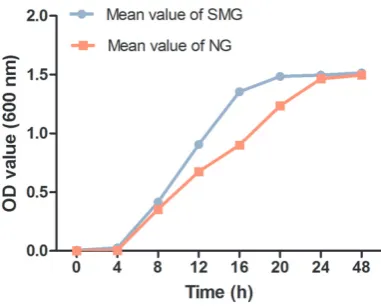
[image:2.629.102.293.80.233.2]The sequencing library was prepared using the NEBNext® Ultra™ RNA Library Prep Kit for Illumina® (NEB, USA) following previous studies [16, 17]. Briefly, 3 μg of total RNA from per specimen was obtained to use for mRNA enrich-ment selection by poly-T oligo-attached mag-netic beads. Then divalent cations under ele-vated temperature in NEBNext First Strand Figure 1. The growth curves of P. gingivalis in SMG
Table 1. Summary of Illumina RNA-seq data
Sample name SMG1 SMG2 NG1 NG2
Total reads 11631288 11092378 10083732 11484150
Total mapped 11506830 (98.93%) 10975968 (98.95%) 7391457 (73.3%) 11461207 (99.8%)
Percent mapped 98.93% 98.95% 73.3% 99.8%
Multiple mapped 719910 (6.19%) 713705 (6.43%) 403175 (4.00%) 677062 (5.90%)
Uniquely mapped 10786920 (92.74%) 10262263 (92.52%) 6988282 (69.3%) 10784145 (93.9%)
Read-1 5392301 (46.36%) 5129061 (46.24%) 3495461 (34.66%) 5391525 (46.95%)
Read-2 5394619 (46.38%) 5133202 (46.28%) 3492821 (34.64%) 5392620 (46.96%)
Reads map to ‘+’ 5392944 (46.37%) 5130775 (46.25%) 3492962 (34.64%) 5391964 (46.95%)
Reads map to ‘-’ 5393976 (46.37%) 5131488 (46.26%) 3495320 (34.66%) 5392181 (46.95%)
P.S: Total reads: the statistics numbers of sequences after sequencing data filtered (Clean data); Total mapped: the statistics
numbers of sequences positioned on the genome sequence; Multiple mapped: the statistics numbers of sequences with mul-tiple mapped on the reference sequence; Uniquely mapped: the statistics numbers of sequences with uniquely mapped on the
reference sequence; Reads map to ‘+’, Reads map to ‘-’: the statistics of plus strand and minus strand in the genome.
[image:3.629.99.541.292.729.2]Synthesis Reaction Buffer (5×) was used to obtain the mRNA fragment. Using random hex-amer primer and M-MuLV Reverse Transcriptase (RNase H) the first strand cDNA was synthe -sized by obtained mRNA as template. We fol-lowed that the second strand cDNA was syn-thesized after adding RNase H and DNA poly-merase I. After exonuclease/polypoly-merase activi-ties the remaining overhangs were converted into blunt ends. Dual-strand cDNA with blunt-end was adenylated at 3’ blunt-end, and the NEBNext Adaptor with hairpin loop structure was ligated to prepare for hybridization. Then the cDNA library fragments were purified with AMPure XP system (Beckman Coulter, Beverly, USA) to pref-erentially select 150~200 bp cDNA in length. Before PCR, 3 μl USER Enzyme (NEB, USA) was added into size-selected and adaptor-ligated cDNA at 37°C for 15 min then 5 min at 95°C. PCR was performed with Phusion High-Fidelity DNA polymerase, Universal PCR primers and Index Primer. Finally, products of PCR were puri-fied and the quality of cDNA library was assessed on the Agilent Bioanalyzer 2100 system.
Statistical analysis
In this study all experiments were repeated at least three times. The data are presented as the mean ± SD. SPSS software, version 16.0 was used to do the statistical analysis with Student’s t-test. P<0.05 was accepted as
sta-Growth of P. gingivalis under SMG condition
To investigate differences in the growth of P. gingivalis under the normal gravity condition (NG) and stimulated microgravity condition (SMG), we measured the growth curves of P. gingivalis in the two groups from beginning to 48 h (Figure 1). Although the maximum bio-mass of P. gingivalis (OD600) was not signifi -cantly different, the growth rate of SMG was a little higher than that of NG. It was similar to the expression of streptococcus mutans, which our team described previously. The finding indicat -ed that the bacteria had respond-ed to SMG condition.
Analysis results of RNA-seq
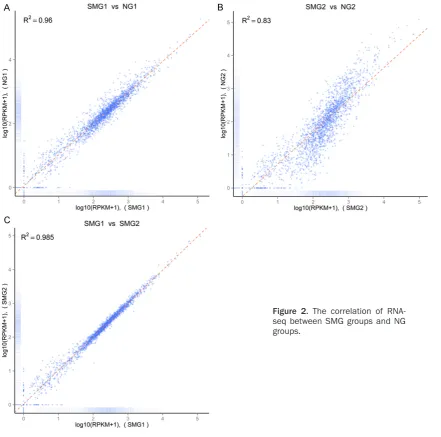
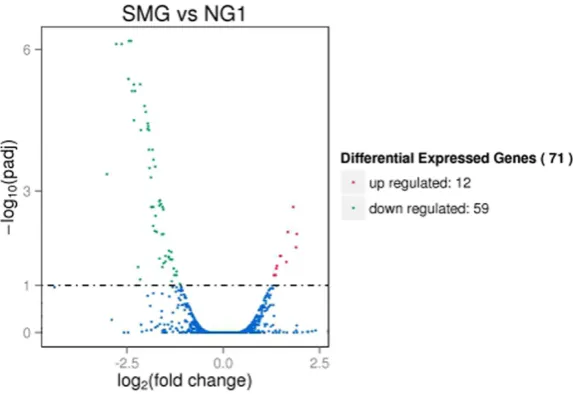
In order to gain the deeper insight on the mech-anisms of P. gingivalis ATCC33277 response to SMG condition, we performed RNA-seq analy-sis on transcriptomes from two biological repli-cates. In Table 1, over 99% of all clean reads aligned to coding regions of the P. gingivalis genome. And in Figure 2, the overall expression levels in the two biological replicates of each group were highly similar to each other (R2>0.8), illustrating that our RNA-seq data was of suit-able quality for transcriptome analysis.In total, 5,880,032 base pairs raw sequence data cor-responding 5,815,644 clean reads and 5,613,464 basepairs raw sequence data cor-responding 5,546,189 clean reads were gener-Figure 3. Scatter plot of RPKM distribution in SMG and NG transcripts. The
blue dots provide the transcripts with RPKM less than 2-fold changes between SMG and NG.
tistically significant. Fisher’s exact test and a hypothesis test method were performed to detect the significant dif -ferential expression of tran-scripts based on the Poisson distribution at P<0.01. In this article only v2 values of the former method were reported due to more confi -dence on statistical results. In order to ensure the credi-bility of expression informa-tion, the significant differen -tial expression was only that the comparison with q-value was less than 0.05 and expression fold change was greater than 2 fold in the Cuffdiff output.
[image:4.629.101.388.81.278.2]ated from the stimulated microgravity groups (SMG1 and SMG2), respectively. 5,127,995 base-pairs raw sequence data corresponding 5,041,866 clean reads and 5,805,403 base-pairs raw sequence data corresponding 5,742,075 clean reads were generated from the normal gravity groups (NG1 and NG2). Gene expression of P. gingivalis under SMG condition
Between SMG group and NG group, overall dif-ferential gene expression was observed. To fur-ther examine this, DEGs were identified using the DEseq package. A total of 71 DEGs were identified, including 12 up-regulated and 59 down-regulated genes (Figure 3). Among the 12 up-regulated genes (Table 2), 3 have not statistical significance. And also in the 59 down-regulated genes, 7 did not have statisti-cal significance. Thus we identified 61 DEGs, containing 9 up-regulated and 52 down-regu-lated genes. This suggests that microgravity have effects on genes expression of P. gingiva-lis ATCC33277.
Among the 9 up-regulated genes, 3 genes (PGN_0583, PGN_0654, PGN_1819) were pre-dicted genes with unknown function coded by hypothetical protein (HPs). Two of the remaining six genes encode HagA (hemagglutinin gene A) which is involved in the adhesion and invasion of P. gingivalis in human gingival epithelial cells. The others genes encode traG (conjugate trans-poson protein); RNA polymerase sigma-70 fac-tor ECF subfamily; Metallophosphoesteras (a hydrolytic enzyme involved metal ions which can hydrolysis important phosphate substanc-es and play extreme rolsubstanc-es in the biochemistry reaction).
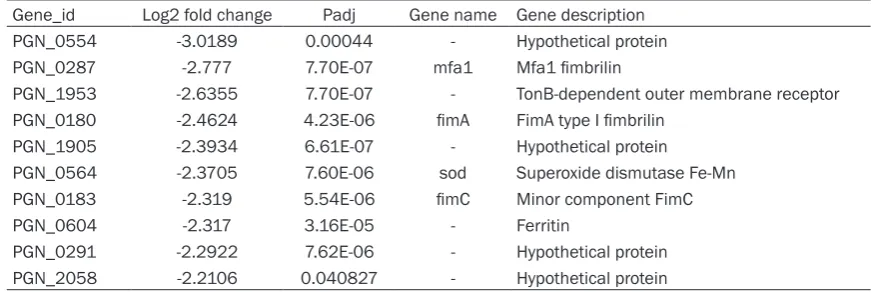
[image:5.629.99.531.92.226.2]Among the top 10 down-regulated genes (Table 3), six were predicted genes of unknown func-tion coded hypothetical protein (HPs) too. One of the remaining four genes encodes Fimbria (PEN_0180), which are associated with the colonization, the formation of biofilm of P. gingi-valis. The other genes encode sod (PEN_0564), TonB-dependent outer membrane receptor (PEN_1953) and ferritin (PEN_0604).
Table 2. The 12 up-regulated P. gingivalis genes after cultured in SMG condition for 48 h
Gene_id Readcount_SMG Readcount_NG1 Log2 Fold Change Pval Padj
PGN_0065 6666.032048 2142.812946 1.6373 0.00089406 0.032007
PGN_0583 1125.799033 400.1103011 1.4925 0.00057801 0.023864
PGN_0654 1503.639115 539.8313586 1.4779 0.00058176 0.023864
PGN_0970 1301.504144 501.7256156 1.3752 0.0013675 0.044142
PGN_1115 2109.741999 599.5303559 1.8152 3.53E-05 0.0021807
PGN_1617 1519.897298 577.9371016 1.395 0.0011154 0.03853
PGN_1733 12687.3018 3428.246675 1.8878 0.00034244 0.01568
PGN_1818 8018.247529 2133.921606 1.9098 0.00017049 0.0081877
PGN_1819 868.4556856 271.8209664 1.6758 0.00014619 0.0073903
Table 3. The top ten down-regulated P. gingivalis genes after cultured in SMG condition for 48 h
Gene_id Log2 fold change Padj Gene name Gene description
PGN_0554 -3.0189 0.00044 - Hypothetical protein
PGN_0287 -2.777 7.70E-07 mfa1 Mfa1 fimbrilin
PGN_1953 -2.6355 7.70E-07 - TonB-dependent outer membrane receptor
PGN_0180 -2.4624 4.23E-06 fimA FimA type I fimbrilin
PGN_1905 -2.3934 6.61E-07 - Hypothetical protein
PGN_0564 -2.3705 7.60E-06 sod Superoxide dismutase Fe-Mn
PGN_0183 -2.319 5.54E-06 fimC Minor component FimC
PGN_0604 -2.317 3.16E-05 - Ferritin
PGN_0291 -2.2922 7.62E-06 - Hypothetical protein
[image:5.629.95.531.261.407.2]The analysis of GO and KEGG pathway
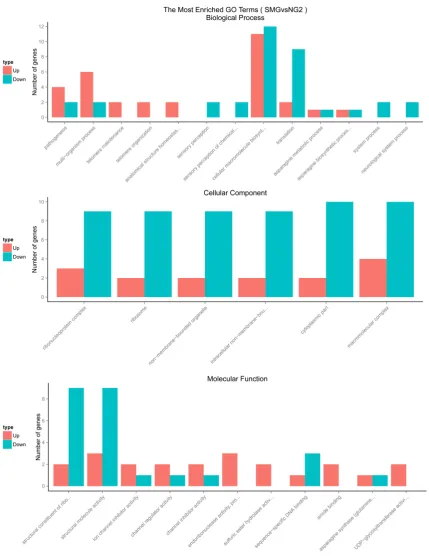
In the three main categories, biological pro-cess, cellular component and molecular
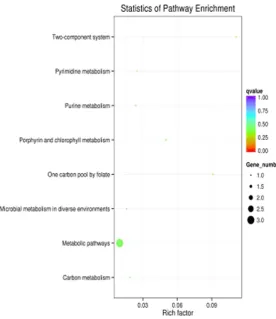
[image:6.629.99.529.77.636.2]“oxidoreductase activity”, etc (Figure 4). And then the biological functions associated with DEGs were further analyzed in terms of enriched Kyoto Encyclopedia of Genes and Genomes (KEGG) pathways, and a total of 8 pathways were predicted in Figure 5, inclu- ding “Porphyrin and chlorophyll metabolism”, “microbial metabolism in diverse environ-ments”, “One carbon pool by folate”, and “two-component system”, “Pyrimidine metabolism”, “Purine metabolism”, “Carbon metabolism”, and “Metabolic pathways”.
Discussion
Microgravity is a condition that the physical gravity of human bodies is reduced, and also the major condition to human in space [18, 19]. It can induce a series of changes in organisms from bacteria to humans. Gravity and sudden changes of gravitational forces may have sig-nificant impact on cells, and organ physiology [20]. For example, exposed to microgravity sta-tus for a long time, human body may suffer of loss bone, immunosuppression [21],
cardiovas-crogravity in vitro condition with obligate anaerobic culture system for P. gingivalis ATCC33277.
Many reporters have revealed that microgra- vity can affect cell growth and gene expre- ssion. Nancy et al. found that 4-8% T lympho-cyte gene expression differentially in micro-gravity status [28]. Pardo et al. revealed that under microgravity condition, among 1000 osteoblast genes, 88 genes were obviously down-regulated and 52 genes were up-regulat-ed [29]. And our results in this study were similar with the previous results.
[image:7.629.101.378.79.399.2]We used RCCS to stimulated microgravity to detect the growth and genes expression of P. gingivalis ATCC33277. The growth rate of P. gingivalis ATCC33277 in SMG group was a little higher than that in NG group. This result indicated that microgravity condition may increase the growth rate of P. gingivalis ATCC33277. Almost all clean reads aligned to coding regions of the P.gingivalis genome, and overall expression levels in SMG and NG group were highly similar by analysis of RNA-seq. By Figure 5. Eight pathways were predicted by KEGG statistics.
cular problems [22], changes in metabolism and body tem-perature activity [23, 24], and so on. The microorganisms in human bodies are also influ -enced under microgravity status.
differentially expressed genes (DEGs) analysis, we identified up-regulated genes and down-regulated genes under SMG condition. In addi-tion to further explore the differentially expressed genes, the analysis of GO and KEGG pathway were also performed. We got the differential genes number enriched on the GO term and the pathways via KEGG enrichment.
The essential key point of this study was the operational time, because some studies showed the bacteria could recuperate their characters if we moved them back from the microgravity to normal gravity condition for some time later. Our study revealed that microgravity can affect the growth and gene expression of P. gingivalis ATCC33277. The results of this study will provide deeper in- sight into transcriptional regulation of the microgravity on P.Gingivalis.
Acknowledgements
14QN11 and BZZ14J001. Disclosure of conflict of interest None.
Address correspondence to: Zhongying Niu, PLA Medical School, Beijing 100853, China; Department of Stomatology, 306 Hospital of PLA, Beijing 100101, China. E-mail: [email protected]
References
[1] Almerich-Silla JM, Montiel-Company JM, Pastor S, Serrano F, Puig-Silla M and Dasi F. Oxidative Stress Parameters in Saliva and Its Association with Periodontal Disease and Types of Bacteria. Dis Markers 2015; 2015: 653537.
[2] Holt SC, Kesavalu L, Walker S and Genco CA. Virulence factors of Porphyromonas gingivalis. Periodontol 2000 1999; 20: 168-238. [3] Zaremba M, Gorska R, Suwalski P and Kowalski
J. Evaluation of the incidence of periodontitis-associated bacteria in the atherosclerotic plaque of coronary blood vessels. J Periodontol 2007; 78: 322-327.
[4] Pan Y, Teng D, Burke AC, Haase EM and Scannapieco FA. Oral bacteria modulate inva-sion and induction of apoptosis in HEp-2 cells by Pseudomonas aeruginosa. Microb Pathog 2009; 46: 73-79.
[5] Robert AA, Rass MD, Al-Zoman KH, Al-Sohail AM, Alsuwyed AS, Ciancio SG and Al-Mubarak SA. Determinants of periodontopathogens in
microbiological monitoring of diabetic patients with periodontitis. Saudi Med J 2010; 31: 1044-1048.
[6] Taiyoji M, Shitomi Y, Taniguchi M, Saitoh E and
Ohtsubo S. Identification of proteinaceous in -hibitors of a cysteine proteinase (an
Arg-specific gingipain) from Porphyromonas gingi -valis in rice grain, using targeted-proteomics approaches. J Proteome Res 2009; 8: 5165-5174.
[7] Martinez-Martinez RE, Abud-Mendoza C, Patino-Marin N, Rizo-Rodriguez JC, Little JW and Loyola-Rodriguez JP. Detection of peri-odontal bacterial DNA in serum and synovial
fluid in refractory rheumatoid arthritis patients.
J Clin Periodontol 2009; 36: 1004-1010. [8] Amano A, Kuboniwa M, Nakagawa I, Akiyama
S, Morisaki I and Hamada S. Prevalence of
specific genotypes of Porphyromonas gingiva
-lis fimA and periodontal health status. J Dent
Res 2000; 79: 1664-1668.
[9] Kacena MA, Merrell GA, Manfredi B, Smith EE, Klaus DM and Todd P. Bacterial growth
in space flight: logistic growth curve parame -ters for Escherichia coli and Bacillus subti- lis. Appl Microbiol Biotechnol 1999; 51: 229-234.
[10] Chang D, Zhu Y, An L, Liu J, Su L, Guo Y, Chen Z, Wang Y, Wang L, Wang J, Li T, Fang X, Fang C, Yang R and Liu C. A multi-omic analysis of an
Enterococcus faecium mutant reveals specific
genetic mutations and dramatic changes in mRNA and protein expression. BMC Microbiol 2013; 13: 304.
[11] Wilson JW, Ott CM, Ramamurthy R, Porwollik S, McClelland M, Pierson DL and Nickerson CA. Low-Shear modeled microgravity alters the Salmonella enterica serovar typhimurium stress response in an RpoS-independent man-ner. Appl Environ Microbiol 2002; 68: 5408-5416.
[12] Wilson JW, Ramamurthy R, Porwollik S, McClelland M, Hammond T, Allen P, Ott CM, Pierson DL and Nickerson CA. Microarray
anal-ysis identifies Salmonella genes belonging to
the low-shear modeled microgravity regulon. Proc Natl Acad Sci U S A 2002; 99: 13807-13812.
[13] Pacello F, Rotilio G and Battistoni A. Low-Shear Modeled Microgravity Enhances Salmonella Enterica Resistance to Hydrogen Peroxide Through a Mechanism Involving KatG and KatN. Open Microbiol J 2012; 6: 53-64. [14] Saxena R, Pan G, Dohm ED and McDonald JM.
[15] Klaus DM and Howard HN. Antibiotic efficacy and microbial virulence during space flight.
Trends Biotechnol 2006; 24: 131-136. [16] Li K, Yang X, Xu G, Cao Y, Lu B and Peng Z.
Identification of putative odorant binding
protein genes in Asecodes hispinarum, a parasitoid of coconut leaf beetle (Brontispa longissima) by antennal RNA-Seq analysis. Biochem Biophys Res Commun 2015; 467: 514-520.
[17] Laroche A, Tran-Cong K, Chaire V, Lagarde P, Hostein I, Coindre JM, Chibon F, Neuville A, Lesluyes T, Lucchesi C and Italiano A. Heterogeneous Mechanisms of Secondary Resistance and Clonal Selection in Sarcoma during Treatment with Nutlin. PLoS One 2015; 10: e0137794.
[18] Xu B, Li C, Zheng Y, Si S, Shi Y, Huang Y, Zhang J and Cui Y. Simulated microgravity
affects ciprofloxacin susceptibility and
ex-pression of acrAB-tolC genes in E. coli ATCC25922. Int J Clin Exp Pathol 2015; 8: 7945-7952.
[19] Murata Y, Yasuda T, Watanabe-Asaka T, Oda S, Mantoku A, Takeyama K, Chatani M, Kudo A, Uchida S, Suzuki H, Tanigaki F, Shirakawa M, Fujisawa K, Hamamoto Y, Terai S and Mitani H. Histological and Transcriptomic Analysis of Adult Japanese Medaka Sampled Onboard the International Space Station. PLoS One 2015; 10: e0138799.
[20] Ranieri D, Cucina A, Bizzarri M, Alimandi M and
Torrisi MR. Microgravity influences circadian
clock oscillation in human keratinocytes. FEBS Open Bio 2015; 5: 717-723.
[21] Zayzafoon M, Meyers VE and McDonald JM. Microgravity: the immune response and bone. Immunol Rev 2005; 208: 267-280.
[22] Hargens AR and Richardson S. Cardiovascular
adaptations, fluid shifts, and countermeasures related to space flight. Respir Physiol Neurobiol
2009; 169 Suppl 1: S30-33.
[23] Robinson EL and Fuller CA. Gravity and ther-moregulation: metabolic changes and
circadi-an rhythms. Pflugers Arch 2000; 441: R32-38.
[24] Murakami DM and Fuller CA. The effect of 2G on mouse circadian rhythms. J Gravit Physiol 2000; 7: 79-85.
[25] Sharma S, Tapashetti RP, Patil SR, Kalra SM, Bhat GK and Guvva S. Revelation of Viral-Bacterial Interrelationship in Aggressive Periodontitis via Polymerase Chain Reaction: A Microbiological Study. J Int Oral Health 2015; 7: 101-107.
[26] Hajishengallis G, Liang S, Payne MA, Hashim A, Jotwani R, Eskan MA, McIntosh ML, Alsam A, Kirkwood KL, Lambris JD, Darveau RP and
Curtis MA. Low-abundance biofilm species or
-chestrates inflammatory periodontal disease
through the commensal microbiota and com-plement. Cell Host Microbe 2011; 10: 497-506.
[27] Curtis MA, Zenobia C and Darveau RP. The re-lationship of the oral microbiotia to periodon-tal health and disease. Cell Host Microbe 2011; 10: 302-306.
[28] Ward NE, Pellis NR, Risin SA and Risin D. Gene expression alterations in activated human T-cells induced by modeled microgravity. J Cell Biochem 2006; 99: 1187-1202.
[29] Pardo SJ, Patel MJ, Sykes MC, Platt MO, Boyd NL, Sorescu GP, Xu M, van Loon JJ, Wang MD and Jo H. Simulated microgravity using the Random Positioning Machine inhibits
differen-tiation and alters gene expression profiles of