Abstract—In Wireless Sensor Networks (WSNs), clustering is one of the most power efficient techniques which minimize the transmission ranges of sensor nodes. Instead of sending packets directly to the BS with high power levels, sensor nodes in the sensing filed can be organized in groups (i.e. clusters), where Cluster Heads (CHs) manage the transmission by aggregating the whole group of packets and retransmit them to the Base Station (BS). Therefore, the clustering technique solve the problem that nodes close to the BS consume a large amount of power due to the need to be active most of the time to retransmit packets to the BS (i.e. sink hole problem). In this paper, we propose a novel Raining Energy Cluster Head Selection (RECHS) protocol which is based on a simple Statistical Discrimination (SD) metric which detects collided packets before decoding as well as the Multi-Dimensional Slotted ALOHA (MDSA) MAC protocol which organizes the access to the communication channel. Hence, both reception and transmission power consumption will be minimized remarkably. In addition, in RECHS protocol, a simple Cluster Head (CH) selection algorithm is proposed which is based on the ratio be-tween the remaining energy of every member (node) in a cluster and the initial (start-up) energy as well as the minimum distance between the CH and the sink node. In this paper, we will show how the proposed CH selection mechanism in RECHS protocol along with the SD technique and the MDSA MAC protocol overcomes some well-known protocols such as LEACH where a CH is selected in a distributed (i.e. random) fashion and the MAC protocol is TDMA. In particular, we will show how the perfor-mance of RECHS protocol overcomes LEACH protocol in terms of the percentage of alive nodes, the average number of success-fully arrived packets to the BS (i.e. the throughput), and the average residual energy of the network per simulation round.
Index Terms— Energy efficient design of WSNs, WSNs MAC protocols, statistical discrimination technique, Slotted ALOHA.
I. INTRODUCTION
Most routing protocols in WSNs use TDMA as MAC scheme in order to organize the access to the channel. Conse-quently, each member in a cluster has its own time slot to send
Manuscript received June 26, 2016; revised July 30, 2016. The work was supported by Taif University, Saudi Arabia.
The author is with the Computer Engineering Department, Taif University, P.O.Box: 888, Hawiyah, Taif, Zip Code: 21974, Saudi Arabia. Email:[email protected]
their packets to a CH. Note, however, that routing protocols which are based on TDMA are known to provide power effi-cient routing solutions due to minimization of idle listening, elimination of overhearing, and collision-free mechanisms. In fact, they have not been considered perfect solutions for power limited WSNs since the difficulties to address the scalability issues and the complications to synchronize sensor nodes in time [1]. In addition, routing protocols which are based on CSMA/CA need to expend significant amounts of power in order to sense the medium before packets transmission (i.e. sensing subsystem in a sensor node architecture) [1].
In WSNs, hierarchical routing protocols are based on the idea that nodes form clusters and every cluster has a CH which is responsible for data aggregation, reduction and transmission to the BS. Hierarchical clustering is one of the most pow-er-efficient designs for WSNs. In addition, the hierarchical clustering protocols have some advantages over different cat-egories of WSNs routing protocols. For example, the hierar-chical clustering protocols can minimize the power consump-tion of intra-cluster and inter-cluster WSNs. Also, the hierar-chical clustering protocols are effective in terms of scalability of WSNs, network lifetime prolonging, reduction of packets transmission delay and handling the heterogeneous nature of WSNs. However, the hierarchical clustering design may has some challenges which are required to be considered when designing low power resources networks such as WSNs [2]. For example:
Some clustering protocols only become effective when the number of nodes in a network is small.
Some clustering protocols are designed for static WSNs while in mobile WSNs their effectiveness become low and the network performance degrades remarkably.
Sending the aggregated data by the CHs may lead to more energy dissipation especially when the BS (the re-ceiver) is located far away from the sensing area.
Some clustering protocols don't use probabilistic ap-proaches when selecting the CHs and pro-cessing/communicating of packets in a network. As a result, nodes may die early since the initial energy of network nodes wasn't considered when selecting the CHs.
In literature, there are many are hierarchical clustering pro-tocols which are proposed for WSNs. The most popular hier-archical routing protocols in WSNs are Low Energy Adaptive Clustering Hierarchy (LEACH) protocol [3]. LEACH is the
Energy-Efficient Transmission, Reception and
Effective Clustering Techniques for Optimal
Design of Wireless Sensor Networks
first and most popular hierarchical clustering protocols for WSNs. Nodes in every round of LEACH protocol perform self-reorganizing as well as re-clustering function. Nodes form clusters, and in each cluster there is a need to select a CH (i.e. the node with more residual energy) which is responsible for data aggregation and transmission of packets to a sink node. So, members of a cluster (i.e. nodes) use the CH as intermedi-ate node to transfer their packets to the sink node. As a result, the CH node consumes a significant amount of power due to these additional responsibilities in comparison with other members in a cluster. Note that in LEACH protocol, if a node remains a CH permanently in all rounds, the node will die very quickly and the network performance will degrade. In addition, LEACH uses a random selection mechanism to choose a CH in every round in order to save the battery lifetime of all sensor nodes in a network [3].
In LEACH, every round has two main phases: setup phase and steady state phase. The setup phase is used for the purpose of organizing the whole network into multiple intra-cluster and advertising the CHs to all members of these cluster. Since the LEACH protocol is based on TDMA MAC protocol, all syn-chronization and scheduling messages need to be transmitted during the setup phase. The steady state phase is used for the purpose of data aggregation and compression in CHs as well as transmission of aggregated packets to a sink node [3].
In this paper we propose RECHS protocol which has the following features:
RECHS is based on hierarchical routing protocols which gained many acceptances in different WSNs applica-tions. In fact, RECHS works very well for applications that depend on static sensor nodes such as monitoring and data collection which occur periodically to a central lo-cation of a network. However, RECHS can be enhanced to be useful for applications that depend on mobile nodes such as vehicle to vehicle (or V2V) communications (i.e. the future direction of our research which has attracted extensive attention of researchers).
As we will discuss in the next section, the network model in RECHS protocol is based on dividing the sensing area into regions and placing a rechargeable node in the center of the sensing field. Hence, it reduces the transmission distance (i.e. translated into reducing the transmission power consumption and prolonging the network lifetime) between CHs and the BS. In other words, RECHS protocol solves the problem of some hierarchical routing protocols (e.g. LEACH) where CHs can be located far away from the BS. So, nodes may die early due to the fact that CHs may send packets with high power level.
In RECHS protocol, the CH selection in one region (e.g. region 1) is independent of other regions (e.g. region 2 and 3). So, in each round, there must be a nominated CH in each region. In fact, this solves a problem in LEACH protocol where sometimes the CHs are located in one region of a network (i.e. the case becomes worse in large-scale WSNs).
The CHs selection in RECHS protocol considers the minimum distance between the CHs and the central re-chargeable node as well as the initial energy of nodes in a
network. This solves the problem of LEACH protocol where CHs are selected randomly. After several rounds of packets transmission, some nodes can be selected to be CHs where there are some other nodes, which have higher remaining energy, not been selected as CHs.
RECHS protocol solves the extra overhead problem of LEACH protocol. LEACH protocol uses TDMA MAC protocol in order to organize access to the communica-tion channel. So, many control (overhead) packets need to be transmitted in the initial phase which consumes a large amount of transmission power for sensor nodes. Instead, RECHS protocol is based on our proposed MDSA MAC protocol [4] which allows nodes to access to the communication channel at any time without sending many control packets. Hence, RECHS reduces the transmission power consumption.
RECHS protocol reduces the reception power consump-tion due to the fact that our proposed SD metrics [5] at the receiver (i.e. the nominated CHs, the rechargeable node in the centre of sensing field and the BS) are used in order to eliminate corrupted (collided) packets from further processing and decoding. Hence, the receiver electronic circuits at the radio model will dissipate less energy and hence reduce the overall power consumption of sensor nodes.
The rest of this paper is organized as follows. In section II, we explain the network model of RECHS protocol. In section III, we extensively describe RECHS protocol. In particular, we explain the initial phase, the set-up phase, the CH selection algorithm, the scheduling protocol, steady state phase, and collision detection at the receiver. In section IV, we investigate the performance evaluation of our proposed RECHS protocol. Finally, the conclusion of the paper is presented in section V.
II. NETWORK MODEL OF RECHSPROTOCOL
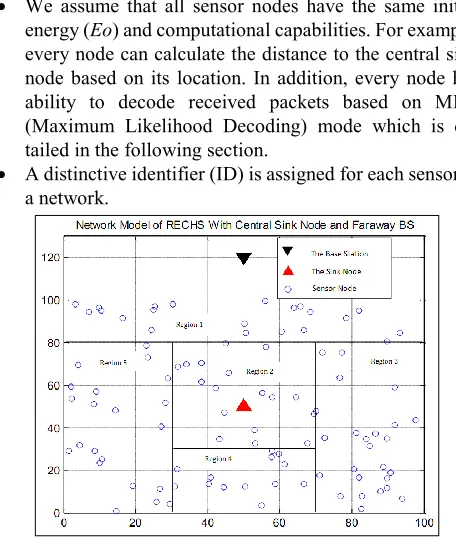
In RECHS protocol, we assume a static WSN which con-tains N sensor nodes that distributed randomly in an environ-ment in order to perform monitoring or data collection. The network model is illustrated in figure 1. In summary, we as-sume the following:
We deploy a BS which is located far away from the sensing field. Also, the sensor nodes are distributed randomly. Both the BS and sensor nodes remain sta-tionary after deployment.
We deploy a rechargeable sink (gateway) node at the center of sensing field. Also, this sink node remains sta-tionary in all rounds.
We assume that all sensor nodes have the same initial energy (Eo) and computational capabilities. For example, every node can calculate the distance to the central sink node based on its location. In addition, every node has ability to decode received packets based on MLD (Maximum Likelihood Decoding) mode which is de-tailed in the following section.
[image:3.612.67.295.46.316.2] A distinctive identifier (ID) is assigned for each sensor in a network.
Figure 1. Network model of RECHS protocol.
A. Radio Signal Propagation Model
RECHS is based on the first order radio model which rep-resents the power consumption of WSNs nodes for transmit-ting, receiving and data aggregation. This radio model has been discussed extensively in literature (e.g. [3]). The first order radio model assumes asymmetric transmission. That is, the power required to transmit a message from node A to node B is the same power required to transmit the message form node B to node A for a given SNR. Based on the distance between a transmitter and a receiver, the first order radio model is divided into free space model and multipath fading model. For in-ter-cluster communication, the distance between sensor nodes and a CH (or the distance between sensor nodes and the BS for region 1, or the distance between sensor nodes and the central sink node for region 2) is small , which is less than a pre-defined threshold level (dth). So, the free space propagation model is used. On the other hand, for intra-cluster communi-cation between CHs and the central sink node (or the sink node and the BS), the distance is large which is larger than the pre-defined threshold level (dth). So, the multipath fading model is used where the signals strength are affected by ob-stacles such as buildings or trees. In general, the respective transmission (ETx) and reception (ERx) energy consumption to transmit and receive l-bits message over a distance d can be defined as:
ETx (l,d) =ETx_ele (l)+ETxAG (l)+ETx_amp (l,d) (1)
ERx (l) = ERx_ele(l)+ERx_SD (l,S) (2)
Where ETx_ele (l) is the energy consumption for electronic circuits when transmitting l-bits message, ETxAG (l) is the en-ergy consumption for data aggregation at the transmitter, ETx_amp (l,d) is the energy consumption due to the amplifier for
[image:3.612.337.552.146.294.2]the free space model or multipath fading modelfading model. ERx_ele (l) is the energy consumption for electronic circuits when receiving l-bits message, ERx_SD(l,S) is the energy con-sumption for a single operation of the statistical discrimination technique and S is the number of computational operation of the statistical discrimination technique [5]. Figure 2 illustrates the first order radio model which includes our proposed statis-tical discrimination techniques at the receiver.
Figure 2. Edited version of First order radio model of RECHS pro-tocol.
III. RECHSPROTOCOL DESCRIPTION
In this section, we detail our proposed RECHS protocol. We assume a static WSN which contains sensor nodes that de-ployed randomly in the sensing field and the sensor nodes always have sensed packets to send to a remote BS. Therefore, an automatic mechanism to aggregate data into a small set of information is required. These data aggregation consumes a small amount of energy which is considered in our analysis for the signal propagation model. Data aggregation or fusion is discussed extensity in literature (e.g. [1] and [2]).
For the purpose of improving the network performance and increase the lifetime of sensor nodes, we deploy a rechargeable sink node at the center of the sensing field. This sink node is responsible for data aggregation from CHs or nodes which are located near to the sink node. After that, the sink node sends the collected packets to the BS which is located far away from the sensing filed. In general, the proposed RECHS protocol ensures high performance with minimum power consumption of sensor nodes which causes a significant increase of the network lifetime. However, REACH comes with the cost of adding the rechargeable sink node. We add this rechargeable sink node because it has been proven in literature that the cost of recharging a sink node is much cheaper than the price of replacing dead nodes in WSNs [7].
A. Initial Phase
distance to the central sink node and the BS. After that, the BS forms a node data table. This data table includes information about a sensor node such as the distinctive node ID, the fre-quency band and code selected by a node, the specific location of a node, the remaining energy of a node, the distance between a node and the central sink node, and the distance between a node and the BS.
B. Setup Phase
In RECHS, the sensing field is divided into five logical regions based on the location of sensor nodes:
Region one (i.e. non-clustering region) contains sensor nodes which are located near to a remote BS. These sensor nodes use direct communication to the BS since the distances between these nodes and the BS are short.
Similarly, region two (i.e. non-clustering region) con-tains sensor concon-tains sensor nodes which are located near to the rechargeable sink node. These sensor nodes use direct communication to the sink node which aggregates data and send them to the BS.
Region three, region four and region five are clustering regions which contain all remaining sensor nodes that are located far away from the rechargeable sink node and the BS. All nodes in a clustering region organize themselves into small groups (clusters). In addition, in each cluster, a nominated node must be selected to be a CH (more de-tails in the following sub-section). Moreover, sensor nodes in these clustering regions use multi-hop commu-nications for packets transmission to CHs.
C. Cluster Head Selection Algorithm
In RECHS, the BS initially divides the sensing area into re-gions and a CH is randomly selected in every cluster. Every node in a cluster has an equal chance to be a CH. The CH is updated in every operation process which is called a round. Let ri represents the number of rounds that a node Ni become a CH. Similar to LEACH that every node in a cluster elects itself to be a CH every ri= 1⁄P rounds; where P is the percentage of CHs (e.g. P=0.05). For example, if a sensor node is selected to be a CH in round 0, it cannot be selected as a CH in the next 1⁄P rounds. Thus, the probability that the remaining nodes become CHs will increase in every round since there is a fewer number of sensor nodes that are eligible to be CHs [3].
At the start of the first round, all members have the same initial energy (Eo) and have the same chance to be a CH. After that, the CH selection is based on two main parameters which are the remaining energy of a sensor node and the shorter dis-tance between the sensor node and the rechargeable sink node which is located at the center of the sensing field. At the first round, a node Ni chooses a random number between 0 and 1. If the selected random number for node Ni is less than a pre-determined threshold level (TN), then the sensor node become a CH in the current round. In RECHS, the threshold level (TN) is defined as the following equation:
{
( ) [ ( ( ) ) ( )]
(3)
where ( ) is a function relevant to the current residual
energy of a sensor node, it represents the effect of the re-maining energy of a node on the CH selection mechanism. P is the percentage of CHs, is the influencing factor which is assumed to be 0.1, r is the current round, ( ) represents
the effect of the distance between a sensor node in a cluster and the central sink node on a CH selection, and is a set of nodes which are not selected as CHs in a current round. ( )
and (
) ( )
,respectively, in which is the current remaining energy of a sensor node, is the initial energy of a sensor node, is the maximum distance
among all members of a cluster to the central sink node, ( )
is the distance between a member node and the central sink node, and is the minimum distance among members of
a cluster to the central sink node. Note that, the probability that a node with higher remaining energy and shorter distance to the central sink node becomes a CH. After electing CHs in regions three, four and five, the CHs broadcast messages to inform all neighbours about their role. Upon receiving these messages, sensor nodes send acknowledgements, and nodes which are located near to the CH become members of the corresponding cluster.
D. Scheduling Technique
Once clusters are formed and CHs are selected, a sensor node remains in an idle state and turn-off its radio transceiver. A sensor node turns-on the radio transceiver only when it has a packet need to be sent either to the BS and the sink node in regions one and two respectively, or to the CHs in regions three, four and five. Switching the radio transceiver between ON and OFF states for a sensor node has a great impact on the overall power saving of WSNs [1].
In RECHS, nodes in all regions use our proposed MDSA MAC protocol [4] in order to organize the access to the communication channel. As explained in [5], MDSA is very simple MAC protocol which avoids sending many control packets as the case in TDMA, or consuming too much power for sensing the transmission medium as the case in CSMA/CA. In RECHS which is based on MDSA protocol, more than two nodes are able to reserve the same time slot and send their packets as long as the nodes have different reservation dimen-sions (i.e. frequency bands and codes). Using optimal numbers of frequency bands and codes will reduce the collision rate which is translated to a significant reduction of the transmis-sion power consumption for a sensor node.
E. Steady State Phase
In steady state phase, all member nodes of a cluster send their packets to the corresponding CH which aggregate the packets and send them to the central sink node. The central sink node received packets from the CHs as well as the nodes located in its region (i.e. region two), aggregate all packets and send them to the BS. The BS receives packets from the central sink node and the nodes which are located in its region.
F. Collision Detection at the Receiver
and for the comparisons purpose between our RECHS and LEACH protocol, it is necessary to decode received signals in order to detect corrupted (collided) packets. If the packet is deemed to have suffered a collision, which in turn triggers the receiver (i.e. the BS and the central sink node or the CH) to issue a NACK message per the mechanism and rules mandated by the MDSA MAC protocol in the network. Thus, corrupted packets will not be decoded.
For simplicity, only the collision free packets will be de-coded using the Maximum Likelihood Decoding (MLD) mechanism to decode the received packets [6]. MLD has the following probability.
( | ) = ( ) (4)
where is the received codeword, is the
trans-mitted codeword, p is the error probability of the communica-tion channel, 1 p is the reliability of the channel, is the
length of the codeword in bits and is the hamming distance between the received and the sent codeword. In our design for decoding the received packets, we assume that the received packet is deemed corrupted if the hamming distance is greater 30% of the length of the packet (this percentage can be tuned as required by a designer. Also, we assume p= 10%, and
=10 bits which is a good bit resolution in most wireless
communication systems.
IV. PERFORMANCE EVALUATION
In this section we evaluate the performance of our proposed RECHS protocol and compare it with well-known protocol such as LEACH.
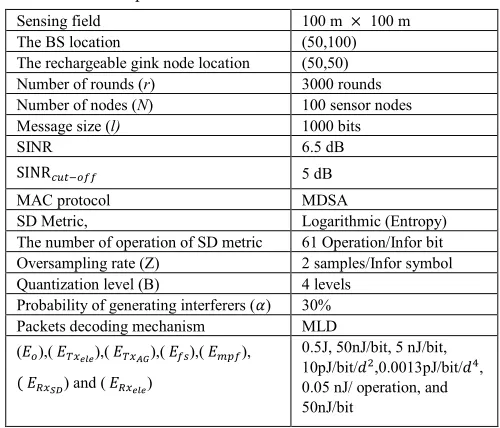
A. Simulation Setting and Performance Parameters In order to demonstrate the performance of RECHS and the comparison between RECHS and LEACH protocols, the proposed RECHS protocol has been simulated using MATLAB. We assume a static WSN which contains 100 sensor nodes that distributed randomly in 100m ×100m sensing field. A stationary and rechargeable sink node is located at the center of the sensing field, and the fixed BS is located faraway from the sensing field. In order to assess the performance of RECHS and compare it with LEACH, we consider the effect of packets collision at the receiver side as well as the transmitter side when access to the communication channel. Also, we consider the effects caused by interference of multiple trans-mitters at the same time. Simulation parameters are summa-rized in table I.
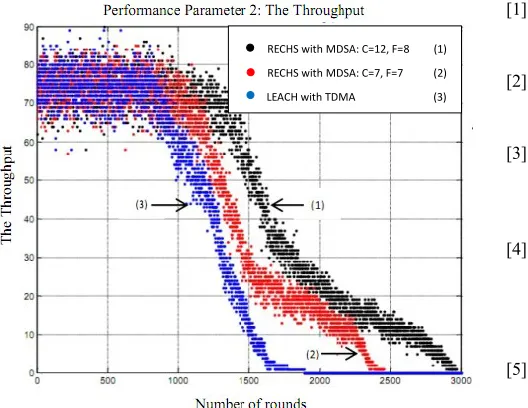
[image:5.612.326.576.53.267.2]The performance parameters that are presented in this sec-tion are the network lifetime which is the time interval from the first packet being transmitted by a sensor node until the death of the last sensor node, the Throughput which can be measured by calculating the number of packets that arrived successfully to the BS, and comparing them with the number of packets that sent by sensor nodes in each simulation round, and the residual energy which is another performance parameter that is sidered in our analysis in order to illustrate the power con-sumption of sensor nodes in each simulation round.
Table I. Simulation parameters.
B. Simulation Results and Analysis
In the following, we detail the simulation parameters of the proposed RECHS protocol and compare them with the LEACH protocol. We run the simulation based on 3000 rounds based on the network model which is illustrated in figure 1.
For the network lifetime, figure 3 shows the network lifetime comparison between our proposed RECHS and LEACH pro-tocols. The precent of alive nodes for RECHS protocol when using the MDSA MAC protocol with C=30 codes and F=28 frequency bands (i.e. the red curve) is larger than the percent of alive nodes for LEACH protocol which is based on TDMA (i.e. the blue curve). Also, RECHS protocol has a larger percent of alive nodes when the MDSA MAC protocol is used with C=12 codes and F=8 frequency bands (i.e. the black curve). In gen-eral, in RECHS protocol, the percent of alive nodes increases when increasing the number of reservation bands in the cor-responding MDSA MAC protocol. In addition, RECHS uses the proposed SD algorithm which is applied at the receiver to detect collided packets before decoding, so no need to consume a 50nJ/bit for decoding corrupted packets. On the other hand, In LAECH protocol, the sensor nodes die very quickly since the CHs may concentrate one part of the network. So, some nodes remain without CHs.
For the throughput, figure 4 shows how many packets ar-rived successfully to the BS. Packets successfully arar-rived if they are not corrupted packets after decoding. In LEACH, packets arrived need to be decoded in order to check their eligibility due to collision. However, in RECHS, the SD algo-rithm is applied at the receiver, which eliminates corrupted packets from further processing and decoding which consume too much power. In figure 4, it is obvious that RECHS protocol has higher performance in comparison with LEACH, and the throughput increases 4 times than LEACH protocol. Also, in RECHS, more nodes stay alive for longer period due to di-viding the network model into regions and using MDSA MAC protocol accelerate packets transmission without dealing with scheduling and synchronization as LEACH protocol.
Sensing field 100 m 100 m
The BS location (50,100)
The rechargeable gink node location (50,50)
Number of rounds (r) 3000 rounds
Number of nodes (N) 100 sensor nodes
Message size (l) 1000 bits
SINR 6.5 dB
SINR 𝑓𝑓 5 dB
MAC protocol MDSA
SD Metric, Logarithmic (Entropy)
The number of operation of SD metric 61 Operation/Infor bit
Oversampling rate (Z) 2 samples/Infor symbol
Quantization level (B) 4 levels
Probability of generating interferers (𝛼) 30%
Packets decoding mechanism MLD
( ),( 𝑇 𝑙 ),( 𝑇 𝐴𝐺),( 𝑓 ),( 𝑝𝑓),
( 𝑅 𝑆𝐷) and ( 𝑅 𝑙 )
0.5J, 50nJ/bit, 5 nJ/bit, 10pJ/bit/ 2,0.0013pJ/bit/ 4,
For the residual energy, figure 5 demonstrates how RECHS protocol save the residual energy of the network per round in comparison with LEACH protocol. As shown in the figure, RECHS protocol outperforms LEACH protocol in term of the energy consumption. As discussed in previous sections that the network model is divided into regions and the CH selection algorithm in some regions is based on the criteria that the node with the shorter distance to the central sink node as well as the higher remaining energy will be selected to be a CH. In fact, this selection mechanism increases the probability that the node close to the central sink node will be selected as a CH, which needs low transmission power to send its packets.
Figure 3. RECHS VS. LEACH, performance parameter 1: The net-work lifetime (the precent of alive nodes).
Figure 4. RECHS VS. LEACH, performance parameter 2: The throughput.
V. CONCLUSION
In this paper, we proposed RECHS protocol for pow-er-efficient routing in WSNs. REACH has a specific network model which solves many problems for well-known network
protocols such as LEACH. RECHS avoid sending many con-trol packets that affect the transmission power consumption as well as avoiding the need for decoding the received corrupted packets which affect the reception power consumption. In particular, RECHS reduces the transmission power consump-tion due to the usage of the proposed MDSA MAC protocol, and reduces the reception power consumption due to the usage of the proposed Statistical Discrimination (SD) algorithms. In addition, RECHS uses a simple CH selection mechanism which is based on the remaining energy of sensor nodes and the shorter distance to the central sink node.
Figure 5. RECHS VS. LEACH, performance parameter 3: The re-sidual energy of the network.
REFERENCES
[1] Giuseppe, A.; Marco, C.; Mario, D. F.; Andrea, P., ―Energy conservation in wireless sensor networks: A survey.‖ Ad Hoc Networks, Volume 7, Issue 3, Pages 537-568, May 2009. [2] K. Akkaya and M. Younis, ―A survey on routing protocols for
wireless sensor networks,‖ Ad Hoc Networks, vol. 3, no. 3, pp. 325–349, 2005.
[3] W. R. Heinzelman, A. Chandrakasan and H. Balakrishnan, "Energy-efficient communication protocol for wireless mi-crosensor networks," System Sciences, 2000. Proceedings of the 33rd Annual Hawaii International Conference, pp. 10 pp, 2000. [4] F. Alassery, W. K. M. Ahmed and V. Lawrence, "MDSA: Multi-dimensional slotted ALOHA MAC protocol for low-collision high-throughput wireless communication sys-tems," Sarnoff Symposium, 2015 36th IEEE, Newark, NJ, 2015, pp. 179-184.
[5] F. Alassery, W. K. M. Ahmed, M. Sarraf and V. Lawrence, "A novel scheme for power saving in wireless sensor networks with packet collision," Wireless and Microwave Technology Con-ference (WAMICON), 2014 IEEE 15th Annual, Tampa, FL, 2014, pp. 1-4.
[6] Harry L. Van Trees. Detection, Estimation, and Modulation Theory: Part I, John Wiley and Sons, 1968.
[7] Songtao Guo; Cong Wang; Yuanyuan Yang, "Joint Mobile Data Gathering and Energy Provisioning in Wireless Rechargeable Sensor Networks," Mobile Computing, IEEE Transactions on , vol.13, no.12, pp.2836,2852, Dec. 2014.
RECHS with MDSA: C=12, F=8 (1)
RECHS with MDSA: C=7, F=7 (2)
LEACH with TDMA (3)
RECHS with MDSA: C=12, F=8 (1)
RECHS with MDSA: C=7, F=7 (2)
LEACH with TDMA (3)
RECHS with MDSA: C=12, F=8 (1)
RECHS with MDSA: C=7, F=7 (2)
[image:6.612.63.296.192.404.2] [image:6.612.62.326.438.642.2]