Effects of Storage and Processing Parameters on Pasting
Properties of Ofada for Production of Boiled and Mashed Rice
Oludare Olumuyiwa ADEKOYENI 1*, Rahman AKINOSO 2, Adekola Felix ADEGOKE 3
and Stephen Akintunde FAGBEMI 4
1Home Science and Management, Federal University Gashua, Yobe state, Nigeria; 2Department of Food Technology, University of Ibadan, Oyo State, Nigeria; 3Department
of Food Science and Engineering, Ladoke Akintola University of Technology, Oyo State, Nigeria;
4National Agency for Food and Drug Administration Control (NAFDAC), Abuja, Nigeria
*Corresponding author: [email protected]
Abstract
Adekoyeni O.O., Akinoso R., Adegoke A.F., Fagbemi S.A. (2018): Effects of storage and processing parameters on pasting properties of Ofada for production of boiled and mashed rice. Czech J. Food Sci., 36: 239–245.
This study was designed to determine the effect of storage duration and processing conditions on pasting characteristics of Ofada rice and to determine the optimum pasting parameters for the production of boiled and mashed rice. The interactions of variables (storage, soaking, parboiling and drying) were studied using response surface methodology and pasting responses (final viscosity, trough, setback viscosity, breakdown, pasting temperature and pasting time) were analysed. The coefficient of R2 and adequate precision ranged between 0.994–0.7374 and 26.825–5.375,
respec-tively, which indicate good fitness of the model. Parboiling temperature, drying temperature and storage duration significantly influenced the pasting properties of grain as revealed by positive coefficients in the model. The pasting requirements for boiled rice are storage of paddy for nine months, soaking for two days and 19 h, parboiling at 90.42°C and drying at 30°C, while for mashed rice storage of paddy for one month followed by soaking for five days, parboiling at 80°C and drying at 54.22°C are required.
Keywords: dry; modelling; Ofada; optimisation; parboiling; response surface methodology; soaking
Finding appropriate solutions for quality rice pro-cessing is one of the main challenges encountered by rice processors in Nigeria (Ajala & Gana 2015). Rice is used for various process applications mainly in the form of boiled rice and as mashed porridge rolled into balls, both eaten with soup. The pasting characteristic of rice is one of the major indicators that determine its utilisation in final products.
In Nigeria, rice in paddy form is processed through a parboiling process. Parboiling is a hydrothermal process consisting of soaking, heating and drying operations that modify the qualitative parameters and processing behaviour of rice (Mir & Bosco 2013). Numerous studies have shown that processing conditions affect the functionality and quality of the
final rice product (Hamaker et al. 1993; Perdon
et al. 2001). Zhou et al. (2002) revealed that one of the sensitive indices of the ageing process in rice is the change in pasting properties, which is dependent on storage temperature and duration. Pasting is a phenomenon that occurs during rice cooking fol-lowing gelatinisation of rice starch, which involves swelling, exudation of molecular components from the granules and eventual total disruption of the granules (Danbaba et al. 2012). Several investiga-tions have been conducted on the effect of specific unit operations (soaking time, parboiling tempera-ture, drying temperature and storage duration) on the quality of rice (Daniels et al. 1998; Otegbayo
Adekoyeni et al. 2012). The present study was aimed at investigating the effect of the interactions of these various operation units on the pasting characteristic that determines the end use of rice. The results of this study provide relevant technical data on the optimum conditions for soaking, parboiling, drying and dura-tion of storage for milled rice processing for utilisa-tion as boiled rice and mashed porridge popularly called ‘tuwo’. The major insight of this research work is the determination of optimum storage duration and processing conditions to give optimum pasting characteristics for boiled and mashed rice products.
MATERIAL AND METHODS
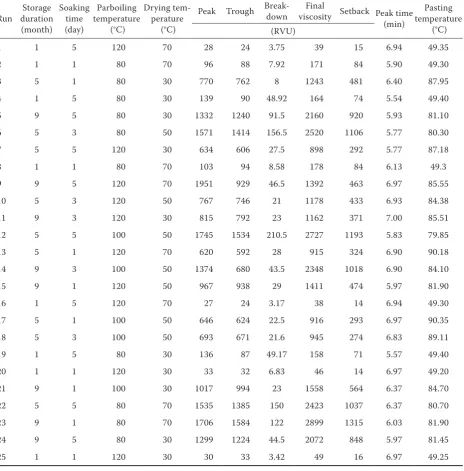
[image:2.595.67.532.300.772.2]Experimental design and paddy processing. Ofada paddy (OS 6) was purchased at farm gate in Mokolokin, Nigeria. The farmers’ practices with respect to storage duration (1–9 months) and pro-cessing unit operations (soaking, parboiling, and drying) in the area were adopted for the treatment. D-Optimal response surface methodology was used for the design of the experiment (Design Expert 6.0.6 software). The independent and levels of variables were decided mainly from the literature (Otegbayo
Table 1. Effects of storage duration and processing conditions on the pasting properties of Ofada rice
Run duration Storage (month)
Soaking time (day)
Parboiling temperature
(°C)
Drying tem-perature
(°C)
Peak Trough Break-down viscosity Setback Peak time Final (min)
Pasting temperature
(°C) (RVU)
et al. 2001; Patindol et al. 2008) and based on a preliminary investigation of rice processing in the area (Table 1). Paddy (4 kg) was soaked in cold water at ambient temperature (28 ± 2°C) to hydrate the kernels, parboiled at varying temperatures at constant pressure using an autoclave for 15 min, tempered for 30 min and air-dried in an oven. The combinations of treatment parameters for the experiment are shown in Table 1. The rice sample was milled (hulling and debranning) in a grantex cono disc milling machine and ground in a hammer mill, sieved (200 micron size) and analysed.
The pasting properties of rice flour were determined using the method described by Mir and Bosco (2013). The following parameters were determined on the RVA curve: peak viscosity, trough (hold vis-cosity), final viscosity, breakdown, setback, pasting temperature and pasting time.
Statistical analyses. Data from the pasting experi-ments were analysed and optimised using the Design Expert 6.0.6 software components. F (P = 0.05) was estimated using Statistical Analysis System version 10.0 as described by Magnus et al. (1997).
RESULTS AND DISCUSSION
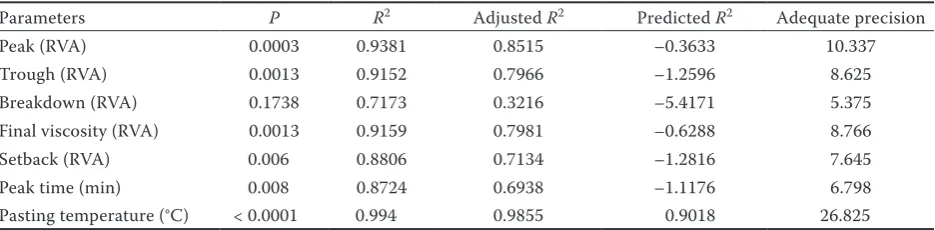
The pasting properties determined in this study are presented in Table 1. The determined parameters were significant at P < 0.05 except for breakdown viscosity (Table 2). The minimum and maximum range of peak, trough, breakdown, final viscosity, setback, peak time and pasting temperature were 27–1951 RVU, 24–1584 RVU, 3–211 RVU, 38–2899 RVU, 14–1315 RVU, 5.54–7 min and 49.20–90.35°C, respectively. The F indicated that the pasting char-acteristic is more dependent on storage duration and parboiling temperature than on soaking time and drying temperature (Table 3). Effect of storage was significant (P < 0.05) on all the pasting
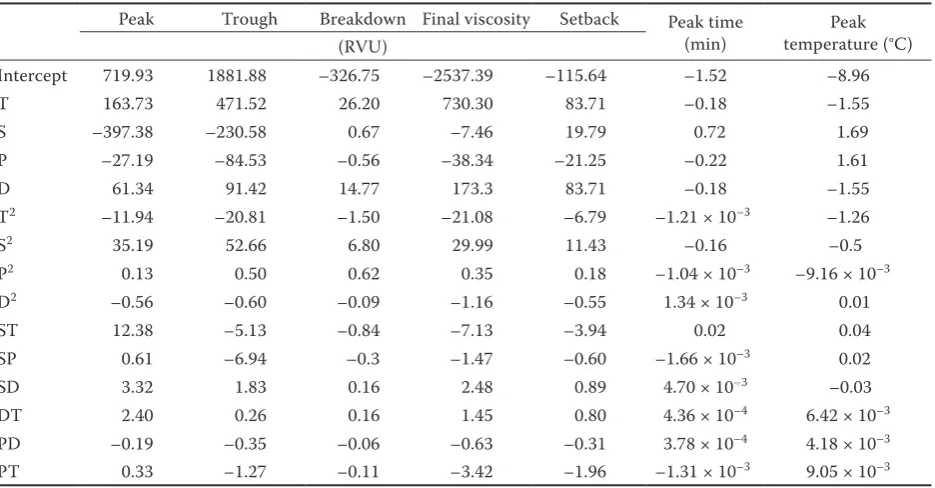
param-eters except breakdown viscosity and pasting time. Quadratic coefficient models of effect of storage and processing conditions on pasting are shown in Table 4.
The minimum and maximum peak times were 5.54 and 7 min respectively with an average of 6.39 min and the result were also significant at P < 0.05. The maximum peak time was obtained from rice stored for nine months, soaked for three days, parboiled at 120°C and dried at 30°C.
The pasting temperatures recorded in the experi-ment were significant at P < 0.05 and ranged from 49.2 to 90.35°C. The pasting temperature is the temperature at which viscosity start to rise. It was observed that Ofada rice stored for one month has a low pasting temperature (less than 50°C) compared to those of rice stored for five and nine months which fall between 78 and 90°C. The range of pasting tem-peratures recorded in this experiment is similar to the results documented by Eke-Ejiofor et al. (2011). Low pasting temperature indicates faster swelling. Higher peak temperature suggests the presence of long amylopectin chains.
The average peak viscosity (801 RVU) recorded was higher than that reported by Danbaba et al. (2012). The maximum peak value was obtained in the rice sample stored for nine months and subjected to a five-day soaking period, parboiling at 120°C and drying at 70°C, while the minimum peak was for one month of storage but with similar processing conditions. The variation in the peak viscosity could be attributed to storage duration since the same processing conditions were utilised. Storage of rice results in changes to its properties such as swelling; three months of storage is regarded as the minimum period required to elicit major changes in the hard-ness of cooked rice (Katekhong & Charoenrein 2012). Perez and Juliano (1981) as well as Daniels
[image:3.595.64.532.650.765.2]et al. (1998) reported that rapid changes occurred in stored rice in the first six weeks and first month, respectively. The data recorded in this experiment
Table 2. ANOVA for regression of pasting properties as a function of processing conditions
Parameters P R2 Adjusted R2 Predicted R2 Adequate precision
revealed an increased peak with increased storage duration in contrast to the conclusions reported by Katekhong and Charoenrein (2012). The peak is affected by both amylose and amylopectin as well as by the molecular conformation of starch molecules (Lin et al. 2010). High peak viscosity values are
[image:4.595.65.531.125.381.2]im-portant in the preparation of stiff dough products such as ‘tuwo shinkafa’, which is popular among the Hausas in Nigeria. Increases in drying temperature and storage duration were proportional to the increase in peak viscosity as shown by the positive coefficients in Table 4.
Table 3. Significance of F (P < 0.05) for effect of storage and processing conditions on pasting properties
Peak (RVA)
Trough Breakdown Final viscosity Setback Pasting time
(min) Pasting temperature (°C) (RVU)
T 67.74 49.66 – 42.61 28.22 – 388.54
S – – – – – 10.24 –
P – 6.45 – 7.71 9.06 76.91 –
D 5.6 – – – – 6.06 –
T*S – – – – – 5.87 –
T*P – – – – – 7.8 –
S*P – – – – – – –
T*D 7.53 – – – – – –
S*D – – – – – 18.72 –
P*D – – – – – – –
T*S*P – – – – – 13.94 –
T*S*D – – – – – 5.15 –
T*P*D – – – – – 15.29 98.4
S*P*D – 5.54 – – – 8.26 48.36
T*S*P*D – – – – – – 26.94
T – storage duration; S – soaking time; P – parboiling temperature; D – drying temperature
Table 4. Coefficient of model on effect of storage and processing conditions on pasting properties of Ofada rice
Peak Trough Breakdown Final viscosity Setback Peak time
(min) temperature (°C)Peak (RVU)
Intercept 719.93 1881.88 –326.75 –2537.39 –115.64 –1.52 –8.96 T 163.73 471.52 26.20 730.30 83.71 –0.18 –1.55 S –397.38 –230.58 0.67 –7.46 19.79 0.72 1.69 P –27.19 –84.53 –0.56 –38.34 –21.25 –0.22 1.61 D 61.34 91.42 14.77 173.3 83.71 –0.18 –1.55 T2 –11.94 –20.81 –1.50 –21.08 –6.79 –1.21 × 10⁻³ –1.26
S2 35.19 52.66 6.80 29.99 11.43 –0.16 –0.5
P2 0.13 0.50 0.62 0.35 0.18 –1.04 × 10⁻³ –9.16 × 10⁻³
D2 –0.56 –0.60 –0.09 –1.16 –0.55 1.34 × 10⁻³ 0.01
ST 12.38 –5.13 –0.84 –7.13 –3.94 0.02 0.04 SP 0.61 –6.94 –0.3 –1.47 –0.60 –1.66 × 10⁻³ 0.02
SD 3.32 1.83 0.16 2.48 0.89 4.70 × 10⁻³ –0.03
DT 2.40 0.26 0.16 1.45 0.80 4.36 × 10⁻⁴ 6.42 × 10⁻³
PD –0.19 –0.35 –0.06 –0.63 –0.31 3.78 × 10⁻⁴ 4.18 × 10⁻³
[image:4.595.65.533.522.766.2]The highest trough value of 1584 RVU was obtained from the rice sample stored for nine months and processed according to the following conditions: one day soaking time, 80°C parboiling temperature and 70°C drying; the minimum trough (24 RVU), meanwhile, was obtained from the rice sample stored for one month, soaked for one day, parboiled at 120°C and dried at 50°C. High trough indicates a tendency of the rice starch to break down during cooking; thus, trough values usually decrease with cooking (Danbaba et al 2012). Removal of bran in the milling process reduces the amylase content of rice and thereby results in less active amylase and higher trough viscosity (Perdon et al. 2001).
Breakdown viscosity describes the ability of swol-len starch granules to rupture when held at high temperatures with continuous shearing (Patindol
et al. 2008). The maximum breakdown was recorded at processing conditions of five days of soaking, 100°C parboiling temperature, 50°C drying tempera-ture and five months of storage. At high breakdown there is tendency for the rice to stick (Gayin et al.
2009). Breakdown viscosity decreases with increasing amylose content (Lin et al. 2010). Minimal levels of breakdown viscosity results in rice that can be used to prepare dishes involving boiled rice that does not stick together. Such dishes are enjoyed by many in Nigeria.
Final viscosity is a parameter which gives an idea of the ability of starch to gel after cooking (Niba et al. 2001) The highest final viscosity was recorded for paddy stored for nine months and subjected to one day of soaking, parboiling at 80°C and drying at 70°C, while the lowest value was obtained for one month of storage, parboiling at 120°C and drying
at 70°C. Rice with high viscosity gives rise to a firm paste, a property which is governed by the tendency of the starch to undergo retrogradation.
Significant differences (P < 0.05) were observed in the values obtained for the setback viscosity as presented in Table 2. The maximum setback was obtained for the rice sample stored for nine months, soaked for one day, parboiled at 80°C and dried at 70°C. The same processing conditions that promoted maximum setback were also those that were optimal for the final viscosity. The minimum setback was ob-tained in response to one month of storage, one day of soaking, parboiling at 120°C and drying at 30°C. The retrogradation tendency of rice is determined by setback (Danbaba et al. 2012). Aging of amyl-ose has major effects on setback viscosity because the molecular movement of starch molecules dur-ing pastdur-ing slows down at low temperature and the amylose molecules tend to arrange themselves in a parallel fashion and to draw close to each other to combine through hydrogen bonds. Thus, starch with high amylose content is easy to retrograde (Lin et al. 2010). Low setback is related to soft rice texture.
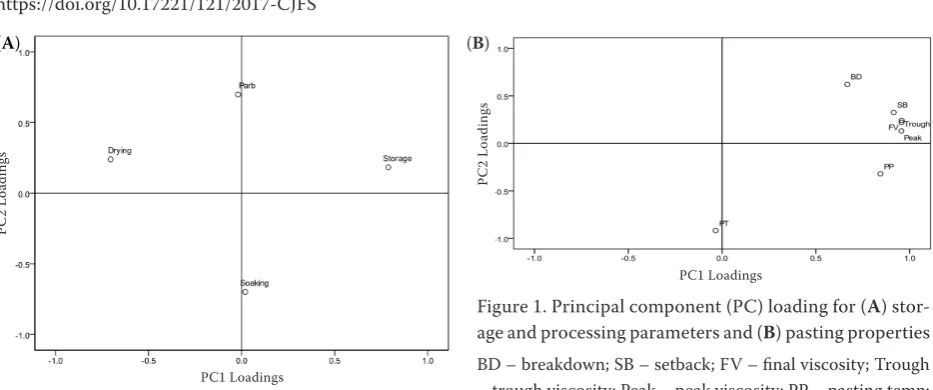
[image:5.595.66.533.90.285.2]Principal component analysis. The loading plots of processing parameters and pasting characteristics are presented in Figure 1 for PC1 and PC2, respectively. Ninety percent of the variations in the processing pa-rameters were explained by the principal components (PCs), 67.7% by PC1 and 22.3% by PC2 (Figure 1A). The results indicated that a storage facility located on the extreme right of the plot was predominantly responsible for the variation in pasting properties such as peak, trough, setback and final viscosity. This is in line with the findings of Daniel et al. (1998) who reported that ageing is the main contributor to
Figure 1. Principal component (PC) loading for (A) stor-age and processing parameters and (B) pasting properties BD – breakdown; SB – setback; FV – final viscosity; Trough – trough viscosity; Peak – peak viscosity; PP – pasting temp; PT – pasting time
(A) (B)
PC2 L
oading
s
PC1 Loadings
PC2 L
oading
s
the molecular changes of starch. Soaking as part of rice processing operations had the lowest effect on the pasting characteristics of Ofada rice.
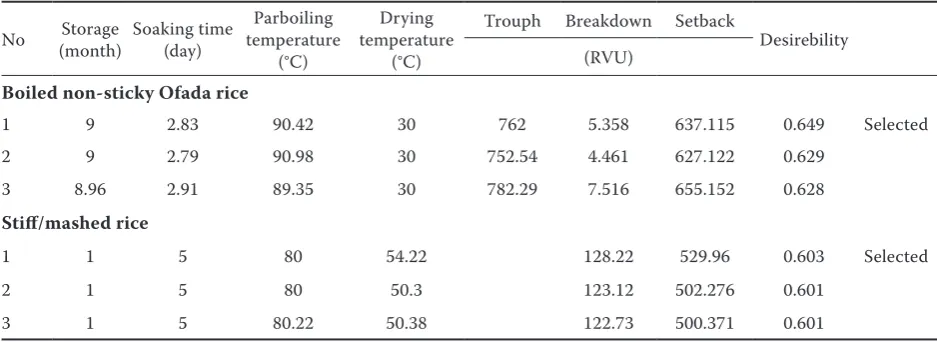
Low breakdown viscosity, minimum trough value and high setback viscosity were optimal for non-sticky boiled rice, while low setback, high breakdown viscos-ity and high trough values were suitable for mashed porridge rice. The best processing conditions for boiled Ofada rice are the following: storage of paddy for nine months and processing by soaking for two days and 19 h, parboiling at 90.42°C, and drying at 30°C (Table 5). For stiff paste/mashy/porridge rice, optimal conditions involve storage of paddy for one month followed by soaking for five days, parboiling at 80°C, and drying at 54.22°C (Table 5).
CONCLUSIONS
Storage duration and processing conditions of pad-dy influenced the pasting properties of Ofada rice. Response surface methodology (design expert) was successfully used to optimise and model the optimum pasting characteristics of Ofada rice for production of boiled and mashed rice. The storage duration of paddy has a major effect on the pasting properties of rice products. This study revealed the optimal parameters for the processing of Ofada rice for the purpose of producing end products with specific characteristics.
References
Adekoyeni O.O., Akinoso R., Malomo O. (2012): Some physical properties and yield of Ofada rice. Journal of Basic Applied Science Research, 2: 4098–4108.
Ajala A.S., Gana A. (2015): Analysis of challenges facing rice processing in Nigeria. Journal of Food Processing, Article ID 893673. doi: 10.1155/2015/893673
Danbaba N., Anounye J.C., Gana A.S., Abo M.E., Ukwun-gwu M.M., Maji A.T. (2012): Physical and pasting prop-erties of Ofada rice (Oryza sativa L.) varieties. Nigerian Food Journal, 30: 18–25.
Daniel M.J., Marks B.P., Siebenmorgen T.J., Menew R.W., Meullenet J.F. (1998): Effect of long grain rough rice stor-age history on end-use quality. Journal of Food Science, 63: 832–835.
Eke-Ejiofor J., Barber L.I., Kiin-Kabari D.B. (2011): Effect of pre-boiling on the chemical, functional and pasting properties of rice. Journal of Agriculture and Biological Sciences, 2: 214–219.
Hamaker B.R., Siebenmorgan T.J., Dilday R.H. (1993): Ag-ing of rice in the first six months after harvest. Arkanas Farm Research, 42: 8–9.
Katekhong W., Charoenerein S. (2012): Effect of rice storage on pasting properties, swelling and granular morphology of rice flour. Asian Journal of Food Agricultural-Industry, 5: 315–321.
Magnus E.M., Brathen E., Sahlsrom S., Faergestad E.M., Ellekjaer M.R. (1997): Effects of wheat variety and pro-cessing conditions in experimental bread baking studied by univariate and multivariate analyses. Journal of Cereal Science, 25: 289–301.
Mir S.A., Bosco S.J. (2013): Effect of soaking temperature on physical and functional properties of parboiled rice cultivars grown in temperate region of Indian. Journal Food and Nutrition Sciences, 4: 282–288.
[image:6.595.63.532.124.295.2]Niba L.L., Bokanga M.M., Jackson F.L., Schlimmee D.S., Li B.W. (2001): Physicochemical properties and starch granu-lar characteristics of flour from various Manihot esculenta (cassava) genotypes. Journal of Food Science, 67: 112–118. Table 5. Parameters predicted to give optimal pasting properties of boiled non-sticky Ofada rice and stiff/mashed rice
No (month)Storage Soaking time (day) temperature Parboiling (°C)
Drying temperature
(°C)
Trouph Breakdown Setback
Desirebility (RVU)
Boiled non-sticky Ofada rice
1 9 2.83 90.42 30 762 5.358 637.115 0.649 Selected 2 9 2.79 90.98 30 752.54 4.461 627.122 0.629
3 8.96 2.91 89.35 30 782.29 7.516 655.152 0.628
Stiff/mashed rice
1 1 5 80 54.22 128.22 529.96 0.603 Selected
2 1 5 80 50.3 123.12 502.276 0.601
Otegbayo B.O., Osamuel F., Fashakin J.B. (2002): Effect of parboiling on chemical qualities of two local rice varieties in Nigeria. Journal of Food Science, 6: 130–132. Patindol J., Newton J., Wang Y.J. (2008): Functional
proper-ties as affected by laboratory scale parboiling of rough rice and brown rice. Journal of Food Science, 73: 370–377. Perdon A.A., Siebenmorgen T.J., Mauromoustakos A., Grif-fin V.K., Johnson E.R. (2001): Degree of milling effects on rice pasting properties. Journal of Cereal Chemistry, 78: 205–209.
Perez C.M., Juliano B.O. (1981): Texture changes and stor-age of rice. Journal of Texture Studies, 12: 321–333.
Lin Q., Xiao H., Li L., Yu F.X., Tian W. (2010): Studies on the pasting and rheology of rice starch with different protein residual. In: Third IFIP TC 12 International Conference on Computer and Computing Technologies in Agricul-ture III (CCTA), Oct 2009, Beijing, China. Springer, IFIP Advances in Information and Communication Technol-ogy, AICT317: 407–419, 2010. Available at www.https:// hal.inria.fr/hal-01055420 (accessed Feb 03, 2018). Zhou Z., Robards K., Helliwell S., Blanchard S. (2002):
Ageing of stored rice: changes in chemical and physical attributes. Journal of Cereal Science, 35: 65–78.