Fuzzy Random Linear Optimization under
Possibilistic Downside Risk Measures:
Minimization of Possibilistic Low Partial Moment
Hideki Katagiri
Abstract—This paper considers new downside risk-aversion models for linear optimization (linear programming) with discrete fuzzy random variables. Through new downside risk measures for fuzzy stochastic optimization problems, possibilis-tic low partial moment (PLPM) models are constructed by incorporating possibility and necessity measures into classical low partial moment. To provide practical models, the case of linear membership functions is focused on. It is shown that the problems involving both fuzziness and randomness are transformed into deterministic polynomial optimization problems.
Index Terms—Linear programming, fuzzy random variable, downside risk measure, possibilistic lower partial moment, polynomial optimization problem
I. INTRODUCTION
Simultaneous consideration of fuzziness and randomness is highly important in modeling decision making problems, because decision making by humans in stochastic environ-ments is intrinsically based not only on randomness but also on fuzziness. One of traditional tools for taking into consid-eration uncertainty of parameters involved in mathematical optimization problems is stochastic programming [2]. On the other hand, to deal with human judgments and/or knowledge in decision making, fuzzy optimization frameworks involving fuzzy programming [38] and possibilistic programming [8] have been developed based on fuzzy-set theory [36] and possibility theory [3], respectively.
In the last decade, mathematical optimization models in decision making which take into consideration both fuzziness and randomness have considerably drawn attentions in the research fields such as linear programming [1], [13], [18], [20], [35], integer programming [17], transportation [6], facility layout [32], network optimization [14], [10] and portfolio selection [16].
Previous studies on fuzzy random linear programming problems have mainly focused on the case where the co-efficients of the objective function and the constraints are expressed by continuous fuzzy random variables. Linear programming problems withdiscretefuzzy random variables [12], [17] have not fully been discussed so far. This is the motivation of this article.
In this paper, we provide new downside risk measures for fuzzy random optimization, which are constructed by incorporating possibility theory into classical low partial moment (LPM). We formulate new downside risk-aversion models, called possibilistic low partial moment models, for
H. Katagiri is with Faculty of Engineering, Kanagawa University, Japan, e-mail: [email protected]
linear programming (linear optimization) problems with dis-crete fuzzy random variable. It is shown that the formulated problems based on the newly proposed risk measures are transformed into polynomial optimization problem [26].
II. PRELIMINARIES
Fuzzy random programming, which means mathematical programming in whichfuzzy random variablesare involved, has been developed as one of the most well-known and popular techniques for fuzzy stochastic optimization in de-cision making. From mathematical viewpoints, there are mainly two definitions of fuzzy random variables. A fuzzy random variable was firstly defined by Kwakernaak [24] in 1978 as random variables whose realized values for given events are not real but fuzzy numbers. Kruse [23] provided some expanded concepts of the model similar to the fuzzy random variable defined by Kwakernaak. Puri and Ralescu [33] defined fuzzy random variables as random fuzzy sets and developed a mathematical basis of fuzzy random variables [22]. Overviews of fuzzy random variables were also presented in some articles [5], [34].
We introduce a general definition of fuzzy random vari-ables, which is based on previous works [4], [23], [24]:
Definition 1: (Fuzzy random variable)
Let (Ω,F, P)be a probability space and F(R) denote the set of all fuzzy numbers inR, whereF(R)denotes a class of normal convex fuzzy subsets of R having compact α level set for α ∈ [0,1]. A fuzzy random variable is a mapping
˜ ¯
A: Ω→F(R)such that for anyα∈[0,1]and allω∈Ω, the real-valued mapping
inf ˜A¯α: Ω→R, satisfying inf ˜Aα(ω) = inf( ˜A(ω))α
and
sup ˜A¯α: Ω→R, satisfying sup ˜Aα(ω) = sup( ˜A(ω))α
are real-valued random variables, that is, Borel measurable real-valued functions. ( ˜A(ω))α is a nonempty compact
in-terval defined by
( ˜A(ω))α=
{x∈
R|µA˜(ω)(x)≥α} if α∈(0,1]
cl(supp µA˜(ω)) if α= 0,
whereµA˜(ω)is the membership function of a fuzzy setA(ω),˜
andcl(supp µA˜(ω))denotes the closure of set supp µA˜(ω),
andsupp µA˜(ω) denotes a support of functionµA˜(ω).
coefficients, and further studied by other researchers [13], [18], [27], [28], [35]. Major fuzzy stochastic programming models were discussed in the survey paper [30].
For the purpose of applying fuzzy random variables to decision making problems, Katagiri et al. [13], [14], [15], [16], [19], [18] introduced some special types of fuzzy random variables. To systematically discuss these papers from the viewpoint of the types of fuzzy random variables, we define anL-R fuzzy random variableas follows:
Definition 2: (L-R fuzzy random variable)
Let d,¯ β¯ and ¯γ be random variables of which realization for a given event ω ∈Ωare d(ω),β(ω) andγ(ω), respec-tively, where Ω is a sample space, and β(ω) and γ(ω) are positive constants for any ω ∈ Ω. Then, a fuzzy random variable F˜¯ is said to be an L-R fuzzy random variable, denoted by ( ¯d,β,¯ ¯γ)LR, if its realized values F(ω) =˜
(d(ω), β(ω), γ(ω))LR for any event ω ∈ Ω are L-R fuzzy
numbers defined as
µF˜(ω)(τ) =
L
d(ω)−τ β(ω)
if τ ≤d(ω)
R
τ−d(ω) γ(ω)
if τ > d(ω). (1)
L-R fuzzy random variables were introduced to decision making problems such as a portfolio selection problem [16], a linear programming problem [15] and a multi-objective programming problem [13], [18]. As a special type of L-R fuzzy random variables, anL fuzzy random variablecan be considered when L = R holds, which means that the left-hand and the right-hand sides of reference functions are the same.L fuzzy random variables were considered in network optimization problems such as bottleneck minimum spanning tree problems [9], [14]. The L fuzzy random variable is closely related to a so-called “hybrid number” which was originally introduced by [21]. When L(t) = R(t) = max{0,1− |t|}in Definition 2, we call such anL-R fuzzy random variable a triangular fuzzy random variable. Triangular fuzzy random variables were introduced in the previous study on a multi-objective linear programming problem [19], where spread parameters β¯ and γ¯ are not random variables but constant values.
III. DISCRETE FUZZY RANDOM VARIABLE
The concept ofdiscrete fuzzy random variablewas origi-nally defined by Kwakernaak [25]. In this paper, we provide the definition of discrete fuzzy random variable as follows:
Definition 3: (Discrete fuzzy random variable)
LetΩbe a set of events such that the occurrence probability of each eventωk ∈Ωispkand thatPkpk = 1. LetF˜k be a
fuzzy set characterized by a membership functionµF˜k, and
let F be a set ofFk, ∀k∈K, where K is an index set of
k. Let F˜¯ be a mapping fromΩtoF such thatF˜¯(ωk) 4
= ˜Fk.
Then, a mapping F˜¯ is said to be a discrete fuzzy random variable.
As a special type of discrete fuzzy random variables, we call a discrete fuzzy random variable a discrete L-R fuzzy
random variablewhen each realizationF˜kis anL-Rnumber
in Definition 3 as follows:
µF˜k(τ) =
L
dk−τ
βk
if τ≤dk
R τ−d
k
γk
if τ > dk.
(2)
In particular, whenL(t) =R(t) = max{0,1− |t|}holds in Definition 2, we call such a discrete L-R fuzzy random variable adiscrete triangular fuzzy random variable. In other words, a discrete triangular fuzzy random variable F˜¯ is a discrete fuzzy random variable whose realization for each eventωk is a triangular fuzzy number characterized by the
following membership function:
µF˜k(τ) =
max
1−|dk−τ| βk
,0
if τ≤dk
max
1−|τ−dk| γk
,0
if τ > dk.
(3)
Discrete fuzzy random variables were firstly introduced in the previous study on a linear programming problem [12], and further discussed in a network optimization problem [11] and a multi-objective 0-1 programming problem [17]. These previous studies mainly focused on the decision making models which maximize probabilistic expectation of the possibility that the goal is attained.
To the author’s best knowledge, there are few studies which considers downside risk-aversion models for linear programming with discrete fuzzy random variables, although possibilistic value-at-risk (PVaR) models [10] were con-structed by the author and his colleagues. Some previous studies discussed variance models [12] and expectation mod-els [11], [17].
Under these circumstances, we propose a new downside risk measure in fuzzy stochastic decision making envi-ronments, called possibilistic low partial moment (PLPM), which is an extended concept of classical low partial moment (LPM) through the incorporation of possibility theory into the LPM.
IV. PROBLEM FORMULATION
Assuming that the coefficients of the objective functions are given as discrete fuzzy random variables, we consider the following fuzzy random programming problem:
minimize C˜¯lx, l= 1,2, . . . , q
subject to Ax≤b, x≥0,
(4)
whereC˜¯l= ( ˜C¯l1, . . . ,C˜¯ln), l= 1,2, . . . , q is an n
dimen-sional coefficient row vector of which elements are discrete fuzzy random variables, x is an n dimensional decision variable column vector, A is an m×n coefficient matrix, andbis anmdimensional column vector. When the number of objective functions equals to 1 (q = 1), then problem (4) becomes a single-objective fuzzy random programming problem; otherwise, when q ≥ 2, (4) is a multi-objective fuzzy random programming problem.
In problem (4), each elementC˜¯lj of the coefficient vector
˜ ¯
Cl = ( ˜C¯l1, . . . ,C˜¯ln), l = 1,2, . . . , q in (4) is a discrete
l = 1,2, . . . , q, j = 1,2, . . . , n, k = 1,2, . . . , rl, where an
event ωlk occurs at probability plk and Pkplk = 1. The
membership function ofC˜ljk is given as follows:
µC˜
ljk(τ) =
max
1−|dljk−τ| βljk
,0
if τ≤dljk
max
1−|τ−dljk| γljk
,0
if τ > dljk.
(5) Then, by applying the Zadeh’s extension principle [36], the realized value of each objective functionC˜¯lxfor a given
eventωlk which occurs at probability plk is calculated as a
single triangular fuzzy number (dlkx,βlkx,γlkx)tri, l =
1,2, . . . , q,k= 1,2, . . . , rl, which is characterized by
µC˜
lkx
(υ) =
max
1−|dlkx−υ| βlkx ,0
if υ≤dlkx
max
1−|υ−dlkx| γlkx ,0
if υ >dlkx.
(6) Figures 1 and 2 show the membership functions of C˜ljk
[image:3.595.50.292.93.161.2]andC˜lkx.
Fig. 1. Membership functionµC˜ljkof the realized value
˜
Cljkfor thekth event of a discrete triangular fuzzy random variableClj˜¯
Fig. 2. Membership functionµC˜
lkxof the realized value
˜
Clkxfor the kth event of a discrete triangular fuzzy random variableC˜¯lx
In decision making situations where the objective function is to be minimized, decision makers (DMs) often have fuzzy goals such as “the objective function value C˜lkx is
substantially less than or equal to a certain valuefl,” which
is expressed by C˜¯lkx <
∼fl, where <
∼denotes “substantially less than or equal to.” LetµG˜lbe a membership function of
fuzzy set G˜l such that the degree of y being substantially
less than or equal to a certain value fl is represented with
µG˜l(y).
Here, we focus on a case where all the membership functions of fuzzy numbers and fuzzy goals are represented
by linear membership functions which are the following piecewise linear membership functionsµG˜
l, l= 1,2, . . . , q:
µG˜l(y) =
0 if y > f0
l
y−fl0 f1
l −f
0
l
if fl1≤y≤fl0 1 if y < f1
l,
(7)
[image:3.595.336.515.192.295.2] [image:3.595.80.262.332.438.2]wherefl0andfl1are parameter values determined by a DM. Figure 3 shows the linear membership functions of fuzzy goalG˜l.
Fig. 3. Linear membership functionµG˜l of a fuzzy goal
˜
Gl
One of reasonable solving processes is to maximize the degree of possibility or necessity that the fuzzy goalsG˜lare
attained. When formulated problems involve only fuzziness, possibilistic programming [7], [8] is applicable to solving them.
Unfortunately, however, possibilistic programming ap-proaches cannot directly be applied to solving mathematical programing problems with discrete fuzzy random variables. This is because the degrees of possibility or necessity are not constants but vary dependent on eventsωlk.
Now we shall discuss how to construct optimization cri-teria in order to solve the problems involving both fuzziness and randomness. Assuming that a certain event ωlk has
occurred, on the basis of possibility theory [3], the degree of possibility thatC˜lkx satisfies fuzzy goalG˜ (namely, the
degree of possibility that the objective function valueC˜¯lkx,
l = 1,2, . . . , q, k = 1,2, . . . , rl for any event ωlk ∈ Ωl is
substantially less than or equal to a certain aspiration level fl) is defined as
ΠC˜lkx <
∼fl
4 = sup
y
minnµC˜
lkx
(y), µG˜l(y)
o .
[image:3.595.80.262.501.601.2](8) Figure 4 illustrates the degree of possibility defined by (8) for a fixed eventωlk, which is the ordinate of the crossing
point between the membership functions of fuzzy goal G˜l
and the objective functionC˜lkx.
Fig. 4. Degree of possibilityΠ
˜ Clkx
< ∼fl
[image:3.595.309.543.659.761.2]The possibility measure is recommended to optimistic DMs. Since DMs are not always optimistic in general, we introduce an optimization criterion based on necessity measures in order to construct an optimization criterion for pessimisticDMs.
On the basis of possibility theory [3], the degree of neces-sity that the objective function value C˜¯lkx,l = 1,2, . . . , q,
k = 1,2, . . . , rl for any event ωlk ∈ Ωl satisfies the fuzzy
goalG˜l is defined as
NC˜lkx <
∼fl
4 = inf
y max
n 1−µC˜
lkx
(y), µG˜
l(y)
o .
[image:4.595.309.558.233.483.2](9) Figure 5 illustrates the degrees of necessity defined by (9), which is the ordinate of the crossing point between the membership functions of fuzzy goalG˜land the upside-down
[image:4.595.48.285.270.402.2]of the membership function of the objective functionC˜lkx.
Fig. 5. Degree of necessityN
˜ Clkx
< ∼fl
.
By usingplkwhich is the probability that an eventwlk
oc-curs, the optimization criterion, the probabilistic expectations of possibility and necessity are defined as follows:
EhΠC˜¯lx <
∼fl
i 4 =
rl
X
k=1
plk·Π
˜ Clkx
<
∼fl
(10)
EhNC˜¯lx <
∼fl
i 4 =
rl
X
k=1
plk·N
˜ Clkx
<
∼fl
(11)
whereE[·] denotes a probabilistic expectation.
Optimization criteria defined as (10) and (11) take into consideration both fuzziness and randomness involved in the coefficients of the mathematical programming problem. Some previous papers [11], [17] addressed optimization problems based on these criteria. A variance minimization model for linear programming problems with discrete fuzzy random variables [12] was also proposed, but those with downside risk measures have not been considered so far.
V. POSSIBILISTICLPMMODELS FOR DOWNSIDE
RISK-AVERSION
In this section, we propose a new downside risk measure in fuzzy stochastic decision making environments, called pos-sibilistic low partial moment (PLPM), which is an extended concept of classical low partial moment (LPM) through the incorporation of possibility theory into the LPM. As PLPM, we propose two measures, namely, possibility low partial moment andnecessity low partial moment.
Firstly, we define the possibility low partial moment as follows:
LP Mγ
h
ΠC˜¯lx <
∼fl
i4 =
rl
X
k=1
plk·
Π
˜ Clkx
<
∼fl
−πˆl
γ
−,
(12) where|a|−
4
= max{−a,0}, andγis a positive integer which represents the degrees of moment. Whenγ= 1, (12) means the semi-absolute deviation of the possibilityΠC˜¯lx
<
∼fl
. On the other hand, when γ = 2, (12) represents the semi-variance of the possibility.
Then, we consider the following optimization problem which minimizes the possibility lower partial moment under the constraint of probabilistic possibility expectation:
minimize LP Mγ
h
ΠC˜¯lx <
∼fl
i
, l= 1,2, . . . , q
subject to EhΠC˜¯lx <
∼fl
i
≥πˆEl , l= 1,2, . . . , q
Ax≤b, x≥0.
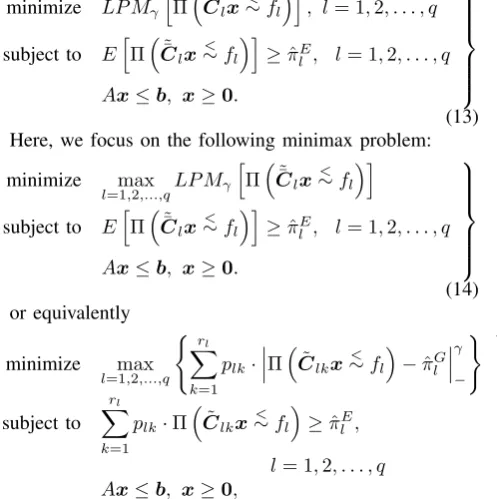
(13) Here, we focus on the following minimax problem: minimize max
l=1,2,...,qLP Mγ
h ΠC˜¯lx
<
∼fl
i
subject to EhΠC˜¯lx <
∼fl
i ≥πˆE
l , l= 1,2, . . . , q
Ax≤b, x≥0.
(14) or equivalently
minimize max
l=1,2,...,q
( rl
X
k=1
plk·
Π
˜ Clkx
<
∼fl
−πˆGl
γ
−
)
subject to
rl
X
k=1
plk·Π
˜ Clkx
<
∼fl
≥πˆlE,
l= 1,2, . . . , q Ax≤b, x≥0,
(15) where ˆπG
l is a target value of the possibility, and πˆlE is a
satisficing value of probabilistic expectation of possibility. All the values of πˆG
l and ˆπlE are given by decision makers
as positive constants greater than or equal to 0 and less than or equal to 1.
Now we consider the case wheref1
l andf
0
l are determined
by the following calculation:
fl1 = min
k xmin∈X n
X
j=1
rl
X
k=1
plkdljkxj
fl0 = max
k maxx∈X n
X
j=1
rl
X
k=1
plkdljkxj.
(16)
Assuming that βijk is not dependent onk and that βijk
is replaced byβij,Π
˜ Clkx
<
∼fl
is calculated as follows [12]:
ΠC˜lkx <
∼fl
4 = sup
y
minnµC˜
lkx
(y), µG˜
l(y)
o
=
n
X
j=1
(βlj−dljk)xj+fl0 n
X
j=1
βljxj−fl1+f
0
l
.
By introducing zΠ
lk, l = 1,2, . . . , q, k = 1,2, . . . , rl,
Π
˜ Clkx
<
∼fl
−πˆGl
− is represented as follows:
Π
˜ Clkx
<
∼fl
−ˆπG
l
−
= minnzlkΠ Π
˜ Clkx
<
∼fl
+zΠlk≥πˆlGo. Consequently, problem (15) is equivalently transformed into the following problem:
minimize max
l=1,2,...,q
( rl
X
k=1
plk· zlkΠ
γ )
subject to ΠC˜lkx <
∼fl
+zΠ
lk≥πˆGl , zlkΠ≥0,
l= 1,2, . . . , q, k= 1, . . . , rl rl
X
k=1
plk·Π
˜ Clkx
<
∼fl
≥πˆEl ,
l= 1,2, . . . , q Ax≤b, x≥0.
(18) By using (17), problem (18) is transformed into the following problem:
minimize max
l=1,2,...,q
( rl
X
k=1
plk· zΠlk
γ ) subject to n X j=1
βljzlkΠxj+ n
X
j=1
βlj−dljk−πˆlG
xj
+(f0
l −fl1)zlkΠ ≥(fl0−fl1)ˆπlG−fl0,
zΠ
lk ≥0, l= 1,2, . . . , q, k= 1, . . . , rl n
X
j=1
βlj−πˆEl − rl
X
k=1
plk·dljk
! xj
≥(f0
l −f
1
l)ˆπ E l −f
0
l,
l= 1,2, . . . , q
Ax≤b, x≥0
(19) or equivalently minimize θ subject to rl X k=1
plk· zlkΠ
γ
≤θ, l= 1,2, . . . , q
n
X
j=1
βljzlkΠxj+ n
X
j=1
βlj−dljk−πˆlG
xj
+(fl0−fl1)zlkΠ ≥(fl0−fl1)ˆπlG−fl0, zΠ
lk ≥0, l= 1,2, . . . , q, k= 1, . . . , rl n
X
j=1
βlj−πˆEl − rl
X
k=1
plk·dljk
! xj
≥(fl0−fl1)ˆπlE−fl0, l= 1,2, . . . , q
Ax≤b, x≥0.
(20) It should be noted here that problem (20) is a polynomial optimization problem [26], which can be solved by using semidefinite programming relaxation under some conditions.
A. Necessity lower partial moment model
In a manner similar to the possibility low partial moment, we propose a necessity low partial moment as follows:
LP Mλ
h
NC˜¯lx <
∼fl
i4 =
rl
X
k=1
plk·
N
˜ Clkx
<
∼fl
−νˆl
λ −. (21) In order to consider the case where a decision maker is pessimistic, we propose the following minimax problem which minimizes the maximum necessity low partial moment under the constraint of the probabilistic necessity expecta-tion:
minimize max
l=1,2,...,qLP Mγ
h
NC˜¯lx <
∼fl
i
subject to EhNC˜¯lx <
∼fl
i
≥νˆlE, l= 1,2, . . . , q Ax≤b, x≥0
(22) or equivalently minimize max
l=1,2,...,q
( rl
X
k=1
plk·
N
˜ ¯ Clx
<
∼fl
−νˆlG
λ) subject to rl X k=1
plk·N
˜ ¯ Clx
<
∼fl
≥νˆlE,
l= 1,2, . . . , q Ax≤b, x≥0.
(23) Assume that f0
l and fl0 are determined by (16), and that
γijk is replaced by γij which does not depend on k.
Then, NC˜lkx <
∼fl
is calculated as the following linear fractional function of decision variablesxj [12]:
NC˜lkx <
∼fl
4 = inf
y max
n 1−µC˜
lkx
(y), µG˜
l(y) o = − n X j=1
dljkxj+fl0 n
X
j=1
γljxj−fl1+f
0
l
.
(24) By introducing zN
lk, l = 1,2, . . . , q, k = 1,2, . . . , rl,
N
˜ Clkx
<
∼fl
−νˆlG
− is represented as follows:
N
˜ Clkx
<
∼fl
−νˆlG
−
= minnzN lk N ˜ Clkx
<
∼fl
+zN
lk ≥νˆlG
o .
Consequently, problem (23) is equivalently transformed into the following problem:
minimize max
l=1,2,...,q
( rl
X
k=1
plk· zNlk
λ )
subject to NC˜¯lx <
∼fl
+zN
lk ≥νˆlG, zlkN ≥0,
l= 1,2, . . . , q, k= 1, . . . , rl rl
X
k=1
plk·N
˜ ¯ Clx
<
∼fl
≥νˆlE,
l= 1,2, . . . , q Ax≤b, x≥0.
In a manner similar to the transformation of problem (18) into (20), it is easily shown that problem (25) is transformed into a polynomial optimization problem, which can be solved by using semidefinite programming relaxation under some conditions.
VI. CONCLUSION
In this paper, we have considered linear optimization (linear programming) problems with discrete fuzzy random variables. To take into consideration downside risk in fuzzy stochastic environments, we have proposed new models based on low partial moment using possibility and necessity measures, which is a generalized version of semi-variance and semi-absolute deviation of possibility and necessity. It has been shown that the problem can be transformed into polynomial optimization problems, which can be solved by semidefinite programming relaxation under some conditions. The framework proposed in this paper can be applied to solv-ing a wide variety of real-world decision maksolv-ing problems which can be modeled as linear programming problems.
Now we are constructing other downside risk measures based on (conditional) value-at-risk using possibility and necessity measures. We will present the results somewhere in the near future.
REFERENCES
[1] Aiche, F., Abbas, M., & Dubois, D. (2013). Chance-constrained programming with fuzzy stochastic coefficients.Fuzzy Optimization Decision Making, 12(2), 125–152.
[2] Birge, J.R. & Louveaux, F. (2011).Introduction to Stochastic Pro-gramming, Second Edition. Springer.
[3] Dubois, D., & Prade, H. (1988).Possibility theory. John Wiley & Sons. [4] Gil, M.A. (2004). Fuzzy random variables: development and state of the art. InMathematics of Fuzzy Systems, Linz Seminar on Fuzzy Set Theory(11–15).
[5] Gil, M.A., Lopez-Diaz, M., & Ralescu, D.A. (2006). Overview on the development of fuzzy random variables.Fuzzy Sets and Systems, 157(19), 2546–2557.
[6] Giri, P.K., Maiti, M.K., & Maiti, M. (2014). Entropy based solid transportation problems with discounted unit costs under fuzzy random environment.OPSEARCH, 51(4), 479–532.
[7] Inuiguchi, M. & Ichihasi, H. (1990). Relative modalities and their use in possibilistic linear programming.Fuzzy Sets and Systems, 35(3), 303–323.
[8] Inuiguchi, M. & Ramik, J. (2000). Possibilistic linear programming: a brief review of fuzzy mathematical programming and a comparison with stochastic programming in portfolio selection problem.Fuzzy Sets and Systems111(1), 3–28.
[9] Katagiri, H., & Ishii, H. (2000). Chance constrained bottleneck span-ning tree problem with fuzzy random edge costs. Journal of the Operations Research Society of Japan, 43(1), 128–137.
[10] Katagiri, H., Kato, K. & Hasuike, T. (2012). A random fuzzy minimum spanning tree problem through a possibility-based value at risk model, Expert Systems with Applications, 39(12), 205–220.
[11] Katagiri, H., Mermri, E.B., Sakawa, M., Kato, K., & Nishizaki, I. (2005). A possibilistic and stochastic programming approach to fuzzy random MST problems,IEICE Transactions on Information and Systems, 88(8), 1912–1919.
[12] Katagiri, H., & Sakawa, M. (2003). A study on fuzzy random linear programming problems based on possibility and necessity measures. InFuzzy Sets and Systems-IFSA 2003(725–732). Springer. [13] Katagiri, H. & Sakawa, M. (2011). Interactive multiobjective fuzzy
random programming through the level set-based probability model. Information Sciences, 181(9), 1641–1650.
[14] Katagiri, H., Sakawa, S. & Ishii, H. (2004). Fuzzy random bottleneck spanning tree problems using possibility and necessity measures, European Journal of Operational Research152(1), 88–95.
[15] Katagiri, H., Sakawa, M., & Ishii, H. (2005). Studies of stochastic programming models using possibility and necessity measures for linear programming problems with fuzzy random variable coefficients. Electronics and Communications in Japan (Part III: Fundamental Electronic Science), 88(1), 68–75.
[16] Katagiri, H., Sakawa, M., & Ishii, H. (2005). A study on fuzzy random portfolio selection problems based on possibility and necessity measures.Scientiae Mathematicae Japonicae, 61(2), 361–370. [17] Katagiri, H., Sakawa, M., Kato, K. & Nishizaki, I. (2004). A fuzzy
random multiobjective 0-1 programming based on the expectation optimization model using possibility and necessity measures. Math-ematical and Computer Modelling, 40(3–4), 411–421.
[18] Katagiri, H., Sakawa, M., Kato, K. & Nishizaki, I. (2008). Interactive multiobjective fuzzy random linear programming: maximization of possibility and probability.European Journal of Operational Research, 188(2), 530–539.
[19] Katagiri, H., Sakawa, M., Kato, K., & Ohsaki, S. (2005). An interactive fuzzy satisficing method based on the fractile optimization model using possibility and necessity measures for a fuzzy random multiobjective linear programming problem. Electronics and Communications in Japan (Part III: Fundamental Electronic Science), 88(5), 20–28. [20] Katagiri, H., Uno, T., Kato, K., Tsuda, H. & Tsubaki, H. (2013).
Ran-dom fuzzy multiobjective programming: Optimization of possibilistic Value at Risk (pVaR),Expert Systems with Applications40(2), 563– 574.
[21] Kaufmann, A., & Gupta, M.M. (1985). Introduction to Fuzzy Arith-metic. Theory and Applications, Van Nostrand Reinhold, New York (1985).
[22] Klement, E.P., Puri, M.L. & Ralescu, D.A. (1986). Limit theorems for fuzzy random variables.Proceedings of the Royal Society of London A 407, 171–182.
[23] Kruse, R. & Meyer, K.D. (1987).Statistics with Vague Data. D. Reidel Publishing Company.
[24] Kwakernaak, H. (1978). Fuzzy random variables-1. Definitions and theorems.Information Sciences, 15(1), 1–29.
[25] Kwakernaak, H. (1979). Fuzzy random variables-II. Algorithms and examples for the discrete case.Information Sciences, 17(3), 253–278. [26] Lasserre, J. B. (2001). Global optimization with polynomials and the problem of moments.SIAM Journal on Optimization, 11(3), 796-817. [27] Liu, B. (2001). Fuzzy random chance-constrained programming.IEEE
Transaction on Fuzzy Systems, 9(5), 713–720.
[28] Liu, Y.-K., Liu, B. (2003). A class of fuzzy random optimization: expected value models.Information Sciences, 155(1–2), 89–102. [29] Luhandjula, M.K. (1996). Fuzziness and randomness in an
optimiza-tion framework.Fuzzy Sets and Systems, 77(3), 291–297.
[30] Luhandjula, M.K. (2006). Fuzzy stochastic linear programming: sur-vey and future research directions.European Journal of Operational Research, 174(3), 1353–1367.
[31] Luhandjula, M.K. & Gupta, M.M. (1996). On fuzzy stochastic opti-mization.Fuzzy Sets and Systems, 81(1), 47–55.
[32] Nematian, J. (2014). A robust single row facility layout problem with fuzzy random variables.The International Journal of Advanced Manufacturing Technology, 72(1-4), 255–267.
[33] Puri, M.L. & Ralescu, D.A. (1986). Fuzzy random variables,Journal of Mathematical Analysis and Applications, 14(2), 409–422. [34] Shapiro, A.F. (2009). Fuzzy random variables,Insurance: Mathematics
and Economics, 44(2), 307–314.
[35] Yano, H. (2014). Fuzzy decision making for fuzzy random multiobjec-tive linear programming problems with variance covariance matrices. Information Sciences, 272, 111–125.
[36] Zadeh, L.A. (1965). Fuzzy sets.Information and Control, 8(3), 338– 353.
[37] Zadeh, L.A. (1978). Fuzzy sets as a basis for a theory of possibility. Fuzzy Sets and Systems, 1(1), 3–28.