© 2019, IRJET | Impact Factor value: 7.211 | ISO 9001:2008 Certified Journal | Page 2626
Recycling E- Waste using E-Technology
Chetan Dilip Chaudhari
Assistant Professor, Dept. of KPG Arts, Commerce and Science College, Igatpuri, Maharashtra, India
---***---Abstract –
“Today New Technology is Old in Tomorrow”
The Electrical & Electronics Industry is one of the fastest growing manufacturing industries in the word. We will see every day new technology is investigated. The IT is part of our live, work & communicates bringing countless benefits to the user. But on the other hand every new part of electronics makes old electronics part is E-waste. The rapid growth of technology makes fast growing waste streams in electrical & electronics equipment products .Electronic Waste includes discarded, obsolete, broken, electrical or electronic devices, including computers, TVs, notebooks, cell phones and other electronic devices, often containing hazardous material not suitable for regular disposal methods.
Key Words:E-Waste, Technology, Recycling, Green Recycling, Treatment & Disposaletc.
1. INTRODUCTION
What is E-Waste?
Electronic/ Electrical device which is not useful or old.,Servers, Computer Peripherals, Monitors, Electronic Keyboards, Printers, TV Peripherals, VCRs,Digital Video Recorders, DVD Players, Digital Converter Boxes, Cable or Satellite Receivers, Video Game Consoles, Portable Devices*,
Portable Digital Music Players, Tablets (considered a computer), E-readers (considered a computer), Electronic Mice or Similar Pointing Devices, Facsimile Machin.
1.1 What is E-Technology?
E-technology (Electronic-technology) covers a diverse range of IT (Information Technology), IS (Information Science), IT/IS and ICT used with the network architecture support of the Internet, or Extranet to assist personal, business, organizational and institutional activities.
1.2 Sub Heading 2
1.2 Why Use E-Technology for E-Waste?
The easy way E-Waste recycling rather than disposing it’s because 90% parts are usable. E-waste is harmful if discarded improperly so proper way to use discard & recycling by using E-Technology. Main Phases in E-Waste is Collection, Storage, Dismantling & Segregation, Recycling, Treatment & Disposal. But main difficulty is how to collect & process E-waste, so required intimidator between E-waste and E-Waste Process.”E-Technology acts Intimidator between E-Waste and E-Waste Process.
2. How Use E-Technology for E-Waste?
© 2019, IRJET | Impact Factor value: 7.211 | ISO 9001:2008 Certified Journal | Page 2627
Process Steps:-Collection Pick-Up
Recycling Process
[image:2.595.74.546.372.760.2]Certification of recycling & destruction
Table -1: S
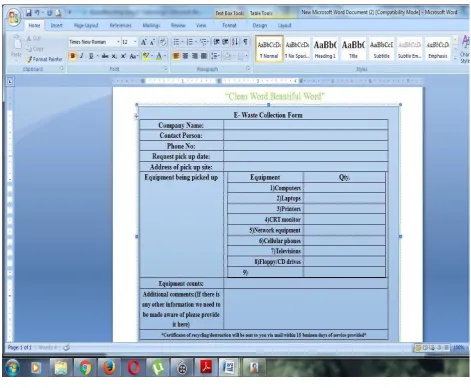
2.1 Collection of E-Waste:-
© 2019, IRJET | Impact Factor value: 7.211 | ISO 9001:2008 Certified Journal | Page 2628
2.2 Pick-Up:-
A pick-up is scheduled & our team of E-waste Specialists arrives to efficiently remove waste at your location.
2.3 Recycling Process:-
Recycling is committed to providing solutions for the responsible, effective management and removal of any
organization’s end-of-life electronic assets in a manner protecting the environment, worker health and safety, our clients and our community.
Recycling is committed to continual improvement.
Recycling is committed to the prevention of pollution and prevention of injury and ill health.
Recycling is committed to comply with applicable legal and other requirements relative to the environmental, stewardship and health and safety aspects of our business.
Recycling is committed to providing a framework for setting and reviewing environmental, health and safety objectives and targets.
Recycling is committed to the prohibition of forced or child labor for processing e-Waste throughout the recycling chain.
All Green Recycling is committed to the prohibition of prison operations throughout the Recycling Chain that involve incarcerated individuals handling Focus Material and Hazardous e-waste or Customer Data, and:
Are subsidized by government (directly or indirectly),
Involve the likelihood of risks of release or misuse of Customer Data, or
Do not provide workers with the same rights as private sector workers to protections from exposure to toxics,
All Green Recycling is committed to social accountability values consistent with the principles of SA 8000 and encourage all Downstream Processors to operate consistent with the principles of SA.
All Green Recycling is committed to communicating and reinforcing this policy throughout our company, as well as to our customers, our suppliers and to the public.
Electronic Waste – recycling laptops, computers and other electronic equipment.
© 2019, IRJET | Impact Factor value: 7.211 | ISO 9001:2008 Certified Journal | Page 2629
Picking Shed – first all the items are sorted by hand and batteries and copper are extracted for quality control.Initial Size Reduction Process – items are shredded into pieces as small as 100mm to prepare the e-waste to be thoroughly sorted. This is also where the data destruction takes place.
Secondary Size Reduction – the small debris is shaken to ensure that it is evenly spread out on the conveyor belt, before it gets broken down even more. Any dust extracted is disposed of in an environmentally friendly way.
Overband Magnet – using magnets, steel and iron are removed from the debris.
© 2019, IRJET | Impact Factor value: 7.211 | ISO 9001:2008 Certified Journal | Page 2630
Cathode Ray Tubes – recycling CRT Monitors and Televisions.Recycling Cathode Ray Tubes, most commonly found in computer monitors and old televisions, is more complicated than recycling most electronic waste. This is because toxins found within CRT’s are among the most dangerous – CRT’s have lead in the glass which can seriously harm the environment and our health if leaked into soil and water systems.
Separation of Monitor Body and Cathode Ray Tube – firstly the front of the monitor is removed so that the tube can be removed from within. The shell is then recycled along with regular ewaste.
Size reduction process – The tubes and screens are shredded down into small pieces. Any glass dust created in this process is disposed of carefully, in an environmentally friendly way.
Metal Removal – the broken bits of glass are then passed under magnets, where iron and steel is extracted from the glass material. The remaining material is then passed through Eddy Currents, which removes any aluminium and copper. These materials are then collected and reused as raw materials.
Washing Line – The remaining glass is then cleared of oxides, phosphors and dust extracts, leaving just clean glass to be sorted.
Glass Sorting Line – the final stage of CRT recycling sorts the leaded glass from the
unleaded glass. These can then both be used in the creation of new screens, which is called closed loop recycling. As you can see, electronic waste recycling is not a simple process. Which is why 1800Ewaste organise it all for you, and all you need to do is place on easy phone call to one of our friendly customer service team. Recycling your electronic waste in this way might not be free, but it’s a small price to pay to avoid sending these toxic materials to landfill, polluting the environment for future generations – especially when they can so easily be recycled.
3. CONCLUSION
Using E-Technology making Mobile application we directly interact with E-waste process in short time, when smart phone or internet not present we simply call E-waste management team.
REFERENCES
1. www.greenchiprecycling.com 2. www.allgreenrecycling.com
3. E- Waste Management using E- Technology Print ISSN: 2395-1265
4. E-Waste_in_ India RESEARCH UNIT (LARRDIS)RAJYA SABHA SECRETARIAT, NEW DELHI JUNE, 2011
5. http://en.wikipedia.org:. Judkis, Maura (2008-07-30). "4 Ways to Earn Cash for Recycling". Fresh Greens. U.S. News
and World Report. Retrieved 2008-03-05.
6. Greenop, Matt (2007-10-18). "Greenpeace slams Apple over 'toxic' iPhone". New Zealand Herald. Retrieved 2009-03-17.
7. The Daily Green Staff. "Recycle Your Cell Phone". The Daily Green. Retrieved 28 November 2012
8. Evans, Johnny. "Is the iPhone evolving faster than Moore's Law?". Computer World. Retrieved 28 November 2012. 9. Duncan, Katherine (May 23, 2013). "The Serial Entrepreneur Who Is Tackling E-Waste With EcoATMs (100 Brilliant
Companies)". Entrepreneur (magazine). Retrieved December 14, 2013. 10. "ecoATM". Popular Science. 2010. Retrieved December 14, 2013.
11. "Coinstar rebrands as Outerwall, acquires phone recycling startup ecoATM for $350M". VentureBeat. Retrieved July 2, 2013.
12. www.Greenpeace.com
13. http://livingtextblog.andosciasociology.net/20 13/04/23/ruth-noelthe-social-repercussions-of-electronic-wastes/ 14. http://ewasteguide.info/files/Amoyaw-Osei_2011_GreenAd-Empa.pdf