© 2019, IRJET | Impact Factor value: 7.211 | ISO 9001:2008 Certified Journal | Page 4282
ANALYSIS OF ACTIVE CONSTELLATION EXTENSION FOR PAPR
REDUCTION IN OFDM SYSTEM FOR HIGH BANDWIDTH APPLICATION
Aravindh vel.S1, Nagarajan.K2, Dr.Jayaraj.V3
1M.E Student, Nehru Institute of Engineering and Technology, Thirumalayam Palayam, Coimbatore, Tamilnadu, India 2Assistant Professor, Nehru Institute of Engineering and Technology, Thirumalayam Palayam, Coimbatore,
Tamilnadu, India
3Head of the Department, Nehru Institute of Engineering and Technology, Thirumalayam Palayam, Coimbatore,
Tamilnadu, India
---
Abstract: —
The orthogonal frequency division multiplexing with the multiple input and multiple output have a higher rate of new features in the current years. They have the significant role with the modulation technique. Thus, the existing systems have used the technique of peak for Average ratio (PAPR) reduction, which is used to reduce the high power amplifier efficiency. This technique has been used widely in the OFDM-OQAM method without the use of any other carrier technique. The proposed work consists of changes in the modulation technique called overlapped segmental Active Constellation Extension (OS-ACE).The proposed modification can reduce the Higher PAPR rate and they can be compared with the various existing algorithm. The modification scheme such as OS-ACE have the input signals which can be divided into various number of segmented signal and they can be permitted towards the ACE operation of each separated segments. Simulation results can be done under the software MATLAB to analyze the modified OFDM-OQAM technique. This proposed technique will proposes the better accuracy and lesser errorrate as compared towards the conventional ACE scheme in the OFDM systems.
KEYWORDS: OFDM-OQAM, overlapped
segmental Active Constellation Extension (OS-ACE) operation, peak for Average ratio (PAPR), Power amplifier efficiency
I. INTRODUCTION
© 2019, IRJET | Impact Factor value: 7.211 | ISO 9001:2008 Certified Journal | Page 4283 has attracted relevant pursuits ongoing years
[2-3]. OFDM-OQAM frameworks furnish cut back part flaps when contrasted with OFDM framework due with the utilization of heartbeat forming channels [4]. Also, the OFDM-OQAM frameworks supply greater ghastly productiveness and cut down restricted band impedance considering it works without CP [5]. In mild of the above aspects of curiosity, the OFDM-OQAM technique has executed as a viable alternative for Cognitive Radio (CR) purposes. Be that as it should, as a multicarrier stability, innovation, the OFDM-OQAM framework undoubtedly creates excessive pinnacle to average manipulate share (PAPR), which debases the effectiveness of the powerful enhancer (HPA) [6]. In the OFDM frameworks, much research has been carried out to control the PAPR problem, which will also be organized into three classifications: sign mutilation calculation, probability calculation and rectangular coding calculation. The sign mutilation calculation restrains the OFDM signal below a given restrict by way of nonlinear bending and contains: sign section [7] and companding trade [8]. The possibility calculation improves the PAPR execution through fundamentally reducing the probability that titanic pinnacle control sign shows up and upgrading multicarrier sign PAPR measurable residences. It comprises unique mapping (SLM)[9], halfway transmit arrangement (PTS)[10, 11], and tone reservation (TR)[12]. The coding calculation [13] limits the signal that can be utilized for transmission, just the sign whose crest esteem is decrease than the most severe pinnacle facet are accredited to be despatched. Amongst these developments,
© 2019, IRJET | Impact Factor value: 7.211 | ISO 9001:2008 Certified Journal | Page 4284 II. PROPOSED WORK
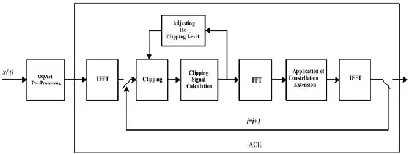
ADAPTIVE CLIPPING WITH NOVEL STEP-SIZE BASED ACTIVE CONSTELLATION EXTENSION The fundamental idea of the proposed ACE plan is to control the assembly rate, cutting dimension and to limit top power. The time space signal after IFFT is cut by versatile cut-out dimension on the transmit side. At that point the time space signal which is cut off is turned around and anticipated to the recurrence area by FFT. The group of stars development standard can be utilized in the recurrence space. On the off chance that the section signal is in the all-inclusive course of the group of stars focuses, it will stay unaltered if not, the cut-out sign will be zero. The recurrence space signal after the alteration is anticipated onto the time area and will create the pinnacle wiping out sign. The pinnacle crossing out sign is added to the first OFDM/OQAM signal and will balance the expansive pinnacle signal in the time area. In this manner, the PAPR will be diminished incredibly. Amid the calculation execution the novel advance size μ is estimation, by thinking about the conceivable cover for every image. Hypothetically, if the progression estimate is littler, the distinction of the recouped information in the recipient and the genuine esteem is littler. Be that as it may, the calculations required for information recuperation is more. Along these lines, the choice of the ideal advance size is important, which can guarantee the unwavering quality of the framework and diminish intricacy of the framework. The sign given by (𝑛), is
demodulated and changed over. In this manner the frequency domain peak
cancelling signals C=[𝐶0, 𝐶1 … . 𝐶𝑀−1]
where, m=0,1… .,M-1. is regulated to get the time space sign of the revised cut sign 𝐶∼(𝑛). So
as to surmised −(𝑛) as near 𝑖(𝑛), 𝑚𝑖is scaled
by a steady 𝝁𝒎is given by
m = 0,1,… , M-1. … .. (5)
Clearly, the target capacity of proposed strategy, which diminishes the Euclidean separation between the cut-out commotion 𝑖(𝑛) and top
dropping sign −𝑖(𝑛)using least square guess by
considering the conceivable image cover in OQAM image structure. This is the time area signal going from mN to N and signal cover with L past areas. In this way while ascertaining μm, the conceivable sign cover is considered over the full interim m N ≤ n ≤ (𝑀 + N) for m = 0,1,… ,M-1.
The least square technique is utilized to figure the scaling factor. As the separation between and (𝒏) as is little, the new pinnacle redressing signal
[image:3.612.329.534.490.567.2]is approximated to unique section commotion inside less cycles. The block diagram of the proposed modulation is shown in the figure 1
Figure 1 Adaptive Clipping ACE-Block
The following steps are the algorithm of the proposed work.
Step-1: Parameters initialization.
i. Target clipping level is selected as A.
© 2019, IRJET | Impact Factor value: 7.211 | ISO 9001:2008 Certified Journal | Page 4285 Step-2: By IFFT, The frequency domain data X is
converted into the time domain signal x (n), Where i= 0
Step-3: Compute the clipping signal (𝒏) according to Step-4: Adjust the clipping level by means of
Where
is the index set
of the clipping signal 𝒄𝒊(𝒏)and s .
Step-5: Demodulate clipping noise (𝒏)to find the
extension regions𝒄𝒊𝒎(k) where m and k represents the
frequency domain symbol and subcarrier, respectively. Maintain only those real components of symbols (k)
which fall within the permissible extension regions and set the rest to zero.
Step-6: Modulate to obtain the time domain signal of the corrected clipped symbol .
Step-7: Accordingly compute the optimal step size 𝝁𝒎 using (), and the minimum value of 𝝁𝒎(𝒏) is used
as the scaling factor for symbol m, and then calculate the peak cancelling signal 𝒄−𝒊(𝒏) using 𝒄−𝒊=
and𝝁𝒎 = 𝒎𝒊𝒏 ((𝒏)) .
Step-7: Obtain 𝒙𝒊+(𝒏) by 𝒙𝒊+𝒏(𝒏)=𝒙𝒊(𝒏)+𝒄 𝒊(𝒏)
Step-8: Calculate the PAPR to judge whether the PAPR reaches the preset threshold or the system reaches the maximum iteration number I. If one of them is satisfied, the iteration will stop; otherwise, let i= i+ 1, return to Step 3 and repeat the iterative process.
In the OFDM frameworks, the sign is handled by the ordinary section plot in every datum square
autonomously. Nonetheless, the sign in the OFDMOQAM framework are covered with numerous contiguous information squares, and the genuine PAPR in a specific time interim relies upon a few back to back information squares [19]. In the event that we lead the ordinary ACE plan in the OQAM-OFDM frameworks legitimately, the pinnacle signal in every datum square might be diminished. Be that as it may, the True PAPR in a specific time interim probably won't be diminished adequately, since the present information square is influenced by various back to back information squares. Hence, legitimately applying the customary ACE method to the OFDM-OQAM frameworks isn't successful. In the OFDM-OQAM framework, since the neighboring separated sign are covered with one another, we lead the ACE plan on the sign which is made out of numerous covered information hinders, rather than on every datum square freely. For our OS-ACE plan, we initially partition the covered information hinders into a few sections and after that diminish the PAPR of each fragment.
OVERLAPPED SEGMENTAL ACTIVE
CONSTELLATION EXTENSION
Step1: Operating the clipping scheme on the signal (𝒏) in the pthsegment. If the amplitude of (𝒏) exceeds
© 2019, IRJET | Impact Factor value: 7.211 | ISO 9001:2008 Certified Journal | Page 4286 Where (𝒏) is the phase of 𝒔(𝒏). The phase
information of (𝒏) remain unchanged after clipping operation.
Step2: The negative clipped portion of the signal (𝐧)is calculated as
Step3: Demodulate (𝒏) to obtain the extension regions where m and k represents the
pthsegment frequency domain symbol and subcarrier
respectively.
Step4: maintain only those real and imaginary components of which fall within the
allowable extension regions and set the rest to zero.
Step5: For oversampling or digital frequency domain filtering, set OOB components to zero.
Step6: Modulate 𝒄𝒎𝒑 (𝒌) to obtain the time domain
portion of the corrected clipped signal .
Step7: And add𝒄 (𝒏)to the original time domain signal 𝑠𝑝(𝑛)to obtain .
Step8: Transmit if it meets PAPR
requirements, otherwise repeat
From step (1) replacing 𝒔(𝒏)with 𝒔 𝒑(𝒏).
After the signal in the pthsegment has been Active
Constellation extended, increase p by 1 and repeat the procedure until all P segments have been processed.
III. SIMULATION RESULTS
A critically sampled OFDM/OQAM system was employed with 64 subcarriers employing QPSK modulation for 104 input data blocks with filter
[image:5.612.324.544.256.372.2]length as L=4.In order to evaluate the BER performance, complex additive white gaussian noise is assumed in the simulation. To ensure the validity of simulation results, transmission of 10,000 OFDM signals is taken into account. The PAPR is the connection between the greatest intensity of an example in a given OFDM transmit image separated by the normal intensity of that OFDM image
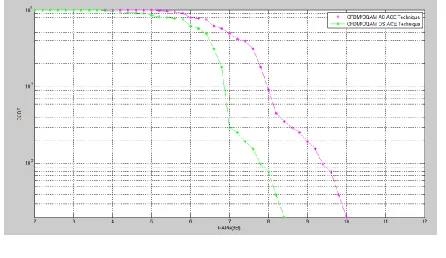
Figure 2 Initial clipping ratio vs PAPR
In Figure 2, the PAPR reduction is investigated to find the better clipping ratio applied to OFDM/OQAM system for performance improvements. As the outcome of the investigation, the proposed OS ACE technique achieves lower PAPR values when compared to the traditional AE ACE technique.
Figure 3 PAPR vs CCDF
[image:5.612.323.546.532.661.2]© 2019, IRJET | Impact Factor value: 7.211 | ISO 9001:2008 Certified Journal | Page 4287 comparisons of OFDM/OQAM AC ACE
[image:6.612.36.255.216.346.2]technique and OFDM/OQAM OS ACE Technique. It is observed that, the proposed Overlapped Segmental ACE techniques reduces the considerable amount of PAPR values when compared to the traditional OS ACE technique.
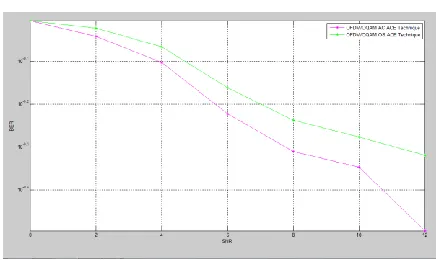
Figure 4 SNR vs BER
As the SNR increase, BER constantly decreases proving the proposed Overlapped segmental Active Constellation Extension algorithm to be efficient when compared to the tradition Adaptive Clipping Active Constellation Extension algorithm is shown in figure 4.
IV. CONCLUSION
In this paper, a Modified OS-ACE plan is proposed to diminish the PAPR of the OFDM-OQAM framework. Considering the covered structure of the OFDMOQAM signals, the altered OS-ACE plan separates the sifted sign into various sections and each portion is made out of numerous successive information squares. Consequently, the impact of adjoining covered information square can be dispensed with and the PAPR amid a specific time interim can be decreased successfully. Furthermore, the
covered structure of the nearby fragments can additionally improve the PAPR decrease execution. The reenactment results demonstrated that the proposed OS-ACE procedure gives a superior PAPR decrease execution than the OFDM-OQAM framework with ordinary ACE plan. In any case, the BER execution stayed unaltered. Plus, the OFDM-OQAM framework with the OS-ACE plan even beat the OFDM framework with the ordinary ACE plan. Thus, to produce the simulation results comparing both adaptive clipping algorithm and overlapped segmental algorithm for ACE based OFDM system has been done. Based on their simulation results, their PAPR performance are compared with the existing algorithm
REFERENCES
[1] Sanjiv Kumar,"BER Analysis of OFDM Digital Communication Systems with Improved ICI Cancellation Technique", IJISA, vol.6, no.4, pp.56-62, 2014. DOI: 10.5815/ijisa.2014.04.06
[2] P. Siohan, C. Siclet and N. Lacaille, “Analysis and design of OFDM/OQAM systems based on filterbank theory,” IEEE Transactions Signal Processing, vol. 50, no. 5, pp. 1170–1183, 2002.
[3] Jinfeng Du and Svante Signell, “Classic OFDM Systems and Pulse Shaping OFDM/OQAM Systems,” Technical Report of NGFDM Project, KTH/ICT/ECS, 2007. [4] M. Bellanger, “Physical layer for future broadband radio systems,” IEEE Conference on Radio and Wireless Symposium, pp. 436–439, 2010.
© 2019, IRJET | Impact Factor value: 7.211 | ISO 9001:2008 Certified Journal | Page 4288 [6] A. Skrzypczak, P. Siohan and J. P. Javaudin,
“Analysis of the peak-to-average power ratio for OFDM/OQAM,” in Proc. of IEEE 7th Workshop on Signal Processing Advances in Wireless Communications, pp. 1–5, 2006.
[7] S.K. Deng and M. C. Lin, “Recursive Clipping and Filtering with Bounded Distortion for PAPR Reduction,” IEEE Transactions Communications, vol. 55, no. 1, pp. 227-230, 2007.
[8] X. B. Wang and T. Tihung, “Reduction of peak-toaverage power ratio of OFDM systems using a companding technique,” IEEE Transaction on Broadcasting, vol. 45, no. 3, pp. 303-307, 1999.
[9] R. W. Bauml, R. F. H. Fischer and J. B. Huber, “Reducing the peak to average power ratio of multicarrier modulation by selected mapping,” IEEE Electronic Letters, vol. 32, no. 22, pp. 2056-2057, 1996.
[10] S. H. Müller and J. B. Huber, “OFDM with Reduce. Peak–to–Average Power Ratio by Optimum Combination of Partial Transmit Sequences,” IEEE Electronic Letters, vol. 33, no. 5, pp. 368-369, 1997
[11] Hwan. Lim. Dai, Ho. Rhee and Byung. “A low complexity PTS technique using threshold for PAPR reduction in OFDM systems,” KSII Transactions on Internet and Information Systems (TIIS), vol. 6, no. 9, 2012.
[12] S. Krongold and D. L. Jones, “An active-set approach for OFDM PAR reduction via tone reservation,” IEEE Transactions on Signal Processing, vol. 52, no. 2, pp. 495-509, 2004.
[13] K. Sathananthan and C. Tellambura, “Coding to reduce both PAR and PICR of OFDM signal,”
IEEE Communications Letters, vol. 6, no. 8, pp. 316-318, 2002.