Original citation:
Alpern, Steve. (2017) Hide-and-seek games on a network, using combinatorial search paths. Operations Research
Permanent WRAP URL:
http://wrap.warwick.ac.uk/84522
Copyright and reuse:
The Warwick Research Archive Portal (WRAP) makes this work by researchers of the University of Warwick available open access under the following conditions. Copyright © and all moral rights to the version of the paper presented here belong to the individual author(s) and/or other copyright owners. To the extent reasonable and practicable the material made available in WRAP has been checked for eligibility before being made available.
Copies of full items can be used for personal research or study, educational, or not-for-profit purposes without prior permission or charge. Provided that the authors, title and full
bibliographic details are credited, a hyperlink and/or URL is given for the original metadata page and the content is not changed in any way.
Publisher’s statement:
https://doi.org/10.1287/opre.2017.1594
A note on versions:
The version presented here may differ from the published version or, version of record, if you wish to cite this item you are advised to consult the publisher’s version. Please see the ‘permanent WRAP URL’ above for details on accessing the published version and note that access may require a subscription.
Hide-and-Seek Games on a Network,
Using Combinatorial Search Paths
Revised Version September 2016
Steve Alpern
ORMS Group, Warwick Business School,
University of Warwick, Coventry CV4 7AL, UK
Abstract
This paper introduces a new search paradigm to hide-and-seek games on networks. The
Hider locates at any point on any arc. The Searcher adopts a ‘combinatorial’path when
searching the network: a sequence of arcs, each adjacent to the last, and traced out at
unit speed. In previous literature the Searcher was allowed ‘simple motion’, any unit
speed path, including ones which turn around inside an arc. The new approach more
closely models real problems such as search for IEDs using vehicles which can only turn
around at particular locations on a road. The search game is zero sum, with the time
taken to …nd the Hider as the payo¤.
Using a lemma giving an upper bound for the expected search time on a semi Eulerian
network, we solve the search game on a networkQ3 consisting of two nodes connected by
three arcs of arbitrary lengths. When twoQ3 networks with unit length arcs are linked
by two small central arcs incident at the start node, one of these arcs must be traversed
at least three times in an optimal search. This property holds for both combinatorial
paths and simple motion paths, and the latter makes it a counterexample to a conjecture
1
Introduction
Network search games are zero sum games where the payo¤ to the maximizing Hider
is the time taken for the Searcher to …nd him, to be located at the same point of the
network. When the topic of ’search games with immobile hiders’was …rst introduced in
a speculative …nal chapter in the classic textDi¤erential Games by Rufus Isaacs (1965),
the search paths available to the Searcher were what Isaacs called a ‘simple motion’,
with "no other restriction save that its speed w is constant". In particular, he said
that "paths with sharp corners are not outlawed". Of course Isaacs was speaking in a
multidimensional context, but this means that for network search it has been allowed,
since the early work of Gal (1979), for the Searcher to change directions inside an arc.
This paper initiates the study of network search games in which the allowed paths
to search the network are the more traditional paths known in graph theory, computer
science and operations research: sequences of arcs, each one sharing a common node
with the previous one. Our new assumption, that the Searcher can only turn around
at designated locations, more closely models real problems where the network is a road
system, Hider is an IED (improvised explosive device), and the searcher is a large vehicle
that can only turn around at intersections or other wider places. Since the networks
studied in search games have given lengths for each arc, it makes sense to additionally
say that these paths (which we call combinatorial paths as opposed to simple motion
search paths simpli…es the game by making the strategy sets …nite, and enables us
to study a wider class of networks. For weakly Eulerian networks (whose 2-connected
components are Eulerian), the important result of Gal (2000) says that an optimal search
strategy is to choose any Chinese Postman (one of minimal length ) Tour (CPT) and
traverse it equiprobably in either direction. Since a CPT path is a combinatorial path, it
follows that for weakly Eulerian networks simple motion paths and combinatorial paths
result in equivalent search games. That is why we deal here exclusively with networks
which are not weakly Eulerian. For network search games with combinatorial paths, the
class of networks that appears to be important are the semi Eulerian networks, those
with exactly two nodes of odd degree. We study these networks here, as well as some
made by combining such networks.
We analyze the following zero sum game. A Searcher wishes to minimize the time
taken to …nd a Hider on a known connected network Q. Starting at a designated node
O; he chooses a combinatorial path, a sequence of adjacent arcs, each traversed at unit
speed. Each arc A of Q has a given length A and the network Q has total length
denoted by : The immobile Hider can choose to hide at any point H of Q. The arcs
are not directed but it is useful to give them an arbitrary orientation so that any point
on arcA is determined by its distancedA from the back end of A:A mixed strategy for
the Hider is a probability measure h on Q: It is clear that two measures h and h0 are
back end of A:The last condition simply says that the center of gravity of the measures
are the same. Thus a mixed strategy for the Hider is determined by the numbers h(A)
and dA for all arcs A: This gameG(Q; O) is a zero sum game between the minimizing
Searcher and the maximizing Hider and has a value V = V (Q; O): The existence of
a value follows from the fact that the game is essentially one with …nitely many pure
strategies for each player. For the Hider, the2m pure strategies (wheremis the number
of arcs) correspond to hiding at the back or front end (‘next’ to the corresponding
node but not on it) of each arc, and hence hiding at distance dA on arc A is a convex
combination of the two pure strategies onA: (We can either interpretdA= 0 and A as
ideal points ofQ;next to a node but not on it; or we can disallow such values of dAand
have only " optimal strategies for the Hider. (In practice this is not a problem.) For
the Searcher, them arcs can be labelledA1 toAm in the order of their …rst appearance
in an undominated search path. (A pure strategy is said to be dominated by another
if the other one does better against any pure strategy of the opponent.) There are at
most m!ways of ordering the …rst appearances. Between the …rst appearance of Ai and
of Ai+1 in the path there are no new points of Q covered, so the intervening arcs must
be taken from the subnetwork consisting of arcs Aj; j i; and form a shortest path in
this subnetwork. A shortest path between two nodes of a network cannot include any
arc more than once, so betweenAi andAi+1 there can be at most i 1connecting arcs.
Thus there are at most m …rst appearance arcs and at most 0 + 1 + 2 + + (m 1)
bym(m+ 1)=2:This estimate is likely much too high, but in any case establishes …nite
length and hence a …nite number of undominated search paths. Note that, unlike the
case for Chinese Postman Tours, undominated search paths may include a given arc
more than twice (a new result of this paper).
This note initiates the study of the search game with combinatorial search paths for
networks which are not weakly Eulerian. It is to be hoped that this approach will enable
progress on the basic game to more general networks (as opposed to newer variations),
which has been sparse since 2000.
For a background in the area of Search Games, see the texts of Gal (1980),
Gar-naev (2000), Alpern & Gal (2003) and the edited volume Alpern et al (2013). Articles
surveying more recent work are Gal (2011,2013), Alpern (2011b) and Lidbetter (2013).
Many new versions of network search games have also been recently introduced:
arbi-trary searcher starting point (Dagan-Gal 2008), …nd-and-fetch search (Alpern, 2011a),
search on windy networks (Alpern 2010, Alpern and Lidbetter (2014)), an expanding
search region rather than a path (Alpern and Lidbetter 2013), search at nodes of a
lat-tice (Zoroa et al 2013), search for a Hider at nodes with searching costs (Baston and
Kikuta, 2015), and two-speed search for a small object (Alpern and Lidbetter 2015).
Computational approaches to determining optimal strategies are given in Anderson and
M. Aramendia (1990). The original article in the …eld was Gal (1979), extended by
2
Searching a Semi Eulerian Network
Note that for Eulerian networks, the value is already known: tracing an Eulerian tour
equiprobably in either direction is optimal, with V = =2: It is not possible to have
only one node of odd degree, so the next type of network to consider is one with exactly
two nodes of odd degree. Such a network is called semi Eulerian (or sometimes
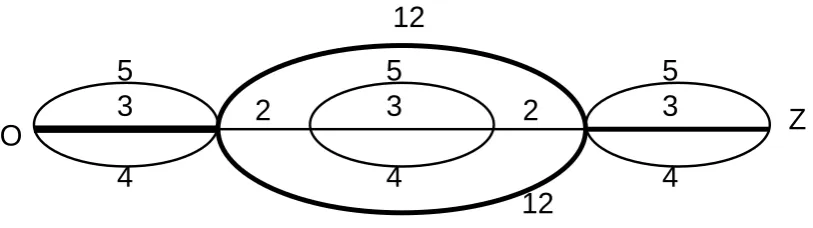
traversable, because it has an Eulerian path): An example of such a network is shown
below in Figure 1, together with a distinguished pathP as in the following Lemma.
O
Z
5
3
4
5
3
4
5
3
4
2 2
12
[image:8.595.93.500.371.485.2]12
Figure 1. Network Q with path P thick (top or bottom), a = 3 + 12 + 3 = 18:
Lemma 1 Let Q be a semi Eulerian network withO andZ its two nodes of odd degree. Let P be a path from O to Z of minimum length a such thatQ P is connected. Then
V (Q; O) V a2 + 2 =2 : (1)
(a+ )=(2 ); …rst traverse P fromO to Z and then follow an Eulerian tour of Q P
from Z; equiprobably in either direction; with probability 1 p; …rst follow an Eulerian
tour of Q P from O; equiprobably in either direction, and then traverse P from O to
Z: To obtain this expected time, the Hider must hide near Z when hiding on P:
Proof. IfH 2P; at distance" from Z; the expected search time T satis…es
T p(a ") + (1 p) (( a) + (a ")) = 1 2 a
2+ 2 2" V ;
with equality only ifH is next toZ, that is, as"!0:IfH 2Q P;which is an Eulerian
network of total length a; we have
T p a+ a
2 + (1 p)
a
2 =V :
Of course there may be no path P for which Q P is connected, in which case the
Lemma does not apply. A natural question that arises from this general bound is when
is it tight. The next two sections give examples where it is tight and where it is not. Also
note that when the bound is tight the Searcher can restrict to adopting Eulerian paths.
In Section 4 we show that sometimes an optimal search strategy for a semi Eulerian
Of course any upper bound on the value of a game with combinatorial search is also
an upper bound for the traditional version of the game, with simple motion, so Lemma 1
applies to those games as well. For semi Eulerian networks like those covered by Lemma
1, the length of a minimal tour is given by +a; as arcs of total length a must be
traversed twice. The upper bound on the value of V is better than that established by
Gal (1979) for arbitrary networks of =2, becauseV can be written as =2+(a=2) (a= )
whereas Gal’s formula gives a higher upper bound of ( +a)=2; or =2 + (a=2): This
shows that networks satisfying the assumptions of Lemma 1 cannot be weakly Eulerian,
where the =2 bound is tight. See Gal (2000).
3
A Three Arc Network
We now consider what is possibly the simplest non weakly Eulerian network, the so
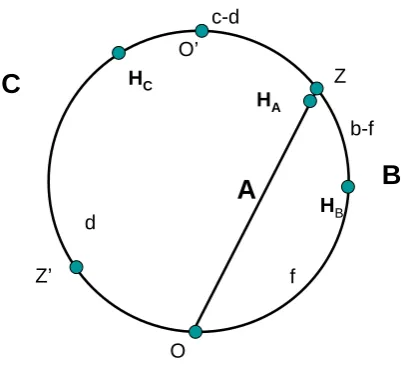
called ‘three arc network’Q3 =Q3(a; b; c)consisting of two nodes, the start nodeO and
another nodeZ;and three arcsA; B; C of lengthsa b c: The ‘arbitrary orientation’
of arcs for notation is fromO to Z: Clearly Q3 is of the form of the Lemma, taking for
P the single arc A: To show that V = V we must …nd a suitable hiding strategy. We
derive the optimal hiding strategy under the assumption thatV =V and that the Hider
locates in each arc with a probability proportional to its length. From the analysis of
Lemma 1, we know that when hiding on A; the Hider must be close to Z; that is, his
asHB and HC respectively and label their distances from O along these arcs asf =dB
and d=dC:Clearly =a+b+c: See Figure 2.
O O’
Z
Z’
C
B
HA
A
HB HC
f d
c-d
[image:11.595.194.396.211.394.2]b-f
Figure 2. The ‘Three-arc’Network
Q3(a; b; c):
The Hider wants to ensure that when touring the circle CB =BC from either O orZ;
the Searcher is indi¤erent between the two directions. For any circle, this is the case
when the center of gravity (mean) of the distribution, considered as being on the line
segment obtained by cutting the circle at the starting point, is located at the antipodal
starting the tour of BC atO; this means that
b
b+c(f) + c
b+c(b+c d) = b+c
2 ; or
d = 2bf b
2+c2
2c : (2)
With this relation between d and f we also have that the mean of the distribution is at
Z0 when cutting at Z:
Recall that in the search strategy of the Lemma 1, the shortest pathP fromO toZ
(which for Q3 is the single arc A) is always searched …rst or last, never in the middle.
To ensure that CBA is better thanCAB (afterC) we need
b
(b f) + a (b+a) a (0) + b (a+f); or
f a
2+b2
2b : (3)
The condition (3) also ensures that BCA is better than BAC (after B). Finally, we
want to make sure that the shortest path fromO toHB is the direct one via B rather
than via A and Z: (We will need this for example to exclude consideration ofACAB:)
This requires that
f a+b
2 : (4)
This condition (4) together with (2) implies
2d c+ b
c a c+a; or
a+ (c d) d:
a+ (c d) d: (5)
The distance fromO toHC viaAandZ is given by the left side of (5), so it is at least d:
Hence the condition (4) also ensures that the shortest path fromO to HC is the direct
one via C:
Proposition 2 For the search game on the three arc networkQ3(a; b; c)(whereA; B; C
are the arcs of respective lengths a b c), the value of the search game with
com-binatorial search paths is given by V = (a2+ 2)=(2 ): An optimal strategy for the
Searcher is the following, where p = (a+ )=(2 ) : with probability p …rst traverse arc
A from O to Z and then tour the cycle BC from Z, equiprobably in either direction.
With complementary probability 1 p; …rst tour the cycle BC from O; equiprobably in
arc X; given by
dA = a ";that is, at the end of A at Z; (6)
dB = f; for
1 2b a
2+b2 f (a+b)
2 ; and (7)
dC = d=
1
2c 2bf b
2+c2 : (8)
More generally, any hider distribution with mean on arc X at distance dX as above is
" optimal.
In particular if the lengths of the two smaller arcs are equal, then it is optimal to
hide at the ends of these arcs at Z and at distance (b2+c2)=(2c) from O on the long
arc. If all three arcs have the same length, then hide equiprobably at the ends of each arc
at Z:
Proof. Note that ((a+b)=2) ((a2+b2)=2b) = (a=2b) (b a) 0; so that the
feasible set for the parameter f given in (7) is not empty. We …rst evaluate the stated
Hider strategies against the six Eulerian search paths using three (distinct) arcs:
ABC; ACB; BCA; CBA BAC; CAB: (9)
First note that the …rst two have the same search times by (2), and similarly the third
and fourth. Furthermore, the lower bound condition (3) on f guarantees that BAC is
search paths ABC and BCA against the stated hiding strategy. For these, we have
ABC : a (a) + b (a+ (b f)) + c (a+b+d) = a2+ 2 =(2 );
BCA : b (f) + c (b+ (c d)) + a(a+b+c) = a2+ 2 =(2 ).
Next we must consider search paths with more than three arcs. These might be used,
for example, whena is small and the Searcher would rather continue his search from O
rather than Z or from Z rather than O: The shortest path between O and Z is arc A;
so repeating other arcs than A is worse than repeating A: The longer paths we must
consider are
ABAC; BAAC; ACAB; CAAB; AABC; AACB:
After A and B are searched (in either order), the shortest path from O to HC is via
arc C, because of condition (4). So we do not have to consider the …rst two paths. A
similar argument shows we may ignore the next two paths. Finally, we consider the last
two paths. The last two paths might make sense to use if the search time for the circle
BC was smaller when starting from Z than when starting fromO; but in fact in both
cases it is(b+c)=2:
An anonymous referee has suggested that we mention the matrix form of the game
the strategy sets are …nite. We can consider that the maximizing Hider has six pure
strategies that we can denote by AO; AZ; BO; BZ; CO and CZ. The subscript O
cor-responds to hiding arbitrarily close to node O on the indicated arc; Z to hiding near
node Z: Hiding at an arbitrary point on say arc B can be written as a convex
com-bination of hiding at BO and BZ: The undominated strategies for the Searcher are
ABC; CBA; BAC; CAB; ACB; BCA (six having three arcs), ABAC; BAAC; ACAB;
CAAB; AABC; AACB (another six with four arcs). Note that the only arc which can
be repeated in an undominated strategy is the shortest one, A: For example CACB is
dominated byCAAB because arcB is search sooner in the later strategy. So the search
game on the three arc network can be represented by a6 12matrix. Of course further
analysis, as we did above, can reduce the number of columns (searcher strategies) that
need to be considered.
Observe that for the network considered in this section, optimal search was
con-centrated on Eulerian paths which could be extended to Chinese Postman tours by
returning to the start node after covering the whole network. Presumably this analysis
can be extended to two nodes connected by an odd number of unequal length arcs.
4
The Double-Triple Network
We now give an example of a network DT, which we call the double triple network,
two ‘three arc’networks Q3 with unit length arcs, which are attached at an end of each.
The start node is one of the nodes of degree3:(In the following section we will consider
a central start.) For this network, we have = 6and the value ofain Lemma 1 isa= 2.
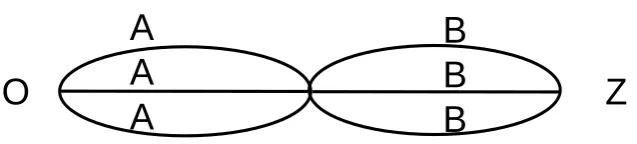
Label the three arcs at O as A and the three at the far end as B; using the symmetry
of the network.
O Z
A
A
A
[image:17.595.107.426.297.369.2]B
B
B
Figure 3. The Double-Triple NeworkDT; with left start.
It turns out that, unlike the case for weakly Eulerian networks, the value of the
double-triple network DT depends on the searcher starting point. In the next two
subsections, we consider both an end start and a central start.
4.1
The Double-Triple Network with End Start
We …rst consider the case where the Searcher begins his search path from an end node,
say the left endO: We …nd the following.
V = 10=3 ' 3:33: The value of the search game is given by V = 29=9 ' 3:22, which
is strictly less than V : The optimal search strategy chooses a random path of the type
A; B; B; A; A; B (a Eulerian path) with probability 5=6 and a random path of the type
A; B; B; B; B; A; A with probability 1=6: By ’type’ we mean that for an arc X 2 fA; Bg
a random untraversed one is chosen; if all have been traversed any can be chosen. An
optimal hiding strategy hides near Z on a random adjacent arc B with probability 2=3
and at the far end of a random arc A at O with probability 1=3:
Proof. First we show that V 29=9: Suppose H is at distance x; 0 < x <1; from
O: With probability 5=6 the expected time for the Searcher to reach H is
1
3(x+ (4 x) + (4 +x)) = 8 +x
3 3(with equality as x!1).
With probability 1=6; the expected search time is
1
3(x+ (6 x) + (6 +x)) =
12 +x
3
13 3
Hence overall, the expected time to reachH is given by
5 6(3) +
1 6
13 3 =
Next suppose H is at distance y; 0 < y < 1 from Z: Then with probability 1=6 the
expected time to reachH is1 +V0;whereV0 = 5=3is the value of the game on the three
arc game, from Proposition 2. With probability5=6;the time is given by
1
3((2 y) + (2 +y) + (6 y)) =
10 y
3
10
3 ;(with equality as y !0).
Hence overall, the expected time to reachH is at most
1
6(1 + 5=3) + 5 6
10 3 =
29 9 :
If H is a node, the expected search time is strictly lower.
Next we show that V 29=9: Clearly the …rst arc chosen is of type A: Then the
Searcher can either (i) search the remaining arcs incident to O; so obtaining the full
path AAABBB; or (ii) continue BB, to produce either of the full paths ABBAAB or
ABBBBAA: The expected search times for these three paths against the stated hiding
strategy are as follows.
Path Expected Search Time
AAABBB 19(1 + 1 + 3) + 29(4 + 4 + 6) = 339 299
ABBAAB 19(1 + 3 + 5) + 29(2 + 2 + 6) = 299
It is useful to note that in the semi Eulerian network DT; the Eulerian path P of
Lemma 1 is no longer a single arc, but is of the formAB (two arcs). This fact is related
to having a value less thanV :
4.2
The Double-Triple Network with Central Start
We now consider the DT network analyzed in the previous section, but with the start
node between the two copies of the three-arc network. This considerably changes the
optimal strategies but, surprisingly, not the value.
O
[image:20.595.124.467.417.468.2]Z
-Z
+Figure 4. The DT network with central start.
Due to the symmetry of DT with central start, all the six unit length arcs are
equivalent under automorphism and so the Hider has only a one parameter family of
mixed strategies, namely to hide equiprobably on arcs and at distance x; 0 < x < 1;
from the end nodes Z (or equivalently, at distance 1 x from O: The Searcher must
begin by going to an end, so without loss of generality assume he starts with A: Then
to Z and then search the right side, this is path AAAABBB; or (ii) he can continue
with BB; and then by symmetry we can assume the remainder of the path is BBA; :
giving full path AABBBBA: Note that while this network is semi Eulerian, Lemma 1
does not apply because the start node has even degree. The expected search times for
these two potential optimal paths are as follows:
AAAABBB; 1
6((1 x) + (1 +x) + (3 x) + (5 x) + (5 +x) + (7 x)) =
22 2x
6 :
AABBBBA; 1
6((1 x) + (1 +x) + (3 x) + (3 +x+ (5 x) + (7 x)) =
20 2x
6
Clearly it is optimal for the Hider to locate at the far end of the arc from O (x ' 0)
and for the Searcher to search for example the top of the network …rst (including the
middle) and then the bottom, any path equivalent to AABBBBA, always choosing
equiprobably among untraversed arcs (of type A or B). We see that the value of the
game for middle start on DT is 10=3; the same as we found in the previous section of
end start. Summarizing this analysis we have the following.
Proposition 4 For middle start on the network DT; we have V = 10=3; the optimal search strategy is to choose randomly among paths equivalent to AABBAAB; and for
5
The Double-Triple Network with Connecting Bridge
We now make an arbitrarily small modi…cation to theDT network with central start as
shown in Figure 4. We separate the two copies of Q3 by two small arcs of arbitrarily
small length " which are incident to the central Searcher starting node O: We call the
modi…ed network DT , as shown in Figure 5. In the following two subsections, we
analyze the search game on DT for combinatorial paths and simple motion paths.
5.1
Search with Combinatorial Paths
We begin our analysis under the assumption (as earlier in the paper) that the Searcher
uses combinatorial paths. First note that the value of the search game on DT ; which
we denote byV remains (in the limit as"!0) at10=3:The analysis is identical except
now when going from O to Z the path is RB and when going directly from Z to Z+
it isALRB: Note that hiding on L orR is dominated, respectively, by hiding atZ or
Z
+Z
-O
A
A
A
B
B
B
[image:23.595.118.474.183.257.2]L R
Figure 5. The DT network with central start, small central arcs Land
R:
We now explain our reason for adding the additional in…nitesimal arcs between the
two copies of the three arc network. Note that by Proposition 4, for optimal searching in
DT , one of the two central arcs must be traversed three times: once at the start, when
leaving node O; and whenever there is a switch between an A and a B: In particular,
the optimal search path AABBBBA traverses arc L three times, at times t = 0;2 and
6: Note that if instead of AABBBBA the optimal path AABBAAB is adopted, then
this arc is traversed four times. This argument uses the fact that Proposition 4 gives all
the optimal search paths.
Corollary 5 Optimal search on the DT network, with the central arcs as in Figure 5, requires traversing one of the two central arcs at least three times.
Optimal (minimax) strategies for searching a target on any graph never use
trajectories which visit some arcs (or parts of arcs ) more than twice.
However it is clear that this conjecture was made in the context of search paths
which are allowed to change direction inside an arc (what we call simple motion paths),
so the above analysis is only a counterexample when the Searcher must use combinatorial
paths. But even with the simple motion paths assumed by Gal, the DT network with
central start gives a counterexample to his conjecture, as we will see in the next section..
5.2
Search with Simple Motion Paths
We now revert to the original de…nition of a search path as in the earlier literature,
that is, simple motion paths. Our aim is to show that even in the original context, the
networkDT requires triple traversal of arcsLorR in an optimal search. LetV+ denote
the value of the search game on DT (with simple motion paths) when no arc (or part
of any arc) can be traversed more than twice. With this restriction on the number of
arc traversals, once the Searcher enters say the right-hand copy of Q3, he must search
all of it (tour it) before returning to search all of the left copy of Q3. Let V3 denote the
value of the search game on the three arc networkQ3 =Q3(1;1;1), with simple motion
paths. (V3 is known, but for the moment we pretend not to know it).
We now give a lower bound onV+ based on the Hider locating equiprobably in either
begins his search by going to the copy of Q3 containing the Hider, the expected search
time is at least V3: If he begins by …rst searching the other copy, he must …rst spend
at least time 4 touring it, and then he must spend expected time at least V3 to …nd
the Hider in the copy of Q3 he is hiding in – thus total expected time at least 4 +V3:
Since the Hider chooses to locate equiprobably in either copy ofQ3;the overall expected
search time is at least
V+
1 2V3+
1
2(4 +V3) = V3+ 2:
Since Q3 has length 3; it is easy to see that by hiding uniformly we have V3 3=2;and
hence
V+
3
2 + 2 = 7
2 = 3:5 . (10)
Denote by V value of the search game on DT : using simple motion paths and without
any restriction on the number of traversals of an arc. Clearly V is bounded above by
the value V = 10=3 of Proposition 4 where the searcher is restricted to combinatorial
paths. It now follows from (10) that
V 10=3< V+: (11)
This says that the Searcher can do strictly better on DT if he is not restricted to
paths) on the network DT , an optimal search strategy requires traversing at least one
of the central arcs L or R at least three times.
We have aimed to keep the proof of this result simple, so we have not referred here
to the deep result of Pavlovic (1993), which showed that in fact V3 = (4 + ln 2)=3'1:
564 4;following restricted proofs of this value by Gal (1980) and Bostock (1984). Hence
the calculation (10) can be improved to show that V+ 3:564: Hence the restriction
to doubly traversing arcs increases the expected search time for the DT network by at
least (3:564 3:334)=3:334'6:8% .
It is of interest to note that Proposition 6 is essentially an existence proof, as we do
not actually say what the optimal search strategy is for the networkDT :We only show
that it must involve pure search paths that thrice traverse a portion of arcs LorR:The
existence of an optimal strategy for search games with simple motion search paths is
given in Appendix 1 of Gal (1980).
6
Conclusions
While there have been many interesting recent variations on the classical network search
game of Gal (1979), the generality of networks where the classical game is understood
has not been greatly expanded since the extension to weakly Eulerian networks by Gal in
2000. In the classical setting, involving the ’simple motion’suggested by Isaacs (1965),
motion by the more familiar notion of a ’combinatorial path’, the notion used in computer
science, graph theory and operations research, it has been possible here to expand the
class of networks that can be analyzed. Hopefully this will be just the …rst of many
papers to use the combinatorial path paradigm. Furthermore, if general results can be
found in this context they could in theory be applied to the simple motion context by
putting additional nodes of degree two into the network.
A rather serendipitous …nding of this paper was a counterexample to the conjecture
of S. Gal that optimal search of a network using simple motion paths never requires
searching any part of an arc more than twice. Is three the new upper bound, or are
there networks requiring arbitrarily many traversals of some arc? Another area for
exploration is the characterization of networks for which the bound of Lemma 1 is tight.
Another possible application of the restriction to combinatorial paths is the min-min
search problem, called the rendezvous search problem, where the two players have the
common aim of …nding each other as soon as possible. See, for example, Alpern (1995,
2002), Baston (1999), Gal (1999), Howard (1999) and Chester and Tutuncu (2004).
7
Acknowledgements
The author wishes to acknowledge support from the US Air Force O¢ ce of Scienti…c
References
[1] S. Alpern (1995). The rendezvous search problem. SIAM J. Control Optim. 33,
673-683.
[2] S. Alpern (2002). Rendezvous search: A personal perspective.Operations Research,
50(5), pp.772-795.
[3] S. Alpern (2010). Search games on trees with asymmetric travel times. SIAM J.
Control Optim. 48, no. 8, 5547-5563.
[4] S. Alpern (2011a). Find-and-fetch search on a tree. Operations Research 59,
1258-1268.
[5] S. Alpern (2011b). A new approach to Gal’s theory of search games on weakly
Eulerian networks. Dynamic Games and Applications 1 , 209-219.
[6] S. Alpern and S. Gal (2003). The Theory of Search Games and Rendezvous. Kluwer
International Series in Operations Research and Management Science. Kluwer,
Boston.
[7] S. Alpern, R. Fokkink, R.,L. G ¾asieniec, R. Lindelauf and V.S. Subrahmanian, eds.
(2013). Search Theory: A Game Theoretic Perspective. Springer, New York.
[8] S. Alpern, and T. Lidbetter (2013). Mining coal or …nding terrorists: The expanding
[9] S. Alpern, and T. Lidbetter (2014). Searching a variable speed network.
Mathemat-ics of Operations Research 39, no. 3 : 697-711.
[10] S. Alpern, and T. Lidbetter (2015). Optimal Trade-O¤ Between Speed and Acuity
When Searching for a Small Object. Operations Research 63, no. 1: 122-133.
[11] E. J. Anderson and M. Aramendia (1990). The search game on a network with
immobile hider. Networks 20, 817-844.
[12] V. Baston (1999). Two rendezvous search problems on the line. Naval Research
Logistics, 46(3), 335-340.
[13] V. Baston and K. Kikuta. Search games on a network with travelling and search
costs. International Journal of Game Theory 44, no. 2 (2015): 347-365.
[14] F. A. Bostock (1984). On a discrete search problem of three arcs.SIAM J. algebraic
Discrete Methods 5, no 1, 94-100.
[15] E. J. Chester and R. H. Tütüncü (2004). Rendezvous search on the labeled line.
Operations Research, 52(2), 330-334.
[16] A. Dagan and S. Gal (2008), Network search games, with arbitrary searcher starting
point, Networks 52, 156–161.
[18] S. Gal (1980), Search Games, Academic Press, New York..
[19] S. Gal (1999). Rendezvous search on the line. Operations Research, 47(6), 974-976.
[20] S. Gal (2000), On the optimality of a simple strategy for searching graphs. Int. J.
Game Theory 29, 533-542
[21] S. Gal (2005). Strategies for searching graphs. InGraph Theory, Combinatorics and
Algorithms,M. Golumbic I. Hartman, eds, Operations Research/Computer Science
Interfaces Series 34,189-214. Springer US.
[22] S. Gal (2011). Search Games.Wiley Encyclopedia of Operations Research and
Man-agement Science.
[23] S. Gal (2013). Search games: a review. In: Alpern, Steve, et al., eds. Search theory:
a game theoretic perspective. Springer, New York.
[24] A. Garnaev (2000). Search Games and Other Applications of Game Theory (Lecture
Notes in Economics and Mathematical Systems Vol. 485), Springer, New York.
[25] J. V. Howard (1999). Rendezvous search on the interval and the circle.Operations
Research 47(4), 550-558.
[26] R. Isaacs (1965). Di¤erential Games, Wiley, New York.
[27] T. R. Lidbetter (2013). Search games with multiple hidden objects. SIAM Journal
[28] T. R. Lidbetter (2013). Search games for an immobile hider. In: Alpern, Steve, et
al., eds. Search theory: a game theoretic perspective. Springer, New York.
[29] L. Pavlovic (1993). Search game on an odd number of arcs with immobile hider.
Yugosl. J. Oper. Res.3, no. 1, 11–19.
[30] J. H. Reijnierse and J. A. M. Potter (1993). Search games with immobile hider.Int.
J. Game Theory 21 , 385-394.
[31] N. Zoroa, M.J. Fernández-Sáez, and P. Zoroa, (2013). Tools to Manage Search
Games on Lattices. In: Search Theory: A Game Theoretic Perspective (pp. 29-58),