Manuscript version: Author’s Accepted Manuscript
The version presented in WRAP is the author’s accepted manuscript and may differ from the published version or Version of Record.
Persistent WRAP URL:
http://wrap.warwick.ac.uk/131806
How to cite:
Please refer to published version for the most recent bibliographic citation information. If a published version is known of, the repository item page linked to above, will contain details on accessing it.
Copyright and reuse:
The Warwick Research Archive Portal (WRAP) makes this work by researchers of the University of Warwick available open access under the following conditions.
Copyright © and all moral rights to the version of the paper presented here belong to the individual author(s) and/or other copyright owners. To the extent reasonable and
practicable the material made available in WRAP has been checked for eligibility before being made available.
Copies of full items can be used for personal research or study, educational, or not-for-profit purposes without prior permission or charge. Provided that the authors, title and full
bibliographic details are credited, a hyperlink and/or URL is given for the original metadata page and the content is not changed in any way.
Publisher’s statement:
Please refer to the repository item page, publisher’s statement section, for further information.
THE EFFECTS OF CONTRACT DETAIL AND PRIOR TIES ON CONTRACT CHANGE: A LEARNING PERSPECTIVE
ABSTRACT
Despite the large literature on alliance contract design, we know little about how transacting parties change and amend their underlying contracts during the execution of strategic alliances. Drawing on existing research in the alliance contracting literature, we develop the empirical question of how contract detail and prior ties influence the amount, direction and type of change in such agreements during the collaboration. We generated a sample of 115 joint ventures by distributing a survey to JV board members or top managers and found that the amount of contract change is negatively associated with the level of detail in the initial contract but is positively associated with the number of prior ties between alliance partners. In relation to the direction of contract change, we find that the level of detail of the initial agreements negatively correlates with the likelihood of removing or weakening existing provisions and that prior collaborative experience positively correlates with the likelihood of strengthening of existing provisions or adding of new ones. We also find that prior ties affect the type of change in that JV parents prefer to change enforcement provisions more so than the coordination provisions in the contract. Our paper generates new insights on the complementarities between relational governance and transaction costs economics (TCE) perspectives on alliance contracting.
INTRODUCTION
While a great deal of research has examined how exchange partners design formal contracts to
govern their collaborations (e.g., Mellewigt et al. 2007, Reuer and Ariño 2007), one key aspect of alliance
governance that has received little attention is what drives transacting parties to alter their formal
agreements during their collaboration (e.g., Reuer, Zollo, and Singh, 2002). There is a great deal of work
on initial contract design (e.g., Faems et al. 2008, Reuer & Ariño 2007) and on how parties learn from
their alliances and modify subsequent contracts (e.g., Mayer & Argyres 2004). However, we still know
relatively little about how transacting parties learn during the course of their collaboration as well as what
leads them to make changes to the existing contract during the execution of the alliance. This issue is
relevant because if exchange partners fail to adapt after the contract is signed, they are more likely to
experience problems in successfully completing their alliance. We therefore examine the effect of
partners’ learning during the collaboration and how this process influences partners’ choice in making
alterations to the underlying contractual agreement that supports the collaboration.
Managers face an important choice when they decide to deviate from a contract. They must
determine whether they simply informally adjust and leave the contract alone, or whether they should
update the contract and go through the associated approval process. Interestingly, we know little about
what types of contractual changes may occur (i.e. what part of the contract is changed and whether it has
become more or less detailed) as well as what factors are associated with these changes. Generating such
insights will help improve our understanding of why repeated collaborations might cause a contract to be
more detailed in general, but not necessarily more effective (Ryall & Sampson 2009). They will also
address the issue of codification in contract adaptation that partners may not rely on relational contracting
when the need for change during the execution of the alliance is present.
There are important tradeoffs regarding formally changing the contract. On the one hand, there
are costs and risks involved with changing contracts during the alliance. For instance, exchange parties
need to invest time and effect when renegotiating the terms (Ariño et al. 2008, Gil 2009). They might also
lawyers, higher-level managers) can create extra work that might also distract from the collaboration and
the specific adaptations they see are needed. Additionally, changing contracts can potentially influence
the quality of the relationship by sending a signal of a lack of trust to the parties involved (Ghoshal &
Moran 1996, Malhotra & Murnighan 2002), particularly when partners decide to alter provisions about
right-based disputes (Lumineau & Malhotra 2011). On the other hand, codifying the changes in the
contract could be beneficial as well. Amendments during the execution of an alliance can improve the
adaptive capacity of contracts (e.g., Mayer & Argyres, 2004; Parkhe, 1993). Codifying the changes not
only makes it easier to deal with personnel turnover during the course of the alliance, it is also useful
because it can have a bearing on future collaborations. Since the current contract tends to be used as a
template for the firms if they work together again, having it reflect what they actually do helps ensure the
new contract will line up with what the firms have learned about working together.
The potential determinants of contract amendments during the execution of an alliance could
therefore be affected by several relationship and environmental factors. For example, the instability of
alliances by nature requires careful consideration of conflicting forces (such as cooperation versus
competition, rigidity versus flexibility, and short-term versus long-term considerations) which can
potentially require more need for contract renegotiation (Das and Teng 2000). The complexity of the
projects undertaken by transacting parties will not only affect the stability of the relationship but also
affect the quality of the relationship which may lead to extensive contract amendments (Ariño and De La
Torre 1998). Moreover, the environment that alliances operate in can change the dynamics in deciding
when and what to change (Blodgett, 1992).
Among the abovementioned factors that drive contract change, two key perspectives—transaction
cost economics (TCE, Williamson 1996, 1999) and organizational learning—in the alliance contracting
literature focused on two forces—prior ties and contract detail—in explaining governance change. The
extant literature offers ambiguous theoretical predictions as to how alliance partners may renegotiate their
initial contracts. It is unclear whether repeated collaborations and detailed or complex initial contracts
that adaptation is less needed when the initial contract is detailed (Ariño et al. 2008, Batenburg et al.
2003, Gil 2009). However, this effect could be the opposite given that the level of detail in the initial
contract signals exchange parties’ intention of addressing exchange hazards by crafting detailed contracts
(e.g., Gulati et al. 2005, Joskow 1988) and that JV partners are more willing to amend the contract during
the course of the alliance as a consequence. Similarly, the effect of prior ties on contract change could be
twofold. Prior ties may lead to fewer changes in the contract because partner-specific trust and routines
will develop when exchange parties collaborate repeatedly and that they reduce the need for contract
amendment as a consequence (Gulati 1995, Zaheer et al. 1998). The behaviors of partners are more
predictable and they might have developed routines on how to address and deal with potential gaps in the
contract. At the same time, previous research also suggests that prior ties can lower the cost of making
contract changes and that partners see more value in pursuing such changes in order to better align
contracts for future interactions (Fudenberg et al. 1994, Poppo et al. 2008, Radner 1986). Table 1
summarizes the mixed predictions and interpretations that provide the foundations for our study.
*** Insert Table 1 about here ****
We therefore draw from transaction cost economics (TCE) and organizational learning as we seek
to study how contract detail and previous collaborative experience between partners (i.e., prior ties) affect
the amount, direction and type of change in contractual agreements during the execution of an alliance.
Similar to Ryall and Sampson (2009), given the lack of clear predictions from existing theory, we do not
specify a model with hypothesized parameters to test nor do we intend to make any causal inferences, but
instead opt for a more inductive approach and provide detailed descriptive results. Our inductive approach
offers exploratory findings that shed light on what managers are doing in practice. We therefore explore
data on the details of contractual change in alliances in order to discover nuances about the amount of
change itself, as well as the direction and the type of change in alliance contracts.
We use primary data on contracts and contractual changes of international joint ventures (IJV) in
China. Chinese IJVs offer an appropriate and interesting context to study contract change for several
with local partners. In exchange for access to the Chinese market, foreign firms provide opportunities for
their local partners to learn advanced technologies (Meyer, 2004). Given this institutional background,
those IJVs require complex governance given the misappropriation concerns for such technologies
(Mjoen and Tallman, 1997; Oxley, 1997). We therefore surveyed those IJV board members or top
managers who directly participated in the management of the joint venture in order to capture their
experience about governance and contractual alterations when they oversaw the collaboration.
This paper generates new insights into our understanding of the type, amount, and direction of
contractual amendments that the literature has neglected in existing theoretical and empirical studies on
alliance contracting to date. Our detailed data allow us to examine both weakening or removing of
particular clauses as well as the adding or strengthening of clauses. This enables us to investigate more
precisely what alliance characteristics are associated with such contract changes in the type of clauses and
how different types of provisions are changed. We find that the level of detail in the initial contract and
the amount of prior ties between alliance partners are associated with the amount, type, and direction of
contract change. We thus contribute to the work on contract design and organizational learning by looking
at how learning is codified in the context of longer-term interfirm relationships—an under-explored issue
that is theoretically and managerially important.
EMPIRICAL CONTEXT: CHINESE INTERNATIONAL JOINT VENTURES
Since the Chinese government adopted the “reform and open-door policy” in 1978, China has
become one of the largest recipients of foreign direct investment (Child & Tse, 2001). However, it is not
costless for foreign firms to enter the Chinese market. Those foreign firms, in many industries, can only
enter the Chinese market by forming IJVs with local partners, granting their local partners exposures to
advanced technologies (Meyer, 2004). Due to the potential advantages and governmental policy, a large
portion of foreign investments were entered through the mode of IJVs (Beamish, 1993). Under such an
First of all, the foreign firm’s strategic objective is to typically to gain access to the Chinese
market in those IJVs, while Chinese firms generally aim to acquire technology and develop management
skills (Si & Bruton, 1999; Walsh et al., 1999) as a means of climbing the value chain (Wan and Wu,
2017). Such technologies are often proprietary, and foreign firms may not want to transfer them due to
concerns regarding misappropriation (Mjoen and Tallman, 1997). The inherent goal incongruence
between foreign and Chinese partners can make their alliances particularly challenging. For example,
research on Chinese IJVs found that the Chinese partners want to acquire foreign technology more
quickly and effectively, while foreign partners prefer to increase market share in the local market (Yan &
Gray, 1994). The goal incongruence may lead to conflicts over time, which increase the need for contract
changes between partners.
Moreover, such situations might be further complicated by insufficient legal protections in China.
The Chinese legal system not only is incompletely developed, but also lacks consistency in its
enforcement (Meyer, 2011; Peng, 2003). This would elevate the transaction cost of doing business in
China, including misappropriations of technology given weak protection of intellectual property in China
(Zhang et. al., 2007). Under such an environment, foreign investors may have limited safeguards from
local partners’ opportunistic behaviors. As a consequence, they may seek to use complex and
multidimensional contracts to protect their knowledge.
At the same time, guanxi (connections) plays an important role in Chinese society. Such informal
institutions can substitute for formal institutions, especially when formal institutional supports are absent
or unclear (e.g., Tsui, et. al., 2004; Zhang & Keh, 2010). Therefore, foreign partners would value Chinese
partners’ local knowledge and network, and may need to rely on informal mechanisms, such as mutual
trust, to foster collaboration (Beamish, 1993; Dong & Glaister, 2006; Yan & Gray, 1994).
Given those challenges, the collaborations between Chinese and foreign partners require complex
governance structures that are often subject to change. This context is, therefore, suitable for a study on
unpredictable than in the US or Europe, so changes in contracts (particularly enforcement provisions), for
instance, are not likely to be purely in anticipation of court enforcement.
RESEARCH METHODS
Data and Sample
We collected primary data on contractual changes in joint venture agreements in China by using a
self-administered survey. In order to identify potential respondents, we first compiled a list of possible
participants by using two secondary data sources, namely the China Industrial Enterprise Statistical
Database as well as the SDC database. We selected Chinese organizations that had formed joint ventures
for the years 2007 through 2011 and obtained the names and contact details for potential respondents that
worked for the joint venture. We then matched the respondents with the alumni contacts of a top Chinese
business school at which two of the authors worked at the time of the distribution of the survey. Finally,
we were able to identify 504 alumni who were in the position to complete the questionnaire.
We decided to opt for a key informant approach and targeted joint venture managers or directors
specifically in order to reduce respondent bias. Relying on key informants is the most appropriate way to
obtain data on contract changes given the confidential nature of the data as well as the lack of such data in
secondary data sources. Given the nature of joint ventures (e.g., high staff turnover, relatively small size,
private legal entity, etc.), obtaining responses from multiple participants is difficult (e.g., Kumar et al.
1993) and therefore research on collaborative agreements often uses single key informants (e.g., Klijn et
al. 2013, Krishnan et al. 2006, Schreiner et al. 2009, White & Lui 2005). In order to minimize response
bias, we constructed a respondent profile and assessed the appropriateness of the informants, which
increased our confidence that respondents had managed or evaluated the JV or had directly taken part in
its negotiation. Specifically, the tenure of our respondents in the JV was 8.84 years on average, 71% of
them were involved in its negotiation, 62% of our respondents were the JV general manager and 45%
In order to ensure face validity, we performed several tests to ascertain the quality of the data.
First, we performed pre-tests with 12 senior executives from 12 different joint ventures in China. These
directors were responsible for establishing joint ventures and served on the board of one or more JVs. In
addition, we also carried out 4 interviews with alliance governance scholars. All the survey questions
were initially worded in English and then translated into Chinese (Mandarin). We used a third,
independent scholar to translate the Chinese version back into English in order to detect any translation
issues. As deemed necessary, we made minor modifications to the survey instrument based on these sets
of interviews and the process of back-translation.
After the distribution of our survey, we received 128 responses that contributed to a response rate
of 25%. Among them, we have 115 responses that provided all the information that we needed about
contract changes. This high percentage can be attributed to our efforts taken to identify knowledgeable
respondents, the incentive of alumni to contribute, the follow-up procedures of sending reminder emails
and making supplementary phone calls, and guarantees of confidentiality as well as access to the study’s
findings (e.g., Dillman 1978). Given the fact that regional institutions have different effects on JVs (Chan
et al. 2010), we have considered the potential non-independence of observations. More specifically, in the
regression models presented in the next section, we estimated robust standard errors by clustering
residuals by province in order to accommodate for regional institutional differences in China.
We undertook several analyses to ascertain the quality of our primary data. First, we assessed
potential non-response bias by investigating differences between early and late respondents under the
assumption that late respondents are similar to non-respondents (Armstrong & Overton 1977). Chi-square
tests for independence revealed no significant differences between the sectoral or temporal distributions
of early and late respondents’ IJVs (i.e., χ2=-1.07, n.s. and χ2=-1.13 n.s., respectively). In addition, we
examined whether significant differences exist across early and late respondents for our key variables,
and none of these tests provided evidence that the data are subject to non-response bias (i.e., amount of
contractual changes: t-value = 1.15, n.s.; contractual detail: t-value = -0.90, n.s.; prior ties: t-value = -0.21,
Harman's (1967) single-factor test to identify whether a significant amount of common variance exists in
the data (e.g., Podsakoff & Organ 1986). By using unrotated factor analysis and the
eigenvalue-greater-than-one criterion, our results generated seven factors and none of them explained a significant part of the
variance in the data (i.e., the first factor explained 12% of the variance). To corroborate this result, we
also used a general factor covariate technique by adding the first unrotated factor as a control in the
multiple regression models (Podsakoff et al. 2003). The inclusion of this factor in our model also showed
that the results presented below cannot be attributed to common method bias.
Variables and Measurement
Contract change. The overall construct that we used to capture contractual alterations was derived from
Parkhe's (1993) measure of contractual complexity. This measure is well-established in the alliance
literature (e.g., Malhotra & Lumineau 2011, Reuer & Ariño 2007) and contains eight provisions (Parkhe,
1993; hereafter see Appendix for the measurement scale). First, we asked respondents to indicate whether
or not each of these eight types of contractual provisions was adopted in the JV agreement when the JV
was formed. We then asked respondents whether each of these contractual safeguards was added,
strengthened, weakened, removed, or maintained over the course of the venture. We constructed a series
of dummy variables that each had a score of 1 for a safeguard that was altered, and 0 otherwise. The
amount of contract change was a variable ranging from 0-8 to capture changes in these eight provisions
for each joint venture (i.e., amount of contract change).
We also used this information to measure the type and direction of change. First, we constructed a
new categorical measure to recognize the type of change, namely whether there was a change in
enforcement provisions or coordination provisions. In classifying the types of safeguards, we followed
Reuer and Ariño's (2007) categorization of provisions, and these two categories were confirmed using
factor analysis of tetrachoric correlations. We observed that the first three safeguards can be termed
‘coordination provisions’ and the remaining five safeguards ‘enforcement provisions.’ We calculated how
We also provided more detail on the direction of change for both these provisions. We summated
all the revised provisions in cases whether they were either strengthened/added or weakened/dropped. In
addition to the amount of changes in each direction, we conducted the ratio of each direction of change by
dividing the two counts (i.e., amount of add/strengthen and weaken/drop) by the total number of change
and non-change (i.e., the ratio of weakened/ dropped and the ratio of added/ strengthened). We also
generated four classifications for the substance of change by subcategorizing whether enforcement
provisions as well as coordination provisions were either “added or strengthened”, or “weakened or
dropped”.
Finally, we performed several robustness tests for our contract measures by incorporating the
suggestion by Malhotra and Lumineau (2011) to leave out alterations of arbitration-related provisions for
all the regression models. These supplemental tests revealed similar and significant findings for all the
models presented below (available from the authors upon request). Moreover, since the amount, type and
direction of change could vary by how many of those 8 safeguards are included in the contract initially,
we controlled the number of initial safeguards (i.e., Initial safeguards) included when the JV was formed
and controlled this variable in our analyses. Therefore, we were able to capture the exposure of
contractual provisions to potential change.
Focal Variables. Prior ties. We asked respondents how many prior collaborations were formed with the
partner(s) before setting up the focal JV (e.g., Gulati 1995)1.
Contract detail. We relied on Luo's (2002) measure of term specificity (i.e., contractual detail).
Reliability test showed that the Cronbach’s alpha for this construct was 0.81. We also performed an
exploratory factor analysis in order to assess the unidimensionality of this construct. A principal
component analysis showed that all four items loaded on a single common factor that explained 64.1% of
the variance.
1 We also tested our models using a log transformation of the variable and the results are similar. We presented our
Other Variables. We introduced several other variables in our analyses in order to account for additional
factors that can potentially be related to changes in JV agreements or the formal or relational governance
mechanisms firms rely upon in their collaboration. First, we included a variable at the focal firm level that
captures the collaborative experience of the partner, assuming that experience affects partners’ ability to
realize the need for contractual adaptation (Ariño, Ragozzino, and Reuer, 2008). Our measure for partner
experience is the total number of previous JVs established by the responding firm prior to the focal JV
(i.e., JV Experience).
Moreover, we included six variables that capture the exchange characteristics. First, the hold-up
problems associated with non-trivial levels of asset specificity can occasion renegotiation (Coles &
Hesterly, 1998; Reuer & Ariño, 2002). Our measure for asset specificity was developed by creating an
unweighted index based on six Likert-type indicators ranging from negligible to substantial. These items
were adopted from Reuer and Ariño (2002). Our measure of asset specificity has a Cronbach’s alpha of
0.77. We also conducted an exploratory factor analysis to ascertain the unidimensionality of the construct
and noted that all items loaded on a single factor that explains 69.3% of the variance (i.e., Asset
specificity). Second, we also measured the extent to which JV parents competed in similar end-markets.
Such contexts involving inter-partner competition affect the likelihood of conflicts and behavioral
uncertainty (e.g., Oxley, 1997; Oxley & Sampson, 2004) and can potentially influence the need to
renegotiate contracts after the JV is formed. We summed three five-point Likert-type items that measure
the degree to which firms operate in three functional areas. The Cronbach alpha for this construct was
0.81 (i.e., Similarity). In supplemental analyses, we also created a multiplicative measure for similarity
under the assumption that more overlap in any of these areas (e.g., geographic markets) will increase
competition when there is already overlap on another dimension (e.g., customer segments), and we found
similar results. A third exchange characteristic is the uncertainty that partners face. In particular, we
measured the uncertainty of the JVs external environment given the difficulties to anticipate future
contingencies that can ultimately lead to a change in the JV agreement (e.g., Carlson, et al., 2006; Reuer
degree to which five external factors were predictable. We then created a weighted measure of the
uncertainty score (i.e., Uncertainty). A fourth variable related to deal characteristics measures JV
complexity. We adopted a vertical or functional definition of the scope of collaborations (e.g.,
Kalaignanam et al. 2007, Oxley 1997). Complexity was measured as the total number of the functional
activities encompassed by the JV (i.e., Project complexity). A fifth variable captured the extent that JV
partners can adjust their own behavior to accommodate each other’s needs using a three point Likert scale
(Pearce 2001). We aggregated these three items and took the mean for our analysis (Cronbach’s alpha =
0.67). (i.e., Flexibility). Lastly, we also measured the difference in equity between the partners by
calculating the absolute difference between the equity percentages among the partners (i.e., Share
differences).
In addition, we studied alternative governance characteristics that may affect contract
renegotiation. First, the amount, direction, and types of contract change on the eight provisions mentioned
above will likely be related to the inclusion of these provisions in the initial agreement. We asked
respondents to select which of the eight safeguards from Parkhe (1993) were included in the initial
agreement. We then summed the total number of provisions (i.e., Initial safeguards). We also decided to
measure the size of the JV board of directors as it can potentially fill contract gaps , thus reducing the
need for renegotiation (e.g., Williamson 1991a). More specifically, we asked respondents to answer how
many executive and non-executive directors serve on the JV board (i.e., Board size).
Lastly, we included several variables that reflect the nature of the JV. Joint venture age was
measured as the number of years that the JV was in operation at the time of the survey or at the time the
JV was discontinued (i.e., JV age). In order to assess the scale of JV operations, we asked respondents
about the number of employees working for the venture. Due to its significant positive skewness, we used
a logarithmic transformation (e.g., Log employees). Finally, given that a significant number of
collaborations operated in manufacturing, we also controlled for the JV’s industry by incorporating a
dummy variable for manufacturing (i.e., Manufacturing JV). This variable had a score of 1 if it operated
RESULTS
Descriptive Overview
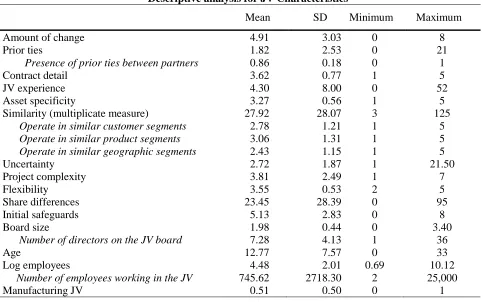
In the descriptive summary provided in Table 2a, we are able to discern several interesting
patterns. First, we find that approximately 51% of all the joint ventures in our sample operated in the
manufacturing industry. The average joint venture had 746 employees and was approximately 13 years
old. The collaborations in our sample were governed by a board of directors that consists on average of
7.28 directors. Parent firms had formed approximately four collaborations in the past on average, which
indicates that the firms in our sample were relatively experienced in establishing collaborations. More
specifically, fifty percent of the partners had formed a single collaboration in the past whereas two
organizations had established more than 50 strategic alliances prior to the establishment of the focal joint
venture. In terms of the equity distribution, 23% of JV partners divide equity evenly (i.e., 50-50 JVs). We
also investigated whether our measures that capture the contract detail are in line with existing alliance
governance studies. The mean level of detail of the agreement in our sample was 3.62 on a scale of 1 to 5.
This seems to be in line with other research. For instance, Luo's (2002) equivalent measure averaged 3.07
and Klijn et al. (2013) observed an average score of 3.58.
In relation to our focal variables, we witnessed some intriguing patterns. In 86% of the cases, JV
partners have collaborated with one another in the past. This average tends to be higher than other studies
that focused on alliance governance. For instance, in Lioukas and Reuer's (2018) sample, in 31% of the
cases partners had formed collaborations with each other in the past. Gulati (1995) noted that prior ties
averaged 12%. In total JV partners established 1.82 collaborations with each other in the past prior to the
focal JV and the maximum number of collaborations formed with one another was 212. We also observed
that 5. 13 (out of 8) safeguards were initially put in place in the JV agreement. This average is slightly
higher than was observed in a comparative study by Reuer and Ariño (2007), who observed a total of 3.69
safeguards that were implemented in the agreement.
2 We have performed robustness tests by excluding the outlier (i.e., prior ties equal 21) and found consistent results
*** Insert Table 2a about here ***
Table 2b provides a detailed overview of the contractual revisions. We look at three aspects of
contract renegotiation: the amount of change (i.e., how many provisions are changed), the direction of
change (i.e., more detail or less detail), and the type of change (i.e., which types of provisions are
changed). In relation to the occurrence that renegotiation between JV partners took place, we observed
that in 87% of the cases partners decided to renegotiate the initial contract. This average is higher than the
results obtained in other alliance studies. For instance, Reuer and Ariño (2002) observed that
renegotiation occurred in 20 percent of their cases. Duplat et al. (2018) noted that 36.2% of the JV
partners altered their initial safeguards over time. One possible explanation for this difference is that the
Chinese context has changed considerably and this has led partners to alter their contracts to adapt to
changing conditions.
We also observe that enforcement provisions were changed in 81% of the JVs, while coordination
provisions were changed in 82% of the JVs. Partners therefore tend to change both types of provisions in
their initial contract. In only 11% of the cases did JV partners decide to change only the contractual
enforcement provisions or the coordination provisions. It also occurs more frequently that safeguards are
strengthened or added (59% of the cases) than they are weakened or dropped (28%) or not changed
(13%). This is consistent with previous research that firms generally tend to add more details and make
more complete contracts in the following transactions (Ryall and Sampson 2009). Our findings show that
existing provisions are adjusted over time and we observe fewer instances of them being removed or
weakened as firm seek to align the contract with current exchange processes. In other words, contractual
renegotiation is primarily concerned about strengthening or adding clarity to existing provisions, rather
than weakening or removing existing ones.
We are able to discern several patterns from our descriptive statistics. First, in case a contract was
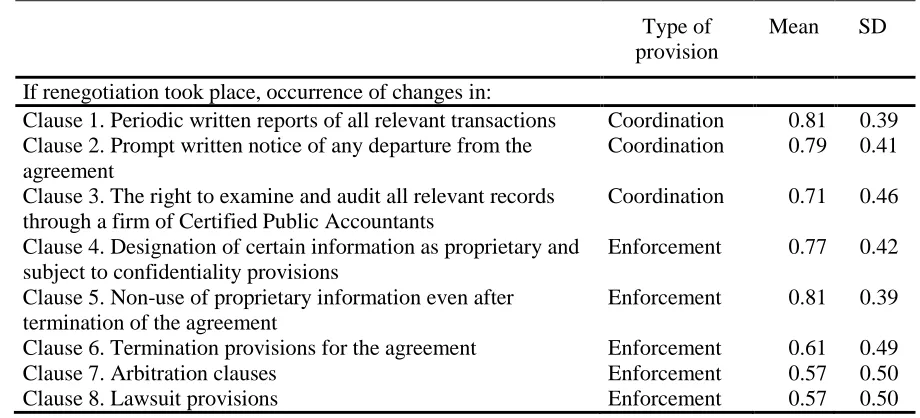
changed, on average partners altered 3.33 out of the 5 enforcement provisions. For coordination
provisions, on average 2.32 out of the 3 provisions are changed. This implies that when partners
written reports, prompt written notices about any departure of the agreement, as well as the right to
examine and audit relevant records). We also decided to explore the direction of change. Transacting
parties on average strengthened 2.47 different safeguards if they decide to change the contract. On
average, they seem to weaken or drop only 1.17 provision, so these changes are less extensive in terms of
the number of provisions altered.
Finally, we also studied the changes in the individual items (see Table 2c). Interestingly,
provisions about periodic written reports for all relevant transaction were altered the most (81.1%) and
changes in arbitration-related provisions or lawsuit provisions were changed the least (57.1% for either
type of provisions respectively). This finding corresponds to Parkhe’s (1993) observation that the latter
provisions are more stringent, so they are apt to be the more difficult ones to renegotiate.
*** Insert Table 2b & 2c about here ****
Given that we have four different types of change (i.e., adding, strengthening, removing and
weakening) and multiple types of contractual provisions, graphical representation of changes is also
informative. As shown in Figure 1, we see the likelihood of change for each provision. In the majority of
the cases, provisions are strengthened, but in line with our earlier observation, this tends to occur less
frequently for arbitration-related provisions as well as lawsuit provisions. Interestingly, Figure 1 shows
that not many types of provisions are weakened, with the exception of “prompt written notice of any
departure from the agreement” where it tends to occur more frequently. One possible explanation is that
during radical change (such as the transitions in the Chinese economy over time), partners might delegate
more responsibilities to the JV managers (Reuer et al. 2014) and not require the other parties involved to
constantly provide written notice for deviations from the JV agreement. A final observation is that both
arbitration-related provisions and lawsuit provisions are less subject to change. While they were
occasionally altered, they were never removed.
*** Insert Figure 1 about here***
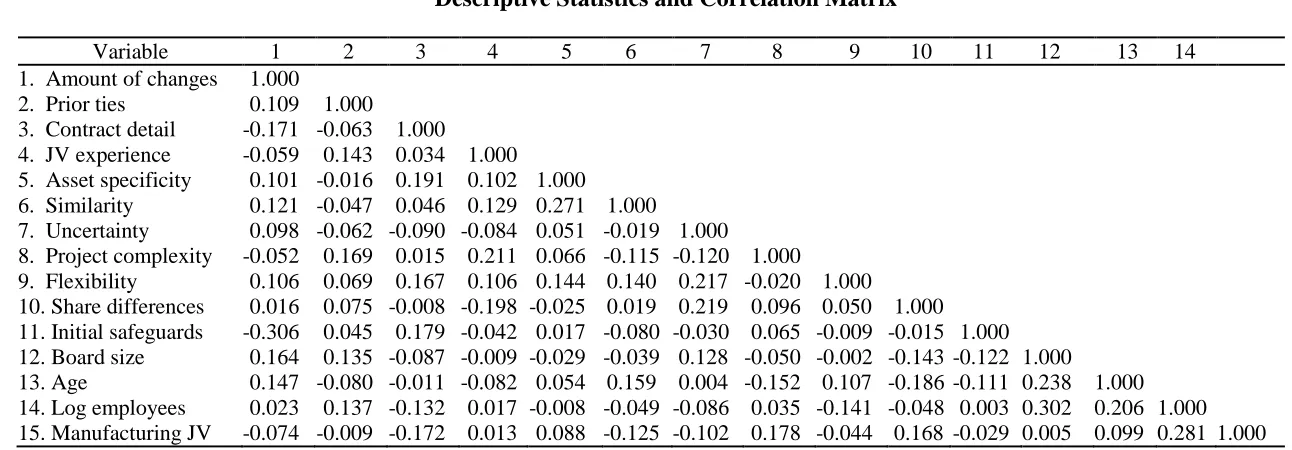
Table 3 provides a correlation matrix in addition to our descriptive findings. We observe some
place when the initial contracts contain a greater number of clauses and when initial contracts are more
detailed (i.e., in terms of how the JV is set up, managed, operated, etc.). These findings seem to support
the notion that well-designed and detailed contracts at the outset of the collaboration require partners to
renegotiate to a lesser extent. It may also suggest that there is less of a need to formally renegotiate when
the initial contract is detailed. Second, we find no correlation between prior ties and contract detail. This
finding is interesting because claims in the alliance literature have been made that prior ties reduce the
need for a detailed and complete contract at the outset of the collaboration (e.g., Argyres et al. 2007).
However, this may also suggest that instead of a sequential effect, prior ties and contract detail may affect
contract change separately.
Regressions on the amount of contract change
Given the considerable amount of heterogeneity in the amount, direction and types of contractual
change, we also investigated factors that may affect contractual adaptation. We build on Mayer and
Argyres’ (2004) main proposition that changes in contractual structures are an outcome of learning and
that partners’ experiences lead to adaptations in agreements from one collaboration to the next. However,
learning during the alliance can also potentially affect contractual changes and it would be interesting to
identify how these effects influence the nature and amount of adjustments. In the first set of regression
analyses below, we first explore the amount of change in contractual structures by performing a negative
binomial regression analysis3. A post-estimation goodness of fit test for over-dispersion confirmed that
this regression technique was appropriate relative to Poisson models that assume the mean and variance
of response are the same (1/df Pearson = 1.93)4. In all the count models we measured the exposure of
provisions to potential change by controlling for the total number of safeguards identified in the initial
contract when the JV was formed (initial safeguards).
3 We compared the value of log likelihood and AIC for NB1 and NB2 models and found that NB2 models assuming mean dispersion fits our data
better, for all the negative binomial models we used in this paper.
4 The alpha value for over-dispersion test is not applicable as we clustered our error terms at province lever. Instead, we compute the Pearson
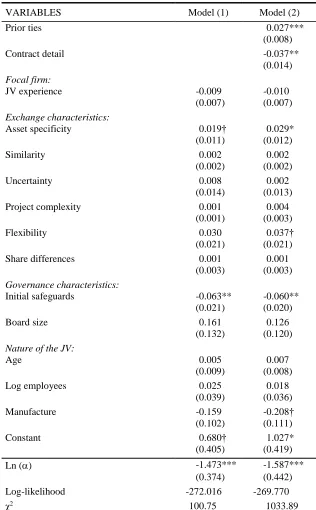
In Table 4, Model (1) is a baseline model and Model (2) is the full model that includes both focal
and other variables. The positive coefficient estimates for prior ties in Model (2) show that partners’
previous experiences positively correlates with the amount of change in contract structures (p=0.001).
Calculating the incident rate ratio of prior ties in Model (2), we find that for one unit increase in prior ties,
the expected amount of contract change would be an increase of 3%, while holding all other variables in
the model constant. Model (2) also shows a negative coefficient estimate for contract detail (p =0.011).
This suggests that for a one unit increase in contract detail, the expected amount of contract change would
decrease by 4%. The finding indicates that negotiating more complete contracts at the outset of
collaborations is associated with fewer alterations to the agreement during execution of the collaboration.
We discuss the theoretical implications of these findings in the discussion section of the paper.
*** Insert Table 4 about here***
Regressions on the direction of contract change
Tables 5 show the results for the direction of changes in contract structures as well as the ratio of
change. We performed bivariate count outcome models that allow for the specification of two correlated
count outcomes with one common covariate list using a copula function approach (Xu and Hardin 2016).
This regression technique also allows for various link functions (i.e., Poisson or negative binomial) for
each dependent variable and provides likelihood-ratio tests to help determine which link function to use.
Results obtained by Pearson tests on over-dispersion confirmed that both dependent variables fit better
with negative binomial models. In Table 5, Model (3a) and Model (3b) consist of other variables only,
while Model (4a) and Model (4b) contain all the variables. We found that the error terms in Model (4a)
and Model (4b) are highly correlated ( = 0.340**), suggesting the appropriateness of the bivariate count
model. In Model (5a) and Model (5b), we replicated the full model using seemingly unrelated regressions
examining the ratio of weakened or dropped provisions with respect to all directions of change and the
ratio of added or strengthened provisions. First, in relation to the number of added or strengthened
provisions, we find a positive coefficient estimate for prior ties in Model (4a) (p = 0.000). Similarly, in
although the association is less significant (p = 0.019). The coefficients suggest that for one unit increase
in the number of prior ties, 6% more clauses will be added or strengthened, and 9% more clauses will be
dropped or weakened. We also find that contract detail is associated with a lesser amount of weakening or
dropping safeguards implying that partners who prefer to specify detailed contracts like to keep them
specific. The significant coefficient of contract detail in Model (4b) translates to the effect that for a one
unit increase in contract detail, 21% fewer clauses will be weakened or dropped. However, the correlation
between contract detail and the number of clauses that are being added or strengthened is insignificant.
*** Insert Table 5 about here ****
Regressions on the type of contract change
We also wanted to explore how prior ties and contract detail affect the changes in the types of
provisions. In doing so, we utilized Reuer and Ariño’s (2007) categorization of enforcement and
coordination provisions. While coordination provisions primarily focus on the alignment of partners’
expectations, enforcement provisions deal with mitigating opportunism (Reuer and Ariño, 2007). Table 6
shows the results of our tests. Model (6a) and Model (6b) are the baseline models and Model (7a) and
(7b) are our full models that include our focal variables. A bivariate count outcome model was performed
in order to test for the effect on the types of change. A Pearson test for over-dispersion indicated the need
to use Poison models for the changes in coordination models but negative binomial models to generate
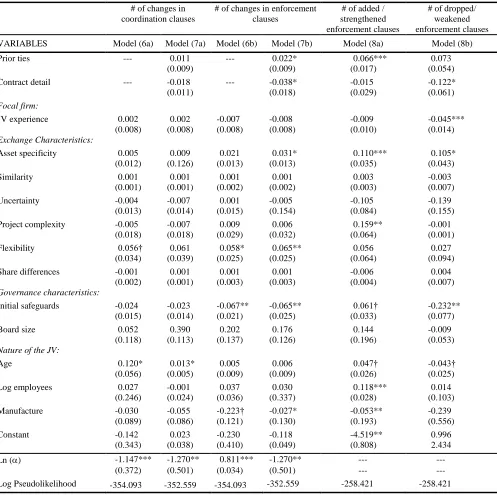
results for enforcement provisions. We found that the error terms of the above two models (Model (7a)
and Model (7b)) are significantly correlated ( = 0.665, p<0.001). Interestingly, prior ties do not have an
effect on coordination provisions, but we find a positive coefficient estimate, albeit weak, in the changes
of enforcement provisions (p=0.018 in Model (7b)). The significant coefficient suggests that for one unit
increase in prior ties, the amount of change towards enforcement clauses will increase by 2%. Contract
detail also has a significant effect on enforcement clauses (p=0.034 in Model (7b)). The coefficient
translates to an effect that for one unit increase in contract detail, the amount of change towards
Finally, we decided to explore the changes in enforcement provisions in greater detail and study
the effects of prior ties and contract detail on both the strengthening and adding of such type of provisions
as well as the extent that these types of safeguards are weakened or dropped. We performed a bivariate
count model in order to show their effects and we presented our results in Models (8a) and (8b). First, we
find that prior ties have a significant positive effect on the number of added or strengthened provisions (p
<0.001 in Model (8a)). Specifically, for one unit increase in prior ties, the number of enforcement clauses
added or strengthened will increase by 7%. We find a negatively significant coefficient for contract detail
on the dropping or weakening enforcement provisions (p=0.046 for Model (8b). Indeed, for a one unit
increase in contract detail, the number of enforcement clauses weakened or dropped will decrease by
12%. This suggests that partners who negotiated detailed contracts at the outset of the collaborations may
not remove these types of provisions and keep the contract detailed. At the same time, we do not find a
significant correlation between contract detail and adding/strengthening provisions.
*** Insert Table 6 about here ****
Other factors that may be correlated with contract change
There are several intriguing findings in relation to variables used in the models to capture other
factors that may be correlated with contract change. The focal firm’s experience with JVs does not seem
to be correlated with the amount of change. Particularly, collaborating with more experienced parent
firms is associated with fewer instances of dropping or weakening contract clauses. In relations to
governance characteristics, we find that the number of initial safeguards adopted is negatively associated
with the amount of change. We also find in Table 5 that the initial safeguards negatively correlate with
the number of provisions that are weakened or dropped but positively correlate with those that are added
or strengthened. These findings further support the idea that those partners’ who specify more complete
contracts tend to renegotiate less (Batenburg et al. 2003) but also indicate that they prefer to keep their
contract detailed and update them as necessary, presumable to keep them aligned with actual processes
In terms of exchange characteristics that we examine in Table 4, we find that the hold-up
concerns associated with asset specificity are correlated with more extensive contractual changes.
Interestingly, the inherent exchange hazards associated with asset specificity affect partners’ desires to
match the contract structure with the level of dedicated investments, because it affects both directions of
change in a positive way. We do not observe similar patterns for the other exchange specific attributes
that we studied in our models. While these characteristics do not affect the amount of contractual change,
they do have an influence on the direction of change. Several findings are noteworthy. First, when
partners face difficulties in anticipating future contingencies due to the turbulent environments in which
their JV operates, they also avoid activities that may involve strengthening or adding new provisions. One
possibility is that the environment makes the exact specification of safeguards difficult. In addition, such
conditions would also affect the cost and risk of renegotiations given that these conditions create goal
misalignment and exchange hazards (e.g., Carson, et al., 2006). Moreover, environmental uncertainty
does not have an effect on the removal of contractual provisions. This reinforces the point that there is
difficulty in specifying the contract in the presence of uncertainty.
Project complexity is negatively correlated with the number of weakened or removed provisions,
but positively correlated with the strengthening of contracts. In contrast to uncertainty, when project
complexity is high, partners need to understand during the course of the alliance whether the contract is
misaligned with the activities that are undertaken in the focal JV. Yet, the existing contract structure is not
weakened under these conditions as can be seen in Table 5. Partners may enhance the contract structure
under these conditions in order to align the JV agreement with project complexity. This finding reinforces
that partners learn during their alliance and opt to change contract structures so as to minimize exchange
hazards. Besides, when organizations become more complex due to their size, there tends to be a higher
need for adding or strengthening the provisions. One potential explanation is that partners face higher
risks in such kind of collaborations and make the contract more extensive in order to reduce risk. In
Finally, we also find that flexibility5 affects changes in contracts. We find that partners that are
flexible also experience a larger amount of contract change in their JVs, although this effect is marginal.
However, while flexibility does correlate with adding or strengthening provisions, particularly
enforcement provisions, it does not have an effect on weakening or dropping provisions. Thus, while
there might be a need for weakening or dropping clauses in the contract, partners may not do that even
though they are flexible to cope with misalignment in case contracts are too detailed, despite that
flexibility provides partners the opportunity to renegotiate underspecified contracts and help them
strengthen and add provisions more extensively.
DISCUSSION
Over the last few decades, a significant body of alliance governance research has focused on the
design of contractual agreements to support collaborations (e.g., Mellewigt et al. 2007, Reuer and Ariño
2007, Ryall and Sampson 2009, 2016). While these studies have generated a significant improvement in
our understanding how partners align contracts to the underlying transaction attributes (Mayer and
Argyres 2004, Parkhe 1993), and how repeated collaborations help partners to make changes from one
contract to the next (e.g., Mayer and Argyres, 2004), less is known on how partners adjust their contract
structures during the focal alliance (Reuer and Ariño 2002; Reuer, Zollo, and Singh, 2002). We believe
that there are structural differences between contractual changes that happen between successive alliances
as well as within an existing alliance. While in both cases, the partners face challenges in coming to an
agreement, in the case of renegotiation, partners dedicate time and effort to change the underlying
contract structure during the course of the alliance. Previous studies looking at changes between
successive alliances focus on the addition or dropping of certain clauses (Ryall & Sampson 2009).
However, in within-alliance renegotiation, we are still able to observe a significant amount of change,
including modifying existing clauses (in both directions). This finding might be context specific as it is
5 Flexibility may only capture the relationship between partners and does not affect any governance choices.
more likely to be found in longer-term alliances in which the formal contract plays an important role, such
as JVs. Additionally, the need for change may be greater in a turbulent environment such as China was
during the time the JVs in our sample were operating.
We observe several patterns in relation to the amount of change. First, we find that transacting
parties with prior collaborations made more alterations to the contract during the alliance itself. This
finding is in line with the literature that collaborative experience lowers renegotiation costs and risks
when partners have formed alliances in the past. It may also suggest that the extent to which the formal
contract is renegotiated is affected by the partners’ interest in using the contract as a planning and
tracking device (Llewellyn 1931) that can be an effective template for their future deals (Das and Teng
1998, Poppo and Zenger 2002). The knowledge that partners gain by collaborating in the focal JV may
help them to resolve collaboration issues, and strategic solutions are incorporated into the JV agreement
to increase the chances that they are incorporated into future collaboration agreements. This finding may
also support Mayer and Argyres’s (2004) claim that adjusted contracts serve as a repositories of
knowledge as they codify the partners’ knowledge about efficient ways to collaborate in the future. Our
results, however, are different from the proposition that familiarity, trust, and learning generated from
prior ties reduce the need for contractual renegotiation (e.g., Gulati 1995, Gulati and Singh 1998, Uzzi
1997). In addition, our findings conflict with arguments that strengthening formal mechanisms may signal
suspicion and a lack of belief in partners’ goodwill or competence so that partners with prior ties tend to
renegotiate less extensive agreements (Ghoshal and Moran 1996, Malhotra and Murnighan 2002).
Second, we find that the level of contractual detail is negatively associated with the number of
contract alterations. This finding is in line with the idea that well-design contracts provide the benefits of
better safeguarding and adaptive capacity (Parkhe, 1993). Detailed, and more complete, contracts
specifying alternatives may be able to align partners’ expectations more adequately (Mayer & Argyres,
2004). More detailed alliance contracts are correlated with fewer contractual changes, potentially because
transacting parties may have dedicated more time and effort to specify roles and responsibilities, reducing
In addition to the amount of change, we also observe that the initial contract structure is
associated with the direction of making changes—by either adding or removing terms. Our results
suggest that while partners with initially detailed contracts make fewer changes in general, they may do
so because they are less willing to remove the extent terms and provisions, not because they are unwilling
to add or strengthen them. These findings suggest that partners took time to carefully consider what
provisions they should include initially, and thus they are less likely to remove detail. These results also
indicate that previous collaborative experiences between partners could probably reduce renegotiation
costs and risks and that they facilitate contract changes. Contrary to the relational governance argument,
we found that prior ties are associated with more adding and strengthening of contract clauses—making
the contract more detailed. Although our analysis is purely correlational, this finding is consistent with
previous research suggesting that prior ties lead to a more detailed contract (e.g., Ryall and Sampson,
2009), or a more customized contract (Poppo and Zenger 2002). The findings are also in line with our
earlier conjecture that transacting parties strengthen their JV agreements because they wish to keep track
of their learning about the focal JV transaction and use their contract as a repository of knowledge and
information for future collaborative endeavors (Mayer and Argyres, 2004).
Finally, we draw on prior work (e.g., Macaulay 1963) on alliances that highlight important
differences between the type of provisions, namely enforcement versus coordination (e.g., Reuer & Ariño,
2007). Our results indicate that contractual alterations by parties with more collaborative experience are
associated with minor process-based (coordination) adjustments, but with more extensive changes that
involve enforcement provisions. This is consistent with the findings by Ryall and Sampson (2009), who
argued that clauses relating to output specifications tend to increase when partners have collaborations in
the past, while those concerned with allocating intellectual property rights decrease. We also find that the
existence of detailed prior contracts does not affect coordination clauses, instead, it is correlated with
fewer changes to enforcement clauses. This finding is consistent with our speculation that adaptation is
less needed when the initial contract is detailed (Ariño et al. 2008, Batenburg et al. 2003, Gil 2009),
Limitation and future research
Since we rely on a cross sectional survey to explore contract renegotiation during the execution of
alliances, we have limited implications for any causal relationships. Therefore, it is difficult for our study
to discover the rationales behind the patterns we find. First, our findings that prior ties are positively
associated with more changes seem to run contrary to Ryall and Sampson (2009)’s conclusion that prior
ties could have the effect of reducing the use or level of detail of certain clauses. However, they did not
claim that this negative relationship was an effect that would be pertinent in all cases and instead, they
suggested that we needed more work to determine when this result would emerge compared to seeing no
effect of prior ties or even having prior ties lead to more detailed contracts. Relatedly, they recently
suggested that while prior ties reduce the ambiguity in the new transaction, clauses about action
requirements still prevail, while clauses about deliverable requirements are not favored (Ryall and
Sampson 2016). Future work could build on our study and Ryall and Sampson’s (2009, 2016) work to
further explore the mechanisms and boundary conditions on when and how prior ties might affect
different kinds of contract clauses.
Second, our findings that prior ties are associated with changes towards enforcement clauses
instead of coordination clauses seem to go against the rationales suggested by relational governance
scholars. Relational governance is concerned with how the relationship between the parties can lead to
trust, which can serve as an effective lubricant to facilitate inter-firm collaboration (Faems et al. 2008,
Gulati 1995, Hoetker and Mellewigt 2009) by reducing moral hazard. One possible explanation for our
finding could be that the learning effects that partners gain by collaborating repeatedly are likely to enrich
their knowledge of how they work together well (Dekker and Van den Abbeele 2010), which may
facilitate informal adaptation to facilitate coordination and/or the routines they develop based on their
joint experience may be more flexible in nature.
Alternatively, it also seems that the shadow of the future weighs heavily on parent firms’
renegotiation of enforcement provision given that they both value the need for future collaborations and
relation to enforcement because of the value of enforcement provisions in a contract template. Firms tend
to use the prior contract as a template for the next transaction because it reflects key elements of the
relationship such as enforcement issues. The nuances of how the firms will coordinate are often
transaction specific, so there is less need to keep these updated in terms of maintaining a strong contract
template for interactions between these two parties. This finding is also at odds with Mayer and Argyres
(2004), but the contracts they examined were statements of work that did not include enforcement
provisions (enforcements provisions were addressed in a master agreement). This suggests that
international JVs are likely to be different from smaller development alliances in important ways that
need to be carefully considered. Therefore, future research could help explore which mechanisms could
explain our findings, and whether contract adaptation in JVs are different from that in none-equity
involved alliances. In addition, future work could more carefully categorize alliances and seek to be more
precise about the types of alliances to which different results may generalize.
Moreover, one may wonder why JVs with prior ties were more focused on adding or
strengthening enforcement clauses which are not typically directly related to the day-to-day activities of
the JV but are important in terms of dealing with issues that might arise in the future. The firms can use
learning and trust from prior ties to adapt their operations and coordinate activities, but they need more
formality to ensure things like dispute resolution are addressed. This provides interesting new insight into
the potential complementarity between findings from research using relational governance and TCE
perspectives. In some areas, firms evidently prefer to document what they are doing (such as enforcement
clauses), while in other parts of the contract prior ties may lead to the ability to adapt informally without
changing the contract. Future research can also explore this interesting interaction of relational
governance and TCE when examining governance adaptation.
Lastly, some aspects of our findings could be context specific. The Chinese context is unique
since trust is unlikely to be sufficient as a safeguard and thus the benefits of trust may manifest in
different ways compared a small contractual alliance in a country like the United States. The institutional
expectations of Chinese government that Chinese firms can learn proprietary knowledge from foreign
firms. Although those incumbents try to learn from entrants and build on their technologies, they may
pose threat to the entrants (Giustiziero, Kaul, & Wu, 2019). Even though foreign firms can thus gain
access to the Chinese market, their concerns regarding misappropriation are significant. Therefore, the
pattern that exchange parties prefer changing enforcement clauses in our sample, which is incongruent
with prior work, could be largely about context. JVs that are established in a constantly changing country
like China may require more adaptation than shorter-term traditional contractual alliances in a single
country.
Contributions
We contribute to existing theory and empirical work by conducting one of the first examinations
of when and how firms make changes to their existing contracts—an important adaptation question in
TCE that has received little theoretical or empirical attention. By contrasting prior findings from TCE and
organizational learning, we find that prior ties are associated with a greater likelihood of making a change
to a contract during execution, which provides evidence of short-term learning within a single transaction,
while prior work has focused more on how prior ties affect the design of future contracts (e.g., Mayer &
Agyres, 2004; Ryall & Sampson, 2009).
Our data, however, allow us to move beyond simply the presence of a change versus no change,
in order to look at (1) what contract terms are changing, and (2) how those terms are changing
(specifically adding detail versus removing detail). We show that, counter to prevailing wisdom, firms in
JVs are more likely to make changes to contracts in order to enhance enforcement related issues in the
presence of longer-term relationships, even within a developing market with relatively weak enforcement
institutions such as China. Consistent with prior work by Mayer and Argyres (2004), our findings are in
accord with a perspective that foresight can be limited and firms go through a learning process that
involves making mistakes when working with new partners. But given the longer-term nature of
international JVs, firms incorporate their learning into the current contract rather than waiting for the next
Finally, we shed light on how JVs in China make adaptations based on the experience of the
parties involved and the details in the JV contract. We explored a unique context where a large amount of
renegotiation took places (87% in our sample). China has been a turbulent policy and market
environment, and the firms in our sample have had to deal with that environmental uncertainty while
managing complex, long-term international JVs. The results presented here also give us insight into how
firms navigate this kind of complex landscape by using JVs between foreign and domestic firms and
adapting their contractual foundations over time. Moreover, our findings also help shed light on policy
making in dynamic markets like China where competition between incumbents and entrants (both
REFERENCES
Anderson SW, Dekker HC (2005) Management Control for Market Transactions: The Relation between Transaction Characteristics, Incomplete Contract Design, and Subsequent Performance.
Management Science 51(12):1734–1752.
Argyres NS, Bercovitz J, Mayer KJ (2007) Complementarity and Evolution of Contractual Provisions: An Empirical Study of IT Services Contracts. Organization Science 18(1):3–19.
Ariño A, De La Torre J (1998) Learning from failure: Towards an evolutionary model of collaborative ventures. Organization science 9(3):306–325.
Ariño A, Ragozzino R, Reuer JJ (2008) Alliance Dynamics for Entrepreneurial Firms. Journal of Management Studies 45(1):147–168.
Armstrong JS, Overton TS (1977) Estimating Nonresponse Bias in Mail Surveys. Journal of Marketing Research 14(3):396–402.
Batenburg RS, Raub W, Snijders C (2003) Contacts and contracts: dyadic embeddedness and the contractual behavior of firms. The Governance of Relations in Markets and Organizations. Research in the Sociology of Organizations. (Emerald Group Publishing Limited), 135–188. Blodgett LL (1992) Research notes and communications factors in the instability of international joint
ventures: An event history analysis. Strategic Management Journal 13(6):475–481.
Bradach JL, Eccles RG (1989) Price, Authority, and Trust: From Ideal Types to Plural Forms. Annual Review of Sociology 15(1):97–118.
Chan CM, Makino S, Isobe T (2010) Does subnational region matter? Foreign affiliate performance in the United states and China. Strategic Management Journal 31(11):1226–1243.
Cyert RM, March JG (1963) A behavioral theory of the firm. Englewood Cliffs, NJ, 2(4): 169-187. Daily CM, Dalton DR, Cannella AA (2003) Corporate Governance: Decades of Dialogue and Data. AMR
28(3):371–382.
Das TK, Teng BS (1998) Between Trust and Control: Developing Confidence in Partner Cooperation in Alliances. Academy of Management Review 23(3):491–512.
Das TK, Teng BS (2000) Instabilities of Strategic Alliances: An Internal Tensions Perspective. Organization Science 11(1):77–101.
Dekker HC, Van den Abbeele A (2010) Organizational Learning and Interfirm Control: The Effects of Partner Search and Prior Exchange Experiences. Organization Science 21(6):1233–1250. Dillman DA (1978) Mail and telephone surveys: The total design method (Wiley New York). Doz YL (1996) The evolution of cooperation in strategic alliances: Initial conditions or learning
processes? Strategic Management Journal 17(S1):55–83.
Duplat V, Coeurderoy R, Hagedoorn J (2018) Contractual governance and the choice of dispute-resolution mechanisms: Evidence on technology licensing. Research Policy 47(6):1096–1110. Faems D, Janssens M, Madhok A, Van Looy B (2008) Toward an Integrative Perspective on Alliance
Governance: Connecting Contract Design, Trust Dynamics, and Contract Application. Academy of Management Journal 51(6):1053–1078.
Feldman MS, Rafaeli A (2002) Organizational Routines as Sources of Connections and Understandings. Journal of Management Studies 39(3):309–331.
Fudenberg D, Levine D, Maskin E (1994) The Folk Theorem with Imperfect Public Information. Econometrica 62(5):997–1039.
Ghoshal S, Moran P (1996) Bad for Practice: A Critique of the Transaction Cost Theory. Academy of Management Review 21(1):13–47.
Gil R (2009) Revenue Sharing Distortions and Vertical Integration in the Movie Industry. Journal of Law, Economics, & Organization 25(2):579–610.
Gulati R (1995) Does Familiarity Breed Trust? The Implications of Repeated Ties for Contractual Choice in Alliances. Academy of Management Journal 38(1):85–112.