Original citation:
Haslegrave, John, Johnson, Richard A. B. and Koch, Sebastian. (2017) Locating a robber with
multiple probes. Discrete Mathematics, 341 (1). pp. 184-193.
Permanent WRAP URL:
http://wrap.warwick.ac.uk/91522
Copyright and reuse:
The Warwick Research Archive Portal (WRAP) makes this work by researchers of the
University of Warwick available open access under the following conditions. Copyright ©
and all moral rights to the version of the paper presented here belong to the individual
author(s) and/or other copyright owners. To the extent reasonable and practicable the
material made available in WRAP has been checked for eligibility before being made
available.
Copies of full items can be used for personal research or study, educational, or not-for-profit
purposes without prior permission or charge. Provided that the authors, title and full
bibliographic details are credited, a hyperlink and/or URL is given for the original metadata
page and the content is not changed in any way.
Publisher’s statement:
© 2017, Elsevier. Licensed under the Creative Commons
Attribution-NonCommercial-NoDerivatives 4.0 International http://creativecommons.org/licenses/by-nc-nd/4.0/
A note on versions:
The version presented here may differ from the published version or, version of record, if
you wish to cite this item you are advised to consult the publisher’s version. Please see the
‘permanent WRAP URL’ above for details on accessing the published version and note that
access may require a subscription.
Locating a robber with multiple probes
John Haslegrave
1, Richard A. B. Johnson
2, Sebastian Koch
3August 7, 2017
Abstract
We consider a game in which a cop searches for a moving robber on a connected graph using distance probes, which is a slight variation on one introduced by Seager (Seager, 2012). Carragher, Choi, Delcourt, Erickson and West showed that for anyn-vertex graphGthere is a winning strategy for the cop on the graphG1/mobtained by replacing each edge ofGby a path of length m, if m ≥ n (Carragher et al., 2012). The present authors showed that, for all but a few small values ofn, this bound may be improved tom≥n/2, which is best possible (Haslegrave et al., 2016b). In this paper we consider the natural extension in which the cop probes a set ofkvertices, rather than a single vertex, at each turn. We consider the relationship between the value ofkrequired to ensure victory on the original graph with the length of subdivisions required to ensure victory withk= 1. We give an asymptotically best-possible linear bound in one direction, but show that in the other direction no subexponential bound holds. We also give a bound on the value ofk for which the cop has a winning strategy on any (possibly infinite) connected graph of maximum degree ∆, which is best possible up to a factor of (1−o(1)).
1
Introduction
Search games and pursuit games on graphs have been widely studied, beginning with a graph searching game introduced by Parsons [20] in which a fixed number of searchers try to find a lost spelunker in a dark cave. The searchers cannot tell where the target is, and aim to move around the vertices and edges of the graph in such a way that one of them must eventually encounter him. The spelunker may move around the graph in an arbitrary fashion and at unlimited speed, and in the worst case may be regarded as an antagonist who knows the searchers’ positions and is trying to escape them. Parsons [21] subsequently introduced thesearch number,s(G), of a graphG, being the minimum number of searchers required to guarantee catching the spelunker. Megiddo, Hakimi, Garey, Johnson and Papadimitriou [18] showed that computing the search number of a general graph is an NP-hard problem. From the subsequent proof by LaPaugh [17] that any number of searchers who can find the spelunker can do so while ensuring the spelunker cannot return to a previously searched edge, it follows that the decision problem is in NP (and hence NP-complete).
1University of Warwick, Coventry, UK.
Robertson and Seymour [23] introduced the concepts of path decomposi-tions and the pathwidth, pw(G) of a graph G, which has deep connections to the theory of graph minors and to algorithmic complexity. Minor-closed families which have a forbidden forest are precisely those with bounded pathwidth [23], and many algorithmic problems which are difficult in general have efficient algo-rithms for graphs of bounded pathwidth [2]. Ellis, Sudborough and Turner [6] independently defined the vertex separation number of a graph, and Kinnersley subsequently showed the equivalence of these two definitions [14]. Ellis, Sudbor-ough and Turner showed that the search number of a graph is almost completely determined by its pathwidth, giving bounds of pw(G)≤s(G)≤pw(G) + 2 [7]. Graph pursuit games date back to the classical Cops and Robbers game, introduced independently by Quillot [22] and Nowakowski and Winkler [19] (who attribute it to G. Gabor). This involves one or more cops and a robber moving around a fixed graph. The cops move simultaneously and alternate moves with the robber, all moves being to neighbouring vertices. The cops win if one of them occupies the robber’s location. On a particular graph G the question is whether a given number of cops have a strategy which is guaranteed to win, or whether there is a strategy for the robber which will allow him to evade capture indefinitely. Thecop number of a graph is the minimum number of cops that can guarantee to catch the robber. An important open problem is Meyniel’s conjecture, published by Frankl [8], that the cop number of any
n-vertex connected graph is at mostO(√n).
Models which focus on finding an invisible target rather than catching a visible one have been the focus of much recent work. In the Hunter versus Rabbit game, studied by Adler, R¨acke, Sivadasan, Sohler and V¨ocking [1] and the Cop versus Gambler game, studied by Komarov and Winkler, [16] the aim is to catch a randomly-moving target as quickly as possible; in both cases the searcher is restricted to moving on the edges of the underlying graph, but the target is not. Related models can be used to design protocols for ad-hoc mobile networks [5]. In Hunter versus Rabbit, the rabbit’s strategy is unrestricted; Adler et al. showed that the hunter can achieve expected capture timeO(nlogn), while for some graphs the rabbit can achieve expected survival time Ω(nlogn) [1]. In Cop versus Gambler, the gambler’s strategy is simply a probability distribution on the vertices, and his location at different time steps is independent. In this setting Komarov and Winkler showed that a cop who knows this probability distribution can achieve expected capture timen, which is trivially best possible for the uniform distribution, and a cop who does not know the distribution can still achieve capture timeO(n) [16].
In the problem variously referred to as Cat and Mouse, Finding a Princess, and Hunter and Mole, it is the target which is constrained to moving around a graph, and the searcher probes vertices one by one in an unrestricted manner. In between any two probes the target must move to an adjacent vertex. The searcher wins if she probes the target’s location, but gets no information other-wise. A complete classification of graphs on which the searcher can guarantee to win was given by Haslegrave [10, 11] and subsequently and independently by Britnell and Wildon [3] and Komarov and Winkler [15].
stationary target vertex; the searcher wins if she can then determine the target’s precise location. The minimum number of probes required to guarantee victory on the graphGis itsmetric dimension,µ(G). If the probed vertices are instead chosen sequentially, with each choice potentially depending on the results of previous probes, it may be possible to ensure victory with fewer probes; this is the Sequential Locating game, studied by Seager [25].
In this paper we consider the Robber Locating game, introduced in a slightly different form by Seager [24] and further studied by Carragher, Choi, Delcourt, Erickson and West [4], as well as by the current authors [12, 13]. This combines features of the other games mentioned above. Like the Sequential Locating game, the aim is to deduce the target’s location from distance probes, but, like Cops and Robbers or Cat and Mouse, the target moves around the graph in discrete steps. A single cop and robber take turns to act. For ease of reading we shall refer to the cop as female and the robber as male. The cop, who is not on the graph, can probe a vertex at her turn and is told the distance to the robber’s current location. If at this point she can identify the robber’s precise location, she wins. At the robber’s turn he may move to an adjacent vertex. (The original version of the game also had the restriction that the robber may not move to the vertex most recently probed, but subsequent work has generally permitted such moves.)
In the Sequential Locating game the searcher can guarantee to win eventu-ally, simply by probing every vertex, and the natural question is the minimum number of turns required to guarantee victory on a given graph G. In the Robber Locating game, by contrast, it is not necessarily true that the cop can guarantee to win in any number of turns. Consequently the primary question in this setting is whether, for a given graphG, the cop can guarantee to catch a robber who has full knowledge of how she will act. (On a finite graph, this is equivalent to asking whether there is some fixed number of turns in which she can guarantee victory.) We say that a graph islocatable if she can do this and
non-locatable otherwise.
The main result of Carragher et al. [4] is that for any graphGa sufficiently large equal-length subdivision of G is locatable. Formally, write G1/m for the
graph obtained by replacing each edge ofGby a path of lengthm, addingm−1 new vertices for each such path. Carragher et al. proved thatG1/m is locatable
whenever m ≥ min{|V(G)|,1 + max{µ(G) + 2µ(G),∆(G)}}. In most graphs
this bound is simply |V(G)|, and they conjectured that this was best possible for complete graphs, i.e. that Kn1/m is locatable if and only if m ≥ n. The
present authors showed that in fact Kn1/m is locatable if and only ifm≥n/2,
for every n ≥ 11 [12], and then subsequently that the same improvement on the upper bound may be obtained in general: provided |V(G)| ≥ 23, G1/m is locatable wheneverm≥ |V(G)|/2 [13]. This bound is best possible, sinceKn1/m
2
Multiple probes vs subdivisions
Subdividing the edges of Gtends to favour the cop both by slowing down the robber’s movement around the graph and by giving her extra vertices to probe. Another way in which we might make the game easier for the cop is to allow her to choose a set ofk vertices to probe at each turn, rather than a single vertex. Formally, we define the k-probe version of the game as follows. At the cop’s turn she chooses a listu1, . . . , uk of vertices, and is then told the corresponding
listd(v, u1), . . . , d(v, uk) of distances to the robber’s location,v. (Note that the
cop must specify allk vertices before being told any of the distances.) If, from this and previous information, she can deducev, she wins. At the robber’s turn, as before, he may move to a neighbouring vertex. We sayGisk-locatable if the cop can guarantee to win the k-probe version of the game, that is to say if she has a deterministic strategy which will succeed against any possible sequence of moves for the robber.
The game thus provides two natural graph invariants. Write rlp(G) for the
minimum value of k such that G is k-locatable, rls(G) for the smallest value
such that G1/m is locatable whenever m ≥ rl
s(G). (We use the subscripts p
and s to indicate that the two quantities are the minimum number of probes and subdivisions respectively required for the cop to win.) We investigate the relationship between the two, showing that rls(G)≤(2 +o(1)) rlp(G) (the
fac-tor of 2 is best possible), but that no subexponential bound holds in the other direction. In Section 3 we also bound rlp(G) for connected, but not necessarily
finite, graphs of maximum degree ∆; our bound is best-possible up to a lower order error term, as shown by the infinite regular tree. We will always assume that the graphGis connected; provided there are only countably many compo-nents the cop can always reduce the problem to the connected case by probing components one by one until the component containing the robber is identified. Recall thatG1/m is the graph obtained by replacing each edge ofGwith a
path of lengthmthrough new vertices. Each such path is called athread, and a
branch vertex in G1/mis a vertex that corresponds to a vertex of G. We write
u· · ·v for the thread between branch vertices u and v. We use “a vertex on
u· · ·v” to mean any of the m+ 1 vertices of the thread, but “a vertex inside
u· · ·v” excludes u and v. When m is even we use the term “midpoint” for the central vertex of a thread, and whenm is odd we will use the term “near-midpoint” for either of the vertices belonging to the central edge of a thread. We say that verticesv1, . . . , vrform aresolving set forW ⊆V(G) if the vectors
(d(w, v1), . . . , d(w, vr)) are different for allw∈W.
We first note that rlp(G) and rls(G) do not exist unlessGis countable. Even
ifGis countable they may not exist, as shown by the infinite clique.
Lemma 1. For any integerk, if Gisk-locatable then V(G)is countable.
Proof. SupposeGisk-locatable, and fix a winning strategyS for the cop. For each vertex v let tv be the number of turns taken for strategy S to succeed
against a robber who is stationary at v, and lets(tv) be the vector of distances
returned in the cop’s tth turn, fort = 1, . . . , tv. Then (s (v) 1 , . . .s
(v)
tv ) are finite
sequences with terms in Zk, and so the set of possible sequences is countable.
Remark. If Gis uncountable then G1/m is uncountable for any m, so neither
rlp(G) nor rls(G) exist. In fact, since we only consider a stationary robber,
we have proved the stronger statement that there is no winning strategy for Seager’s Sequential Locating game [25] on any uncountable graph.
2.1
rl
s(
G
)
is
O
(rl
p(
G
))
In this section we show that rls(G)≤2 rlp(G) + 2 whenever rlp(G) exists, and
also show that this bound cannot be improved to arlp(G) +b for anya, b∈R
with a <2 by giving examples of graphsGn with rlp(Gn) =nand rls(Gn)≥
2n−O(log(n)).
Note that rlp(G)≤µ(G), since if the cop probesµ(G) vertices which form a
resolving set forV(G) she will locate the robber immediately. Thus Theorem 2 implies that rls(G) ≤ 2µ(G) + 2, a considerable improvement of the bound
rls(G)≤1 + max{µ(G) + 2µ(G),∆(G)} given by Carragher et al. [4].
Theorem 2. If Gisk-locatable then G1/m is locatable providedm≥2k+ 2.
Proof. Suppose G is k-locatable (and so, by Lemma 1, V(G) is countable), and fix a winning strategy S in which the cop probesk vertices of G at each turn. We show how to use S to define a winning strategy for the cop with one probe per turn onG1/m. In fact we can do this with the added restriction that the cop only probes branch vertices of G1/m. Note that from the result of such a probe considered mod m the cop can always determine the robber’s distance to his nearest branch vertex; in particular, she can determine whether he is at a midpoint or near-midpoint, and whether he is at a branch vertex. Also, provided the robber is not at a midpoint, she can determine the distance between his nearest branch vertex and the branch vertex probed (being the nearest multiple ofmto the result of the probe), and hence the distance between the corresponding vertices ofG.
Claim 2.1. From any position, the cop can probe branch vertices ofG1/msuch
that after at finitely many turns either she locates the robber or he reaches a midpoint or near-midpoint.
Proof of Claim. If the robber does not reach a midpoint or near-midpoint, his closest branch vertex, v, cannot change. By probing branch vertices in order, the cop will eventually identify v. Then she starts probing branch vertices in order again. If the robber reaches v she will recognise that he is at a branch vertex, which must bev, and win. If not then he will remain on a single thread
v· · ·w, and once the cop probes wshe will win. ♦
Claim 2.2. Fix a set {a1, . . . , ak} of branch vertices. Suppose the robber is at
a midpoint or near-midpoint. Then the cop may probe branch vertices ofG1/m
such that after finitely many turns either she has won or all of the following hold:
(a) the robber is at some branch vertex,v;
(b) he has not reached a branch vertex in the interim; and
(c) she has probed every ai after the robber’s last visit to a (near-)midpoint,
Proof of Claim. The cop proceeds as follows. She starts by probing any branch vertex, and every time the result of a probe indicates that the robber was at a (near-)midpoint, she probes a new branch vertex (using an ordering which includes every branch vertex). Once the robber is no longer at a (near-)midpoint she starts probinga1, . . . , ak in turn. Every time that the robber returns to a
(near)-midpoint she resumes probing new branch vertices, and every time that he leaves the (near-)midpoint(s) she restarts probinga1, . . . , ak, beginning with
a1. If she finishes probinga1, . . . , ak she resumes probing new branch vertices.
She continues this process until either she has won or the robber is at a branch vertex.
In this way, the cop will probe at least one new branch vertex everyk+ 1 turns, so she will eventually probe both endpoints of the robber’s thread, unless he reaches a branch vertex first. But if she probes both endpoints while the robber remains inside a thread, she identifies the thread and so wins. If the robber reaches a branch vertex first, then since m ≥2k+ 2 the cop will have probed at least k+ 1 vertices since the robber was last at a (near-)midpoint, and therefore she will have probed all of Ain that time, as required. ♦ Writem1 for the first (near-)midpoint the robber reaches, v1 for the next
branch vertex he reaches after leavingm1,m2for the next (near-)midpoint after
leavingv1, and so on. Note that vi+1 is either equal tovi or adjacent to it in
G, and so v1v2· · · is a possible trajectory for the robber in thek-probe game
onG. We know that strategy S locates the robber in that game; writeAi for
the set of vertices probed by the cop at turniwhen playing strategyS against a robber following trajectoryv1v2· · ·.
The cop will alternate between using Claim 1.1 to force the robber to mi
and using Claim 1.2 with setAito force him tovi. We show that, assuming she
has not yet won, she has enough information to do this by induction: she does fori= 1 becauseA1is fixed; fori >1,Aidepends only on the distances (inG)
of vertices inAj tovj forj < i, which the cop will be able to deduce using (c)
above. In this manner she ensures for each i that either the robber reaches vi
in finite time or he is caught before reaching it.
If the cop would have located the robber on hertth turn playing strategy
S against a robber following trajectory v1v2· · · on G, then she has enough
information to identifyvtbefore the robber leaves it, and so locates him.
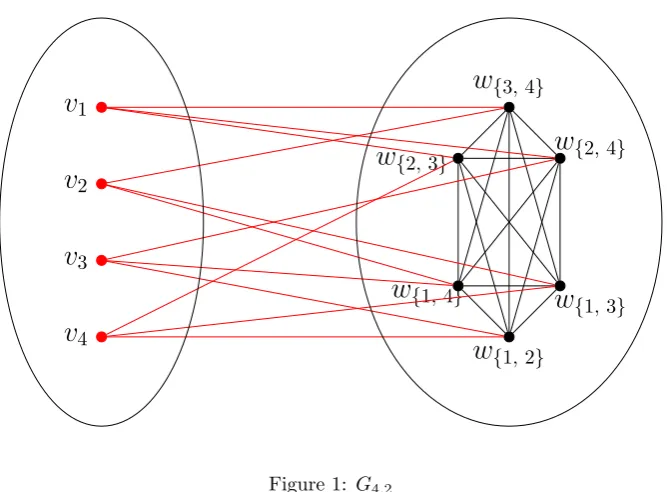
In fact the factor of 2 in Theorem 2 is best possible, as there arek-locatable graphs for which subdivisions of length at least (2−o(1))kare required. We use the notation [n] for the set{1, . . . , n}and [n](k)for the set ofk-element subsets
of [n]. Define the graph Gn,k, where 1≤k < nas follows. Take as a vertex set
{vi|i∈[n]} ∪ {wA|A∈[n](k)}; for eachA6=B ∈[n](k), add the edgewAwB,
and for eachi∈[n] andA∈[n](k)such thati6∈A, add the edgev
iwA. Figure 1
showsG4,2.
Lemma 3. Providedk≤n−2,rlp Gn,k=n−1.
Proof. Consider the effect of probing v1, . . . , vn−1. If the robber is at one of
those vertices, he has certainly been located. If he is at vn, each probe will
return distance 2, whereas if he is at somewAat least one probe will return 1,
so in the former case he is located. If he is at somewAthen from the distances
w
{1, 2}w
{1, 4}w
{1, 3}
w
{2, 3}w
{2, 4}w
{3, 4}v
4v
3v
2 [image:8.595.131.465.117.363.2]v
1Figure 1: G4,2
these n distances must be 1, and so she can deduce whetheri ∈A for eachi, and hence determine A.
To complete the proof we show that the graph is not (n−2)-locatable. This is true even if the robber is confined to the set W = {wS | S ∈ [n](k)}: we
show that for any set of n−2 probes there is someA 6=B ∈[n](k) such that the probes fail to distinguish wA andwB. This is certainly true if none of the
vertices probed are among the vi, since then there are at least two unprobed
vertices in W, and these have distance 1 from every probed vertex. Suppose that exactly r >0 of the vi and n−r−2 vertices in W are probed, and let
t= min{k−1, r}. There are then nk−−rt
≥n−rvertices inW which are adjacent to the firsttof thoservertices, but not to the remainingr−t. At least two of these vertices are unprobed, and these two vertices have the same distance as each other from every probed vertex.
Consequently, at each of the cop’s turns she must leave some two vertices in
W undistinguished, and both of these are possible locations for the robber since from any vertex inW he can reach either of them. So the cop cannot guarantee to locate the robber at any point.
Lemma 4. Provided n−k−bkm/2c
≥2m+ 2,rls Gn,k
> m.
Proof. We’ll play the game on G1n,k/m with some restrictions. The robber must stay within the wsection (i.e.W together with all threads between vertices in
W), and every time he gets to a branch vertex he must leave it at his next turn and proceed along some thread without stopping or turning round. Also, every time he leaves a branch vertex he will announce which one it was. We show that the cop cannot guarantee to identify the branch vertex the robber is approaching by the time he reaches it, and thus she cannot guarantee to locate the robber. When the robber leaves a branch vertex, say wA, the cop
wB). During the nextdm/2eprobes, she can identify for eachi∈Awhether or
noti ∈B, by probing vi or inside one of the threads leading from it, and she
can additionally eliminate two possible candidates for B per turn, by probing inside a thread of the form wC· · ·wD. Other probes are not helpful: probing
vi fori6∈A gives no information, since the shortest path to the robber passes
throughwA, and probing inside a thread meeting such avi only eliminates one
candidate for B. In the remainingbm/2cprobes up to and including the time the robber is atwB, she can determine whetheri∈B forbm/2cother values of
i, and eliminate at most two other candidates forB per turn. If each of the at mostbm/2c+kvalues ofithe cop checks are not inB, and none of the at most 2mcandidates forB she tests are correct, there are at least n−k−bkm/2c
−2m
possibilities forBremaining. If this is at least 2, she cannot guarantee to catch the robber before he next leaves a branch vertex.
Supposem= 2dn−alogneandk=bblognc. Then
n+ 1−k−m/2
k
≥
d(a−b) logne
bblognc
=
a−b b
b
+o(1)
logn
.
If a−bbb >e, as is the case when a = 3.6 andb = 0.8, then n+1−kk−m/2 =
ω(n) and so for sufficiently large n we have rls G[n+1],k
> m. Thus we have established the following result.
Theorem 5. For all sufficiently largenthere is a finite graphGwithrlp(G) =n
andrls(G)>2n−7.2 logn.
2.2
rl
p(
G
)
is not
O
(rl
s(
G
))
In this section we show that rlp(G) can be exponentially large in terms of rls(G).
Naively we might expect a linear bound, since a successful strategy for G1/m
may only havemturns between visits of the robber to different branch vertices. However, each vertex probed can depend on the results of previous ones, so the number of vertices which the strategy could potentially probe in thosemturns can be large.
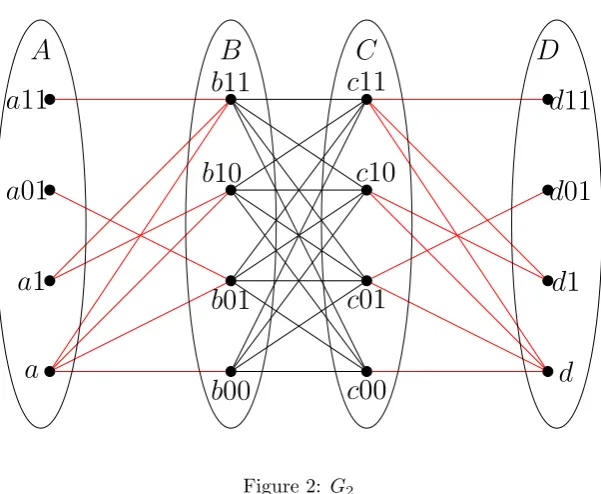
Construct a graphGn as follows. There are four classes of vertices: A, B, C
and D. Each has 2n vertices. Label the vertices in B as b0...0, . . . , b1...1 (b
followed by all binary words of lengthn), and similarly forC. Label the vertices ofAasa, a1, a01, a11. . .(afollowed by all words of length at mostnwhich are either empty or end in 1), and similarly for D. The only edges are between adjacent classes: A–B,B–CorC–D. All vertices inB are adjacent to all inC. The verticesaxandbyare adjacent if and only ifxis a prefix ofy; similarly for
dx andcy. Figure 2 showsG2.
Lemma 6. For eachn≥2,rls(Gn) =n+ 1.
Proof. The cop’s strategy on G1n/m for m ≥ n+ 1 is as follows. First she
probes branch vertices one by one until either a probe results in a multiple of
A
B
C
D
a
a
1
a
01
a
11
d
d
1
d
01
d
11
b
00
b
01
b
10
b
11
c
00
c
01
c
10
[image:10.595.147.448.116.363.2]c
11
Figure 2: G2
not passed through a branch vertex and the cop has identified both ends of the thread he is on, so has located him.
Suppose that a probe has given a multiple ofm, indicating that the robber is at a branch vertex. From the result of the probe mod 2m, the cop will also know either that he is inA∪Cor that he is inB∪D; assume without loss of generality the former. Probing d next will tell her whether the robber was in
A, was in C and is still there, or was inC and has moved. In the latter case she next probes ata, which will tell her whether the robber has returned toC
or not, and if not in whether he is on a thread between B andCor betweenC
andD. Now she probes branch vertices until the robber is at a branch vertex or is caught; if he reaches a branch vertex before being caught, the cop will know, from the information she had about his thread together with the result of her last probe mod 2m, that he is at a branch vertex in a specific class.
Case 1. The result of a probe establishes that the robber is inA, or establishes that the robber is in D.
Without loss of generality we assume the cop knows that the robber is inA. She probes vertices inA which are possible locations for the robber, until she gets a response which is not a multiple ofm, indicating that he has leftA, or a response of 0, which locates him. One of these must happen, since if he remains at his location inAshe will eventually probe it.
Once the robber moves away from A he must be on a thread between a vertex inAand one inB; the cop now attempts to identify the endpoint inB. She does this by first probinga1 to find out whether it is of the formb1xorb0x: a response less than 2m indicates that it is of the formb1x; a response greater than 2mindicates that it is of the form b0x, and a response of exactly 2m (or 0) indicates that he has returned toA.
the endpoint of his thread which is in B. She then probes either a11 or a01, depending on this digit, in order to determine the second digit. By continuing in this manner, either she will identify that the robber has returned to his original vertex in A or she will identify the endpoint of his thread in B while he is still inside the thread. In the latter case she then probes vertices inA in turn, allowing her to tell if he reaches the branch vertex in B or to eventually find the other end of his current thread if he remains inside it. If he returns to A
she restarts this case; since the robber must have returned to the same branch vertex inAshe reduces the set of possible locations inAwith each iteration of this case, so she will locate him within 2n iterations.
Case 2. The result of a probe establishes that the robber is inB, or establishes that the robber is in C.
Without loss of generality we assume the cop knows that the robber is in
A. She probes vertices at distance 1 from B which are on threads for which one endpoint is a possible location for the robber inB and the other is c0...0. She does this until she gets a response which is not±1 modm, indicating that the robber has moved. If he does not move she will eventually probe a vertex adjacent to him and win.
Once the robber leaves B, the cop will know whether he is on a thread leading toc0...0, since she will get a response of 0 or 2m−2 in this case and 2 or 2m otherwise; since m ≥ n+ 1 ≥ 3, 2m−2 6= 2. If the robber is not on such a thread, the cop attempts to either identify the vertex inC which is an endpoint of his thread or identify that no such vertex exists (i.e. he is on a thread between A and B). She does this as in Case 1 by probing first d1, then d01 or d11, as appropriate, and so on. If she detects that the robber has returned to B (indicated by a result of exactly 2m), she restarts this case; as before she reduces the set of possible locations inB every time this happens, so at most 2n iterations can occur.
If the robber does not return toB, and is on a thread betweenBandC, the cop will have time to complete this process while he is still on that thread, and since the endpoint inCis notc0...0, she will have probed at least one vertex at distance less than 2m. Thus she will have identified both that he is on a thread between B andC and the endpoint of that thread in C, either while he is at that branch vertex or while he is still inside the thread. In the latter case she probes vertices inB until she locates the other end of the thread or establishes that the robber has reached the known vertex inC.
If the robber does not return to B, and is on a thread between A and B, again the cop will complete the process before he reachesA, and since in this case none of her probes will have given a result of less than 2m, she will identify that he is on a thread between A and B. If he has not reached A when she identifies this, she probes vertices in B in turn until she either locates him or identifies that he is inA, reducing to Case 1.
This completes the proof thatG1n/mis locatable form≥n+ 1.
Next we show thatG1n/nis not locatable. Again, we may restrict the robber:
d, he will never actually do this; however, sometimes there will only be two possible locations which are consistent with the probe results, one of which is
a.
Suppose the robber is at a branch vertex in B∪ {d} (the case C∪ {a} is equivalent), but the cop does not know which one (i.e. there are at least two possibilities). The robber might remain at this branch vertex, so the cop needs to probe some vertex which eliminates at least one possible branch vertex. So she must probe a vertex inB∪ {d}, or inA, or inside a thread betweenAandB
or betweenB∪ {d}andC. Suppose when she does this that the robber has just left a branch vertex, which is not d(since there were at least two possibilities, this is always possible). He is heading towards a vertex in C ∪ {a}. If she has just probed a vertex inB she has no further information about where the robber is heading. If she has just probedd, or a vertex inAor betweenA and
B, she may be able to tell whether or not he is heading towards a, but cannot distinguish destinations in C. If she has just probed a vertex inC or between
B andCshe can tell whether he is heading to a specific vertex inC, but cannot distinguish other destinations inC∪ {a}. Finally, if she has just probed inside the threadcx· · ·dfor somexthen she can tell whether he is heading tocx, but cannot distinguish other vertices inC∪ {a} (the shortest route from anywhere inside this thread to the vertex adjacent to by on the thread to a is via by). Consequently, some response to the probe is consistent with at least 2n possible
destinations.
In order to win before the robber reaches the next branch vertex, the cop must identify the thread he is on by the time he reaches the end of it, so she has
n−1 turns remaining to do this. If she probes a vertex inA\ {a} orB, or on a thread between the two, she gets no additional information. If she probes a vertex inC∪ {a}or on a thread betweenBandC∪ {a}then she may eliminate one possible thread, but will not distinguish between the rest. If she probes a vertex on a thread betweenCandD, or a vertex inD, then she may eliminate one possible thread, but all other possible locations for the robber will give one of two possible responses. Thus, if there were k possibilities before the probe, and the response to the probe is that consistent with the greatest number of those possibilities, at leastd(k−1)/2epossibilities remain. Since there were 2n
possibilities, at least 2 will remain aftern−1 additional probes, and so the cop cannot guarantee to locate him.
Lemma 7. For eachn≥1,rlp(Gn) = 2n.
Proof. We show that if the cop is permitted 2n−1 probes per turn, the robber can escape forever provided at every turn he knows which vertices the cop will probe at her next turn. Suppose he constrains himself to moving between B
andC. If he is inB, the cop will get no information about which vertex inBhe is at unless she probes at least one vertex inA∪B, so he need not move unless that happens. Similarly if he is in C he need not move unless the cop is about to probe at least one vertex inC∪D. If he moves, he can get to any vertex in the other class, so in order to win the cop must at some point probe a resolving set forB, say, together with some vertex inC∪D. Since the smallest resolving set forB has size 2n−1, and another probe is needed, this is not possible.
If the cop is permitted 2n probes per turn, she may win as follows. In the
the robber immediately or pin him down to a set of the form {by0, by1} or
{cy0, cy1}; assume without loss of generality he is in {by0, by1}. On her next turn the cop probes {ay1} ∪D\ {d}. This either locates the robber, or shows that he is in A∪ {c0...0}. If the robber is inA∪ {c0...0}, next turn he must be inA∪B∪ {c0...0, d}. Now the cop can win by probingA, since it is a resolving set forA∪B∪ {c0...0, d}.
Thus we have shown the following result.
Theorem 8. For every m≥3 there is a finite graphG with rls(G) =m and
rlp(G) = 2m−1.
3
Graphs of bounded degree
In this section we obtain a general bound for rlp(G) (and hence, using
Theo-rem 2, a bound of the same order on rls(G)) in terms of the maximum degree
∆(G). We allow graphs to be infinite (but connected) in this case. By consid-ering infinite regular trees we show that our bound is tight up to a factor of 1 +o(1). In the case ∆ = 3 we show that rlp(G)≤ 3, which is best possible.
The case ∆(G) = 2 (i.e. G is a finite cycle or path, or infinite ray or path) is trivial: any such graph is 2-locatable, since any two adjacent vertices form a resolving set forV(G), and this is best possible sinceC3is not 1-locatable.
3.1
General quadratic bounds
In this section we give a quadratic upper bound on rlp(G) in terms of ∆(G),
and a lower bound on max{rlp(G) |∆(G) = ∆} which differs from our upper
bound only in lower-order terms.
Theorem 9. For any connected graphGwith∆(G) = ∆,rlp(G)≤
(∆+1)2
4
+1.
Proof. We give a winning strategy for the cop using(∆+1)4 2+ 1 probes at each turn. On her first turn she probes arbitrary vertices; since Gis connected, all distances are finite.
Suppose that, from the results of probes at the copstth turn, she knows that the robber is at distancedtfrom some vertexvt, and that the shortest path from
vt to his location passes through one of kt neighbours of vt, w1, . . . , wkt. For
eachi choose ∆−kt neighbours ofwi, not includingvt. At her next turn the
cop probes all these neighbours, together with vt and w1, . . . , wkt. This is a
total of at most
kt(∆−kt+ 1) + 1≤
(∆ + 1)2
4
+ 1
vertices, so she can always do this. If none of the distances returned is less than
dt, then at least one of thewi (sayw1) will return exactlydt, and the shortest
path fromw1to the robber’s location must not pass throughvtor any of ∆−kt
other neighbours ofw1. So settingvt+1=w1, the cop is in the same position as
before, withdt+1=dtandkt+1< kt. Consequently (dt, kt) is decreasing in the
lexicographic ordering; since kt≤∆, the cop takes a bounded number of steps
Theorem 10. For some connected graphGwith ∆(G) = ∆,rlp(G)≥ ∆2
4
.
Proof. We show that on the infinite ∆-regular tree,T∆, if the cop probes fewer
than ∆2
4
vertices on each turn, it is possible that she never probes a vertex within r of the robber’s location, where r is an arbitrarily large distance. In fact we claim that for any fixed r, it is possible that for every t, after the cop’s tth turn there is some vertex vt such that T∆−vt has at least ∆−21
components which have never been probed, the robber’s distance from vt isr,
and any vertex at distance rfrom vt in the unprobed components is possible.
This is certainly possible after the first step, since there is some finite subtree containing all the vertices probed, so settingv1 be a leaf of that subtree, there
are ∆−1 components of T∆ which have not been probed, and all vertices in
these components which have distance rfrom v1 are possible locations for the
robber which are not distinguished by the results of the cop’s first turn. Suppose that the cop is in the required situation after hertth turn, and writew1, . . . , wk
for the neighbours of vt in unprobed components of T∆−vt. If, at the cop’s
(t+1)th turn, she probes vertices in at least∆+1 2
of the components ofT∆−wi
which do not includevtfor eachi, then she makes at least
∆−1 2
∆ + 1 2
=
∆2 4
probes, since all these sets of vertices are disjoint. So this is not the case, and without loss of generality T∆−w1 has at least
∆−1 2
unprobed components. Provided the robber was in one of these, and has moved further away fromvt,
the same situation holds withvt+1=w1.
3.2
Exact result for maximum degree
3
In this case we prove that all connected graphs with maximum degree 3 are 3-locatable. This is trivially best possible, since rlp(K4) = 3. Again, our bound
applies even if the graph is infinite.
Theorem 11. For any connected graphG with∆(G) = 3,rlp(G)≤3.
Proof. IfG∼=K3,3, say with verticesa, b, cin one class andu, v, win the other,
the cop can win by probinga, b, u on the first turn and, if necessary,a, b, v on the second. Henceforth we assume G 6∼=K3,3. We will also use the following
observation several times.
Observation 11.1. Suppose the cop knows that at the time of her last probe the robber was at one of two verticesp, qwhich have at least two neighboursr, sin common. Write p0 for the third neighbour of p, andq0 for the third neighbour ofq. Ifp0=q, orp0 is not adjacent to bothrands, the cop can win by probing
q, r, s. Otherwiseq0 is not adjacent to bothr ands, so she can win by probing
p, r, s.
may eventually force a result of 1. We then show how she may win from that position.
Suppose the cop probedx0which returned distancer. At the next turn she
probes the neighbours ofx0; one of these probes must be at distance at most r
from the robber’s new position. If it is less thanr, we are done; otherwise from probingx1, say, we get a result of r, and we know that the shortest path from
x1 to the robber’s location must not go throughx0. Writex2, x3 for the other
neighbours ofx1. LetS = (Γ(x2)∪Γ(x3))\ {x1, x2, x3}. At her next turn the
cop probes as many vertices in S as possible. If none of the responses is less than r then we must have |S| = 4, and the one unprobed vertex of S would have returned less than r. Now she probes all the neighbours of that vertex; one of them must be at distance less thanr.
Continuing in this manner, the cop will either win or reach a position where she has just probed some vertex v adjacent to the robber’s position. We now show how the cop can win from this point.
Writea, b, c for the neighbours of v. The cop next probes a, b, c. It is not possible for there to be three locations for the robber consistent with the results of these probes, since G6∼=K3,3, so either the cop has won or there are exactly
two possible locations for the robber. Consequently, if at least two of the probes returned 1, she can win using Observation 11.1.
The only remaining possibility is that exactly one of the probes, say at a, returned 1, and the robber could have been at either of the neighbours of a
which are notv, sayuandw. Ifuandwhave another common neighbour, the cop can win using Observation 11.1. If not, we may write Γ(u) = {a, x1, x2}
and Γ(w) ={a, y1, y2}, where x1, x2, y1, y2are all distinct.
On her next turn, the cop will probe at aand two ofx1, x2, y1, y2; we will
describe how she chooses which two to probe below. Note that the probe at a
will distinguish whether the robber is ata, in {u, v} or in{x1, x2, y1, y2}, and
the other probes will distinguish between uand v, so the cop will win unless she is unable to distinguish between the two unprobed vertices in{x1, x2, y1, y2}
(and the robber is at one of them). We consider five cases depending on the local structure.
(i) One of x1, x2, y1, y2 (sayx1) is adjacent to exactly one of the others. In
this case the cop probes a,x1 and one of x2, y1, y2 which is not adjacent
to x1.
(ii) One ofx1, x2, y1, y2 (sayx1) is adjacent to two of the others. In this case
the cop probesa, x1 and one ofx2, y1, y2 which is adjacent tox1.
(iii) Some pair ofx1, x2, y1, y2(sayx1, y1) are at distance more than 2. In this
case the cop probesa,x1andy2.
(iv) Some pair ofx1, x2, y1, y2 have two common neighbours. In this case the
cop probes aand the other two vertices.
(v) Every pair ofx1, x2, y1, y2 have a unique common neighbour. In this case
the cop probesa, x1 andx2.
Cases (i)–(v) exhaust all possibilities. In cases (i), (ii) and (iii), the probe at
x1will distinguish between the two unprobed vertices in{x1, x2, y1, y2}, and so
one of the two unprobed vertices; these vertices have two common neighbours so she can now win using Observation 11.1. In case (v), the six common neighbours of the pairs must all be different; writezi,j for the common neighbour ofxi and
yj. The cop wins immediately unless the robber was aty1ory2. In this case his
possible locations at her next probe will be{w, y1, y2, z1,1, z1,2, z2,1, z2,2}. The
cop can therefore win by probing x1,y1 andy2.
4
Acknowledgements
The first author acknowledges support from the European Union through fund-ing under FP7–ICT–2011–8 project HIERATIC (316705) and from the Euro-pean Research Council (ERC) under the EuroEuro-pean Union’s Horizon 2020 re-search and innovation programme (grant agreement no. 639046), and is grateful to Douglas B. West for drawing his attention to this problem. The second author acknowledges support through funding from NSF grant DMS 1301614 and MULTIPLEX grant no. 317532, and is grateful to the organisers of the 8th Graduate Student Combinatorics Conference at the University of Illinois at Urbana-Champaign for drawing his attention to the problem. The third author acknowledges support through funding from the European Union under grant EP/J500380/1 as well as from the Studienstiftung des Deutschen Volkes.
References
[1] M. Adler, H. R¨acke, N. Sivadasan, C. Sohler, B. V¨ocking, Randomized pursuit-evasion in graphs,Combin. Probab. Comput.11(2003), 225–244.
[2] S. Arnborg, Efficient algorithms for combinatorial problems on graphs with bounded decomposability—a survey,BIT,25 (1985), 2–23.
[3] J. R. Britnell and M. Wildon, Finding a princess in a palace: a pursuit-evasion problem.Electron. J. Combin.20 (2013).
[4] J. Carraher, I. Choi, M. Delcourt, L.H. Erickson and D.B. West, Locating a robber on a graph via distance queries,Theoretical Comp. Sci.463(2012), 54–61.
[5] I. Chatzigiannakis, S. Nikoletseas and P. Spirakis, An efficient communica-tion strategy for ad-hoc mobile networks.Proc. 20th ACM Symposium on Principles of Distributed Computing (2001), 320–322.
[6] J. A. Ellis, I. H. Sudborough and J. S. Turner, Graph separation and search number, Proc. 21st Allerton Conf. Communication, Control, Com-put.(1983), 224–233.
[7] J. A. Ellis, I. H. Sudborough and J. S. Turner, The vertex separation and search number of a graph.Inform. and Comput.113(1994), 50–79.
[8] P. Frankl, Cops and robbers in graphs with large girth and Cayley graphs,
Discrete Appl. Math.17(1987), 301–305.
[10] J. Haslegrave, Extremal results on hypergraphs, trees and regular graphs, PhD thesis, University of Cambridge (2011).
[11] J. Haslegrave, An evasion game on a graph, Discrete Math. 314 (2014), 1–5.
[12] J. Haslegrave, R. A. B. Johnson and S. Koch, The Robber Locating game,
Discrete Math.339(2016), 109–117.
[13] J. Haslegrave, R. A. B. Johnson and S. Koch, Subdivisions in the robber locating game,Discrete Math.339(2016), 2804–2811.
[14] N. G. Kinnersley, The vertex separation number of a graph equals its path width,Inform. Process Lett.42(1992), 345–350.
[15] N. Komarov and P. Winkler, Hunter & Mole, arxiv:1311.0211.
[16] N. Komarov and P. Winkler, Cop vs. gambler,Discrete Math. 339(2016), 1677–1681.
[17] A. S. LaPaugh, Recontamination does not help to search a graph,J. Assoc. Comput. Mach.40(1993), 224–245.
[18] N. Megiddo, S. L. Hakimi, M. R. Garey, D. S. Johnson, and C. H. Papadim-itriou, The complexity of searching a graph.J. Assoc. Comput. Mach. 35
(1988) 18–44.
[19] R. Nowakowski and P. Winkler, Vertex to vertex pursuit in a graph, Dis-crete Math.43(1983), 235–239.
[20] T. D. Parsons, Pursuit-evasion in a graph, Theory and Applications of Graphs, inLecture Notes in Mathematics, Springer-Verlag (1976), 426–441.
[21] T. D. Parsons, The search number of a connected graph, Proc. 9th South-eastern Conf. Combin., Graph Theory, Computing (1978), 549–554.
[22] A. Quillot,Jeux et pointes fixes sur les graphes.Th`ese de 3`eme cycle, Uni-versit´e de Paris VI (1978), 131–145.
[23] N. Robertson and P. Seymour, Graph minors. I. Excluding a forest, J. Combin. Theory, Series B,35(1983), 39–61.
[24] S. Seager, Locating a robber on a graph,Discrete Math.312(2012), 3265– 3269.
[25] S. Seager, A sequential locating game on graphs,Ars Combin.110(2013), 45–54.
[26] S. Seager, Locating a backtracking robber on a tree,Theoretical Computer Science 539(2014), 28–37.