creative performance of
co-located and virtual teams
Benjamin Oliver Shreeve
Digital Innovation MRes (Lancaster University)
Business Studies BSc (Lancaster University)
Highwire Centre for Doctoral Training
School of Computing and Communications
Lancaster University
Submitted 31st March 2017
This thesis compares the creative performance of traditional co-located and virtual teams. Motivation for this research is twofold. Firstly
there is the reluctance shown by many organisations to adopt virtual
working practises. Second, there is the gap in existing research
ex-ploring how virtual teams collaborate synchronously when addressing
complex tasks. In particular there is a lack of empirical research
com-paring co-located and virtual team performance. The CreativeTeams
tool has been created to address this by providing an objective method
of measuring team creative performance regardless of location.
Cre-ativity is assessed because it is an important socio-cognitive process,
and is often key in addressing complex tasks requiring extensive team collaboration such as designing, problem solving and emergency
plan-ning. Such complex tasks have traditionally been the sole domain of
co-located teams. This thesis therefore provides a point of
compar-ison. The tool itself incorporates a number of activities, the core of
which are adapted from the Torrance Tests of Creative Thinking.
A study has been run with 150 student participants, working in 50
teams. Each team completes the CreativeTeams activities in either a
co-located or virtual environment. Outputs from these activities are
assessed by multiple markers and analysed along with meta data from
the tool. A comparison of these metrics indicates no significant
differ-ence in co-located and virtual team performance across the majority
of metrics. This demonstrates that virtual teams can be as effective
as co-located teams in addressing complex tasks and is a key research
I would like to thank a number of people for helping me with this
thesis. I need to thank Professor Pete Sawyer for being a bit of a
hero and stepping into the supervision void, taking over supervision
mid-way through my PhD and sticking it out to the very end. I also
need to thank Dr Paul Ralph for being ambitious enough to suggest
I pursue this area in the first place.
I need to thank the various developers who have worked with me on
this project including David Gullick and Adam Smith at Lancaster
University and Habib Naderi at the University of Auckland.
I need to thank family and friends for putting up with this nonsense and in particular my fianc´ee Dr Kylie O’Shea for all her support
throughout the PhD.
This work has been funded by the Digital Economy programme (RCUK
This thesis is my own work and no portion of the work referred to in this thesis has been submitted in support of an application for another
1 Introduction 1
1.1 Creativity in teams . . . 1
1.2 Practice-based motivation . . . 3
1.3 Knowledge-based motivation . . . 4
1.4 Research approach . . . 5
1.5 Outline of thesis . . . 7
2 Related work: The role of creativity in virtual teams 8 2.1 Literature Review Method . . . 10
2.2 Virtual Working and Virtual Teams . . . 11
2.2.1 Task Processes . . . 13
2.2.2 Socio-Emotional Processes . . . 15
2.2.3 Summary . . . 16
2.3 Creativity . . . 17
2.3.1 What is creativity? . . . 17
2.3.2 Creativity Science . . . 26
2.3.3 Sensemaking . . . 31
2.3.4 The impact of environment on the creative process . . . . 40
2.3.5 Summary . . . 46
2.4 Chapter Summary . . . 47
3 Methodological considerations and research design 51
3.1 Epistemological position . . . 52
3.2 Research Design . . . 54
3.2.1 Early stages of research . . . 54
3.2.2 Research design . . . 55
3.2.3 Measuring creativity . . . 58
3.3 Chapter Summary . . . 67
4 Method 68 4.1 Designing the CreativeTeams tool . . . 70
4.1.1 Requirements . . . 70
4.1.2 R1: Collecting evidence of team creativity . . . 74
4.1.3 R2: Designing a platform experience to support collabora-tive creativity . . . 82
4.2 The CreativeTeams Tool . . . 90
4.2.1 The Practice Area . . . 92
4.2.2 Creative Activity 1: Picture Construction . . . 95
4.2.3 Creative Activity 2: Picture Completion . . . 95
4.2.4 Creative Activity 3: Parallel Lines . . . 96
4.2.5 Creative Activity 4: The Alternative Uses Test . . . 96
4.2.6 Creative Activity 5: The Design Challenge . . . 97
4.2.7 Creative Activity 6: Design Questions . . . 99
4.2.8 Participant Questionnaire . . . 100
4.3 Experiment Setup . . . 101
4.3.1 Emulating co-located and virtual working environments . . 101
4.3.2 Team size . . . 102
4.3.3 Participant selection . . . 103
4.4 Chapter summary . . . 106
5 Scoring creativity and establishing inter-rater agreement 107 5.1 Scoring CreativeTeams outputs . . . 108
5.1.1 Originality . . . 109
5.1.3 Title Originality . . . 115
5.1.4 Marker assessed creativity . . . 116
5.2 Inter-rater agreement . . . 117
5.2.1 Statistical Methods Used . . . 117
5.2.2 Assessing inter-rater agreement . . . 120
5.3 Chapter Summary . . . 127
6 Co-located vs Virtual Team Creative Performance 130 6.1 Statistical methods used . . . 132
6.1.1 Mann-Whitney U Test . . . 132
6.1.2 Independent Samples T-Test . . . 133
6.1.3 Somers’ delta . . . 134
6.1.4 Spearman’s rank-order correlation . . . 134
6.2 Analysis of creativity metrics . . . 135
6.2.1 Originality . . . 135
6.2.2 Elaboration . . . 138
6.2.3 Fluency . . . 142
6.3 Analysis of CreativeTeams Metadata . . . 144
6.3.1 Drawing Actions . . . 144
6.3.2 Drawing Time . . . 146
6.4 What about the impact of artistic ability? . . . 148
6.5 Does the amount that teams talk matter? . . . 151
6.6 Chapter Summary . . . 159
7 Discussion 161 7.1 Research questions revisited . . . 163
7.2 Key Contributions . . . 165
7.2.1 The CreativeTeams Tool . . . 166
7.2.2 The Study . . . 169
7.3 Threats to validity . . . 172
7.3.1 The CreativeTeams Tool . . . 172
7.3.2 The Study . . . 174
7.5 Summary . . . 179
8 Conclusion and Future Research 180 8.1 Future Research . . . 182
8.2 Concluding Remarks . . . 184
References 185 Appendix A Drawing examples 206 Appendix B Scoring Documentation 215 B.1 Originality . . . 216
B.1.1 Picture Construction . . . 216
B.1.2 Picture Completion . . . 217
B.1.3 Parallel Lines . . . 220
B.1.4 Alternative Uses . . . 223
B.1.5 Potential Design Questions . . . 227
Appendix C Team data 229 C.1 Originality . . . 230
C.2 Elaboration . . . 235
C.3 Title originality . . . 239
C.4 Marker assessed creativity . . . 241
C.5 Fluency . . . 244
C.6 Team Meta Data . . . 245
C.7 Number of utterances . . . 247
Appendix D Findings Charts 249 D.1 Originality . . . 249
D.2 Elaboration . . . 252
D.3 Fluency . . . 254
D.4 Total drawing actions per activity . . . 255
Introduction
1.1
Creativity in teams
This thesis describes a study to compare the creative performance of traditional
co-located and virtual teams. Creativity is “the ability to produce work that
is both novel (i.e. original, unexpected), and appropriate (i.e. useful, adaptive
to task constraints).” [1]. It is a key component in the way that teams address
complex and often ambiguous tasks like designing, or problem solving.
Co-located teams are the traditional office-based teams with which we are all
familiar. Virtual teams by contrast are “groups of geographically, organizationally
and/or time dispersed workers brought together by information and
telecommu-nication technologies to accomplish one or more organizational tasks” [2]. The
nature of virtual teams means that employees can (in theory) benefit from
im-proved control over their work-life balance. Likewise, employers can benefit from
reduced overheads and access to the best workers from the global workforce.
However, virtual working does introduce completely different team dynamics and
therein lies the problem. There is only a limited amount of research into virtual
teams in contrast with co-located teams. And, given the relative immaturity of
virtual working there aren’t established best practises yet. This makes adopting
to predict whether these teams will be better or worse than their co-located
coun-terparts.
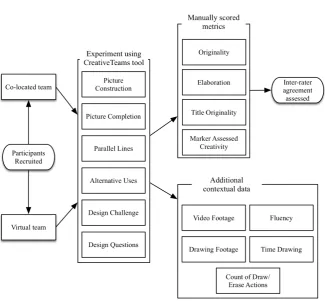
The CreativeTeams tool has therefore been developed to provide an objective
means of gauging the creative performance of both types of team. This tool is used in a study with 150 participants working in 50 teams in both co-located
and virtual environments (see the method in chapter 4 for more detail). The
data from the two team environments is compared providing an initial indication
that virtual teams are as creative as their traditional co-located counterparts (see
1.2
Practice-based motivation
Virtual work in practice remains contentious despite offering an apparent panacea
for modern life. Interest in virtual working has been steadily growing over the
last twenty years, spurred on by improvements in communication infrastructure
and tools that make virtual work a practical alternative to co-located work.
How-ever, many organisations remain unconvinced, with some banning it outright and others limiting it to only very specific (usually simple) tasks for individuals. The
mainstream press is littered with articles like “Why aren’t we all working from
home today?” [3], “Teleworking: The myth of working from home” [4] and
“Ya-hoo chief bans working from home” [5] that suggest that subscribing to this new
means of working is by no means simple. And whilst there are some organisations
like Virgin and Canonical that actively embrace virtual working, many remain
unconvinced.
This hesitation to adopt virtual working is easy to appreciate, after all
peo-ple have been working in traditional co-located teams since time immemorial.
Virtual working by comparison is in its infancy and the level of research reflects this. Virtual working ultimately represents a shift in how organisations structure
themselves. Collaborators no longer have to meet face to face. They can instead
video conference and work together from opposite sides of the planet. Many
tasks can be (and indeed are) readily adapted to this way of working. However,
other tasks require more complex interactions between team members to succeed.
These are typically tasks involving the negotiation of ambiguous problems and
are often associated with high stake consequences. Creativity is key to the way
that teams develop understanding and go about resolving these situations.
The practice-based motivation for this thesis is to provide organisations and
1.3
Knowledge-based motivation
There is extensive research into virtual team working within Computer Supported
Cooperative Work (CSCW), Information Systems (IS) and wider schools of
Man-agement research. Recent work by Vlaar et al. [6] has applied sensemaking theory
to understand the way that physically distributed organisations share
informa-tion and develop understanding together. Meanwhile work by Kanawattanachi et al. [7] has demonstrated that virtual teams can demonstrate comparable
Trans-active Memory Systems (a type of complex socio-cognitive process) to co-located
teams. However, these represent the closest research to that within this thesis.
The focus of this thesis is on an organisational framing of creativity. That
is, creativity which helps teams to resolve problems or develop innovations and
opportunities. Organisations often use the terms creativity, sensemaking,
prob-lem identification and probprob-lem solving interchangeably to describe this
action-orientated form of creativity. In this thesis I therefore utilise Torrance’s [8]
defi-nition which states that creativity is:
“A process of becoming sensitive to problems, deficiencies, gaps
in knowledge, missing elements, disharmonies, and so on;
identifiy-ing the difficulty; searchidentifiy-ing for solutions, makidentifiy-ing guesses, or
formu-lating hypotheses about the deficiencies: testing and retesting these
hypotheses and possibly modifying and retesting them; and finally communicating the results” [8].
The knowledge-based motivation for this thesis is therefore to contribute to
the fledgling discussion on virtual team creativity by providing empirical evidence
1.4
Research approach
The measurement of creativity is paramount to this thesis. Unfortunately there is
little consensus around what constitutes creativity, instead most researchers adopt
a “we know it when we see it” approach. Despite this ambiguity, the majority
of disciplines readily acknowledge the importance that creativity plays in the
identification and resolution of problems and opportunities. There is a school
of research within Psychology in particular concerned with the measurement of
creativity. E.P.Torrance is considered one of the founders of this school and is
responsible for developing The Torrance Tests of Creative Thinking (TTCT) [8].
The TTCT were originally developed in the 1960s as an alternative to the IQ
test that was being used within the U.S.A. to identify gifted children. The TTCT
include both figural (involving drawing) and verbal activities that are then scored
against established criteria to provide an indication of an individual’s creativity.
The TTCT are still considered valid despite their relative age [9]. I have adapted
them first to work with teams and then further extended them to measure virtual
(and co-located) team creativity.
A number of challenges needed to be addressed in order to use the TTCT to
study co-located and virtual teams performance. The original TTCT is paper
based and intended for individuals. Initial research therefore explored whether
teams could complete the figural form of these tests using a series of paper
pro-totypes tested with a series of teams. The outcome of this early testing indicated
that co-located teams were capable of completing the TTCT figural component
as Torrance intended. However, virtual teams would not be able to complete the
adaptation in this form because it relied on teams working on the same single
white board (see section 4.1.2 for more details).
The CreativeTeams platform was developed as part of this thesis to overcome
this problem. The platform provides teams with an iPad based adaptation of
the TTCT that is identical for both co-located and virtual teams. A shared
syn-chronous drawing canvas is included in the CreativeTeams platform and
partici-pants are provided with digital pencils to draw with. This mimics the experience
participants can see and edit what each other are drawing in real time. The risk
of bias from the use of technology is reduced by designing the interface to be as
simple as possible and the collaboration synchronous.
Ideally, practising co-located and virtual teams would be recruited to com-plete the CreativeTeams activities. However, this proved problematic on several
fronts. Firstly it was impossible to negotiate access to a sufficient number of
practising teams for meaningful statistical comparison. Secondly, the
communi-cation tools used by any practicing virtual teams would have varied, introducing
additional complications to the analysis. I therefore decided to recruit teams
from the student population, this enabled me to control team formation and the
communication tools used by the virtual teams (they used Google Hangouts for
video conferencing). The final data set is drawn from 90 participants completing
the activity in 30 teams, each session lasting just over one hour. This provides
a rich data set comprising of not only hundreds of drawings from teams that are assessed according to Torrance’s criteria [8], but also highly reliable meta data
from the CreativeTeams tool that describe how teams used the tool, along with
video footage of both the teams and drawing process. Multiple markers are used
and the level of inter-rater agreement assessed to ensure that there was no risk
1.5
Outline of thesis
In summary, the goals of this research are first to adapt the Torrance Tests of
Creative Thinking into not only a team format, but a synchronous digital format;
and second, to then run an experiment in which both co-located and virtual
teams complete the Adapted TTCT. The overall motivation of this approach is
to provide empirical data that highlights the differences in the performance of co-located and virtual teams completing complex creative activities.
Chapter 2 reviews the literature related to creativity including research in
both co-located and virtual team contexts and uses this to identify the research
questions to be addressed in this thesis. The methodological considerations and
use of an interpretive stance are discussed in chapter 3. Chapter 4 introduces
the method employed in this research, with a dedicated section describing the
development of the CreativeTeams tool and a sectioned describing the final tool
itself in detail. Chapter 5 describes how the study outputs are scored by multiple
markers and inter-rater agreement is assessed. Chapter 6 outlines the key findings
from the study. There follows the discussion of this study (chapter 7) which highlights the key contributions of this thesis along with threats to validity and
reflections on the process. Finally, chapter 8 concludes this thesis with a dedicated
Related work: The role of
creativity in virtual teams
This chapter outlines the existing literature related to creativity in co-located and
virtual teams. This thesis is motivated by the challenge that many organisations
currently face in moving toward virtual forms of working. That is, trying to
gauge the impact that a move to virtual working may have on performance. In
particular this work explores the potential impact that these differing methods of
working have on the creativity of teams. Organisations continue to place a high
value on ‘creativity’, that is the capacity to identify, make sense of problems and
ultimately to innovate.
Figure 2.1 outlines the conceptual path used to structure this chapter and
illustrates how these complex interwoven research areas have been navigated to
arrive at the final research questions (section 2.5). I begin by introducing a
summary of virtual work research that provides the overarching context for this
research (section 2.2). Section 2.3.1 then provides an introduction to the work
on creativity, paying particular attention to the research into divergent thinking
(section 2.3.1.1). This is followed by a review of work in the emerging field of
creativity science (section 2.3.2). This field of research synthesises work from
design and CSCW to consider the impact that new tools and techniques can
work that underpins much of the creativity that is valued by organisations. This
is because organisations often treat the term creativity as an analog for problem
solving and innovation. Section 2.3.4 then ties all four areas of research together to
highlight how collaboration differs between individuals and co-located or virtual teams. Finally, section 2.4 summarises the chapter before introducing the research
2.1
Literature Review Method
The method used in this literature review has been developed taking into
ac-count the valuable suggestions made by Webster and Watson [10] relating to
ideal approaches for identifying and analysing literature.
1. Range of disciplines explored
I have reviewed literature from a range of disciplines with an emphasis on
the following related disciplines: Computer Supported Cooperative Work
(CSCW), Creativity Science, Management, Information Systems (IS),
Re-quirements Engineering (RE) and Global Software Engineering/Design (GSE/D).
2. Provide definitions of key topic areas
Sections 2.2 and 2.3 explore the key characteristics and definitions that
exist in the existing literature and outlines the accepted definition used
throughout the rest of this thesis.
3. Themes in existing topic area research are identified
Where possible I have used well cited meta-analyses or existing literature
reviews to provide a broad overview of research themes within a topic, I have
then supplemented these with any important missing themes and research.
Where a pre-existing review does not exist I have identified topic themes
myself.
4. Themes are discussed to highlight key areas
Themes are discussed to identify those areas key to my thesis, these are
then explored in detail reviewing key trends and major contributions.
5. Calls for research and gaps in the literature are highlighted
Gaps in existing work are described and calls for future research explained.
From these the core research questions are developed at the end of the
2.2
Virtual Working and Virtual Teams
Powell et al. define virtual teams as “groups of geographically, organizationally
and/or time dispersed workers brought together by information and
telecommuni-cation technologies to accomplish one or more organizational tasks” [2]. They [2]
suggest that Teams and Groups are in fact very different things citing Cohen & Bailey [11] who state “A team is a collection of individuals who are
interdepen-dent in their tasks, who share responsibility for outcomes, who see themselves
and who are seen by others as an intact social entity embedded in one or more
larger social systems, and who manage their relationship across organizational
boundaries.” [11]. By contrast, a group is a collection of individuals who happen
to be co-located but do not rely upon each other to complete tasks e.g.,
Cham-bers, where a group of Barristers work but where each addresses their cases in
isolation.
The importance of teams in organisations has long been established. Teams
are often formed where tasks are ambiguous and complex; requiring the
knowl-edge and skills of multiple individuals. Teams are utilised for a wide range of
organisational tasks: from permanent organisational teams (e.g., Computer
Sup-port Teams) to temporary teams (e.g., Project Teams). This thesis focuses on
teams, maintaining the distinction set out by Cohen & Bailey [11].
Whilst there is a wealth of research on virtual working, my focus in
particu-lar is upon virtual teams. The term virtual teams is commonly associated with Information Systems (IS) research. However, it describes such a ubiquitous
phe-nomenon that it is also referred to as distributed working, remote working and
telecommuting amongst other terms. I therefore take a multi-disciplinary
ap-proach in order to develop as broad an understanding of the state of research as
possible. Research is included from Management, Information Systems (IS),
Re-quirements Engineering (RE), Computer Supported Cooperative Work (CSCW)
and Global Software Engineering/Design (GSE/D).
This section is structured using the major themes identified by Powell et
al. [2] in their literature review (see Fig 2.2). I briefly discuss which of these
Processes (§ 2.2.1) and Socio-Emotional Processes (§ 2.2.2). Finally, I conclude with a summary (§2.2.3) outlining the importance of a greater understanding of socio-cognitive processes (such as collective creativity) in virtual teams.
Figure 2.2: Model of virtual Team literature [2]
Powell et al. [2] adapt Saunders [12] highly cited Life Cycle Model utilising the four variables (Inputs, Socio-Emotional Processes, Task Processes and Out-puts) as categories that contain related research themes. I use Powell et al.’s [2]
model to show the position of my research within virtual team literature. Whilst
Raghuram et al.’s [13] co-citation analysis offers a more recent review it utilises
auto-generated groupings of the literature. These auto-generated groupings do
not describe the literature as concisely as Powell et al.’s [2] model. I therefore
structure my analysis using Powell et al.’s [2] model but incorporate the more
recent work identified by Raghuram et al. [13].
Saunders Life Cycle Model [12] introduces four broad categories of virtual team research (see Fig 2.2): Inputs, Socio-Emotional Processes, Task Processes and Outputs. Research relating toInputs tends to explore the design and charac-teristics of a virtual team, including studies of resources available like the skills
and abilities of team members. The category of Socio-Emotional Processes in-cludes research into the social aspects of teams; how team relationships develop
and the associated synergistic aspects of cohesion and trust. Much of this research
Processes research explores the communication processes and associated practises that enable and inhibit virtual team working. Research in this area is commonly
from CSCW, IS, Management or GSD disciplines. Finally, research categorised
in Outputs tends to focus on establishing the effectiveness of virtual teams to support discussions surrounding the efficiency of such teams. Research in this
final categories is predominantly from Management and IS.
This thesis sets out to explore the creativity of teams. I am interested in
team creativity within an organisational context. For organisations, creativity
tends to either be proactive or reactive. That is, creativity that involves
oppor-tunity identification and exploitation in the form of innovation and ultimately
competitive advantage (proactive). Reactive creativity by contrast, is associated
with problem identification and resolution. Creativity as far as organisations are
concerned is therefore closely aligned with sensemaking, that is the capacity to
notice changes in the environment and develop a response.
I am therefore interested in exploring the way that collective understanding is
developed. This work closely relates to research on the Task Processes of teams and theirSocio-emotional Processes. In particular I am interested in the cohesion aspect of socio-emotional processes.
In the next two subsections I move on to describe key virtual work research
pertaining to Task Processes and Socio-emotional Processes, and highlight gaps and calls for research.
2.2.1
Task Processes
The category ofTask Processes introduces three sub-themes in Powell et al.’s [2] review: Communication, Coordination and Task-Technology-Structure fit.
Communication is vital for virtual teams to collaborate successfully. Research in this area (e.g., [14, 15]) discuss a range of topics including: tool evaluation,
tool proposal and sufficiency of media richness.
Research relating to Coordination perhaps offers the closest overlap with or-ganisational creativity; it refers to the way that team members from different
are a wide range of contributions to this theme [16, 17, 18, 19, 20]. I
supple-ment this with an additional theme on temporal-separation and its impact on
coordination (e.g., [21, 22, 23, 24]).
Finally, Task-technology-structure research explores the relationship between
both communication (i.e., the tool, its design and function) and coordination
(i.e., the impact the tool has on the way a team thinks) [25, 26, 27, 28].
Research in these three themes covers a range of topics related to virtual
team creativity. Research pertaining to communication is generally concerned with the tools used by teams to communicate and collaborate and as such is a
well established field of research. However, much of the work on tool development
assumes that the best way to work is to emulate co-located methods of working.
There is very little communication research that is related to the way meaning is
developed, I have therefore not explored the associated research further.
Work related to task-technology-structure-fit generally evaluates how organ-isational processes and communication tools adjust in order to support virtual
working better. Little of this research explores creativity or work related to it.
As such, research in this area is not particularly relevant to this thesis, even if
the findings in this thesis contribute to the design of tools and organisational
processes.
Coordination research by contrast is much more closely related to my area of interest with a number of papers introducing work about how teams coordinate
meaning and understanding. Work by Rogers [16] discusses distributed cognition
(collective sensemaking), summarising a number of previous studies of teams in
situ. Rogers [16] argues that “a general assumption of the distributed cognition
approach is that cognitive systems consisting of more than one individual have
cognitive properties that differ from those individuals that participate in those
systems” [16]. Rogers [16] describes a small collection of related work that seeks
to understand how two or more teams operate when all the team members are
co-located, but where each team is in a different location. Such studies include
analysis of how London underground control rooms operate [17] when the control
team is physically distributed from multiple other teams working on the network.
Other notable studies have explored how flight deck [29] teams and emergency
develop understanding (in the strict definition of distribution outlined earlier in
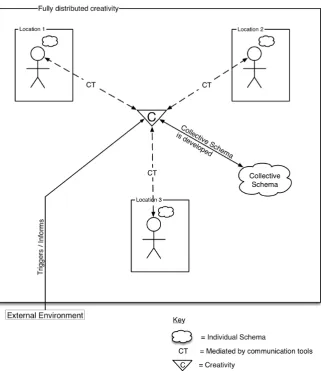
this section), my thesis focus is on teams that are fully geographically distributed.
That is, teams where each team member works from a separate location (e.g.,
employees who work from home). It is important to note that whilst much of the
aforementioned research does touch on creativity in distributed teams, most fail
to explore the creativity of fully geographically distributed teams that form the
focus of this thesis.
2.2.2
Socio-Emotional Processes
This category incorporates a wide range of literature, particularly from
manage-ment, relating to the themes ofRelationship Building, Cohesion and Trust [2]. Research into relationship building explores the way that team relationships develop over time. In the virtual work environment it isn’t always necessary (or
possible) to work synchronously (e.g., via video conferencing) and consequently
it can be harder for teams to develop beyond task-oriented relationships.
How-ever, it has been found that virtual teams can develop task-related, and social
relationships over time [31, 32]. Other work in this area has explored how teams
resolve conflicts [33, 34].
The second theme,team cohesionis closely related torelationship building but emphasises understanding of how teams develop not only emotionally, but how
they come to understand and perform together. Since Powell et al.’s [2] paper
was published new research has found that virtual teams can develop Transactive
Memory Systems (TMS) [7, 35]; “TMS refer to the specialised division of labour
that develops within a team with respect to the encoding, storage, and retrieval
of knowledge (Wegner, 1987)” [7]. That is, Transactive Memory Systems are the
awareness of other team member’s strengths, weaknesses and preferences
allow-ing teams to divide tasks more efficiently. This is important because
Kanawat-tanachai and Yoo’s [7] paper is the first to demonstrate that virtual teams can
demonstrate complex socio-cognitive processes in the same way as co-located
teams.
recently (e.g., [36, 37, 38, 39, 40, 41]). Trust is vital for virtual teams to operate,
especially when team members may never meet. Combine this with the slow
pace of virtual team relationship building and a tendency toward task-only
com-munication and it becomes apparent that virtual teams need careful coaching to establish trust, especially in short-term projects. My research involves working
with newly formed teams which should mean all teams will have similar levels of
trust. The teams may vary in the speed with which they develop trust.
How-ever, because they will only be working together for a very short time I have not
focused in more detail on work relating to trust.
Research into these three areas helps to explain the relationship between social
interactions and shared socio-cognitive development. Of these themes, research
relating to cohesion contributes the most to my understanding of virtual team
creativity. In particular the work by Kanawattanachai et al. [7] contributes to
the motivation for this research by highlighting the capacity for virtual teams to demonstrate complex socio-cognitive processes. This thesis builds on the work
of Kanawattanachai et al. [7] by demonstrating how virtual teams utilise other
complex socio-cognitive processes in the form of creativity.
2.2.3
Summary
Virtual working provides the key context for this thesis. Virtual work affects the
way that teams are able to operate and it is these differences that I am
particu-larly interested in, especially in relation to creativity. While the aforementioned
themes in this section introduce related research (e.g., Cohesion and
Coordina-tion) there are few that address creativity (in one guise or another). We can
infer certain speculations about virtual team creativity from a number of these
contributions. For example, the research into TMS in virtual teams [7, 35] demon-strates that virtual teams are capable of complex socio-cognitive processes. Such
contributions are important to support what we know from experience, i.e., that
virtual teams can be creative. The virtual working literature introduces a range
2.3
Creativity
This section provides a review of the wide range of creativity research (see
fig-ure 2.3). Each of the four levels in figfig-ure 2.3 illustrate a stage of refinement. The
top level lists the 10 broad areas of creativity research as suggested by Kozbelt
et al. [42]. The arrows highlight those areas that are particularly pertinent to my
work. These are explored in further detail in the second level with a particular focus on those area related to team creativity. The third layer refines this further
by emphasising creativity research in virtual environments. Finally, divergent
thinking (level 4) represents the most pertinent area of research to this thesis.
This section is structured as follows. Section 2.3.1 provides an overview of
the broad field of creativity research, with section 2.3.1.1 focussing on divergent
thinking. This is followed by section 2.3.2 which summarises the research within
the emergent field of creativity science. Section 2.3.3 then introduces a review
of sensemaking; this research helps to explain the way that understanding is
developed and is particularly key to understanding the way that organisations
frame and use creativity. Section 2.3.4 discusses how the creative process changes between individuals and co-located/virtual teams. Finally, section 2.3.5 provides
a closing summary.
2.3.1
What is creativity?
Torrance defines creativity as:
“A process of becoming sensitive to problems, deficiencies, gaps in
knowledge, missing elements, disharmonies, and so on; identifiying the
difficulty; searching for solutions, making guesses, or formulating
hy-pothesis about the deficiencies: testing and retesting these hypotheses and possibly modifying and retesting them; and finally
communicat-ing the results” [8].
Torrance suggests that creativity is not just the act of thinking, but of identifying
the need to think in the first place, and the exploratory and reasoning process
Creativity is highly subjective, making it difficult to identify and quantify
consistently; after all, what you and I consider creative may differ. To address
this some researchers choose to describe creativity in terms of magnitude; at one
extreme isBig-C Creativity - this describes the extreme creativity of individuals like Leonardo da Vinci and Wolfgang Mozart [43]. Unfortunately we aren’t all
Mozart and yet we are still creative, often on a smaller scale, this is described
as little-c creativity. More recently Kaufman and Beghetto [44] have proposed that there are in fact further forms of creativity. They suggest that individuals
experience creativity when they learn for themselves; during the act of learning
an individual may not be making something truly new, but it is new to the
individual. Kaufman and Beghetto [44] classify this asmini-c creativity. Finally, they propose that there is often a difference between creative professionals who
do not achieve Big-C status, yet who are creative professionally in a way that is
more substantial than little-c creativity. This they refer to asPro-C creativity. The ambiguous nature of creativity results in highly varied research. Most
research tends to focus on one of the four Ps of creativity: Process, Product, Person and Place [45, 46]. More recent research has argued for the addition of 2 more dimensions: Persausion [47] and Potential [48].
Research that explores the processes of creativity tends to focus on the cog-nitive processes that occur during creativity. Research exploring product is more interested in the end result of the creativity. Research that emphasises theperson
(or personality) seeks to investigate the relationship between creativity and the
creator’s personality and background. This ties into the idea of place, that is research that explores how the context or environment affects creativity. Persua-sion research explores how people go about altering the way others think during creativity. Finally, potential based research seeks to understand if (and how) we can identify underlying creative potential. In this thesis I am most interested in
theprocess of creativity, how creativity emerges in a team, noting thatpersuasion
also plays an important role. It is important to clarify that the place research does not relate to the focus of this research. Research categorised asplace tends to explore how the immediate physical environment can be augmented to better
my my research which seeks to explore the impact that working in co-located and
virtual environments have on creative performance.
A recent review of existing creativity research by Kozbelt et al. [42] suggests
that existing research can be split into ten broad categories: Developmental, Psy-chometric, Economic, Stage & Componential Process, Cognitive, Problem Solving & Expertise Based, Problem Finding, Evolutionary (Darwinian), Typological or
Systems based; each emphasising slightly different aspects of the six Ps. Develop-mental research explores how an individuals’ background and experiences inform their creativity. This research often includes working with significantly creative
individuals (Big-C) to understand how their childhood and life experiences have
helped them to develop. This form of research emphasises the role of the Person
aspect of creativity. Psychometric research is concerned with measuring creativ-ity. Most of this research explores the creative product and how best to analyse it.
Key concerns pertain to reliability and validity of measuring methods. This form
of research emphasises the creative Product. Economic approaches attempt to synthesise the repeatable methods of economic modelling with creativity. Stage & Componential Process seeks to explore creativity as a series of stages, a pro-cess that can be modelled. Cognitive research seeks to understand if there is a difference in the way that highly creative people think. There are many
stud-ies that explore creative cognition. Problem Solving & Expertise related research
treats creativity as a rational phenomenon that occurs during problem solving. A
sub-set of this research addresses the role of expert knowledge in creativity. Prob-lem Finding is distinct from Problem solving, the research explores the aspect of creativity concerned with developing problem and requirement understanding.
Evolutionary theories draw from a Darwinian perspective and explore creativity as a complex organic process. Typological research attempts to identify types of creator. This research is often closely related to the developmental research as
it attempts to categorise creators. Finally, Systems research tends not to focus on any aspect of creativity, instead considering creativity as emerging from a
complex series of sub-components.
Of these ten suggested areas, this thesis is mostly closely aligned with the
work pertaining to psychometric research and problem solving & expertise
creativity as more than just a source of fine artwork but as a mechanism for
problem solving and innovation that can be utilised by organisations. The field
of psychometric research is typically concerned with the ability to assess creative
performance and provides methods for comparing the creativity of co-located and
virtual environments that are used in this thesis.
Other research into creativity within Management and Computer Science
re-search is concerned with the development of tools, methods and guides for
sup-porting creativity (e.g.,[49, 50, 51, 52, 53, 54]). Other research explores the
ef-ficiency and effectiveness of creativity (e.g., [55, 56, 57]). However, my research
does not propose methods of improving creativity in terms of efficiency nor
effec-tiveness. My research is partially motivated by some of the discussions within this
research area, particularly in response to the work of Nemiro [55]. In this work
Nemiro [55] introduces five building blocks for enhancing and supporting creative
work in virtual teams: Design, Climate, Resources, Norms and Protocols, and
Continual Assessment. As part of the process of identifying these five functions Nemiro [55] has completed a review of research relating to virtual team
effec-tiveness (including [58, 59, 60, 61]). Despite this wide ranging literature review
Nemiro [55] doesn’t identify any research related to the way teams use creativity
or collaborate to solve problems. This is indicative of much of the research on
creative efficiency; there is little to no consideration of the role of team cognition.
Many researchers take a holistic view of creativity; that it is too complex a
phenomenon to develop generalisable representations. Other researchers
mean-while attempt break creativity into stages (e.g., [62, 63, 64]). It seems unlikely
that such an ambiguous phenomenon as creativity can ever be definitively
mod-elled. This is reflected in the lack of consensus about what constitutes creativity,
despite the extensive body of research. In this thesis I therefore take a holistic
view of creativity, seeking only to explore aspects of creativity specific to the
context of my research.
One subset of research that tends to extend from Management research
ex-plores the role of creativity in organisations (e.g., [65, 66, 67, 68]). This research
often emphasises the development of a culture of creativity in organisations.
Au-thors discussing creativity in organisations have a tendency to emphasise the
organisations often view creativity “as a basic skill for those whose job it is to
invent and design new products, materials or services.” [66]. Whilst creativity is
important for organisations, most are wary of creativity for it’s own sake. For
many organisations creativity is often associated with vague project specifications,
time wasted over-exploring requirements, and projects that run over-schedule and
over-budget. It is for these reasons that organisations often prefer structuring
cre-ative processes using methods like brainstorming [69] and convergent/divergent
processes [70].
Related to this organisational framing of creativity is research into social
col-laboration. This represents one of the key motivations for forming teams; to
share knowledge, ideas and opinions to arrive at informed decisions. There is
an established field of research that explores the role of social interactions in
the creative process (e.g., [1, 71, 72, 73]). Of particular note is the research by
Ford [71]. In his paper Ford [71] discusses not only the close relationship between
creativity and innovation, but also the relationship between creativity and
sense-making. He outlines the existing discussion around what makes creativity and
innovation different; proposing that both are similar, but that innovation tends
to emphasise the production of something tangible. Ford [71] relates sensemaking
and creativity by proposing that creativity is key for resolving ambiguity during
sensemaking. Ford [71] suggests that interpretive processes are vital for making
sense of highly ambiguous stimuli, stating that “relatively few empirical or
con-ceptual efforts have been focused on these interpretative processes”. Fischer [74]
discusses the importance of social collaboration for creativity specifically within
virtual environments. Fischer [74] argues that creativity is inherently social (even
when an individual process), “The complexity of design problems transcends the
individual human mind” [74]. Fischer [74] argues that creativity requires social
collaboration to explore a wider range of perspectives and knowledge. He
ar-gues that the virtualisation of creativity through communication tools and online
communities serves only to enhance creativity.
An important strand of research that is closely related with my research is
work on idea generation and electronic brainstorming [75, 76, 77]. This area of
research is particularly popular because it provides a means of structuring and
have since been adapted for use with virtual teams. Such structured forms of
creativity are often referred to asDivergent Thinking (DT), and are a considered a specific form of creativity. I explore divergent thinking in more detail in the
next section 2.3.1.1.
2.3.1.1 Divergent Thinking
Divergent thinking describes the process of generating ideas. It is typified by
Os-born’s [69] extremely popular brainstorming model where groups are encouraged
to list as many possible responses (e.g., questions, solutions, ideas, information,
criticisms) to a given task. The aim is to allow the generation of responses in a
non-judgemental environment. Once gathered, responses can then be reviewed.
Using such an approach means that a wider range of responses can be gathered
and evaluated. This Divergent-Convergent approach to exploring ideas and
prob-lems represents the dominant form of creativity used by many organisations. This
research uses divergent thinking as a heuristic for measuring general creativity
because “divergent thinking is related to real life creative behaviour” [78]. The
popularity of divergent thinking stems from its bounded nature and the fact that
it follows a specific, repeatable (and readily understood) process, unlike many
other aspects of creativity.
A small collection of research explores divergent thinking specifically within
a virtual context (e.g. [76, 79, 80, 81]). The paper by DeRosa [76] provides
a meta analysis of Electronic Brainstorming research, exploring various factors
including the evaluation of EBS Groups Vs Traditional face-to-face Groups; the
paper concludes that EBS groups outperform face-to-face groups the majority of
the time in terms of number and quality of ideas generated. Other papers in this
area [79, 80, 81] are based on the development and exploration of EBS with a
view to providing practical improvements. Liikkanen et al. [80] seek to explore
why face-to-face brainstorming is still most commonly used when EBS has been
proven more effective. In doing so they develop a new EBS tool by augmenting
traditional brainstorming approaches. Whilst these papers explore the process of
idea generation in a virtual context their emphasis on the development of tools
interest in understanding the underlying socio-cognitive processes. Furthermore,
these tools are extensions of Osborn’s [69] brainstorming technique. This means
they aim to improve practice, rather than generate new information about the
actual phenomenon.
Recent Requirement Engineering research has used Divergent Thinking to help
stakeholders think beyond their existing working practices, or to help identify
features that will give software producers an innovative edge (e.g. [1, 73, 82, 83]).
A reductive form of DT has even been used as the basis for algorithmic methods
for combining linguistic elements of existing (human-authored) requirements to
synthesise new requirements [84].
A large proportion of divergent thinking research explores the relationship
between creativity and divergent thinking (e.g. [78, 85, 86]). This conversation
has its roots in the works of Guilford [87], Torrance [8] and their peers. This
group of psychologists disagreed with the use of IQ tests as an absolute measure of
intelligence, proposing instead that creativity should be included in any measure
of intelligence, motivating the development of a range of creativity tests. Modern
reviewers criticise the claim that these tests measure creativity [9, 86]. Instead,
they assert that such tests capture an aspect of creativity that we now identify as
divergent thinking. More recent work accepts this distinction and acknowledges
the validity of DT as a means of exploring creativity. Runco [86] notes “One
attractive feature of research on DT is that it offers information about both
creative product and the creative process”. It is for this reason that I will be
incorporating divergent thinking methods in this thesis.
Two of the most widely used and well established methods of measuring
di-vergent thinking are the Torrance Tests of Creative Thinking (TTCT) [8] and
Guilford’s Alternative Uses test [87].
The Torrance Tests of Creative Thinking (TTCT) [8] challenges individuals
to complete a series of abstract drawing and reasoning challenges. These are
scored against a set lexicon of common responses to provide a score indicative
of both the originality along with an indication of the level of complexity of
responses. Despite it’s relative age the TTCT is still in use through the U.S.A.
as a means of identifying gifted children. Recent critiques by Runco [86] and
utilising it as part of a triangulation strategy for gathering a broad understanding
of creative performance. It is important to note that in it’s original form the
TTCT is a paper-based test for individuals. Whilst Torrance suggests that it
should be applicable to teams there is no such adaptation currently available. Guilford’s [87] Alternative Uses Test is less complex than the TTCT but
still equally valid (so much so that Torrance incorporates it into his test). The
test challenges participants to list as many different uses for a particular given
object (e.g., a brick) as possible. The list of suggested uses is then scored against
a lexicon of common responses to gauge creative thinking. Unlike the TTCT,
Guilford’s Alternative Uses Test is widely used with teams (e.g., as the core
method of analysis in Kanawattanachai and Yoo’s [7] study of TMS in virtual
teams) with no further adaptation required.
My research utilises both TTCT and Guilford’s Alternative Uses Test to gauge
the creativity of teams (measuring creativity is discussed in more detail in sec-tion 3.2.3). I focus on the divergent thinking aspect of creativity for two reasons:
First, Divergent Thinking represents a bounded form of creativity often uses by
organisations. Secondly, I am able to draw on the proven tests developed by
2.3.2
Creativity Science
Creativity science is an emerging field that synthesises aspects of computer
sci-ence and design research (amongst others) to explore how creativity is affected
by and affects distributed working. The field originates from early Computer
Supported Cooperative Work (CSCW) research into basic approaches for
dis-tributed collaboration. Over time the infrastructure and tools and techniques
have improved drastically enabling people to design and create collaboratively
across both geographic and temporal barriers.
There are two core creativity science research areas that inform this thesis:
firstly, research that explores how people and teams collaborate; and secondly
research that introduces new tools and methods for supporting (and evaluating)
creativity. Figure 2.4 outlines these two core areas and the sub-areas of Trust and
Awareness, Team Dynamics, Supporting Creativity and Evaluating tools that sit
within these. The size of the circles provides a rough indication of the relative
quantity of research in these areas, with research into supporting creativity (via
tools and methods) the dominant research focus within creativity science.
Figure 2.4: Core creativity science themes
(Size of circle relative to quantity of research in area)
Research into how teams collaborate is often concerned with how teams
and virtual perspectives [90, 91]. Awareness is particularly important to the
sensemaking aspect of collaborative creativity (see section 2.3.4) because it helps
collaborators to recognise when contributors are stating fact or hypothesising. Of
particular note in this area is the work by Lopez and Guerrero [92] who provide
a systematic review of the awareness-supporting technologies used in a wide
ar-ray of collaborative systems that have been proposed during the last ten years,
reviewing some 400 papers in total. They define awareness as “the knowledge
that a person has of the activities they are supposed to execute and the
activ-ities their collaborators are performing” [92]. They make a point that despite
reviewing over 400 papers they have found no tools (or studies) for exploring
synchronous collaboration of both co-located and distributed teams. Whilst this
review specifically relates to the use of awareness technologies in particular, it
serves to highlight an overarching trend within the literature, namely that very
little research has provided a comparison between co-located and virtual team
interactions.
Other research in this area has explored collaborative decision-making.
Stud-ies have looked at the way that user roles emerge during decision-making tasks
[93]. Luther et al. [94] introduce a new tool, Pipeline, to aid the management
of online creative collaborations. They [94] suggest that many fully-distributed
creative collaborations fail because the new work domain introduces challenges
for the management and leadership of teams. They utilise distributed leadership
theory to inform the design of Pipeline. Pipeline serves to help leaders of these
teams to decentralise tasks and delegate them amongst the online workforce. It
is interesting in that it suggests that delegation of tasks is much harder in virtual
teams. It is possible that this is a trend that emerges during the study used in
this thesis.
Other work on decision making investigates how relief volunteers were
coor-dinated online following the Haiti earthquake [95]. This research follows on from
that of Weick [29] and others who have used analysis of similar extreme
situa-tions to highlight how creative sensemaking occurs. Tausczik et al. [64] provide
a further study of collaborative problem solving within the MathOverflow online
community. It is interesting to observe how little problem solving research there
the relative lack of dialogue around creativity/sensemaking particularly within a
virtual context.
The core of the research in creativity science relates to the development of
new tools and techniques for supporting creativity. This research tends to be split
between co-located and virtual contexts. The co-located tools proposed often set
out to support the awareness of collaborators by helping them to communicate
choices (e.g.,[96]) better. Other work helps collaborators to reflect in order to aid
the sensemaking process (e.g.,[97]). Some tools aid the decision making process
by digitally augmenting the environment.
In the case of Verma et al. [98] this is done by providing a means for teams
to share the information stored on the multiple devices each team member
typ-ically owns in order to help collaborators encounter a wider range of contextual
information. Shi et al. [99] introduce another contextualisation tool - a digital
wall that listens to conversations and then uses speech recognition to source and
display further contextual information automatically.
Biskjaer et al. [100] describe approaches for helping interaction designers
dur-ing the early stages of design. They suggest a number of methods for “scaffolddur-ing
creativity and innovation”. These include a range of workshop suggestions and
approaches to help promote creative thinking. Whilst these are interesting they
are almost exclusively practice-based and meant to be used with co-located teams.
Geyer et al. [101] propose a tool to help augment affinity diagramming during
the very early stages of design in a co-located team. They emphasise the fact
that design teams still prefer to use physical materials during the early stages of
design instead of using digital mediums, because of perceived barriers to
creativ-ity. However, they suggest that ubiquitous computing has improved to such an
extent that new tools can be developed with design affordances such that these
barriers to use and creativity are greatly reduced. They introduce a new tool
to support these co-located teams and report on initial feedback indicating that
their digital tool can indeed supplement the design process. This finding serves
to support the notion that technology has improved to the point that it can be
used for complex creative tasks.
Closely related to this is a piece by O’Neill [102] who presents a short reflection
interesting, he notes in particular that over-design (e.g., a large and often
con-fusing range of brushes etc) of such tools is often a key inhibitor of creativity.
He suggests that a more basic and easily understood range of options is all that
is really necessary in order to effectively mimic the creativity that emerges from
most artists’ interactions with traditional sketchbooks. He does concede that
the ability to undo/redo does provide a particular bonus of digital sketchbooks.
Similarly, Obrenovic and Martens [103] reflect on their study to investigate how
sketching can be used to support innovation. They ultimately conclude that
peo-ple innovate the most when sketching in response to abstract prompts and when
sketching without a prompt.
Tools that support virtual collaboration relate to advances in video
commu-nication and new collaboration tools/methods. Some of this research (e.g.,[104,
105]) explores how video communication itself can be augmented to improve
in-teractions. Research by Li et al. [106] is perhaps the most relevant to this thesis.
In their research they introduce SketchComm [106], a tool for supporting the
early idea generation of teams that work asynchronously. They explain that face
to face meetings are often key during the early stages of design activities but
that this isn’t always possible. SketchComm is introduced as a tool to help in
these situations by enabling designers to include an array of additional contextual
information along with the design ideas to help alleviate the constraints enforced
by asynchronous collaboration. A small number of papers propose new working
methods to support distributed collaborative creativity, for example Malone et
al. [107] who introduce a new method for breaking complex tasks into smaller
subordinate tasks that can then be reassembled once addressed.
There are a number of similar papers that explore techniques for evaluating
these tools and interactions (e.g.,[108, 109, 110, 111, 112]). Dong and Fu [109]
introduce a review of video communication and demonstrate that it is a more
effective communication medium for negotiation and conflict resolution. Rae et
al. [110] introduce a new framework that aims to help designers of telepresence
interfaces. Carroll and Latulipe [112] introduce a simple survey tool based on the
NASA Task Level Index to help interaction designers consider how to support
creativity. Finally, Yamauchi et al. [111] provide a paper that reports on the
Finally, there is a small subset of this research related to the measurement of
creativity (e.g.,[113, 114, 115, 116]). Han Koh et al. [113] look at how to
mea-sure creative divergence. Davis et al. [114] explore how to quantify interaction
dynamics. Tripathi et al. [115] propose new ways to predict creativity in situ.
Finally, Mattingly et al. [116] examine the creative activities of participants as
they go about designing a chair. I am wary of using such new methods for
mea-suring aspects of creativity in this thesis because such approaches are relatively
immature and often focus on very specific aspects of creative interactions. I am
interested in gathering as broad an understanding of creativity as possible, for
which the TTCT and Guilford’s Alternative Uses Test provide a better (and more
established) fit. However, I will seek to borrow from these newer approaches in
the development of my third supplementary approach to measuring creativity.
In summary, the existing creativity science literature helps to provide
im-portant contextual information for this thesis. It highlights the opportunity to
provide a meaningful comparison between the creativity of co-located and virtual
teams. Despite the wide array of existing research no one appears to have
estab-lished a direct point of comparison between co-located and virtual environments.
Furthermore, there is relatively little research within this field that actually
ex-plores creative performance with the bulk of the related research focusing on how
to evaluate ideation alone rather than establishing a broader exploration of
cre-ativity. It is clear that the core research is into the development of new tools,
some tend to focus on the collaboration aspect that forms the mainstay of CSCW
whilst relatively little actually discusses supporting creativity directly. Of this
re-search the most relevant for this thesis are the very short observations made by
O’Neill [102].
It seems that there is a gap within this area of research first and foremost
to provide a comparison of co-located and virtual team creativity. Such a
com-parison would be invaluable to those developing tools within creativity science
by providing a method for evaluating performance as well as providing an initial
demonstration of how early stage collaborative creativity occurs in both
2.3.3
Sensemaking
Sensemaking and creativity are inherently linked. Where creativity is“The abil-ity to produce work that is both novel (i.e. original, unexpected), and appropriate (i.e. useful, adaptive to task constraints).” [1], sensemaking is described as “a developing set of ideas with explanatory possibilities, rather than as a body of
knowledge. This means that the topic exists in the form of an ongoing
con-versation” [117]. The close relationship between creativity and sensemaking is
especially apparent within an organisational context where ’creativity’ is often
used interchangeably to refer to both the identification and exploitation of
op-portunities in order to develop innovations; and the identification and resolution
of complex problems. In both cases teams demonstrate sensemaking in order
to recognise these scenarios and then to develop an understanding or to plan a
response. For example, a team of engineers designing a car will have to work through many complex design problems and decisions utilising both sensemaking
and creativity concurrently. Brown et al. [118] describe the interplay between
sensemaking and creativity as:
“A kind of creative authoring on the part of individuals and groups
who construct meaning from initially puzzling and sometimes
trou-bling data (Shotter, 1993; Weick, 1995)” [118].
Sensemaking is therefore about developing an understanding of some newly
encountered phenomenon. The emphasis is on developing possible explanations.
Note that sensemaking does not have to be about developing absolute knowledge;
it is often about developing increasingly accurate hypotheses about phenomenon.
As such, sensemaking is often explained as the process by which we “structure
the unknown” [119] by synthesising past experiences, researched information and
experimentation that help the sensemaker to “comprehend, understand, explain,
attribute, extrapolate, and predict” [120] the phenomenon. A great deal of the ex-isting sensemaking literature describes sensemaking in these terms: as the place-ment of phenomenon into some kind of framework.
We can consider sensemaking in terms of scale of magnitude from everyday
simple individual sensemaking through to complex sensemaking requiring
occur mindlessly, that is the sensemaker may develop their framework of
under-standing drawing on past experiences and information without conscious effort.
Organisations, however often encounter complex situations that require
sense-making by teams; this is because no single individual has sufficient knowledge
that can address the problem, or political authority to do so alone. As we will see
later (see section 2.3) the insights provided by others’ creativity play an important
role in sensemaking. In these situations sensemaking becomes a collective
pro-cess, often fraught with complications, where team members go about collective
sensemaking. The sort of situations that call for team sensemaking (e.g.,
design-ing, problem solving) are often high impact, and complex, so any improvement in
sensemaking is of vital importance. The team that can make sense of an
oppor-tunity before their competitors may be key to organisational success. This thesis
explores the latter form of sensemaking which often occurs during creativity,
re-quiring contribution, collaboration and negotiation by multiple sensemakers’ as
a team addressing a sensemaking task of higher magnitude (complexity).
Weick [117] suggests that sensemaking is often treated as a retrospective
pro-cess, particularly at an organisational level to try and make sense of past actions.
This is reflected in the range of sensemaking research that is based upon secondary
sources of information e.g., research that uses sensemaking to analyse responses
to and the causes of complex disaster situations (e.g., [121, 122, 123, 124]). Whilst
these retrospective analyses provide valuable insight, the use of secondary sources
and retrospective analysis are criticised for the risk that post-event accounts
pro-vide a ’rose-tinted’ version of the event [120]. There is therefore a need to try
and observe sensemaking first-hand, analysing primary data to gain an
alter-native (and hopefully more realistic) insight to how sensemaking occurs (e.g.,
[6, 120, 125, 126, 127, 128]). My work follows this second school by studying the
interactions of teams within a repeated experiment.
Sensemaking occurs at Individual and Group/Team levels, as well as at or-ganisational and inter-organisational levels. Research at the individual level seeks to understand the way that individuals make sense of the world. The
group/team level research explores how collections of individuals collaborate to-gether to make sense. This level introduces socio-cognitive, knowledge, political
macro-level strategic decision making that steers an organisation. Above this lies
theinter-organisational level that explores the sensemaking that occurs amongst organisations. Much of the research at this level explores how major disasters
have been addressed by collaboration between multiple parties. Finally, spanning
all of these levels is research into methods and tools for supporting sensemaking
(e.g., [129, 130, 131, 132, 133]).
Existing theories of sensemaking tend to describe sensemaking in terms of very
broad characteristics [117, 118, 120, 125, 134, 135]. Weick [117] is perhaps the
best know researcher in this area. His bookSensemaking in Organizations [117] suggests that sensemaking be described in terms of the following seven
charac-teristics:
1. Grounded in identity construction
Whilst there may only be an individual who is sensemaking, their own
iden-tity is part of the wider set of interactions they have with their environment.
So, as they interact with others, perhaps gathering knowledge to aid their
sensemaking they are going about a process of choosing what to share and
how to behave with others. The representation the sensemaker chooses to
portray varies depending on their environment and who they are interacting
with.
2. Retrospective
This relates to a point raised by Starbuck and Milliken [120] that much of
our sensemaking occurs when we try to reason, to understand past events.
It is important to recognise this because so much sensemaking and decision
making is based upon previous experiences.
3. Enactive of sensible environments
When sensemaking, people often affect their sensemaking environment,
in-troducing boundaries and constraints. This point is related to the
descrip-tion of sensemaking being about the development of frameworks that
![Figure 2.2: Model of virtual Team literature [2]](https://thumb-us.123doks.com/thumbv2/123dok_us/9349219.436979/21.595.102.509.210.382/figure-model-of-virtual-team-literature.webp)


![Figure 3.3: Picture Completion Starting ShapesReproduced from TTCT Figural Part A, 1972 [154]](https://thumb-us.123doks.com/thumbv2/123dok_us/9349219.436979/72.595.128.485.140.459/figure-picture-completion-starting-shapesreproduced-ttct-figural.webp)
![Figure 3.4: Parallel Lines Starting ShapeReproduced from TTCT Figural Part A, 1972 [154]](https://thumb-us.123doks.com/thumbv2/123dok_us/9349219.436979/73.595.149.463.156.346/figure-parallel-lines-starting-shapereproduced-ttct-figural.webp)