Learning Action Recognition Model From Depth and Skeleton Videos
Hossein Rahmani, and Mohammed Bennamoun
School of Computer Science and Software Engineering,
The University of Western Australia
[email protected], [email protected]
Abstract
Depth sensors open up possibilities of dealing with the human action recognition problem by providing 3D human skeleton data and depth images of the scene. Analysis of hu-man actions based on 3D skeleton data has become popular recently, due to its robustness and view-invariant represen-tation. However, the skeleton alone is insufficient to distin-guish actions which involve human-object interactions. In this paper, we propose a deep model which efficiently mod-els human-object interactions and intra-class variations un-der viewpoint changes. First, a human body-part model is introduced to transfer the depth appearances of body-parts to a shared view-invariant space. Second, an end-to-end learning framework is proposed which is able to effectively combine the view-invariant body-part representation from skeletal and depth images, and learn the relations between the human body-parts and the environmental objects, the interactions between different human body-parts, and the temporal structure of human actions. We have evaluated the performance of our proposed model against15existing techniques on two large benchmark human action recogni-tion datasets including NTU RGB+D and UWA3DII. The Experimental results show that our technique provides a significant improvement over state-of-the-art methods.
1. Introduction
Automatic human action recognition from videos is a significant research problem with wide applications in var-ious fields such as smart surveillance, health and medicine, sports and recreation. Depth cameras, such as Microsoft Kinect, have become popular for this task because, depth images are robust to variations in illumination, clothing color and texture, and 3D human joint positions can be ex-tracted from a single depth image due to the development of a real-time human skeleton tracking framework [28].
The depth sensor based human action recognition re-search can be broadly divided into three categories includ-ing skeleton data [6,12,25,33,34,38,40], depth images [15,
17,18,20,21,23,37,39] and depth skeleton [19,26,27,36] based methods. Although depth based approaches achieve impressive results on most RGB-Depth action recogni-tion datasets, their performance drops sharply in scenarios where the humans significantly change their spatial loca-tions, and the temporal extents of the activities significantly vary [15]. On the other hand, limiting the learning into skeleton based features cannot deliver high recognition ac-curacy in action recognition, because depth visual appear-ances of human body-parts provide discriminative informa-tion, and most of the usual human actions are defined based on the interaction of the body with other objects. For ex-ample,drinkingandeating snacksactions have a very sim-ilar skeleton motion. Thus, additional information, such as depth images, is required to distinguish such actions. The straightforward method for combining depth and skeleton data (feature fusion) is to concatenate these different types of features [19,35,36]. In this fashion, achieving the op-timal combination of features for an accurate classification cannot be guaranteed.
Moreover, a practical system should be able to rec-ognize human actions from novel and unseen viewpoints (generalization). However, unlike 3D skeletal data, view-invariant representation of depth images is a challenging task [20–22,24]. This is because the depth images of a hu-man performing an action appear quite different when ob-served from different viewpoints. Thus, how to effectively represent these depth images in a view-invariant space and combine them with estimated 3D skeleton data is a signifi-cant research problem which remains under explored.
Furthermore, in human actions, body joints move to-gether in groups. Each group can be considered as a set of body-parts, and actions can be interpreted as interactions of different body-parts. Thus, the most discriminative interac-tions corresponding to different acinterac-tions need to be exploited for better recognition. Moreover, human actions may have a specific temporal structure. Modeling the temporal struc-ture of action videos is also crucial for the action recog-nition problem. Most existing depth sensor based meth-ods [23,33–36] model the temporal variations of videos
ing Fourier Temporal Pyramid (FTP) and/or Dynamic Time Warping (DTW) which results in a two-step system that typ-ically performs worse than an end-to-end system [9]. Some other methods [6,12,25], use Recurrent Neural Networks (RNNs) or extensions, such as Long Short Term Memory (LSTM) networks, to model the temporal variations of ac-tion videos. However, CNN+RNN/LSTM models intro-duce a large number of additional parameters, and thus need much more training videos which are expensive to label [7].
This paper proposes a deep model for human action recognition from depth and skeleton data to deal with the above mentioned challenges in an end-to-end learning framework. First, we propose a deep CNN model which transfers the depth appearance of human body-parts to a shared view-invariant space. Learning this deep CNN re-quires a large dataset containing a variety of human body-parts in different actions observed from many viewpoints. Rahmaniet al. [23] showed that a model learned on syn-thetic depth human body images can be generalized to real depth images without the need of fine-tuning. Thus, we gen-erate a large training dataset by synthesizing human body-parts from different views. More importantly, we propose a framework which is able to1)effectively combine infor-mation from depth and skeletal data, 2) capture the rela-tions between the human body-parts and the environmental objects,3)model the interactions between different human body-parts, and 4) learn the temporal structure of human actions in an end-to-end learning framework.
Our main contributions include the following three as-pects.First, this paper proposes a model for view-invariant appearance representation of human body-parts. Second, we propose an end-to-end learning human action recogni-tion model, which is shown through our experiments to be well suitable for the depth sensor based human action recog-nition task. Third, the proposed method simultaneously learns to combine features from different modalities, i.e. depth and skeleton, capture the interactions between differ-ent human body-parts for differdiffer-ent actions, and model the temporal structure of different human actions.
The proposed method is evaluated on two large bench-mark datasets including NTU RGB+D [25] and UWA3D Multiview Activity II [20] datasets. The first dataset con-tains more than56Ksequences captured simultaneously by three Kinect cameras from three different views, and the second dataset consists of30human actions captured from four different viewpoints. This dataset is challenging be-cause the videos were captured by a Kinect camera at four different times from four different viewpoints. Our exten-sive experimental results show that the proposed method is able to achieve a significantly better recognition accuracy compared with the state-of-the-art methods.
2. Related Work
Human action recognition has been explored from differ-ent aspects during the recdiffer-ent years. In this section, we limit our review to the most recent related approaches, which can be divided into three different categories, namely depth, skeleton and skeleton depth video based methods. Depth Videos: Most existing depth video based action recognition methods use global features such as silhouettes and space-time volume information. For instance, Oreifej and Liu [15] proposed a spatio-temporal depth video rep-resentation by extending histogram of oriented 3D normals [30] to 4D by adding the time derivative. Yang and Tian [39] extended HON4D by concatenating the 4D normals in the local neighbourhood of each pixel as its descriptor. How-ever, these methods are not view-invariant. Recently, Rah-maniet al. [23] proposed to generate synthetic depth train-ing data of human poses in order to train a deep CNN model that transfers human poses, acquired from different views, to a view-invariant space. They used group sparse Fourier Temporal Pyramid to encode the temporal variations of hu-man actions. Such holistic methods may fail in scenarios where the human significantly changes her/his spatial po-sition, or the temporal extent of the activities significantly vary [15]. Some other methods [20,21,37] use local features where a set of interest points are detected, and then, the depth features are extracted from the local neighbourhood of each interest point. For example, DSTIP [37] localizes activity related interest points from depth videos by sup-pressing flip noise. This approach may fail when the action execution speed is faster than the flip of the signal caused by sensor noise. Recently, Rahmaniet al. [20,21] introduced to directly process the sequence of pointclouds correspond-ing to an action video. They proposed a view-invariant in-terest point detector and descriptor by calculating Principle Component Analysis (PCA) at every point which is a com-putationally expensive process [23]. However, these meth-ods use hand-crafted features and implicitly assume that the viewpoint does not change significantly [23].
to five major groups of joints which were passed through hierarchical RNNs. The hidden representation of the final RNN was fed to a softmax classifier layer for action clas-sification. Differential LSTM [32] introduced a new gating inside LSTM to discover patterns within salient motion pat-terns. Shahroudyet al. [25] proposed a part-aware exten-sion of LSTM by splitting the memory cell of the LSTM into part-based sub-cells and pushing the network towards learning the long-term context representations individually for each part.The output of the network was learned over the concatenated part-based memory cells followed by the common output gate. More recently, Liuet al. [12] intro-duced a spatial-temporal LSTM to jointly learn both spatial and temporal relationships among joints.
Skeleton Depth Videos: Although skeleton based meth-ods achieve impressive action recognition accuracies on human action datasets, it is not sufficient to only use the skeletal data to model actions, especially when the actions have very similar skeleton motion and include the interac-tions between the subject and other objects [36]. Therefore, skeleton depth based approaches are becoming an effec-tive way to describe activities of interactions. Rahmaniet al. [19] proposed a set of random forests to fuse the spatio-temporal depth and joints features. Wang et al. [36] pro-posed to compute the histogram of occupancy patterns of a fixed region around each joint in each frame of action videos. In the temporal dimension, low frequency Fourier components were used as features for classification. Re-cently, Shahroudyet al. [27] proposed hierarchical mixed norms to fuse different features and select the most infor-mative body joints. Our proposed approach also falls in this category. However, unlike the above mentioned works, the framework proposed in this paper is robust to signifi-cant changes in viewpoints. Moreover, the proposed model learns the relations between the human body-parts and the environmental objects, along with the temporal structure of actions in an end-to-end learning framework.
3. Proposed Approach
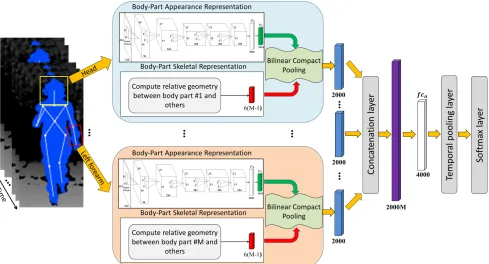
This section presents a view-invariant human action recognition model using a depth camera. The proposed ar-chitecture is illustrated in Fig.1. Based on the depth im-ages and the estimated 3D joint positions, we propose a new model which is able to1)transfer the human body-parts to a shared view-invariant space,2) capture the relations be-tween the human body-parts and environmental objects for human-object interaction, and3)learn the temporal struc-ture of actions in an end-to-end learning framework. The details of the proposed architecture are given below.
3.1. Human Body-Part Representation
In this section, we introduce two approaches to repre-sent skeletal information of a body-part (subsection3.1.1)
and to transfer the depth appearances of human body-parts (subsection3.1.2) to a shared view-invariant space.
3.1.1 Body-Part Skeletal Representation
Given a skeletal data of a human pose performing an action, all 3D joint coordinates are transformed from the real-world coordinate system to a person-centric coordinate system by placing the hip center at the origin. This operation makes the skeletons invariant to absolute location of the human in the scene. Given a skeleton as reference, all the other skele-tons are normalized without changing their joint angles such that their body-part lengths are equal to the corresponding lengths of the reference skeleton. This normalization makes the skeletons scale-invariant. The skeletons are also rotated such that the ground plane projection of the vector, from the left hip to the right hip, is parallel to the global x-axis. This rotation makes the skeletons view-invariant.
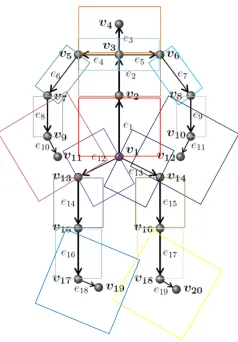
As shown in Fig.2, letS pV, Eqqbe a human body skeleton, where V tv1, v2, , vNurepresents the set of body joints, andE te1, e2, , eMudenotes the set of body-parts. Vemulapalliet al. [33] showed that the rel-ative geometry of a pair of human body-parts en andem can be represented in a local coordinate system attached to the other. The local coordinate system of body-parten is calculated by minimum rotation so that its stating joint be-comes the origin and it coincides with the x-axis. Then, we can compute the translation vector, d~m,nptq, and the rota-tion matrix,Rm,n, fromemto the local coordinate system of en. Thus, the relative geometry betweenemanden at time instancetcan be described using
Pm,nptq
Rm,nptq d~m,nptq
0 1
. (1)
Using the relative geometry between pairs of body-parts, we represent a body-parteiat time instancetusingCiptq pP1,iptq, P2,iptq, , Pi1,iptq, Pi 1,iptq, , PM,iptqq P
SEp3q SEp3q, whereSEp3qdenotes Special Eu-clidean group andMis the number of body-parts. Then, the representation of the body-parteiat time instancet,Ciptq, is mapped from Special Euclidean group to its Lie algebra in vector representation using
ζiptq rvecplogpP1,iptqqq, vecplogpP2,iptqqq, vecplogpPi1,iptqqq, vecplogpPi 1,iptqqq,
vecplogpPM,iptqqqs, (2)
wherelogdenotes the usual matrix logarithm.
Figure 1: Architecture of the proposed model. Given a sequence of depth images and their corresponding skeleton data, the relative geometry between every body-part and others are calculated (see Section3.1.1). The bounding boxes containing human body-parts are passed through the same body-part appearance representation model (see Section3.1.2) to extract view-invariant depth information (the outputs off c7 layer). Bilinear compact pooling is then applied to the skeletal and appearance representations of each body-part (see
Section 3.2.1) which results in a compact2000-dimensional feature vector. The compact feature vectors from allM body-parts are concatenated to from a2000M-dimensional vector and then passed through a fully-connected layer,f ca, which encodes the interactions between different human body-parts (see Section3.2.2). Finally, a sequence of4000-dimensional feature vectors corresponding to the sequence of depth frames are passed through the temporal pooling layer (see Section3.2.3) to extract a fixed-length feature vector for classification.
3.1.2 Body-Part Appearance Representation
Unlike 3D skeletons, view-invariant depth appearance rep-resentation of human body-parts is challenging. This is be-cause the depth images of human body-parts appear quite different when observed from different viewpoints. To over-come this problem, we learn a single deep CNN model for all human body-parts to transfer them to a shared view-invariant space. However, learning such a deep CNN re-quires a large training dataset containing a large number of human body-parts, performing a variety of actions observed from many viewpoints. Our solution is to generate synthetic training data since Rahmani and Mian [23] showed that a model trained on synthetic depth images is able to general-ize real depth images without the need for retraining or fine tuning the model.
The set of all possible human actions, and thus, body-part appearances is extremely large. Therefore, we propose a method to select the most representative human body-parts. We use the CMU mocap database [2] containing
over 200K poses of subjects performing a variety of ac-tions. However, many body-parts are quite similar even for different actions. In order to find the most representative body-parts, we first normalize the mocap skeleton data us-ing the approach given in the previous section. We consider the 3D vector connecting the hip centre to spine as a refer-ence. The rotation required to take a body-part to the ref-erence is used as the body-part features. Using Euclidean Distance between the Euler Angles [10], we apply k-means clustering to each body-part features independently. Given the fact that human body-parts have different degrees of movement, we extracted different numbers of clusters for different body-parts. This algorithm results in 480 repre-sentative body-parts.
differ-Figure 2: An example skeleton consisting of20joints and 19 body-parts. The bounding boxes show regions of interest corre-sponding to different body-parts.
ent viewpoints and the bounding boxes containing the rep-resentative body-parts are used as training data. In total, 480108depth images corresponding to480 representa-tive body-parts viewed from 108 different views are gen-erated. Note that the length and width of a bounding box containing a body-part are appropriately chosen to cover the whole body-part. For example, we set the length and width of a bounding box surrounding theleft hand to twice of the body-part’s length. This is because humans usually interact with their environment,e.g. objects and other hu-man, by hands and feet. Thus, a larger bounding box is able to cover both the hand and the object. For instance, Fig.1 shows two bounding boxes corresponding toheadandleft forearmof a human performing an action, and Fig.2 illus-trates the bounding boxes corresponding to19 body-parts of an example skeleton.
We propose a view-invariant human body-part represen-tation model that learns to transfer body-parts from any view to a shared view-invariant space. The model is a deep convolutional neural network (CNN) whose architecture is as follows: Cp11,96,4q Ñ RL Ñ Pp3,2q Ñ N Ñ Cp5,256,1q Ñ RLÑ Pp3,2q Ñ N Ñ Cp3,384,1q Ñ
RL Ñ Cp3,384,1q Ñ RL Ñ Cp3,256,1q Ñ RL Ñ Pp3,2q ÑF Cp2048q ÑRLÑDp0.5q ÑF Cp1024q Ñ
RL Ñ Dp0.5q Ñ F Cp480q, whereCpk, n, sqdenotes a convolutional layer with kernel sizekk,nfilters and a stride of s, Ppk, sq is a max pooling layer of kernel size
kkand strides,Nis a normalization layer, RL a rectified linear unit,F Cpnqa fully connected layer withnfilters and
Dprqa dropout layer with dropout ratior. We refer to the fully-connected layers asf c6, f c7, and f c8, respectively.
During learning, a softmax loss layer is added at the end of the network.
The generated synthetic depth images corresponding to
each representative body-part i, where i 1, ,480, from all 108viewpoints are assigned the same class label
i. Thus, our training dataset consists of480human body-part classes. We initialize the convolution layers of the pro-posed CNN with the model trained on depth images of full human body from [23]. We fine-tune the proposed CNN model with back-propagation and use an initial learning rate of 0.001 for the convolution layers and0.01for the fully-connected layers. We use a momentum of0.9and a weight decay of0.0005. We train the network for30Kiterations. After training, the last fully-connected (f c8) and softmax
layers are removed and the remaining layers, as shown in Fig.1, are used as view-invariant body-part appearance rep-resentation model.
3.2. Learning End-to-End Human Action
Recogni-tion Model
So far, we have represented the skeletal data and depth images corresponding to human body-parts in two differ-ent view-invariant spaces, Lie algebra andf c7, respectively.
However, a human action is carried out by moving body-parts and interacting between them along time. To take this information into account, we propose an end-to-end learn-ing model, which is shown in Fig.1. The details of each step are given below.
3.2.1 Bilinear Compact Pooling Layer
Bilinear classifiers take the outer product of two vectors
x1 P Rn1 and x2 P Rn2 and learn a model W, i.e.
zWrx1bx2s, wherebdenotes the outer productx1x2T
andr.sdenotes linearizing the matrix in a vector. Thus, all elements of both vectorsx1andx2are interacted with each
other in a multiplicative way. However, the outer product of vectorsx1 andx2, whenn1andn2are large, results in
an infeasible number of parameters to learn inW. To over-come this problem, Gaoet al. [8] proposed a bilinear com-pact pooling for a single modality which projects the outer product to a lower dimensional space and also avoids com-puting the outer product directly. This idea is based on the Tensor Sketch algorithm of [16].
Letxpsiqptq P R6pM1q andxp iq d ptq P R
1024 denote the
feature vectors obtained from the body-part skeletal (Sec-tion 3.1.1) and appearance (Section 3.1.2) representation models for thei-th body-part at timet, respectively. We ap-ply bilinear compact pooling onxpsiqptqandxpdiqptqto com-bine them efficiently and expressively. We set the projec-tion dimension,dto2000. This process results in a 2000-dimensional feature vector for every body-part.
3.2.2 Fully-Connected Layer
[image:5.612.109.228.69.240.2]com-pact feature vectors of allM body-parts to form a2000M -dimensional feature vector and then pass them through a fully-connected layer consisting of 4000units. Thus, the proposed model extracts a4000-dimensional feature vector for every depth image in an action video.
3.2.3 Temporal Pooling Layer
The straightforward CNN-based method for encoding a video is to apply temporal max pooling or temporal average pooling over the frames. However, such temporal pooling methods are not able to capture the time varying informa-tion of the video. To overcome this problem, we use the recently proposed rank-pool operator [4]:
argmin
u
1 2||u||
2 C
2 T ¸
t1
maxp0,|tuTvt| q2, (3)
wherevtPR4000denotes the outputs of thef calayer cor-responding to the frame at timet,~v pv1, ,vTq
de-notes a sequence of feature vectors anduis a fixed-length representation of the video which is used for classification. This temporal rank pooling layer attempts to capture the or-der of elements in the sequence by finding a vectorusuch thatuTv
i uTvjfor alli j, which can be solved using
regularized support vector regression (SVR) in Eq. (3).
3.2.4 Classification Layer and Learning
The aim of the classification layer is to assign one of the ac-tion class labels to the sequence descriptoru. In this work, we use soft-max classifier. Given a dataset of video-label pairs,tp~xpiq, ypiqquni1, we jointly estimate the parameters of the temporal pooling layer Eq. (3) and the soft-max classi-fication function as follows:
minimize θ
n ¸
i1
logPpypiq|~xpiqq Rpθq
subject toupiqPEq.(3), (4)
wherelogPpypiq|~xpiqqis the cross-entropy loss for the soft-max classifier and Rpθq is`2-norm regularization of the model parameters. Eq. (4) is a bilevel optimization prob-lem and its derivative with respect to any parameters in the model can be computed by applying the chain rule [7]. We use stochastic gradient descent (SGD) to learn all parame-ters jointly.
4. Experiments
We evaluate our proposed model on two large bench-mark datasets including NTU RGB+D [25] and UWA3D Multiview Activity II [20]. We compare our performance
to the state-of-the-art action recognition methods includ-ing Comparative Codinclud-ing Descriptor (CCD) [5], Histogram of Oriented Gradients (HOG2) [14], Discriminative Virtual Views (DVV) [11], Continuous Virtual Path (CVP) [41], Histogram of Oriented 4D Normals (HON4D) [15], Ac-tionlet Ensemble (AE) [36], Lie Algebra Relative Pairs (LARP) [33,34], Super Normal Vector (SNV) [39], His-togram of Oriented 3D Pointcloud (HOPC) [20], Hier-archical recurrent neural network (HBRNN) [6], STA-LSTM [29], Spatio-Temporal STA-LSTM with Trust Gates (ST-LSTM+TG) [12], Human Pose Model with Tempo-ral Modelling (HPM+TM) [23], Long-Term Motion Dy-namics (LTMD) [13], and Deep Learning on Lie Groups (LieNet) [9]. The baseline results are reported from their original papers or [12,23].
In addition to other compared methods, we report the accuracy of our defined baseline methods, including:
• Baseline 1 (appearance only): The vectors of size2000 in our proposed architecture are replaced by their cor-responding body-part appearance representations,
• Baseline 2 (skeletal only): The vectors of size 2000 in our proposed architecture are replaced by by their corresponding body-part skeletal representations,
• Baseline 3 (max-pooling for encoding temporal varia-tion): Rank-pooling layer is replaced by max-pooling,
• Baseline 4 (replacing bilinear pooling by concatena-tion): The proposed view-invariant body-part appear-ance representation is combined with the correspond-ing skeletal representation by a concatenation layer, followed by a fully connected and rank pooling layers.
We used the MatConvNet toolbox [31] as the deep learn-ing platform. We train the network uslearn-ing stochastic gra-dient descent, and set the learning rate, momentum and weight decay 103, 0.9 and5 104, respectively. We
also use a dropout rate of0.5for fully connected layers. It is important to note that we set the learning rate of the pro-posed view-invariant visual body-part representation model to zero. This is because we have already learned this model using synthetic training depth images to transfer human body-part images to the view-invariant space.
4.1. NTU RGB+D Action Recognition Dataset
has two standard evaluation protocols [25] including cross-subject and cross-view. Following the cross-cross-subject proto-col, we split the40subjects into training and testing sets. Each set contains samples captured from different views performed by20subjects. Following the cross-view pro-tocol in [25], we use all the samples of camera1and2for training and samples of the remaining camera for testing.
Table1shows the performances of various methods on this dataset. The recognition accuracy of our proposed method significantly outperforms our defined baselines and all existing methods. Our defined baseline methods achieve lower accuracy than our proposed method in both cross-subject and cross-view settings. This demonstrates the ef-fectiveness of the feature fusion and end-to-end learning of the proposed method.
[image:7.612.310.541.69.251.2]Since this dataset provides rich samples for training deep models, the RNN-based methods,e.g. ST-LSTM+TG [12], achieve high accuracy. However, our method achieves6% and 5.4% higher accuracy than ST-LSTM+TG [12] in cross-subject and cross-view settings, respectively. This re-sult shows the effectiveness of our method to tackle chal-lenges such as viewpoint variations in large scale of data.
Table 1: Comparison of action recognition accuracy (%) on the the NTU RGB+D dataset [25].
Method Cross-Subject Cross-View
HON4D [15] 30.6 7.3
SNV [39] 31.8 13.6
HOG2[] 32.24 22.27
LARP-SE [33] 50.1 52.8
LARP-SO [34] 52.1 53.4
HBRNN [6] 59.1 64.0
Part-aware LSTM [25] 62.9 70.3
STA-LSTM [29] 73.4 81.2
Deep RNN [25] 56.3 64.1
Deep LSTM [25] 60.7 67.3
ST-LSTM+TG [12] 69.2 77.7
LTMD [13] 66.2
LieNet [9] 61.4 67.0
Baseline 1 67.3 74.1
Baseline 2 58.8 62.7
Baseline 3 69.0 76.5
Baseline 4 68.1 75.7
Ours 75.2 83.1
It is important to emphasize that the proposed body-part appearance representation model (Section 3.1.2) was learned from synthetic depth images of human body-parts generated from a small number of human poses. A search for many human actions/poses such aswear on glasses, tak-ing a selfie, typtak-ing on a keyword,andtear up paper, from the NTU RGB-D dataset [25] returns no results in the CMU mocap dataset which is used to train the body-part
appear-Figure 3:Sample frames from the NTU RGB+D [25] dataset.
Figure 4:Sample frames from the UWA3DII [20] dataset.
ance representation model. However, the proposed method achieves a high classification accuracy. For instance, the ac-curacies obtained forwear on glasses, taking a selfie, typing on a keyword, andtear up paperare90.1%,85.6%,80.0%, and85.7%, respectively.
4.2. UWA3D Multiview Activity II Dataset
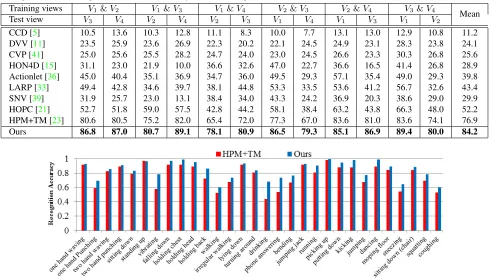
[image:7.612.312.541.281.467.2] [image:7.612.54.284.373.605.2]simi-Table 2: Comparison of action recognition accuracy (%) on the UWA3D Multiview ActivityII dataset. Each time two views are used for training and the remaining two views are individually used for testing.
Training views V1&V2 V1&V3 V1&V4 V2&V3 V2&V4 V3&V4
Mean
Test view V3 V4 V2 V4 V2 V3 V1 V4 V1 V3 V1 V2
CCD [5] 10.5 13.6 10.3 12.8 11.1 8.3 10.0 7.7 13.1 13.0 12.9 10.8 11.2
DVV [11] 23.5 25.9 23.6 26.9 22.3 20.2 22.1 24.5 24.9 23.1 28.3 23.8 24.1
CVP [41] 25.0 25.6 25.5 28.2 24.7 24.0 23.0 24.5 26.6 23.3 30.3 26.8 25.6
HON4D [15] 31.1 23.0 21.9 10.0 36.6 32.6 47.0 22.7 36.6 16.5 41.4 26.8 28.9 Actionlet [36] 45.0 40.4 35.1 36.9 34.7 36.0 49.5 29.3 57.1 35.4 49.0 29.3 39.8
LARP [33] 49.4 42.8 34.6 39.7 38.1 44.8 53.3 33.5 53.6 41.2 56.7 32.6 43.4
SNV [39] 31.9 25.7 23.0 13.1 38.4 34.0 43.3 24.2 36.9 20.3 38.6 29.0 29.9
HOPC [21] 52.7 51.8 59.0 57.5 42.8 44.2 58.1 38.4 63.2 43.8 66.3 48.0 52.2
HPM+TM [23] 80.6 80.5 75.2 82.0 65.4 72.0 77.3 67.0 83.6 81.0 83.6 74.1 76.9
Ours 86.8 87.0 80.7 89.1 78.1 80.9 86.5 79.3 85.1 86.9 89.4 80.0 84.2
Figure 5:Per class recognition accuracy of our proposed method and HPM+TM [23] on the UWA3D Multiview ActivityII [20] dataset.
larity among actions. Moreover, in the top view, the lower part of the body was not properly captured because of oc-clusion. Figure4shows four sample actions observed from 4viewpoints.
We follow [20] and use the samples from two views as training data, and the samples from the remaining views as test data. Table 2 summarizes our results. Our pro-posed model significantly outperforms the state-of-the-art methods on all view pairs. The overall accuracies of depth based methods, such as HOPC [20] and CCD [5], and Depth+Skeleton based methods, such as HON4D [15], SNV [39], and Actionlet [36], are low because depth ap-pearances of many actions look very different across view changes. However, our method achieves 84.2% average recognition accuracy which is about7.3%higher than than the nearest competitor, HPM+TM [23].
Figure5 compares the class specific action recognition accuracies of our proposed approach and the nearest com-petitor, HPM+TM [23]. The proposed method achieves better recognition accuracy on all action classes exclud-ing standing up. For example, our method achieves 24% and20%higher accuracies than HPM+TM [23] for drink-ingandphone answering, respectively. This is because our proposed model is able to capture the interactions between human body-parts and environmental objects.
Notice that for many actions in the UWA3D Multiview ActivityII dataset such asholding chest, holding head, hold-ing back, sneezhold-ing andcoughing, there are no similar ac-tions in the CMU mocap dataset. However, our method still achieves high recognition accuracies for these actions. This demonstrates the effectiveness and generalization ability of our proposed model.
5. Conclusion
We proposed an end-to-end learning model for action recognition from depth and skeleton data. The proposed model learned to fuse features from depth and skeletal data, capture the interactions between body-parts and/or interac-tions with environmental objects, and model the temporal structure of human actions in an end-to-end learning frame-work. In order to make our method robust to viewpoint changes, we introduced a deep CNN which transfers vi-sual appearance of human body-parts acquired from differ-ent unknown views to a view-invariant space. Experimdiffer-ents on two large benchmark datasets showed that the proposed approach outperforms existing state-of-the-art.
[image:8.612.52.545.93.371.2]References
[1] Blender: a 3D modelling and rendering package. http: //www.blender.org/. 4
[2] CMU motion capture database. http://mocap.cs. cmu.edu/.4
[3] MakeHuman: an open source 3D computer graphics soft-ware.http://www.makehuman.org/.4
[4] H. Bilen, B. Fernando, E. Gavves, A. Vedaldi, and S. Gould. Dynamic image networks for action recognition. InCVPR, 2016.6
[5] Z. Cheng, L. Qin, Y. Ye, Q. Huang, and Q. Tian. Human daily action analysis with multi-view and color-depth data. InECCVW, 2012.6,8
[6] Y. Du, W. Wang, and L. Wang. Hierarchical recurrent neu-ral network for skeleton based action recognition. InCVPR, 2015.1,2,6,7
[7] B. Fernando and S. Gould. Learning end-to-end video clas-sification with rank-pooling. InICML, 2016.2,6
[8] Y. Gao, O. Beijbom, N. Zhang, and T. Darrell. Compact bilinear pooling. InCVPR, 2016.5
[9] Z. Huang, C. Wan, T. Probst, and L. V. Gool. Deep learn-ing on Lie groups for skeleton-based action recognition. In
CVPR, 2017.2,6,7
[10] D. Q. Huynh. Metrics for 3D rotations: Comparison and analysis. Journal of Mathematical Imaging and Vision, 35(2):155–164, 2009.4
[11] R. Li and T. Zickler. Discriminative virtual views for cross-view action recognition. InCVPR, 2012.6,8
[12] J. Liu, A. Shahroudy, D. Xu, and G. Wang. Spatio-temporal LSTM with trust gates for 3D human action recognition. In
ECCV, 2016.1,2,3,6,7
[13] Z. Luo, B. Peng, D.-A. Huang, A. Alahi, and L. Fei-Fei. Unsupervised learning of long-term motion dynamics for videos. InCVPR, 2017.6,7
[14] E. Ohn-Bar and M. Trivedi. Joint angles similarities and HOG2for action recognition. InCVPRW, 2013.6
[15] O. Oreifej and Z. Liu. HON4D: histogram of oriented 4D normals for activity recognition from depth sequences. In
CVPR, 2013.1,2,6,7,8
[16] N. Pham and R. Pagh. Fast and scalable polynomial kernels via explicit feature maps. InProceedings of the 19th ACM SIGKDD Int. Conf. on Knowledge Discovery and Data Min-ing, 2013.5
[17] H. Rahmani, D. Q. Huynh, A. Mahmood, and A. Mian. Discriminative human action classification using locality-constrained linear coding.Pattern Recognition Letters, 2016.
1
[18] H. Rahmani, A. Mahmood, D. Huynh, and A. Mian. Ac-tion classificaAc-tion with locality-constrained linear coding. In
ICPR, 2014.1
[19] H. Rahmani, A. Mahmood, D. Q. Huynh, and A. Mian. Real time action recognition using histograms of depth gradients and random decision forests. In WACV, pages 626–633, 2014.1,3
[20] H. Rahmani, A. Mahmood, D. Q. Huynh, and A. Mian. His-togram of oriented principal components for cross-view ac-tion recogniac-tion.TPAMI, 2016.1,2,6,7,8
[21] H. Rahmani, A. Mahmood, D. Q Huynh, and A. Mian. HOPC: Histogram of oriented principal components of 3D pointclouds for action recognition. InECCV, 2014.1,2,8
[22] H. Rahmani and A. Mian. Learning a non-linear knowledge transfer model for cross-view action recognition. InCVPR, 2015.1
[23] H. Rahmani and A. Mian. 3D action recognition from novel viewpoints. InCVPR, 2016.1,2,4,5,6,8
[24] H. Rahmani, A. Mian, and M. Shah. Learning a deep model for human action recognition from novel viewpoints.TPAMI, 2017.1
[25] A. Shahroudy, J. Liu, T.-T. Ng, and G. Wang. NTU-RGB+D: A large scale dataset for 3D human activity analysis. In
CVPR, 2016.1,2,3,6,7
[26] A. Shahroudy, T.-T. Ng, Y. Gong, and G. Wang. Deep multimodal feature analysis for action recognition in rgb+d videos.TPAMI, 2017.1
[27] A. Shahroudy, T.-T. Ng, Q. Yang, and G. Wang. Multimodal multipart learning for action recognition in depth videos.
TPAMI, 2016.1,3
[28] J. Shotton, A. Fitzgibbon, M. Cook, T. Sharp, M. Finocchio, R. Moore, A. Kipman, and A. Blake. Real-time human pose recognition in parts from single depth images. In CVPR, pages 1297–1304, 2011. 1,2
[29] S. Song, C. Lan, J. Xing, W. Zeng, , and J. Liu. An end-to-end spatio-temporal attention model for human action recog-nition from skeleton data. InAAAI, 2017.6,7
[30] S. Tang, X. Wang, X. Lv, T. Han, J. Keller, Z. He, M. Skubic, and S. Lao. Histogram of oriented normal vectors for object recognition with a depth sensor. InACCV, 2012.2
[31] A. Vedaldi and K. Lenc. MatConvNet - Convolutional Neu-ral Networks for MATLAB. InACM International Confer-ence on Multimedia, 2015.6
[32] V. Veeriah, N. Zhuang, and G. Qi. Differential recurrent neu-ral networks for action recognition. InICCV, 2015.3
[33] R. Vemulapalli, F. Arrate, and R. Chellappa. Human action recognition by representing 3D skeletons as points in a Lie group. InCVPR, 2014.1,2,3,6,7,8
[34] R. Vemulapalli and R. Chellappa. Rolling rotations for rec-ognizing human actions from 3d skeletal data. In CVPR, 2016.1,2,6,7
[35] J. Wang, Z. Liu, Y. Wu, and J. Yuan. Mining actionlet en-semble for action recognition with depth cameras. InCVPR, pages 1290 –1297, 2012.1
[36] J. Wang, Z. Liu, Y. Wu, and J. Yuan. Learning actionlet ensemble for 3D human action recognition. PAMI, 2013. 1,
3,6,8
[37] L. Xia and J. Aggarwal. Spatio-temporal depth cuboid simi-larity feature for activity recongition using depth camera. In
CVPR, 2013.1,2
[38] X. Yang and Y. Tian. Eigenjoints-based action recognition using naive bayes nearest neighbor. InCVPRW, 2012.1,2
[39] X. Yang and Y. Tian. Super normal vector for activity recog-nition using depth sequences. InCVPR, 2014. 1,2,6, 7,
8
[41] Z. Zhang, C. Wang, B. Xiao, W. Zhou, S. Liu, and C. Shi. Cross-view action recognition via a continuous virtual path. InCVPR, 2013.6,8
![Table 1: Comparison of action recognition accuracy (%) onthe the NTU RGB+D dataset [25].](https://thumb-us.123doks.com/thumbv2/123dok_us/9380742.440939/7.612.54.284.373.605/table-comparison-action-recognition-accuracy-onthe-ntu-dataset.webp)