Economics Working Paper Series
2017/023
Robust Toll Pricing
Trivikram Dokka, Alain Zemkoho, Sonali SenGupta,
and Fabrice Talla Nobibon
The Department of Economics Lancaster University Management School
Lancaster LA1 4YX UK
© Authors
All rights reserved. Short sections of text, not to exceed two paragraphs, may be quoted without explicit permission,
provided that full acknowledgement is given.
Robust Toll Pricing
∗
Trivikram Dokka
†1, Alain Zemkoho
‡2, Sonali SenGupta
§3,
and Fabrice Talla Nobibon
¶41
Department of Management Science, Lancaster University,
United Kingdom
2
Department of Mathematics, University of Southampton,
United Kingdom
3
Department of Economics, Lancaster University, United
Kingdom
4
Fedex Europe, Brussels, Belgium
September 11, 2017
Abstract
We study a robust toll pricing problem where toll setters and users have different level of information when taking their decisions. Toll setters do not have full information on the costs of the network and rely on historical information when determining toll rates, whereas users decide on the path to use from origin to destination knowing toll rates and having, in addition, more accurate traffic data. In this work, we first consider a single origin-destination parallel network and
∗A preliminary version of this work has appeared in Proceedings of ATMOS’2016 with
titlePricing toll roads under uncertainty.
†Email: [email protected]; Corresponding author
‡Email: [email protected]; The work of this author is supported by the EPSRC grant with reference EP/P022553/1
formulate the robust toll pricing problem as a distributionally robust optimization problem, for which we develop an exact algorithm based on a mixed-integer programming formulation and a heuristic based on two-point support distribution. We further extend our formula-tions to more general networks and show how our algorithms can be adapted for the general networks. Finally, we illustrate the usefulness of our approach by means of numerical experiments both on randomly generated networks and on the road network of the city of Chicago.
keywords: Toll-pricing; Conditional value at risk; Robust optimization
1
Introduction and Literature
1.1
Introduction
Road networks played a crucial role in economic and social development act-ing as trade enablers. Hence they find an important place in every govern-ment’s policies. There has been much debate on how roads building should be funded. Traditionally it has been the case that roads were built and maintained by the funds collected from the public in the form of taxes. How-ever, many economists, researchers and policymakers questioned this practice Lindsay (2006). The main critique being that significant proportion of the
tax payers may not be using the road being built. In fact, in his book The
type of model after the introduction of the amendment of National Highway Act 1956 in the year 1995, which enabled private investors participation in highway construction and maintenance, see Singh and Kalidindi (2006) and references therein. Typically these projects employ build-operate-transfer model. Here the investing company enters in a contract with government to build a road/highway. In return of the investment, the company is allowed to collect tolls for an agreed period of time before the transfer of ownership to government. In fact, tolls have become a primary way to encourage pri-vate investment in public infrastructure; see Brown (2005). There are both successes and failures of this model. One of the notable examples is the M6 toll between Cannock and Coleshill, which opened in 2003. According to a BBC News Report, “the company operating M6 toll made a 1 million pound loss in the year 2012”,“drivers have said the road is underused because of its prices”. Therefore, a key element to the success of this model is the revenue generated from tolls. The investor company’s main objective is to maximize the revenue from tolls. Hence the “right” toll price can be the defining factor to the success of the project. The key to a successful revenue maximization pricing mechanism lies in understanding the network users options compared to the toll road.
In Labb´e et al. (1998), a bilevel model is proposed to capture the
other hand users have full (or reasonbly accurate) information before they make their decisions.
In this work we study a robust toll-pricing mechanism which aims to minimize the risk of the toll-setter against this uncertainty. In doing so, we use the ideas from robust optimization literature and show that our ap-proach is very near to the conditional value-at-risk apap-proach used in portfolio optimization and other problems.
1.2
Literature
Profit and revenue maximization problems over a transportation network are given much attention in pricing literature, see for eg., van Hoesel (2008), Bouhtou et al. (2007b), Karakostas and Kolliopoulos (2004) to name a few. Within a huge body of papers, many have studied the application of bilevel
programming paradigm to pricing problems, such as Labb´e et al. (1998); and
many subsequent papers, Cot´e et al. (2003), Bouhtou et al. (2007a), Heilporn
et al. (2010), Myklebust et al. (2016), Dempe and Zemkoho (2012) applied bilevel framework to several different application areas. A deterministic
ver-sion of the problem we study in this paper has been investigated in Labb´e
et al. (1998), Brotcorne et al. (2000), Labb´e and Violin (2013), Heilporn
et al. (2011, 2009), van Hoesel (2008), Bouhtou et al. (2007b). However, the stochastic extensions of the problem have gained more interest only in
recent years. Two different stochastic extensions of the model in Labb´e et al.
studies where robust optimization framework is applied to pricing problems, in Violin (2014) and Gardner et al. (2010). In both these works the models considered are different from our model and problem setting. Furthermore, the budgeted uncertainty model considered in Violin (2014) gives tractable models but may not be best in terms of robustness as found in Dokka and Goerigk (2017). Understanding the pricing problem in parallel networks will provide useful insights into the complexity of pricing for more general net-works involving more commodities and with variable demands. As we will show that the ideas we propose in this work will provide a basis for solving toll-pricing problem in more general networks.
The broader scope of the paper is to propose a bilevel type methodology to pricing problems with limited pricing (or price revising) power. Within this broader scope we are mainly inspired by the toll pricing problem faced by a risk averse toll setter. Our aim in this work is to provide a better under-standing of the toll-pricing problem faced by a risk-averse toll-setter when there is uncertainty on non-toll costs. We use the framework of distributional robustness which is very useful in making optimal decisions under limited or imprecise information, see Goh and Sim (2010) for recent developments on distributionally robust optimization. Our work also fits into the emerging literature on general static and dynamic pricing that studies pricing problem faced by a seller with insufficient information about demand. Bergemann and Schlag (2008) and Bergemann and Schlag (2011) study robust static pricing problems who formulate the problem as minmax regret problem. Within the dynamic pricing literature we mention here Besbes and Zeevi (2009), van den Boer and Zwart (2015), Lim and Shanthikumar (2007), Keskin and Zeevi (2014), van den Boer and Zwart (2014). Also see the survey on studies on dynamic pricing in van den Boer (2015). While most of this literature studies dynamic pricing and learning and earning problems, to the best of our knowledge none take into consideration of the case when seller has limited price revising opportunity due to price controls imposed.
character-istics of our robust model; Section 5 gives the numerical performance of two point algorithm on simulated and real data sets; Extensions and future work are discussed in Section 6.
2
Problem definition
We will first describe the deterministic pricing model as used in Labb´e et al.
(1998). We consider a single-commodity transportation network with a single
origin and single destination,G= (N, A), whereN (of cardinalityn) denotes
the set of nodes, and A (of cardinality m) the set of Arcs. The arc set A of
the network G is partitioned into two subsetsA1 and A2, where A2 denotes
the set of roads which are toll-free (public roads), and A1 the set of roads
which are owned by a toll-setter (toll roads). There can be two parallel roads
between any two nodes in G.
With each toll arcainA1, we associate a generalized travel cost composed
of two parts: toll (ra) - set by toll-setter expressed in time units, and non-toll
cost (ca) - which in our case varies over time (discretized into unit intervals).
An arc a ∈ A2 only bears the non-toll cost ca. Once the toll is set on arcs
in A1, it cannot be changed for T consecutive time periods. We will refer
to T consecutive time periods in which toll is fixed as tolling period. At the
end of the tolling period toll setter may be able to revise his price. However, in this paper we only consider static pricing problem which can still be used in dynamic case but does not explicitly optimize pricing decisions over time.
We denote b ∈ Rn the fixed demand, with the assumption that all nodes
except origin and destination nodes have a demand equal to 0. Assuming fixed demand and neglecting congestion implies users choose shortest paths between the origin and destination. Further we assume that when faced with two equal alternatives a user will choose the one which maximizes the revenue of toll-setter. Another key assumption is that it allows conversion from time to money and assumes it to be uniform throughout the users. In other words, this can be seen one user using network every time period. Under this setting when the non-toll costs are known to both toll-setter and user the question
toll-setter faces is:How to set prices which maximizes the total toll revenue
when the network user chooses shortest path to minimize his cost?
The deterministic problem is well understood both conceptually and algo-rithmically. Our focus in this paper will be to extend the above deterministic
un-certainty model and assumptions are as follows:
• In our model toll-setter has the historical information encoded in the
form of previously observed states. A state s corresponds to an
ob-served state of the network in a single time period. In other words, in
each state s the non-toll cost on each arca∈A is fixed denoted as cs
a.
The advantage of modeling uncertainty in this way is that correlations between different arcs of network are captured in the states.
• The number of states equals to #H×T. That is, toll-setter observes
#H tolling periods. Hereafter we will writeT for the rest of all tolling
periods assuming toll setter cannot change his price in the future.
• We assume the variability on each arc is bounded, that is the
variance-to-mean ratio for the toll period is bounded by a constant which is unknown to the toll-setter. This is usually the case in real world net-works.
• The cost distribution (unknown to toll-setter) of each arc is assumed
to be fixed and belongs to a set of non-negative distributions D with
support in Ω = [q, Q]. Given the bounded variability assumption it
is reasonable to assume fixed support. One can also consider different supports for different arcs, however, we see Ω as the aggregated support set.
Given this setting our aim is to answer the following question faced by a toll-setter:
How to set toll prices under uncertainty of non-toll costs, when network costs are random with unknown distribution?
We will now study robust pricing methodologies to answer this question. Starting with a simple two link parallel network we first review more popular robust methodology and then propose a new robust methodology.
3
Robust Model
of exposition that the non-toll costs on the toll arc are zero or negligible. We will later remove this assumption and show the method can be extended to such a case. As mentioned in previous section toll-setter has a sample
of costs of #H tolling periods from the recent history. Using this sample,
toll-setter wishes to calculate the toll on the toll arc. Hereafter, we will refer
to non-toll arc as a. In the rest of the section we will drop the suffix a for
the ease of notation and readability. If toll-setter knows the distribution F
(we denote the density ofF withF) ofcthen to fix the toll which maximizes
his expected revenue he solves the following optimization problem which maximizes his expected revenue:
max
r∈Ω
Z Q
r
rF(c)dc. (1)
To solve this problem note that we can rewrite the objective as r[1−
Rr
q F(c)dc]. We can solve the problem by equating the first derivative which
is 1−Rr
q F(c)dc+rF(r)
to 0. For example if F is uniform distribution
with support Ω then r is obtained by solving Q−qr−q +rQ−q1 = 1, which implies
revenue maximizing integer toll is Q2.
In the absence of this knowledge, a risk -averse toll-setter would prefer to insure his revenues by setting tolls such that the usage of toll arc is maximized as much as possible. On the other hand, setting toll too low, for example
close to q, will result in high usage but does not necessarily mean better
revenue as setting it to a higher price may give much better revenue. Setting it too high may mean no usage and loss of revenues. Suppose that, toll-setter first decides his toll and then nature, who plays adversary to toll-setter, will
decide on F. Then toll-setter wishes to calculate a robust toll price which
maximizes his revenue by solving the following optimization problem.
max
r∈Ω
RQ
r rF(c)dc
s.t. min
F∈D
RQ
r rF(c)dc
s.t. u≤µF(c)≤u (2)
σ2
F(c)≤κµF(c)
Here the parametersu,uare calculated as confidence limits of mean;κis
controlling the risk averseness of toll setter. This belief can change over time
and possibly converge to κ. Assuming an adversarial nature is very
com-mon in robust optimization and online optimization literature, for example it has been used in Bergemann and Schlag (2008) and Lim and Shanthikumar
(2007). We will refer to this as AN model. Note that the constraints in (2)
correspond mainly to nature’s problem i.e., to find a distribution satisfying mean (or moment) constraint. The second constraint limits the possible dis-tributions by using the assumption of bounded variability. Such a situation with sufficiently high allowed variability gives too much power to
adversar-ial nature forcing toll-setter (to be too conservative) to set very low r if
he chooses to be robust against all possible F ∈ D. To avoid such
over-conservativeness, we propose to consider that nature does not play such a role. Instead nature’s objective is to minimize the overall expected cost of the network user, that is:
Z Q
r
rF(c)dc+
Z r
q
cF(c)dc, (3)
where the first term is the expected cost of travel on toll road and second term is expected cost on non-toll road. Toll-setter then solves the following
bi-level distributionally robust program to find the robust r:
maxr∈Ω
RQ
r rF(c)dc
minF∈D
RQ
r rF(c)dc+
Rr
q cF(c)dc
s.t. u≤µF(c)≤u (4)
σ2
F(c)≤κµF(c)
We refer to the model (4) as UFN model. To illustrate the difference
between nature’s role in formulations (2) and (4), consider the following example.
Suppose Ω = [1,100] and r = 90, consider two distributions: F1 puts 0.45
probability mass on 89, 0.5 on 109 and 0.05 on 110; F2 puts 0.135 probability
mass on 75 and 0.865 on 104. Between these two distributions a nature with objective in (2) will choose first strategy whereas in (4) nature will choose the second one as it minimizes expected cost of the user which is 87.975 for
The main motivation behind our model comes from the deterministic bilevel model where, under full information, toll-setter and user have con-flicting objectives. However, user’s objective is not to make his decisions to decrease toll-setter’s revenue but to minimize his own cost. Similarly, in our model the lower level decision maker is acting to minimize the expected cost of user by choosing a distribution which is consistent with the observed mean.
Another way of interpreting UFN model is as follows: the distributions available to nature in the lower level problem can be seen as willing-to-pay (WtP) distributions of different users whose mean is consistent with the toll-setter’s belief. In the lower level, by choosing a user whose expected WtP is minimum, toll-setter is taking robust decision by choosing a toll which maximizes his revenue from the user with worst expected WtP.
We will now relate UFN model with worst-case conditional value-at-risk (CVaR) optimization. To do this we first rewrite the objective function using
the assumption of fixed support and then introduce a parameter similar to
the risk level in CVaR.
Let us start with rewriting the objective function, since we consider F
with support in Ω, we can use RrQF(c)dc+RqrF(c)dc = 1 and rewrite the
nature’s objective function as
Z Q
r
rF(c)dc+
Z r
q
cF(c)dc =r(1−Rr
q F(c)dc) +
Rr
qcF(c)dc
=r−Rr
q(r−c)F(c)dc (5)
Consider now the following function,
f(r, F) =
r− 1
(1−)
Z r
q
(r−c)F(c)dc
,
where ∈ (0,1). Observe that f is nothing but nature’s objective with an
additional term involving . We have the following property of f
Proposition 1 For a fixed F ∈ D and ∈ (0,1), f(r, F) is concave and continuously differentiable, and the maximum of f is attained at r ∈Ωsuch that Rc≤rF(c)dc=1−.
Proof Let G(r) = Rr
q(r −c)F(c)dc. From Lemma 1 of Rockafeller and
Fundamental theorem of calculus and using differentiation by parts, we can
derive G0(r) = Rc≤rF(c)dc. This implies ∂f∂r = 1− 1
(1−)
R
c≤rF(c)dc, which
proves the statement.
Proposition 1 implies that if the distribution of cis known to F and toll
setter is interested in finding a toll such that the toll road is used (100×)
percent of times in expectation then he should set toll equal to r which
satisfies R
c≤rF(c)dc=1−. That is, should be interpreted as probability
that toll road is used at price r. In other words, given F when toll-setter
decides toll according to (1) he indirectly also chooses this probability. This implies that the bi-level problem in (4) can be written as a parametric single
level problem with a max-min objective with parameter as follows:
maxr∈Ω;∈[0,1]minF∈D r− 1−1
RQ
q max(r−c,0)F(c)dc
s.t. u≤µF(c)≤u (6)
σ2F(c)≤κµF(c)
For a fixedF the objective function in f is very similar to the concept of
Conditional-Value-at-Risk, which has been applied to portfolio optimization problems in Rockafeller and Uryasev (2000). In fact, our problem formu-lation is similar to worst-case conditional value-at-risk studied in Zhu and Fukushima (2009) and more recently in Toumazis and Kwon (2015).
In the rest of the paper we assume time is discretized and we consider the discrete version of (4) with nature’s objective rewritten using fixed support
and can be seen as nature optimizing over samples C drawn from
distribu-tions in D:
max
r∈Ω r
h
1
T
PT
i=1Ir≤ci
i
min
C∈ΩT
h
r− 1
T
PT
i=1max(r−ci,0)
i
s.t. u≤µF(c)≤u (7)
σ2F(c)≤κµF(c)
3.1
Inner/Nature’s problem
For a fixed value of toll price r the inner problem in (7) is a minimization
problem with a concave objective function. Concave minimization problem are hard to solve, for some recent work on minimizing quasi-concave mini-mization over convex sets see Goyal and Ravi (2013) and references therein. To solve the inner problem in (7) we reformulate the inner problem as the fol-lowing non-convex integer programming problem by introducing additional variables:
min
C∈ΩT
h
r− 1
T
PT
i=1zi
i
(8)
s.t. u≤µ(c)≤u (9)
σ2(c)≤κµ(c) (10)
ci−r+zi ≥0 i= 1, . . . , T (11)
r−ci+M yi ≥0 i= 1, . . . , T (12)
zi ≤M(1−yi) i= 1, . . . , T (13)
zi−(r−ci)(1−yi)≤0 i= 1, . . . , T (14)
Y ∈ {0,1};C, Z ≥0 (15)
Note that forM in the above formulation any value greater than or equal
to Q suffices which gives our next theorem:
Theorem 2 For a fixed r, (8)-(15) is a valid reformulation of the inner problem of (7).
Proof Constraints (11) - (13) ensure that yi = 0 when r > ci and yi = 1
otherwise, and (13)- (14) ensure zi = max[r−ci,0].
The only non-convex constraint apart from integrality constraints in the above formulation is (14). We linearize this by introducing two additional
sets of variables as follows. Replace the product terms ryi and ciyi in this
constraint by variables ui and vi and then add constraints (23)-(28). After
min
C∈ΩT
h
r− 1
T
PT
i=1zi
i
(16)
s.t. u≤µ(c)≤u (17)
σ2(c)≤κµ(c) (18)
ci−r+zi ≥0 i= 1, . . . , T (19)
r−ci+M yi ≥0 i= 1, . . . , T (20)
zi ≤M(1−yi) i= 1, . . . , T (21)
zi−r+ci+ui−vi ≤0 i= 1, . . . , T (22)
ui ≤M yi i= 1, . . . , T (23)
vi ≤M yi i= 1, . . . , T (24)
vi ≤ci i= 1, . . . , T (25)
ui ≤r i = 1, . . . , T (26)
r−M(1−yi)≤u≤r i = 1, . . . , T (27)
Y ∈ {0,1};C, Z, U, V ≥0 (28)
Theorem 3 (16)-(28) is a valid reformulation of (8)-(15).
Proof To see this is true note that for every solution to (8)-(15) we can
create an equivalent solution to (16)-((28)) by taking the C, Z, Y values
as they are and putting ui = r and vi = ci for every i with yi = 1 and 0
otherwise.
For a fixed r, (16) - (28) can be solved using a state of the art commercial
solver like CPLEX and more specialized algorithms are also conceivable ow-ing to tremendous success and availability of techniques for solvow-ing convex quadratic integer programs in last few years. We will now look at solving the toll setting problem.
3.2
Solution Algorithms
3.2.1 Exact Algorithm
Proposition 1 implies that for a fixed ∈ {1
T,
2
T, . . . ,1} we can add the
con-straint (29) to (16) - (28) and solve the inner problem treating r as variable.
This will give us a maximum price to have toll road used T times. We will
formally give this in Algorithm 1.
X
i
yi
T ≤ (29)
Algorithm 1 Robust Toll Algorithm
INPUT: u, u,κ
R=φ for ∈ {1
T,
2
T, . . . ,1}do
Solve (16) - (28) +
P
iyi
T ≤
Let r be solution output;r ∈R
end for
OUTPUT: r = arg maxr
3.2.2 Two-point Heuristic
The formulation given in (16)-(28) can be hard to solve and can be time consuming when using the generic solvers like CPLEX. Of course, one can derive efficient algorithms using branch and bound and/or other methodolo-gies. In this section, however, we focus on constructing a simple approximate solution to toll pricing problem. In our computational experience of solving (16) using CPLEX we found that in all cases the solution found has two-point support. That is, the vector of costs returned by CPLEX has exactly two distinct values. If we restrict to the distributions with two-point support
{`, u}, assuming `≤r≤u, the nature’s problem (16)-(28) can be written as
min
`∈Ω,u∈Ω;λ∈[0,T]r(T −λ) +`λ
s.t.(T −λ)u+λ`=µT u≤µ≤u
Suppose that we fixµ=u, we can write the problem of finding of {`, u}
as
min
`∈Ω,u∈Ω;λ∈[0,T]r(T −λ) +`λ
s.t.(T −λ)u+λ`=µT
λ(`−µ)2+ (T −λ)(u−µ)2 ≤κµ(T −1)
Eliminatingu, we get
min
`∈Ωλ∈[0,T]rT −λ(r−`) (30)
s.t.λ(`−µ)2+ (T −λ)([µT −λ`
(T −λ)]−µ)
2 ≤κµ(T −1)
For a fixed λ, the objective function in (30) is linear in ` with a positive
slope. This implies that the solution to (30) simply is the lowest value
satis-fying the inequality in (30) and u∈Ω. Using this observation we now give a
simple algorithm for finding a two-point solution to (16). Hereafter we will
denote the integers in Ω by ¯Ω.
Algorithm 2 approximately solves by searching for all values of λ, where
obj is the objective in (30). Note we search for ` ∈ Ω, this is for numerical¯
simplification and moreover given thatr ∈Ω this will only result in minor loss¯
in terms of approximation. Note that the heuristic presented in Algorithm
2 is aimed mainly for a quick solution where we fix µ = u and κ = κ and
the run-time complexity of algorithm is O(|Ω¯|2). We now prove that the
optimal solution to the nature’s problem for a fixed toll is indeed a two-point distribution.
Theorem 4 The optimal solution to nature’s problem is always a two-point distribution.
Proof From Popescu (2007) it is enough to consider three-point distribu-tions. In Birge and Dula (1991), it is shown that a two point distribution
(z, r3) with the same mean and variance as the three point distribution can
be found, where r1 < z < r2. Suppose that the optimal three point
Algorithm 2 Two Point Algorithm
INPUT: u, κ
Set BR(r) = 0 for all r ∈Ω¯\u;BR(u) = 1
for r ∈Ω¯ do λ =T −1,µ=u while λ ≥1do
`= 0
while ` < µdo u= ((µ×T(T)−λ−(λ×`) ))
if u≤Q and λ(`−µ)2+ (T −λ)([µT−λ`
(T−λ)]−µ)
2 ≤κµ(T −1)then
if obj >(λ×`+ (T −λ)×r) then obj = (λ×`+ (T −λ)×r)
BR(r) =r×(T −λ)
end if
break
else
`=`+ 1
end if end while λ=λ−1
end while end for
a two-point distribution 2D = (z, r3) with probabilities (p1 +p2, p3) with
r1 < z < r3 with the same mean and variance at most that of 3D.
The variance of 2D is at most that of 3D. To see this note that the following inequality is true:
p1(z−r1)
p2(r2−z)
≤ r2+z
r1+z
, (31)
LHS is equal to 1 due to equivalence of means and RHS is clearly ≥ 1.
Rearranging terms and adding p3r32 on both sides we get,
(p1+p2)z2+p2r32 ≤p1r12+p2r22+p3r32. (32)
To show that 2D has a lower expected cost we need to show that
(p1+p2)g(z) +p3g(r3)≤p1g(r1) +p2g(r2) +p3g(r3) (33)
where g(x) =r if x≥r and x otherwise.
Consider first the case when r = r2. From the equivalence of means we
have
p1(z−r1) = p2(r−z) (34)
rearranging and adding p3r on both sides we get
(p1+p2)z+p3r=p1r1+p2r2+p3r (35)
which is (33).
The case when r2 < r follows using a similar reasoning as above. Now
consider the case when r2 > r. It is enough to observe that increasing r to
r2 will not change nature’s optimal action 3D, in which case setting r to r2
gives improved revenues to toll setter with same nature’s response.
4
Characteristics of UFN model
4.1
Discrete costs
Given that we are inspired mainly by toll prices it should be noted that in many cases prices usually are not any continuous values. Instead, prices are almost always numbers with up to two significant digits. This motivates us to consider the case when Ω is discrete set of prices with minimum price
equal to q and maximum equal to Q. In this case toll pricing problem can
be formulated as following:
maxr∈Ω
P
i≥rxir (36)
minX
P
i≥rxir+
P
i<rxici (37)
s.t. P
ixi = 1 (38)
P
iixi =µ (39)
P
ixic
2
i −µ2 ≤κµ (40)
Wherexi is the probability mass assigned to priceci ∈Ω, first constraint
corresponds to the mean (first moment) constraint and second constraint to the bounded variability. In this case the nature’s problem is simply a linear program, which is easy to solve. Also, using linear programming theory it is easy to note that the optimal solution has at most three support points. However, in numerical experiments we found that in many cases it is either a two point distribution or it is three point distribution with two support points very close to each other. We now use this formulation to illustrate some characteristics of UFN model.
4.2
AN vs UFN
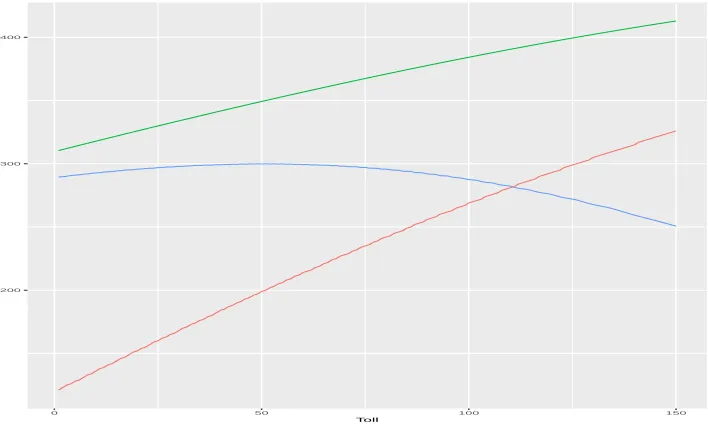
Ω = [0,1000], with tolls changed between 350 and 500, with µ = 500 and
κ = 60. Figure 2 illustrates the changes in the lower support point, revenue
0 100 200 300
0 50 100 150
Toll
Re
ven
ue colour
AN
[image:20.612.117.491.169.379.2]UFN
Figure 1: Comparison of revenues for varying tolls between user-friendly and adversarial nature
and nature’s objective values for the UFN two point distribution as the toll is increased with the same parameters as for Figure 1.
4.3
Impact of
κ
As mentioned in Section3, ¯κ indicates the belief of the toll setter about
the level of uncertainty. In other words a higher value of ¯κ compared to κ
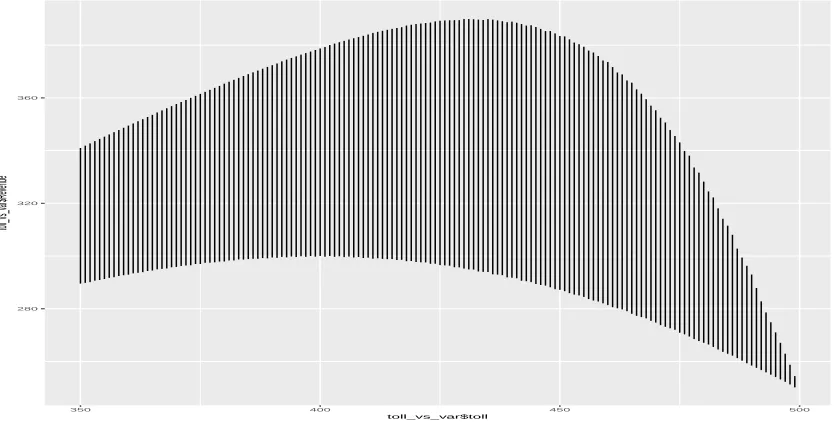
indicates that the toll setter is overly pessimistic. This implies he will try to set a lower toll and hence will have lesser revenue. This is reflected in the illustration given in Figure 3 where we plot revenue from optimal two point UFN distribution as toll and variances are changed with mean kept constant. The vertical line of revenues against each toll value correspond to different variances. The behavior of the revenue curve is such that the maximizing point (w.r.t the two point distribution found) shifts to the left when variance is higher as the toll increases. For the numerical experiment used in Figure
200 300 400
0 50 100 150
Toll
colour
lower
[image:21.612.124.478.126.338.2]Nat_obj Revenue
Figure 2: Change in two-point distribution as toll increases
500, µ= 500 and ¯κ= [5,60]. It is also worth noting, with toll closer to mean
the variation in the revenue is very less with varying ¯κ.
4.4
Normal Distribution - Entropy
In order to assess the performance of UFN model we compared the
distri-bution calculated in the lower level to the case when the distridistri-bution of cis
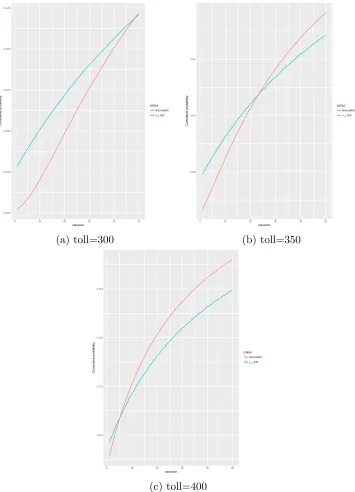
Normal with same mean and variance. Figure 4 gives the change in cumu-lative probabilities, for a fixed toll with same mean but changing variance, of two-point distribution calculated in nature’s problem versus the actual Normal distribution.The mean is set to 500 with variance changing between
10 and 60 with support in [0,1000]. The tolls are set at 300, 350 and 400
for Figures (4a)-(4c) respectively. The plots give cumulative probabilities in both cases, that is cumulative probability in both distributions at toll value.
More formally, plots give PU F N(c≤r) andPN(c≤r) as variance is changed
distri-280 320 360
350 400 450 500
toll_vs_var$toll
toll_vs_v
ar$Re
ven
[image:22.612.117.534.127.338.2]ue
Figure 3: Change in two-point distribution as toll increases
bution of c is Normal given that toll setter has a correct belief about the ¯κ.
We believe this behavior is related to maximum entropy probability dis-tributions. The entropy of a probability distribution represents the amount of uncertainty associated with the distribution. The distribution maximizing the entropy is believed to be a good prior distribution. As observed by Per-akis and Roels (2008) entropy maximization is not a decision making criteria which can be used under uncertainty, it can only be used as selection criteria for selecting a probability distribution within a stochastic model. Also, it is similar to a barrier function (Boyd and van den Berghe (2004)). The entropy of a discrete random variable with a given distribution is defined as,
H(c) = −X
i
p(ci)logp(ci). (41)
Our approach can be related to maximizing entropy by replacing the logp(x)
with g(x). In other words maximizing (minimizing negative of) a similar
measure as entropy. Let Gr(x) be defined as
Gr(c) =
1
D
X
i
0.000 0.025 0.050 0.075 0.100 0.125
0 10 20 30 40 50
variance
Cum
ulativ
e probability
colour
NOrmal300
x_l_300
(a) toll=300
0.05 0.10 0.15
0 10 20 30 40 50
variance
Cum
ulativ
e probability
colour
Normal350
x_l_350
(b) toll=350
0.10 0.15 0.20 0.25
0 10 20 30 40 50
variance
Cum
ulativ
e probability
colour
Normal400
x_l_400
[image:23.612.127.482.132.624.2](c) toll=400
where is Dis some fixed constant, thenG is an approximation ofH for each
value of r. Our approach can be interpreted as approximating H usingG by
choosing r =ci where ci(1−Pci>=rp(i)) is maximized. We wonder if it is
possible to quantify this relationship and leave it for the future study.
5
Computational experiments
We performed two sets of numerical experiments to assess the UFN model, first set of experiments is on simulated data while the second set of experi-ments are performed on real-world traffic data collected by City of Chicago. In Section 5.2 we present our numerical results on simulated data. In Section 5.3 we assess the performance of two point toll algorithm on City of Chicago data.
5.1
Performance metric
A commonly used metric to measure the robustness of an algorithm in pric-ing literature is (relative) regret. We follow this practice and we use the percentage relative regret from using the robust toll which is calculated as follows:
relative regret(%) = optimal revenue - robust toll revenue
optimal revenue
From these experiments we want to understand the answers to the fol-lowing two questions:
• how bad are revenues from robust tolls compared to the optimal
rev-enues?
• how do robust tolls compare to optimal tolls?
In both experiments we used the two-point approximate algorithm to
com-pute the robust tolls, and we set T = 50, #H = 1, and kappa¯ = 1.
5.2
Simulated data
Distribution First parameter second parameter
Beta [2,5] [2,5]
Beta [1,3] [1,3]
Gamma [1,3] [13,15]
Normal [90,110] [10,30]
[image:25.612.173.440.124.214.2]Lognormal [0.1,0.3] [0.1,0.3]
Table 1: Distributions and parameters used
robustness of our procedure under two different experimental set-ups differing in network structure and cost distributions. We explain them below.
• First-Experiment: We consider a parallel network with five parallel links connecting origin to destination. In this set-up we fix the dis-tributions of the links to be same but allow the parameters to vary randomly within a given interval.
• Second-Experiment: We consider the same network as in first but the distributions on each links can be different including parameters.
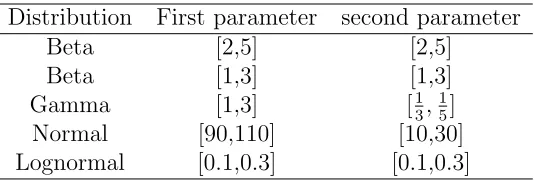
In both experiments we would like to understand the robustness of the two-point toll. The distributions we use are Beta, Gamma, Normal and Lognormal. The parameters for each distribution are selected uniformly from an interval. The parameter intervals are given in Table 1.
We first created 50 samples (history sample), from each distribution which are used to calculate the robust tolls. We then created 2500 random samples from each distribution and computed optimal revenue generating tolls for each of these samples. We compare the revenues from optimal tolls in each of these 2500 samples with revenues when a robust toll is used which is calculated from a sample in history sample. To calculate an optimal toll for
a given instance we try each integer in ¯Ω and select the toll which generates
the most revenue. In total we compare robust tolls with optimal tolls on 125000 samples.
5.2.1 Results and Discussion: Fixed distributions
displays the average percentage relative regret for each of the four distribu-tions. From Table 2 we observe that the robust toll achieves a regret less than 14% in all distributions with except Gamma all other figures below 10%. On the other hand we observed fixing the toll equal to sample mean can have give regret as high as 23%. Furthermore, as seen from standard deviation values variation in regrets is also not large. This suggests that revenues from robust toll compare well especially given the fact that the toll decision is taken with minimal knowledge about the network cost distributions.
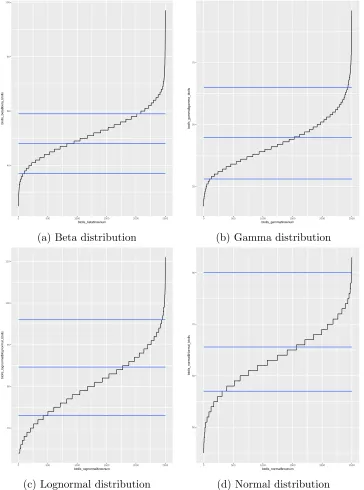
As previously pointed out a measure of robustness of the toll is how it compares with the optimal revenue generating tolls. Figure 5a-5d displays the comparison of minimum, maximum and average values of tolls over the 50 history samples, and optimal revenue generating tolls in each of the 2500 samples (sorted in increasing order). From Figure 5a-5d we observe that it is possible that the UFN tolls can be too high or too low especially as seen in Normal distributions. However, the average robust toll compares well with optimal tolls and is very close to average optimal toll in almost all with slightly below average in case of Beta. Also the variability in robust tolls displayed in Table 3 illustrates the robustness of UFN tolls. Figures also
suggest that with a higher #H the variability can be further reduced.
Distribution Average Stdev
Beta 7.62 5.77
Gamma 13.57 12.51
Lognormal 8.31 8.18
[image:26.612.219.391.413.488.2]Normal 7.36 8.12
Table 2: Fixed case: average (%) relative regret
5.2.2 Results and Discussion: Mixed distributions
40 60 80 100
0 500 1000 1500 2000 2500
btolls_beta$rownum
btolls_beta$beta_btolls
(a) Beta distribution
25 50 75
0 500 1000 1500 2000 2500
btolls_gamma$rownum
btolls_gamma$gamma_btolls
(b) Gamma distribution
70 80 90 100 110
0 500 1000 1500 2000 2500
btolls_lognormal$rownum
btolls_lognor
mal$lognor
mal_btolls
(c) Lognormal distribution
50 60 70 80
0 500 1000 1500 2000 2500
btolls_normal$rownum
btolls_nor
mal$Nor
mal_btolls
[image:27.612.125.489.127.617.2](d) Normal distribution
Distribution Robust toll Stdev
Beta 4.94
Gamma 8.56
Lognormal 5.16
Normal 5.13
Table 3: robust toll variation
Distribution Average Stdev
Beta 6.44 5.77
Gamma 10.2 12.51
Lognormal 6.73 8.18
Normal 5.11 8.12
Table 4: Fixed case: average (%) relative regret with average robust toll
optimum revenue generating tolls. The average robust toll is again slightly higher than but very close to the optimal average.
5.3
Real data
In real world the times of travel and hence costs may not have any known distribution which can be analytically expressed and may have seasonality and trends over time. Moreover, model which performs well on simulated data may not perform well on real data as modeling assumptions may not be satisfied. To test our approach on real data which as we explain below is given as travel times on a real road network, we assume the generalized cost is proportional to the time taken. We first explain the details of data
Distribution Average Stdev
Mixed 7.84% 6.2%
40 60 80 100
0 500 1000 1500 2000 2500
btolls_mixed$rownum
btolls_mix
ed$mix
[image:29.612.216.395.126.361.2]ed_btolls
Figure 6: Exp. 3: Comparison of optimal tolls with robust tolls
collection and then give then details of experimental setup and results.
5.4
Data Collection and Cleaning
We used data provided by the City of Chicago1, which provides a live traffic
data interface. We recorded traffic updates in a 15-minute interval over a time horizon of 24 hours for several days between March 28th 2017 to May 13th 2017. A total of 4473 data observations were used.
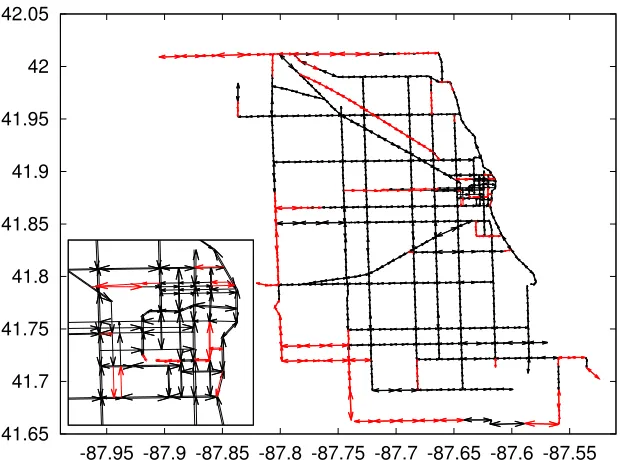
Every observation contains the traffic speed for a subset of a total of 1,257 segments. For each segment the geographical position is available, see the re-sulting plot in Figure 7a with a zoom-in for the city center. There were 1,045 segments where the data was recorded at least once of the 4473 time points. We used linear interpolation to fill the missing records keeping in mind that data was collected over time. The data after removing missing records and
filling missing values can be found at www.lancaster.ac.uk/
dokka/robust-sp-data.zip. Segment lengths were given through longitude and latitude coordi-nates, and approximated using the Euclidean distance.
Robust toll mean-variance toll Robust toll mean-variance toll
Average Average Stdev Stdev
[image:30.612.130.482.125.174.2]6.29% 18.31% 8.59% 9.21%
Table 6: real data: average (%) relative regret
As segments are purely geographical objects without structure, we needed to create a graph for our experiments. To this end, segments were split when they crossed or nearly crossed, and start- and end-points that were sufficiently close to each other were identified as the same node. The resulting graph is shown in Figure 7b; note that this process slightly simplified the network, but kept its structure intact. The final graph contains 538 nodes and 1308 arcs.
5.5
Experimental Setup, Results and Discussion
We assume cost of travel on each road in this network is proportional to the time of travel. Since there are no toll roads in this network which we can use for our experiments we have randomly selected 200 pairs of cities and calculated tolls by imagining a toll road between these each of these pair of cities, under the assumption that non-toll cost is zero or such costs have been adjusted in the costs of the other roads. Of 4473 observations we used 1273 as history and all observations for calculating the regrets in all of 200 cases. The average percentage regret over 200 pairs is given in Table 6. As can be seen the average regret is less than that observed in simulated case. It is noteworthy that unlike the case of simulate data UFN tolls were set higher than optimal for most pairs. Figure 8 illustrates distribution of ratio of UFN tolls over optimal tolls. UFN toll was set roughly 17% higher in extreme case with most tolls within 5% of optimal tolls.
6
Extensions
41.65 41.7 41.75 41.8 41.85 41.9 41.95 42 42.05
-87.95 -87.9 -87.85 -87.8 -87.75 -87.7 -87.65 -87.6 -87.55
(a) Raw segments with zoom-in for the city center. In red are segments without data.
41.65 41.7 41.75 41.8 41.85 41.9 41.95 42 42.05
-87.95 -87.9 -87.85 -87.8 -87.75 -87.7 -87.65 -87.6 -87.55
[image:31.612.152.462.130.360.2](b) Resulting graph model with zoom-in for the city center.
1.00 1.05 1.10
0 50 100 150 200
Instances
Rob
[image:32.612.118.534.247.529.2]ust toll/Optimal toll
6.1
General single commodity networks
Our first extension is to consider UFN in more general single commodity networks.
6.1.1 Multiple parallel arcs
Let us first consider the immediate extension to a network where there are
k non-toll arcs parallel to the toll arc between origin and destination. Let
a1, . . . , ak be the non-toll arcs. We input the mean and variance limits (u, u
and κ) of the data obtained from taking the following minima, minki=1cs
ai to
calculate the two point robust toll.
6.1.2 Multiple parallel arcs with positive non-toll costs on toll arc
Let us now consider the above network when the assumption that the
non-toll costs on non-toll arc are not zero. Let ak+1 be the toll arc. To apply our
method to this case we calculate the mean and variance limits (u, u and κ)
of
k
min
i=1[c
s
ai−c
s
ak+1] (43)
for all s.
6.1.3 General networks with polynomial(in n) number of paths
Consider now a general single commodity network with multiple toll arcs but with few (polynomial) number of paths between origin and destination, for example the network on the left given in Figure 9. To UFN approach we construct an equivalent parallel network is constructed as shown in the right side in Figure 9. For each path in this parallel network with toll arcs we will calculate the state minima given in (43) by ignoring all other paths with toll arcs. That is we calculate the robust toll on each toll path as if that is the only path with toll arcs in the network. This we treat as an upper bound on the total toll on each path. We then solve an integer/linear programming problem to allocate the tolls to individual toll arcs. Suppose
the upper bounds for the paths in the example network in Figure 9 are ς1,
ς2,ς3 respectively from left to right, then we solve the following optimization
max r1+r2+r3||s.t r2+r3 ≤ς1, r1+r2 ≤ς2, r1 ≤ς3, ri ∈Z
O
D
r
1r
2r
3O
D
r
2+ r
3r
1[image:34.612.142.508.202.404.2]
r
1+ r
3Figure 9: General network and an equivalent parallel network
In theory there can be many paths between any two nodes in a network. However, in practice especially in real world transportation networks the number of paths between any two nodes/cities is usually small or limited. Also, many paths between pairs of cities are far from optimal in any of the scenarios, that is they are usually dominated by a few number of paths. We observed this in Chicago data where there may be several paths between two cities but most often it was only few paths which were optimal with many paths never optimal, not even in a single state. So, in practice even if there are many paths we can still use the above approach.
6.2
Dynamic pricing
can be naturally extended to dynamic case where toll setter observes the us-age till latest tolling period and recalculates the toll. To give a first idea we treated the 2500 instances used in our experiments as periods and we fixed toll equal to average of UFN tolls found using 50 history data sets. In Fig-ures (10a)- (10d), we report the cumulative regrets over time. By cumulative
regret we mean regret up to periodtcalculated against a static optimal price.
The assumption of toll setter able to observe the cost may not be true. In Dokka et al. (2017), the UFN model is extended to the case with price controls and toll setter learns the distribution by changing the price dynamically and observing the usage.
Acknowledgements
We would like to thank Martine Labb´e for an interesting discussion on the
topic and also for pointing out references. We thank Marc Goerigk for spot-ting a mistake in an early version of the paper.
References
Alizadeh, S., Marcotte, P., and Savard, G. (2013). Two-stage stochastic bilevel programming over a transportation network. Transportation Research Part B, 58:92–105.
Bergemann, D. and Schlag, K. (2008). Pricing without priors. Journal of European Economic Association., 6(2-3):560–569.
Bergemann, D. and Schlag, K. (2011). Robust monopoly pricing. Journal of Economic Theory., 146(6):2527–2543.
Besbes, O. and Zeevi, A. (2009). Dynamic pricing without knowing the demand function: Risk bounds and near-optimal algorithms. Operations Research., 57(6):1407–1420.
Birge, J. and Dula, J. (1991). Bouding separable recourse functions with limited distribution information. Annals of Operations Research, 30(1):277–298. Bouhtou, M., Erbs, G., and Minoux, M. (2007a). Joint optimization of pricing and
resource allocation in competitive telecommunication networks. Networks, 50(1):37–49.
0.00 0.05 0.10 0.15
0 500 1000 1500 2000 2500
reg_ln$rownum
reg_ln$gamma
colour
gamma
(a) Gamma distribution
0.00 0.02 0.04 0.06 0.08
0 500 1000 1500 2000 2500
reg_ln$rownum
reg_ln$ln
colour
lognorm
(b) Lognormal distribution
0.02 0.04 0.06
0 500 1000 1500 2000 2500
reg_ln$rownum
reg_ln$nor
mal
colour
norm
(c) Normal distribution
0.00 0.01 0.02
0 500 1000 1500 2000 2500
reg_ln$rownum
reg_ln$beta
colour
beta
[image:36.612.128.491.140.632.2](d) Beta distribution
Boyd, S. and van den Berghe, L. (2004). Convex optimization. Operations Re-search, 56(1):188–203.
Brotcorne, L., Labb´e, M., Marcotte, P., and Savard, G. (2000). A bilevel model and solution algorithm for a frieght tariff-setting problem. Transportation Science, 34:289–302.
Brown, C. (2005). Financing transport infrastructure: For whom the road tolls.
Australian Economic Review, 38:431–438.
Cot´e, J.-P., Marcotte, P., and Savard, G. (2003). A bilevel modeling approach to pricing and fare optimization in the airline industry. Journal of Revenue and Pricing Management, 1:23–36.
Dempe, S. and Zemkoho, A. (2012). Bilevel road pricing: theoretical analysis and optimality conditions. Annals of Operations Research, 196:223–240.
Dokka, T. and Goerigk, M. (2017). Experimental evaluation of uncertainty sets for robust shortest path problem. In proceedings of ATMOS 2017, 56(1):188–203. Dokka, T., Jacko, P., and Aslam, W. (2017). Robust dynamic pricing in the
presence of price controls. LUMS working paper., 1:1–20.
Gardner, L., Unnikrishnan, A., and Waller, S. (2010). Solution methods for robust pricing of transportation networks under uncertain demand. Transportation Research Part C, 18:656–667.
Gilbert, F., Marcotte, P., and Savard, G. (2015). A numerical study of the logit network pricing problem. Transportation Science, 49(3):706–719.
Goh, J. and Sim, M. (2010). Distributionally robust optimization and its tractable approximations. Operations Research, 58(4):902–917.
Goyal, V. and Ravi, R. (2013). An fptas for minimizing a class of quasi-concave functions over a convex set. Operations Research Letters, 41(2):191–196. Heilporn, G., Labb´e, M., Marcotte, P., and Savard, G. (2009). A polyhedral study
of the network pricing problem with connected toll arcs. Networks, pages 1–25.
Heilporn, G., Labb´e, M., Marcotte, P., and Savard, G. (2010). A parallel between two classes of pricing problems in transportation and marketing. Journal of Revenue and Pricing Management, 9:110–125.
Heilporn, G., Labb´e, M., Marcotte, P., and Savard, G. (2011). Valid inequalities and branch-and-cut for the clique pricing problem. Discrete Optimization, 8:393–410.
Karakostas, G. and Kolliopoulos, S. (2004). Edge pricing of multicommodity net-works for heterogenous selfish users. FOCS.
model: Asyptotically optimal semi-myopic policies. Operations Research., 62(5):1142–1167.
Labb´e, M., Marcotte, P., and Savard, G. (1998). A bilevel model of taxation and its application to optimal highway pricing. Management Science, 44:1608–1622. Labb´e, M. and Violin, A. (2013). Bilevel programming and price setting problems.
4OR, 11:1–30.
Lim, A. and Shanthikumar, J. G. (2007). Relative entropy, exponential utility, and robust dynamic pricing. Operations Research., 55(2):198–214.
Lindsay, R. (2006). Do economists reach a conclusion? Econ Journal Watch, 3(2):292–379.
Myklebust, T., Sharpe, M., and Tuncel, L. (2016). Efficient heuristic algorithms for maximum utility product pricing problems. Computers and Operations Research, 69:25–39.
Perakis, G. and Roels, G. (2008). Regret in the newsvendor model with partial information. Operations Research, 56(1):188–203.
Popescu, I. (2007). Robust mean-covariance solutions for stochastic optimization.
Operations Research., 55(1):98–112.
Rockafeller, R. and Uryasev, S. (2000). Optimization of conditional value-at-risk.
Journal of Risk, 2(3):21–42.
Singh, L. B. and Kalidindi, S. (2006). Traffic revenue risk management through annuity model of ppp road projects in india. International Journal of Project Management, 24:605–613.
Toumazis, I. and Kwon, C. (2015). Worst-case conditional value-at-risk min-imization for hazardous materials transportation. Transportation Science, http://dx.doi.org/10.1287/trsc.2015.0639:1–14.
van den Boer, A. (2015). Dynamic pricing and learning: Historical origins, current research and new directions. Surveys in Operations Research and Managment Science., 20:1–18.
van den Boer, A. and Zwart, B. (2014). Simultaneously learning and optimizing using controlled variance pricing. Management Science., 60(3):770–783. van den Boer, A. and Zwart, B. (2015). Dynamic pricing and learning with finite
inventories. Operations Research., 63(4):965–978.
van Hoesel, S. (2008). An overview of stackelberg pricing in networks. European Journal of Operational Reseach, 189:1393–1492.
Violin, A. (2014). Mathematical programming approaches to pricing problems.