Syntactic Re-Alignment Models for Machine Translation
Jonathan May
Information Sciences Institute University of Southern California
Marina del Rey, CA 90292
Kevin Knight
Information Sciences Institute University of Southern California
Marina del Rey, CA 90292
Abstract
We present a method for improving word alignment for statistical syntax-based ma-chine translation that employs a syntacti-cally informed alignment model closer to the translation model than commonly-used word alignment models. This leads to ex-traction of more useful linguistic patterns and improved BLEU scores on translation experiments in Chinese and Arabic.
1 Methods of statistical MT
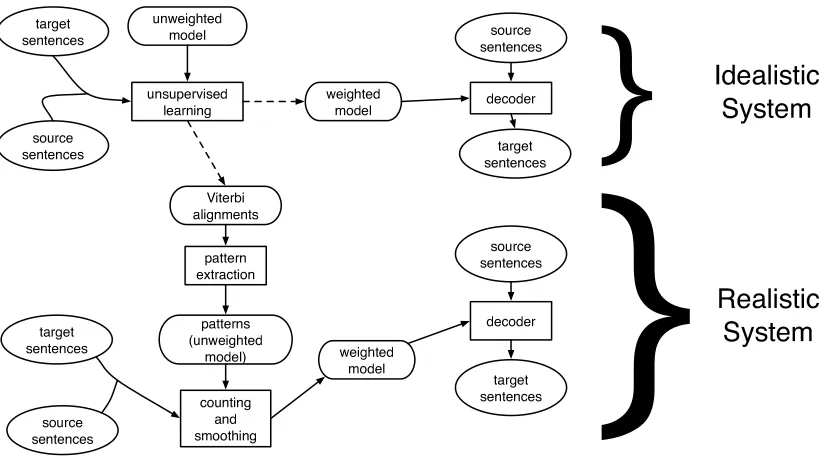
Roughly speaking, there are two paths commonly taken in statistical machine translation (Figure 1). The idealistic path uses an unsupervised learning algorithm such as EM (Demptser et al., 1977) to learn parameters for some proposed translation model from a bitext training corpus, and then di-rectly translates using the weighted model. Some examples of the idealistic approach are the direct IBM word model (Berger et al., 1994; Germann et al., 2001), the phrase-based approach of Marcu and Wong (2002), and the syntax approaches of Wu (1996) and Yamada and Knight (2001). Idealistic approaches are conceptually simple and thus easy to relate to observed phenomena. However, as more parameters are added to the model the idealistic ap-proach has not scaled well, for it is increasingly dif-ficult to incorporate large amounts of training data efficiently over an increasingly large search space. Additionally, the EM procedure has a tendency to overfit its training data when the input units have varying explanatory powers, such as variable-size phrases or variable-height trees.
The realistic path also learns a model of transla-tion, but uses that model only to obtain Viterbi word-for-word alignments for the training corpus. The bitext and corresponding alignments are then used as input to a pattern extraction algorithm, which yields a set of patterns or rules for a second trans-lation model (which often has a wider parameter space than that used to obtain the word-for-word alignments). Weights for the second model are then set, typically by counting and smoothing, and this weighted model is used for translation. Realistic ap-proaches scale to large data sets and have yielded better BLEU performance than their idealistic coun-terparts, but there is a disconnect between the first model (hereafter, the alignment model) and the sec-ond (the translation model). Examples of realistic systems are the phrase-based ATS system of Och and Ney (2004), the phrasal-syntax hybrid system Hiero (Chiang, 2005), and the GHKM syntax sys-tem (Galley et al., 2004; Galley et al., 2006). For an alignment model, most of these use the Aachen HMM approach (Vogel et al., 1996), the implemen-tation of IBM Model 4 in GIZA++ (Och and Ney, 2000) or, more recently, the semi-supervised EMD algorithm (Fraser and Marcu, 2006).
The two-model approach of the realistic path has undeniable empirical advantages and scales to large data sets, but new research tends to focus on devel-opment of higher order translation models that are informed only by low-order alignments. We would like to add the analytic power gained from mod-ern translation models to the underlying alignment model without sacrificing the efficiency and empiri-cal gains of the two-model approach. By adding the
u n sup e rvise d
l
ea rn in g
t
a rg e
t
se n
t
en ce s
so u rce se n
t
en ce s
u n w e ig h e d m o de
l
w e igh
t
e d m od e
l
pa tt
erns
(
un w eig h
t
ed m o de
l)
co un
t
in g an d sm o o
t
h in g
w e ig h
t
e d m od e
l
de co d er so urce se n
t
e nc es
t
a rg e
t
se n
t
e nc es p a
tt e rn e x
t
ra c
t
io n
t
a rg e
t
se n
t
e n ce s
sou rce sen
t
en ce s
V
i
t
erbi
a
l
ign m e n
t
s
Id e a lis t ic
S y s t e m
R e a lis t ic
S y s t e m de co d er
so urce se n
t
e nc es
t
a rg e
t
se n
t
[image:2.612.100.512.74.305.2]e n ces
Figure 1: General approach to idealistic and realistic statistical MT systems
syntactic information used in the translation model to our alignment model we may improve alignment quality such that rule quality and, in turn, system quality are improved. In the remainder of this work we show how a touch of idealism can improve an existing realistic syntax-based translation system.
2 Multi-level syntactic rules for syntax MT
Galley et al. (2004) and Galley et al. (2006) de-scribe a syntactic translation model that relates En-glish trees to foreign strings. The model describes joint production of a (tree, string) pair via a non-deterministic selection of weighted rules. Each rule has an English tree fragment with variables and a corresponding foreign string fragment with the same variables. A series of rules forms an explanation (or derivation) of the complete pair.
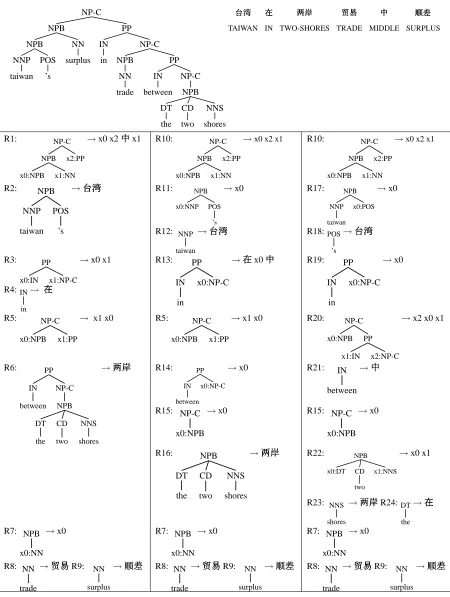
As an example, consider the parsed English and corresponding Chinese at the top of Figure 2. The three columns underneath the example are different rule sequences that can explain this pair; there are many other possibilities. Note how rules specify ro-tation (e.g. R10, R5), direct translation (R12, R8), insertion and deletion (R11, R1), and tree traversal (R7, R15). Note too that the rules explain
variable-size fragments (e.g. R6 vs. R14) and thus the possi-ble derivation trees of rules that explain a sentence pair have varying sizes. The smallest such deriva-tion tree has a single large rule (which does not ap-pear in Figure 2; we leave the description of such a rule as an exercise for the reader). A string-to-tree decoder constructs a derivation forest of deriva-tion trees where the right sides of the rules in a tree, taken together, explain a candidate source sentence. It then outputs the English tree corresponding to the highest-scoring derivation in the forest.
3 Introducing syntax into the alignment model
We now lay the ground for a syntactically motivated alignment model. We begin by reviewing an align-ment model commonly seen in realistic MT systems and compare it to a syntactically-aware alignment model.
3.1 The traditional IBM alignment model
NP-C
NPB
NPB
NNP
taiwan POS
’s
NN
surplus
PP
IN
in
NP-C
NPB
NN
trade
PP
IN
between NP-C
NPB
DT
the CD
two NNS
shores Ñ Ñ
Ñ lll óóó ÜÜÜ 444 ¥¥¥ ~~~
TAIWAN IN TWO-SHORES TRADE MIDDLE SURPLUS
R1: NP-C
NPB x0:NPB x1:NN
x2:PP
→x0 x2¥¥¥x1 R10:
NP-C NPB x0:NPB x1:NN
x2:PP
→x0 x2 x1 R10: NP-C
NPB x0:NPB x1:NN
x2:PP
→x0 x2 x1
R2: NPB
NNP
taiwan POS
’s
→ÑÑÑlll R11: NPB x0:NNP POS
’s
→x0 R17: NPB
NNP
taiwan x0:POS
→x0
R12: NNP
taiwan
→ÑÑÑlll R18:
POS ’s
→ÑÑÑlll
R3: PP
x0:IN x1:NP-C
→x0 x1 R13: PP
IN
in
x0:NP-C
→óóóx0¥¥¥ R19: PP
IN
in
x0:NP-C →x0
R4:IN
in
→ óóó
R5: NP-C
x0:NPB x1:PP
→ x1 x0 R5: NP-C
x0:NPB x1:PP
→x1 x0 R20: NP-C
x0:NPB PP
x1:IN x2:NP-C
→x2 x0 x1
R6: PP
IN
between NP-C
NPB DT
the CD
two NNS
shores
→ÜÜÜ R14: PP IN
between x0:NP-C
→x0 R21: IN
between →¥¥¥
R15: NP-C
x0:NPB
→x0 R15: NP-C
x0:NPB →x0
R16: NPB
DT
the CD
two NNS
shores
→ÜÜÜ R22: NPB x0:DT CD
two x1:NNS
→x0 x1
R23: NNS
shores
→ÜÜÜR24:
DT the
→óóó
R7: NPB
x0:NN
→x0 R7: NPB
x0:NN
→x0 R7: NPB
x0:NN →x0
R8: NN
trade
→444R9: NN surplus
→~~~ R8: NN trade
→444R9: NN surplus
→~~~ R8: NN trade
→444R9: NN surplus
[image:3.612.80.530.61.658.2]→~~~
S-C
NP-C
NPB
NNP
guangxi POS
’s
VP
VBG
opening PRT
RP
up
PP
TO
to
NP-C
NPB
DT
the JJ
outside NN
world
ÜÜÜ
é é é iii
888
GUANGXI OUTSIDE-WORLD OPENING-UP
R24: S-C
NP-C
NPB
x0:NNP POS
’s
VP
VBG
opening PRT
RP
up
PP
TO
to
NP-C
NPB
DT
the JJ
outside NN
world
→x0ééé iii 888 R25: NNP
guangxi
→ ÜÜÜ
R26: S-C
x0:NP-C x1:VP
→x0 x1 R15: NP-C
x0:NPB
→x0 R11: NPB
x0:NNP POS
’s
→x0 R27: VP
VBG
opening PRT
RP
up x0:PP
→x0 888
R28: PP
TO
to
x0:NP-C
→x0 R15: NP-C
x0:NPB
→x0 R29: NPB
DT the
JJ outside
NN world
→ééé iii R25: NNP
guangxi
[image:4.612.75.541.62.447.2]→ ÜÜÜ
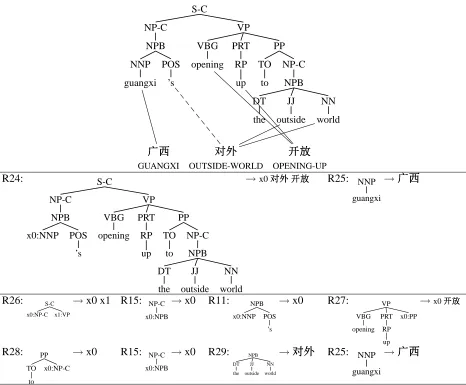
Figure 3: The impact of a bad alignment on rule extraction. Including the alignment link indicated by the dotted line in the example leads to the rule set in the second row. The re-alignment procedure described in Section 3.2 learns to prefer the rule set at bottom, which omits the bad link.
1. A fertilityyfor each wordeiineis chosen
with probabilitypf ert(y|ei).
2. A null word is inserted next to each fertility-expanded word with probability pnull.
3. Each token ei in the fertility-expanded
word and null string is translated into some foreign wordfiinfwith probability
ptrans(fi|ei).
4. The position of each foreign word fi that was translated from ei is
changed by ∆ (which may be posi-tive, negaposi-tive, or zero) with probability
pdistortion(∆|A(ei),B(fi)), where Aand
Bare functions over the source and target vocabularies, respectively.
3.2 A syntax re-alignment model
Now let us contrast this commonly used model for obtaining alignments with a syntactically motivated alternative. We recall the rules described in Section 2. Our model learns a single probability table to computep(etree, f)given a foreign sentencef and a parsed target translation etree. In the following generative story we assume a starting variable with syntactic typev.
1. Choose a rule r to replacev, with proba-bilityprule(r|v).
2. For each variable with syntactic typeviin
the partially completed (tree, string) pair, continue to choose rulesri with
probabil-ity prule(ri|vi) to replace these variables
until there are no variables remaining.
In Section 5.1 we discuss an EM learning proce-dure for estimating these rule probabilities.
As in the IBM approach, we must miti-gate intractability by limiting the parameter space searched, which is potentially much wider than in the word-to-word case. We would like to supply to EM all possible rules that explain the training data, but this implies a rule relating each possible tree fragment to each possible string fragment, which is infeasible. We follow the approach of bootstrapping from a model with a narrower parameter space as is done in, e.g. Och and Ney (2000) and Fraser and Marcu (2006).
To reduce the model space we employ the rule ac-quisition technique of Galley et al. (2004), which obtains rules given a (tree, string) pair as well as an initial alignment between them. We are agnos-tic about the source of this bootstrap alignment and in Section 5 present results based on several differ-ent bootstrap alignmdiffer-ent qualities. We require an ini-tial set of alignments, which we obtain from a word-for-word alignment procedure such as GIZA++ or EMD. Thus, we are not aligning input data, but rather re-aligning it with a syntax model.
4 The appeal of a syntax alignment model
Consider the example of Figure 2 again. The left-most derivation is obtained from the bootstrap align-ment set. This derivation is reasonable but there are some poorly motivated rules, from a linguistic stand-point. The Chinese wordÜÜÜroughly means “the
SENTENCE PAIRS
DESCRIPTION CHINESE ARABIC
TUNE NIST 2002 short 925 696
[image:5.612.314.545.59.115.2]TEST NIST 2003 919 663
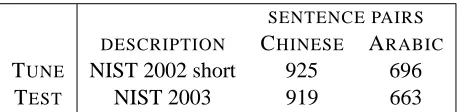
Table 1: Tuning and testing data sets for the MT system described in Section 5.2.
two shores” in this context, but the rule R6 learned from the alignment incorrectly includes “between”. However, other sentences in the training corpus have the correct alignment, which yields rule R16. Mean-while, rules R13 and R14, learned from yet other sentences in the training corpus, handle theóóó...¥¥¥
structure (which roughly translates to “in between”), thus allowing the middle derivation.
EM distributes rule probabilities in such a way as to maximize the probability of the training corpus. It thus prefers to use one rule many times instead of several different rules for the same situation over several sentences, if possible. R6 is a possible rule in 46 of the 329,031 sentence pairs in the training corpus, while R16 is a possible rule in 100 sentence pairs. Well-formed rules are more usable than ill-formed rules and the partial alignments behind these rules, generally also well-formed, become favored as well. The top row of Figure 3 contains an exam-ple of an alignment learned by the bootstrap align-ment model that includes an incorrect link. Rule R24, which is extracted from this alignment, is a poor rule. A set of commonly seen rules learned from other training sentences provide a more likely explanation of the data, and the consequent align-ment omits the spurious link.
5 Experiments
In this section, we describe the implementation of our semi-idealistic model and our means of evaluat-ing the resultevaluat-ing re-alignments in an MT task.
5.1 The re-alignment setup
BOOTSTRAPGIZACORPUS RE-ALIGNMENT EXPERIMENT
ENGLISH WORDS CHINESE WORDS TYPE RULES TUNE TEST
9,864,294 7,520,779
[image:6.612.142.471.60.122.2]baseline 19,138,252 39.08 37.77 initial 18,698,549 39.49 38.39 adjusted 26,053,341 39.76 38.69
Table 2: A comparison of Chinese BLEU performance between the GIZA baseline (no alignment), re-alignment as proposed in Section 3.2, and re-re-alignment as modified in Section 5.4
algorithm (Galley et al., 2004) to obtain a rule set for each bootstrap alignment.
Now we need an EM algorithm for learn-ing the parameters of the rule set that maximizeY
corpus
p(tree, string). Such an algorithm is
pre-sented by Graehl and Knight (2004). The algorithm consists of two components: DERIV, which is a pro-cedure for constructing a packed forest of derivation trees of rules that explain a (tree, string) bitext cor-pus given that corcor-pus and a rule set, and TRAIN, which is an iterative parameter-setting procedure.
We initially attempted to use the top-down DE
-RIV algorithm of Graehl and Knight (2004), but as
the constraints of the derivation forests are largely lexical, too much time was spent on exploring dead-ends. Instead we build derivation forests using the following sequence of operations:
1. Binarize rules using the synchronous bina-rization algorithm for tree-to-string trans-ducers described in Zhang et al. (2006). 2. Construct a parse chart with a CKY parser
simultaneously constrained on the foreign string and English tree, similar to the bilingual parsing of Wu (1997)1.
3. Recover all reachable edges by traversing the chart, starting from the topmost entry. Since the chart is constructed bottom-up, leaf lex-ical constraints are encountered immediately, result-ing in a narrower search space and faster runnresult-ing time than the top-down DERIV algorithm for this application. Derivation forest construction takes around 400 hours of cumulative machine time (4-processor machines) for Chinese. The actual run-ning of EM iterations (which directly implements the TRAINalgorithm of Graehl and Knight (2004))
1
In the cases where a rule is not synchronous-binarizable standard left-right binarization is performed and proper permu-tation of the disjoint English tree spans must be verified when building the part of the chart that uses this rule.
takes about 10 minutes, after which the Viterbi derivation trees are directly recoverable. The Viterbi derivation tree tells us which English words produce which Chinese words, so we can extract a word-to-word alignment from it. We summarize the ap-proach described in this paper as:
1. Obtain bootstrap alignments for a training corpus using GIZA++.
2. Extract rules from the corpus and align-ments using GHKM, noting the partial alignment that is used to extract each rule. 3. Construct derivation forests for each (tree, string) pair, ignoring the alignments, and run EM to obtain Viterbi derivation trees, then use the annotated partial alignments to obtain Viterbi alignments.
4. Use the new alignments as input to the MT system described below.
5.2 The MT system setup
A truly idealistic MT system would directly apply the rule weight parameters learned via EM to a ma-chine translation task. As mentioned in Section 1, we maintain the two-model, or realistic approach. Below we briefly describe the translation model, fo-cusing on comparison with the previously described alignment model. Galley et al. (2006) provides a more complete description of the translation model and DeNeefe et al. (2007) provides a more complete description of the end-to-end translation pipeline.
(a) Chinese re-alignment corpus has 9,864,294 English and 7,520,779 Chinese words
BOOTSTRAPGIZACORPUS RE-ALIGNMENT EXPERIMENT ENGLISH WORDS CHINESE WORDS TYPE RULES TUNE TEST
9,864,294 7,520,779 baseline 19,138,252 39.08 37.77
re-alignment 26,053,341 39.76 38.69
221,835,870 203,181,379 baseline 23,386,535 39.51 38.93
re-alignment 33,374,646 40.17 39.96
(b) Arabic re-alignment corpus has 4,067,454 English and 3,147,420 Arabic words BOOTSTRAPGIZACORPUS RE-ALIGNMENT EXPERIMENT
ENGLISH WORDS ARABIC WORDS TYPE RULES TUNE TEST
4,067,454 3,147,420 baseline 2,333,839 47.92 47.33
re-alignment 2,474,737 47.87 47.89
168,255,347 147,165,003 baseline 3,245,499 49.72 49.60
re-alignment 3,600,915 49.73 49.99
Table 3: Machine Translation experimental results evaluated with case-insensitive BLEU4.
weights for these by counting and smoothing. A dozen other features are also added to the rules. We obtain weights for the combinations of the features by performing minimum error rate training (Och, 2003) on held-out data. We then use a CKY decoder to translate unseen test data using the rules and tuned weights. Table 1 summarizes the data used in tuning and testing.
5.3 Initial results
An initial re-alignment experiment shows a reason-able rise in BLEU scores from the baseline (Treason-able 2), but closer inspection of the rules favored by EM implies we can do even better. EM has a tendency to favor few large rules over many small rules, even when the small rules are more useful. Referring to the rules in Figure 2, note that possible derivations for (taiwan ’s, ÑÑÑlll)
2 are R2, R11-R12, and
R17-R18. Clearly the third derivation is not desirable, and we do not discuss it further. Between the first two derivations, R11-R12 is preferred over R2, as the conditioning for possessive insertion is not re-lated to the specific Chinese word being inserted. Of the 1,902 sentences in the training corpus where this pair is seen, the bootstrap alignments yield the R2 derivation 1,649 times and the R11-R12 deriva-tion 0 times. Re-alignment does not change the re-sult much; the new alignments yield the R2 deriva-tion 1,613 times and again never choose R11-R12. The rules in the second derivation themselves are
2
The Chinese gloss is simply “taiwan”.
not rarely seen – R11 is in 13,311 forests other than those where R2 is seen, and R12 is in 2,500 addi-tional forests. EM gives R11 a probability ofe−7.72
– better than 98.7% of rules, and R12 a probability ofe−2.96. But R2 receives a probability of e−6.32
and is preferred over the R11-R12 derivation, which has a combined probability ofe−10.68.
5.4 Making EM fair
The preference for shorter derivations containing large rules over longer derivations containing small rules is due to a general tendency for EM to pre-fer derivations with few atoms. Marcu and Wong (2002) note this preference but consider the phe-nomenon a feature, rather than a bug. Zollmann and Sima’an (2005) combat the overfitting aspect for parsing by using a held-out corpus and a straight maximum likelihood estimate, rather than EM. We take a modeling approach to the phenomenon.
LANGUAGE PAIR TYPE RULES TUNE TEST
CHINESE-ENGLISH baseline 55,781,061 41.51 40.55 EMD re-align 69,318,930 41.23 40.55
[image:8.612.180.434.59.117.2]ARABIC-ENGLISH baseline 8,487,656 51.90 51.69 EMD re-align 11,498,150 51.88 52.11
Table 4: Re-alignment performance with semi-supervised EMD bootstrap alignments
same sentence contain the same number of atoms:
1. Choose a rule sizeswith costcsize(s)s−
1
. 2. Choose a ruler (of size s) to replace the start symbol with probabilityprule(r|s, v).
3. For each variable in the partially com-pleted (tree, string) pair, continue to choose sizes followed by rules, recur-sively to replace these variables until there are no variables remaining.
This generative story changes the derivation com-parison from R2 vs R11-R12 to S2-R2 vs R11-R12, where S2 is the atom that represents the choice of size 2 (the size of a rule in this context is the number of non-leaf and non-root nodes in its tree fragment). Note that the variable number of inclusions implied by the exponent in the generative story above en-sures that all derivations have the same size. For ex-ample, a derivation with one size-3 rule, a derivation with one size-2 and one size-1 rule, and a deriva-tion with three size-1 rules would each have three atoms. With this revised model that allows for fair comparison of derivations, the R11-R12 derivation is chosen 1636 times, and S2-R2 is not chosen. R2 does, however, appear in the translation model, as the expanded rule extraction described in Section 5.2 creates R2 by joining R11 and R12.
The probability of size atoms, like that of rule atoms, is decided by EM. The revised generative story tends to encourage smaller sizes by virtue of the exponent. This does not, however, simply ensure the largest number of rules per derivation is used in all cases. Ill-fitting and poorly-motivated rules such as R22, R23, and R24 in Figure 2 are not preferred over R16, even though they are smaller. However, R14 and R16 are preferred over R6, as the former are useful rules. Although the modified model does not sum to 1, it leads to an improvement in BLEU score, as can be seen in the last row of Table 2.
5.5 Results
We performed primary experiments on two different bootstrap setups in two languages: the initial exper-iment uses the same data set for the GIZA++ initial alignment as is used in the re-alignment, while an experiment on better quality bootstrap alignments uses a much larger data set. For each bootstrap-ping in each language we compared the baseline of using these alignments directly in an MT sys-tem with the experiment of using the alignments ob-tained from the re-alignment procedure described in Section 5.4. For each experiment we report: the number of rules extracted by the expanded GHKM algorithm of Galley et al. (2006) for the translation model, converged BLEU scores on the tuning set, and finally BLEU performance on the held-out test set. Data set specifics for the GIZA++ bootstrapping and BLEU results are summarized in Table 3.
5.6 Discussion
condition, but leave those results for future work. We can see from the results presented that the im-pact of the syntax-aware re-alignment procedure of Section 3.2, coupled with the addition of size param-eters to the generative story from Section 5.4 serves to remove links from the bootstrap alignments that cause less useful rules to be extracted, and thus in-crease the overall quality of the rules, and hence the system performance. We thus see the benefit to in-cluding syntax in an alignment model, bringing the two models of the realistic machine translation path somewhat closer together.
Acknowledgments
We thank David Chiang, Steve DeNeefe, Alex Fraser, Victoria Fossum, Jonathan Graehl, Liang Huang, Daniel Marcu, Michael Pust, Oana Pos-tolache, Michael Pust, Jason Riesa, Jens V¨ockler, and Wei Wang for help and discussion. This re-search was supported by NSF (grant IIS-0428020) and DARPA (contract HR0011-06-C-0022).
References
Adam Berger, Peter Brown, Stephen Della Pietra, Vin-cent Della Pietra, John Gillett, John Lafferty, Robert Mercer, Harry Printz, and Luboˇs Ureˇs. 1994. The candide system for machine translation. In Proc. HLT, pages 157–162, Plainsboro, New Jersey, March.
Daniel Bikel. 2004. Intricacies of Collins’ parsing model. Computational Linguistics, 30(4):479–511.
Peter F. Brown, Vincent J. Della Pietra, Stephen A. Della Pietra, and Robert L. Mercer. 1993. The mathemat-ics of statistical machine translation: parameter esti-mation. Computational Linguistics, 19(2):263–311.
David Chiang. 2005. A hierarchical phrase-based model for statistical machine translation. In Proc. ACL, pages 263–270, Ann Arbor, Michigan, June.
Arthur P. Demptser, Nan M. Laird, and Donald B. Ru-bin. 1977. Maximum likelihood from incomplete data via the EM algorithm. Journal of the Royal Statistical
Society, Series B, 39(1):1–38.
Steve DeNeefe, Kevin Knight, Wei Wang, and Daniel Marcu. 2007. What can syntax-based MT learn from phrase-based MT? In Proc. EMNLP/CONLL, Prague, June.
Alexander Fraser and Daniel Marcu. 2006. Semi-supervised training for statistical word alignment. In
Proc. COLING-ACL, pages 769–776, Sydney, July.
Michel Galley, Mark Hopkins, Kevin Knight, and Daniel Marcu. 2004. What’s in a translation rule? In Proc.
HLT-NAACL, pages 273–280, Boston, May.
Michel Galley, Jonathan Graehl, Kevin Knight, Daniel Marcu, Steven DeNeefe, Wei Wang, and Ignacio Thayer. 2006. Scalable inference and training of context-rich syntactic models. In Proc.
COLING-ACL, pages 961–968, Sydney, July.
Ulrich Germann, Michael Jahr, Kevin Knight, Daniel Marcu, and Kenji Yamada. 2001. Fast decoding and optimal decoding for machine translation. In Proc.
ACL, pages 228–235, Toulouse, France, July.
Jonathan Graehl and Kevin Knight. 2004. Training tree transducers. In Proc. HLT-NAACL, pages 105–112, Boston, May.
Daniel Marcu and William Wong. 2002. A phrase-based, joint probability model for statistical machine transla-tion. In Proc. EMNLP, pages 133–139, Philadelphia, July.
Franz Och and Hermann Ney. 2000. Improved statisti-cal alignment models. In Proc. ACL, pages 440–447, Hong Kong, October.
Franz Och and Hermann Ney. 2004. The alignment tem-plate approach to statistical machine translation.
Com-putational Linguistics, 30(4):417–449.
Franz Och. 2003. Minimum error rate training for sta-tistical machine translation. In Proc. ACL, pages 160– 167, Sapporo, Japan, July.
Stephan Vogel, Hermann Ney, and Christoph Tillmann. 1996. HMM-based word alignment in statistical trans-lation. In Proc. COLING, pages 836–841, Copen-hagen, August.
Dekai Wu. 1996. A polynomial-time algorithm for sta-tistical machine translation. In Proc. ACL, pages 152– 158, Santa Cruz, California, June.
Dekai Wu. 1997. Stochastic inversion transduction grammars and bilingual parsing of parallel corpora.
Computational Linguistics, 23(3):377–404.
Kenji Yamada and Kevin Knight. 2001. A syntax-based statistical translation model. In Proc. ACL, pages 523– 530, Toulouse, France, July.
Hao Zhang, Liang Huang, Daniel Gildea, and Kevin Knight. 2006. Synchronous binarization for machine translation. In Proc. HLT-NAACL, pages 256–263, New York City, June.
Andreas Zollmann and Khalil Sima’an. 2005. A consis-tent and efficient estimator for data-oriented parsing.
Journal of Automata, Languages and Combinatorics,