A M E T H O D F O R I M P R O V I N G A U T O M A T I C W O R D
C A T E G O R I Z A T I O N
Emin
E r k a n K o r k m a z
G S k t f i r k
U~oluk
Department of Computer Engineering Middle East Technical University
Emails: [email protected] [email protected]
Abstract
This paper presents a new approach to automatic word categorization which im- proves both the efficiency of the algorithm and the quality of the formed clusters. The unigram and the bigram statistics of a cor- pus of about two million words are used with an efficient distance function to mea- sure the similarities of words, and a greedy algorithm to put the words into clusters. The notions of fuzzy clustering like cluster prototypes, degree of membership are used to form up the clusters. The algorithm is of unsupervised type and the number of clus- ters are determined at run-time.
1
Introduction
Statistical natural language processing is a challeng- ing area in the field of computational natural lan- guage learning. Researchers of this field have an approach to language acquisition in which learning is visualised as developing a generative, stochastic model of language and putting this model into prac- tice (de Marcken, 1996). It has been shown practi- cally that the usage of such an approach can yield better performances for acquiring and representing the structure of language.
Automatic word categorization is an important field of application in statistical natural language processing where the process is unsupervised and is carried out by working on n-gram statistics to find out the categories of words. Research in this area points out that it is possible to determine the struc- ture of a natural language by examining the regular- ities of the statistics of the language (Finch, 1993).
The organization of this paper is as follows. After the related work in the area of word categorization is presented in section 2, a general background of the categorization process is described in 3 section,
which is followed by presentation of newly proposed method. In section 4 the results of the experiments are given. We discuss the relevance of the results and conclude in the last section.
2
Related
W o r k
There exists previous work in which the unigram and the bigram statistics are used for automatic word clustering. Here it is concluded that the frequency of single words and the frequencies of occurance of word pairs of a large corpus can give the necessary information to build up the word clusters. Finch (Finch and Chater, 1992), makes use of these bigram statistics for the determination of the weight matrix of a neural network. Brown, (Brown et al., 1992) uses the same bigrams and by means of a greedy algorithm forms the hierarchical clusters of words.
Genetic algorithms have also been successfuly used for the categorization process. Lanchorst (Lankhorst, 1994) uses genetic algorithms to deter- mine the members of predetermined classes. The drawback of his work is that the number of classes is determined previous to run-time and the genetic algorithm only searches for the membership of those classes.
McMahon and Smith (McMahon and Smith, 1996) also use the mutual information of a corpus to find the hierarchical clusters. However instead of using a greedy algorithm they use a top-down ap- proach to form the clusters. Firstly by using the mutual information the system divides the initial set containing all the words to be clustered into two parts and then the process continues on these new clusters iteratively.
Statistical NLP methods have been used also to- gether with other methods of NLP. Wilms (Wilms, 1995) uses corpus based techniques together with knowledge-based techniques in order to induce a lex- ical sublanguage grammar. Machine Translation is an other area where knowledge bases and statistics
Korkmaz ~ U~oluk 43 Automatic Word Categorization
Emin Erkan Korkmaz and GSktiirk U~oluk (1997) A M e t h o d for Improving A u t o m a t i c Word Categorization.
are integrated. Knight, (Knight et al., 1994) aims to scale-up g r a m m a r - b a s e d , knowledge-based M T tech- niques by m e a n s of statistical methods.
3 Word Categorization
T h e words in a n a t u r a l language can be visualised as consisting of two different sets. T h e closed class words and the open class ones. New open class words can be added to the language as the language pro- gresses, however the closed class is a fixed one and no new words are added to the set. For instance the prepositions are in the closed class. However nouns are in the open class, since new nouns can be added to the language as the social and economical life pro- gresses. However the m o s t frequently used words in a n a t u r a l language usually f o r m a closed class.
Zipf, (Zipf, 1935), who is a linguist, was one of the early researchers on statistical language models. His work states t h a t only 2% of the words of a large English corpus f o r m 66% of the total corpus. There- fore, it can be claimed t h a t by working on a small set consisting of frequent words it is possible to build a f r a m e w o r k for the whole n a t u r a l language.
N - g r a m models of language are c o m m o n l y used to b u i l d up such framework. An n - g r a m model can be formed by collecting the probabilities of word
s t r e a m s
(will
: 1..n). T h e probabilities will beused to f o r m the model where we can predict the behaviour of the language up to n words. There ex- ists current research t h a t use b i g r a m statistics for word categorization in which probabilities of word pairs in the text are collected and processed.
3.1 M u t u a l I n f o r m a t i o n
As stated in the related work p a r t these n - g r a m m o d - els can be used together with the concept of m u t u a l
information to f o r m the clusters.
Mutual Informa-
tion
is based on the concept ofentropy
which can be defined informally as the uncertainty of a stochas- tic experiment. Let X be a stochastic variable de-fined over the set
X = {Xl,X2,...,x,~}
where theprobabilities
Px(xi)
are defined for 1 _< i _~ n asPx(xi) = P ( X = xi)
then the entropy ofX, H(X)
is defined as:
H { X } = - E
Px(x,)logPx(x,)
(1)And if Y is another stochastic variable t h a n the m u t u a l information between these two stochastic variables is defined as:
I { X : V} : H { X } + H { Y } - H { X , Y }
(2)Korkmaz ~ O~oluk
Here
H{X, Y}
is the joint e n t r o p y of the stochas-tic variables X and Y. T h e
joint entropy
is defineda s :
44
H { X , Y } = -
E
E
P~u(x"YJ)l°gP~u(x"YJ)
(3)
And in this formulation
Pxu(xi, yj)
is thejoint
probability
defined asP~u(xi, yj) : P ( X : x~, Y :
Given a lexicon space W = {wl, w2, ..., w , } con- sisting of n words to be clustered, we can use the formulation of m u t u a l information for the b i g r a m statistics of a n a t u r a l language corpus. In this for- m u l a t i o n X and Y are defined over the sets of the words appearing in the first and second positions re- spectively. So the m u t u a l i n f o r m a t i o n t h a t is the a m o u n t of knowledge t h a t a word in a corpus can give a b o u t the proceeding word can be reformulated using the b i g r a m statistics as follows:
N~j ,
Nij. N**
i t x : Y } =
(4)
l _< i _< n l _< j _< n
In this formulation N** is the total number of
word pairs in the corpus and N~j is the n u m b e r of
occurances of word pair
(wordi, wordj), Ni.
is then u m b e r of occurences of
wordi
and N . j is the n u m -ber of occurences of
wordj
respectively. This formu-lation denotes the a m o u n t of linguistic knowledge preserved in b i g r a m of words in a n a t u r a l language.
3.2 C l u s t e r i n g A p p r o a c h
W h e n the m u t u a l information is used for clustering, the process is carried out s o m e w h a t at a macro-level. Usually search techniques and tools are used to- gether with the m u t u a l i n f o r m a t i o n in order to f o r m some combinations of different sets each of which is
then subject to some
validity
test. T h e idea usedfor the validity testing process is as follows. Since the m u t u a l information denotes the a m o u n t of prob- abilistic knowledge t h a t a word provides on the pro- ceeding word in a corpus, if similar behaving words are collected together to the s a m e clusters t h a n the loss of m u t u a l information would be m i n i m a l . So the search is a m o n g possible alternatives for sets or clusters with the a i m to obtain a m i n i m a l loss in m u t u a l information.
Although this t o p - t o - b o t t o m m e t h o d seems theo- retically possible, in the presented work a different approach, which is b o t t o m - u p is used. In this incre- mental approach, set p r o t o t y p e s are first built and then combined with other sets or single words to
f o r m larger ones. T h e m e t h o d is based on the sim- ilarities or differences between single words rather t h a n the m u t u a l information of a whole corpus. In combining words into sets a fuzzy set approach is used. T h e authors believe t h a t this serves to deter- mine the behavior of the whole set more properly.
Using this constructive approach, it is possible to visualize the word clustering problem as the prob- lem of clustering points in an n-dimensional space if the lexicon space to be clustered consists of n words. T h e points t h a t are the words in a corpus are positioned on this n-dimensional space accord- ing to their behaviour related to other words in the
lexicon space. Each
wordi
is placed on the i th di-mension according to its b i g r a m statistic with the word representing the dimension. So the degree of
similarity
between two words can be defined as hav-ing close b i g r a m statistics in the corpus. Words
are distributed in the plane according to those bi- g r a m statistics. T h e idea is quite simple: Let wl and w~ be two words f r o m the corpus. Let Z be the stochastic variable ranging over the words to be
clustered. T h e n if
Px (Wl, Z)
is close toPx
(w2, Z)and if
Px(Z, wl)
is close toPx(Z, w2)
for Z rang-ing over all the words to be clustered in the corpus,
t h a n we can state a
closeness
between the words Wland w2. Here
Px
is the probability of occurences ofword pairs as stated in section 3.1.
Px(wl, Z)
is theprobability where Wl appears as the first element in
a word pair and
Px(Z, wl)
is the reverse probabil-ity where wl is the second element of the word pair. This is the s a m e for w2 respectively.
In order to s t a r t the clustering process, a distance function has to be defined between the elements in our plane. Using the idea presented above we define a simple distance function between words using the b i g r a m statistics. T h e distance function D between two words wl and w2 is defined as follows:
D ( w l , w2) = Dl(Wl, w2) + D2(wl,w2)
where
(5)
Dl(Wl,W2) : ~
] Px(wl,Wl)- Px(w2,wl) l
l < i < n
(6)
and
D~(wl, w2) = ~
I PX(W,, Wl)
--Px(wi, w2) ]
l<i<n
(7)
Korkmaz ~ O~oluk
45Here n is the total n u m b e r of words to be clus-
tered. Since
Px(wi wj)
is defined as ~ the pro-' N e e '
portion of the n u m b e r of occurences of word pair
wi and
wj
to the total n u m b e r of word pairs in thecorpus, the distance function for wl and w2 reduces down to:
D(wl, w2) = ~
[ N ~ l i - Nw2i
[ + IN/w1 -Nivo2 [l<#.<n
(8)
Having such a distance function, it is possible to start the clustering process. T h e first idea t h a t can be used is to form a greedy algorithm to s t a r t form- ing the hierarchy of word clusters. If the lexicon space to be clustered consists of {Wl, w2, ..., wn}, then the first element f r o m the lexicon space wl is taken and a cluster with this word and its near-
est neighbour or neighbors is formed. T h e n the
lexicon space is {(Wl, W,,, ..., Wsk), Wi, ..., Wn) where
(wl, ws,, ..., wsk) is the first cluster formed. T h e pro- cess is repeated with the first element in the list t h a t is outside the formed sets, wi for our case and the process iterates until no word is left not being a m e m b e r of any set. T h e formed sets will be the clusters at the b o t t o m of the cluster hierarchy. T h e n to determine the behaviour of a set, the frequencies of its elements are added and the previous process is carried on the sets this t i m e rather t h a n on sin- gle words until the cluster hierarchy is formed, so the algorithm stops when a single set is formed t h a t contains all the words in the lexicon space.
In the early stages of this research such a greedy m e t h o d was used to f o r m the clusters, however, though some clusters at the low levels of the tree seemed to be correctly formed, as the n u m b e r of elements in a cluster increased towards the higher levels, the clustering results b e c a m e unsatisfactory.
T w o m a i n factors were observed as the reasons for the unsatisfactory results.
These were:
• Shortcomings of the greedy t y p e algorithm.
• Inadequency of the m e t h o d used to obtain the set behaviour from its element's properties.
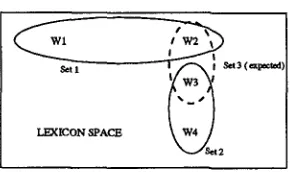
T h e greedy m e t h o d results in a n o n o p t i m a l clus- tering in the initial level. To m a k e this point clear consider the following example: Let us assume t h a t four words wl,w2, w3 and w4 are forming the lexicon space. And let the distances between these words be defined as d ~ , ~ j . T h e n consider the distribu- tion in Figure 1. If the greedy m e t h o d first tries to cluster wl. T h e n it will be clustered with w2, since
Set
ILEXICON
SPACE
' ~ ~ 3 (¢=pected)
Figure 1: E x a m p l e f o r t h e c l u s t e r i n g p r o b l e m o f g r e e d y al- g o r i t h m in a l e x i c o n s p a c e w i t h f o u r d i f f e r e n t w o r d s . N o t e t h a t d ~ , ~ 3 is t h e s m a l l e s t d i s t a n c e in t h e d i s t r i b u t i o n . H o w e v e r s i n c e w l is t a k e n i n t o c o n s i d e r a t i o n , it f o r m s s e t l w i t h its n e a r e s t n e i g h - b o u r w~ a n d w s c o m b i n e s w i t h w4 a n d f o r m s e t 2 , a l t h o u g h w~ is n e a r e r . A n d t h e e x p e c t e d t h i r d s e t is n o t f o r m e d .
the smallest d~l,w , for the first word is d~l,w~. So the second word will be captured in the set and the algorithm will skip w2 and continue the clustering process with w3. At this point, though w3 is clos- est to w2, since it is captured in a set and since w3 is m o r e closer to w4 t h a n the center of this set is, a new cluster will be formed with m e m b e r s w3 and w4. However, as it can be obviously seen visually f r o m Figure 1 the first o p t i m a l cluster to be formed between these four words is the set {w2, w3}.
T h e second p r o b l e m causing unsatisfactory clus- tering occurs after the initial sets are formed. Ac- cording to the algorithm after each cluster is formed, the clusters behave exactly like other single words and get into clustering with other clusters or single words. However to continue the process, the b i g r a m statistics of the clusters or in other words the com- m o n behaviour of the elements in a cluster should be determined so t h a t the distance between the cluster and other elements in the search space could be cal- culated. One easy way to determine this behaviour is to find the average of the statistics of all the ele- ments in a cluster. This m e t h o d has its drawbacks. T h e points in the search space for the natural lan- guage application are very close to each other. Fur- thermore, if the corpus used for the process is not large, the p r o x i m i t y problem becomes more severe. On the other hand the linguistic role of a word m a y v a r y in contexts in different sentences. Many words are used as noun, adjective or falling into some other linguistic category depending on the context. It can be claimed t h a t each word initially shall be placed in a cluster according to its d o m i n a n t role. However to determine the behaviour of a set the d o m i n a n t roles of its elements should also be used. Somehow the c o m m o n properties (bigrams) of the elements should be always used and the deviations of each element should be eliminated in the process.
3.2.1
Improving the
G r e e d y M e t h o dT h e clustering process is improved to overcome the above mentioned drawbacks.
T h e idea used to find the o p t i m a l cluster for each word at the initial step is to f o r m up such initial clus- ters in the algorithm used in which words are allowed to be m e m b e r s of more t h a n one class. So after the first pass over the lexicon space, intersecting clus- ters are formed. For the lexicon space presented in Figure 1 with four words, the expected third set is also formed. As the second step these intersecting sets are combined into a single set. T h e n the clos- est two words (according to the distance function) are found in each combined set and these two closest words are taken into consideration as the p r o t o t y p e for t h a t set. After finding the centroids of all sets, the distances between a m e m b e r and all the cen- troids are calculated for all the words in the lexicon space. Following this, each word is m o v e d to the set where the distance between this m e m b e r and the set center is minimal. This procedure is necessary since the initial sets are formed with combining the inter- secting sets. W h e n these intersecting sets are com- bined the set center of the resulting set m i g h t be far away f r o m some elements and there m a y be other closer set centers formed with other combinations, so a reorganization of m e m b e r s h i p is a p p r o p r i a t e .
3.2.2 F u z z y M e m b e r s h i p
As presented in the previous section the clustering process builds up a cluster hierarchy. In the first step, words are combined to f o r m the initial clusters, then those clusters become m e m b e r s of the process themselves. To combine clusters into new ones the statistical behaviour of t h e m should be determined, since b i g r a m statistics are used for the process. T h e statistical behaviour ~of a cluster is related to the b i g r a m s of its m e m b e r s . In order to find out the d o m i n a n t statistical role of each cluster the notion of fuzzy m e m b e r s h i p is used.
T h e p r o b l e m t h a t each word can belong to m o r e t h a n one linguistic category brings up the idea t h a t the sets of word clusters cannot have crisp border- lines and even i f a word is in a set due to its d o m i n a n t linguistic role in the corpus, it can have a degree of m e m b e r s h i p to the other clusters in the search space. Therefore fuzzy m e m b e r s h i p can be used for deter- mining the b i g r a m statistics of a cluster.
Researchers working on fuzzy clustering present a framework for defining fuzzy m e m b e r s h i p of ele- ments. G a t h and G e v a ( G a t h and Geva, 1989) de- scribe such an unsupervised o p t i m a l fuzzy cluster- ing. T h e y present the K - m e a n s algorithm based on minimization of an objective function. For the pur-
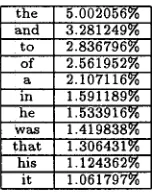
[image:4.596.113.258.98.184.2]t h e 5 . 0 0 2 0 5 6 % a n d 3 . 2 8 1 2 4 9 % t o 2 . 8 3 6 7 9 6 % o f 2 . 5 6 1 9 5 2 % a 2 . 1 0 7 1 1 6 % m 1 . 5 9 1 1 8 9 % h e 1 . 5 3 3 9 1 6 % w a s 1 . 4 1 9 8 3 8 % t h a t 1 . 3 0 6 4 3 1 % his 1 . 1 2 4 3 6 2 % it 1 . 0 6 1 7 9 7 %
Table 1: Frequencies of the m o s t frequent ten words
pose of this research only the m e m b e r s h i p function of the presented algorithm is used. T h e m e m b e r s h i p
function uij t h a t is the degree of m e m b e r s h i p of the
i th element to the jth cluster is defined as:
~x77~y
= -K
1
ir -
(9)
E k = l I X77 5
Here Xi denotes an element in the search space,
l,~ is the centroid of the
jth
cluster. K denotes then u m b e r of clusters. And d2(Xi, ~ ) is the distance
of Xith element to the centroid I,~ of the
jth
cluster.T h e p a r a m e t e r q is the weighting exponent for ztij
and controls the fuzziness of the resulting cluster. After the degrees of m e m b e r s h i p for all the ele- ments of all classes in the search space are calculated, the b i g r a m statistics of the classes are added up. To find those statistics the following m e t h o d is used: T h e b i g r a m statistics of each element is multiplied with the degree of the m e m b e r s h i p of the element in the working set and this forms the a m o u n t of statis- tical knowledge passed from the element to t h a t set. So the elements chosen as set centroids will be the ones t h a t affect a set's statistical behaviour mostly. Hence an element away from a centroid will have a lesser statistical contribution.
4 R e s u l t s
T h e algorithm is tested on a corpus formed with on- line novels collected f r o m the www page of the " B o o k Stacks Unlimited, Inc." T h e corpus consists of twelve free on-line novels adding up to a b o u t 1.700.000 words. T h e corpus is passed through a filtering pro- cess where the special words, useless characters and words are filtered and the frequencies of words are collected. T h e n the m o s t frequent thousand words are chosen and they are sent to the clustering process described in the previous sections. These most fre- quent thousand words form the 70.4% of the whole corpus. T h e percentage goes up to a b o u t 77% if the next m o s t frequent t h o u s a n d is added to the lexi- con space. T h e first ten m o s t frequent words in the
Korkmaz ~ Ufoluk
corpora and their frequencies are presented i n Table 1.
T h e clustering process builds up a tree of words having words on the leaves and clusters on the in- ner nodes. T h e starting node denotes the largest class containing all the lexicon space. T h e n u m b e r of leaves t h a t is the n u m b e r of clusters formed at the initial step is 60. T h e depth of the tree is 8.
Leaves a p p e a r starting f r o m the 5th level and they
are mainly located at the 5th and 6th level. T h e
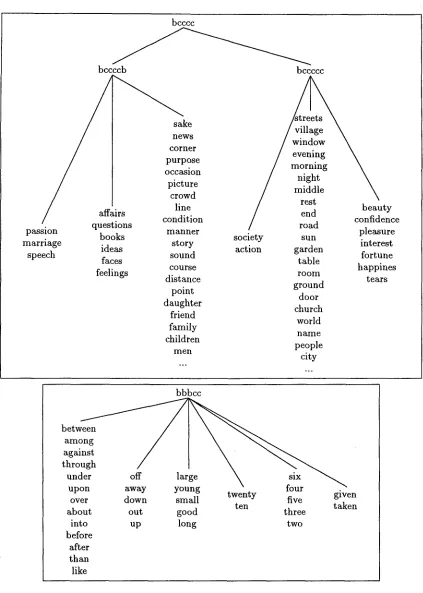
n u m b e r of nodes connecting the initial clusters is 18. So on the average a b o u t three clusters are combined together in the second step. Table 2 displays two re- sults from the clustering tree. T h e first one collects a set of nouns f r o m the lexicon space. However the second one is s o m e w h a t ill-structured n a m e l y two prepositions, two adjectives and a verb cluster are combined into one.
Some linguistic categories inferred by the algo- r i t h m are listed below:
. p r e p o s i t i o n s ( l ) : b y w i t h in t o a n d o f
s p r e p o s i t i o n s ( 2 ) : f r o m o n a t f o r
s p r e p o s i t i o n s ( 3 ) : m u s t m i g h t will s h o u l d c o u l d w o u l d m a y
s d e t e r m i n e r s ( l ) : y o u r i t s o u r t h e s e s o m e t h i s m y h e r all a n y n o
. p r e p o s i t i o n s ( 4 ) : b e t w e e n a m o n g a g a i n s t t h r o u g h u n d e r u p o n o v e r a b o u t
. a d j e c t i v e s ( l ) : l a r g e y o u n g s m a l l g o o d l o n g
• n o u n s ( l ) : s p i r i t b o d y s o n h e a d p o w e r a g e c h a r a c t e r d e a t h sense p a r t c a s e s t a t e
• v e r b s ( l ) : e x c l a i m e d a n s w e r e d c r i e d s a y s k n e w felt s a i d o r i s w a s s a w d i d a s k e d g a v e t o o k m a d e t h o u g h t e i t h e r t o l d
w h e t h e r r e p l i e d b e c a u s e t h o u g h h o w r e p e a t e d o p e n
r e m a i n e d lived d i e d l a y d o e s w h y
• v e r b s ( 2 ) : s h o u t e d w r o t e s h o w e d s p o k e m a k e s d r o p p e d s t r u c k l a i d k e p t h e l d r a i s e d led c a r r i e d s e n t b r o u g h t r o s e d r o v e t h r e w d r e w s h o o k t a l k e d y o u r s e l f l i s t e n e d w i s h e d m e a n t o u g h t s e e m s e e m s s e e m e d t r i e d w a n t e d b e g a n u s e d c o n t i n u e d r e t u r n e d a p p e a r e d c o m e s k n o w s liked l o v e d
• a d j e c t i v e s ( 2 ) : s a d w o n d e r f u l s p e c i a l f r e s h s e r i o u s p a r t i c u l a r p a i n f u l t e r r i b l e p l e a s a n t h a p p y e a s y h a r d s w e e t
• n o u n s ( 2 ) : b o y s girls g e n t l e m e n l a d i e s
s a d v e r b s ( l ) : s c a r c e l y h a r d l y n e i t h e r p r o b a b l y
• v e r b s ( 3 ) : c o n s i d e r r e m e m b e r f o r g e t s u p p o s e b e l i e v e s a y d o t h i n k k n o w feel u n d e r s t a n d
• v e r b s ( 4 ) : k e e p i n g c a r r y i n g p u t t i n g t u r n i n g s h u t h o l d i n g g e t t i n g h e a r i n g k n o w i n g f i n d i n g d r a w i n g l e a v i n g g i v i n g t a k - i n g m a k i n g h a v i n g b e i n g s e e i n g d o i n g
s n o u n s ( 3 ) : s t r e e t s v i l l a g e w i n d o w e v e n i n g m o r n i n g n i g h t m i d d l e r e s t e n d r o a d s u n g a r d e n t a b l e r o o m g r o u n d d o o r c h u r c h w o r l d n a m e p e o p l e c i t y y e a r d a y t i m e h o u s e c o u n t r y w a y p l a c e f a c t r i v e r n e x t e a r t h
$ n o u n s ( 4 ) : b e a u t y c o n f i d e n c e p l e a s u r e i n t e r e s t f o r t u n e h a p - p i n e s s t e a r s
[image:5.596.127.203.101.197.2]bcccc
bccccb
r,,r
irs
~o@n~i~i!in
passion
questions
books
manner
marriage
ideas
story
speech
faces
sound
feelings
course
distance
point
daughter
friend
family
children
m e n
bccccc
ty
/
/ o a ~ t
confidence
pleasure
society
sun
interest
action
garden
fortune
table
happines
room
tears
ground
door
church
world
name
people
city
between
among
against
through
under
upon
o v e r
about
into
before
after
than
like
bbbcc
down
small
twenty
five
given
ten
taken
out
good
three
up
long
two
Table 2: Examples from the cluster hierarchy
[image:6.596.95.518.109.702.2]The ill-placed members in the clusters are shown above using bold font. The clusters represent the lin- guistic categories with a high success rate (,~ 91%). Some semantic relations in the clusters can also be observed. Group nouns(2) is a good example for such a semantic relation between the words in a clus- ter.
5
D i s c u s s i o n A n d C o n c l u s i o n
It can be claimed that the results obtained in this research are encouraging. Although the corpus used for the clustering is quite small compared to other researches, the clusters formed seem to represent the linguistic categories. It is believed that the incorrect ones are due to the poorness of the knowledge con- veyed through the corpus. With a larger training data, an increase in the convergence of frequencies, thus an increase in the quality of clusters is expected. Since the distance function depends on only the dif- ference of the bigram statistics, the running time of the algorithm is quite low compared to algorithms using mutual information. Though the complexity of the two algorithms are the same there is an increase in the efficiency due to the lack of time consuming mathematical operations like division and multipli- cation needed to calculate the mutual information of the whole corpus.
This research has focussed on adding fuzziness to the categorization process. Therefore different simi- larity metrics have not been tested for the algorithm. For further research the algorithm could be tested with different distance metrics. The metrics from the statistical theory given in (de Marcken, 1996) could be used to improve the algorithm. Also the algorithm could be used to infer the phrase struc- ture of a natural language. Finch (Finch, 1993) again uses the mutual information to find out such structures. Using fuzzy membership degrees could be another way to repeat the same process. To find out the phrases, most frequent sentence segments of some length could be collected from a corpus. In ad- dition to the frequencies and bigrams of words, the statistics for these frequent segments could be gath- ered and then they could also be passed to the clus- tering inference mechanism and the resulting clus- ters would then be expected to hold such phrases together with the words.
To conclude, it can claimed that automatic word categorization is the initial step for the acquisition of the structure in a natural language and the same method could be used with modifications and im- provements to find out more abstract structures in the language and moving this abstraction up to the sentence level succesfuly might make it possible for
Korkmaz ~ (/~oluk
a computer to acquire the whole grammar of any natural language automatically.
R e f e r e n c e s
Brown, P.F., V.J. Della Pietra, P.V. de Souza, J.C. Lai, and R.L. Mercer. Class-based n-gram models of natural language. Computational Linguistics, 18(4):467-477, 1992
Finch, Steven. Finding Structure in language. PhD Thesis. Centre for Cognitive Science, Univer- sity of Edinburgh, 1993.
Finch, S. and N. Chater, Automatic methods for finding linguistic categories. In Igor Alexan- der and John Taylor, editors, Artificial Neural Networks, volume 2. Elsevier Science Publish- ers, 1992
Gath, I and A.B. Geva. Unsupervised Optimal Fuzzy Clustering. IEEE Transactions on pat- tern analysis and machine intelligence, Vol. 11, No. 7, July 1989.
Knight, Kevin, Ishwar Chander, Matthew Haines, Vasieios Hatzivassiloglou, Eduard Hovy, Iida Masayo, Steve Luk, Okumura Akitoshi, Richard Whitney, Yamada Kenji. Integrat- ing Knowledge Bases and Statistics in MT. Proceedings of the 1st AMTA Conference. Columbia, MD. 1994.
Lankhorst, M.M. A Genetic Algorithm for Auto- matic Word Categorization. In: E. Backer (ed.), Proceedings of Computing Science in the Netherlands CSN'94, SION, 1994, pp. 171-182.
de Marcken, Carl G. Unsupervised Language Acqui- sition PhD Thesis, 1996.
McMahon, John G. and Francis J. Smith. Improv- ing Statistical Language Model Performance with Automatically Generated Word Hierar- chies. Computational Linguistics, 1996.
Wilms, Geert Jan. Automated Induction of a Lex- ical Sublanguage Grammar Using a Hybrid System of Corpus and Knowledge-Based Tech- niques. Mississippi State University. PhD The- sis, 1995.
Zipf, G. K. The psycho-biology of Language. Boston: Houghton Mifflin. 1935.