Proceedings of NAACL-HLT 2019, pages 4159–4170 4159
Probing the Need for Visual Context in Multimodal Machine Translation
Ozan Caglayan LIUM, Le Mans University
Pranava Madhyastha Imperial College London
Lucia Specia Imperial College London
Lo¨ıc Barrault LIUM, Le Mans University
Abstract
Current work on multimodal machine trans-lation (MMT) has suggested that the vi-sual modality is either unnecessary or only marginally beneficial. We posit that this is a consequence of the very simple, short and repetitive sentences used in the only available dataset for the task (Multi30K), rendering the source text sufficient as context. In the general case, however, we believe that it is possible to combine visual and textual information in or-der to ground translations. In this paper we probe the contribution of the visual modality to state-of-the-art MMT models by conducting a systematic analysis where we partially de-prive the models from source-side textual con-text. Our results show that under limited tex-tual context, models are capable of leveraging the visual input to generate better translations. This contradicts the current belief that MMT models disregard the visual modality because of either the quality of the image features or the way they are integrated into the model.
1 Introduction
Multimodal Machine Translation (MMT) aims at designing better translation systems which take into account auxiliary inputs such as im-ages. Initially organized as a shared task within the First Conference on Machine Translation (WMT16) (Specia et al., 2016), MMT has so far been studied using the Multi30K dataset (Elliott et al.,2016), a multilingual extension of Flickr30K (Young et al., 2014) with translations of the En-glish image descriptions into German, French and Czech (Elliott et al.,2017;Barrault et al.,2018).
The three editions of the shared task have seen many exciting approaches that can be broadly cat-egorized as follows: (i) multimodal attention us-ing convolutional features (Caglayan et al.,2016; Calixto et al., 2016; Libovick´y and Helcl, 2017; Helcl et al., 2018) (ii) cross-modal interactions
with spatially-unaware global features (Calixto and Liu, 2017; Ma et al., 2017;Caglayan et al., 2017a;Madhyastha et al.,2017) and (iii) the in-tegration of regional features from object detec-tion networks (Huang et al.,2016;Gr¨onroos et al., 2018). Nevertheless, the conclusion about the con-tribution of the visual modality is still unclear: Gr¨onroos et al.(2018) consider their multimodal gains “modest” and attribute the largest gain to the usage of external parallel corpora. Lala et al. (2018) observe that their multimodal word-sense disambiguation approach is not significantly dif-ferent than the monomodal counterpart. The orga-nizers of the latest edition of the shared task con-cluded that the multimodal integration schemes explored so far resulted in marginal changes in terms of automatic metrics and human evaluation (Barrault et al., 2018). In a similar vein, Elliott (2018) demonstrated that MMT models can trans-late without significant performance losses even in the presence of features from unrelated images.
2 Input Degradation
In this section we propose several degradations to the input language modality to simulate condi-tions where sentences may miss crucial informa-tion. We denote a set of translation pairs byDand indicate degraded variants with subscripts. Both the training and the test sets are degraded.
Color Deprivation. We consistently replace sourcewords that refer to colors with a special to-ken[v] (DCin Table1). Our hypothesis is that a monomodal system will have to rely on source-side contextual information and biases, while a multimodal architecture could potentially capital-ize on color information extracted by exploiting the image and thus obtain better performance. This affects 3.3% and 3.1% of the words in the training and the test set, respectively.
Entity Masking. The Flickr30K dataset, from which Multi30K is derived, has also been ex-tended with coreference chains to tag mentions of visually depictable entities in image descriptions (Plummer et al.,2015). We use these to mask out the head nouns in thesourcesentences (DNin Ta-ble 1). This affects 26.2% of the words in both the training and the test set. We hypothesize that a multimodal system should heavily rely on the im-ages to infer the missing parts.
Progressive Masking. A progressively de-graded variant Dk replaces all but the first k tokens of source sentences with [v]. Unlike the color deprivation and entity masking, mask-ing out suffixes does not guarantee systematic removal of visual context, but rather simulates an increasingly low-resource scenario. Overall, we form 16 degraded variants Dk (Table 1) wherek ∈ {0,2, . . . ,30}. We stop atD30 since 99.8% of the sentences in Multi30K are shorter than 30 words with an average sentence length of 12 words. D0 – where the only remaining information is the source sentence length – is an interesting case from two perspectives: a neural machine translation (NMT) model trained on it resembles a target language model, while an MMT model becomes an image captioner with access to “expected length information”.
Visual Sensitivity. Inspired by Elliott (2018), we experiment withincongruent decodingin order to understand how sensitive the multimodal sys-tems are to the visual modality. This is achieved
D a lady in a blue dress singing
DC a lady in a [v] dress singing
DN a [v] in a blue [v] singing
D4 a lady in a [v] [v] [v]
D2 a lady [v] [v] [v] [v] [v]
D0 [v] [v] [v] [v] [v] [v] [v]
Table 1: An example of the proposed input degradation schemes:Dis the original sentence.
by explicitly violating the test-time semantic con-gruence across modalities. Specifically, we feed the visual features in reverse sample order to break image-sentence alignments. Consequently, a model capable of integrating the visual modality would likely deteriorate in terms of metrics.
3 Experimental Setup
Dataset. We conduct experiments on the English→French part of Multi30K. The models are trained on the concatenation of thetrain and val sets (30K sentences) whereas test2016 (dev) and test2017 (test) are used for early-stopping and model evaluation, respectively. For entity masking, we revert to the default Flickr30K splits and perform the model evaluation on test2016, since test2017 is not annotated for entities. We use word-level vocabularies of 9,951 English and 11,216 French words. We use Moses (Koehn et al., 2007) scripts to lowercase, normalize and tokenize the sentences with hyphen splitting. The hyphens are stitched back prior to evaluation.
Visual Features. We use a ResNet-50 CNN (He et al., 2016) trained on ImageNet (Deng et al., 2009) as image encoder. Prior to feature extrac-tion, we center and standardize the images using ImageNet statistics, resize the shortest edge to 256 pixels and take a center crop of size 256x256. We extract spatial features of size 2048x8x8 from the final convolutional layer and apply L2
normaliza-tion along the depth dimension (Caglayan et al., 2018). For the non-attentive model, we use the 2048-dimensional global average pooled version (pool5) of the above convolutional features.
D DC
[image:3.595.313.520.60.204.2]NMT 70.6±0.5 68.4±0.1 INIT 70.7±0.2 68.9±0.1 HIER 70.9±0.3 69.0±0.3 DIRECT 70.9±0.2 68.8±0.3
Table 2: Baseline and color-deprivation METEOR scores: bold systems are significantly different from the NMT system within the same column (p-value≤0.03).
For the MMT model, we explore the basic multimodal attention (DIRECT) (Caglayan et al., 2016) and its hierarchical (HIER) extension ( Li-bovick´y and Helcl, 2017). The former linearly projects the concatenation of textual and visual context vectors to obtain the multimodal context vector, while the latter replaces the concatena-tion with another attenconcatena-tion layer. Finally, we also experiment with encoder-decoder initializa-tion (INIT) (Calixto and Liu, 2017; Caglayan et al.,2017a) where we initialize both the encoder and the decoder using a non-linear transformation of the pool5 features.
Hyperparameters. The encoder and decoder GRUs have 400 hidden units and are initialized with 0 except the multimodal INIT system. All embeddings are 200-dimensional and the decoder embeddings are tied (Press and Wolf, 2016). A dropout of 0.4 and 0.5 is applied on source embed-dings and encoder/decoder outputs, respectively (Srivastava et al.,2014). The weights are decayed with a factor of1e−5. We use ADAM (Kingma and Ba, 2014) with a learning rate of 4e−4 and mini-batches of 64 samples. The gradients are clipped if the total norm exceeds 1 (Pascanu et al., 2013). The training is early-stopped ifdevset ME-TEOR (Denkowski and Lavie,2014) does not im-prove for ten epochs. All experiments are con-ducted withnmtpytorch1(Caglayan et al.,2017b).
4 Results
We train all systems three times each with dif-ferent random initialization in order to perform significance testing with multeval (Clark et al., 2011). Throughout the section, we always report the mean over three runs (and the standard devi-ation) of the considered metrics. We decode the translations with a beam size of 12.
[image:3.595.88.274.62.137.2]1github.com/lium-lst/nmtpytorch
Figure 1: Entity masking: all masked MMT models are significantly better than the masked NMT (dashed). In-congruent decoding severely worsens all systems. The vanilla NMT baseline is 75.92.
We first present test2017 METEOR scores for the baseline NMT and MMT systems, when trained on the full dataset D (Table 2). The first column indicates that, although MMT models per-form slightly better on average, they are not sig-nificantly better than the baseline NMT. We now introduce and discuss the results obtained under the proposed degradation schemes. Please refer to Table5and the appendix for qualitative examples.
4.1 Color Deprivation
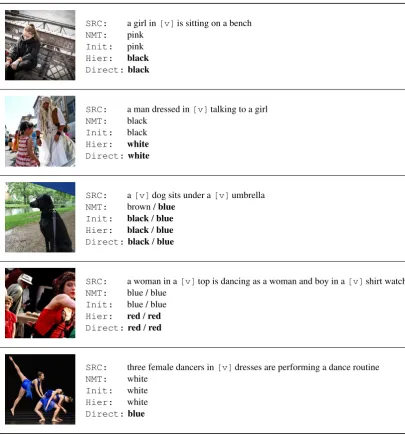
Unlike the inconclusive results forD, we observe that all MMT models are significantly better than NMT when color deprivation is applied (DCin Ta-ble 2). If we further focus on the subset of the test set subjected to color deprivation (247 sen-tences), the gain increases to 1.6 METEOR for HIER. For the latter subset, we also computed the average color accuracy per sentence and found that the attentive models are 12% better than the NMT (32.5→44.5) whereas the INIT model only brings 4% (32.5→36.5) improvement. This shows that more complex MMT models are better at integrat-ing visual information to perform better.
4.2 Entity Masking
The gains are much more prominent with entity masking, where the degradation occurs at a larger scale: Attentive MMT models show up to 4.2 ME-TEOR improvement over NMT (Figure1). We ob-served a large performance drop withincongruent decoding, suggesting that the visual modality is
2Since entity masking uses Flickr30K splits (Section 3)
young
song
jeune chanson
jeune
young
[v]
enfant
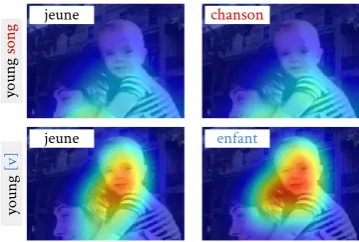
Figure 2: Baseline MMT (top) translates the misspelled “son” while the masked MMT (bottom) correctly pro-duces “enfant” (child) by focusing on the image.
+Gain (↓Incongruence Drop)
INIT HIER DIRECT
[image:4.595.91.271.61.182.2]Czech +1.4 (↓2.9) +1.7 (↓3.5) +1.7 (↓4.1) German +2.1 (↓4.7) +2.5 (↓5.9) +2.7 (↓6.5) French +3.4 (↓6.5) +3.9 (↓9.0) +4.2 (↓9.7)
Table 3:Entity maskingresults across three languages: all MMT models perform significantly better than their NMT counterparts (p-value≤0.01). The incongruence drop applies on top of the MMT score.
now much more important than previously demon-strated (Elliott,2018). A comparison of attention maps produced by the baseline and masked MMT models reveals that the attention weights are more consistent in the latter. An interesting example is given in Figure2where the masked MMT model attends to the correct region of the image and suc-cessfully translates a dropped word that was oth-erwise a spelling mistake (“son”→“song”).
Czech and German. In order to understand whether the above observations are also consis-tent across different languages, we extend the en-tity masking experiments to German and Czech parts of Multi30K. Table3shows the gain of each MMT system with respect to the NMT model and the subsequent drop caused by incongruent decod-ing3. First, we see that the multimodal benefits clearly hold for German and Czech, although the gains are lower than for French4. Second, when we compute the average drop from using incon-gruent images across all languages, we see how conservative the INIT system is (↓4.7) compared
3For example, the INIT system for French (Figure1)
sur-passes the baseline (50.5) by reaching 53.9 (+3.4), which ends up at 47.4 (↓6.5) after incongruent decoding.
4This is probably due to the morphological richness of DE
and CS which is suboptimally handled by word-level MT.
0 4 8 12 16 20 24 28
Context Size (k)
0 25 50 75 100
Source Information (%)
METEOR over NMT
0 2 4 6 8
INIT HIER DIRECT
Figure 3: Multimodal gain in absolute METEOR for
progressive masking: the dashed gray curve indicates
the percentage of non-masked words in the training set.
D4 D6 D12 D20 D
DIRECT 32.3 42.2 64.5 70.1 70.9
Incongruent Dec. ↓6.4 ↓5.5 ↓1.4 ↓0.7 ↓0.7
Blinding ↓3.9 ↓2.9 ↓0.4 ↓0.5 ↓0.3 NMT ↓3.7 ↓2.6 ↓0.6 ↓0.2 ↓0.3
Table 4: The impact of incongruent decoding for
pro-gressive masking: all METEOR differences are against
the DIRECT model. The blinded systems are both trained and decoded using incongruent features.
to HIER (↓6.1) and DIRECT (↓6.8). This raises a follow-up question as to whether the hidden state initialization eventually loses its impact through-out the recurrence where, as a consequence, the only modality processed is the text.
4.3 Progressive Masking
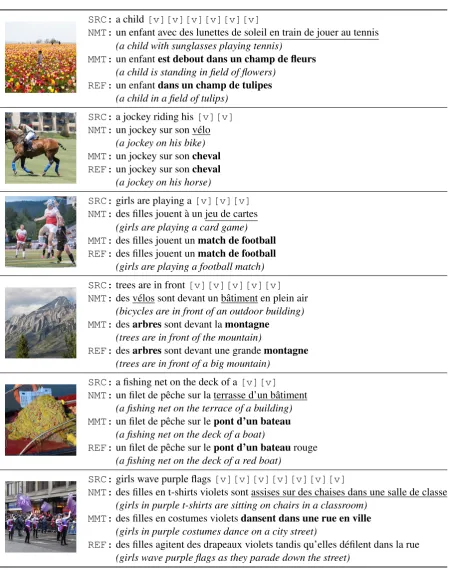
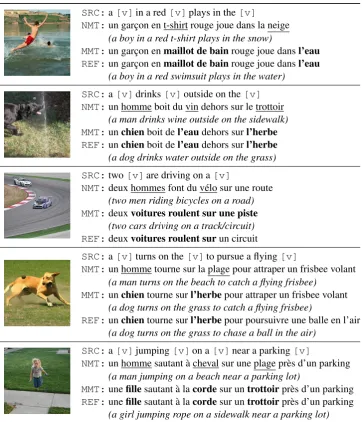
Finally, we discuss the results of the progressive masking experiments for French. Figure3clearly shows that as the sentences are progressively de-graded, all MMT systems are able to leverage the visual modality. When the multimodal task be-comes image captioning at k=0, MMT models improve over the language-model counterpart by ∼7 METEOR. Further qualitative examples show that the systems perform surprisingly well by pro-ducing visually plausible sentences (see Table 5 and the Appendix).
[image:4.595.306.526.63.179.2]SRC:an older woman in[v][v][v][v][v][v][v][v][v][v][v]
NMT:une femme ˆag´ee avec un t-shirt blanc et des lunettes de soleil est assise sur un banc (an older woman with a white t-shirt and sunglasses is sitting on a bank)
MMT:une femme ˆag´ee enmaillot de bain roseest assise sur unrocher au bord de l’eau
(an older woman with a pink swimsuit is sitting on a rock at the seaside)
REF:une femme ˆag´eeen bikinibronze surun rocher au bord de l’oc´ean
(an older woman in bikini is tanning on a rock at the edge of the ocean)
SRC:a young[v]in[v]holding a tennis[v]
NMT:un jeune garc¸on en bleu tenant une raquette de tennis (a young boy in blue holding a tennis racket)
MMT:unejeunefemmeenblanctenant une raquette de tennis
REF:unejeunefemmeenblanctenant une raquette de tennis (a young girl in white holding a tennis racket)
SRC:little girl covering her face with a[v]towel
NMT:une petite fille couvrant son visage avec une serviette blanche (a little girl covering her face with a white towel)
MMT:une petite fille couvrant son visage avec une serviettebleue
REF:une petite fille couvrant son visage avec une serviettebleue
[image:5.595.82.519.60.309.2](a little girl covering her face with a blue towel)
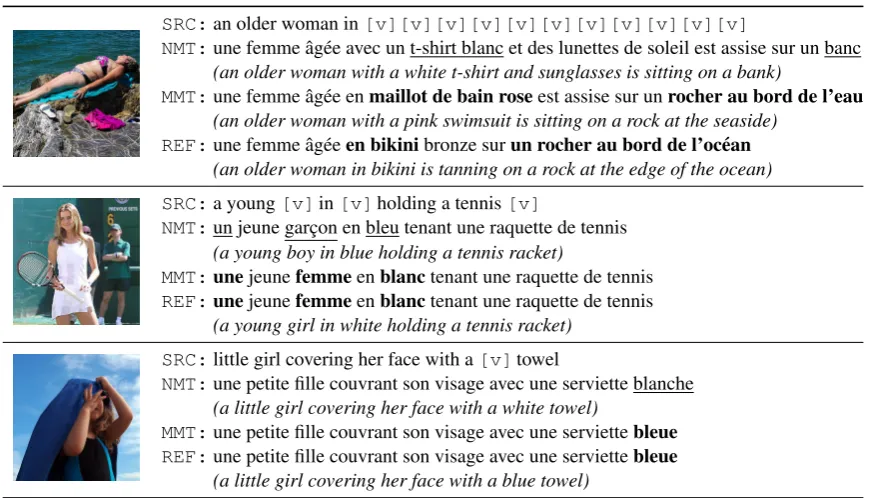
Table 5: Qualitative examples from progressive masking, entity masking and color deprivation, respectively. Un-derlined and bold words highlight the bad and good lexical choices. MMT is an attentive system.
We then conduct a contrastive “blinding” exper-iment where the DIRECT models are not only fed with incongruent features at decoding time but also trained with them from scratch. The results suggest that the blinded models learn to ignore the visual modality. In fact, their performance is equivalent to NMT models.
5 Discussion and Conclusions
We presented an in-depth study on the potential contribution of images for multimodal machine translation. Specifically, we analysed the behav-ior of state-of-the-art MMT models under several degradation schemes in the Multi30K dataset, in order to reveal and understand the impact of tex-tual predominance. Our results show that the mod-els explored are able to integrate the visual modal-ity if the available modalities are complementary rather than redundant. In the latter case, the pri-mary modality (text) sufficient to accomplish the task. This dominance effect corroborates the sem-inal work of Colavita (1974) in Psychophysics where it has been demonstrated that visual stimuli dominate over the auditory stimuli when humans are asked to perform a simple audiovisual discrim-ination task. Our investigation using source degra-dation also suggests that visual grounding can in-crease the robustness of machine translation sys-tems by mitigating input noise such as errors in
the source text. In the future, we would like to devise models that can learn when and how to in-tegrate multiple modalities by taking care of the complementary and redundant aspects of them in an intelligent way.
Acknowledgments
This work is a follow-up on the research ef-forts conducted within the “Grounded sequence-to-sequence transduction” team of the JSALT 2018 Workshop. We would like to thank Jindˇrich Libovick´y for contributing the hierarchical atten-tion tonmtpytorchduring the workshop. We also thank the reviewers for their valuable comments.
Ozan Caglayan and Lo¨ıc Barrault received funding from the French National Research Agency (ANR) through the CHIST-ERA M2CR project under the contract ANR-15-CHR2-0006-01. Lucia Specia and Pranava Madhyastha re-ceived funding from the MultiMT (H2020 ERC Starting Grant No. 678017) and MMVC (Newton Fund Institutional Links Grant, ID 352343575) projects.
References
Dzmitry Bahdanau, Kyunghyun Cho, and Yoshua Ben-gio. 2014. Neural machine translation by jointly learning to align and translate.Computing Research
Lo¨ıc Barrault, Fethi Bougares, Lucia Specia, Chi-raag Lala, Desmond Elliott, and Stella Frank. 2018. Findings of the third shared task on multimodal ma-chine translation. InProceedings of the Third Con-ference on Machine Translation, Volume 2: Shared
Task Papers, pages 308–327, Belgium, Brussels.
As-sociation for Computational Linguistics.
Ozan Caglayan, Walid Aransa, Adrien Bardet, Mer-cedes Garc´ıa-Mart´ınez, Fethi Bougares, Lo¨ıc Bar-rault, Marc Masana, Luis Herranz, and Joost van de Weijer. 2017a. LIUM-CVC submissions for WMT17 multimodal translation task. In Proceed-ings of the Second Conference on Machine
Trans-lation, Volume 2: Shared Task Papers, pages 432–
439, Copenhagen, Denmark. Association for Com-putational Linguistics.
Ozan Caglayan, Adrien Bardet, Fethi Bougares, Lo¨ıc Barrault, Kai Wang, Marc Masana, Luis Herranz, and Joost van de Weijer. 2018. LIUM-CVC sub-missions for WMT18 multimodal translation task.
InProceedings of the Third Conference on Machine
Translation, Volume 2: Shared Task Papers, pages
603–608, Belgium, Brussels. Association for Com-putational Linguistics.
Ozan Caglayan, Lo¨ıc Barrault, and Fethi Bougares. 2016. Multimodal attention for neural ma-chine translation. Computing Research Repository, arXiv:1609.03976.
Ozan Caglayan, Mercedes Garc´ıa-Mart´ınez, Adrien Bardet, Walid Aransa, Fethi Bougares, and Lo¨ıc Barrault. 2017b. NMTPY: A flexible toolkit for ad-vanced neural machine translation systems. Prague
Bull. Math. Linguistics, 109:15–28.
Iacer Calixto, Desmond Elliott, and Stella Frank. 2016. DCU-UvA multimodal MT system report. In Pro-ceedings of the First Conference on Machine
Trans-lation, pages 634–638, Berlin, Germany.
Associa-tion for ComputaAssocia-tional Linguistics.
Iacer Calixto and Qun Liu. 2017. Incorporating global visual features into attention-based neural machine translation. InProceedings of the 2017 Conference on Empirical Methods in Natural Language
Pro-cessing, pages 992–1003, Copenhagen, Denmark.
Association for Computational Linguistics.
Kyunghyun Cho, Bart van Merrienboer, Caglar Gul-cehre, Dzmitry Bahdanau, Fethi Bougares, Holger Schwenk, and Yoshua Bengio. 2014. Learning phrase representations using RNN encoder–decoder for statistical machine translation. InProceedings of the 2014 Conference on Empirical Methods in
Nat-ural Language Processing, pages 1724–1734, Doha,
Qatar. Association for Computational Linguistics.
Jonathan H. Clark, Chris Dyer, Alon Lavie, and Noah A. Smith. 2011. Better hypothesis testing for statistical machine translation: Controlling for opti-mizer instability. InProceedings of the 49th Annual
Meeting of the Association for Computational Lin-guistics: Human Language Technologies: Short
Pa-pers - Volume 2, HLT ’11, pages 176–181,
Strouds-burg, PA, USA. Association for Computational Lin-guistics.
Francis B. Colavita. 1974. Human sensory dominance.
Perception & Psychophysics, 16 (2):409–412.
J. Deng, W. Dong, R. Socher, L. Li, Kai Li, and Li Fei-Fei. 2009. Imagenet: A large-scale hierarchical im-age database. In 2009 IEEE Conference on
Com-puter Vision and Pattern Recognition, pages 248–
255.
Michael Denkowski and Alon Lavie. 2014. Meteor universal: Language specific translation evaluation for any target language. InProceedings of the Ninth
Workshop on Statistical Machine Translation, pages
376–380. Association for Computational Linguis-tics.
Desmond Elliott. 2018. Adversarial evaluation of mul-timodal machine translation. InProceedings of the 2018 Conference on Empirical Methods in
Natu-ral Language Processing, pages 2974–2978,
Brus-sels, Belgium. Association for Computational Lin-guistics.
Desmond Elliott, Stella Frank, Lo¨ıc Barrault, Fethi Bougares, and Lucia Specia. 2017. Findings of the second shared task on multimodal machine transla-tion and multilingual image descriptransla-tion. In Proceed-ings of the Second Conference on Machine
Trans-lation, Volume 2: Shared Task Papers, pages 215–
233, Copenhagen, Denmark. Association for Com-putational Linguistics.
Desmond Elliott, Stella Frank, Khalil Sima’an, and Lu-cia SpeLu-cia. 2016. Multi30K: Multilingual english-german image descriptions. InProceedings of the
5th Workshop on Vision and Language, pages 70–
74, Berlin, Germany. Association for Computational Linguistics.
Stig-Arne Gr¨onroos, Benoit Huet, Mikko Kurimo, Jorma Laaksonen, Bernard Merialdo, Phu Pham, Mats Sj¨oberg, Umut Sulubacak, J¨org Tiedemann, Raphael Troncy, and Ra´ul V´azquez. 2018. The MeMAD submission to the WMT18 multimodal translation task. InProceedings of the Third
Confer-ence on Machine Translation, pages 609–617,
Bel-gium, Brussels. Association for Computational Lin-guistics.
K. He, X. Zhang, S. Ren, and J. Sun. 2016. Deep resid-ual learning for image recognition. In 2016 IEEE Conference on Computer Vision and Pattern
Recog-nition (CVPR), pages 770–778.
Jindˇrich Helcl, Jindˇrich Libovick´y, and Dusan Varis. 2018. CUNI system for the WMT18 multimodal translation task. InProceedings of the Third Con-ference on Machine Translation, Volume 2: Shared
Task Papers, pages 622–629, Belgium, Brussels.
Po-Yao Huang, Frederick Liu, Sz-Rung Shiang, Jean Oh, and Chris Dyer. 2016. Attention-based multi-modal neural machine translation. InProceedings of
the First Conference on Machine Translation, pages
639–645, Berlin, Germany. Association for Compu-tational Linguistics.
Diederik Kingma and Jimmy Ba. 2014. Adam: A method for stochastic optimization. Computing
Re-search Repository, arXiv:1412.6980.
Philipp Koehn, Hieu Hoang, Alexandra Birch, Chris Callison-Burch, Marcello Federico, Nicola Bertoldi, Brooke Cowan, Wade Shen, Christine Moran, Richard Zens, Chris Dyer, Ondˇrej Bojar, Alexandra Constantin, and Evan Herbst. 2007. Moses: Open source toolkit for statistical machine translation. In Proceedings of the 45th Annual Meeting of the ACL
on Interactive Poster and Demonstration Sessions,
ACL ’07, pages 177–180, Stroudsburg, PA, USA. Association for Computational Linguistics.
Chiraag Lala, Pranava Swaroop Madhyastha, Carolina Scarton, and Lucia Specia. 2018. Sheffield sub-missions for WMT18 multimodal translation shared
task. InProceedings of the Third Conference on
Ma-chine Translation, Volume 2: Shared Task Papers,
pages 630–637, Belgium, Brussels. Association for Computational Linguistics.
Jindˇrich Libovick´y and Jindˇrich Helcl. 2017. Attention strategies for multi-source sequence-to-sequence learning. InProceedings of the 55th Annual Meet-ing of the Association for Computational LMeet-inguis-
Linguis-tics (Volume 2: Short Papers), pages 196–202,
Van-couver, Canada. Association for Computational Lin-guistics.
Mingbo Ma, Dapeng Li, Kai Zhao, and Liang Huang. 2017. OSU multimodal machine translation system report. In Proceedings of the Second Conference on Machine Translation, Volume 2: Shared Task Pa-pers, pages 465–469, Copenhagen, Denmark. Asso-ciation for Computational Linguistics.
Pranava Swaroop Madhyastha, Josiah Wang, and Lu-cia SpeLu-cia. 2017. Sheffield MultiMT: Using object posterior predictions for multimodal machine trans-lation. InProceedings of the Second Conference on Machine Translation, Volume 2: Shared Task Pa-pers, pages 470–476, Copenhagen, Denmark. Asso-ciation for Computational Linguistics.
Razvan Pascanu, Tomas Mikolov, and Yoshua Bengio. 2013. On the difficulty of training recurrent neural networks. InProceedings of the 30th International
Conference on Machine Learning, volume 28 of
Proceedings of Machine Learning Research, pages
1310–1318, Atlanta, Georgia, USA. PMLR.
B. A. Plummer, L. Wang, C. M. Cervantes, J. C. Caicedo, J. Hockenmaier, and S. Lazebnik. 2015. Flickr30k entities: Collecting region-to-phrase cor-respondences for richer image-to-sentence models.
In 2015 IEEE International Conference on
Com-puter Vision (ICCV), pages 2641–2649.
Ofir Press and Lior Wolf. 2016. Using the output em-bedding to improve language models. Computing
Research Repository, arXiv:1608.05859.
Rico Sennrich, Orhan Firat, Kyunghyun Cho, Alexan-dra Birch, Barry Haddow, Julian Hitschler, Marcin Junczys-Dowmunt, Samuel L¨aubli, Antonio Valerio Miceli Barone, Jozef Mokry, and Maria Nadejde. 2017. Nematus: a toolkit for neural machine trans-lation. InProceedings of the Software Demonstra-tions of the 15th Conference of the European
Chap-ter of the Association for Computational Linguistics,
pages 65–68. Association for Computational Lin-guistics.
Lucia Specia, Stella Frank, Khalil Sima’an, and Desmond Elliott. 2016. A shared task on multi-modal machine translation and crosslingual image description. InProceedings of the First Conference
on Machine Translation, pages 543–553, Berlin,
Germany. Association for Computational Linguis-tics.
Nitish Srivastava, Geoffrey Hinton, Alex Krizhevsky, Ilya Sutskever, and Ruslan Salakhutdinov. 2014. Dropout: A simple way to prevent neural networks from overfitting. J. Mach. Learn. Res., 15(1):1929– 1958.
Peter Young, Alice Lai, Micah Hodosh, and Julia Hockenmaier. 2014. From image descriptions to visual denotations: New similarity metrics for se-mantic inference over event descriptions. Transac-tions of the Association for Computational Linguis-tics, 2:67–78.
A Qualitative Examples
SRC: a girl in[v]is sitting on a bench
NMT: pink
Init: pink
Hier: black
Direct:black
SRC: a man dressed in[v]talking to a girl
NMT: black
Init: black
Hier: white
Direct:white
SRC: a[v]dog sits under a[v]umbrella
NMT: brown /blue Init: black/blue Hier: black/blue Direct:black/blue
SRC: a woman in a[v]top is dancing as a woman and boy in a[v]shirt watch
NMT: blue / blue
Init: blue / blue
Hier: red/red Direct:red/red
SRC: three female dancers in[v]dresses are performing a dance routine
NMT: white
Init: white
Hier: white
[image:8.595.95.501.177.613.2]Direct:blue
SRC:a[v]in a red[v]plays in the[v] NMT:un garc¸on en t-shirt rouge joue dans la neige
(a boy in a red t-shirt plays in the snow)
MMT:un garc¸on enmaillot de bainrouge joue dansl’eau
REF:un garc¸on enmaillot de bainrouge joue dansl’eau
(a boy in a red swimsuit plays in the water)
SRC:a[v]drinks[v]outside on the[v] NMT:un homme boit du vin dehors sur le trottoir
(a man drinks wine outside on the sidewalk)
MMT:unchienboit del’eaudehors surl’herbe
REF:unchienboit del’eaudehors surl’herbe
(a dog drinks water outside on the grass)
SRC:two[v]are driving on a[v]
NMT:deux hommes font du v´elo sur une route (two men riding bicycles on a road)
MMT:deuxvoitures roulent sur une piste
(two cars driving on a track/circuit)
REF:deuxvoitures roulent surun circuit
SRC:a[v]turns on the[v]to pursue a flying[v]
NMT:un homme tourne sur la plage pour attraper un frisbee volant (a man turns on the beach to catch a flying frisbee)
MMT:unchientourne surl’herbepour attraper un frisbee volant
(a dog turns on the grass to catch a flying frisbee)
REF:unchientourne surl’herbepour poursuivre une balle en l’air
(a dog turns on the grass to chase a ball in the air)
SRC:a[v]jumping[v]on a[v]near a parking[v]
NMT:un homme sautant `a cheval sur une plage pr`es d’un parking (a man jumping on a beach near a parking lot)
MMT:unefillesautant `a lacordesur untrottoirpr`es d’un parking
[image:9.595.119.482.182.605.2]REF:unefillesautant `a lacordesur untrottoirpr`es d’un parking (a girl jumping rope on a sidewalk near a parking lot)
u
n
e
mère
et sa
jeu
n
e
c
h
a
n
s
o
n
p
ro
fi
ta
n
t
d
&
a
p
o
s
;
u
n
e
b
el
le
jo
u
rn
ée
d
eh
o
rs .
<
eo
s
>
a mother and her young song enjoying a beautiful day outside . <eos>
une mère et sa
jeune chanson profitant d' une
belle journée dehors . <eos>
(a) Baseline (non-masked) MMT
u
n
e
mère
et
s
o
n
jeu
n
e
en
fa
n
t
p
ro
fi
ta
n
t
d
&
a
p
o
s
;
u
n
e
b
el
le
jo
u
rn
ée
d
eh
o
rs .
<
eo
s
>
a [v] and her young [v] enjoying a beautiful [v] outside . <eos>
une mère et son
jeune enfant profitant d' une
belle journée dehors . <eos>
[image:10.595.77.514.207.571.2](b) Entity-masked MMT
u
n
terri
er de
b o s to n c o u rt s u r l& a p o s ; h erb e v erte lu x u ri a n te d ev a n t u n e c lô tu re b la n c h e . < eo s > a boston terrier is running on lush green grass in front of a white fence . <eos>
un terrier de boston
court sur l' herbe verte
luxuriante devant une clôture blanche
. <eos>
(a) Baseline (non-masked) MMT
u n b erg er a ll e ma n d c o u rt s u r l& a p o s ; h erb e v erte d ev a n t u n e c lô tu re b la n c h e . < eo s > a boston [v] is running on lush green [v] in front of a white [v] . <eos>
un berger allemand court
sur l' herbe verte devant
une clôture blanche . <eos>
[image:11.595.80.514.174.592.2](b) Entity-masked MMT
SRC:a child[v][v][v][v][v][v]
NMT:un enfant avec des lunettes de soleil en train de jouer au tennis (a child with sunglasses playing tennis)
MMT:un enfantest debout dans un champ de fleurs
(a child is standing in field of flowers) REF:un enfantdans un champ de tulipes
(a child in a field of tulips)
SRC:a jockey riding his[v][v] NMT:un jockey sur son v´elo
(a jockey on his bike) MMT:un jockey sur soncheval
REF:un jockey sur soncheval
(a jockey on his horse)
SRC:girls are playing a[v][v][v] NMT:des filles jouent `a un jeu de cartes
(girls are playing a card game) MMT:des filles jouent unmatch de football
REF:des filles jouent unmatch de football
(girls are playing a football match)
SRC:trees are in front[v][v][v][v][v] NMT:des v´elos sont devant un bˆatiment en plein air
(bicycles are in front of an outdoor building)
MMT:desarbressont devant lamontagne
(trees are in front of the mountain)
REF:desarbressont devant une grandemontagne
(trees are in front of a big mountain)
SRC:a fishing net on the deck of a[v][v] NMT:un filet de pˆeche sur la terrasse d’un bˆatiment
(a fishing net on the terrace of a building) MMT:un filet de pˆeche sur lepont d’un bateau
(a fishing net on the deck of a boat)
REF:un filet de pˆeche sur lepont d’un bateaurouge (a fishing net on the deck of a red boat)
SRC:girls wave purple flags[v][v][v][v][v][v][v]
NMT:des filles en t-shirts violets sont assises sur des chaises dans une salle de classe (girls in purple t-shirts are sitting on chairs in a classroom)
MMT:des filles en costumes violetsdansent dans une rue en ville
(girls in purple costumes dance on a city street)
[image:12.595.75.528.107.678.2]REF:des filles agitent des drapeaux violets tandis qu’elles d´efilent dans la rue (girls wave purple flags as they parade down the street)

![Figure 4: Attention example from entity masking experiments: (a) Baseline MMT translates the misspelled “son”(song → chanson) while (b) the masked MMT achieves a correct translation ([v]→ enfant) by exploiting thevisual modality.](https://thumb-us.123doks.com/thumbv2/123dok_us/1389251.673290/10.595.77.514.207.571/attention-experiments-baseline-translates-misspelled-translation-exploiting-thevisual.webp)
![Figure 5: Attention example from entity masking experiments where terrier, grass and fence are dropped from thesource sentence: (a) Baseline MMT is not able to shift attention from the salient dog to the grass and fence, (b) theattention produced by the masked MMT first shifts to the background area while translating “on lush green [v]”then focuses on the fence.](https://thumb-us.123doks.com/thumbv2/123dok_us/1389251.673290/11.595.80.514.174.592/attention-experiments-thesource-baseline-attention-theattention-background-translating.webp)