Proceedings of NAACL-HLT 2019, pages 3361–3371 3361
Semantic Role Labeling with Associated Memory Network
Chaoyu Guan†, Yuhao Cheng†, Hai Zhao†∗
†Department of Computer Science and Engineering, Shanghai Jiao Tong University †Key Laboratory of Shanghai Education Commission for Intelligent Interaction
and Cognitive Engineering, Shanghai Jiao Tong University, Shanghai, China {351549709,cyh958859352}@sjtu.edu.cn
Abstract
Semantic role labeling (SRL) is a task to rec-ognize all the predicate-argument pairs of a sentence, which has been in a performance improvement bottleneck after a series of lat-est works were presented. This paper pro-poses a novel syntax-agnostic SRL model enhanced by the proposed associated mem-ory network (AMN), which makes use of inter-sentence attention of label-known asso-ciated sentences as a kind of memory to fur-ther enhance dependency-based SRL. In de-tail, we use sentences and their labels from train dataset as an associated memory cue to help label the target sentence. Furthermore, we compare several associated sentences se-lecting strategies and label merging methods in AMN to find and utilize the label of associ-ated sentences while attending them. By lever-aging the attentive memory from known train-ing data, Our full model reaches state-of-the-art on CoNLL-2009 benchmark datasets for syntax-agnostic setting, showing a new effec-tive research line of SRL enhancement other than exploiting external resources such as well pre-trained language models.
1 Introduction
Semantic role labeling (SRL) is a task to recog-nize all the predicate-argument pairs of a given sentence and its predicates. It is a shallow seman-tic parsing task, which has been widely used in a series of natural language processing (NLP) tasks, such as information extraction (Liu et al., 2016) and question answering (Abujabal et al.,2017).
Generally, SRL is decomposed into four classi-fication subtasks in pipeline systems, consisting of
∗
Corresponding author. This paper was partially sup-ported by National Key Research and Development Program of China (No. 2017YFB0304100), National Natural Science Foundation of China (No. U1836222 and No. 61733011) and Key Project of National Society Science Foundation of China (No. 15-ZDA041).
predicate identification, predicate disambiguation, argument identification, and argument classifica-tion. In recent years, great attention (Zhou and Xu, 2015; Marcheggiani et al., 2017; He et al.,
2017, 2018a,b) has been turned to deep learn-ing method, especially Long Short-term Memory (LSTM) network for learning with automatically extracted features. (Zhou and Xu, 2015) pro-posed the first end-to-end recurrent neural network (RNN) to solve the SRL task. (Marcheggiani et al.,
2017) studied several predicate-specified embed-ding and decoembed-ding methods. (He et al.,2017) de-livered a full study on the influence of RNN train-ing and decodtrain-ing strategies. Whether to use the syntactic information for SRL is also studied ac-tively (He et al.,2017,2018b).
Since the recent work of (Marcheggiani et al.,
2017), which surprisingly shows syntax-agnostic dependency SRL for the first time can be rival of syntax-aware models, SRL has been more and more formulized into standard sequence labeling task on a basis of keeping syntax unavailable. A series of work on SRL received further perfor-mance improvement following this line through further refining neural model design (He et al.,
2018a). Different from all previous work, we pro-pose to introduce an associated memory network which builds memory from known data through the inter-sentence attention to enhance syntax-agnostic model even further.
Based on Memory Network (Weston et al.,
2014; Sukhbaatar et al., 2015), (Miller et al.,
2016) proposed Key-Value Memory Network (KV-MemNN) to solve Question Answering prob-lem and gain large progress. Our proposed method is similar to KV-MemNN, but with a different def-inition of key-value and different information dis-tilling process. Thus, we propose a carefully de-signed inter-sentence attention mechanism to han-dle it.
Recently, there are also some attempts to make use of attention mechanism in SRL task. (Tan et al., 2018; Strubell et al., 2018) focus on self-attention, which only uses the information of the input sentence as the source of attention. (Cai et al., 2018) makes use of biaffine attention (Dozat and Manning,2017) for decoding in SRL, which was the current state-of-the-art (SOTA) in CoNLL-2009 benchmark as this work was em-barking. Different from all previous work, we uti-lize inter-sentence attention to help model lever-age associated information from other known sen-tences in the memory.
To our best knowledge, this is the first time to use memory network in the SRL task. Our eval-uation on CoNLL-2009 benchmarks shows that our model outperforms or reaches other syntax-agnostic models on English, and achieves compet-itive results on Chinese, which indicates that mem-ory network learning from known data is indeed helpful to SRL task.
There are several SRL annotation conventions, such as PropBank (Bonial et al., 2012) and FrameNet (Baker et al.,1998). This paper focuses on the former convention. Under PropBank con-vention, there are two role representation forms, which are span-based SRL, such as CoNLL 2005 and CoNLL 2012 shared tasks, and dependency-based SRL, such as CoNLL 2009 shared task. The former uses span to represent argument, while the latter uses the headword of the span to represent the argument. As the latter has been more actively studied due to dependency style SRL for conve-nient machine learning, we will focus on depen-dency SRL only in this work.
Given a sentence S, the goal of dependency SRL task is to find all the predicate-argument pairs
(p, a). The following shows an example sentence with semantic role labels marked in subscripts.
SheA0 haslostvitA1justARGM−M N R as quickly.
Here, v means the predicate, A0 means the agent, A1 means the patient and ARGM-MNR means how an actionvis performed.
In the rest of this paper, we will describe our model in Section 2. Then, the experiment set-up and results are given in Section3. Related works about SRL and attention mechanism will be given in Section 4. Conclusions and future work are drawn in Section5.
2 Model
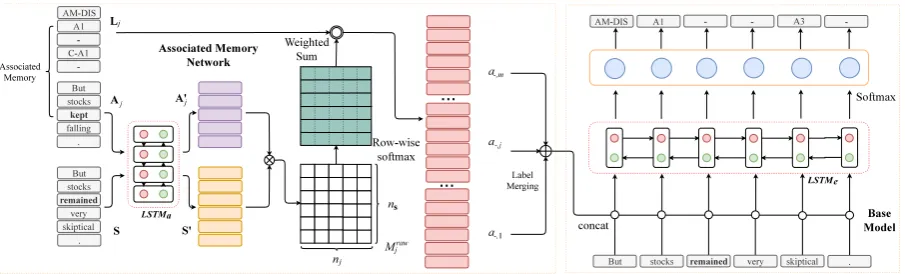
An SRL system usually consists of four pipeline modules: predicate identification and disambigua-tion, argument identification and classification. Following most of previous work, we focus on the last two steps in standard SRL task: argument identification and classification. The predicate identification subtask is not needed in CoNLL-2009 shared task1, and we follow previous work (He et al., 2018b) to handle the predicate disam-biguation subtask. This work will only focus on the argument labeling subtask through sequence labeling formalization. We first describe our base model in Section2.1. Then we introduce the pro-posed associated memory network including the inter-sentence attention design and label merging strategies in Section2.2. The full model architec-ture is shown in Figure1.
2.1 Base Model
Word Embedding
We use the concatenation of the following embed-dings as the representation for every word. (1) Random-initialized word embeddingxrei ∈ Rdre
(2) GloVe (Pennington et al., 2014) word em-bedding xpei ∈ Rdpe pre-trained on 6B tokens
(3) Random-initialized part-of-speech (POS) tag embedding xposi ∈ Rdpos (4) Random-initialized
lemma embeddingxlei ∈ Rdle (5) Contextualized
word embedding derived by applying fully con-nected layer on ELMo embeddingxcei ∈Rdce( Pe-ters et al.,2018), and (6) Random-initialized pred-icate specified flag embedding xpredi ∈ Rdpred.
The final representation of each word is:
xi=xrei ◦xpei ◦xipos◦xlei ◦xcei ◦xpredi
where◦stands for concatenation operator.
1In CoNLL-2009 task, the predicates information is
BiLSTM Encoder
LSTM network is known to handle the depen-dency over long sentence well, and can effec-tively model the context information when encod-ing. Therefore, we leverage a stacked BiLSTM networkLST Meto be our encoder. It takes word embedding sequence x = [xi]ni=1S of sentence S= [wi]nS
i=1as input (nSis the length of sentence), and outputs two different hidden states−→hi and←hi− for wordwiby processing the sequence in forward and backward directions. The final contextual rep-resentation of wordwiis the concatenation of two hidden stateshi=
− →
hi◦
←−
hi.
Then, we use a final softmax layer after the Bi-LSTM encoding to predict the label of each word.
2.2 Associated Memory Network
Using the base model as backbone, we introduce an associated memory network (AMN) compo-nent for further performance improvement. The proposed AMN memorizes known associated sen-tences and their labels, then the useful clue in the memory will be delivered to the SRL module through an inter-sentence mechanism. AMN pro-cessing includes three steps, associated sentence selection, inter-sentence attention and label merg-ing.
Associated Sentence Selection
We aim to utilize the associated sentences and their labels to help our model label the target sen-tences. For the sake of fairness, we only use the sentences in train dataset as our source. However, it is impossible to attend all the sentences in train dataset because of the extremely high computa-tional and memory cost. Therefore, we propose a filter to select the most useful sentences from the given dataset (train dataset in this paper) when given the label-unknown sentenceS.
The filter algorithm is straightforward. First, We compute the distance of every two sentences. Then, we sort all the sentences in train dataset according to their distances with the target sen-tenceS, and select topmsentences{Aj}mj=1with the minimum distances and their label sequences
{Lj}mj=1 as our associated attention. m is the memory size.
As for the computation of distance between two sentences, we formally consider three types of dis-tances, which are edit distance (ED), word mov-ing distance (WMD)andsmooth inverse frequency
distance (SD), plusrandom distance (RD)as base-line. These distances are defined as follows,
• edit distance This method uses the edit dis-tance of the POS tag sequences of two sen-tences as the distance value.
• word moving distance Following (Kusner et al.,2015), this method takes word moving distance of two sentences2.
• smooth inverse frequency distance Follow-ing (Arora et al., 2017), we use Euclidean distance between the SIF embedding of two sentences as the distance value.
• random distance This method returns a ran-dom value for distance computation thus lead to selecting sentences randomly in the train dataset.
Inter-sentence Attention
This part aims to attain the inter-sentence atten-tion matrix, which can be also regarded as the core memory part of the AMN. The input sentence S and associated sentences{Aj}mj=1first go through a stacked BiSLTM networkLST Mato encode the sentence-level information to each word represen-tation3:
S0=LST Ma(S)
A0j =LST Ma(Aj) j∈ {1,2, ..., m}
where S0 = [x0i]nS
i=1 andA
0
j = [x0j,k] nj
k=1 are the lists of new word representations, with each word representation is a vector x0 ∈ Rda, where da is the size of hidden state inLST Ma.
Then, for each associated sentenceA0j, we mul-tiply it with the input sentence representationS0to get the raw attention matrixMraw
j .
Mjraw=S0A0jT
Every elementMjraw(i, k) = x0i ·x0j,kT can be re-garded as an indicator of similarity between the ithword in input sentenceS0 and thekthword in associated sentenceA0j.
Finally, we perform softmax operation on every row inMjraw to normalize the value so that it can
2
In this paper, we use relaxed word moving distance (rwmd) for efficiency
3Here we abuse the symbolSandA
Figure 1: Semantic role labeling with associated memory network, whereSis the input sentence with its length nS. Aj is the jth associated sentence of S with its label sequence Lj and its length nj. S0 andA0j are the
result ofLST M1withSandAj as input respectively. dae is the dimension of argument embedding. Mjrawis
the raw attention matrix ofAj andS. a−,j = [a1,j, a2,j, ..., anS,j]is the associated-sentence-specified attention
embedding.
be considered as probability from input sentence Sto associated sentenceAj.
αi,j =f([Mjraw(i,1)..., Mjraw(i, nj)])
Mj = [α1,j, α2,j, ..., αnS,j]
wheref(·) stands for softmax function. αi,j can be regarded as probability vector indicating the similarity between theithword in sentenceSand every word in the associated sentenceA0j.
Label Merging
In order to utilize the labels{Lj}mj=1 of the asso-ciated sentences during decoding, a label merging needs to be done.
We use randomly initialized argument embed-ding xae ∈ Rdae to embed each argument
la-bel. Therefore, the label sequence Lj of as-sociated sentence Aj can be written as Lj =
[xaej,k]nk=1j .We treat the probability vector αi,j as weight to sum all the elements in Lj to get the associated-sentence-specified argument em-bedding ai,j, which represents the attention em-bedding of word wi ∈ S calculated from thejth associated sentenceAj and labelLj.
ai,j =αi,j·LTj =Pnj
k=1αi,j(k)xaej,k Because the associated sentences are different, the overall contributions of these argument em-beddings should be different. We let the model itself learn how to make use of these argument em-beddings. Following attention combination mech-anism from (Libovick`y and Helcl,2017), we con-sider four ways to merge the label information. 1) ConcatenationAll the associated argument bedding are concatenated as the final attention em-beddings.
ai=ai,1◦ai,2◦...◦ai,m
2) AverageThe average value of all the associated argument embeddings is used as the final attention embedding.
ai= m1 Pm
j=1ai,j
3) Weighted AverageThe weighted average of all the associated argument embedding is used as the final attention embedding. We calculate the mean value of every raw similarity matrixMjraw to in-dicate the similarity between input sentenceSand associated sentence Aj, and we use the softmax function to normalize them to get a probability vectorβindicating the similarity of input sentence Stowards all the associated sentences{Aj}mj=1.
β =f([g(M1raw), ..., g(Mmraw)])
where f(·) stands for softmax function and g(·)
represents the mean function. Then, we use the probability vector β as weight to sum all the associated-sentence-specified attention em-beddingai,j to get the final attention embedding aiof theithwordwiin input sentenceS.
ai =Pmj=1β(j)ai,j
4) FlatThis method does not useai,jinformation. First, we concatenate all the raw similarity matrix Mjrawalong the row.
Mraw= [Mraw
1 , M2raw, ..., Mmraw] Then, we perform softmax operation on every row inMraw to normalize the value so that it can be considered as probability from input sentence Sto all associated sentencesAj.
Name Meaning Value
dre random word embedding 100 dpe pre-trained word embedding 100 dpos POS embedding 32 dle lemma embedding 100 dce contextualized embedding 128 dpred flag embedding 16 dae argument embedding 128
m memory size 4
ke #LST Melayers 2
ka #LST Malayers 3
de LST Mehidden state 512 da LST Mahidden state 512
rd dropout rate 0.1
[image:5.595.321.509.59.245.2]lr learning rate 0.001
Table 1: Hyper-parameter settings (signal #x means number of x).
wheref(·) stands for softmax operation. nall =
Pm
j=1njis the total length of allmassociated sen-tences.
We also concatenate the associated label infor-mation, and useγi as weight to sum the concate-nated label sequence as final attention embedding.
L= [L1,L2, ...,Lj], ai=γi·LT
After we have the final attention embeddingai, we concatenate it with word embeddingxi as the input of the BiLSTM encoderLST Me.
3 Experiments
We conduct experiments on CoNLL-2009 (Hajiˇc et al.,2009) English and Chinese dataset. We use the standard training, development and test data split provided by CoNLL-2009 shared task. The word lemma, word POS are the predicted ones given in CoNLL-2009 dataset. Adam optimizer (Kingma and Ba, 2014) is used for training to minimize the categorical cross entropy loss. All the hyper-parameters we use are listed in Table1. All parameters are learned during training, and are randomly initialized except the pre-trained GloVe (Pennington et al.,2014) word embeddings.
For English, We independently determine the best distance calculating method and the best merging method one after another. First, we select a distance according to the results on development set and then we determine the merging method with the selected distance method. At last we ex-plore the impact of memory size. For Chinese,
System (syntax-aware single) P R F1
(Zhao et al.,2009a) - - 86.2
(Zhao et al.,2009c) - - 85.4
(FitzGerald et al.,2015) - - 86.7
(Roth and Lapata,2016) 88.1 85.3 86.7 (Marcheggiani and Titov,2017) 89.1 86.8 88.0
(He et al.,2018b) 89.7 89.3 89.5
(Li et al.,2018) 90.3 89.3 89.8
System (syntax-aware ensemble) P R F1
(FitzGerald et al.,2015) - - 87.7
(Roth and Lapata,2016) 90.3 85.7 87.9
(Marcheggiani and Titov,2017) 90.5 87.7 89.1
System (syntax-agnostic single) P R F1 (Marcheggiani et al.,2017) 88.7 86.8 87.7
(He et al.,2018b) 89.5 87.9 88.7
(Cai et al.,2018) 89.9 89.2 89.6
(Li et al.,2018) 89.5 87.9 88.7
[image:5.595.75.285.60.268.2]Ours ( + AMN + ELMo) 90.0 89.2 89.6
Table 2: Results on CoNLL-2009 English in-domain (WSJ) test set.
System (syntax-aware single) P R F1
(Zhao et al.,2009a) - - 74.6
(Zhao et al.,2009c) - - 73.3
(FitzGerald et al.,2015) - - 75.2
(Roth and Lapata,2016) 76.9 73.8 75.3 (Marcheggiani and Titov,2017) 78.5 75.9 77.2
(He et al.,2018b) 81.9 76.9 79.3
(Li et al.,2018) 80.6 79.0 79.8
System (syntax-aware ensemble) P R F1
(FitzGerald et al.,2015) - - 75.5
(Roth and Lapata,2016) 79.7 73.6 76.5 (Marcheggiani and Titov,2017) 80.8 77.1 78.9
System (syntax-agnostic single) P R F1 (Marcheggiani et al.,2017) 79.4 76.2 77.7
(He et al.,2018b) 81.7 76.1 78.8
(Cai et al.,2018) 79.8 78.3 79.0
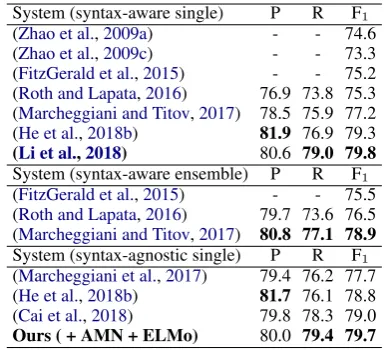
Ours ( + AMN + ELMo) 80.0 79.4 79.7
Table 3: Results on CoNLL-2009 English out-of-domain (Brown) test set.
we obtain the result with similar parameters as for the best model in English. The English and Chi-nese GloVe word embeddings are both trained on Wikipedia. The pretrained English ELMo model is from (Peters et al.,2018), and the Chinese one is from (Che et al.,2018), which is hosted at (Fares et al.,2017). The model is trained for maximum 20 epochs for the nearly best model based on de-velopment set results. We re-run our model using different initialized parameters for 4 times and re-port the average performance4.
3.1 Results
For the predicate disambiguation, we use the same one from (He et al., 2018b) with the precisions
4Our implementation is publicly available athttps://
[image:5.595.319.512.295.470.2]System (syntax-aware single) P R F1 (Zhao et al.,2009a) 80.4 75.2 77.7 (Roth and Lapata,2016) 83.2 75.9 79.4 (Marcheggiani and Titov,2017) 84.6 80.4 82.5 (He et al.,2018b) 84.2 81.5 82.8
(Li et al.,2018) 84.8 81.2 83.0
System (syntax-agnostic single) P R F1 (Marcheggiani et al.,2017) 83.4 79.1 81.2 (He et al.,2018b) 84.5 79.3 81.8
(Cai et al.,2018) 84.7 84.0 84.3
[image:6.595.317.516.61.146.2]Ours ( + AMN + ELMo) 85.0 82.6 83.8
Table 4: Results on CoNLL-2009 Chinese test set.
of 95.01% and 95.58% on development and test sets. We compare our full model (usingedit dis-tanceandaverage method) with the reported state-of-the-art models on both English and Chinese dataset. The results are in Tables2,3and4.
For English in-domain test, our model outper-forms the syntax-agnostic model in (He et al.,
2018b), whose architecture is quite similar to our base model. Our model achieves 89.6% in F1 score, which is the same with current SOTA syntax-agnostic model (Cai et al.,2018). Besides, our result is competitive with existing syntax-aware and better than ensemble models.
The advantage is more salient on English out-of-domain test set. The F1 score of our model is 79.7%, which is 0.7% higher than the current SOTA syntax-agnostic model (Cai et al., 2018). The result is also competitive with the best syntax-aware model (Li et al., 2018). The comparisons show that the proposed model has a greater gener-alization ability.
For Chinese, starting with the similar parame-ters as for the best model in English, we find that attending 5 associated sentences shows a better re-sult on Chinese. Our model achieves 83.8% F1 score, outperforming (He et al., 2018b) with an improvement of 2.0% in F1 score. Our result is also competitive with that of (Cai et al.,2018).
Note that our method is not conflict with the one in (Cai et al., 2018), which leverages biaffine at-tention (Dozat and Manning,2017) for decoding. However, due to experiment cycle, we are not able to combine these two methods together. We will leave the combination as future work.
In the following part, we conduct several ab-lation studies on our model. All the experiments are run 2-4 times and the average values are
re-System P R F1
WMD(Kusner et al.,2015) 89.1 87.1 88.1
SD(Arora et al.,2017) 88.5 87.5 88.0
RD 89.1 87.2 88.1
Base Model 88.7 86.9 87.8
[image:6.595.75.289.62.213.2]ED 89.0 87.5 88.3
Table 5: Ablations about distance on CoNLL-2009 En-glish development set. ED means edit distance, WMD means word moving distance, SD means SIF distance, RD means random distance.
System P R F1
Concatenation 88.9 86.6 87.7
Average 89.0 87.5 88.3
[image:6.595.323.512.220.304.2]Weighted Average 88.7 87.4 88.1 Flat 88.4 86.9 87.7 None 88.7 86.9 87.8
Table 6: Ablations about label merging method on CoNLL-2009 English development set.
Figure 2: The comparison of our full model and base model with distance increases.
ported on CoNLL-2009 English development set.
3.2 Ablation on Distance Method
[image:6.595.316.520.356.477.2]se-lection methods based on word embeddings like WMD and SD have similar performance with ran-dom distance (RD), which shows simple word em-bedding may not be good enough signal indicator to measure semantic structure similarity in SRL task. On the contrary, we may also try to explain why even the random distance selection may work to some extent. As sentences always have core ar-guments label such as A0, A1 and A2, associated sentences even from random selection may also have such labels, which makes them helpful to en-hance SRL over these labels. This may explain why our model with randomly selected associated sentences can distinguish core arguments better.
3.3 Ablation on Label Merging Method
Table6 shows the performance of different label merging methods. All models use edit distance with 4 associated sentences. The result shows that Averagelabel merging strategy gives the best per-formance, achieving 88.3% in F1 score with an improvement of 0.5% compared to the baseline model.
Note that our weighted average model does not outperform the average model, which is a surprise to us. We speculate that the current weight calcu-lation method needs to be more improved to fit the concerned task.
3.4 ELMo vs. AMN
Table 7 compares the performance contribution from ELMo and AMN. Our model can achieve better performance only using informative clue from training set in terms of AMN design, rather than focusing on external resource like ELMo. However, even though our baseline SRL has been enhanced by ELMo, it can still receive extra per-formance improvement from the propose AMN. Note that our enhancement from the proposed AMN keeps effective when ELMo is included (a 0.5% enhancement on baseline over the 0.3% en-hancement on ELMo baseline)
3.5 Ablation on Memory Size
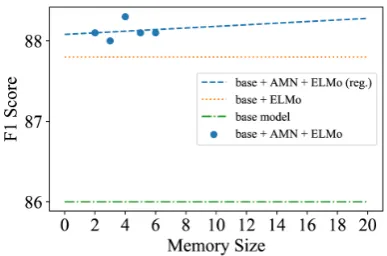
We show the effect of different memory size in Figure 3. Note that more associated sentences means more cost on time and space. We test mem-ory size m from 2 to 6 (which reaches the limit under experiment setting in 11G GPU). We also fit the measured points with a linear function (the blue line in Figure 3). The performance of our model has a general trend of increasing when the
System (syntax-aware) P R F1 (He et al.,2018b) 86.8 85.8 86.3 (He et al.,2018b) + ELMo 87.7 87.0 87.3 (Li et al.,2018) 87.7 86.7 87.2
(Li et al.,2018) + ELMo 89.2 87.6 88.4
Ours (syntax-agnostic) P R F1
Base 86.9 85.0 86.0
Base + AMN 86.9 85.6 86.3 Base + ELMo 88.7 86.9 87.8
[image:7.595.322.512.62.200.2]Ours + AMN + ELMo 89.0 87.5 88.3
Table 7: AMN vs. ELMo, the performance compari-son on English development set.
Figure 3: Model performance on English devel-opment set with different memory sizes, in which base+AMN+ELMo(reg.) indicates the general trend of our base model enhanced by the AMN when the mem-ory size is enlarged.
memory size becomes larger, which shows the po-tential of the proposed AMN.
3.6 Analysis on Confusion Matrix
[image:7.595.322.516.264.392.2]Figure 4: Confusion matrix for labeling errors in base model.
Figure 5: Confusion matrix for labeling errors in pro-posed model.
Figure 6: Visualization of similar matrixM. The input sentence is at the left of the matrix, with its golden ar-gument label at the right. The associated sentence is at the top of the matrix, with its golden argument label at the bottom. Their predicate is bolded.
3.7 Analysis of Performance on Distance
We compare the performance concerning with the distance of argument and predicate on our best model and base model in Figure2, from which we can observe that our model performs better nearly at any distance.
3.8 Case Study on AMN
To explore how the AMN works in the model, we visualize the similarity matrix M of some sen-tences from development set in Figure6. The in-put sentence is
itA1shouldAM−M ODrunvforeverAM−T M P. And the associated sentence is
itA1woAM−M ODn´tAM−N EGhappenv
againAM−T M P.
The current predicates are run, happen respec-tively. The visualization shows that inter-sentence attention can find and align the word in the similar context correctly, which shows that the proposed AMN is reasonable and effective.
4 Related Works
Early attempts (Pradhan et al., 2005;Zhao et al.,
2009a,b,2013;Roth and Woodsend, 2014) to the SRL task were mainly linear classifiers. The main focus was how to find proper feature templates that can best describe the sentences. (Pradhan et al., 2005) utilized a SVM classifier with rich syntactic features. (Toutanova et al., 2008) took the structural constraint into consideration by us-ing a global reranker. (Zhao et al.,2009c) adopted a maximum entropy model with large scale feature template selection. (Roth and Woodsend, 2014) explored the distributional word representations as new feature to gain more powerful models.
Recently, a great attention has been paid on neural networks. (Zhou and Xu, 2015) proposed an end-to-end model using stacked BiLSTM net-work combined with CRF decoder without any syntactic input. (Marcheggiani et al., 2017) ex-plored the predicate-specified encoding and de-coding and also provided a syntax-agnostic LSTM model. (He et al.,2017) followed (Zhou and Xu,
2015) and analyzed all popular methods for initial-ization and regularinitial-ization in LSTM network.
[image:8.595.81.282.328.452.2]bor-rows power from the memory, the proposed inter-sentence attention in our AMN shares features with memory networks, which was proposed in (Weston et al., 2014) with motivation that mem-ory may reduce the long-term forgetting issues. (Sukhbaatar et al.,2015) and (Miller et al.,2016) later further improved this work. However, we use quite different mechanisms to store the memory, and the effectiveness of our model needs a care-fully designed attention mechanism to handle the sequence-level information distilling.
Attention mechanism was first used by ( Bah-danau et al., 2014) in machine translation. Re-cently, (Tan et al.,2018) and (Strubell et al.,2018) proposed to use self-attention mechanism in SRL task. (Cai et al.,2018) leveraged the biaffine atten-tion (Dozat and Manning,2017) for better decod-ing performance. Different from all the existdecod-ing work, we instead introduce an inter-sentence at-tention to further enhance the current state-of-the-art SRL.
5 Conclusions and Future Work
This paper presents a new alternative improvement on strong SRL baselines. We leverage memory network which seeks power from known data, the associated sentences, and thus is called associated memory network (AMN). The performance of our model on CoNLL-2009 benchmarks shows that the proposed AMN is effective on SRL task.
As to our best knowledge, this is the first at-tempt to use memory network in SRL task. There is still a large space to explore along this re-search line. For example, our weighted aver-age method may need more carefully improved. Our model can be built over the biaffine attention which has been verified effective in (Cai et al.,
2018)5, and the encoder in our model can be im-proved with more advanced forms such as Trans-former (Vaswani et al.,2017). At last, as this work is done on a basis of quite limited computational resources, only one piece of nVidia 1080Ti (11G graphic memory), much plentiful available com-putational resource will greatly enable us to ex-plore more big model setting (i.e., larger memory sizem) for more hopefully better performance im-provement.
5As this paper is submitting, we get to know the work
(Li et al.,2019), which has taken both strengths of biaffine and ELMo. We leave the verification of our proposed method over this new strong baseline in the future.
References
Abdalghani Abujabal, Mohamed Yahya, Mirek Riede-wald, and Gerhard Weikum. 2017. Automated tem-plate generation for question answering over knowl-edge graphs. In Proceedings of the 26th Inter-national Conference on World Wide Web (WWW), pages 1191–1200.
Sanjeev Arora, Yingyu Liang, and Tengyu Ma. 2017. A simple but tough-to-beat baseline for sentence em-beddings. InProceedings of the International Con-ference on Learning Representations (ICLR).
Dzmitry Bahdanau, Kyunghyun Cho, and Yoshua Ben-gio. 2014. Neural machine translation by jointly learning to align and translate. arXiv preprint arXiv:1409.0473.
Collin F Baker, Charles J Fillmore, and John B Lowe. 1998. The berkeley framenet project. In36th An-nual Meeting of the Association for Computational Linguistics and 17th International Conference on Computational Linguistics (COLING), volume 1.
Claire Bonial, Jena Hwang, Julia Bonn, Kathryn Con-ger, Olga Babko-Malaya, and Martha Palmer. 2012. English propbank annotation guidelines. Center for Computational Language and Education Research Institute of Cognitive Science University of Col-orado at Boulder.
Jiaxun Cai, Shexia He, Zuchao Li, and Hai Zhao. 2018. A full end-to-end semantic role labeler, syntax-agnostic over syntax-aware? In Proceedings of the 27th International Conference on Computational Linguistics (CoNLL), pages 2753–2765.
Wanxiang Che, Yijia Liu, Yuxuan Wang, Bo Zheng, and Ting Liu. 2018. Towards better ud parsing: Deep contextualized word embeddings, ensemble, and treebank concatenation. Proceedings of the CoNLL 2018 Shared Task: Multilingual Parsing from Raw Text to Universal Dependencies, pages 55–64.
Timothy Dozat and Christopher D. Manning. 2017. Deep biaffine attention for neural dependency pars-ing. InProceedings of 5th International Conference on Learning Representations (ICLR).
Murhaf Fares, Andrey Kutuzov, Stephan Oepen, and Erik Velldal. 2017. Word vectors, reuse, and repli-cability: Towards a community repository of large-text resources. In Proceedings of the 21st Nordic Conference on Computational Linguistics (NoDaL-iDa), pages 271–276.
Jan Hajiˇc, Massimiliano Ciaramita, Richard Johans-son, Daisuke Kawahara, Maria Ant`onia Mart´ı, Llu´ıs M`arquez, Adam Meyers, Joakim Nivre, Sebastian Pad´o, Jan ˇStˇep´anek, et al. 2009. The conll-2009 shared task: Syntactic and semantic dependencies in multiple languages. InProceedings of the Thir-teenth Conference on Computational Natural Lan-guage Learning (CoNLL): Shared Task, pages 1–18.
Luheng He, Kenton Lee, Omer Levy, and Luke Zettle-moyer. 2018a. Jointly predicting predicates and ar-guments in neural semantic role labeling. In Pro-ceedings of the 56th Annual Meeting of the Associa-tion for ComputaAssocia-tional Linguistics (ACL), volume 2, pages 364–369.
Luheng He, Kenton Lee, Mike Lewis, and Luke Zettle-moyer. 2017. Deep semantic role labeling: What works and what’s next. InProceedings of the 55th Annual Meeting of the Association for Computa-tional Linguistics (ACL), volume 1, pages 473–483.
Shexia He, Zuchao Li, Hai Zhao, and Hongxiao Bai. 2018b. Syntax for semantic role labeling, to be, or not to be. InProceedings of the 56th Annual Meet-ing of the Association for Computational LMeet-inguistics (ACL), volume 1, pages 2061–2071.
Diederik P Kingma and Jimmy Ba. 2014. Adam: A method for stochastic optimization. arXiv preprint arXiv:1412.6980.
Matt Kusner, Yu Sun, Nicholas Kolkin, and Kilian Weinberger. 2015. From word embeddings to doc-ument distances. InProceedings of the 32nd Inter-national Conference on Machine Learning (ICML), pages 957–966.
Zuchao Li, Shexia He, Jiaxun Cai, Zhuosheng Zhang, Hai Zhao, Gongshen Liu, Linlin Li, and Luo Si. 2018. A unified syntax-aware framework for seman-tic role labeling. In Proceedings of the 2018 Con-ference on Empirical Methods in Natural Language Processing (EMNLP), pages 2401–2411.
Zuchao Li, Shexia He, Hai Zhao, Yiqing Zhang, Zhu-osheng Zhang, Xi Zhou, and Xiang Zhou. 2019. De-pendency or span, end-to-end uniform semantic role labeling. In Proceedings of the Thirty-Third AAAI Conference on Artificial Intelligence.
Jindˇrich Libovick`y and Jindˇrich Helcl. 2017. Attention strategies for multi-source sequence-to-sequence learning. InProceedings of the 55th Annual Meet-ing of the Association for Computational LMeet-inguistics (ACL), volume 2, pages 196–202.
Feifan Liu, Jinying Chen, Abhyuday Jagannatha, and Hong Yu. 2016. Learning for biomedical informa-tion extracinforma-tion: Methodological review of recent ad-vances. arXiv preprint arXiv:1606.07993.
Diego Marcheggiani, Anton Frolov, and Ivan Titov. 2017. A simple and accurate syntax-agnostic neural model for dependency-based semantic role labeling.
InProceedings of the 21st Conference on Computa-tional Natural Language Learning (CoNLL), pages 411–420.
Diego Marcheggiani and Ivan Titov. 2017. Encoding sentences with graph convolutional networks for se-mantic role labeling. In Proceedings of the 2017 Conference on Empirical Methods in Natural Lan-guage Processing (EMNLP), pages 1506–1515.
Alexander Miller, Adam Fisch, Jesse Dodge, Amir-Hossein Karimi, Antoine Bordes, and Jason We-ston. 2016. Key-value memory networks for di-rectly reading documents. In Proceedings of the 2016 Conference on Empirical Methods in Natural Language Processing (EMNLP), pages 1400–1409.
Jeffrey Pennington, Richard Socher, and Christopher Manning. 2014. Glove: Global vectors for word representation. In Proceedings of the 2014 Con-ference on Empirical Methods in Natural Language Processing (EMNLP), pages 1532–1543.
Matthew Peters, Mark Neumann, Mohit Iyyer, Matt Gardner, Christopher Clark, Kenton Lee, and Luke Zettlemoyer. 2018. Deep contextualized word rep-resentations. In Proceedings of the 2018 Confer-ence of the North American Chapter of the Associ-ation for ComputAssoci-ational Linguistics: Human Lan-guage Technologies (NAACL-HLT), volume 1, pages 2227–2237.
Sameer Pradhan, Wayne Ward, Kadri Hacioglu, James H Martin, and Daniel Jurafsky. 2005. Seman-tic role labeling using different syntacSeman-tic views. In Proceedings of the 43rd Annual Meeting on Asso-ciation for Computational Linguistics (ACL), pages 581–588.
Michael Roth and Mirella Lapata. 2016. Neural se-mantic role labeling with dependency path embed-dings. In Proceedings of the 54th Annual Meet-ing of the Association for Computational LMeet-inguistics (ACL), volume 1, pages 1192–1202.
Michael Roth and Kristian Woodsend. 2014. Composi-tion of word representaComposi-tions improves semantic role labelling. InProceedings of the 2014 Conference on Empirical Methods in Natural Language Processing (EMNLP), pages 407–413.
Emma Strubell, Patrick Verga, Daniel Andor, David Weiss, and Andrew McCallum. 2018. Linguistically-informed self-attention for semantic role labeling. In Proceedings of the 2018 Confer-ence on Empirical Methods in Natural Language Processing (EMNLP), pages 5027–5038.
Zhixing Tan, Mingxuan Wang, Jun Xie, Yidong Chen, and Xiaodong Shi. 2018. Deep semantic role label-ing with self-attention. InProceedings of the Thirty-Second AAAI Conference on Artificial Intelligence, pages 4929–4936.
Kristina Toutanova, Aria Haghighi, and Christopher D Manning. 2008. A global joint model for se-mantic role labeling. Computational Linguistics, 34(2):161–191.
Ashish Vaswani, Noam Shazeer, Niki Parmar, Jakob Uszkoreit, Llion Jones, Aidan N Gomez, Łukasz Kaiser, and Illia Polosukhin. 2017. Attention is all you need. InAdvances in Neural Information Pro-cessing Systems 30: Annual Conference on Neu-ral Information Processing Systems (NIPS), pages 6000–6010.
Jason Weston, Sumit Chopra, and Antoine Bor-des. 2014. Memory networks. arXiv preprint arXiv:1410.3916.
Hai Zhao, Wenliang Chen, Jun’ichi Kazama, Kiyotaka Uchimoto, and Kentaro Torisawa. 2009a. Multi-lingual dependency learning: Exploiting rich fea-tures for tagging syntactic and semantic dependen-cies. In Proceedings of the Thirteenth Confer-ence on Computational Natural Language Learn-ing: Shared Task, pages 61–66.
Hai Zhao, Wenliang Chen, and Chunyu Kit. 2009b. Se-mantic dependency parsing of nombank and prop-bank: An efficient integrated approach via a large-scale feature selection. In Proceedings of the 2009 Conference on Empirical Methods in Natural Lan-guage Processing: Volume 1-Volume 1, pages 30– 39.
Hai Zhao, Wenliang Chen, Chunyu Kit, and Guodong Zhou. 2009c. Multilingual dependency learning: A huge feature engineering method to semantic depen-dency parsing. In Proceedings of the Thirteenth Conference on Computational Natural Language Learning (CoNLL): Shared Task, pages 55–60.
Hai Zhao, Xiaotian Zhang, and Chunyu Kit. 2013. In-tegrative semantic dependency parsing via efficient large-scale feature selection. Journal of Artificial Intelligence Research, 46:203–233.