3268
Using Large Corpus N-gram Statistics to Improve Recurrent Neural
Language Models
Yiben Yang, Ji-Ping Wang
Department of Statistics Northwestern University Evanston, IL, 60208, USA
{yiben.yang,jzwang}@northwestern.edu
Doug Downey
Department of Electrical Engineering & Computer Science
Northwestern University Evanston, IL, 60208, USA {d-downey}@northwestern.edu
Abstract
Recurrent neural network language models (RNNLM) form a valuable foundation for many NLP systems, but training the models can be computationally expensive, and may take days to train on a large corpus. We ex-plore a technique that uses large corpus n-gram statistics as a regularizer for training a neural network LM on a smaller corpus. In experi-ments with the Billion-Word and Wikitext cor-pora, we show that the technique is effective, and more time-efficient than simply training on a larger sequential corpus. We also intro-duce new strategies for selecting the most in-formative n-grams, and show that these boost efficiency.
1 Introduction
Recurrent neural network models of language (RNNLMs) form a foundation for many natural language processing systems. However, the net-works can be expensive to train: training a single model over several million tokens can take hours, and searching through the large hyperparameter space of RNNLMs often entails training and test-ing hundreds of different models. This makes it burdensome to experiment with new RNNLM ar-chitectures on large corpora, or to train RNNLMs for new textual domains.
RNNLMs are typically trained on sequential text. In this paper, we investigate how to effi-ciently augment the training of RNNLMs by reg-ularizing the models to match n-gram statistics taken from a much larger corpus. The motivation is that large-corpus n-gram statistics may be in-formative to an RNNLM trained on a smaller se-quential corpus, but unlike RNNLM training, n-gram statistics are inexpensive to compute even over large corpora. Moreover, the statistics only need to be computed once and can be re-used for training many different smaller-corpus RNNLMs. Naively, regularizing an RNNLM to match a
given set of n-gram statistics is non-trivial, be-cause the marginal probabilities that n-gram statis-tics represent are not parameters of the RNNLM. In recent work,Noraset et al.(2018) showed that it was possible to regularize an RNNLM to match given n-gram statistics by training the network, when started from a zero state, to match each n-gram probability. However, the regularization ap-proach in that work had tractability limitations— the time cost of the regularization was sufficiently high that using it was inferior to simply training the RNNLM on more sequential text.
In this paper, we present an efficient n-gram reg-ularization technique and show that the technique can improve RNNLM training. Our method has three distinctions from previous work that provide efficiency. First, we prioritize regularizing only the n-grams that are most likely to improve the model, by focusing on cases where the RNNLM’s sequential training corpus diverges significantly from the n-gram statistics. Secondly, we regular-ize the entire output softmax of the RNN to match given conditional n-gram statistics, which means we can impose a large number of statistical con-straints using only one softmax evaluation. Fi-nally, we use an ensemble of multiple loss func-tions in our regularizer, which provides an addi-tional boost. In experiments, we show how n-gram regularization with these enhancements results in better models using the same amount of training time, compared to standard sequential training. We also plan to release our code base and to the research community.1
2 Methods
RNNLMs are trained to optimize a loss function Ld, which is defined as the average negative
log-likelihood of a training corpus. We regularize the RNNLM to match n-gram statistics by
ing another penalty term Lp to the loss function
that captures how well the model matches n-gram statistics, giving a combined lossL:
L=Ld+αLp,
whereα is a hyperparameter to control the regu-larization strength. We use the termlarge corpus
to refer to the text utilized to compute the n-gram statistics. We expect the large corpus to be multi-ple orders of magnitude larger than thesmall cor-pus utilized for computing the RNN’s sequential loss Ld. In the rest of this section, we first
de-fine what we mean by conditional n-gram statis-tics, and then present our regularization methods.
2.1 Conditional N-gram Statistics
An order-Nn-gram is a sequence ofNwords. For a given corpusc, we denote thekth distinct order-N n-gram wk1, wk2, ..., wkN as wNk , and denote
the corresponding orderN−1n-gram formed by the firstN −1words aswNk−1. Here, in order to eliminate ambiguity, the notationN −1is exclu-sively used to represent the prefix. For instance, w3kis thek-th trigram, whilewk4−1 is the trigram prefix of thek-th 4-gram. We define conditional n-gram statistics as the empirical conditional proba-bilities of observing each next wordwkNgiven the
previousN −1gramwNk−1for allks :
ˆ
P(wkN|wNk−1) =
count(wNk)
count(wkN−1),∀w
N
k ∈Ω(c),
wherewkN andwkN−1 are theNth word and the
corresponding previous N −1 gram of wkN re-spectively, andΩ(c) is the set of all uniquewNks contained in the corpusc. For a given RNNLM, the model conditional probability for some n-gram wNk is defined as:
Pθ(wkN|wkN−1) =Eh(Pθ(wkN|wkN−1, h)),
where h is the model’s hidden state prior to en-countering the N-gram. However, it is difficult to express that expectation in terms of the model parameters, so we adopt the approach from No-raset et al. (2018), which has shown preliminary evidence of forming an effective regularizer:
Eh(Pθ(wkN|wNk−1, h))≈Pθ(wkN|wkN−1, h0),
whereh0 is a zero hidden state.
2.2 Conditional N-gram Regularization
We propose three forms of regularization loss functions that penalize the divergence of the model’s conditional probabilities from the condi-tional n-gram statistics.
2.2.1 Mean Squared Log Probability Ratio
We denote our first penalty asLsqp , defined as:
Lsqp = 1
kRk
X
wN k∈R
logPˆ(wkN|w
N−1 k )
Pθ(wkN|wNk−1)
!2 ,
where R is a set of n-grams wNk to regularize, andPˆandPθare conditional n-gram statistics and
model conditional probabilities as defined in Sec-tion 2.1. This penalty is similar to that of ( No-raset et al.,2018). However, instead of computing the loss with multiple forward passes for differ-ent wNks that have the same wNk−1, we propose to only perform one forward pass for eachwNk−1, and regularize all subsequent Nth words. This makes our loss much more computationally effi-cient. As this penalty only accounts differences in point-wise probabilities for specific wordswN,
it can be used for partially specified distributions where we only know the desired probabilities for some Nth words in a given context, but not the entire distribution.
2.2.2 Mean Kullback–Leibler Divergence
We denote our second penalty asLKLp , defined as:
PwN−1
k
= ˆP(w|wNk−1), QwN−1
k
=Pθ(w|wNk−1)
LKLp = 1
kRk
X
wNk−1∈R
DKL(PwN−1
k
||QwN−1
k ),
where hereR is a set of prefixes wNk−1 to regu-larize. This penalty regularizes all possible sub-sequent words wN, thus it only works for
fully-specified reference distributions.
2.2.3 Combined Penalty
Because the above two penalty functions differ, we hypothesize that they may be complementary and propose acombinedpenaltyLcp =Lsqp +LKLp .
2.3 N-gram Selection Strategy
cost of our regularization methods. Naively regu-larizing all unique prefixes in a large corpus usu-ally requires a large number of forward passes, which could be expensive. We hypothesize that some prefixes are more useful than others, so we attempt to select the ones that will improve the model the most. We propose to select pre-fixes wNk−1 that maximize the Expected L og-likelihoodChange (ELC), defined as:
ELC(wNk−1) =XPˆ(wNk)logPˆ(wkN|w
N−1 k )
Pθ(wkN|wNk−1)
.
Ideally, Pθ would reflect the statistics of the
RNNLM, updated during training, but these are expensive to obtain. Thus we propose to train a inexpensive n-gram model (Chen and Goodman,
1999) on the sequential corpus to serve asPθ, and
we use that to select a fixed set of n-grams to reg-ularize.
3 Experiments
We now present our experiments measuring the ef-fectiveness of conditional n-gram regularization.
3.1 Data and Settings
We experiment on a medium-size (2 layers with 650 hidden states) LSTM language model (Zaremba et al., 2014) over two corpora: Wiki-text (Merity et al.,2016) and Google Billion-Word (Chelba et al., 2013) (1B). We adopt weight ty-ing (Inan et al.,2016) and variational dropout (Gal and Ghahramani,2016). All models are trained by SGD for 30 epochs with batch size 64 and trun-cated backpropagation (Mikolov et al.,2011) with 35 time steps. The learning rate starts at 20 and then is reduced to 5 at epoch 20. For the 1B corpus, we follow the same procedure in Yang et al. (2017) to generate training, validation and test sets, except that we use only the top 50K vo-cabulary terms. For the Wikitext corpus, we adopt the Wikitext-2 vocabulary. All of the RNNLM sequential training sets are small subsets sampled from the Wikitext-103 and 1B training corpora.
For each dataset, we use the whole training set as the large corpus for building our reference con-ditional n-gram statistics. In this study, we only consider conditional trigram regularization for all experiments. The regularization takes additional time during training. To enable a fair experiment, we equalize the training time between regularized
models and the baselines, by providing the base-lines with more sequential training data than the regularized models. The three proposed penalties are almost equally fast, thus they can be compared against the same baseline. Unlike RNNs, there are no hyperparameter settings or decisions in-volved in computing the n-gram counts, so this can be done once and re-used across the many RNN training runs that adequate hyperparameter search for RNNs often entails. Moreover, counting n-grams is fast. We approximate that it takes about one minute to obtain n-gram statistics from the Wikitext-103 training corpus, for example. Thus, we set up our experiments to equalize neural net-work training time, and we ignore the small one-time cost of computing n-gram statistics.
We fix the number of bigrams per batch to be 500, and employ the proposed strategy to select the top X most informative bigrams (X depends on the number of batches in sequential data). Fi-nally, instead of tuning the regularization strength hyperparameterαfor each setting, we fixαto be 1.0, 0.75 and 0.5 for the three sequential data sizes based on the heuristic that larger sequential data may need less regularization. More carefully tun-ing the regularization strength might yield some-what better results for our methods. Also, using different regularization strengths in the combined penalty might further improve results.
3.2 Results
In Table 1, we compare the performance of our proposed methods against equal-time controlled baselines under different token sizes for both the Wikitext and 1B data sets. In the table, the num-bers in the column headings indicate the token count of the sequential corpus used to train the regularized methods. The baselines train on larger corpora, to ensure an equal-time setting as de-scribed above. All regularized models outper-form their baseline counterparts for all token sizes. Among them, the models regularized by the com-bined penalty consistently perform best. This il-lustrates that conditional n-gram regularization is effective at incorporating large-corpus statistics to improve an RNNLM trained on a relatively small corpus. Performing regularization using the com-bined selection strategy yields more accurate mod-els compared to simply training on a larger se-quential corpus.
each training epoch for models trained on the 5M-token 1B corpus, against an equal-time baseline. The plot shows that the relative performance of the methods remains similar across training epochs.
[image:4.595.309.497.61.124.2]Methods Wikitext Google 1B 500K 1M 2M 2.5M 5M 10M baseline 161 110 76 110 90 81 sq log 122 91 72 98 86 80 KL 137 100 77 100 86 78 combined 112 86 69 94 83 77
Table 1: Test perplexities of different methods and se-quential training token sizes. sq log: mean squared log probability ratio penalty. KL: mean Kullback-Leibler divergence penalty. Models with the combined penalty achieve the lowest perplexities.
Figure 1: Validation Perplexities on the 5M-token 1B Dataset. The combined penalty performs best.
3.3 Analysis
In Table2, we demonstrate how the number of reg-ularized bigrams affects the performance. Here, the regularized models always train on wikitext-2 as a sequential corpus, and the baseline trains on larger corpora as the fractions of bigrams in-creases. The regularized model achieves 66 test perplexity on Wikitext-2 corpus, which is about 2.7 points worse than a state of the art mixture of softmax model (Yang et al.,2017) even though our model has fewer parameters (25M vs. 35M). In-cluding more bigrams helps lower the perplexity, while it also demands extra computational time. ELC performs best when using less than 20% of the bigrams. Regularizing randomly selected n-grams does not outperform the equal-time base-line, indicating that not all n-grams are equally useful. In order to be time efficient, it is impor-tant to select informative n-grams, and ELC is an
% of total bigrams baseline random ELC
0% 86 86 86
5% 76 83 69
10% 71 77 67
20% 66 71 67
[image:4.595.72.289.128.192.2]40% 61 68 66
Table 2: Test perplexities of RNNLMs trained on Wikitext-2 regularized with different numbers of bi-grams using the combined penalty. Baseline indicates an equal-time controlled baseline, random is a regular-ized model with bigrams selected randomly, and ELC indicates our proposed strategy.
effective measure of informativeness.
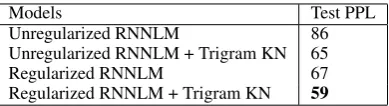
In Table3, we consider ensembling a standard RNN with a KN-smoothed trigram model. This achieves a ppl of 65, but requires 51M more pa-rameters, whereas our regularization with the n-grams achieves most of the perplexity improve-ment at the cost of zero additional parameters. Further, somewhat surprisingly we find that an esemble of our regularized RNNLM with the n-gram model achieves much better perplexity of 59.
Models Test PPL
Unregularized RNNLM 86 Unregularized RNNLM + Trigram KN 65 Regularized RNNLM 67 Regularized RNNLM + Trigram KN 59
Table 3: Test perplexities of RNN-LMs trained with and without regularization on the Wikitext-2 corpus, ensembled with a KN-smoothed trigram model trained on the Wikitext-103 corpus.
Another possible way of efficiently utilizing a large corpus would involve training a Word2vec model on the large corpus, and using the pre-trained embeddings within a RNNLM pre-trained on a small corpus. This approach can utilize larger corpora since training a Word2vec model is much faster than training a RNNLM. However, in our preliminary experiments with this approach, we did not observe any improvement when using word embeddings trained on a large corpus. Fur-ther experiments with variants of this approach are an item of future work.
4 Related Work
[image:4.595.72.290.285.446.2] [image:4.595.309.504.369.422.2]standard sequential RNNLM training to improve the training procedure. We introduce n-gram se-lection techniques and distinct loss functions that increase the effectiveness of the combined train-ing. Ganchev et al. (2010) presents a posterior regularization method for restricting posterior dis-tributions of probabilistic models with latent vari-ables to obey predefined constraints using the EM algorithm. This approach shares our goal of im-posing constraints on probabilistic models, but we focus on RNNLMs, which do not estimate dis-tributions over latent state variables and are not trained using EM. Finally,Mikolov et al. (2011),
J´ozefowicz et al.(2016) andChelba et al. (2013) trained ensembles of RNNLMs and KN-smoothed n-gram models, and showed that one can obtain a better model when ensembling RNNLMs with n-gram models. Our experiments show that com-pared to ensemble methods, conditional n-gram regularization achieves similar results at the cost of zero additional parameters, and can perform even better when combined with ensembling.
5 Conclusion and Future Work
In this paper, we have proposed methods to utilize using large corpus n-gram statistics to regularize RNNLMs trained on a smaller corpus. Our ex-periments demonstrate that the proposed regular-ization penalties are effective in improving model performance, and can be more time efficient than training RNNLMs on a larger sequential corpus. Selecting informative n-grams is shown to be im-portant. In future work, we would like to obtain a better theoretical understanding of why starting the RNNLM from a zero state forms an effective n-gram regularizer. We would also like to extend our regularization approach to BiLSTMs (Peters et al.,2017) and Transformers (Alec Radford and Sutskever,2018;Devlin et al.,2018).
Acknowledgments
This work was supported in part by NSF Grant IIS-1351029 and the Allen Institute for Artificial Intelligence.
References
Tim Salimans Alec Radford, Karthik Narasimhan and Ilya Sutskever. 2018. Improving language under-standing with unsupervised learning. Technical re-port, OpenAI.
Ciprian Chelba, Tomas Mikolov, Mike Schuster, Qi Ge, Thorsten Brants, and Phillipp Koehn. 2013. One bil-lion word benchmark for measuring progress in sta-tistical language modeling.CoRR, abs/1312.3005.
Ciprian Chelba, Mohammad Norouzi, and Samy Bengio. 2017. N-gram language modeling us-ing recurrent neural network estimation. CoRR, abs/1703.10724.
Stanley F. Chen and Joshua Goodman. 1999. An empirical study of smoothing techniques for lan-guage modeling. Computer Speech & Language, 13(4):359–393.
Jacob Devlin, Ming-Wei Chang, Kenton Lee, and Kristina Toutanova. 2018. Bert: Pre-training of deep bidirectional transformers for language understand-ing.arXiv preprint arXiv:1810.04805.
Yarin Gal and Zoubin Ghahramani. 2016. A theoret-ically grounded application of dropout in recurrent neural networks. InAdvances in Neural Informa-tion Processing Systems 29: Annual Conference on Neural Information Processing Systems 2016, De-cember 5-10, 2016, Barcelona, Spain, pages 1019– 1027.
Kuzman Ganchev, Jo˜ao Grac¸a, Jennifer Gillenwater, and Ben Taskar. 2010. Posterior regularization for structured latent variable models. Journal of Ma-chine Learning Research, 11:2001–2049.
Hakan Inan, Khashayar Khosravi, and Richard Socher. 2016. Tying word vectors and word classifiers: A loss framework for language modeling. CoRR, abs/1611.01462.
Rafal J´ozefowicz, Oriol Vinyals, Mike Schuster, Noam Shazeer, and Yonghui Wu. 2016. Exploring the lim-its of language modeling. CoRR, abs/1602.02410.
Stephen Merity, Caiming Xiong, James Bradbury, and Richard Socher. 2016. Pointer sentinel mixture models. CoRR, abs/1609.07843.
Tomas Mikolov, Stefan Kombrink, Luk´as Burget, Jan Cernock´y, and Sanjeev Khudanpur. 2011. Exten-sions of recurrent neural network language model. In Proceedings of the IEEE International Confer-ence on Acoustics, Speech, and Signal Processing, ICASSP 2011, May 22-27, 2011, Prague Congress Center, Prague, Czech Republic, pages 5528–5531.
Thanapon Noraset, Doug Downey, and Lidong Bing. 2018. Estimating marginal probabilities of n-grams for recurrent neural language models. In Proceed-ings of the 2018 Conference on Empirical Methods in Natural Language Processing, pages 2930–2935. Association for Computational Linguistics.
Zhilin Yang, Zihang Dai, Ruslan Salakhutdinov, and William W. Cohen. 2017. Breaking the softmax bot-tleneck: A high-rank RNN language model. CoRR, abs/1711.03953.