2418
A Simple and Robust Approach to
Detecting Subject–Verb Agreement Errors
Simon Flachs1,2, Ophélie Lacroix1,
Marek Rei3, Helen Yannakoudakis3, Anders Søgaard2 1 Siteimprove, Denmark
2CoAStaL DIKU, Department of Computer Science, University of Copenhagen, Denmark 3 The ALTA Institute, Dept. of CS & Technology, University of Cambridge, United Kingdom
{sfl, ola}@siteimprove.com,
{marek.rei, helen.yannakoudakis}@cl.cam.ac.uk, [email protected]
Abstract
While rule-based detection of subject–verb agreement (SVA) errors is sensitive to syntac-tic parsing errors and irregularities and excep-tions to the main rules, neural sequential la-belers have a tendency to overfit their training data. We observe that rule-basederror genera-tionis less sensitive to syntactic parsing errors and irregularities than error detection and ex-plore a simple, yet efficient approach to getting the best of both worlds: We train neural sequ-ential labelers on the combination of large vo-lumes of silver standard data, obtained through rule-based error generation, and gold standard data. We show that our simple protocol leads to more robust detection of SVA errors on both in-domain and out-of-domain data, as well as in the context of other errors and long-distance dependencies; and across four standard bench-marks, the induced model on average achieves a new state of the art.
1 Introduction
Grammatical Error Detection. Grammatical Error Detection (GED, Leacock et al., 2010) is the task of detecting grammatical errors in text. It is used in various real-world applications, such as writing assistance tools, self-assessment fra-meworks and language tutoring systems, facili-tating incremental and/or exploratory editing of one’s writing. Accurate error detection systems also have potential applications for language ge-neration and machine translation systems, guiding automatically generated output towards gramma-tically correct sequences.
The problem of detecting subject–verb agre-ement (SVA) errors is an important subtask of GED. In this work, we focus on detecting subject– verb agreement errors in the English as a Second Language (ESL) domain. Most SVA errors occur at the third-person present tense when determining
whether the subject describes a singular or a plu-ral concept. The following examples demonstrate subject–verb agreement errors (bold):
(1) a. *They allknowswhere the conference is. b. *The Hotelarevery close to Town Hall.
The task can be formulated as a sequence labe-ling problem, with the goal of labelabe-ling subject– verb pairs as being in agreement or not.
Approaches. Sequence labeling problems in NLP, including GED and the subtask of iden-tifying SVA errors, have, in recent years, been handled with Recurrent Neural Networks (RNNs) trained on large amounts of data (Rei and Yan-nakoudakis, 2016, 2017). However, most publi-cly available datasets for GED are relatively small, making it difficult to learn a general grammar re-presentation and potentially leading to over-fitting. Previous work has also shown that neural langu-age models with a similar architecture have diffi-culty learning subject–verb agreement patterns in the presence of agreement attractors (Linzen et al.,
2016).
Rule-based approaches (Andersen et al.,2013) are still considered a strong alternative to end-to-end neural networks, with many industry solutions still relying on rules defined over syntactic trees. The rule-based approach has the advantage of not requiring manual annotation, while also allowing easy access to adding and removing individual ru-les. On the other hand, language is continuously evolving, and there are exceptions to most gram-mar rules we know. Additionally, rule-based mat-ching typically relies on syntactic pre-processing, which is error-prone, leading to compounding er-rors that hurt the downstream GED performance.
end-to-end neural models for the detection of SVA errors. We show that rule-based systems are vul-nerable to errors in the underlying syntactic par-sers, while also failing to capture irregularities and exceptions. In contrast, end-to-end neural archi-tectures are limited by the available labeled exam-ples and sensitive to the variance in these datasets. We then make the following observation: while rule-based errordetection is severely affected by errors and irregularities in syntactic parsing, rule-based errorgenerationis more robust. SVA errors can be generated without identifying subject de-pendency relations in advance, and changing the number of a verb almost always leads to an er-ror. This generated data can be used as a silver standard for optimizing neural sequence labeling models. We demonstrate that a system trained on a combination of available labeled data and large volumes of silver standard data outperforms both neural and rule-based baselines by a margin on three out of four standard benchmarks, and on ave-rage achieves a new state-of-the-art on detecting SVA errors.
2 Related work
Neural approaches. Recent neural approaches to GED include Rei and Yannakoudakis (2016) who argue that bidirectional (bi-) LSTMs, in par-ticular, are superior to other RNNs when eva-luated on standard ESL benchmarks for GED and give state-of-the-art results. Rei and Yan-nakoudakis(2017) show even better performance using a multi-task learning architecture for trai-ning bi-LSTMs that additionally predicts linguis-tic properties of words, such as their part of spe-ech (PoS).
Recent studies (Linzen et al.,2016;Gulordava et al.,2018;Kuncoro et al.,2018) have specifically analyzed the performance of LSTMs in learning syntax-sensitive dependencies such as SVA.
Rule-based approaches. Cai et al. (2009) use a combination of dependency parsing and sen-tence simplification, as well as special handling of wh-elements, to detect SVA errors. Once the subject–verb relation is identified, after parsing the simplified input sentence, a PoS tagger is used to check agreement. This is similar in spirit to the rule-based baseline system used in our expe-riments below. Wang et al. (2015) use a simi-lar approach, distinguishing between four diffe-rent sentence types and using slightly diffediffe-rent
ru-les for each type. Their ruru-les are, again, defined over the outputs of a dependency parser and a PoS tagger.Sun et al.(2007) use labeled data to derive rules based on dependency tree patterns.
Automatic error generation. Because of the scarcity of annotated datasets in GED, research has been carried out on creating artificial er-rors, where errors are injected into otherwise cor-rect text using deterministic rules or probabilis-tic approaches using linguisprobabilis-tic information (Felice and Yuan,2014;Kasewa et al.,2018). Studies fo-cusing on detecting specific error types such as de-terminers and prepositions (Rozovskaya and Roth,
2011) or noun number (Brockett et al.,2006) are mainly developed within the framework of auto-matic error generation. Recent work, expanding the detection (Rei et al.,2017) and the correction (Xie et al.,2018) tasks to all types of errors, impro-ves the performance of neural models by training on additional artificial error data generated via ma-chine translation methods.
Miscellaneous. Recent work has also led to good performance in correcting grammatical er-rors (Yannakoudakis et al.,2017;Bryant and Bri-scoe,2018;Chollampatt and Ng,2018). However, in this paper, we are interested in the task of gram-matical errordetectionand we therefore compare our work to current state-of-the-art approaches to detecting errors and do not report the performance of correction systems.
3 Subject–verb agreement detection
Following recent work on GED (Rei and Yannako-udakis,2016), we define SVA error detection as a sequence labeling task, where each token is simply labeled as correct or incorrect. For a given SVA error, only the verb is labeled as incorrect. Error types other than SVA are ignored, i.e., we do not correct the errors in the text and we do not attempt to predict them as incorrect.
In this paper, we only study SVA in English. We note that even for English, there is some controversy about what constitutes an SVA error.
Manaster-Ramer(1987), cites this example, which has been used by some as an argument for English exhibiting cross-serial dependencies:
(2) The man and the women dance and sing, res-pectively.
be more or less pervasive across languages, de-pending on how rich the morphology is, whether the given language exhibitspro-drop, and how far apart subjects and verbs are likely to occur.
4 Systems
4.1 Rule-based system
Typically, building a GED rule-based system is time-consuming and requires specific knowledge to deal with the multiple exceptions and irregula-rities of languages. Difficult cases (such as long distance subject–verb relations) are often ignored in order to ensure high precision, at the expense of the recall of the system. However, our rule-based system is not limited to the detection of sim-ple cases of SVA errors. It relies on PoS tags and dependency relations to identify all types of SVA errors. Specifically, our rule-based system opera-tes as follows: (i) it identifies the candidate verbs based on PoS tags;1 (ii) for a given verb, it uses the dependency relations to find its subject;2 (iii) the PoS tag of the verb and its subject are used to check whether they agree in number and person. We use predicted Penn Treebank PoS tags and de-pendency relations provided by the Stanford Log-linear PoS Tagger (Toutanova et al., 2003) and the Stanford Neural Network Dependency Parser (Chen and Manning,2014) respectively.
4.2 Neural system
We use the state-of-the-art neural sequence labe-ling architecture for error detection (Rei and Yan-nakoudakis, 2016). The model receives a sequ-ence of tokens (w1, ..., wT) as input and outputs
a sequence of labels(l1, ..., lT), i.e., one for each
token, indicating whether a token is grammatically correct (in agreement) or not, in the given context. All tokens are first mapped to distributed word re-presentations, pre-trained using word2vec ( Miko-lov et al.,2013) on the Google News corpus. Fo-llowingLample et al.(2016), character-based re-presentations are also built for every word using a bi-LSTM (Hochreiter and Schmidhuber, 1997) and then concatenated onto the word embedding.
The combined embeddings are then given as in-put to a word-level bi-LSTM, creating represen-tations that are conditioned on the context from
1
Present tense verbs + “was” and “were”.
2The subject can be direct – attached with ansubj
re-lation – or indirect, such as when the syntactic subject is a relative pronoun, e.g.,who, or an expletive, e.g.,there.
both sides of the target word. These representa-tions are then passed through an additional feed-forward layer, in order to combine the extracted features and map them to a more suitable space. A softmax output layer returns the probability dis-tribution over the two possible labels (correct or
incorrect) for each word. We also include the lan-guage modeling objective proposed byRei(2017), which encourages the model to learn better repre-sentations via multi-tasking and predicting surro-unding words in the sentence. Dropout ( Srivas-tava et al., 2014) with probability 0.5 is applied to word representations and to the output from the word-level bi-LSTM. The model is optimi-sed using categorical cross-entropy with AdaDelta (Zeiler,2012).
5 Data
5.1 Data preprocessing
As the public datasets either have their own taxo-nomy or they are not annotated with error types at all, we apply the error type extraction tool of
Bryant, Felice, and Briscoe(2017) to automatica-lly get error types mapped to the same taxonomy for all datasets. The tool automatically annotates parallel original and corrected sentences with error type information. When evaluated by human ra-ters, the predicted error types were rated as “good” or “acceptable” in at least 95%of the cases. We use their publicly available tool3 to automatically get error types for all public datasets mapped to the same taxonomy of25 error types in total. We then set SVA errors as our target class.
5.2 Test data
We compare the rule-based and neural approaches for the task of SVA error detection on four bench-marks in the ESL domain.
• FCE. The Cambridge Learner Corpus of First Certificate in English (FCE) exam scripts consists of texts produced by ESL learners taking the FCE exam, which assesses English at the upper-intermediate proficiency level (Yannakoudakis et al., 2011). We use the publicly available test set.
• AESW. The dataset from the Automated Evaluation of Scientific Writing Shared Task
2016 (AESW) is a collection of text ex-tracts from published journal articles (mos-tly in physics and mathematics) along with their (sentence-aligned) corrected counter-parts (Daudaravicius et al.,2016). We test on the combined trained, development and test set.4
• JFLEG. The JHU Fluency-Extended GUG corpus (JFLEG) represents a cross-section of ungrammatical data, consisting of sentences written by ESL learners with different profi-ciency levels and L1s (Napoles et al.,2017). We evaluate our models on the public test set.
• CoNLL14. The test dataset from the CoNLL 2014 shared task consists of (mostly argu-mentative) essays written by advanced un-dergraduate students from the National Uni-versity of Singapore, and are annotated for grammatical errors by two native speakers of English (Ng et al.,2014).
5.3 Training data
ESL writings. We use the following ESL data-sets as training data:
• Lang8is a parallel corpus of sentences with errors and their corrected versions created by scraping the Lang-8 website5, which is an open platform where language learners can write texts and native speakers of that lan-guage can provide feedback via error cor-rection (Mizumoto et al., 2011). It contains
1,047,393sentences.
• NUCLE comprises around 1,400 essays written by students from the National Uni-versity of Singapore. It is annotated for error tags and corrections by professional English instructors (Dahlmeier et al., 2013). It con-tains57,151sentences.
• FCE train set. We use the publicly available FCE training set, containing25,748 senten-ces. A subset of5,000sentences was separa-ted and used for development experiments.
4
Sentences containing special placeholders for mathema-tical equations, dates, etc. are filtered out.
5http://lang-8.com/
Artificial errors. We generate artificial subject– verb agreement errors from large amounts of data. Specifically, we use the British National Corpus (BNC,BNC-Consortium et al.,2007), a collection of British English sentences that includes samples from different media such as newspapers, jour-nals, letters or essays. Subject–verb agreement in English merely consists of inflecting 3rd per-son singular verbs in the present tense (andbe in the past), which makes any text in English fairly easy to corrupt with SVA errors. We assume that the BNC data is written in correct British English. Using predicted PoS tags provided by the Stanford Log-linear PoS Tagger, we identify verbs in pre-sent tense, as well as was and were for the past tense, and flip them to their respective opposite version using the list of inflected English words (annotated with morphological features) from the Unimorph project (Kirov et al., 2016). The final artificial training set includes the sentences with injected errors (265,742sentences), their original counterpart, and sentences where SVA errors co-uld not be injected due to not containing candidate verbs that could be flipped (241,295sentences).
6 Experiments
The models. We compare our neural model trained on both artificially generated errors and ESL data (LSTMESL+art) to three
baseli-nes: a neural model trained only on ESL data (LSTMESL) (i.e., reflecting the performance of
current state-of-the-art approaches for GED), a language model based method (BERT-LM) and
our rule-based system.
In order to measure the real performance of a language model (LM) on the detection of SVA errors, we choose to use the BERT system (Devlin et al., 2018) to assign probabilities to different versions of the test sentences. Specifically, we use the pre-trained uncased BERT-Base model. We duplicate the sentences each time a corruptible verb occurs (flipping its number). The LM assigns a probability to both possible versions of the verbs. We select the version which has the highest probability, if this probability is at least 0.16
higher than the probability of the verb in the original sentence.
6We tune the threshold on the test dataset from the CoNLL
FCE AESW CoNLL14 JFLEG
System P R F0.5 P R F0.5 P R F0.5 P R F0.5 F0.5avg.
Rules 43.75 40.23 43.00 14.82 49.75 17.24 27.93 31.96 28.65 37.50 48.21 39.24 32.03 BERT-LM 66.67 52.87 63.36 18.36 39.61 20.57 50.00 35.24 46.13 60.00 32.14 51.14 45.30 LSTMESL 71.88 26.44 53.49 27.75 10.33 20.75 54.84 17.53 38.46 73.91 30.91 57.82 42.63
[image:5.595.77.518.62.135.2]LSTMESL+art 72.41 48.84 66.04 19.05 40.66 21.31 49.32 37.11 46.27 64.71 39.29 57.29 47.73
Table 1: Performance of our systems (rule-based and LSTMs) and baselines. BERT-LM is the language model baseline.
Hyper-parameters. We tune the model hyper-parameters on the FCE development set, accor-ding to the F0.5 score. Training is stopped when
F0.5on the FCE development set does not improve
over 7 epochs. Word representations have size
300, while character representations have size100. The word-level LSTM hidden layers have size300
for each direction, and the character-level LSTM hidden layers have size100for each direction.
Evaluation. Existing approaches are typically optimised for high precision at the cost of recall, as a system’s utility depends strongly on the ra-tio of true to false positives, which has been found to be more important in terms of learning effect. A high number of false positives would mean that the system often flags correct language as incor-rect, and may therefore end up doing more harm than good (Nagata and Nakatani,2010). Because of this, F0.5 is preferred to F1 in the GED domain
as it puts more weight on precision than recall. For each experiment, we report the token-level preci-sion (P), the recall (R), and the F0.5scores.
7 Results
The main results are summarized in Table1. Loo-king at the performance of the LSTMESL+art
sys-tem, we see that on 3 out of 4 benchmarks, our neural model trained on artificially generated er-rors outperforms the LSTMESL system with
res-pect to F0.5. On average, over the four
bench-marks, itsF0.5score is2.43points higher than the
best performing baseline. Both neural models ob-tain higher F0.5 scores than the rule-based
base-line, on average and across the board, i.e., +10.6
for LSTMESLand+15.7for LSTMESL+Art. The
BERT-LM outperforms the LSTMESL (mostly
due to its higher recall, i.e.,+18.66) but still does not reach theF0.5score of the LSTMESL+Art
sys-tem which gets higher precision and recall overall (+2.62and+1.51respectively).
Furthermore, we observe a trend that the two
LSTM systems trade off precision and recall, with the LSTMESL system yielding the highest
preci-sion across most datasets, but also yielding signifi-cantly lower recall than LSTMESL+Art. It is also
evident that the performance varies over domains: all models struggle with AESW. This is likely due to the complexity of the scientific writing genre where, for example, sentences contain parenthe-ses interposed between a verb and its subject. We also note errors are far less frequent in this genre, leading to moderate recall and very low precision. For the rest of the datasets, system performance is generally better.
8 Analysis
We analyze the effect of adding artificial errors to the training data. In particular, we focus on the ro-bustness of our models by looking at how sensitive they are to grammatical errors in the surrounding context; and by looking at how good the models are at predicting agreement relative to the distance between the subject and verb. This set of experi-ments is similar in spirit to Linzen et al. (2016). We also analyze our rule-based baseline: so far, we know our rule-based baseline was sensitive to parser errors and irregularities. We inspect the qu-ality of the underlying parser by evaluating it on data that resembles the data used in our experi-ments, to see whether errors seem to result more from parser errors or irregularities. Finally, we also look at the sensitivity of our systems to other linguistic phenomena such as relative clauses or conjunctions.
8.1 Sensitivity to other errors in the surrounding context
0 1 2 3 4 5 6 7 8 9 10 0
0.2 0.4 0.6 0.8 1
F0
.
5
FCE
0 1 2 3 4 5 6 7 8 9 10 0
0.2 0.4 0.6 0.8 1
# maximum non-SVA errors per sentence AESW
0 1 2 3 4 5 6 7 8 9 10 0
0.2 0.4 0.6 0.8 1
CoNLL14
LSTMESL LSTMESL+art rule-based
0 1 2 3 4 5 6 7 8 9 10 0
0.2 0.4 0.6 0.8 1
JFLEG
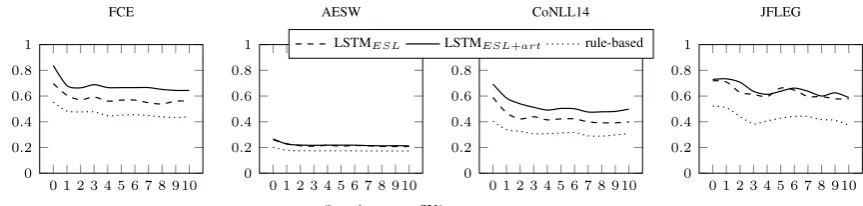
Figure 1: Performance (F0.5 scores) of the systems with respect to the noise in test data (i.e., the number of
additional non-SVA errors in sentences).
Testing on noisy contexts We first evaluate how our systems are impacted by additional non-SVA errors in the surrounding context of SVA errors in our test data. For each of the test datasets, we cre-ate multiple versions, allowing fornnon-SVA er-rors per sentence (we correct the extra non-SVA errors). This way we can create datasets with di-fferent levels of complexity with respect to the grammatical errors within them.
In Figure 1, the F0.5 scores of the models are
shown for different numbers of grammatical errors per sentence. It is evident that all of the models are negatively affected by the presence of other errors in the same sentence. Using more data for trai-ning – i.e., our artificial traitrai-ning data which does not include context errors – generally boosts per-formance on data with and without grammatical errors in the context. In other words, training with additional artificially generated errors seems, ove-rall, to be making our model more robust. We also note that our rule-based baseline is affected by errors to roughly the same extent as our base-line neural model is. One might have thought the rule-based baseline would suffer more, because of it being sensitive to errors in the underlying syn-tactic parser. We return to this issue below.
Training on non-noisy contexts In order to as-sess the benefit of training on non-erroneous con-texts, we create a new dataset from our ESL trai-ning data (see §5.3). Based on the annotations in the data, we apply the corrections of error ty-pes other than SVA, thereby only leaving SVA er-rors in the data. We experiment with how adding this ‘clean’ dataset to the training set of our exis-ting systems affects performance. The resulexis-ting F0.5 scores are listed in Table 2. Using ‘clean’
sentences in addition to our original ESL data for training always positively affects performance. In this regard, as experimented in (Rei and
Yannako-udakis,2016), training on more data in the same domain is a valid solution for improving the per-formance of LSTM models. However, when also adding artificially generated data to the training set, we reach higher scores only on 2 out of the 4 benchmarks. It greatly improves the average recall (+11.03), without hurting the precision on FCE and CoNLL14 but affects negatively the pre-cision on AESW and JFLEG.
FCE AESW CoNLL14 JFLEG
System F0.5 F0.5 F0.5 F0.5
LSTMESL 53.49 20.75 38.46 57.82
LSTMESL+art 66.04 21.31 46.27 57.29
LSTMESL+cor 65.08 27.16 46.26 59.52
[image:6.595.88.520.63.166.2]LSTMESL+art+cor 67.16 21.12 52.28 54.64
Table 2: Performance (F0.5scores) of the LSTM
mo-dels when trained using an additional set of ‘clean’ sen-tences (cor) where non-SVA errors have been correc-ted.
8.2 Sensitivity to long-distance dependencies
Next, we want to study how well our models per-form when the subjects and verbs are far apart, i.e., when the agreement relation is defined over a long-distance dependency. In order to see how our systems are affected by the distance between the subject and verb, we split the test sets based on different subject–verb distances.
way we corrupted the BNC (§5.3) to create addi-tional training data.
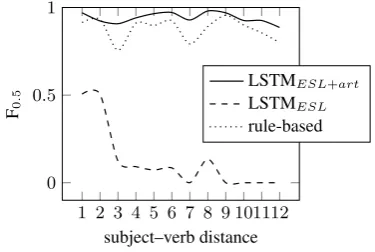
For each sentence in the PTB, we identify a subject–verb pair, and group the sentences by the subject–verb distance. We then run our models on two versions of each sentence: an unaltered ver-sion and a corrupted one, where we have genera-ted an SVA error by corrupting the verb, using the method described earlier (§5.3). This way we can compute the performance of our models as F0.5
scores over this dataset. The results are displayed in Figure 2. We can see that the LSTM trained with artificial data performs significantly better on long-distance subject–verb pairs than the LSTM trained only on ESL data. This suggests that trai-ning on artificially generated errors also makes our models more robust to this potential source of er-ror.
1 2 3 4 5 6 7 8 9 101112 0
0.5 1
subject–verb distance F0
.
5 LSTMESL+art
LSTMESL
rule-based
Figure 2: F0.5scores of the systems on the PTB as a
function of subject–verb distance.
Note that, in general, there is a substantial gap between the performance of the two LSTM mo-dels. This is because one is trained on artificial data – similar to the data we use in our analysis. However, the conclusions are based on the relative differences in performance over long-distance de-pendencies, and these differences should still be comparable across the two models.
8.3 Sources of error for our rule-based baseline
There are two obvious potential sources of error for our rule-based baseline: sensitivity to errors in the underlying syntactic parsers, and sensitivity to the irregularities of language, e.g., when collec-tive nouns or named entities are subjects, subject– verb agreement cannot always be determined by the PoS tags. We show that the main source of error seems to be irregularities by showing that the underlying syntactic parsers perform relatively
well, even in the ESL domain.
Table 3 lists the parsing and tagging perfor-mance of our underlying syntactic parsers across three domains: learner data (ESL) and web data (EWT) from the Universal Dependencies (UD) project (Nivre et al., 2017), as well as the new-swire data it was trained on (PTB). We only evalu-ate subject–verb relations, since these are the only ones of interest in this paper. We see that while there is a noticeable out-of-domain drop going from newswire to learner language or web data, the parser is still able to detect subject–verb rela-tions with high precision and recall. This suggests that the vulnerability of our rule-based baseline is primarily a result of linguistic irregularities and exceptions to the implemented rules.
UD-ESL UD-EWT PTB 23
[image:7.595.87.275.319.445.2]Subject–verb precision 88.47 88.86 91.31 Subject–verb recall 89.37 85.11 89.84 PoS tags accuracy 96.36 93.20 97.79
Table 3: The Stanford PoS Tagger and Dependency Parser’s performance on different treebanks. Subject– verb precision/recall relates to subject–verb relations. PoS tag accuracy is only for PoS tags of the subjects and verbs.
8.4 Sensitivity to other linguistic phenomena
Finally, manually reviewing the errors made by the rule-based system, we identified frequent lingu-istic sources of errors, including relative clauses, conjunctions, ambiguous PoS tags, and collective nouns. We therefore analyze how the LSTMs and the rule-based system are globally sensitive to these potential sources of error. Since our bench-marks are not annotated with PoS and dependency relations, we again use the corrupted PTB senten-ces (see §8.2).
Many of the examples in which our rule-based baseline fails include relative clauses (when the verb is the root of a relative clause) and conjunc-tions (when the subject is a conjunction). A se-cond major cause of failure is ambiguous verbs, i.e., verb forms that can also be nouns (ambiguous PoS, e.g., “need”, “stop”, “point”, etc.), and sub-jects which are singular nouns describing groups of people or things (collective nouns, e.g., “team”, “family”, “staff”, etc.). The following examples illustrate these cases (underlined):
rule-basedLSTME SL
LSTM ESL
+ar t
0 20 40
error
rate
(%)
Relative Clauses
relative other
rule-basedLSTME SL
LSTM ESL
+ar t
0 20 40
Conjunctions
conjunction other
rule-basedLSTME SL
LSTM ESL
+ar t
0 20 40
error
rate
(%)
Ambiguous PoS
ambiguous other
rule-basedLSTME SL
LSTM ESL
+ar t
0 20 40
Collective nouns
[image:8.595.74.288.64.305.2]collective other
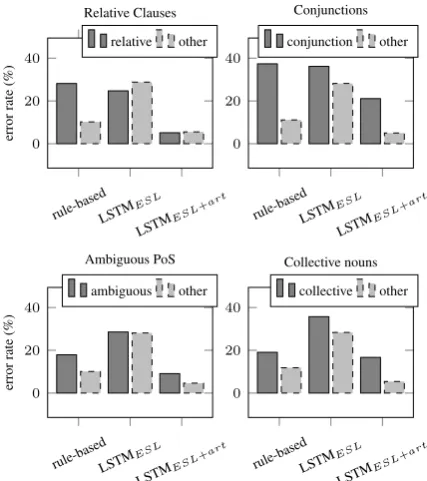
Figure 3: SVA error rates on the PTB data for complex syntactic structures and ambiguous cases.
b. If there is someone who doesn’t agree with me, he or she [. . . ] (relative clause) c. It is said that the majority of the citizens hasgot a car [. . . ] (collective noun) d. [. . . ] and police officerwalkaround the building as well. (ambiguous PoS)
We evaluate our models on the PTB data and re-port the error rate (the lower the better) on pre-sent tense verbs (Figure3). Overall, results show that all models are negatively affected when they encounter complex syntactic structures and ambi-guous cases. Figure3also confirms that the rule-based baseline is the most sensitive one to com-plex structures. Especially in comparison with the LSTMESL+art model, the rule-based system
achieves good scores on verbs which are not part of complex structures, but performs significantly worse on difficult cases. The LSTMESL model
is the worst across almost all cases, while the LSTMESL+art shows significant improvements
over the baselines, in particular for the difficult ca-ses.
9 Conclusion
In this paper, we argue for artificial error gene-ration as an effective approach to learning more robust neural models for subject–verb agreement detection. We demonstrate that error generation
is much less sensitive to parsing errors and ir-regularities than rule-based systems for detecting subject–verb agreement. On the other hand, arti-ficial error generation enables us to utilise much more training data, and therefore can develop more robust neural models for SVA error detec-tion that do not overfit the available, manually an-notated training data. Our simple approach to de-tecting subject–verb agreements achieves a new state of the art on three out of four available ben-chmarks, and, on average, is better than previous approaches on the task. We show that, in particu-lar, models trained on large volumes of artificia-lly generated errors become more robust to other errors in the surrounding context of SVA, long-distance dependencies, and other challenging lin-guistic phenomena.
Acknowledgements
This project was supported by Siteimprove and the Innovation Fund of Denmark through an industrial PhD grant. Marek Rei and Helen Yannakoudakis were supported by Cambridge Assessment, Uni-versity of Cambridge.
References
Øistein E. Andersen, Helen Yannakoudakis, Fiona Bar-ker, and Tim Parish. 2013. Developing and testing a self-assessment and tutoring system. InProceedings of BEA 2013.
BNC-Consortium et al. 2007. The British National Corpus, Version 3. Distributed by Bodleian Libra-ries, University of Oxford.
Chris Brockett, William B Dolan, and Michael Gamon. 2006. Correcting ESL Errors Using Phrasal SMT Techniques. InProceedings of COLING-ACL 2006.
Christopher Bryant and Ted Briscoe. 2018. Language Model Based Grammatical Error Correction without Annotated Training Data. In Proceedings of BEA 2018.
Christopher Bryant, Mariano Felice, and Ted Briscoe. 2017. Automatic Annotation and Evaluation of Er-ror Types for Grammatical ErEr-ror Correction. In Pro-ceedings of ACL 2017.
Dongfeng Cai, Yonghua Hu, Xuelei Miao, and Yan Song. 2009. Dependency Grammar Based English Subject-Verb Agreement Evaluation. In Procee-dings of PACLIC 2009.
Shamil Chollampatt and Hwee Tou Ng. 2018. A Mul-tilayer Convolutional Encoder-Decoder Neural Ne-twork for Grammatical Error Correction. In Proce-edings of AAAI 2018.
Daniel Dahlmeier, Hwee Tou Ng, and Siew Mei Wu. 2013. Building a Large Annotated Corpus of Lear-ner English: The NUS Corpus of LearLear-ner English. InProceedings of BEA 2013.
Vidas Daudaravicius, Rafael E. Banchs, Elena Volo-dina, and Courtney Napoles. 2016. A Report on the Automatic Evaluation of Scientific Writing Shared Task. InProceedings of BEA 2016.
Jacob Devlin, Ming-Wei Chang, Kenton Lee, and Kristina Toutanova. 2018. BERT: Pre-training of Deep Bidirectional Transformers for Language Un-derstanding.arXiv preprint arXiv:1810.04805.
Mariano Felice and Zheng Yuan. 2014. Generating ar-tificial errors for grammatical error correction. pa-ges 116–126.
Kristina Gulordava, Piotr Bojanowski, Edouard Grave, Tal Linzen, and Marco Baroni. 2018. Colorless Green Recurrent Networks Dream Hierarchically. InProceedings of NAACL 2018.
Sepp Hochreiter and Jürgen Schmidhuber. 1997. Long Short-term Memory.Neural Computation, 9.
Sudhanshu Kasewa, Pontus Stenetorp, and Sebastian Riedel. 2018. Wronging a right: Generating better errors to improve grammatical error detection. In
Proceedings of EMNLP 2018.
Christo Kirov, John Sylak-Glassman, Roger Que, and David Yarowsky. 2016. Very-large Scale Parsing and Normalization of Wiktionary Morphological Pa-radigms. InProceedings of LREC 2016.
Adhiguna Kuncoro, Chris Dyer, John Hale, Dani Yo-gatama, Stephen Clark, and Phil Blunsom. 2018.
LSTMs Can Learn Syntax-Sensitive Dependencies Well, But Modeling Structure Makes Them Better. InProceedings of ACL 2018.
Guillaume Lample, Miguel Ballesteros, Sandeep Su-bramanian, Kazuya Kawakami, and Chris Dyer. 2016. Neural architectures for named entity recog-nition. InProceedings of NAACL 2016.
Claudia Leacock, Martin Chodorow, Michael Gamon, and Joel Tetreault. 2010. Automated Grammatical Error Correction for Language Learners. Synthesis lectures on human language technologies, 3(1):1– 134.
Tal Linzen, Emmanuel Dupoux, and Yoav Goldberg. 2016. Assessing the Ability of LSTMs to Learn Syntax-Sensitive Dependencies.Transactions of the Association for Computational Linguistics (TACL), 4.
Alexis Manaster-Ramer. 1987. Subject-verb Agre-ement in Respective Coordinations and Context-freeness.Computational Linguistics, 13:64–65.
Mitchell P. Marcus, Mary Ann Marcinkiewicz, and Beatrice Santorini. 1993. Building a Large Anno-tated Corpus of English: The Penn Treebank. Com-putational linguistics, 19(2):313–330.
Tomas Mikolov, Ilya Sutskever, Kai Chen, Greg S. Cor-rado, and Jeff Dean. 2013. Distributed Representa-tions of Words and Phrases and their Compositiona-lity. InProceedings of NIPS 2013.
Tomoya Mizumoto, Mamoru Komachi, Masaaki Na-gata, and Yuji Matsumoto. 2011. Mining Revision Log of Language Learning SNS for Automated Ja-panese Error Correction of Second Language Lear-ners. InProceedings of IJCNLP 2011.
Ryo Nagata and Kazuhide Nakatani. 2010. Evaluating performance of grammatical error detection to ma-ximize learning effect. InProceedings of COLING 2010.
Courtney Napoles, Keisuke Sakaguchi, and Joel Te-treault. 2017. JFLEG: A Fluency Corpus and Ben-chmark for Grammatical Error Correction. In Pro-ceedings of EACL 2017.
Hwee Tou Ng, Siew Mei Wu, Ted Briscoe, Christian Hadiwinoto, Raymond Hendy Susanto, and Christo-pher Bryant. 2014. The CoNLL-2014 Shared Task on Grammatical Error Correction. InProceedings of CoNLL 2014: Shared Task.
Joakim Nivre, Željko Agi´c, Lars Ahrenberg, Lene An-tonsen, Maria Jesus Aranzabe, Masayuki Asahara, Luma Ateyah, Mohammed Attia, Aitziber Atutxa, Liesbeth Augustinus, Elena Badmaeva, Miguel Ba-llesteros, et al. 2017. Universal dependencies 2.1. LINDAT/CLARIN digital library at the Institute of Formal and Applied Linguistics (ÚFAL), Faculty of Mathematics and Physics, Charles University.
Marek Rei. 2017.Semi-supervised Multitask Learning for Sequence Labeling. Proceedings of ACL 2017.
Marek Rei, Mariano Felice, Zheng Yuan, and Ted Bri-scoe. 2017. Artificial Error Generation with Ma-chine Translation and Syntactic Patterns. In Procee-dings of BEA 2017.
Marek Rei and Helen Yannakoudakis. 2016. Composi-tional Sequence Labeling Models for Error Detec-tion in Learner Writing. In Proceedings of ACL 2016.
Marek Rei and Helen Yannakoudakis. 2017.Auxiliary Objectives for Neural Error Detection Models. In
Proceedings of BEA 2017.
Nitish Srivastava, Geoffrey Hinton, Alex Krizhevsky, Ilya Sutskever, and Ruslan Salakhutdinov. 2014.
Dropout: A Simple Way to Prevent Neural Networks from Overfitting. The Journal of Machine Learning Research, 15(1):1929–1958.
Guihua Sun, Gao Cong, Xiaohua Liu, Chin-Yew Lin, and Ming Zhou. 2007. Mining Sequential Patterns and Tree Patterns to Detect Erroneous Sentences. In
Proceedings of AAAI 2007.
Kristina Toutanova, Dan Klein, Christopher D. Man-ning, and Yoram Singer. 2003. Feature-Rich Part-of-Speech Tagging with a Cyclic Dependency Ne-twork. InProceedings of NAACL 2003.
Yuzhu Wang, Hai Zhao, and Dan Shi. 2015. A Light Rule-based Approach to English Subject-Verb Agre-ement Errors on the Third Person Singular Forms. InProceedings of PACLIC 2015.
Ziang Xie, Guillaume Genthial, Stanley Xie, Andrew Ng, and Dan Jurafsky. 2018. Noising and Denoi-sing Natural Language: Diverse Backtranslation for Grammar Correction. In Proceedings of NAACL 2018.
Helen Yannakoudakis, Ted Briscoe, and Ben Medlock. 2011.A New Dataset and Method for Automatically Grading ESOL Texts. InProceedings of ACL 2011.
Helen Yannakoudakis, Marek Rei, Øistein E Andersen, and Zheng Yuan. 2017. Neural Sequence-Labelling Models for Grammatical Error Correction. In Pro-ceedings of EMNLP 2017.