MUSE: Modularizing Unsupervised Sense Embeddings
Guang-He Lee?† Yun-Nung Chen†
?Massachusetts Institute of Technology, Cambridge, MA †National Taiwan University, Taipei, Taiwan [email protected] [email protected]
Abstract
This paper proposes to address the word sense ambiguity issue in an unsupervised manner, where word sense representations are learned along a word sense selection mechanism given contexts. Prior work focused on designing a single model to deliver both mechanisms, and thus suf-fered from either coarse-grained represen-tation learning or inefficient sense selec-tion. The proposed modular approach,
MUSE, implements flexible modules to optimize distinct mechanisms, achieving the first purely sense-level representation learning system with linear-time sense se-lection. We leverage reinforcement learn-ing to enable joint trainlearn-ing on the pro-posed modules, and introduce various ex-ploration techniques on sense selection for better robustness. The experiments on benchmark data show that the proposed approach achieves the state-of-the-art per-formance on synonym selection as well as on contextual word similarities in terms of MaxSimC.
1 Introduction
Recently, deep learning methodologies have dom-inated several research areas in natural language processing (NLP), such as machine translation, language understanding, and dialogue systems. However, most of applications usually utilize word-level embeddings to obtain semantics. Con-sidering that natural language is highly ambigu-ous, the standard word embeddings may suffer from polysemy issues. Neelakantan et al. (2014) pointed out that, due to triangle inequality in vec-tor space, if one word has two different senses but is restricted to one embedding, the sum of
the distances between the word and its synonym in each sense would upper-bound the distance be-tween the respective synonyms, which may be mu-tually irrelevant, in embedding space1. Due to the theoretical inability to account for polysemy us-ing a sus-ingle embeddus-ing representation per word, multi-sense word representations are proposed to address the ambiguity issue using multiple em-bedding representations for different senses in a word (Reisinger and Mooney,2010;Huang et al.,
2012).
This paper focuses on unsupervised learning from the unannotated corpus. There are two key mechanisms for a multi-sense word representation system in such scenario: 1) a sense selection (de-coding) mechanism infers the most probable sense for a word given its context and 2) a sense repre-sentation mechanism learns to embed word senses in a continuous space.
Under this framework, prior work focused on designing a single model to deliver both mech-anisms (Neelakantan et al., 2014; Li and Juraf-sky, 2015;Qiu et al., 2016). However, the previ-ously proposed models introduce side-effects: 1) mixing word-level and sense-level tokens achieves efficient sense selection but introduces ambigu-ous word-level tokens during the representation learning process (Neelakantan et al.,2014;Li and Jurafsky, 2015), and 2) pure sense-level tokens prevent ambiguity from word-level tokens but re-quire exponential time complexity when decoding a sense sequence (Qiu et al.,2016).
Unlike the prior work, this paper proposes
MUSE2—a novel modularization framework in-corporating sense selection and representation learning models, which implements flexible mod-ules to optimize distinct mechanisms. Specifically,
1d(rock,stone) +d(rock,shake)≥d(stone,shake) 2The trained models and code are available athttps: //github.com/MiuLab/MUSE.
MUSE enables linear time sense identity decoding with a sense selection module and purely sense-level representation learning with a sense repre-sentation module.
With the modular design, we propose a novel joint learning algorithm on the modules by con-necting to a reinforcement learning scenario, which achieves the following advantages. First, the decision making process under reinforcement learning better captures the sense selection mech-anism than probabilistic and clustering methods. Second, our reinforcement learning algorithm re-alizes the first single objective function for modu-lar unsupervised sense representation systems. Fi-nally, we introduce various exploration techniques under reinforcement learning on sense selection to enhance robustness.
In summary, our contributions are five-fold: • MUSE is the first system that maintains
purely sense-level representation learning with linear-time sense decoding.
• We are among the first to leverage reinforce-ment learning to model the sense selection process in sense representations system. • We are among the first to propose a single
objective for modularized unsupervised sense embedding learning.
• We introduce a sense exploration mechanism for the sense selection module to achieve bet-ter flexibility and robustness.
• Our experimental results show the state-of-the-art performance for synonym selection and contextual word similarities in terms of MaxSimC.
2 Related Work
There are three dominant types of approaches for learning multi-sense word representations in the literature: 1) clustering methods, 2) probabilis-tic modeling methods, and 3) lexical ontology based methods. Our reinforcement learning based approach can be loosely connected to clustering methods and probabilistic modeling methods.
Reisinger and Mooney (2010) first proposed multi-sense word representations on the vector space based on clustering techniques. With the power of deep learning, some work exploited neu-ral networks to learn embeddings with sense se-lection based on clustering (Huang et al., 2012;
Neelakantan et al., 2014). Chen et al. (2014) re-placed the clustering procedure with a word sense
disambiguation model using WordNet (Miller,
1995). K˚ageb¨ack et al.(2015) andVu and Parker
(2016) further leveraged a weighting mechanism and interactive process in the clustering proce-dure. Moreover,Guo et al.(2014) leveraged bilin-gual resources for clustering. However, most of the above approaches separated the clustering pro-cedure and the representation learning propro-cedure without a joint objective, which may suffer from the error propagation issue. Instead, the proposed approach, MUSE, enables joint training on sense selection and representation learning.
Instead of clustering, probabilistic modeling methods have been applied for learning multi-sense embeddings in order to make the multi-sense se-lection more flexible, where Tian et al. (2014) and Jauhar et al. (2015) conducted probabilis-tic modeling with EM training. Li and Jurafsky
(2015) exploited Chinese Restaurant Process to infer the sense identity. Furthermore, Bartunov et al.(2016) developed a non-parametric Bayesian extension on the skip-gram model (Mikolov et al., 2013b). Despite reasonable modeling on sense selection, all above methods mixed word-level and sense-word-level tokens during representation learning—unable to conduct representation learn-ing in the pure sense level due to the complicated computation in their EM algorithms.
Recently, Qiu et al. (2016) proposed an EM algorithm to learn purely sense-level representa-tions, where the computational cost is high when decoding the sense identity sequence, because it takes exponential time to search all sense com-bination within a context window. Our modular design addresses such drawback, where the sense selection module decodes a sense sequence with linear-time complexity, while the sense represen-tation module remains represenrepresen-tation learning in the pure sense level.
Unlike a lot of relevant work that requires addi-tional resources such as the lexical ontology ( Pile-hvar and Collier,2016;Rothe and Sch¨utze,2015;
Jauhar et al., 2015;Chen et al., 2015; Iacobacci et al., 2015) or bilingual data (Guo et al., 2014;
Corpus: { Smartphone companies including apple blackberry, and sony will be invited.}
… 𝐶𝑡= 𝑤𝑖
𝐶𝑡−1
𝑞(𝑧𝑖1| ഥ𝐶𝑡) 𝑞(𝑧𝑖2| ഥ𝐶𝑡) 𝑞(𝑧𝑖3| ഥ𝐶𝑡)
𝑧𝑖1
Sense Representation Module
… 𝑃(𝑧𝑗2|𝑧𝑖1) 𝑃(𝑧𝑢𝑣|𝑧𝑖1)
sense selection ←
Sense Selection Module
re
w
ar
d
si
gn
al
←
sense
selecti
on
→
Sense selection for target word𝐶𝑡 Sense selection for collocated word 𝐶𝑡′
negative sampling
matrix 𝑄𝑖 matrix 𝑉
matrix 𝑈
matrix 𝑃
Sense Selection Module
… 𝐶𝑡+1
including apple blackberry
… 𝐶𝑡′= 𝑤𝑗
𝐶𝑡′−1
𝑞(𝑧𝑗1|𝐶𝑡′) 𝑞(𝑧𝑗2|𝐶𝑡′) 𝑞(𝑧𝑗3|𝐶𝑡′)
matrix 𝑄𝑗
matrix 𝑃
… 𝐶𝑡′+1
apple and
companies and including sony
sample collocation
1
2
2
3
[image:3.595.75.524.62.225.2]blackberry
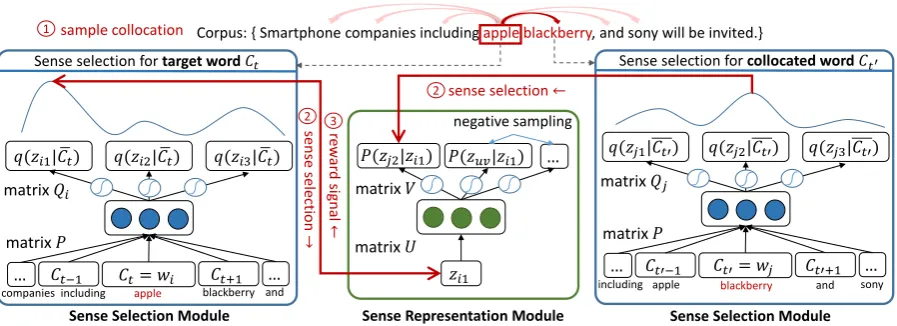
Figure 1: TheMUSE architecture with a 3-step learning algorithm: 1) collocation sampling, 2) sense selection for sense representation learning, and 3) optimizing sense selection with a reward signal from sense representation. Reward signal is only passed to the target word to stabilize model training due to directional architecture in the sense representation module.
word embeddings.
3 Proposed Approach: MUSE
This work proposes a framework to modularize two key mechanisms for multi-sense word repre-sentations: a sense selection module and asense representation module. The sense selection mod-ule decides which sense to use given a text con-text, whereas the sense representation module learns meaningful representations based on its sta-tistical characteristics. Unlike prior work that must suffer from either inefficient sense selec-tion (Qiu et al.,2016) or coarse-grained represen-tation learning (Neelakantan et al., 2014;Li and Jurafsky, 2015; Bartunov et al., 2016), the pro-posed modularized framework is capable of per-forming efficient sense selection and learning rep-resentations in pure sense level simultaneously.
To learn sense-level representations, a sense selection model should be first established for sense identity decoding. On the other hand, the sense embeddings should guide the sense selection model when decoding a sense identity sequence. Therefore, these two modules should be tangled. This indicates that a naive two-stage algorithm or two separate learning algorithms proposed by prior work are not optimal.
By connecting the proposed formulation with reinforcement learning literature, we design a novel joint training algorithm. Besides, taking ad-vantage of the form of reinforcement learning, we are among the first to investigate various explo-ration techniques in sense selection for
unsuper-vised sense embedding learning.
3.1 Model Architecture
Our model architecture is illustrated in Figure 1, where there are two modules in optimization.
3.1.1 Sense Selection Module
Formally speaking, given a corpusC, vocabulary W, and thet-th wordCt = wi ∈ W, we would
like to find the most probable sense zik ∈ Zi,
where Zi is the set of senses in word wi.
As-suming that a word sense is determined by the local context, we exploit a local context C¯t =
{Ct−m,· · ·, Ct+m}for sense selection according
to the Markov assumption, where m is the size of a context window. Then we can either for-mulate a probabilistic policy π(zik | C¯t) about
sense selection or estimate the individual likeli-hoodq(zik|C¯t)for each sense identity.
To ensure efficiency, here we exploit a linear neural architecture that takes word-level input to-kens and outputs sense-level identities. The ar-chitecture is similar to continuous bag-of-words (CBOW) (Mikolov et al., 2013a). Specifically, given awordembedding matrixP, the local con-text can be modeled as the summation of word em-beddings from its context C¯t. The output can be
formulated with a 3-mode tensorQ, whose dimen-sions denote words, senses, and latent variables. Then we can modelπ(zik|C¯t)orq(zik |C¯t)
distribution using a softmax layer:
π(zik|C¯t) = exp(Q T ik
P
j∈C¯tPj)
P
k0∈Ziexp(QTik0Pj∈C¯tPj).
(1) On the other hand, the likelihood of selecting dis-tinct sense identities, q(zik | C¯t), is modeled as
a Bernoulli distribution with a sigmoid function σ(·):
q(zik|C¯t) =σ(QTik X
j∈C¯t
Pj). (2)
Different modeling approaches require different learning methods, especially for the unsupervised setting. We leave the corresponding learning al-gorithms in§ 3.2. Finally, with a built sense se-lection module, we can apply any sese-lection algo-rithm such as a greedy selection strategy to infer the sense identityzikgiven a wordwiwith its
con-textCt.
We note that modularized model enables effi-cient sense selection by leveraging word-level to-kens, while remaining purely sense-level tokens in the representation module. Specifically, if n de-notesmaxk|Zk|, decodingLwords takesO(nL)
senses to be searched due to independent sense selection. The prior work using a single model with purely sense-level tokens (Qiu et al., 2016) requires exponential time to calculate the collo-cation energy for every possible combination of sense identities within a context window,O(n2m),
for asingle target sense. Further,Qiu et al.(2016) took an additional sequence decoding step with quadratic time complexity O(n4mL), based on
an exponential number n2m in the base unit. It
demonstrates the achievement about sense infer-ence efficiency in our proposed model.
3.1.2 Sense Representation Module
The semantic representation learning is typically formulated as a maximum likelihood estimation (MLE) problem for collocation likelihood. In this paper, we use the skip-gram formulation (Mikolov et al., 2013b) considering that it requires less training time, where only two sense identities are required for stochastic training. Other pop-ular candidates, like GloVe (Pennington et al.,
2014) and CBOW (Mikolov et al.,2013a), require more sense identities to be selected as input and thus not suitable for our scenario. For example, GloVe (Pennington et al., 2014) takes computa-tionally expensive collocation counting statistics
for each token in a corpus as input, which requires sense selection for every occurrence of the target word across the whole corpus for a single opti-mization step.
To learn the representations, we first create in-put sense representation matrixU and collocation estimation matrixV as the learning targets. Given a target wordwiand collocated wordwjwith
cor-responding local contexts, we map them to their sense identities as zik and zjl by the sense
se-lection module, and maximize the sense colloca-tion log likelihood logL(·). A natural choice of the likelihood function is formulated as a categor-ical distribution over all possible collocated senses given the target sensezik:
max
U,V logL(zjl|zik) = log
exp(UT zikVzjl)
P
zuvexp(UzTikVzuv)
. (3) Instead of enumerating all possible collocated senses which is computationally expensive, we use the skip-gram objective (4) (Mikolov et al.,
2013b) to approximate (3) as shown in the green block of Figure1.
max
U,V log ¯L(zjl|zik) = logσ(U T
zikVzjl) (4)
+ M X
v=1
Ezuv∼pneg(z)[logσ(−UzTikVzuv)],
where pneg(z) is the distribution over all senses for negative samples. In our experiment with|Zi|
senses for word wi, we use (1/|Zi|) word-level
unigram as sense-level unigram for efficiency and the3/4-th power trick inMikolov et al.(2013b).
We note that our modular framework can easily maintain purely sense-level tokens with an arbi-trary representation learning model. In contrast, most related work using probabilistic modeling (Tian et al.,2014;Jauhar et al.,2015;Li and Juraf-sky,2015;Bartunov et al.,2016) binded sense rep-resentations with the sense selection mechanism, so efficient sense selection by leveraging word-level tokens can be achieved only at the cost of mixing word-level and sense-level tokens in their representation learning process.
3.2 Learning
to the representation module. Then we cast the es-timated collocation likelihood as a reward signal for the selected sense for effective learning.
To realize the above procedure, we cast the learning problem a one-step Markov decision pro-cess (MDP) (Sutton and Barto, 1998), where the state, action, and reward correspond to contextC¯t,
sensezik, and collocation log likelihoodlog ¯L(·),
respectively. Based on different modeling meth-ods ((1) or (2)) in the sense selection module, we connect the model to respective reinforcement learning algorithms to solve the MDP. Specifically, we refer (1) to policy distribution and refer (2) to Q-value estimation in the reinforcement learning literature.
The proposed MDP framework embodies sev-eral nuances of sense selection. First, the deci-sion of a word sense is Markov: taking the whole corpus into consideration is not more helpful than a handful of necessary local contexts. Second, the decision making in MDP exploits a hard de-cision for selecting sense identity, which captures the sense selection process more naturally than a joint probability distribution among senses (Qiu et al.,2016). Finally, we exploit the reward mech-anism in MDP to enable joint training: the estima-tion of sense representaestima-tion is treated as a reward signal to guide sense selection. In contrast, the decision making under clustering (Huang et al.,
2012;Neelakantan et al.,2014) considers the sim-ilarity within clusters instead of the outcome of a decision using a reward signal as MDP.
3.2.1 Policy Gradient Method
Because (1) fits a valid probability distribution, an intuitive optimization target is the expectation of resulting collocation likelihood among each sense. In addition, as the skip-gram formulation in (4) is unidirectional (L¯(zik | zjl) 6= ¯L(zjl | zik)), we
perform one-side optimization for the target sense zik to stabilize model training3. That is, for the
target wordwi and the collocated wordwj given
respective contextsC¯tandC¯t0 (0<|t−t0| ≤m), we first draw a sense zjl for wj from the policy
π(· | C¯t0) and optimize the expected collocation likelihood for the target sensezikas follows,
max
P,Q Ezik∼π(·|C¯t)[log ¯L(zjl|zik)]. (5) Note that (4) can be merged into (5) as a sin-gle objective. The objective is differentiable and 3We observe about4%performance drop by optimizing input selectionzikand output selectionzjlsimultaneously.
supports stochastic optimization (Lei et al.,2016), which uses a stochastic sample zik for
optimiza-tion.
However, there are two possible disadvantages in this formulation. First, because the policy as-sumes the probability distribution in (1), optimiz-ing the selected sense must affect the estimation of the other senses. Second, if applying stochastic gradient ascent to optimizing (5), it would always lower the probability estimation for the selected sensezik even if the model accurately selects the
right sense. The detailed proof is in AppendixA.
3.2.2 Value-Based Method
To address the above issues, we apply the Q-learning algorithm (Mnih et al.,2013). Instead of maintaining a probabilistic policy for sense selec-tion, Q-learning estimates the Q-value (resulting collocation log likelihood) for each sense candi-date directly and independently. Thus, the estima-tion of unselected senses may not be influenced by the selected one. Note that in one-step MDP, the reward is equivalent to the Q-value, so we will use reward and Q-value interchangeably, hereinafter, based on the context.
We further follow the convention of recent neu-ral reinforcement learning by reducing the re-ward range to aid model training (Mnih et al.,
2013). Specifically, we replace thelog likelihood log ¯L(·) ∈ (−inf,0] with the likelihood L¯(·) ∈
[0,1] as the reward function. Due to the mono-tonic operation in log(), the relative ordering of the reward remains the same.
Furthermore, we exploit the probabilistic na-ture of likelihood for Q-learning. To elaborate, as Q-learning is used to approximate the Q-value for each action in typical reinforcement learning, most literature adopted square loss to characterize the discrepancy between the target and estimated Q-values (Mnih et al.,2013). In our setting where the Q-value/reward is a likelihood function, our model exploits cross-entropy loss to better capture the characteristics of probability distribution.
Given that the collocation likelihood in (4) is an approximation to the original categorical dis-tribution with a softmax function shown in (3) (Mikolov et al.,2013b), we revise the formulation by omitting the negative sampling term. The re-sulting formulationLˆ(·)is a Bernoulli distribution indicating whetherzjlcollocates or not givenzik:
ˆ
There are three advantages about using Lˆ(·) in-stead of approximated L¯(·) and original L(·). First, regarding the variance of estimation, Lˆ(·)
better captures L(·) than L¯(·) because L¯(·) in-volves sampling:
V ar( ¯L(·))≥V ar( ˆL(·)) =V ar(L(·)) = 0. (7)
Second, regarding the relative ordering of estima-tion, for any two collocated senseszjlandzjl0with a target sensezik, the following equivalence holds:
L(zjl|zik)<L(zjl0 |zik) (8) ⇔ L¯(zjl|zik)<L¯(zjl0 |zik)
⇔ Lˆ(zjl|zik)<Lˆ(zjl0 |zik)
Third, for collocation computation, L(·) requires all sense identities andL¯(·)requires(M+1)sense identities, whereasLˆ(·)only requires1sense iden-tity. In sum, the proposedLˆ(·)approximatesL(·)
with no variance, no “bias” (in terms of relative ordering), and significantly less computation.
Finally, because both target distribution Lˆ(·)
and estimated distributionq(·)in (2) are Bernoulli distributions, we follow the last section to conduct one-side optimization by fixing a collocated sense zjland optimize the selected sensezik with cross
entropy as
min
P,Q H( ˆL(zik|zjl), q(zik |C¯t)). (9)
3.2.3 Joint Training
To jointly train sense selection and sense represen-tation modules, we first select a pair of the collo-cated senses, zik andzjl, based on the sense
se-lection module with any selecting strategy (e.g. greedy), and then optimize the sense representa-tion module and the sense selecrepresenta-tion module using the above derivations. Algorithm 1describes the proposed MUSE model training procedure.
As modular frameworks, the major distinc-tion between our modular framework and two-stage clustering-representation learning frame-work (Neelakantan et al., 2014; Vu and Parker,
2016) is that we establish a reward signal from the sense representation to the sense selection module to enable immediate and joint optimization.
3.3 Sense Selection Strategy
Given a fitness estimation for each sense, exploit-ing the greedy sense is the most popular strat-egy for clustering algorithms (Neelakantan et al.,
Algorithm 1:Learning Algorithm
forwi=Ct∈Cdo
samplewj =Ct0(0<|t0−t| ≤m); zik =select(Ct, wi);
zjl=select(Ct0, wj);
optimizeU, V by (4) for the sense representation module;
optimizeP, Qby (5) or (9) for the sense selection module;
2014;K˚ageb¨ack et al.,2015) and hard-EM algo-rithms (Qiu et al., 2016; Jauhar et al., 2015) in literature. However, there are two incentives to conduct exploration. First, in the early training stage when the fitness is not well estimated, it is desirable to explore underestimated senses. Sec-ond, due to high ambiguity in natural language, sometimes multiple senses in a word would fit in the same context. The dilemma between ex-ploring sub-optimal choices and exploiting the optimal choice is called exploration-exploitation trade-off in reinforcement learning (Sutton and Barto,1998).
We introduce exploration mechanisms for sense selection for both policy gradient and Q-learning. For policy gradient, we sample the policy distri-bution to approximate the expectation in (5). Be-cause of the flexible formulation of Q-learning, the following classic exploration mechanisms are ap-plied to sense selection:
• Greedy: selects the sense with the largest Q-value (no exploration).
• -Greedy: selects a random sense with probability, and adopts the greedy strategy otherwise (Mnih et al.,2013).
• Boltzmann: samples the sense based on the Boltzmann distribution modeled by Q-value. We directly use (1) as the Boltzmann distri-bution for simplicity.
We note that Q-learning with Boltzmann sampling yields the same sampling process as policy gradi-ent but differgradi-ent optimization objectives. To our best knowledge, we are among the first to ex-plore several exploration strategies for unsuper-vised sense embedding learning.
4 Experiments
We evaluate our proposed MUSE model in both quantitative and qualitative experiments.
4.1 Experimental Setup
Our model is trained on the April 2010 Wikipedia dump (Shaoul and Westbury, 2010), which con-tains approximately 1 billion tokens. For fair comparison, we adopt the same vocabulary set as Huang et al. (2012) and Neelakantan et al.
(2014). For preprocessing, we convert all words to their lower cases, apply the Stanford tokenizer and the Stanford sentence tokenizer (Manning et al.,
2014), and remove all sentences with less than 10 tokens. The number of senses per word inQis set to 3 as the prior work (Neelakantan et al.,2014).
In the experiments, the context window size is set to 5 (|C¯t| = 11). Subsampling
tech-nique introduced byword2vec(Mikolov et al.,
2013b) is applied to accelerate the training pro-cess. The learning rate is set to 0.025. The em-bedding dimension is 300. We initializeQandV as zeros, andP andU from uniform distribution
[−p1/100,p1/100] such that each embedding has unit length in expectation (Lei et al., 2015). Our model uses 25 negative senses for negative sampling in (4). We use = 5% for -Greedy sense selection strategy
In optimization, we conduct mini-batch training with 2048 batch size using the following proce-dure: 1) select senses in the batch; 2) optimize U, V using stochastic training within the batch for efficiency; 3) optimize P, Qusing mini-batch training for robustness.
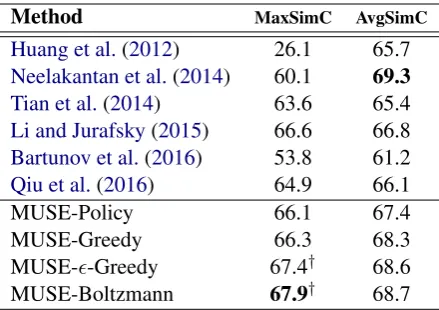
4.2 Experiment 1: Contextual Word Similarity
To evaluate the quality of the learned sense em-beddings, we compute the similarity score be-tween each word pair given their respective lo-cal contexts and compare with the human-judged score using Stanford’s Contextual Word Similari-ties (SCWS) dataset (Huang et al.,2012). Specifi-cally, given a list of word pairs with correspond-ing contexts, S = {(wi,C¯t, wj,C¯t0)}, we cal-culate the Spearman’s rank correlationρbetween human-judged similarity and model similarity es-timations4. Two major contextual similarity esti-4For example, human-judged similarity between “... east
bankof the Des Moines River ...” and “... basis of allmoney
laundering ...” is 2.5 out of 10.0 in SCWS dataset (Huang
Method MaxSimC AvgSimC
Huang et al.(2012) 26.1 65.7
Neelakantan et al.(2014) 60.1 69.3
Tian et al.(2014) 63.6 65.4
Li and Jurafsky(2015) 66.6 66.8
Bartunov et al.(2016) 53.8 61.2
Qiu et al.(2016) 64.9 66.1
MUSE-Policy 66.1 67.4
MUSE-Greedy 66.3 68.3
MUSE--Greedy 67.4† 68.6
[image:7.595.308.528.61.216.2]MUSE-Boltzmann 67.9† 68.7
Table 1: Spearman’s rank correlation ρ x100 on the SCWS dataset.†denotes superior performance
to all unsupervised competitors.
mations are introduced byReisinger and Mooney
(2010): AvgSimC and MaxSimC. AvgSimC is a
softmeasurement that addresses the contextual in-formation with a probability estimation:
AvgSimC(wi,C¯t, wj,C¯t0) =
|Zi|
X
k=1
|Zj|
X
l=1
π(zik|C¯t)π(zjl|C¯t0)d(zik, zjl),
whered(zik, zjl)refers to the cosine similarity
be-tweenUzik andUzjl. AvgSimC weights the sim-ilarity measurement of each sense pair zik and
zjlby their probability estimations. On the other
hand, MaxSimC is ahard measurement that only considers the most probable senses:
MaxSimC(wi,C¯t, wj,C¯t0) =d(zik, zjl), zik= arg max
zik0 π(zik 0|C¯t), zjl= arg max
zjl0 π(zjl 0|C¯t0).
The baselines for comparison include classic clustering methods (Huang et al.,2012; Neelakan-tan et al.,2014), EM algorithms (Tian et al.,2014;
Qiu et al., 2016;Bartunov et al.,2016), and Chi-nese Restaurant Process (Li and Jurafsky,2015)5, where all approaches are trained on the same cor-pus except Qiu et al. (2016) used more recent Wikipedia dumps. The embedding sizes of all baselines are 300, except 50 inHuang et al.(2012). For every competitor with multiple settings, we re-port the best performance in each similarity mea-surement setting and show in Table1.
et al.,2012).
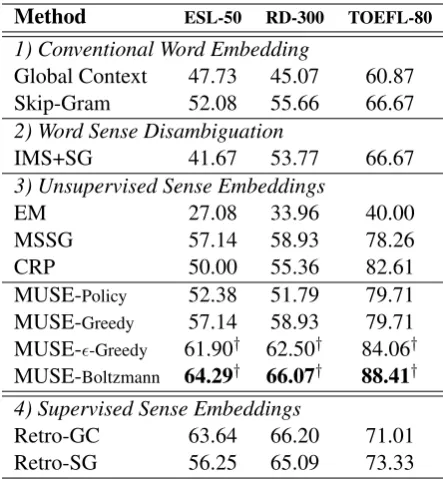
Method ESL-50 RD-300 TOEFL-80
1) Conventional Word Embedding
Global Context 47.73 45.07 60.87
Skip-Gram 52.08 55.66 66.67
2) Word Sense Disambiguation
IMS+SG 41.67 53.77 66.67
3) Unsupervised Sense Embeddings
EM 27.08 33.96 40.00
MSSG 57.14 58.93 78.26
CRP 50.00 55.36 82.61
MUSE-Policy 52.38 51.79 79.71
MUSE-Greedy 57.14 58.93 79.71
MUSE--Greedy 61.90† 62.50† 84.06†
MUSE-Boltzmann 64.29† 66.07† 88.41† 4) Supervised Sense Embeddings
Retro-GC 63.64 66.20 71.01
[image:8.595.71.293.61.301.2]Retro-SG 56.25 65.09 73.33
Table 2: Accuracy on synonym selection. †
de-notes superior performance to all unsupervised competitors.
Our MUSE model achieves the state-of-the-art performance on MaxSimC, demonstrating supe-rior quality on independent sense embeddings. On the other hand, MUSE achieves comparable per-formance with the best competitor in terms of AvgSimC (68.7 vs. 69.3), while MUSE outper-forms the same competitor significantly in terms of MaxSimC (67.9 vs. 60.1). The results demon-strate not only the high quality of sense represen-tations but also accurate sense selection.
From the application perspective, MaxSimC refers to a typical scenario using single embedding per word, while AvgSimC employs multiple sense vectors simultaneously per word, which not only brings computational overhead but changes exist-ing neural architecture for NLP. Hence, we argue that MaxSimC better characterize practical usage of a sense representation system than AvgSimC.
Among various learning methods for MUSE, policy gradient performs worst, echoing our ar-gument in§ 3.2.1. On the other hand, the supe-rior performance of Boltzmann sampling and -Greedy over -Greedy selection demonstrates the ef-fectiveness of exploration.
Finally, replacing L¯(·) with Lˆ(·) as the re-ward signal yields2.3 times speedup for -Greedy and 1.3 times speedup for MUSE-Boltzmann to reach 67.0 in MaxSimC, which demonstrates the efficacy of proposed
approxima-tion Lˆ(·) over typical L¯(·) in terms of conver-gence.
4.3 Experiment 2: Synonym Selection
We further evaluate our model on synonym selection using multi-sense word representa-tions (Jauhar et al., 2015). Three standard syn-onym selection datasets, ESL-50 (Turney,2001), RD-300 (Jarmasz and Szpakowicz, 2004), and TOEFL-80 (Landauer and Dumais,1997), are per-formed. In the datasets, each question consists of a question word wQ and four answer candidates
{wA, wB, wC, wD}, and the goal is to select the
most semantically synonymous choice among the four candidates. For example, in the TOEFL-80 dataset, a question shows {(Q) enormously, (A) appropriately, (B) uniquely, (C) tremendously, (D) decidedly}, and the answer is (C). For multi-sense representations system, it selects the synonym of the question wordwQusing the maximum
sense-level cosine similarity as a proxy of the semantic similarity (Jauhar et al.,2015).
Our model is compared with the following base-lines: 1) conventional word embeddings: global context vectors (Huang et al., 2012) and skip-gram (Mikolov et al., 2013b); 2) applying su-pervised word sense disambiguation using the IMS system and then applying skip-gram on dis-ambiguated corpus (IMS+SG) (Zhong and Ng,
2010); 3) unsupervised sense embeddings: EM algorithm (Jauhar et al., 2015), multi-sense skip-gram (MSSG) (Neelakantan et al., 2014), Chi-nese restaurant process (CRP) (Li and Jurafsky,
2015), and the MUSE models; 4) supervised sense embeddings with WordNet (Miller, 1995): retrofitting global context vectors (Retro-GC) and retrofitting skip-gram (Retro-SG) (Jauhar et al.,
2015).
Among unsupervised sense embedding ap-proaches, CRP and MSSG refer to the baselines with highest MaxSimC and AvgSimC in Table1
respectively. Here we report the setting for base-lines based on the best average performance in this task. We also show the performance of supervised sense embeddings as an upperbound of unsuper-vised methods due to the usage of additional su-pervised information from WordNet.
Context k-NN Senses
· · ·braves finish the season intiewith the los angeles dodgers· · · scoreless otl shootout 6-6 hingis 3-3 7-7 0-0 · · ·his later years proudly woretiewith the chinese characters for· · · pants trousers shirt juventus blazer socks anfield · · ·of the mulberry or theblackberryand minos sent him to· · · cranberries maple vaccinium apricot apple · · ·of the large number ofblackberryusers in the us federal· · · smartphones sap microsoft ipv6 smartphone · · ·shells and/or high explosive squashheadhesh and/or anti-tank· · · venter thorax neck spear millimeters fusiform · · ·head was shaven to preventheadlice serious threat back then· · · shaved thatcher loki thorax mao luthor chest · · ·appoint john pope republican asheadof the new army of· · · multi-party appoints unicameral beria appointed
Table 3: Different word senses are selected by MUSE according to different contexts. The respective k-NN (sorted by collocation likelihood) senses are shown to indicate respective semantic meanings.
sense vectors in last section. MUSE-Boltzmann also outperforms the supervised sense embeddings except 1 setting without any supervised signal dur-ing traindur-ing. Finally, the MUSE methods with proper exploration outperform all unsupervised baselines consistently, demonstrating the impor-tance of exploration.
4.4 Qualitative Analysis
We further conduct qualitative analysis to check the semantic meanings of different senses learned by MUSE with k-nearest neighbors (k-NN) us-ing sense representations. In addition, we provide contexts in the training corpus where the sense will be selected to validate the sense selection mod-ule. Table3shows the results. The learned sense embeddings of the words “tie”, “blackberry”, and “head” clearly correspond to correct senses under different contexts.
Since we address an unsupervised setting that learns sense embeddings from unannotated cor-pus, the discovered senses highly depend on the training corpus. From our manual inspection, it is common for our model to discover only two senses in a word, like “tie” and “blackberry”. However, we maintain our effort in developing unsupervised sense embeddings learning methods in this work, and the number of discovered sense is not a focus.
5 Conclusion
This paper proposes a novel modularized frame-work for unsupervised sense representation learn-ing, which supports not only the flexible de-sign of modular tasks but also joint optimization among modules. The proposed model is the first work that implements purely sense-level represen-tation learning with linear-time sense selection, and achieves the state-of-the-art performance on benchmark contextual word similarity and
syn-onym selection tasks. In the future, we plan to in-vestigate reinforcement learning methods to incor-porate multi-sense word representations for down-stream NLP tasks.
Acknowledgements
We would like to thank reviewers for their insight-ful comments on the paper. The authors are sup-ported by the Ministry of Science and Technology of Taiwan under the contract number 105-2218-E-002-033, Institute for Information Industry, and MediaTek Inc..
References
Sergey Bartunov, Dmitry Kondrashkin, Anton Osokin, and Dmitry Vetrov. 2016. Breaking sticks and
ambi-guities with adaptive skip-gram. Proceedings of the
19th International Conference on Artificial
Intelli-gence and Statistics, page 130–138.
Tao Chen, Ruifeng Xu, Yulan He, and Xuan Wang. 2015. Improving distributed representation of word sense via wordnet gloss composition and context clustering. Association for Computational Linguis-tics.
Xinxiong Chen, Zhiyuan Liu, and Maosong Sun. 2014. A unified model for word sense representation and
disambiguation. In EMNLP, pages 1025–1035.
Citeseer.
Allyson Ettinger, Philip Resnik, and Marine Carpuat. 2016. Retrofitting sense-specific word vectors using
parallel text. InProceedings of NAACL-HLT, pages
1378–1383.
Jiang Guo, Wanxiang Che, Haifeng Wang, and Ting Liu. 2014. Learning sense-specific word
embed-dings by exploiting bilingual resources. In
COL-ING, pages 497–507.
Word Prototypes. In Annual Meeting of the
Asso-ciation for Computational Linguistics (ACL).
Ignacio Iacobacci, Mohammad Taher Pilehvar, and Roberto Navigli. 2015. Sensembed: Learning sense embeddings for word and relational similarity. In
ACL (1), pages 95–105.
Mario Jarmasz and Stan Szpakowicz. 2004. Roget’s
thesaurus and semantic similarity. Recent Advances
in Natural Language Processing III: Selected Papers
from RANLP, 2003:111.
Sujay Kumar Jauhar, Chris Dyer, and Eduard H Hovy. 2015. Ontologically grounded multi-sense represen-tation learning for semantic vector space models. In
HLT-NAACL, pages 683–693.
Mikael K˚ageb¨ack, Fredrik Johansson, Richard Johans-son, and Devdatt Dubhashi. 2015. Neural context embeddings for automatic discovery of word senses.
InProceedings of NAACL-HLT, pages 25–32.
Thomas K Landauer and Susan T Dumais. 1997. A solution to plato’s problem: The latent semantic analysis theory of acquisition, induction, and
rep-resentation of knowledge. Psychological review,
104(2):211.
Tao Lei, Regina Barzilay, and Tommi Jaakkola. 2015. Molding cnns for text: non-linear, non-consecutive
convolutions. EMNLP.
Tao Lei, Regina Barzilay, and Tommi Jaakkola. 2016.
Rationalizing neural predictions. Proceedings of the
2016 Conference on Empirical Methods in Natural
Language Processing.
Jiwei Li and Dan Jurafsky. 2015. Do multi-sense em-beddings improve natural language understanding?
Proceedings of the 2015 Conference on Empirical
Methods in Natural Language Processing, pages
1722–1732.
Pengfei Liu, Xipeng Qiu, and Xuanjing Huang. 2015a. Learning context-sensitive word embeddings with
neural tensor skip-gram model. In IJCAI, pages
1284–1290.
Yang Liu, Zhiyuan Liu, Tat-Seng Chua, and Maosong
Sun. 2015b. Topical word embeddings. In AAAI,
pages 2418–2424.
Christopher D. Manning, Mihai Surdeanu, John Bauer, Jenny Finkel, Steven J. Bethard, and David
Mc-Closky. 2014. The Stanford CoreNLP natural
lan-guage processing toolkit. InAssociation for
Compu-tational Linguistics (ACL) System Demonstrations,
pages 55–60.
Tomas Mikolov, Kai Chen, Greg Corrado, and Jeffrey Dean. 2013a. Efficient estimation of word
represen-tations in vector space. Proceedings of Workshop at
ICLR.
Tomas Mikolov, Ilya Sutskever, Kai Chen, Greg S Cor-rado, and Jeff Dean. 2013b. Distributed representa-tions of words and phrases and their
compositional-ity. InAdvances in neural information processing
systems, pages 3111–3119.
George A Miller. 1995. Wordnet: a lexical database for
english. Communications of the ACM, 38(11):39–
41.
Volodymyr Mnih, Koray Kavukcuoglu, David Silver, Alex Graves, Ioannis Antonoglou, Daan Wierstra, and Martin Riedmiller. 2013. Playing atari with
deep reinforcement learning. NIPS Deep Learning
Workshop.
Arvind Neelakantan, Jeevan Shankar, Alexandre Pas-sos, and Andrew McCallum. 2014. Efficient non-parametric estimation of multiple embeddings per
word in vector space. Proceedings of the 2014
Con-ference on Empirical Methods in Natural Language
Processing.
Jeffrey Pennington, Richard Socher, and Christopher D Manning. 2014. Glove: Global vectors for word representation. volume 14, pages 1532–1543.
Mohammad Taher Pilehvar and Nigel Collier. 2016.
De-conflated semantic representations.Proceedings
of the 2016 Conference on Empirical Methods in
Natural Language Processing.
Lin Qiu, Kewei Tu, and Yong Yu. 2016.
Context-dependent sense embedding. InProceedings of the
2016 Conference on Empirical Methods in Natural
Language Processing.
Joseph Reisinger and Raymond J Mooney. 2010. Multi-prototype vector-space models of word
mean-ing. InHuman Language Technologies: The 2010
Annual Conference of the North American
Chap-ter of the Association for Computational Linguistics,
pages 109–117. Association for Computational Lin-guistics.
Sascha Rothe and Hinrich Sch¨utze. 2015. Autoex-tend: Extending word embeddings to embeddings
for synsets and lexemes. InProceedings of the ACL.
Cyrus Shaoul and Chris Westbury. 2010. The westbury lab wikipedia corpus.
Simon ˇSuster, Ivan Titov, and Gertjan van Noord. 2016. Bilingual learning of multi-sense embeddings with
discrete autoencoders.NAACL-HLT 2016.
Richard S Sutton and Andrew G Barto. 1998.
Re-inforcement learning: An introduction, volume 1.
MIT press Cambridge.
Fei Tian, Hanjun Dai, Jiang Bian, Bin Gao, Rui Zhang, Enhong Chen, and Tie-Yan Liu. 2014. A probabilis-tic model for learning multi-prototype word
Peter D Turney. 2001. Mining the web for synonyms:
Pmi-ir versus lsa on toefl. InEuropean Conference
on Machine Learning, pages 491–502. Springer.
Thuy Vu and D Stott Parker. 2016. K-embeddings: Learning conceptual embeddings for words using
context. In Proceedings of NAACL-HLT, pages
1262–1267.
Zhi Zhong and Hwee Tou Ng. 2010. It makes sense: A wide-coverage word sense disambiguation system
for free text. InProceedings of the ACL 2010
Sys-tem Demonstrations, pages 78–83. Association for
Computational Linguistics.
A Doubly Stochastic Gradient
To derive doubly stochastic gradient for equation (5), we first denote (5) asJ(Θ)withΘ ={P, Q} and resolve the expectation form as:
J(θ) =Ezik∼π(·|C¯t)[log ¯L(zjl|zik)] =X
k
π(zik |C¯t) log ¯L(zjl|zik).
DenoteΘ = {P, Q}as the parameter set for pol-icyπ. The gradient with respect toΘshould be:
∂J(θ)
∂Θ =
∂
∂Θ
X
k
π(zik |C¯t) log ¯L(zjl|zik)
=X k
log ¯L(zjl|zik)∂π(zik| ¯
Ct)
∂Θ
=X k
log ¯L(zjl|zik)(∂logπ(zik| ¯
Ct)
∂Θ )(π(zik |C¯t))
=Ezik∼π(·|C¯t)[log ¯L(zjl|zik)∂logπ(zik| ¯
Ct)
∂Θ ]
Accordingly, if we conduct typical stochastic gra-dient ascent training on J(Θ) with respect to Θ
from samples zik with a learning rate η, the
up-date formula will be:
Θ = Θ +ηlog ¯L(zjl|zik)∂logπ(zik| ¯
Ct)
∂Θ .
However, the collocation log likelihood should al-ways be non-positive: log ¯L(zjl | zik) ≤ 0.
Therefore, as long as the collocation log likelihood
log ¯L(zjl |zik)is negative, the update formula is
to minimize the likelihood of choosingzik, despite
the fact thatzikmay be good choices. On the other
hand, if the log likelihood reaches0, according to (4), it indicates:
log ¯L(zjl|zik) = 0⇒ L¯(zjl|zik) = 1