
Question Generation for Question Answering
Nan Duan†, Duyu Tang†, Peng Chen§, Ming Zhou†
Microsoft Research Asia†
Microsoft Research and AI Group§
{nanduan,dutang,peche,mingzhou}@microsoft.com
Abstract
This paper presents how to generate ques-tions from given passages using neural networks, where large scale QA pairs are automatically crawled and processed from Community-QA website, and used as training data. The contribution of the pa-per is 2-fold: First, two types of question generation approaches are proposed, one is a retrieval-based method using convo-lution neural network (CNN), the other is a generation-based method using recurrent neural network (RNN); Second, we show how to leverage the generated questions to improve existing question answering sys-tems. We evaluate our question generation method for the answer sentence selection task on three benchmark datasets, includ-ing SQuAD, MS MARCO, and WikiQA. Experimental results show that, by using generated questions as an extra signal, sig-nificant QA improvement can be achieved. 1 Introduction
Question Answering (or QA) is one of the core problems for AI, and consists of several typical tasks, i.e. community-based QA (Qiu and Huang, 2015), knowledge-based QA (Berant et al.,2013), text-based QA (Yu et al.,2014), and reading com-prehension (Rajpurkar et al.,2016). Most of cur-rent QA systems, e.g. (Berant and Liang,2014), (Qiu and Huang,2015), (Xiong et al.,2017), (Yin and Schtze,2017), need labeled QA pairs as train-ing data. Although labeltrain-ing efforts have been made, such as WebQuestions dataset (Berant et al., 2013) and SimpleQuestions dataset (Bordes et al., 2015) for knowledge-based QA, WikiQA dataset (Yang et al., 2015) for text-based QA, SQuAD dataset (Rajpurkar et al.,2016) and MS MARCO
dataset (Nguyen et al.,2016) for reading compre-hension, these datasets are still with limited sizes, as labeling is very expensive.
Motivated by this, we explore how to generate questions from given passages using neural net-works, with three expected goals: (1) the training data should need few or no human efforts and re-flect commonly-asked question intentions; (2) the questions are generated based on natural language passages, and should have good quality; (3) the generated questions should be helpful to QA tasks. To achieve the 1st goal, we propose to
ac-quire large scale high-quality training data from Community-QA (CQA) website. The motivation of using CQA website for training data collection is that, such websites (e.g., YahooAnswers, Quo-ra, etc.) contain large scale QA pairs generated by real users, and these questions reflect the most common user intentions, and therefore are useful to search, QA, and chatbot scenarios.
To achieve the 2nd goal, we explore two ways
to generate questions for a given passage, one is a retrieval-based method using convolution neural network (CNN), the other is a generation-based method using recurrent neural network (RNN). We evaluate the generation quality by BLEU score (Papineni et al.,2002) and human annotations, and discuss their pros and cons in Section 9.
To achieve the3rdgoal, we integrate our
ques-tion generaques-tion approach into an end-to-end QA task, i.e., answer sentence selection, and evaluate its impact on three popular benchmark datasets, SQuAD, MS MARCO, and WikiQA. Experimen-tal results show that, the generated questions can improve the QA quality on all these three datasets.
2 Question Generation
Formally, given a passageS, question generation (QG) engine generates a set of questions {Qi},
where each generatedQi can be answered byS.
There are four components in our QG engine: 1. Question Pattern Mining, which extracts the
frequently-asked question patterns from large scale CQA questions, without any human an-notation effort;
2. Question Pattern Prediction, which predicts top-N question patternsQ1
p, ...,QNp givenS,
by a retrieval-based method or a generation-based method. Therefore, “Prediction” has two different meanings here: in retrieval-based method, it means to rank existing ques-tion patterns and select the highest ranked ones, while in generation-based method, it means to generate question patterns based on
Sin a sequence-to-sequence manner, each of which could be a totally new question pattern beyond the existing question pattern set; 3. Question Topic Selection, which selects a
phraseQtfromSas the question topic, based
on a predicted question patternQp. Qt will
be filled intoQpto form a complete question;
4. Question Ranking, which ranks all generated questions by a set of features. Here, multiple questions with different intentions could be generated, asScould contain multiple facts. 3 Question Pattern Mining
A question pattern (orQP) is defined as a word se-quenceQp = {w1, w2, ..., wL}. Each QP should
contain one and only one special word “#” as the placeholder, and all the otherL−1words are ter-minal words. For example, “who founded # ?” is a question pattern, and “#” denotes the placeholder, which could be an organization name. We gener-ate questions only usingfrequently-askedquestion patterns, where “frequently-asked” denotes that each question pattern should be extracted from a large scale question set more thanT times, where
T denotes a pre-defined threshold.
In this paper, a question cluster (orQC) based approach is proposed to mine frequently-asked question patterns from large scale CQA questions. First, a set of question clusters is collected from CQA webpages, and each question cluster consists of questions that are grouped as related question-s1 by the CQA website. For example, when the
1Usually, each question page of a CQA website contains
a field that shows a list of related questions.
query “what is the population of nyc” is issued to YahooAnswers2, the returned page contains a list
of related questions including “population of nyc”, “nyc population”, “nyc census”, and etc.
Second, for each question cluster QC =
{Q1, ...,QK}, we enumerate all valid continuous
n-grams, each of which should contain at least one content word and its order should be equal or less then 7, as question topic candidates{Q1
t, ...,QMt }.
We then assign an importance scoreImpts(·) to each question topic candidateQm
t :
Impts(Qmt ) = X
Qk∈QC
δ(Qmt ,Qk)· |Qmt |
Qm
t denotes the mth question topic candidate, δ(Qm
t ,Qk) equals to 1 when Qmt occurs in Qk,
and 0 otherwise,|Qm
t |denotesQmt ’s word count,
which boosts longer question topic candidates. For eachQC, we selectQtwith the highest
im-portance score as the question topic, and remove it from each question to form a question pattern. We call each removed question topic as a histor-ical question topicof its corresponding question pattern. IfQtdoesn’t exist in a question, ignore it.
Mining question patterns based on question clusters is motivated by the observation that, all questions within a QC tend to ask questions about an identical “question topic” (e.g.,nycin the above example) from different aspects, or the same as-pect but using different expressions. Thus, we can leverage the consensus information among ques-tions to detect the boundary of the question topic: the more times an n-gram occurs in different ques-tions within a question cluster, the more likely it is the question topic of the current question cluster.
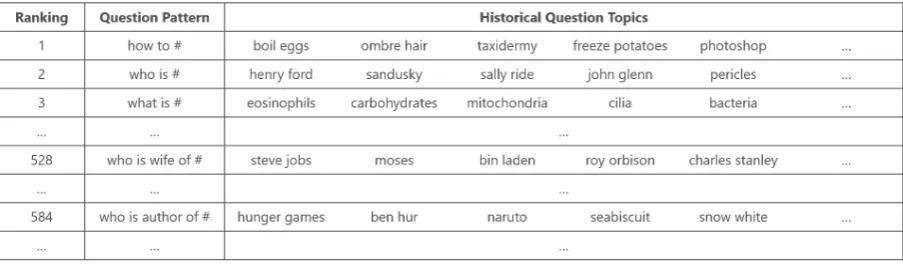
Although the question pattern mining approach described above is simple, it works surprisingly well. Table 1 shows statistics of question patterns mined from YahooAnswers, and Figure 1 gives ex-amples of frequently-asked question patterns with their corresponding historical question topics. We have two interesting observations:
1. Most frequently-asked question patterns (fre-quency>=10,000) are with high quality, and reflect the most common user intentions; 2. Most historical question topics extracted are
entities. This is achieved without using any prior semantic knowledge base or dictionary.
Figure 1: Examples of frequently-asked question patterns with corresponding historical question topics.
[image:3.595.73.525.63.195.2]# of QCs 67,330,506 # of QPs 20,818,569 # of QPs (freq.>=10,000) 105,623
Table 1: Statistics of question patterns mined from YahooAnswers, where QC denotes Question Clus-ter and QP denotes Question PatClus-tern.
4 Question Pattern Prediction
Given a passage S, question pattern prediction predicts S’s most related question patterns, and then use them to generate questions. For exam-ple, givenS as “Tesla Motors is an American au-tomaker and energy storage company co-founded by Elon Musk, Martin Eberhard, Marc Tarpen-ning, JB Straubel and Ian Wright, and is based in Palo Alto.”, two question patterns can be derived from S, including: (1) who founded # ?, which can be inferred by the context around “co-founded by”, and (2)where is#located ?, which can be in-ferred by the context around “is based in”. Based on these two question patterns, we can generate t-wo questions, “who founded Tesla Motors ?” and “where is Tesla Motors located ?” respectively.
4.1 Training Data Construction
We collect QA pairs from YahooAnswers. For each QA pair<Q, A >, if (1)Qcan be matched by a frequently-asked question patternQp, and (2)
the matched question topicQtofQ based onQp
exists in A, then we create a training instance as
< A,Qp,Qt>.Qt∈Amakes sure that the
ques-tion topic occurs in bothQandA. If the matched question topic only exists inQ, we just discard it. By doing so, we collect a total of 1,984,401 train-ing instances as traintrain-ing data for QP prediction.
Two neural network-based question pattern
pre-diction approaches are explored in this paper:
• Retrieval-based QP Prediction, which con-siders QP prediction as a ranking task;
• Generation-based QP Prediction, which con-siders QP prediction as a generation task.
4.2 Retrieval-based QP Prediction
The retrieval-based QP prediction is done based on an attention-based convolution neural network. It takes a passage and a question pattern as input, and outputs their corresponding vector representa-tions. We denote each input pair ashS,Qpi, where
Sis a passage, andQpis a question pattern. In the input layer, given an input pairhS,Qpi,
an attention matrix Att ∈ <|S|×|Qp| is
generat-ed by pre-traingenerat-ed word embgenerat-eddings ofS andQp,
where each elementAtti,j ∈ Att is computed as:
Atti,j =cosine(viS, vQp j )
wherevS
i (orvjQp) denotes the embedding vector
of theith(orjth) word inS(orQp).
Then, column-wise and row-wise max-pooling are applied toAtt to generate two attention vec-torsVS ∈ <|S|andVQp ∈ <|Qp|, where thekth
elements ofVSandVQpare computed as:
VS
k = max
1<l<|Qp|{Attk,l}and V Qp
k = max1<l<|S|{Attl,k}
VS
k (or VkQp) can be interpreted as theattention
scoreof thekth word inS (orQp) with regard to
all words inQp (orS).
Next, two attention distributions DS ∈ <|S|
and DQp ∈ <|Qp| are generated for S and Qp
based onVS andVQp respectively, where thekth
elements ofDSandDQp are computed as:
DS k = e
VS
k P|S|
l=1eV S
l and D SY
k = e VkQp P|Qp|
DSX
k (orDSkY) can be interpreted as the
normal-ized attention scoreof thekth word inS (orQp)
with regard to all words inQp(orS).
Last, we update each pre-trained word embed-ding vS
k (or vkQp) to ˆvSk (or vˆkQp), by multiplying
every value invS
k (orvkQp) withDSk (orDkQp). The
underlying intuition of updating pre-trained word embeddings is tore-weight the importance of each word inS(orQp) based onQp(orS), instead of
treating them in an equal manner.
In the convolution layer, we first derive an in-put matrixZS ={l1, ..., l|S|}, whereltis the
con-catenation of a sequence ofm = 2d−13
updat-ed word embupdat-eddings [ˆvS
t−d, ...,vˆtS, ...,vˆtS+d],
cen-tralized in the tth word in S. Then, the
convo-lution layer performs sliding window-based fea-ture extraction to project each vector representa-tionlt∈ZSto a contextual feature vectorhSt:
hSt =tanh(Wc·lt)
where Wc is the convolution matrix, tanh(x) =
1−e−2x
1+e−2x is the activation function. The same
oper-ation is performed toQpas well.
In the pooling layer, we aggregate local fea-tures extracted by the convolution layer from S, and form a sentence-level global feature vector with a fixed size independent of the length of the input sentence. Here,max-poolingis used to force the network to retain the most useful local features bylS
p = [v1S, ..., vKS], where:
viS = max
t=1,...,|S|{h S t(i)}
hS
t(i)denotes theithvalue in the vectorhSt. The
same operation are performed toQpas well. In the output layer, one more non-linear trans-formation is applied tolS
p:
y(S) =tanh(Ws·lpS)
Ws is the semantic projection matrix,y(S) is the
final sentence embedding of S. The same opera-tion is performed toQpto obtainy(Qp).
We train model parametersWcandWsby
min-imizing the following ranking loss function:
L= max{0, M −cosine(y(S), y(Qp))
+cosine(y(S), y(Q− p))}
whereM is a constant,Q−
p is a negative instance.
3In this paper,mis set to 3.
4.3 Generation-based QP Prediction
The generation-based QP prediction is done based on an sequence-to-sequence BiGRU (Bahdanau et al.,2015) that is commonly used in the neural machine translation field.
The encoder reads a word sequence of an input passageS = (x1, ..., x|S|), and the decoder
pre-dicts a word sequence of an output question pat-ternQp = (y1, ..., y|Qt|). The probability of
gen-erating a question patternQpis computed as:
p(Qp) = |QYp|
i=1
p(yi|y1, ..., yi−1, ci)
where each conditional probability is defined as:
p(yi|y1, ..., yi−1, ci) =g(yi−1, si, ci)
g(·) denotes a nonlinear function that outputs the probability of generatingyi.sidenotes the hidden state of timetin decoder, which is computed as:
si= (1−zi)◦si−1+zi◦˜si
where ˜
si= tanh(W Eyi−1 +U[ri◦si−1] +Cci)
zi =δ(WzEyi−1 +Uzsi−1+Czci)
ri=δ(WrEyi−1 +Ursi−1+Crci)
δ(·)is the sigmoid function,◦represents element-wise multiplication, Ew ∈ <m×1 denotes the word embedding of a word w, W, Wz, Wr ∈
<n×m, U, Uz, Ur ∈ <n×n, and C, Cz, Cr ∈
<n×2nare weights. ci denotes the context vector,
which is computed as:
ci= |S| X
j=1
αijhj
where
αij = P|S|exp(eij) k=1exp(eik)
eij =vaTtanh(Wasi−1+Uahj)
va ∈ <n 0
, Wa ∈ <n 0
×n, and U
a ∈ <n 0
×2n are
weights. hj denotes thejthhidden state from
For training, stochastic gradient descent (SGD) algorithm is used, and Adadelta (Zeiler, 2012) is used to adapt the learning rate of each parameter. Given a batch ofD={<S,Qp>}Mi=1pairs with sizeM instances, the objective function is to min-imize the negative log-likelihood:
L=−M1 X
<S,Qp> T X
t=1
log(p(yt|y<t,S))
For prediction, beam search is used to output the top-N question pattern predictions.
Retrieval-based approach can only find existing question patterns for each passage, but it makes sure that each question pattern comes from re-al questions and is in a good grammaticre-al form; Generation-based approach, on the other hand, can generate totally new question patterns beyond ex-isting question pattern set. We will compare both of them in the experimental part (Section 8). 5 Question Topic Selection
Given a passageSand a predicted question pattern
Qp, question topic selection selects an n-gram (or
a phrase)QtfromS, which can be then filled into
Qp to form a complete question. Since we have
two question pattern prediction methods, we have two ways to select the question topicQtas well.
For Qp from retrieval-based method, two
types of prior knowledge are used to extract ques-tion topic candidates fromS, including:
• Entities as question topic candidates, which are detected based on Freebase4entities;
• Noun phrases as question topic candidates, which are detected based on the Stanford parser (Klein and Manning,2003).
Once a question topic candidateQtis extracted
fromS, we then measure howQtcan fitQpby:
s(Qt,Qp) =N1 · X
k
#(Qtk
p )·dist(vQt, vQtkp )
s(Qt,Qp)denotes the confidence that Qt can be
filled into Qp to generate a reasonable question.
Qtk
p denotes the kth historical question topic of
Qp. #(Qtpk) denotes the number of times that
Qtk
p is extracted from different question clusters
to generateQp. vp denotes the question topic
em-bedding ofp, which is computed as the average of
4https://developers.google.com/freebase/
word embeddings inp. dist(·)denotes the cosine distance between two question topic embeddings.
N =Pk#(Qtk
p )denotes the total number of
his-torical question topics ofQp. The basic principle
of the above equation is that,the historical ques-tion topics of a given quesques-tion pattern can help on measuring how possible a question topic can-didate can be filled into this question pattern to form a reasonable question. For example, as most historical question topics of “who founded # ?” are organization names, then it is very unlikely a date or a film name is suitable for this question pattern to generate a reasonable question.
For Qp from generation-based method,
sup-pose the placeholder # is theithword inQp, then
we select the jth word w
j ∈ S as the question
topic, which satisfies the following constraint:
wj = arg max
wj0∈Sαij0 = arg maxwj0∈S
exp(eij0) P|S|
k=1exp(eik)
This question topic selection strategy leverages the attention scores between S and Qp, and can be
considered as aCOPYmechanism. 6 Question Ranking
Given a predicted question pattern Qp and a
se-lected question topicQtof an input passageS, a
complete questionQcan be simply generated by replacing#inQp with Qt. We use a set of
fea-tures to rank generated question candidates:
• question pattern prediction score, which is the prediction score by either retrieval-based approach or generation-based approach;
• question topic selection score, for retrieval-based approach, this score is computed as
s(Qt,Qp), while for generation-based
ap-proach, this score is the attention score;
• QA matching score, which measures rele-vance between generated questionQandS.
• word overlap betweenQandS, which counts number of words that co-occur inQandS;
• question pattern frequency, which equals to the extraction frequency ofQp, ifQis
gener-ated from or matched byQp, and0otherwise.
All features are combined by a linear model as:
p(Q|S) =X
i
wherehi(Q,S,Qp,Qt)is one of the features
de-scribed above, andλiis the corresponding weight.
7 Question Generation for QA
This section describes how question generation can improve existing QA systems. There are sev-eral types of QA systems, i.e. knowledge-based QA, community-based QA, text-based QA, etc, and in this paper, we focus on text-based QA task (a.k.a. answer sentence selection), which aims to select one or multiple answer sentences from a tex-t given an inputex-t questex-tion. We selectex-t tex-this tex-task as itex-t can be considered as a dual task of QG.
A typical answer sentence selection method, such as (Yin et al.,2016;Santos et al.,2016;Miller et al.,2016;Tymoshenko et al., 2016), computes the relevance score between input questionQand each answer candidateA, and selects the one with the highest relevance score as the final answer:
b
A= arg max
A P(A|Q)
Motivated by Dual Learning (He et al.,2016), we integrate question generation into answer rank-ing procedure, by changrank-ing the above formula to:
b
A= arg max
A {P(A|Q) +λ·QQ(Q,Q gen max)} λ is hyper-parameter, and in order to com-puteQQ(Q,Qgen
max), we generate top-10 questions
{Qgen1 , ...,Qgen10 }for current answer candidateA, and then compute thequestion-to-generated ques-tionmatching scoreQQ(Q,Qgen
max), by computing
the similarity between input questionQ and gen-erated questions{Qgen1 , ...,Qgen10 }as:
QQ(Q,Qgen
max) = arg maxi=1,...,10sim(Q,Qgeni )·p(Qgeni )
sim(Q,Qgeni )is the similarity between the input question Q and the ith generated questionQgen
i ,
and computed as the cosine distance between av-eraged word embedding ofQ and averaged word embedding ofQgeni ,p(Qgeni )denotes the posterior probability that is computed based on the genera-tion score of each generated quesgenera-tion:
p(Qgeni ) = P p(Qgeni |A)
10
i0=1p(Qgeni0 |A)
p(Qgeni |A) is output by the question generation model described in Section 6. The underlying motivation is that, the questions generated from correct answers are more likely to be similar to labeled questions than questions generated from wrong answers.
8 Related Work
Yao et al.(2012) proposed a semantic-based ques-tion generaques-tion approach, which first parses the in-put sentence into its corresponding Minimal Re-cursion Semantics (MRS) representation, and then generates a question guided by the English Re-source Grammar that includes a large scale hand-crafted lexicon and grammar rules.
Labutov et al. (2015) proposed an ’ontology-crowd-relevance’ method for question genera-tion. First, Freebase types and Wikipedia session names are used as semantic tags to understand texts. Question are then generated based on ques-tion templates that are aligned with types/session names and labeled by crowdsourcing. All gener-ated questions are ranked by a relevance model.
Chali and Hasan (2015) proposed a topic-to-question method, which uses about 350 general-purpose rules to transform the semantic-role la-beled sentences into corresponding questions.
Serban et al. (2016) used the encoder-decoder framework to generate 30M QA pairs, but their in-puts are knowledge triples, instead of passages.
Song and Zhao(2016) proposed a question gen-eration method using question template seeds and used search engine to do question expansion.
Du et al. (2017) proposed a neural question generation method using a vanilla sequence-to-sequence RNN model, which is most-related to our work. But this method is still based on labeled dataset, and tried RNN only.
Comparing to all these related work mentioned above, our question generation approach has two uniqueness: (1) all question patterns, that are used as training data for question generation, are auto-matically extracted from a large scale CQA ques-tion set without any crowdsourcing effort. Such question patterns reflect the most common user in-tentions, and therefore are useful to search, QA, and chatbot engines; (2) it is also the first time question generation is integrated and evaluated in an end-to-end QA task directly, and shows signifi-cant improvements.
9 Experiment
9.1 Dataset
As described in Section 4.1, we collect1,984,401
< A,Qp,Qt > pairs from YahooAnswers, and
test sets of SQuAD, MS MARCO, and WikiQA, to evaluate the quality of generated questions. The dataset statistics are in Table 2.
[image:7.595.89.274.112.229.2]# of QA Pairs training set 1,984,401 dev set (SQuAD) 26,442 test set (SQuAD) 26,604 dev set (MS MARCO) 39,510 test set (MS MARCO) 42,850 dev set (WikiQA) 2,733 test set (WikiQA) 6,165
Table 2: Dataset Statistics.
Besides, an answer sentence selection model (Yin et al.,2016) is trained based on the 1,984,401 QA pairs from the training set as well, and used to compute the QA matching score for question rank-ing, as we described in Section 6. Feature weights for question ranking are optimized on dev set.
9.2 Evaluation on Question Generation
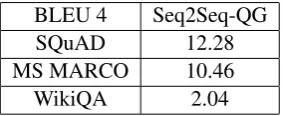
[image:7.595.111.253.439.497.2]We first perform a vanilla sequence-to-sequence method (Du et al.,2017) using the original training sets of these three datasets, and show QG results in Table 3, where BLEU 4 score is used as the metric.
BLEU 4 Seq2Seq-QG
SQuAD 12.28
MS MARCO 10.46
WikiQA 2.04
Table 3: QG results using original training sets.
We then evaluate the quality of the generated questions based on auto-extracted training set. For each passage in the test set, we generate two top-1 questions based on retrieval-based method and generation-based method respectively, and then compare them with labeled questions usingBLEU 4as the metric. Results are listed in Table 4.
BLEU 4 R-QG G-QG
[image:7.595.82.279.640.699.2]SQuAD (crawled) 9.87 12.39 MS MARCO (crawled) 9.86 11.46 WikiQA (crawled) 11.38 13.57
Table 4: QG results using auto-extracted training set, where R-QGdenotes results from Retrieval-based QG method, G-QG denotes results from Generation-based QG method.
From Table 3 and 4 we can see two findings: (1) Comparing to QG results based on original la-beled training sets, G-QG achieves comparable or better results. We think this is due to two fact-s: first, the size of the automatically constructed training set is much larger than the labeled train-ing sets, and second, as the QA pairs from CQA websites are generated by real users, the quality is good. (2) Generation-based QG performs bet-ter than Retrieval-based QG. By analyzing outputs we find that, for question pattern prediction, both retrieval-based and generation-based methods per-form similarly. However, Generation-based QG performs better than Retrieval-based QG on ques-tion topic selecques-tion. This could be caused by the fact that, in Generation-based QG, question top-ic selection is based on the attention mechanis-m, which is optimized together with question pat-tern prediction in an end-to-end way; while in Retrieval-based QG, question topic selection is a separate task, and based on the similarity between each question topic candidate and historical ques-tion topics of a given quesques-tion pattern. The embed-ding of each question topic is pre-trained, which is not directly related to the question generation task. So such method cannot handle unseen ques-tion topics very well. Another disadvantage of Retrieval-based QG is that, each time, we have to compute the similarity between the input passage and each question pattern. When question pattern size is large, the computation is very expensive.
In order to better understand the question gener-ation quality, we manually check a set of sampled outputs, and list the main errors in Figure 2:
• Multi-Fact Error (40%). Most input pas-sages include more than one fact. For such a question, it is reasonable to generate different questions from different aspects, all of which can be answered by the input passage. For each passage in QAGen, we only label one question as ground truth. In the future, we will extend QAGen to be a more comprehen-sive dataset, by labeling multiple questions to each passage for more reasonable evaluation;
• Paraphrase Error(30%). The same question can be expressed by different ways. Labeling more paraphrased questions for a passage can alleviate this issue as well;
total-Figure 2: List of error analysis examples. [P]denotes a passage,[Ref]denotes the labeled question of the passage, and[Gen]denotes the generated question of the passage.
ly wrong question topic, or a partially right question topic. In the future, we plan to de-velop an independent question topic selection model for the question generation task.
9.3 Evaluation on QA
As described in Section 7, we combine question generation into QA system for answer sentence s-election task, and do evaluation on SQuAD, M-S MARCO, and WikiQA. Evaluation results are shown in Table 5, 6, and 7, where QA denotes the result of our in-house implementation of a retrieval-based answer selection approach (Doc-Chat) proposed by (Yan et al.,2016),QA+QG de-notes result by combining question-to-generated question matching score with DocChat score.
SQuAD MAP MRR ACC@1
QA 0.8843 0.8915 0.8160 QA+QG 0.8887 0.8963 0.8232
Table 5: Impact of QG on SQuAD.
MS MARCO MAP MRR ACC@1
QA 0.5131 0.5195 0.3029 QA+QG 0.5230 0.5291 0.3153 Table 6: Impact of QG on MS MARCO.
The improvement on MS MARCO dataset is most significant. We think it due to the fact that, the questions from MS MARCO dataset are from Bing search log, which are generated naturally by real users. This is similar to the questions coming
WikiQA MAP MRR ACC@1
QA 0.7703 0.7851 0.6540 QA+QG 0.7742 0.7893 0.6624
Table 7: Impact of QG on WikiQA.
for CQA websites; while questions from the other datasets are labeled by crowd-sourcing.
In order to explain these improvements, two datasets, WikiQG+ and WikiQG-, are built from WikiQA test set: given each document and its la-beled question, we pair the question with its COR-RECT answer sentence as a QA pair and add it to WikiQG+; we also pair the same question with a randomly selected WRONG answer sentence as a QA pair and add it to WikiQG-. Then, we generate questions for passages in WikiQG+ and WikiQG-respectively, and compare them with labeled ques-tions. The BLEU 4 score is 0.2031 on Wik-iQG+, and 0.1301 on WikiQG-, which indicates that the questions generated from correct answers are more likely to be similar to labeled questions than questions generated from wrong answers.
10 Conslusion
[image:8.595.71.526.63.237.2]References
Dzmitry Bahdanau, Kyunghyun Cho, and Yoshua Ben-gio. 2015. Neural machine translation by jointly learning to align and translate. InICLR.
Jonathan Berant, Andrew Chou, Roy Frostig, and Per-cy Liang. 2013. Semantic parsing on freebase from question-answer pairs. InEMNLP.
Jonathan Berant and Percy Liang. 2014. Semantic parsing via paraphrasing. InACL.
Antoine Bordes, Nicolas Usunier, Sumit Chopra, and Jason Weston. 2015. Large-scale simple question answering with memory networks. InarXiv. Yllias Chali and Sadid Hasan. 2015. Towards
topic-to-question generation. InCL.
Xinya Du, Junru Shao, and Claire Cardie. 2017. Learn-ing to ask: Neural question generation for readLearn-ing comprehension. In Association for Computational Linguistics (ACL).
Di He, Yingce Xia, Tao Qin, Liwei Wang, Nenghai Yu, Tie-Yan Liu, and Wei-Ying Ma. 2016. Dual learning for machine translation. InNIPS.
Dan Klein and Christopher D. Manning. 2003. Accu-rate unlexicalized parsing. InACL.
Igor Labutov, Sumit Basu, and Lucy Vanderwende. 2015. Deep questions without deep understanding. InACL.
Alexander Miller, Adam Fisch, Jesse Dodge, Amir-Hossein Karimi, Antoine Bordes, and Jason West-on. 2016. Key-value memory networks for directly reading documents. InEMNLP.
Tri Nguyen, Mir Rosenberg, Xia Song, Jiangfeng Gao, Saurabh Tiwary, Rangan Majumder, and Li Deng. 2016. Ms marco: A human generated machine read-ing comprehension dataset. InNIPS.
Kishore Papineni, Salim Roukos, Todd Ward, and Wei-Jing Zhu. 2002. Bleu: a method for automatic eval-uation of machine translation. InACL.
Xipeng Qiu and Xuanjing Huang. 2015. Convolution-al neurConvolution-al tensor network architecture for community based question answering. InIJCAI.
Pranav Rajpurkar, Jian Zhang, Konstantin Lopyrev, and Percy Liang. 2016. Squad: 100,000+ questions for machine comprehension of text. InEMNLP. Cicero dos Santos, Ming Tan, Bing Xiang, and Bowen
Zhou. 2016. Attentive pooling networks. InarXiv. Iulian Vlad Serban, Alberto Garca-Durn, Caglar
Gulcehre, Sungjin Ahn, Sarath Chandar, Aaron Courville, and Yoshua Bengio. 2016. Generat-ing factoid questionswith recurrent neural networks: The 30m factoid question-answer corpus. InACL.
Linfeng Song and Lin Zhao. 2016. Domain-specific question generation from a knowledge base. In arX-iv.
Kateryna Tymoshenko, Daniele Bonadiman, and A-lessandro Moschitt. 2016. Convolutional neural net-works vs. convolution kernels: Feature engineering for answer sentence reranking. InNAACL.
Caiming Xiong, Victor Zhong, and Richard Socher. 2017. Dynamic coattention networks for question answering. InICLR.
Zhao Yan, Nan Duan, Junwei Bao, Peng Chen, Ming Zhou, Zhoujun Li, and Jianshe Zhou. 2016. Doc-chat: An information retrieval approach for chatbot engines using unstructured documents. InACL. Yi Yang, Wen-tau Yih, and Christopher Meek. 2015.
Wikiqa: A challenge dataset for open-domain ques-tion answering. InEMNLP.
Xuchen Yao, Gosse Bouma, and Yi Zhang. 2012. Semantics-based question generation and imple-mentation. InDialogue and Discourse.
Wenpeng Yin and Hinrich Schtze. 2017. Task-specific attentive pooling of phrase alignments contributes to sentence matching. InEACL.
Wenpeng Yin, Hinrich Schtze, Bing Xiang, and Bowen Zhou. 2016. Abcnn: Attention-based convolution-al neurconvolution-al network for modeling sentence pairs. In TACL.
Lei Yu, Karl Morizt Hermann, Phil Blunsom, and Stephen Pulman. 2014. Deep learning for answer sentence selection. InNIPS Workshop.
![Figure 2: List of error analysis examples. [P] denotes a passage, [Ref] denotes the labeled question ofthe passage, and [Gen] denotes the generated question of the passage.](https://thumb-us.123doks.com/thumbv2/123dok_us/1353606.667622/8.595.71.526.63.237/figure-analysis-examples-question-denotes-generated-question-passage.webp)