PATTY: A Taxonomy of Relational Patterns with Semantic Types
Ndapandula Nakashole, Gerhard Weikum, Fabian Suchanek Max Planck Institute for Informatics
Saarbr¨ucken, Germany
{nnakasho,weikum,suchanek}@mpi-inf.mpg.de
Abstract
This paper presents PATTY: a large resource for textual patterns that denote binary relations between entities. The patterns are semanti-cally typed and organized into a subsumption taxonomy. The PATTY system is based on ef-ficient algorithms for frequent itemset mining and can process Web-scale corpora. It har-nesses the rich type system and entity popu-lation of large knowledge bases. The PATTY taxonomy comprises 350,569 pattern synsets. Random-sampling-based evaluation shows a pattern accuracy of 84.7%. PATTY has 8,162 subsumptions, with a random-sampling-based precision of 75%. The PATTY resource is freely available for interactive access and download.
1 Introduction
Motivation.WordNet (Fellbaum 1998) is one of the most widely used lexical resources in computer sci-ence. It groups nouns, verbs, and adjectives into sets of synonyms, and arranges these synonyms in a tax-onomy of hypernyms. WordNet is limited to single words. It does not contain entirephrases or pat-terns. For example, WordNet does not contain the pattern X is romantically involved with Y. Just like words, patterns can be synonymous, and they can subsume each other. The pattern X is romantically involved with Yis synonymous with the patternX is dating Y. Both are subsumed byX knows Y. Patterns for relations are a vital ingredient for many appli-cations, including information extraction and ques-tion answering. If a large-scale resource of relaques-tional patterns were available, this could boost progress in NLP and AI tasks.
Yet, existing large-scale knowledge bases are mostly limited to abstract binary relationships be-tween entities, such as “bornIn” (Auer 2007; Bol-lacker 2008; Nastase 2010; Suchanek 2007). These do not correspond to real text phrases. Only the Re-Verb system (Fader 2011) yields a larger number of relational textual patterns. However, no attempt is made to organize these patterns into synonymous patterns, let alone into a taxonomy. Thus, the pat-terns themselves do not exhibit semantics.
Goal. Our goal in this paper is to systematically compile relational patterns from a corpus, and to im-pose a semantically typed structure on them. The result we aim at is a WordNet-style taxonomy of binary relations. In particular, we aim at patterns that contain semantic types, such ashsingeri sings
hsongi. We also want to automatically generalize syntactic variations such as sings her hsongi and sings his hsongi, into a more general patternsings [prp] hsongi with POS tag [prp]. Analogously but more demandingly, we want to automatically infer that the above patterns are semantically subsumed by the pattern hmusiciani performs on hmusical compositioniwith more general types for the entity arguments in the pattern.
Compiling and organizing such patterns is chal-lenging for the following reasons. 1) The number of possible patterns increases exponentially with the length of the patterns. For example, the string “Amy sings ‘Rehab”’ can give rise to the patternshsingeri
sings hsongi, hpersoni sings hartifacti, hpersoni
[vbz]hentityi, etc. If wildcards for multiple words are allowed (such as inhpersonisings *hsongi), the number of possible patterns explodes. 2) A pattern
can be semantically more general than another pat-tern (when one relation is implied by the other re-lation), and it can also be syntactically more gen-eral than another pattern (by the use of placehold-ers such as [vbz]). These two subsumption ordplacehold-ers have a non-obvious interplay, and none can be ana-lyzed without the other. 3) We have to handle pattern sparseness and coincidental matches. If the corpus is small, e.g., the patternshsingerilater disliked her songhsongiandhsingerisanghsongi, may apply to the same set of entity pairs in the corpus. Still, the patterns are not synonymous. 4) Computing mutual subsumptions on a large set of patterns may be pro-hibitively slow. Moreover, due to noise and vague semantics, patterns may even not form a crisp tax-onomy, but require a hierarchy in which subsump-tion relasubsump-tions have to be weighted by statistical con-fidence measures.
Contributions. In this paper, we present PATTY, a large resource of relational patterns that are arranged in a semantically meaningful taxonomy, along with entity-pair instances. More precisely, our contribu-tions are as follows:
1) SOL patterns: We define an expressive fam-ily of relational patterns, which combines syntac-tic features (S), ontological type signatures (O), and lexical features (L). The crucial novelty is the addi-tion of the ontological, semantic dimension to pat-terns. When compared to a state-of-the-art pattern language, we found that SOL patterns yield higher recall while achieving similar precision.
2) Mining algorithms: We present efficient and scalable algorithms that can infer SOL patterns and subsumptions at scale, based on instance-level over-laps and an ontological type hierarchy.
3) A large Lexical resource:. On the Wikipe-dia corpus, we obtained 350,569 pattern synsets
with 84.7% precision. We make our
pat-tern taxonomy available for further research at
www.mpi-inf.mpg.de/yago-naga/patty/. The paper is structured as follows. Section 2 dis-cusses related work. Section 3 outlines the basic machinery for pattern extraction. Section 4 intro-duces our SOL pattern model. Sections 5 and 6 present the syntactic and semantic generalization of patterns. Section 7 explains how to arrange the
pat-terns into a taxonomy. Section 8 reports our experi-mental findings.
2 Related Work
A wealth of taxonomic knowledge bases (KBs) about entities and their semantic classes have be-come available. These are very rich in terms of unary predicates (semantic classes) and their entity instances. However, the number ofbinary relations (i.e., relation types, not instances) in these KBs is usually small: Freebase (Bollacker 2008) has a few thousand hand-crafted relations. WikiNet (Nastase 2010) has automatically extracted ca. 500 relations from Wikipedia category names. DBpedia (Auer 2007) has automatically compiled ca. 8000 names of properties from Wikipedia infoboxes, but these include many involuntary semantic duplicates such assurname and lastname. In all of these projects, the resource contains therelation names, but not the natural language patternsfor them. The same is true for other projects along these lines (Navigli 2010; Philpot 2008; Ponzetto 2007; Suchanek 2007).
In contrast, knowledge base projects that auto-matically populate relations from Web pages also learn surface patterns for the relations: examples are TextRunner/ReVerb (Banko 2007; Fader 2011), NELL (Carlson 2010; Mohamed11), Probase (Wu 2011), the dynamic lexicon approach by (Hoffmann 2010; Wu 2008), the LDA-style clustering approach by (Yao 2011), and projects on Web tables (Li-maye 2010; Venetis 2011). Of these, only TextRun-ner/ReVerb and NELL have made large pattern col-lections publicly available.
ReVerb(Fader 2011) constrains patterns to verbs or verb phrases that end with prepositions, while PATTY can learn arbitrary patterns. More impor-tantly, all methods in the TextRunner/ReVerb family are blind to the ontological dimension of the enti-ties in the patterns. Therefore, there is no notion of semantic typing for relation phrases as in PATTY.
InOntExt (Mohamed11), the NELL architecture was extended to automatically compute new re-lation types (beyond the prespecified ones) for a given type signature of arguments, based on a clus-tering technique. For example, the relation mu-sicianPlaysInstrument is found by clustering pat-tern co-occurrences for the noun-phrase pairs that fall into the specific type signature hmusiciani × hmusicinstrumenti. This technique works for one type signature at a time, and does not scale up to mining a large corpus. Also, the technique is not suitable for inferring semantic subsumptions. In contrast, PATTY efficiently acquires patterns from large-scale corpora and organizes them into a sub-sumption hierarchy.
Class-based attribute discovery is a special case of mining relational patterns (e.g., (Alfonseca 2010; Pasca 2007; Pasca 2008; Reisinger 2009)). Given a semantic class, such asmoviesormusicians, the task is to determine relevant attributes, such ascast and budgetfor movies, oralbumsandbiographyfor mu-sicians, along with their instances. Unlike PATTY’s patterns, the attributes are not typed. They come with a prespecified type for the domain, but without any type for the range of the underlying relation.
There are further relation-centric tasks in NLP and text mining that have commonalities with our endeavor, but differ in fundamental ways. The SemEval-2010 task on classification of semantic re-lations between noun-phrase pairs (Hendrickx 2010) aimed at predicting the relation for a given sentence and pair of nominals, but used a fixed set of prespec-ified relations. Another task in this research avenue is to characterize and predict the argument types for a given relation or pattern (Kozareva 2010; Nakov 2008). This is closer to KB population and less re-lated to our task of discovering relational patterns and systematically organizing them.
From a linguistic perspective, there is ample work on patterns for unary predicates of the form class(entity). This includes work on entailment of classes, i.e., on is-a and subclassOf relationships. Entailment among binary predicates of the form re-lation(entity1, entity2) has received less attention (Lin 2001; Chklovski 2004; Hashimoto 2009; Be-rant 2011). These works focus solely on verbs, while
PATTY learns arbitrary phrases for patterns.
Several lexical resources capture verb categories and entailment: WordNet 3.0 (Fellbaum 1998) con-tains about 13,000 verb senses, with troponymy and entailment relations; VerbNet (Kipper 2008) is a hi-erarchical lexicon with more than 5,000 verb senses in ca. 300 classes, including selectional preferences. Again, all of these resources focus solely on verbs.
ConceptNet 5.0 (Havasi 2007) is a thesaurus of commonsense knowledge built as a crowdsourcing endeavor. PATTY, in contrast, is constructed fully automatically from large corpora. Automatic learn-ing of paraphrases and textual entailment has re-ceived much attention (see the survey of (Androut-sopoulos 2010)), but does not consider fine-grained typing for binary relations, as PATTY does.
3 Pattern Extraction
This section explains how we obtain basic textual patterns from the input corpus. We first apply the Stanford Parser (Marneffe 2006) to the individual sentences of the corpus to obtain dependency paths. The dependency paths form a directed graph, with words being nodes and dependencies being edges. For example, the sentence“Winehouse effortlessly performed her song Rehab.”yields the following de-pendency paths:
nsubj(performed-3, Winehouse-1) advmod(performed-3, effortlessly-2) poss(Rehab-6, her-4)
nn(Rehab-6, song-5) dobj(performed-3, Rehab-6)
While our method also works with patterns obtained from shallow features such as POS tags, we found that dependency paths improve pattern extraction precision especially on long sentences.
use a simple context-similarity prior, as described in (Suchanek 2009). We empirically found that this technique has accuracy well above 80% (and higher for prominent and thus frequently occurring enti-ties). In our example, the entity detection yields the entitiesAmy WinehouseandRehab (song).
Whenever two named entities appear in the same sentence, we extract a textual pattern. For this pur-pose, we traverse the dependency graph to get the shortest path that connects the two entities. In the example, the shortest path between “Winehouse” and “Rehab” is: Winehouse nsubj performed dobj Rehab. In order to capture only relations that refer to subject-relation-object triples, we only consider shortest paths that start with subject-like dependen-cies, such as nsubj, rcmod and partmod. To re-flect the full meaning of the patterns, we expand the shortest path with adverbial and adjectival modifiers, for example theadvmoddependency. The sequence of words on the expanded shortest path becomes our final textual pattern. In the example, the textual pat-tern isAmy Winehouse effortlessly performed Rehab (song).
4 SOL Pattern Model
Textual patterns are tied to the particular surface form of the text. Therefore, we transform the textual patterns into a new type of patterns, called syntactic-ontologic-lexical patterns (SOL patterns). SOL pat-terns extend lexico-syntactic patpat-terns by ontological type signatures for entities. The SOL pattern lan-guage is expressive enough to capture fine-grained relational patterns, yet simple enough to be dealt with by efficient mining algorithms at Web scale.
A SOL pattern is an abstraction of a textual pat-tern that connects two entities of interest. It is a sequence of words, POS-tags, wildcards, and onto-logical types. A POS-tag stands for a word of the part-of-speech class. We introduce the special POS-tag [word], which stands for any word of any POS class. A wildcard, denoted ∗, stands for any (pos-sibly empty) sequence of words. Wildcards are es-sential to avoid overfitting of patterns to the corpus. An ontological type is a semantic class name (such ashsingeri) that stands for an instance of that class. Every pattern contains at least two types, and these
are designated asentity placeholders.
A string and a patternmatch, if there is an order-preserving bijection from sequences of words in the string to items in the pattern, so that each item can stand for the respective sequence of words. For ex-ample, the pattern hpersoni’s [adj] voice * hsongi
matches the strings “Amy Winehouse’s soft voice in ‘Rehab”’ and “Elvis Presley’s solid voice in his song ‘All shook up”’. Thetype signatureof a pat-tern is the pair of the entity placeholders. In the ex-ample, the type signature is person×song. The support setof a pattern is the set of pairs of entities that appear in the place of the entity placeholders in all strings in the corpus that match the pattern. In the example, the support set of the pattern could be {(Amy, Rehab),(Elvis, AllShookU p)}. Each pair is called asupport pairof the pattern.
PatternB issyntactically more generalthan pat-tern Aif every string that matches A also matches
B. Pattern B is semantically more generalthan A
if the support set of B is a superset of the support set ofA. IfAis semantically more general than B
andBis semantically more general thanA, the pat-terns are calledsynonymous. A set of synonymous patterns is called apattern synset. Two patterns, of which neither is semantically more general than the other, are calledsemantically different.
To generate SOL patterns from the textual pat-terns, we decompose the textual patterns into n-grams (n consecutive words). A SOL pattern con-tains only the n-grams that appear frequently in the corpus and the remaining word sequences are re-placed by wildcards. For example, in the sentence “was the first female to run for the governor of” might give rise to the pattern* the first female * gov-ernor of, if “the first female” and “govgov-ernor of” are frequent in the corpus.
To find the frequent n-grams efficiently, we apply the technique of frequent itemset mining (Agrawal 1993; Srikant 1996): each sentence is viewed as a “shopping transaction” with a “purchase” of several grams, and the mining algorithm computes the n-gram combinations with large co-occurrence sup-port1. These n-grams allow us to break down a
tence into wildcard-separated subsequences, which yields an SOL pattern. We generate multiple pat-terns with different types, one for each combination of types that the detected entities have in the under-lying ontology.
We quantify thestatistical strengthof a pattern by means of its support set. For a given patternpwith type signaturet1 ×t2, thesupport ofp is the size of its support set. For confidence, we compare the support-set sizes ofpand an untyped variantpu of
p, in which the types ht1i andht2i are replaced by the generic typehentityi. We define theconfidence ofpas the ratio of the support-set sizes ofpandpu.
5 Syntactic Pattern Generalization
Almost every pattern can be generalized into a syn-tactically more general pattern in several ways: by replacing words by POS-tags, by introducing wild-cards (combining more n-grams), or by generaliz-ing the types in the pattern. It is not obvious which generalizations will be reasonable and useful. We observe, however, that generalizing a pattern may create a pattern that subsumes two semantically dif-ferent patterns. For example, the generalization
hpersoni [vb]hpersoni subsumes the two semanti-cally different patternshpersoniloves hpersoni and
hpersonihateshpersoni. This means that the pattern is semantically meaningless.
Therefore, we proceed as follows. For every pat-tern, we generate all possible generalizations. If a generalization subsumes multiple patterns with dis-joint support sets, we abandon the generalized pat-tern. Otherwise, we add it to our set of patterns.
6 Semantic Pattern Generalization
The main difficulty in generating semantic subsump-tions is that the support sets may contain spurious pairs or be incomplete, thus destroying crisp set in-clusions. To overcome this problem, we designed a notion of asoft set inclusion, in which one setS
can be a subset of another setBto a certain degree. One possible measure for this degree is the confi-dence, i.e., the ratio of elements inS that are inB,
deg(S ⊆B) = |S∩B|/|S|. However, if a support setS has only few elements due to sparsity, it may become a subset of another support setB, even if the
two patterns are semantically different. Therefore, one has to take into account also thesupport, i.e., the size of the setS. Traditionally, this is done through a weighted trade-off between confidence and support. To avoid the weight tuning, we instead devised a probabilistic model. We interpretS as arandom samplefrom the “true” support setS0that the pattern would have on an infinitely large corpus. We want to estimate the ratio of elements of S0 that are in
B. This ratio is a Bernoulli parameter that can be estimated from the ratio of elements of the sampleS
that are inB. We compute the Wilson score interval [c−d, c+d] (Brown 2001) for the sample. This interval guarantees that with a given probability (set a priori, usually toα= 95%), the true ratio falls into the interval[c−d, c+d]. If the sample is small,d
is large andcis close to0.5. If the sample is large,
ddecreases and c approaches the naive estimation
|S ∩B|/|S|. Thereby, the Wilson interval center naturally balances the trade-off between confidence and the support. Hence we definedeg(S ⊂B) =c. This estimator may degrade when the sample size is too small We can alternatively use a conservative estimatordeg(S ⊂B) =c−d, i.e., the lower bound of the Wilson score interval. This gives a low score to the case whereS ⊂Bif we have few samples (S is small).
7 Taxonomy Construction
We now have to arrange the patterns in a semantic taxonomy. A baseline solution would compare ev-ery pattern support set to evev-ery other pattern support set in order to determine inclusion, mutual inclusion, or independence. This would be prohibitively slow. For this reason, we make use of a prefix-tree for fre-quent patterns (Han 2005). The prefix-tree stores support sets of patterns. We then developed an algo-rithm for obtaining set intersections from the prefix-tree.
7.1 Prefix-Tree Construction
ID Pattern Synset & Support Sets P1 hP oliticianiwas governor of hStatei
A,80 B,75 C,70
P2 hP oliticianipolitician from hStatei
A,80 B,75 C,70 D,66 E,64
P3 hP ersonidaughter of hP ersoni
F,78 G,75 H,66
P4 hP ersonichild of hP ersoni
[image:6.612.82.293.52.197.2]I,88 J,87 F,78 G,75 K,64
Table 1: Pattern Synsets and their Support Sets
Root
A p1,p2
B
C
D p1,p2
p1,p2
p2
E p2
F
G
H
p3 I
J
F p4
G p4
K p4 p4
p4 p3
[image:6.612.88.280.239.379.2]p3
Figure 1: Prefix-Tree for the Synsets in Table 1.
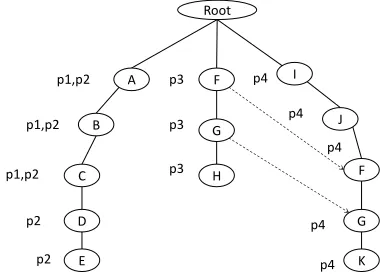
pairArnold Schwarzenegger, California, with an oc-currence frequency80. The contents of the support sets are used to construct a prefix-tree, where nodes are entity pairs. If synsets have entity pairs in com-mon, they share a common prefix; thus the shared parts can be represented by one prefix-path in the tree. This enables subsumptions to be directly “read off” from the tree, while representing the tree in a compact manner. To increase the chance of shared prefixes, entity pairs are inserted into the tree in de-creasing order of occurrence frequency.
The prefix-tree of support sets is a prefix-tree aug-mented with synset information stored at the nodes. Each node (entity pair) stores the identifiers of the pattern sysnets whose support sets contain that en-tity pair. In addition, each node stores a link to the next node with the same entity pair.
Figure 1 shows the tree for the pattern synsets in Table 1. The left-most path contains synsets P1 andP2. The two patterns have a prefix in common,
thus they share the same path. This is reflected by the synsets stored in the nodes in the path. Synsets
P2 andP3 belong to two different paths due to dis-similar prefixes although they have common nodes. Instead, their common nodes are connected by the same-entity-pair links shown as dotted lines in Fig-ure 1. These links are created whenever the entity pair already exists in the tree but with a prefix differ-ent from the prefix of the synset being added to the tree. The size of the tree is at most the total num-ber of entity pairs making up the supports sets of the synsets. The height of the tree is at most the size of the the largest support set.
7.2 Mining Subsumptions from the Prefix-Tree
To efficiently mine subsumptions from the prefix-tree, we have to avoid comparing every path to every other path as this introduces the same inefficiencies that the baseline approach suffers from.
From the construction of the tree it follows that for any nodeNiin the tree, all paths containing Ni
can be found by following nodeNi’s links
includ-ing the same-entity-pair links. By traversinclud-ing the en-tire path of a synsetPi, we can reach all the pattern
synsets sharing common nodes withPi. This leads
to our main insight: if we start traversing the tree bottom up, starting at the last node in Pi0ssupport set, we can determine exactly which paths are sub-sumed by Pi. Traversing the tree this way for all
patterns gives us the sizes of the support set intersec-tion. The determined intersection sizes can then be used in the Wilson estimator to determine the degree of semantic subsumption and semantic equivalence of patterns.
7.3 DAG Construction
removing cycles and eliminating redundancy in the subsumptions, thus effectively constructing a DAG. Starting with a list of subsumption edges ordered by decreasing weights, we construct the DAG bottom-up by adding the highest-weight subsumption edge. This step is repeated for all subsumptions, where we add a subsumption to the DAG only if it does not introduce cycles or redundancy. Redundancy occurs when there already exists a path, by transitivity of subsumptions, between pattern synsets linked by the subsumption. This process finally yields a DAG of pattern synsets – the PATTY taxonony.
8 Experimental Evaluation
8.1 Setup
The PATTY extraction and mining algorithms were run on two different input corpora: the New York Times archive (NYT) which includes about 1.8 Mil-lion newspaper articles from the years 1987 to 2007, and the English edition of Wikipedia (WKP), which contains about 3.8 Million articles (as of June 21, 2011). Experiments were carried out, for each cor-pus, with two different type systems: a) the type sys-tem of YAGO2, which consists of about 350,000 se-mantic classes from WordNet and the Wikipedia cat-egory system, and b) the two-level domain/type hier-archy of Freebase which consists of 85 domains and a total of about 2000 types within these domains.
All relational patterns and their respective entity pairs are stored in a MongoDB database. We evalu-ated PATTY along four dimensions: quality of pat-terns, quality of subsumptions, coverage, and de-sign alternatives. These dimensions are discussed in the following four subsections. We also per-formed an extrinsic study to demonstrate the use-fulness of PATTY for paraphrasing the relations of DBpedia and YAGO2. In terms of runtimes, he most expensive part is the pattern extraction, where we identify pattern candidates through de-pendency parsing and perform entity recognition on the entire corpus. This phase runs about a day for Wikipedia a cluster. All other phases of the PATTY system take less than an hour. All experimental data is available on our Web site at
www.mpi-inf.mpg.de/yago-naga/patty/.
8.2 Precision of Relational Patterns
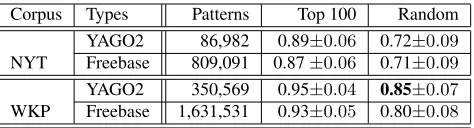
To assess the precision of the automatically mined patterns (patterns in this section always mean pattern synsets), we sampled the PATTY taxonomy for each combination of input corpus and type system. We ranked the patterns by their statistical strength (Sec-tion 4), and evaluated the precision of the top 100 pattern synsets. Several human judges were shown a sampled pattern synset, its type signature, and a few example instances, and then stated whether the pattern synset indicates a valid relation or not. Eval-uators checked the correctness of the type signature, whether the majority of patterns in the synset is rea-sonable, and whether the instances seem plausible. If so, the synset was flagged as meaningful. The re-sults of this evaluation are shown in column four of Table 2, with a 0.9-confidence Wilson score inter-val (Brown 2001). In addition, the same assessment procedure was applied torandomly sampledsynsets, to evaluate the quality in the long tail of patterns. The results are shown in column five of Table 2. For the top 100 patterns, we achieve above 90% preci-sion for Wikipedia, and above 80% for 100 random samples.
Corpus Types Patterns Top 100 Random
NYT
YAGO2 86,982 0.89±0.06 0.72±0.09 Freebase 809,091 0.87±0.06 0.71±0.09
WKP
[image:7.612.314.551.410.474.2]YAGO2 350,569 0.95±0.04 0.85±0.07 Freebase 1,631,531 0.93±0.05 0.80±0.08
Table 2: Precision of Relational Patterns
assignment of entities to categories.
8.3 Precision of Subsumptions
We evaluated the quality of the subsumptions by assessing 100 top-ranked as well as 100 randomly selected subsumptions. As shown in Table 3, a large number of the subsumptions are correct. The Wikipedia-based PATTY taxonomy has a random-sampling-based precision of 75%.
Corpus Types # Edges Top 100 Random
NYT
YAGO2 12,601 0.86±0.07 0.68±0.09 Freebase 80,296 0.89±0.06 0.41±0.09
WKP
YAGO2 8,162 0.83±0.07 0.75±0.07 Freebase 20,339 0.85±0.07 0.62±0.09
Table 3: Quality of Subsumptions
Example subsumptions from Wikipedia are:
• hpersoninominated forhawardi = hpersoniwinner ofhawardi
• hpersoni’ s wifehpersoni = hpersoni’s widowhpersoni
8.4 Coverage
To evaluate the coverage of PATTY, we would need a complete ground-truth resource that contains all possible binary relations between entities. Unfor-tunately, there is no such resource2. We tried to approximate such a resource by manually compil-ing all binary relations between entities that ap-pear in Wikipedia articles of a certain domain. We chose the domain of popular music, because it offers a plethora of non-trivial relations (such as addict-edTo(person,drug), coveredBy(musician,musician), dedicatedSongTo(musician,entity))). We considered the Wikipedia articles of five musicians (Amy Wine-house, Bob Dylan, Neil Young, John Coltrane, Nina Simone). For each page, two annotators hand-extracted all relationship types that they would spot in the respective articles. The annotators limited themselves to relations where at least one argument type ishmusiciani. Then we formed the intersection of the two annotators’ outputs (i.e., their agreement)
2
Lexical resources such as WordNet contain only verbs, but not binary relations such asis the president of. Other resources are likely incomplete.
as a reasonable gold standard for relations identifi-able by skilled humans. In total, the gold-standard set contains 163 relations.
We then compared our relational patterns to the relations included in four major knowledge bases, namely, YAGO2, DBpedia (DBP), Freebase (FB), and NELL, limited to the specific domain of music. Table 4 shows the absolute number of relations cov-ered by each resource. For PATTY, the patterns were derived from the Wikipedia corpus with the YAGO2 type system.
gold standard PATTY YAGO2 DBP FB NELL
163 126 31 39 69 13
Table 4: Coverage of Music Relations
PATTY covered 126 of the 163 gold-standard re-lations. This is more than what can be found in large semi-curated knowledge bases such as Freebase, and twice as much as Wikipedia-infobox-based re-sources such as DBpedia or YAGO offer. Some PATTY examples that do not appear in the other re-sources at all are:
• hmusicianiPRP idolhmusicianifor the relation hasMusicalIdol
• hpersoni criticized by horganizationi for critizedByMedia
• hpersoniheadlinerhartifactiforheadlinerAt
• hpersonisuccessfully suedhpersoniforsuedBy
• hmusicianiwrote hits for hmusiciani for wrote-HitsFor,
This shows (albeit anecdotically) that PATTY’s pat-terns contribute added value beyond today’s knowl-edge bases.
8.5 Pattern Language Alternatives
Reverb-style patterns PATTY without types PATTY full
# Patterns 5,996 184,629 350,569
Patterns Precision 0.96±0.03 0.74±0.08 0.95±0.04
# Subsumptions 74 15,347 8,162
Subsumptions Precision 0.79±0.09 0.58±0.09 0.83±0.07
# Facts 192,144 6,384,684 3,890,075
[image:9.612.137.474.57.141.2]Facts Precision. 0.86±0.07 0.64±0.09 0.88±0.06
Table 5: Results for Different Pattern Language Alternatives
Relation Paraphrases Precision Sample Paraphrases
DBPedia/artist 83 0.96±0.03 [adj] studio album of, [det] song by . . . DBPedia/associatedBand 386 0.74±0.11 joined band along, plays in . . . DBPedia/doctoralAdvisor 36 0.558±0.15 [det] student of, under * supervision . . . DBPedia/recordLabel 113 0.86±0.09 [adj] artist signed to, [adj] record label . . . DBPedia/riverMouth 31 0.83±0.12 drains into, [adj] tributary of . . .
DBPedia/team 1,108 0.91±0.07 be * traded to, [prp] debut for . . . YAGO/actedIn 330 0.88±0.08 starred in * film, [adj] role for . . . YAGO/created 466 0.79±0.10 founded, ’s book . . .
YAGO/isLeaderOf 40 0.53±0.14 elected by, governor of . . . YAGO/holdsPoliticalPosition 72 0.73±0.10 [prp] tenure as, oath as . . .
Table 6: Sample Results for Relation Paraphrasing
YAGO2 type system are shown in Table 5; preci-sion figures are based on the respective top 100 pat-terns or subsumption edges. We observe from these results that the type signatures are crucial for pre-cision. Moreover, the number of patterns, subsump-tions and facts found by verb-phrase-centric patterns (ReVerb (Fader 2011)), are limited in recall. Gen-eral pattern synsets with type signatures, as newly pursued in this paper, substantially outperform the verb-phrase-centric alternative in terms of pattern and subsumption recall while yielding high preci-sion.
8.6 Extrinsic Study: Relation Paraphrasing
To further evaluate the usefulness of PATTY, we per-formed a study on relation paraphrasing: given a re-lation from a knowledge base, identify patterns that can be used to express that relation. Paraphrasing relations with high-quality patterns is important for populating knowledge bases and counters the prob-lem of semantic drifting caused by ambiguous and noisy patterns.
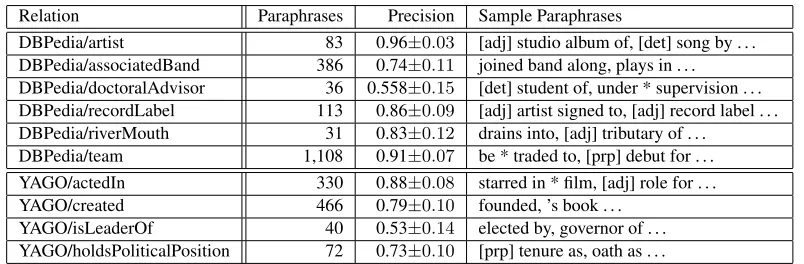
We considered relations from two knowledge bases, DBpedia and YAGO2, focusing on relations that hold between entities and do not include literals. PATTY paraphrased 225 DBpedia relations with a
total of 127,811 patterns, and 25 YAGO2 relations with a total of 43,124 patterns. Among these we evaluated a random sample of 1,000 relation para-phrases. Table 6 shows precision figures for some selected relations, along anecdotic example patterns. Some relations are hard to capture precisely. For DBPedia/doctoralAdvisor, e.g., PATTY picked up patterns like “worked with” as paraphrases. These are not entirely wrong, but we evaluated them as false because they are too general to indicate the more specific doctoral advisor relation.
Overall, however, the paraphrasing precision is high. Our evaluation showed an average precision of0.76±0.03across all relations.
9 Conclusion and Future Directions
[image:9.612.105.507.169.301.2]freely available for interactive access and download at www.mpi-inf.mpg.de/yago-naga/patty/. Our approach harnesses existing knowledge bases for entity-type information. However, PATTY is not tied to a particular choice for this purpose. In fact, it would be straightforward to adjust PATTY to us-ing surface-form noun phrases rather than disam-biguated entities, as long as we have means to infer at least coarse-grained types (e.g., person, organiza-tion, location). An interesting future direction is to study this generalized setting. We would also like to investigate the enhanced interplay of information extraction and pattern extraction, and possible appli-cations for question answering.
References
Ion Androutsopoulos, Prodromos Malakasiotis: A Sur-vey of Paraphrasing and Textual Entailment Methods. Journal of Artificial Intelligence Research 38: 135– 187, 2010
Rakesh Agrawal, Tomasz Imielinski, Arun N. Swami: Mining Association Rules between Sets of Items in Large Databases. SIGMOD Conference 1993
Enrique Alfonseca, Marius Pasca, Enrique Robledo-Arnuncio: Acquisition of instance attributes via la-beled and related instances. SIGIR 2010
S¨oren Auer, Christian Bizer, Georgi Kobilarov, Jens Lehmann, Richard Cyganiak, Zachary G. Ives: DBpe-dia: A Nucleus for a Web of Open Data. ISWC 2007, data athttp://dbpedia.org
Michele Banko, Michael J. Cafarella, Stephen Soderland, Matthew Broadhead, Oren Etzioni: Open Information Extraction from the Web. IJCAI 2007
Jonathan Berant, Ido Dagan, Jacob Goldberger: Global Learning of Typed Entailment Rules. ACL 2011 Kurt D. Bollacker, Colin Evans, Praveen Paritosh, Tim
Sturge, Jamie Taylor: Freebase: a collaboratively created graph database for structuring human knowl-edge. SIGMOD Conference 2008, data athttp:// freebase.com
Lawrence D. Brown, T.Tony Cai, Anirban Dasgupta: In-terval Estimation for a Binomial Proportion. Statistical Science 16: 101–133, 2001
Andrew Carlson, Justin Betteridge, Bryan Kisiel, Burr Settles, Estevam R. Hruschka Jr., Tom M. Mitchell. Toward an Architecture for Never-Ending Language Learning. AAAI 2010, data at http://rtw.ml. cmu.edu/rtw/
Timothy Chklovski, Patrick Pantel: VerbOcean: Mining the Web for Fine-Grained Semantic Verb Relations.
EMNLP 2004; data available at http://demo. patrickpantel.com/demos/verbocean/
Anthony Fader, Stephen Soderland, Oren Etzioni: Identifying Relations for Open Information Extrac-tion. EMNLP 2011, data athttp://reverb.cs. washington.edu
Christiane Fellbaum (Editor): WordNet: An Electronic Lexical Database. MIT Press, 1998
Jiawei Han, Jian Pei , Yiwen Yin : Mining frequent pat-terns without candidate generation. SIGMOD 2000. Chikara Hashimoto, Kentaro Torisawa, Kow Kuroda,
Stijn De Saeger, Masaki Murata, Jun’ichi Kazama: Large-Scale Verb Entailment Acquisition from the Web. EMNLP 2009
Catherine Havasi, Robert Speer, and Jason Alonso. Con-ceptNet 3: a Flexible, Multilingual Semantic Net-work for Common Sense Knowledge, RANLP 2007; data available athttp://conceptnet5.media. mit.edu/
Iris Hendrickx, Su Nam Kim, Zornitsa Kozareva, Preslav Nakov, Diarmuid O Seaghdha, Sebastian Pado, Marco Pennacchiotti, Lorenza Romano, Stan Szpakowicz: SemEval-2010 Task 8: Multi-Way Classification of Semantic Relations Between Pairs of Nominals, 5th ACL International Workshop on Semantic Evaluation, 2010; data available at http://www.isi.edu/ ˜kozareva/downloads.html
Johannes Hoffart, Fabian Suchanek, Klaus Berberich, Edwin Lewis-Kelham, Gerard de Melo, Ger-hard Weikum: YAGO2: Exploring and Query-ing World Knowledge in Time, Space, Con-text, and Many Languages. WWW 2011, data at
http://yago-knowledge.org
Raphael Hoffmann, Congle Zhang, Daniel S. Weld: Learning 5000 Relational Extractors. ACL 2010 Vigo Kann: On the approximability of NP-complete
opti-mization problems. PhD thesis, Department of Numer-ical Analysis and Computing Science, Royal Institute of Technology, Stockholm. 1992.
Karin Kipper, Anna Korhonen, Neville Ryant, Martha Palmer, A Large-scale Classification of English Verbs, Language Resources and Evalua-tion Journal, 42(1): 21-40, 2008, data available at
http://verbs.colorado.edu/˜mpalmer/ projects/verbnet/downloads.html
Zornitsa Kozareva, Eduard H. Hovy: Learning Argu-ments and Supertypes of Semantic Relations Using Recursive Patterns. ACL 2010
Girija Limaye, Sunita Sarawagi, Soumen Chakrabarti: Annotating and Searching Web Tables Using Entities, Types and Relationships. PVLDB 3(1): 1338-1347 (2010)
Marie-Catherine de Marneffe, Bill MacCartney and Christopher D. Manning. Generating Typed Depen-dency Parses from Phrase Structure Parses. LREC 2006.
Thahir Mohamed, Estevam R. Hruschka Jr., Tom M. Mitchell: Discovering Relations between Noun Cat-egories. EMNLP 2011
Ndapandula Nakashole, Martin Theobald, Gerhard Weikum: Scalable Knowledge Harvesting with High Precision and High Recall. WSDM 2011
Preslav Nakov, Marti A. Hearst: Solving Relational Simi-larity Problems Using the Web as a Corpus. ACL 2008 Vivi Nastase, Michael Strube, Benjamin Boerschinger, C¨acilia Zirn, Anas Elghafari: WikiNet: A Very Large Scale Multi-Lingual Concept Network. LREC 2010, data at http://www.h-its.org/english/ research/nlp/download/wikinet.php
Roberto Navigli, Simone Paolo Ponzetto: BabelNet: Building a Very Large Multilingual Semantic Net-work. ACL 2010 data athttp://lcl.uniroma1. it/babelnet/
Marius Pasca, Benjamin Van Durme: What You Seek Is What You Get: Extraction of Class Attributes from Query Logs. IJCAI 2007
Marius Pasca, Benjamin Van Durme: Weakly-Supervised Acquisition of Open-Domain Classes and Class At-tributes from Web Documents and Query Logs. ACL 2008
Andrew Philpot, Eduard Hovy, Patrick Pantel: The Omega Ontology, in: Ontology and the Lexicon, Cambridge University Press, 2008, data at http: //omega.isi.edu/
Simone Paolo Ponzetto, Michael Strube: Deriving a Large-Scale Taxonomy from Wikipedia. AAAI 2007, data at http://www.h-its.org/english/ research/nlp/download/wikitaxonomy. php
Joseph Reisinger, Marius Pasca: Latent Variable Models of Concept-Attribute Attachment. ACL/AFNLP 2009 Ramakrishnan Srikant, Rakesh Agrawal: Mining
Se-quential Patterns: Generalizations and Performance Improvements. EDBT 1996
Fabian M. Suchanek, Gjergji Kasneci, Gerhard Weikum: YAGO: a Core of Semantic Knowledge. WWW 2007 Fabian M. Suchanek, Mauro Sozio, Gerhard Weikum:
SOFIE: a self-organizing framework for information extraction. WWW 2009
Lin Sun, Anna Korhonen: Hierarchical Verb Clustering Using Graph Factorization. EMNLP 2011
Petros Venetis, Alon Y. Halevy, Jayant Madhavan, Marius Pasca, Warren Shen, Fei Wu, Gengxin Miao, Chung Wu: Recovering Semantics of Tables on the Web. PVLDB 4(9): 528-538, 2011
Tom White: Hadoop: The Definitive Guide, 2nd Edition. O’Reilly, 2010.
Fei Wu, Daniel S. Weld: Automatically refining the wiki-pedia infobox ontology. WWW 2008
Wentao Wu, Hongsong Li, Haixun Wang, Kenny Q. Zhu: Towards a Probabilistic Taxonomy of Many Concepts. Technical Report MSR-TR-2011-25, Microsoft Re-search, 2011
Limin Yao, Aria Haghighi, Sebastian Riedel, Andrew McCallum: Structured Relation Discovery using Gen-erative Models. EMNLP 2011