Why Question Answering using Sentiment Analysis and Word Classes
Jong-Hoon Oh∗ Kentaro Torisawa† Chikara Hashimoto‡ Takuya Kawada§ Stijn De Saeger¶ Jun’ichi Kazamak Yiou Wang∗∗
Information Analysis Laboratory Universal Communication Research Institute
National Institute of Information and Communications Technology (NICT) {∗rovellia,†torisawa,‡ch,§tkawada,¶stijn,kkazama,∗∗wangyiou}@nict.go.jp
Abstract
In this paper we explore the utility of sen-timent analysis and semantic word classes for improving why-question answering on a large-scale web corpus. Our work is moti-vated by the observation that a why-question and its answer often follow the pattern thatif something undesirable happens, the reason is also often something undesirable, andif some-thing desirable happens, the reason is also of-ten something desirable. To the best of our knowledge, this is the first work that intro-duces sentiment analysis to non-factoid ques-tion answering. We combine this simple idea with semantic word classes for ranking an-swers to why-questions and show that on a set of 850 why-questions our method gains 15.2% improvement in precision at the top-1 answer over a baseline state-of-the-art QA system that achieved the best performance in a shared task of Japanese non-factoid QA in NTCIR-6.
1 Introduction
Question Answering (QA) research for factoid ques-tions has recently achieved great success as demon-strated by IBM’s Watson at Jeopardy: its accuracy has been reported to be around 85% on factoid ques-tions (Ferrucci et al., 2010). Although recent shared QA tasks (Voorhees, 2004; Peñas et al., 2011; Fuku-moto et al., 2007) have stimulated the research com-munity to move beyond factoid QA, comparatively little attention has been paid to QA for non-factoid questions such as why questions and how to ques-tions, and the performance of the state-of-art non-factoid QA systems reported in the literature (Mu-rata et al., 2007; Surdeanu et al., 2011; Verberne et
al., 2010) remains considerably lower than that of factoid QA (i.e., 34% in MRR at top-150 results on why-questions (Verberne et al., 2010)).
In this paper we explore the utility of sentiment analysis (Pang et al., 2002; Turney, 2002; Nakagawa et al., 2010) and semantic word classes for improv-ing why-question answerimprov-ing (why-QA) on a large-scale web corpus. The inspiration behind this work is the observation that why-questions and their an-swers often have the following tendency:
• if something undesirable happens, the reason is often also something undesirable, and
• if something desirable happens, its reason is of-ten also desirable.
Consider the following question Q1, and its an-swer candidatesA1-1andA1-2.
• Q1: Why does cancer occur?
• A1-1: Carcinogens such as nitrosamine and benzopyrenemay increase the risk of cancer by altering DNA in cells.
• A1-2: Maintaining a healthy weightmay lower the risk of various types of cancer.
HereA1-1describes an undesirable event related to cancer, while A1-2 suggests a desirable action for its prevention. Our hypothesis suggests that A1-1 is more appropriate for answering Q1. If this hy-pothesis holds, we can obtain a significant improve-ment in performance on why-QA tasks by exploiting the sentiment orientation1of expressions obtainable
1
In this paper we denote thedesirable/undesirable polar-ity of an expression by the term “sentiment orientation” instead of “semantic orientation” to avoid confusion with our different notion of “semantic word classes.”
by automatic sentiment analysis of questions and an-swers.
A second observation motivating this work is that there are often significant associations between the lexico-semantic classes of words in a question and those in its answer sentence. For instance, questions concerning diseases likeQ1often have answers that include references to specific semantic word classes such as chemicals (like A1-1), viruses, body parts, and so on. Capturing such statistical correlations be-tween diseases and harmful substances may lead to higher why-QA performance. For this purpose we use classes of semantically similar words that were automatically acquired from a large web corpus us-ing an EM-based clusterus-ing method (Kazama and Torisawa, 2008).
Another issue is that simply introducing the sen-timent orientation of words or phrases in question and answer sentences in a naive way is insufficient, since answer candidate sentences may contain mul-tiple sentiment expressions with different polarities in answer candidates (i.e., about 33% of correct an-swers had such multiple sentiment expressions with different polarities in our test set). For example, if A1-2contained a second sentiment expression with negative polarity like the example below,
“Trusting a specific food is not effective for preventing cancer, but maintaining a healthy weightmay help lower the risk of
various types of cancer.”
both A1-1 and A1-2 would contain sentiment ex-pressions with the same polarity as that ofQ1. Thus, it is difficult to expect that the sentiment orientation alone will work well for recognizingA1-1as a cor-rect answer toQ1. To address this problem, we con-sider the combination of sentiment polarity and the contents of sentiment expressions associated with the polarity in questions and their answer candidates as well. To deal with the data sparseness problem arising in using the content of sentiment expressions, we developed a feature set that combines the polar-ity and the semantic word classes effectively.
We exploit these two main ideas (concerned with the sentiment orientation and the semantic classes described so far) for training a supervised classi-fier to rank answer candidates to why-questions. Through a series of experiments on 850 Japanese why-questions, we showed that the proposed
semtic features were effective in identifying correct an-swers, and our proposed method obtained more than 15% improvement in precision of its top answer (P@1) over our baseline, which achieved the best performance in the non-factoid QA task in NTCIR-6 (Murata et al., 2007). We also show that our method can potentially perform with high precision (64.8% in P@1) when answer candidates containing at least one correct answer are given to our re-ranker.
2 Approach
Our proposed method is composed of answer re-trieval and answer re-ranking. The first step, an-swer retrieval, extracts a set of anan-swer candidates to a why-question from 600 million Japanese Web cor-pus. The answer retrieval is our implementation of the state-of-art method that has shown the best per-formance in the shared task of Japanese non-factoid QA in NTCIR-6 (Murata et al., 2007; Fukumoto et al., 2007). The second step, answer re-ranking, is the focus of this work.
2.1 Answer Retrieval
We use Solr2to retrieve documents from a 600 mil-lion Japanese Web page corpus3for a given why-question. Let a set of content words in a why-question beT ={t1,· · ·, tn}. Two boolean queries for a why-question, “t1AND· · · ANDtn” and “t1 OR· · · ORtn,” are given to Solr and top-300 doc-uments for each query are retrieved. Note that re-trieved documents by each query have different cov-erage and relevance to a given why-question. To keep balance between the coverage and relevance of retrieved documents, we use a set of retrieved doc-uments by these two queries for obtaining answer candidates. Each document in the result of docu-ment retrieval is split into a set of answer candi-dates consisting of five subsequent sentences4. Sub-sequent answer candidates can share up to two sen-tences to avoid errors due to wrong document seg-mentation.
2
http://lucene.apache.org/solr
3 To the best of our knowledge, few Japanese non-factoid
QA systems in the literature have used such a large-scale cor-pus.
4
Answer candidate ac for question q is ranked according to scoring function S(q, ac) given in Eq. (1) (Murata et al., 2007). Murata et al. (2007)’s method uses text search to look for answer candi-dates containing terms from the question with ad-ditional clue terms referring to “reason” or “cause.” Following the original method we usedriyuu( rea-son),genin(cause) andyouin(cause) as clue terms. The top-20 answer candidates for each question are passed on to the next step, which is answer re-ranking. S(q, ac) assigns a score to answer candi-dates liketf-idf, where1/dist(t1, t2)functions like
tf and1/df(t2)isidf for given termst1 andt2 that are shared byqandac.
S(q, ac) =maxt1∈T
X
t2∈T
φ×log(ts(t1, t2)) (1)
ts(t1, t2) =
N
2×dist(t1, t2)×df(t2)
HereT is a set of terms including nouns, verbs, and adjectives in questionq that appear in answer can-didateac. Note that the clue terms are added toT
if they exist inac. N is the total number of docu-ments (600 million),dist(t1, t2) represents the dis-tance (the number of characters) betweent1 andt2 in answer candidate ac, df(t) is the document fre-quency of term t, and φ ∈ {0,1} is an indicator, whereφ= 1ifts(t1, t2)>1,φ= 0otherwise.
2.2 Answer Re-ranking
Our re-ranker is a supervised classifier (SVMs) (Vapnik, 1995) that uses three types of feature sets: features expressing morphological and syn-tactic analysis of questions and answer candidates, features representing semantic word classes appear-ing in questions and answer candidates, and features from sentiment analysis. All answer candidates of a question are ranked in a descending order of their score given by SVMs. We trained and tested the re-ranker using 10-fold cross validation on a cor-pus composed of 850 why-questions and their top-20 answer candidates provided by the answer re-trieval procedure in Section 2.1. The answer candi-dates were manually annotated by three human an-notators (not by the authors). Our corpus construc-tion method is described in more detail in Secconstruc-tion 4.
3 Features for Answer Re-ranking
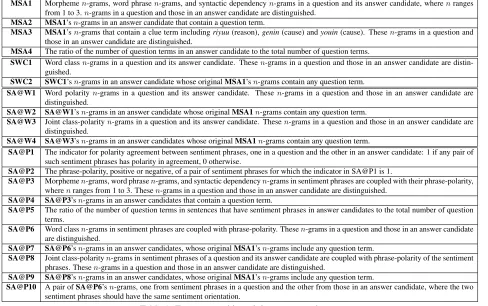
This section describes our feature sets for answer re-ranking: features expressing morphological and syntactic analysis (MSA), features representing se-mantic word class (SWC), and features indicat-ing sentiment analysis (SA). MSA, which has been widely used for re-ranking answers in the literature, is used to identify associations between questions and answers at the morpheme, word phrase, and syn-tactic dependency levels. The other two feature sets are proposed in this paper. SWC is devised for iden-tifying semantic word class associations between questions and answers. SA is used for identify-ing sentiment orientation associations between ques-tions and answers as well as expressing the combi-nation of each sentiment expression and its polarity. Table 1 summarizes the respective feature sets, each of which is described in detail below.
3.1 Morphological and Syntactic Analysis
MSA includingn-grams of morphemes, words, and syntactic dependencies has been widely used for re-ranking answers in non-factoid QA (Higashinaka and Isozaki, 2008; Surdeanu et al., 2011; Verberne et al., 2007; Verberne et al., 2010). We use MSA as a baseline feature set in this work.
We represent all sentences in a question and its answer candidate in three ways: morphemes, word phrases (bunsetsu5) and syntactic dependency chains. These are obtained using a morphological analyzer6 and a dependency parser7. From each question and answer candidate we extract n-grams of morphemes, word phrases, and syntactic depen-dencies, wherenranges from 1 to 3. Syntactic de-pendencyn-grams are defined as a syntactic depen-dency chain containing nword phrases. Syntactic dependency grams coincide with word phrase 1-grams, so they are ignored.
Table 1 defines four types of MSA (MSA1 to MSA4). MSA1 is n-gram features from all sen-tences in a question and its answer candidates and distinguishes an n-gram feature found in a ques-tion from that same feature found in answer candi-dates. MSA2 containsn-grams found in the answer
5
Abunsetsuis a syntactic constituent composed of a content word and several function words such as post-positions and case markers. It is the smallest unit of syntactic analysis in Japanese.
6http://nlp.ist.i.kyoto-u.ac.jp/EN/index.php?JUMAN 7
MSA1 Morphemen-grams, word phrasen-grams, and syntactic dependencyn-grams in a question and its answer candidate, wherenranges from 1 to 3.n-grams in a question and those in an answer candidate are distinguished.
MSA2 MSA1’sn-grams in an answer candidate that contain a question term.
MSA3 MSA1’sn-grams that contain a clue term includingriyuu(reason),genin(cause) andyouin(cause). Thesen-grams in a question and those in an answer candidate are distinguished.
MSA4 The ratio of the number of question terms in an answer candidate to the total number of question terms.
SWC1 Word classn-grams in a question and its answer candidate. Thesen-grams in a question and those in an answer candidate are distin-guished.
SWC2 SWC1’sn-grams in an answer candidate whose originalMSA1’sn-grams contain any question term.
SA@W1 Word polarityn-grams in a question and its answer candidate. Thesen-grams in a question and those in an answer candidate are distinguished.
SA@W2 SA@W1’sn-grams in an answer candidate whose originalMSA1n-grams contain any question term.
SA@W3 Joint class-polarityn-grams in a question and its answer candidate. Thesen-grams in a question and those in an answer candidate are distinguished.
SA@W4 SA@W3’sn-grams in an answer candidates whose originalMSA1n-grams contain any question term.
SA@P1 The indicator for polarity agreement between sentiment phrases, one in a question and the other in an answer candidate: 1 if any pair of such sentiment phrases has polarity in agreement, 0 otherwise.
SA@P2 The phrase-polarity, positive or negative, of a pair of sentiment phrases for which the indicator in SA@P1 is 1.
SA@P3 Morphemen-grams, word phrasen-grams, and syntactic dependencyn-grams in sentiment phrases are coupled with their phrase-polarity, wherenranges from 1 to 3. Thesen-grams in a question and those in an answer candidate are distinguished.
SA@P4 SA@P3’sn-grams in an answer candidates that contain a question term.
SA@P5 The ratio of the number of question terms in sentences that have sentiment phrases in answer candidates to the total number of question terms.
SA@P6 Word classn-grams in sentiment phrases are coupled with phrase-polarity. Thesen-grams in a question and those in an answer candidate are distinguished.
SA@P7 SA@P6’sn-grams in an answer candidates, whose originalMSA1’sn-grams include any question term.
SA@P8 Joint class-polarityn-grams in sentiment phrases of a question and its answer candidate are coupled with phrase-polarity of the sentiment phrases. Thesen-grams in a question and those in an answer candidate are distinguished.
SA@P9 SA@P8’sn-grams in an answer candidates, whose originalMSA1’sn-grams include any question term.
[image:4.612.72.560.60.366.2]SA@P10 A pair ofSA@P6’sn-grams, one from sentiment phrases in a question and the other from those in an answer candidate, where the two sentiment phrases should have the same sentiment orientation.
Table 1: Features used in training our re-ranker
candidates that themselves contain a term from the question (e.g., “types of cancer” in exampleA1-2). MSA3 is then-gram feature that contains one of the clue terms used for answer retrieval (riyuu(reason),
genin(cause) oryouin(cause)). Here too, n-grams obtained from the questions and answer candidates are distinguished. Finally, MSA4 is the percentage of the question terms found in an answer candidate.
3.2 Semantic Word Class
Semantic word classesare sets of semantically simi-lar words. We construct these semantic word classes by using the noun clustering algorithm proposed in Kazama and Torisawa (2008). The algorithm fol-lows the distributional hypothesis, which states that semantically similar words tend to appear in simi-lar contexts (Harris, 1954). By treating syntactic de-pendency relations between words as “contexts,” the clustering method defines a probabilistic model of noun-verb dependencies with hidden classes as:
p(n, v, r) =X
c
p(n|c)p(hv, ri|c)p(c) (2)
Here,nis a noun,vis a verb or noun on whichn de-pends via a grammatical relationr(post-positions in Japanese), andcis a hidden class. Dependency rela-tion frequencies were obtained from our 600-million page web corpus, and model parameters p(n|c),
p(hv, ri|c) and p(c) were estimated using the EM algorithm (Hofmann, 1999). We successfully clus-tered 5.5 million nouns into 500 classes. For each nounn, EM clustering estimates a probability dis-tribution over hidden variables representing seman-tic classes. From this distribution we obtained dis-crete semantic word classes by assigning each noun
n to semantic class c = argmaxc∗ p(c∗|n). The resulting classes actually form clean semantic cat-egories such as chemicals, nutrients, diseases and
conditions, in our examples of Q1 and Q2. The fol-lowing are the top-10 words (English translation) ac-cording top(c|n)for these classes.
nutrients: glucide, carbonhydrate, mineral, salt, sugar, water, fat, vitamin, nutrients, protein
diseases: pneumonia, neuritis, cancer, oral leuko-plakia, pachymeningitis, acidosis, encephalitis, abdominal injury, valvulitis, gingivitis
conditions: proficiency, decrepitude, deficiency, impurity, abnormalities, floated, crisis, dis-placement, condition, shortage
Semantic word class (SWC) features are used to capture associations between semantic classes of words in the question and those in the answer candi-dates. For example:
• Q2: Why does rickets (Wdisease) occur in chil-dren?
• A2: Deficiency (Wcondition) of vitamin D (Wnutrients) can cause rickets (Wdisease).
Wcondition, Wdisease and Wnutrients represent se-mantic word classes ofconditions,diseasesand nu-trients, respectively. If this question-answer pair is given to the classifier as a positive training sample, we expect it to learn that if a disease name appears in a question then, everything else being equal, an-swers including nutrient names are more likely to be correct. Note that in principle the same association could be learned between word pairs, i.e.,ricketsand
vitamin D. However, we found that word level asso-ciations are often too specific, and because of data sparseness this knowledge cannot easily be general-ized to unseen questions. This is our main motiva-tion for introducing broad coverage semantic word classes into the feature set.
We call the feature set with the word classes SWC and use two types of SWC, as shown in Table 1. To obtain the first type (SWC1), we convert all nouns in the MSA1 n-grams into their respective word classes, and keep all n-grams that contain at least one word class. We call these features word class
n-grams. Again, word classn-grams obtained from questions are distinguished from the ones in answer candidates. For example, we extract “Wdisease oc-cur” as a word class 2-gram fromQ2.
The second type of SWC, SWC2, represents word class n-grams in an answer candidate, in which question terms are replaced by their respective se-mantic word classes. For example,Wdiseasein word class 2-gram “cause Wdisease” from A2 is the se-mantic word class of rickets, one of the question
terms. These features capture the correspondence between semantic word classes in the question and answer candidates.
3.3 Sentiment Analysis
Sentiment analysis (SA) features are classified into word-polarity and phrase-polarity features. We use
opinion extraction tool8 and sentiment orientation lexicon in the tool for these features.
3.3.1 Opinion Extraction Tool
Opinion extraction tool is a software, the im-plementation of Nakagawa et al. (2010). It ex-tracts linguistic expressions representing opinions (henceforth, we call them sentiment phrases) from a Japanese sentence and then identifies the polarity of these sentiment phrases using machine learning techniques. For example, rickets occur in Q2and
Deficiency of vitamin D can cause ricketsinA2can be identified as sentiment phrases with a negative polarity. The tool identifies sentiment phrases and their polarity by using polarities of words and de-pendency subtrees as evidence, where these polari-ties are given in a word polarity dictionary.
In this paper, we use a trained model and a word polarity dictionary (containing about 35,000 entries) distributed via the ALAGIN forum9 for our sen-timent analysis. Table 2 shows the performance ofopinion extraction tool, precision (P), recall (R) and F-value (F), in this setting (reported in the Japanese homepage of this tool). In the evaluation of sentiment-phrase extraction, an extracted sentiment phrase is determined as correct if its head word is the same as one in the gold standard. Polarity clas-sification is evaluated under the condition that all of the sentiment phrases are correctly extracted.
P R F
Sentiment-phrase extraction 0.602 0.408 0.486 Polarity classification (pos.) 0.873 0.893 0.883 Polarity classification (neg.) 0.866 0.842 0.854 Table 2: The performance ofopinion extraction tool
3.3.2 Word Polarity (SA@W)
Polarities of words are identified by simply look-ing up the word polarity dictionary of opinion
ex-8
Available at http://alaginrc.nict.go.jp/opinion/index_e.html
9
traction tool. Word polarity features are used for identifying associations between the polarity of words in a question and that in a correct answer. For example:
• Q2: Why does rickets (W−) occur in children?
• A2: Deficiency (W−) of vitamin D can cause rickets (W−).
Here,W− represents negative word polarities. We expect our classifier to learn from this question and answer pair that if a word with negative polarity ap-pears in a question then its correct answer is likely to contain a negative polarity word as well.
SA@W1 and SA@W2 in Table 1 are sentiment analysis features fromword polarity n-grams, which contain at least one word that has word polarities. We obtain thesen-grams by converting all nouns in MSA1 n-grams into their word polarities through dictionary lookup. For example, from Q2 in the above example we extract “W− occur” as a word polarity 2-gram. SA@W1 is concerned with all
word polarityn-grams in questions and answer can-didates. For SA@W2, we restrict word polarity
n-grams from SA@W1 to those whose originaln -gram include a question term.
Furthermore, word polarities are coupled with se-mantic word classes so that our classifier can iden-tify meaningful combinations of both. For example,
deficiencyinA2can be represented asWcondition− by its respective semantic word class and word polar-ity, which allows for the representation of undesir-able conditions. This in turn lets our system learn meaningful correlations between words expressing these kind of negative conditions and their connec-tion to quesconnec-tions asking about diseases. SA@W3 and SA@W4 are features from this combination. They are defined in the same way as SA@W1 and SA@W2 except that word polarities are replaced with the combination of semantic word classes and word polarities. We calln-grams in SA@W3 and SA@W4joint (word) class-polarityn-grams.
3.3.3 Phrase Polarity (SA@P)
Opinion extraction toolis applied to question and its answer candidate to identify sentiment phrases and their phrase-polarities. In preliminary tests we found that sentiment phrases do not help to iden-tify correct answers if answer sentences including the sentiment phrases do not have any term from the
question. So we restrict the target sentiment phrases to those acquired from sentences containing at least one question term. From these sentiment phrases we extract three categories of features.
First, SA@P1 and SA@P2 are features concerned with phrase-polarity agreement between sentiment phrases in a question and its answer candidate. We consider all possible pairs of sentiment phrases from the question and answer. If any such pair agrees in phrase-polarity, an indicator for the agreement and its polarity in the agreement become features SA@P1 and SA@P2, respectively.
Secondly, following the original hypothesis un-derlying this paper, we assume that sentiment phrases often represent the core part of the cor-rect answer (e.g., A2 above) and it is important to express the content of the sentiment phrases in features. SA@P3 and SA@P4 were devised for this purpose. SA@P3 represents this sentiment phrase contents asn-grams of morphemes, words, and syntactic dependencies of sentiment phrases, together with their phrase-polarity. Furthermore, SA@P4 is the subset of SA@P3n-grams restricted to those that include terms found in the question, and SA@P5 indicates the percentage of sentiment
n-grams from the question that are found in a given answer candidate.
Finally, features SA@P6 through SA@P9 use se-mantic word classes to generalize the content fea-tures mentioned above. These feafea-tures consist of word classn-grams and joint class-polarityn-grams taken from sentiment phrases, together with their phrase polarity. Similar to the definition of SA@P4, for SA@P7 and SA@P9 we restrict ourselves ton -grams containing a question term. SA@P10 repre-sents the semantic content of two sentiment phrases with the same sentiment orientation (one from a question and the other from an answer candidate) using word classn-grams, together with the phrase-polarity in agreement.
4 Test Set
We prepared three sets of why-questions (QS1, QS2 and QS3) and used these questions to build two test sets for our experiments.
Why-questions in QS1 are taken from the Japanese version of Yahoo! Answers (called Ya-hoo! Chiebukuro)10. We automatically extracted
10
questions consisting of a single sentence and con-taining the interrogativenaze (why), and our anno-tators verified that these questions are meaningful without further context. For example, they discarded questions like “Why doesn’t the WBC (world box-ing council) make an objection to the WBC (World baseball classic)?” (the object of the objection is unclear) and “Why do minors trade at the auction even though it is disallowed by the rules” (informa-tion about which auc(informa-tion is not provided).
Because questions in Yahoo! Answers are aimed at human readers, users often “set the stage” by giv-ing lots of background information about their ques-tion. This often leads to large stylistic differences between the questions inYahoo! Answersand those typically posed to a QA system. We therefore cre-ated a second set of why-questions, QS2, whose style should be more appropriate for a QA system (examples showing these differences are given in the supplementary materials of this paper). Six human annotators (not the authors) were asked to create why-questions in their own words, keeping in mind that the questions they create are for a QA system. In addition, the annotators were asked to verify on the Web that the questions they created ask about some real event or phenomena. For example, a question like “Why does Mars appear blue?” is disallowed in QS2 because “Mars appears blue” is false. Note that the correct answer to these questions does not have to be either in our target corpus or in real-world Web texts. These two sets of why-questions, QS1 and QS2, are used to build a test set for evaluating our proposed method.
Finally, QS3contains why-questions that have at least one answer in our target corpus (600 million Japanese Web page corpus). For creating such why-questions, four human annotators (not the authors) were given a text passage composed of three contin-uous sentences and asked to locate the reasons for some event as described in this passage. Then they created a why-question for which the description is a correct answer. Because randomly selected passages from our target corpus have little chance of generat-ing good why-questions we extracted passages from our target corpus that include at least one of the clue terms used in our answer retrieval step (i.e. riyuu
(reason),genin(cause), oryouin(cause)). This
set-provided by Yahoo Japan Corporation and contains 16 million questions asked from April, 2004 to April 2009.
ting may not necessarily reflect a “real world” dis-tribution of why-questions, in which ideally a wide range of people ask questions that may or may not have an answer in our corpus. However, QS3 al-lows us to evaluate our method under theidealized
conditions where we have a perfect answer retrieval module whose answer candidates always contain at least one correct answer (the source passage used for creating the why-question). This setting allows us to estimate the ideal-case performance of our method. Under these circumstances we found that our method achieves almost 65% precision in P@1, which suggests that it can potentially perform with high precision if the answer candidates given by the answer retrieval module contain at least one correct answer. This is the main purpose of QS3. Addition-ally, we use QS3 for building training data, to check whether questions that do not reflect the real-world distribution of why-questions are useful for improv-ing the system’s performance on “real-world” ques-tions (see Section 5.1).
In addition, we checked QS1, QS2 and QS3 for questions having the same topic, to avoid the pos-sibility that the distribution of questions is biased towards certain topics. We manually extracted the questions’ topic words and randomly selected a sin-gle representative question from all questions with the same topic. For example, “Why does Twitter only allow 140 characters?” and “Why is Twitter so popular?” both have as topicTwitter. In the end we obtained 250 questions in QS1, 250 questions in QS2 and 350 questions in QS3.
Q1:二酸化炭素などの温室効果ガスが増えると海面水位が上昇するといわれているのはなぜですか?
(Why does the increase of greenhouse gases such as carbon dioxide in the atmosphere lead to a rise of ocean level?)
A1: ..化石燃料等の使用が増えるにつれて、温室効果ガスが大気中に大量に放出され、その濃度が増加し、大気中に吸収される熱が
増えたことにより、地球規模での気温上昇が進行しています。 これが地球温暖化です。...温暖化による海水膨張と両極の氷解で、海 面が平均9〜88cm上昇すると警告しています。
(The burning of fossil fuels contributes to the increase of atmospheric concentrations of greenhouse gases and this makes the atmosphere absorb more thermal radiation. As a result, Earth’s average surface temperature increases. This is global warming. ... There are warnings that the increase of sea water and melting of polar ice due to the global warming may cause sea-surface height to rise by 9–88 cm on average.
Q2:ヘモグロビンが不足すると体が酸素不足になるのはなぜですか?
(Why does hemoglobin deficiency cause lack of oxygen in the human body?)
A2:...ヘモグロビンは酸素を体の中に運び、いらなくなった二酸化炭素を持ち帰り、肺から外に出すなど重要な働きをしています。 もし鉄分が不足してヘモグロビンが少ししか作られないと、全身に運ばれる酸素の量が減少し、カラダが酸素不足になります。.. (... Hemoglobin has an important role in the human body of carrying oxygen to the organs and transferring carbon dioxide back to the lungs, to be dispensed from the organism. If the amount of hemoglobin produced by the body is insufficient due to iron deficiency, the amount of oxygen delivered throughout the body decreases, causing oxygen deficiency. ... )
Table 3: Correct question-answer pairs in our test set
Table 3 shows a sample of correct question-answer pairs in our test set. Please see the supplementary materials of this paper for more examples.
Note that word and phrase polarities are not con-sidered by the annotators in building our test sets and these polarities are automatically identified us-ing a word polarity dictionary andopinion extraction tool. We confirmed that about 35% of questions and 40% of answer candidates had at least one sentiment phrase byopinion extraction tool, and about 45% of questions and 85% of answer candidates contained at least one word having polarity by a word polarity dictionary.
5 Experiments
We use TinySVM11with a linear kernel for training our re-ranker. Evaluation was done by P@1 (Pre-cision of the top answer) and MAP (Mean Average Precision). P@1 measures how many questions have a correct top answer candidate. MAP, widely used in evaluation of IR systems, measures the overall qual-ity of the top-nanswer candidates (n=20 in this ex-periment) using the formula:
M AP = 1 |Q|
X
q∈Q Pn
k=1(P rec(k)×rel(k)) |Aq| (3)
HereQis a set of why-questions,Aqis a set of cor-rect answers to why-questionq ∈Q,P rec(k)is the precision at cut-offkin the top-nanswer candidates,
rel(k)is an indicator, 1 if the item at rankkis a cor-rect answer inAq, 0 otherwise.
We evaluated all systems using 10-fold cross val-idation in two ways. In the first setting we per-formed 10-fold cross validation on Set1. Set1
con-11
http://chasen.org/∼taku/software/TinySVM/
sists of 10,000 question-answer pairs (500 questions with their 20 answer candidates), and was parti-tioned into 10 subsamples such that the questions in one subsample do not overlap with those of the other subsamples. 9 subsamples (9,000 question-answer pairs) were used as training data and the remaining subsample (1,000 question-answer pairs) was retained as test data. This experiment is called CV(Set1). It shows the effect of answer re-ranking when evaluating our proposed method with train-ing data built with real world why-questions alone. In the second setting, we used the same 10 sub-samples of Set1 as in CV(Set1) and exploited Set2 (composed of 7,000 question-answer pairs) as ad-ditional training data for 10-fold cross validation. As a result, in each fold 16,000 question-answer pairs (9,000 from Set1 and 7,000 from Set2) were used as training data for re-rankers, and all systems were evaluated on the remaining 1,000 question-answer pair subsample from Set1. We call this set-ting CV(Set1+Set2). It verifies whether training data that does not necessarily reflect a real-world distribution of why-questions can improve why-QA performance on real-world questions.
5.1 Results
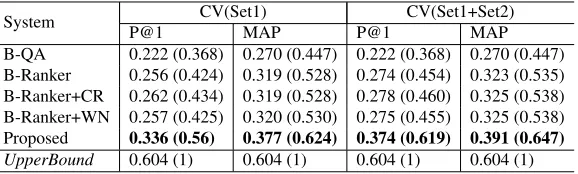
Table 4 shows the evaluation results of six different systems. For each system, we represent the perfor-mance in P@1 and MAP. B-QA is a system of our answer retrieval and the other five re-rank top-20 an-swer candidates using their own re-ranker.
B-QA: our answer retrieval system, our implemen-tation of Murata et al. (2007).
System CV(Set1) CV(Set1+Set2)
P@1 MAP P@1 MAP
B-QA 0.222 (0.368) 0.270 (0.447) 0.222 (0.368) 0.270 (0.447) B-Ranker 0.256 (0.424) 0.319 (0.528) 0.274 (0.454) 0.323 (0.535) B-Ranker+CR 0.262 (0.434) 0.319 (0.528) 0.278 (0.460) 0.325 (0.538) B-Ranker+WN 0.257 (0.425) 0.320 (0.530) 0.275 (0.455) 0.325 (0.538) Proposed 0.336 (0.56) 0.377 (0.624) 0.374 (0.619) 0.391 (0.647)
[image:9.612.164.453.57.144.2]UpperBound 0.604 (1) 0.604 (1) 0.604 (1) 0.604 (1)
Table 4: Comparison of systems
B-Ranker+CR: a system has a re-ranker trained with our MSA features and the causal relation (CR) features used in Higashinaka and Isozaki (2008). The CR features include binary fea-tures indicating whether an answer candidate contains a causal relation pattern, which causal relation pattern the answer candidate has, and whether the question-answer pair contains a causal relation instance — cause in the answer, effect in the question). We acquired causal relation instances from our target corpus us-ing the method from (De Saeger et al., 2009), and exploited the top-100,000 causal relation instances and the patterns that extracted them for CR features. Note that these CR features are introduced only for comparing our semantic features with ones in Higashinaka and Isozaki (2008) and they are not a part of our method. B-Ranker+WN: its re-ranker is trained with our
MSA features and the WordNet features in Ver-berne et al. (2010). The WordNet features in-clude the percentage of the question terms and their synonyms in WordNet synsets found in an answer candidate and the semantic related-ness score between a question and its answer candidate, the average of the concept similar-ity between each question term and all of the answer terms by WordNet::Similarity (Peder-sen et al., 2004). We used the Japanese Word-Net 1.1 (Bond et al., 2009) for these WordWord-Net features. Note that the Japanese WordNet 1.1 has 93,834 Japanese words linked to 57,238 WordNet synsets, while the English WordNet 3.0 covers 155,287 words linked to 117,659 synsets. Due to this lower coverage, the Word-Net features in Japanese may have a less power for finding a correct answer than those in En-glish used in Verberne et al. (2010).
Proposed: our proposed method. All of the MSA, SWC and SA features are used for training our
re-ranker.
UpperBound: a system that ranks allncorrect an-swers as the topnresults of the 20 answer can-didates if there are any. This indicates the per-formance upperbound in this experiment. The relative performance of each system compared toUpperBoundis shown in parentheses.
The proposed method achieved the best perfor-mance both in CV(Set1) and CV(Set1+Set2). Our method shows a significant improvement (11.4– 15.2% in P@1 and 10.7–12.1% in MAP) over our answer retrieval method, B-QA. Its improvement over B-Ranker, B-Ranker+CR and B-Ranker+WN (7.6–10% in P@1 and 5.7–6.6% in MAP) shows the effectiveness of our proposed feature set over the features used in previous works. Both B-Ranker+CR and B-Ranker+WN did not show signif-icant performance improvement over B-Ranker. At least in our setting, the causal relation and WordNet features did not prove effective. The performance gap between B-Ranker and B-QA (3.4–5.2% in P@1 and 4.9–5.3% in MAP) suggests the effectiveness of re-ranking. All systems consistently show better performance in CV(Set1+Set2) than CV(Set1). This suggests that training data built with why-questions that does not reflect real-world distribution of why-questions is useful in training re-rankers.
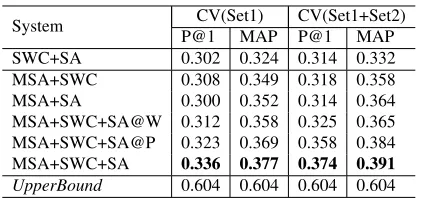
We investigate the contribution of each type of features to the performance by removing one fea-ture set from the all feafea-ture sets in training our re-ranker. In this experiment, we splitSAintoSA@W
(features expressing words and their polarity) and
SA@P (features expressing phrases and their po-larity) to investigate their contribution either. The results are summarized in Table 5.
System CV(Set1) CV(Set1+Set2)
P@1 MAP P@1 MAP
SWC+SA 0.302 0.324 0.314 0.332 MSA+SWC 0.308 0.349 0.318 0.358 MSA+SA 0.300 0.352 0.314 0.364 MSA+SWC+SA@W 0.312 0.358 0.325 0.365 MSA+SWC+SA@P 0.323 0.369 0.358 0.384 MSA+SWC+SA 0.336 0.377 0.374 0.391
[image:10.612.81.295.55.154.2]UpperBound 0.604 0.604 0.604 0.604
Table 5: Evaluation with different combination of feature sets used in training our re-ranker
performance. The significant performance improve-ment bySA(features from sentiment analysis) and
SW C (features from semantic word classes) (The gap betweenMSA+SWC+SAandMSA+SWCwas 2.8–6% and that between MSA+SWC+SA and MSA+SAwas 3.6%–6% in P@1) supports the hy-pothesis for sentiment analysis and semantic word classes in this paper.
Though the performance gap between
MSA+SWC+SA and MSA+SWC+SA@P
(1.3%–1.6% in P@1) shows that SA@W is useful in training our re-ranker, we found that
MSA+SWC+SA@W made only 0.4–0.7%
im-provement over MSA+SWC. We believe that this is mainly because SA@W and SWC are based on semantic and sentiment information at the word level, and these often capture a similar type of information. For instance, disease names that are grouped together into one class in SWC are typi-cally classified as negative in SA@W. Therefore the similarity in the information provided by SA@W and SWC causes a classifier trained with both of these features to obtain only a minor improvement over a classifier using only one of the features.
To estimate the ideal-case performance of our proposed method, we made another experiment by using Set1 as training data for our re-ranker and Set2 as test data for evaluating our proposed method. Here, we assume a perfect answer retrieval module that adds the source passage that was used for gener-ating the original why-question in Set2 as a correct answer to the set of existing answer candidates, giv-ing 21 answer candidates. The performance of our method in this setting was 64.8% in P@1 and 66.6% in MAP. This evaluation result suggests that our re-ranker can potentially perform with high precision when at least one correct answer in answer candi-dates is given by the answer retrieval module.
6 Related Work
In the QA literature, Higashinaka and Isozaki (2008), Verberne et al. (2010), and Surdeanu et al. (2011) are closest to our work. The first two deal with why-questions, the last with how-questions. Similar to our method, they use machine learn-ing techniques to re-rank answer candidates to non-factoid questions based on various combinations of syntactic, semantic and other statistical features such as the density and frequency of question terms in the answer candidates and patterns for causal relations in the answer candidates. Especially for why-QA, Higashinaka and Isozaki (2008) used causal relation features and Verberne et al. (2010) exploited Word-Net features as a kind of semantic features for train-ing their ranker, where we used these features, re-spectively, for B-Ranker+CR and B-Ranker+WN in our experiment.
Our work differs from the above approaches in that we propose semantic word classes and senti-ment analysis as a new type of semantic features, and show their usefulness in why-QA. Sentiment analysis has been used before on the slightly un-usual task of opinion question answering, where the system is asked to answer subjective opinion ques-tions (Stoyanov et al., 2005; Dang, 2008; Li et al., 2009). To the best of our knowledge though, no pre-vious work has systematically explored the use of sentiment analysis in a general QA setting beyond opinion questions.
7 Conclusion
References
Francis Bond, Hitoshi Isahara, Sanae Fujita, Kiyotaka Uchimoto, Takayuki Kuribayashi, and Kyoko Kan-zaki. 2009. Enhancing the japanese wordnet. In Pro-ceedings of the 7th Workshop on Asian Language Re-sources, pages 1–8.
Hoa Tran Dang. 2008. Overview of the TAC 2008 opin-ion questopin-ion answering and summarizatopin-ion tasks. In Proc. TAC 2008.
Stijn De Saeger, Kentaro Torisawa, Jun’ichi Kazama, Kow Kuroda, and Masaki Murata. 2009. Large scale relation acquisition using class dependent patterns. In Proc. of ICDM 2009, pages 764–769.
David A. Ferrucci, Eric W. Brown, Jennifer Chu-Carroll, James Fan, David Gondek, Aditya Kalyanpur, Adam Lally, J. William Murdock, Eric Nyberg, John M. Prager, Nico Schlaefer, and Christopher A. Welty. 2010. Building Watson: An overview of the DeepQA project. AI Magazine, 31(3):59–79.
Junichi Fukumoto, Tsuneaki Kato, Fumito Masui, and Tsunenori Mori. 2007. An overview of the 4th ques-tion answering challenge (QAC-4) at NTCIR work-shop 6. InProc. of NTCIR-6.
Zellig Harris. 1954. Distributional structure. Word, 10(23):146–162.
Chikara Hashimoto, Kentaro Torisawa, Stijn De Saeger, Jong-Hoon Oh, and Jun’ichi Kazama. 2012. Excita-tory or inhibiExcita-tory: A new semantic orientation extracts contradiction and causality from the web. In Proceed-ings of EMNLP-CoNLL 2012.
Ryuichiro Higashinaka and Hideki Isozaki. 2008. Corpus-based question answering for why-questions. InProc. of IJCNLP, pages 418–425.
Thomas Hofmann. 1999. Probabilistic latent semantic indexing. In Proc. of the 22nd annual international ACM SIGIR conference on Research and development in information retrieval, SIGIR ’99, pages 50–57. Jun’ichi Kazama and Kentaro Torisawa. 2008. Inducing
gazetteers for named entity recognition by large-scale clustering of dependency relations. InProc. of ACL-08: HLT, pages 407–415.
Fangtao Li, Yang Tang, Minlie Huang, and Xiaoyan Zhu. 2009. Answering opinion questions with ran-dom walks on graphs. InProc. of the Joint Conference of the 47th Annual Meeting of the ACL and the 4th International Joint Conference on Natural Language Processing of the AFNLP: Volume 2 - Volume 2, pages 737–745.
Masaki Murata, Sachiyo Tsukawaki, Toshiyuki Kana-maru, Qing Ma, and Hitoshi Isahara. 2007. A system for answering non-factoid Japanese questions by using passage retrieval weighted based on type of answer. In Proc. of NTCIR-6.
Tetsuji Nakagawa, Kentaro Inui, and Sadao Kurohashi. 2010. Dependency tree-based sentiment classification using CRFs with hidden variables. In Human Lan-guage Technologies: The 2010 Annual Conference of the North American Chapter of the Association for Computational Linguistics, pages 786–794, Los An-geles, California, June. Association for Computational Linguistics.
Bo Pang, Lillian Lee, and Shivakumar Vaithyanathan. 2002. Thumbs up? Sentiment classification using ma-chine learning techniques. InProc. of the 2002 Con-ference on Empirical Methods in Natural Language Processing (EMNLP), pages 79–86.
Ted Pedersen, Siddharth Patwardhan, and Jason Miche-lizzi. 2004. WordNet::Similarity: measuring the relatedness of concepts. In Demonstration Papers at HLT-NAACL 2004, HLT-NAACL–Demonstrations ’04, pages 38–41.
Anselmo Peñas, Eduard H. Hovy, Pamela Forner, Álvaro Rodrigo, Richard F. E. Sutcliffe, Corina Forascu, and Caroline Sporleder. 2011. Overview of QA4MRE at CLEF 2011: Question answering for machine reading evaluation. InCLEF.
Veselin Stoyanov, Claire Cardie, and Janyce Wiebe. 2005. Multi-perspective question answering using the opqa corpus. InProceedings of the conference on Hu-man Language Technology and Empirical Methods in Natural Language Processing, HLT ’05, pages 923– 930.
Mihai Surdeanu, Massimiliano Ciaramita, and Hugo Zaragoza. 2011. Learning to rank answers to non-factoid questions from web collections. Computa-tional Linguistics, 37(2):351–383.
Peter D. Turney. 2002. Thumbs up or thumbs down?: semantic orientation applied to unsupervised classifi-cation of reviews. InProc. of the 40th Annual Meeting on Association for Computational Linguistics, ACL ’02, pages 417–424.
Vladimir N. Vapnik. 1995. The nature of statistical learning theory. Springer-Verlag New York, Inc., New York, NY, USA.
Suzan Verberne, Lou Boves, Nelleke Oostdijk, and Peter-Arno Coppen. 2007. Evaluating discourse-based an-swer extraction forwhy-question answering. InSIGIR, pages 735–736.
Suzan Verberne, Lou Boves, Nelleke Oostdijk, and Peter-Arno Coppen. 2010. What is not in the bag of words for why-QA? Computational Linguistics, 36:229– 245.